












































Short answer: Chitwan National Park is Nepal's first national park and a UNESCO World Heritage Site in the southern Terai, best known for the one-horned rhino. Most visitors stay in Sauraha, about 5 to 6 hours by road from Kathmandu, and explore by open jeep, dugout canoe on the Rapti River and guided jungle walk. October to March is the main safari season.
This guide is written for Nepali families planning a holiday, Nepalis coming home from abroad who want to show the jungle to their children, and anyone else heading south from Kathmandu. It covers the park, the safari types and how to choose between them, seasons, getting there, safety and what to pack. If you would rather have it all arranged, our Chitwan jungle safari tour covers transport, hotel, park entry and activities, planned by our Kathmandu team.
What is Chitwan National Park?
Chitwan National Park is a protected area of sal forest, riverine forest and tall grassland in south-central Nepal. It was gazetted in 1973 as Nepal's first national park, after earlier protection as a rhino sanctuary, and UNESCO listed it as a World Heritage Site in 1984. The park covers about 953 square kilometres, and a buffer zone of community forests and farmland was added around it in 1996.
UNESCO describes Chitwan as one of the last refuges of the Bengal tiger and home to one of the last populations of the greater one-horned rhinoceros. The Department of National Parks and Wildlife Conservation (DNPWC) records more than 50 mammal species, over 525 bird species and 55 species of amphibians and reptiles.
| Fact | Detail |
|---|---|
| Established | 1973, Nepal's first national park |
| UNESCO World Heritage Site | Since 1984 |
| Core park area | About 953 sq km (DNPWC) |
| Buffer zone | Declared in 1996, community forests and villages around the park |
| Main gateway town | Sauraha, on the Rapti River |
| Park headquarters | Kasara |
| Main safari season | October to March |
What wildlife can you see on a Chitwan jungle safari?
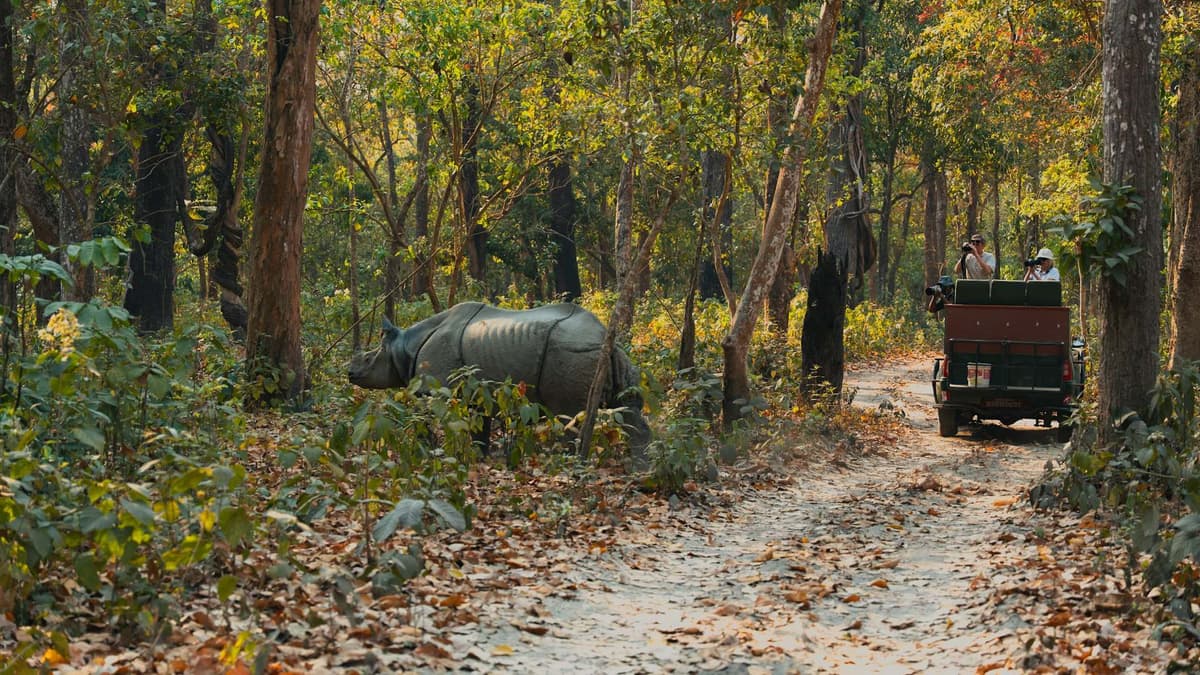
On a Chitwan jungle safari you are very likely to see one-horned rhinos, spotted deer, wild boar, monkeys, mugger crocodiles and plenty of birds. A Bengal tiger sighting is possible but rare, and nobody can promise one.
One-horned rhino
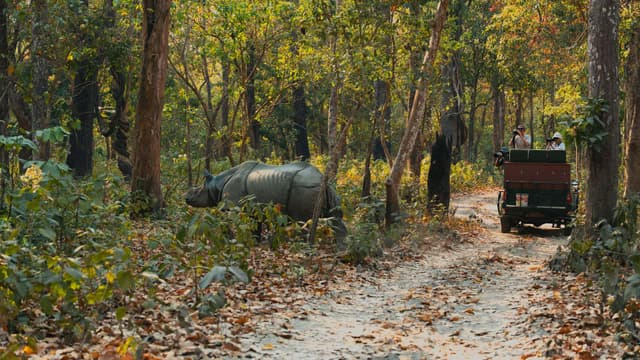
The rhino is the animal most people come for, and Chitwan is the best place in Nepal to see it. The last national rhino count, in 2021, recorded 752 rhinos in Nepal, 694 of them in Chitwan National Park and the surrounding forests. A count planned for 2025 was halted for lack of funds, so 2021 remains the latest official figure. Rhinos often graze in the open grassland and wallow at river edges, which is why they are seen on most jeep safaris.
Bengal tiger
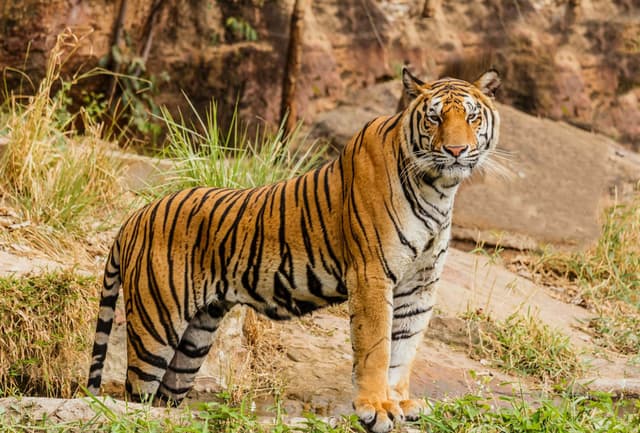
Nepal's 2026 national tiger survey, run with camera traps from December 2025 to April 2026, counted 429 tigers in the country, with 145 in Chitwan National Park and its buffer zone, the highest of any park. That is good news for conservation, but tigers are shy and the forest is dense. Treat a tiger as a lucky bonus. Fresh pugmarks and the alarm calls of deer and monkeys are more common signs.
Gharial and mugger crocodiles
Chitwan's rivers hold two crocodile species. The mugger is the broad-snouted crocodile you often see basking on the Rapti's banks from a canoe. The gharial, with its long thin snout, is critically endangered. The park runs a gharial breeding centre near its headquarters at Kasara, which also keeps mugger crocodiles and turtles.
Birds and other animals
Chitwan is one of the best birdwatching areas in Nepal, with kingfishers, storks, hornbills, peafowl and many raptors. DNPWC notes that migratory birds arrive in several waves, around September, November, February and April. Other mammals include sambar, hog deer and barking deer, rhesus and langur monkeys, gaur, sloth bear and leopard; the last three are seen far less often.
Sauraha, Meghauli or Amaltari: where should you stay?
For a first visit, stay in Sauraha. It is the main gateway to Chitwan National Park, with the widest choice of hotels and resorts, a riverside promenade for sunset and the easiest access to canoe rides, jungle walks and the elephant breeding centre. Most safari jeeps also start here: of the 49 jeeps authorised for safaris in 2025, 32 operated from Sauraha, according to The Himalayan Times.
The park has several other entry points. DNPWC lists nine entrance gates, including Kasara, Sauraha and Bhimle near Meghauli.
| Gateway | Where | Good for |
|---|---|---|
| Sauraha | Northern edge of the park, on the Rapti River | First-timers, families, the widest choice of stays and activities |
| Meghauli | Western side of the park, near the Narayani River | A quieter base with fewer vehicles |
| Amaltari | Across the Narayani, Nawalpur side | Community homestays and a rural feel |
Gomayu's Chitwan jungle safari tour is based in Sauraha, in a 3 or 4 star hotel or a standard jungle resort, on a twin-sharing basis with breakfast.
Which Chitwan safari should you choose?
Choose the jeep safari if you want the best chance of seeing rhinos, the canoe for crocodiles and birds, and the jungle walk if you want to feel the forest on foot. Most visitors do all three in one full day.
| Activity | What you see | Best for | Keep in mind |
|---|---|---|---|
| Jeep safari | Rhino, deer, wild boar, birds, sometimes tiger or sloth bear | Everyone, including children and elders | Bumpy and dusty; core-park routes close in the monsoon |
| Dugout canoe on the Rapti | Mugger crocodiles, kingfishers, storks, river life | Bird lovers and photographers | Sit still; the canoe is low to the water |
| Guided jungle walk | Tracks, birds, insects, plants, sometimes deer or rhino | Fit adults and older children | Only with licensed naturalist guides; follow every instruction |
| Elephant breeding centre | Adult elephants and calves, without riding | Families with young children | A short visit near Sauraha |
| Bis Hazari Tal | Wetland birds, sometimes crocodiles | Birdwatchers | A stop on the road between Chitwan and Kathmandu |
Jeep safari
An open jeep safari is the main way to explore Chitwan National Park. Jeeps follow forest tracks through grassland and sal forest, stopping at waterholes, river edges and watchtowers. Safaris run as half-day or full-day outings; full-day safaris go deeper into the park and suit keen wildlife watchers. Inside the buffer zone, community forests such as Kumroj near Sauraha also run their own jeep safaris, and these keep running when the core park closes for the monsoon. Gomayu's Chitwan tour includes a jeep safari inside the national park.
Dugout canoe on the Rapti
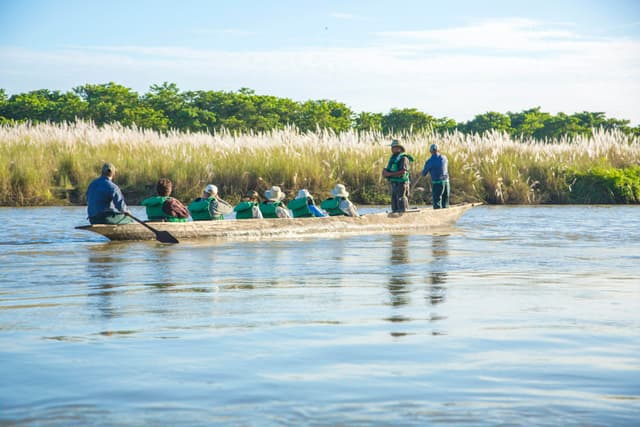
Local boatmen paddle traditional dugout canoes, carved from a single tree trunk, along the Rapti River. Early morning is the best time, with mist on the water and birds at their busiest. On Gomayu's tour the dawn canoe ride is followed by a guided jungle walk.
Guided jungle walk
A jungle walk is slow and quiet. Your naturalist guide reads tracks, dung and scratch marks, points out birds and insects, and explains how the forest works. You may see deer or a rhino at a distance, but the walk is about the forest as much as the animals. See the safety section below before you go.
Elephant breeding centre
The government elephant breeding centre at Khorsor, near Sauraha, is run by the park. It is a calm way to see adult elephants and their calves up close without riding them, and children usually love it. On Gomayu's Chitwan tour it is an optional visit if time allows.
Is elephant riding in Chitwan ethical?
Gomayu does not include elephant rides on its Chitwan tours, and we suggest you skip them. Carrying people is hard on an elephant's back and joints, and many travellers now prefer to watch elephants rather than ride them.
The debate has reached Nepal's courts. In December 2025, the Supreme Court directed the government to look for alternatives to elephant-back safaris and to move towards ethical eco-tourism, according to The Kathmandu Post. Commercial safari elephants in Sauraha are privately owned and work in the buffer zone, and owners have asked for support in changing their business. Rules may change, so check the current position before you travel. A jeep safari, a canoe, a jungle walk and a visit to the breeding centre give you a full Chitwan experience without riding.
What is the Tharu stick dance?
The Tharu are one of the Indigenous peoples of the Terai, and Chitwan has been their home for generations. Their culture shows in the mud-walled houses, the farming calendar and their music and dance.
The Tharu stick dance, known locally as lathi nach, is a group dance in which performers keep the beat by striking their wooden sticks against each other. It is traditionally danced at festivals, especially Dashain, and at weddings. In Sauraha, the stick-dance show brings together several Tharu ritual and festival dances in one evening, and it has been performed for visitors there for more than four decades. Gomayu's Chitwan tours include an evening Tharu stick-dance cultural show in Sauraha.
When is the best time for a Chitwan jungle safari?
The best time for a Chitwan jungle safari is October to March, when the Terai is dry and comfortable. Late winter into spring often gives clearer views as the tall grass dies back. April to June is very hot, and from July to around Dashain jeep safaris inside the core park are paused.
| Months | Weather | Safari conditions |
|---|---|---|
| October to November | Warm days, cool nights, rain ending | Core park reopens around Dashain; busy with festival travel |
| December to February | Mild days, cold mornings, Terai fog | Good safaris; dress warmly for dawn canoe and jeep rides |
| March to April | Hot by midday | Clearer grassland views; plan early-morning outings |
| May to June | Very hot (Bharatpur averages about 36 °C in May) | Safaris run but are tiring; go early |
| July to around Dashain | Monsoon rain and humidity | Core-park jeep safaris paused; buffer-zone safaris continue |
The monsoon closure
Every year, Chitwan National Park pauses jeep safaris inside the core park for the monsoon. In 2026 the closure started on 1 July. The park gave two reasons: the monsoon is the breeding season for most wildlife and birds, and heavy rain damages the unpaved forest tracks with floods and fallen trees. Jeep safaris in buffer-zone community forests continue through the monsoon.
Reopening depends on the weather and the state of the tracks. In 2025 the core park reopened on 29 September, and as of 5 October 2026 park officials said they planned to reopen on 9 October, just before Dashain. If you are travelling in late September or early October, check with us before you book.
Dashain, Tihar and school holidays
Dashain and Tihar fall in the best season, and they are also when most Nepali families travel. Sauraha hotels and the road from Kathmandu get busy in the days before Fulpati and Tika, so book early. For month-by-month weather across Nepal, see our guide to the best time to visit Nepal.
How do you get to Chitwan from Kathmandu?
Most people drive. Sauraha is about 155 to 170 km from Kathmandu, roughly 5 to 6 hours in a private vehicle, along the Prithvi Highway to Mugling and then south through Narayangadh and Bharatpur. The road is paved but winding and busy, and in the monsoon landslides and road works can cause delays.
- Private vehicle: the most comfortable choice for families, with stops when you need them. Gomayu's Chitwan tour includes a private vehicle with driver for the full round trip.
- Tourist bus: regular tourist buses run between Kathmandu and Sauraha. They are slower, with fixed stops.
- Flight: domestic flights from Kathmandu to Bharatpur take about 20 to 25 minutes, followed by a short drive to Sauraha. Morning fog in December and January can delay flights.
Coming home from abroad? Rest a night in Kathmandu after your international flight, then drive to Chitwan the next morning. It is safer than starting a 5 to 6 hour mountain-road drive straight after a long flight.
How many days do you need in Chitwan?
Two nights is the right length for most visitors. That gives you one full jungle day for the jeep safari, canoe and jungle walk, plus arrival and departure days with time for the Rapti sunset, the Tharu show and a birdwatching stop on the way back. Our 3-day Chitwan jungle safari tour is built this way and returns via Bis Hazari Tal, a wetland listed under the Ramsar Convention.
Add a third night if you are a keen birder or photographer, want a full-day jeep safari deeper into the park, or simply want a slower pace with children or elders.
Is Chitwan good for children and elderly parents?
Yes. Chitwan is one of the easiest holidays in Nepal for mixed-age families. There is no trekking and no altitude, and most activities are done sitting in a jeep or a canoe.
- Children: the jeep safari, crocodiles from the canoe, the elephant breeding centre and the stick dance are the usual favourites. Keep jungle walks for children of about ten and older who can stay quiet and follow instructions.
- Elderly parents: jeep tracks are bumpy, so anyone with back or knee problems may prefer a shorter safari. Getting into a dugout canoe needs a steady hand; ask the boatmen to help.
- Heat and cold: carry water, hats and snacks from March onwards, and warm layers for dawn outings from December to February.
- Pace: with grandparents or small children, an extra night makes the trip more relaxed.
What should you wear and pack for a Chitwan safari?
Wear muted colours such as khaki, olive, brown or grey, with long sleeves and long trousers. Bright colours and white stand out in the forest, and long clothing protects against sun, insects and grass.
- Closed walking shoes for the jungle walk (not sandals)
- A hat, sunglasses and sunscreen
- Insect repellent, especially in the evenings
- Binoculars, which improve every sighting more than any other item
- A camera with a zoom lens and spare batteries
- A refillable water bottle and a small daypack
- A warm jacket from December to February for cold, foggy mornings
- A light rain jacket and leech socks if you visit in the monsoon
- Your citizenship card or passport for park entry
- Personal medicines
How safe is a jungle walk in Chitwan?
A guided jungle walk in Chitwan is safe when you go with licensed naturalist guides and follow their instructions exactly. Rhinos, wild elephants, sloth bears and tigers live in the forest, and serious incidents, though rare, have happened when people walked without guides or ignored them.
- Never walk into the park or community forests without a licensed guide.
- Stay close together, walk in single file and keep quiet.
- Listen to the safety briefing before you start, including what to do if a rhino or elephant comes towards the group.
- Do not approach, feed or follow animals for photographs.
- Do not wander away from the group, even for a moment.
- Skip the walk if you cannot move quickly or stay silent; a jeep safari shows you more animals with less risk.
Can you combine Chitwan with Pokhara?
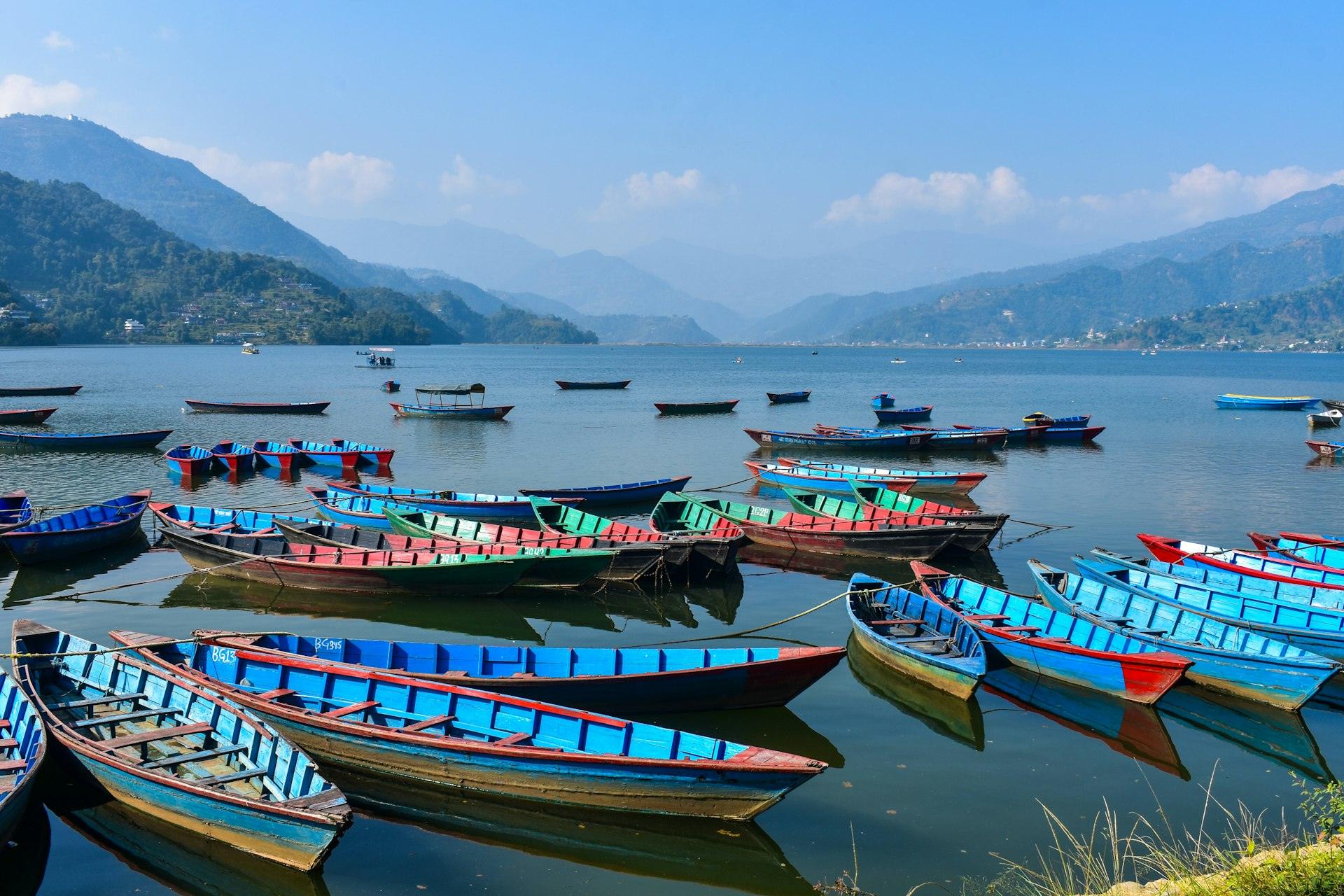
Yes, and it is a popular combination for a first Nepal holiday. Chitwan's jungle and Pokhara's lakes and mountain views make a good contrast, and the two connect by road in a few hours. Our 5-day Chitwan and Pokhara tour drives from Kathmandu to Sauraha for the jungle, continues to Pokhara with a stop in the old Newari hill bazaar of Bandipur, and returns to Kathmandu, all in a private vehicle. It suits families, couples and honeymooners who want both wildlife and the lakes. Lumbini is also within a few hours of Chitwan if you want to add a pilgrimage; ask our team to plan the route.
Chitwan or Bardiya: which park should you choose?
Choose Chitwan for a first safari, for families with young children and for the best chance of seeing rhinos. Choose Bardiya, in far-western Nepal, if you want a quieter, wilder park and a stronger focus on tigers.
| Chitwan National Park | Bardiya National Park | |
|---|---|---|
| Getting there from Kathmandu | About 5 to 6 hours by road, or a short flight to Bharatpur | Flight to Nepalgunj (about 50 minutes) and a 1.5 to 2 hour drive |
| Rhinos (2021 count) | 694 | 38 |
| Tigers (2026 survey) | 145, including the buffer zone | 112 |
| Crowds | Busier, more facilities | Far fewer vehicles and visitors |
| Special features | Canoe on the Rapti, elephant breeding centre, Tharu stick dance | Karnali River, Gangetic dolphins (water level permitting) |
| Best for | First-timers, families, short trips | Wildlife lovers, second safaris |
Many travellers do Chitwan first and come back for a Bardiya jungle safari later.
Do Nepalis and NRNs need a permit for Chitwan?
Nepali citizens do not need any permit to visit Chitwan National Park; an entry fee applies, so carry your citizenship card or passport. Foreign passport holders, including foreign spouses or children travelling with an NRN family, need a park entry permit and are charged a different rate. Gomayu's Chitwan tour includes national park and activity entry at Nepali rates; if anyone in your group holds a foreign passport, tell us when you enquire and we will arrange their entry.
Ready to plan? Browse all our trips on the Nepal tour packages page, or message our Kathmandu team on WhatsApp with your dates and who is travelling. Every package shows a price for each group size on its page, and tours can be adjusted on request.
Frequently asked questions
Is Chitwan National Park a UNESCO World Heritage Site?
Yes. Chitwan National Park was listed as a UNESCO World Heritage Site in 1984, eleven years after it became Nepal's first national park in 1973. UNESCO recognises it as one of the last refuges of the Bengal tiger and home to one of the last populations of the greater one-horned rhinoceros, along with an exceptional variety of birds.
Will I see a rhino or a tiger on a Chitwan jungle safari?
You are very likely to see a one-horned rhino on a Chitwan jungle safari, as the 2021 count found 694 rhinos in the park and surrounding forests. Tigers are much harder to spot. The 2026 survey counted 145 tigers in Chitwan and its buffer zone, but they are shy and the forest is dense, so treat a tiger sighting as a lucky bonus.
Is Chitwan jungle safari open in the monsoon?
Jeep safaris inside the core of Chitwan National Park pause every monsoon, from 1 July in 2026, and usually reopen in late September or early October, around Dashain. Jeep safaris in buffer-zone community forests keep running through the monsoon. If you plan a Chitwan trip between July and early October, ask us what is open on your dates.
What is the difference between a core-park and a buffer-zone jeep safari in Chitwan?
A core-park jeep safari goes inside Chitwan National Park itself, with larger areas of forest and grassland and the best wildlife chances. A buffer-zone safari runs through community forests around the park, such as Kumroj near Sauraha. Buffer-zone safaris are shorter and stay open in the monsoon, when core-park safaris pause.
Is Sauraha the best place to stay for a Chitwan safari?
For most visitors, yes. Sauraha is the main gateway to Chitwan National Park, with the widest choice of hotels, most safari jeeps, canoe rides on the Rapti, the elephant breeding centre and the Tharu stick-dance show. Meghauli on the western side is quieter, and Amaltari offers community homestays. Gomayu's Chitwan tours are based in Sauraha.
Does Gomayu's Chitwan tour include an elephant ride?
No. Gomayu's Chitwan tours do not include elephant rides, for animal welfare reasons. You explore Chitwan National Park by jeep safari, dawn dugout canoe on the Rapti River and a guided jungle walk, with an optional visit to the government elephant breeding centre near Sauraha, where you can see adult elephants and calves without riding them.
How long is the drive from Kathmandu to Chitwan?
The drive from Kathmandu to Sauraha in Chitwan takes roughly 5 to 6 hours by private vehicle, covering about 155 to 170 km via the Prithvi Highway, Mugling and Narayangadh. Traffic, road works and monsoon landslides can add time. You can also fly from Kathmandu to Bharatpur in about 20 to 25 minutes and drive a short distance to Sauraha.
What should I wear on a Chitwan jungle walk?
On a Chitwan jungle walk, wear muted colours such as khaki, olive or brown, with long sleeves, long trousers and closed walking shoes. Avoid white and bright colours, which stand out to wildlife. Add a hat, insect repellent and a water bottle, and a warm layer for cold winter mornings. Binoculars make a real difference to what you see.