
Chitwan Pokhara Tour
5Days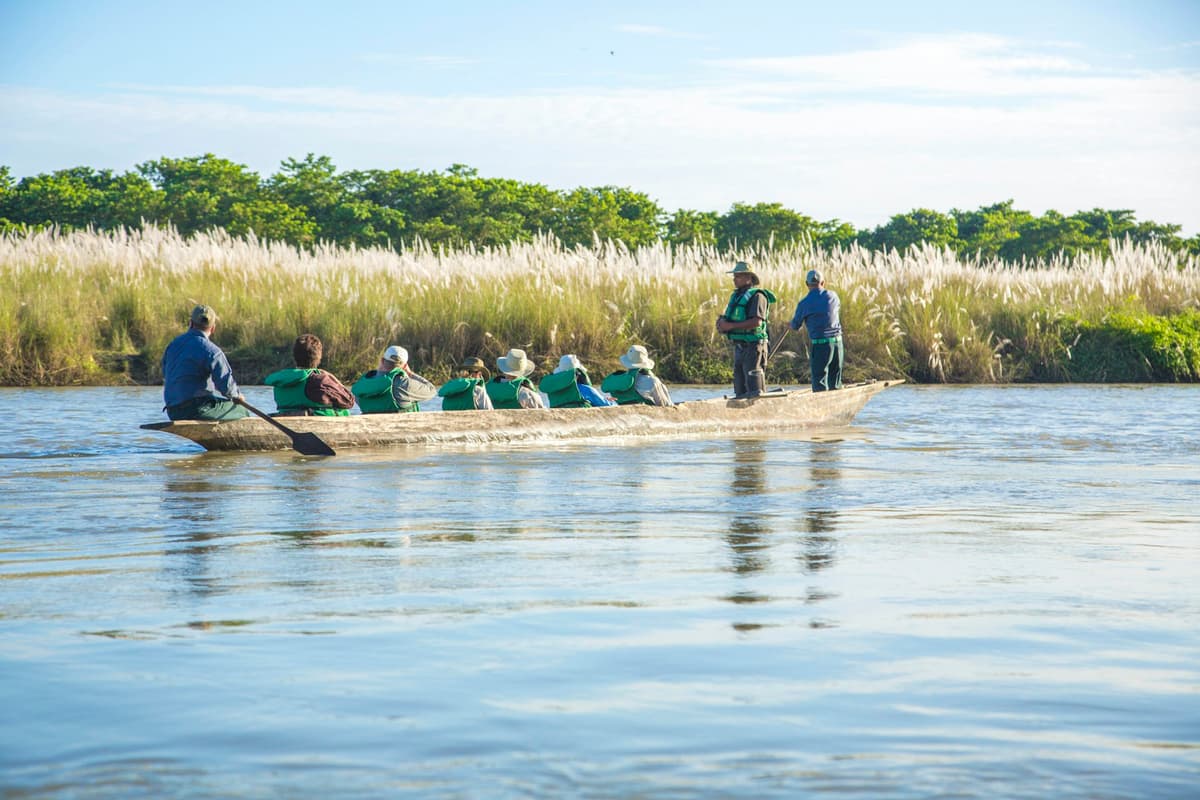
| Group size | Price / person |
|---|---|
| 2 pax | NRs 59,500 /person |
| 3 pax | NRs 47,000 /person |
| 4 pax | NRs 47,000 /person |
| 5 pax | NRs 43,000 /person |
| 6+ pax | NRs 39,500 /person |
- Prices vary with your travel dates, season and group size.
Chitwan jungle and Pokhara lakeside in one road trip
The Chitwan Pokhara tour is Nepal's easiest way to see two very different sides of the country in one short trip. Over five days by road from Kathmandu you swap the wild grasslands and rhino country of Chitwan National Park for the lakes, sunrise viewpoints and mountain air of Pokhara, with the hilltop bazaar of Bandipur on the way.
Designed for Nepali families, couples and groups of friends, this Chitwan Pokhara tour keeps things simple: a private vehicle and driver throughout, comfortable hotels, daily breakfast and lunch, a jungle safari, a Tharu cultural evening and all the Pokhara highlights. No trekking, no camping, just an easy loop you will remember.
Trip highlights
Day-by-day itinerary
Everything below is fully customizable. Add nights, swap activities, or change hotels.
Day1 Kathmandu to Sauraha (Chitwan) & Tharu cultural show
- Morning pickup in Kathmandu and drive south to Sauraha on the edge of Chitwan National Park. Check in, relax by the Rapti river and, in the evening, enjoy the lively Tharu stick-dance cultural show.
Day2 Chitwan jungle day: canoe, jeep safari & optional elephant centre
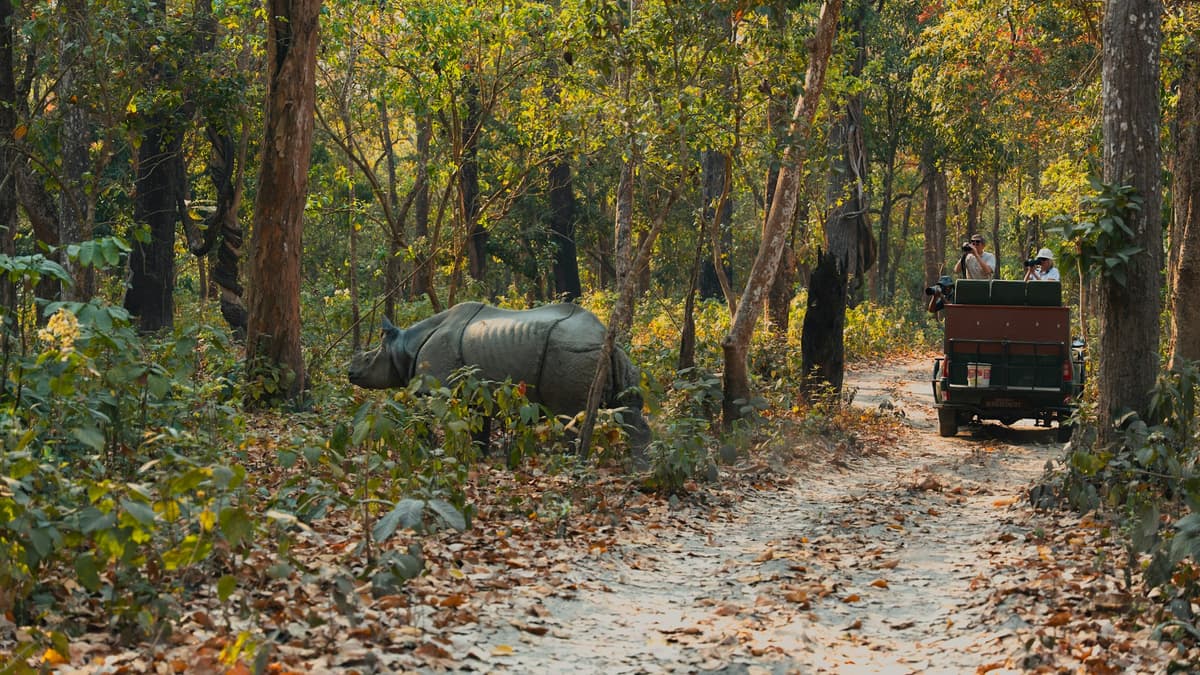
- Early morning canoe ride on the Rapti river to spot birds, gharial and marsh mugger crocodiles, followed by a guided jungle walk with a naturalist. After lunch, a jeep safari deep into the park in search of one-horned rhino, deer and, if you are lucky, a tiger. If time allows, an optional visit to the elephant breeding centre.
- Activities: Canoe, jungle walk, jeep safari
Day3 Sauraha to Pokhara via Bandipur; evening Barahi Temple boat
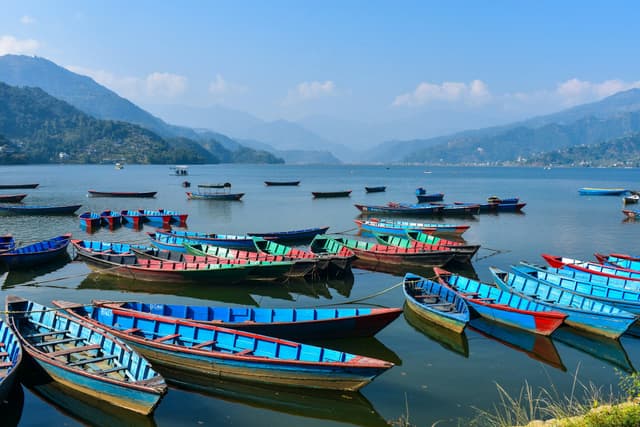
- After breakfast, drive north toward Pokhara. On the way, stop at Bandipur, a beautifully restored Newari hill bazaar with mountain views and a car-free main street, for lunch and a stroll. Continue to Pokhara and check in at lakeside. In the evening, take a wooden boat across Phewa Lake to the island Barahi Temple.
Day4 Sarangkot sunrise & Pokhara sightseeing›
- Early drive up to Sarangkot for sunrise over the Annapurna range and Machhapuchhre (Fishtail). Back for breakfast, then after lunch visit Davis Falls (Patale Chhango), the underground Gupteshwor Mahadev Cave, the Pumdikot Shiva statue and viewpoint, and the World Peace Pagoda above the lake.
- Activities: Sarangkot sunrise, Pokhara city sights
Day5 Pokhara back to Kathmandu
- After breakfast and any last lakeside time, drive back to Kathmandu along the Prithvi Highway, following the Trishuli river, with a lunch stop on the way. Drop-off in Kathmandu, where your Chitwan Pokhara tour ends.
Package pricing
The more travellers in your group, the lower the price per person.
| Group size | Price / person |
|---|---|
| 2 pax | NRs 59,500 /person |
| 3 pax | NRs 47,000 /person |
| 4 pax | NRs 47,000 /person |
| 5 pax | NRs 43,000 /person |
| 6+ pax | NRs 39,500 /person |
- Prices vary with your travel dates, season and group size.
Prices are per person · see what’s included.
What's included
| Items | This package |
|---|---|
| Private vehicle + driver | Included |
| 3/4-star hotels & jungle stay | Included |
| Breakfast & lunch daily | Included |
| Chitwan jungle activities | Included |
| Park permits & entry fees | Included |
| Tharu cultural show | Included |
| Pokhara sightseeing | Included |
| Elephant breeding centre | Optional |
| Personal expenses & tips | Not included |
Anything not listed here is not included.
What our travellers say
Real reviews from Google, verified by travelers.
“It was our best decision to choose Gomayu. We had a wonderful experience with GOMAYU during our Thailand trip. Hotels, Location and itinerary all were well planned and was according to our expectations. Response and communication was very good in Thailand as well. You made our trip very smooth, hassle free and stress free from begning to the end of our trip. This trip was memorable, as me and my husband got to celebrate our 20th wedding Anniversary together in the beautiful place of Thailand and credit goes to GOMAYU for all the arrangements . We are very much satisfied with your service and hope to have other trips with you soon. I would happily Recommend GOMAYU to my friends and family for their excellent service and professional support.”

“Me and my family had a great 10 days trip to Vietnam and Bangkok. All thanks to the wonderful service of Gomayu. Thank you so much for making our trip so easy, fun and stress free.”

“We had an unforgettable 5D4N trip to Bali with Gomayu Holidays! From the very beginning, the communication was smooth, clear, and professional. Everything was perfectly organized; airport pickup, hotel check-ins, and daily tours were always on time, with no stress at all. Our stay was split between a beautiful private pool villa in Seminyak and a comfortable room at Grand Mega Resort, both of which exceeded expectations. The itinerary was well-balanced with adventure, culture, and relaxation. We really enjoyed the watersports (banana boat, jet ski, parasailing), the stunning Uluwatu Temple with Kecak dance, and the romantic candlelight dinner at Jimbaran Beach. The Bali swing and tandem ATV ride were absolute highlights and so much fun! Visiting Lempuyang Temple (Gate of Heaven) was magical and very well arranged despite the crowds. We had some spare time to visit the malls and try local food as well. Special thanks to the guide and driver, who was friendly, helpful, super-flexible and always made sure we were comfortable. We didn’t have to worry about anything as everything was well-organized. Highly recommended for anyone planning a hassle-free and memorable Bali trip. Thank you, Gomayu Holidays, for making our holiday truly special!”

“We had a wonderful experience with Gomayau as our travel partner, with everything being well-organized and thoughtfully planned from start to finish, making the entire trip smooth and enjoyable; the overall coordination was excellent, with timely arrangements and great attention to detail, and the team’s consistent support throughout the journey made a real difference, while communication remained easy and reliable, giving us confidence and peace of mind; we truly appreciated the professionalism and dedication in handling logistics and day-to-day planning, which allowed us to fully relax and enjoy the trip, and overall, it was a great experience that we will remember for future travels and would highly recommend to anyone looking for a hassle-free and well-managed trip.”

“Thank you so much Gomayu Holidays. We had an amazing trip. we are extremely satisfied with their service. The itinerary was wonderfully planned and perfectly organized.Highly recommend planning your next vacation with Gomayu Holidays they are truly EXCELLENT. Special heartfelt thank you to Krishtina and Elho from Gomayu Holidays!”

Good to know
Complete travel guide
What is the Chitwan Pokhara tour and why combine the two?
The Chitwan Pokhara tour is a 5 day, 4 night road trip from Kathmandu that joins Nepal's most famous jungle with Nepal's most famous lake town in one easy loop. You spend two nights in Sauraha on the edge of Chitwan National Park for canoe rides, jungle walks and a jeep safari, then drive north through the hilltop bazaar of Bandipur to Pokhara for two nights of lakeside living, a Sarangkot sunrise and the classic city sights. There is no trekking, no camping and no hard walking. A private car or van takes you door to door, and you return to Kathmandu on the fifth day.
Why combine them? Because the two places are completely different and they sit on the same road. Chitwan is flat, hot and wild: rhinos in the grassland, crocodiles on the riverbank, Tharu drums at night. Pokhara is cool, calm and scenic: a still lake, a temple you reach by boat, and a wall of white Himalayan peaks at dawn. Doing both in a single Chitwan and Pokhara tour means you see the Terai and the middle hills in five days, and the drive between them through the Trishuli and Marsyangdi valleys is part of the experience rather than wasted time.
For many Nepali families this is the first proper holiday outside the Valley. For couples it is a gentle honeymoon. For groups of friends it is the trip you finally take after years of saying you will. For relatives visiting from abroad it is the simplest way to show them the Nepal that lives beyond Kathmandu. This guide walks you through every part of the 5 days Chitwan Pokhara tour honestly, so you know exactly what you are booking before you message us.
If you already know you want to go, send Gomayu a WhatsApp message with your travel dates and group size and we will send back a clear quote in Nepali rupees the same day.
How does the Chitwan Pokhara tour from Kathmandu work by road?
The route is a triangle: Kathmandu down to Sauraha in Chitwan, Sauraha up to Pokhara via Bandipur, and Pokhara back to Kathmandu. Each leg is a single day of driving in a private vehicle with stops for tea and lunch. Total driving over the five days is roughly 17 to 19 hours, spread across three travel days, with the two middle days spent entirely on sightseeing. Here is how each leg actually goes.
Day 1: Kathmandu to Sauraha, Chitwan (5 to 6 hours)
You leave Kathmandu in the morning, climb out of the Valley at Thankot and drop down to Naubise, where the road joins the Prithvi Highway. From here the highway follows the Trishuli River west, the same river the rafting companies use, so you get long stretches of green water and steep valley walls on your right. At Mugling the road forks: Pokhara is straight ahead, Chitwan is to the left along the Narayani River. You pass through Narayanghat and Bharatpur, the busy commercial hub of the Terai, and reach Sauraha in the early afternoon.
The change in climate is the first thing you notice. Kathmandu is cool and dusty; Sauraha is warm, green and humid, with rice fields, mustard flowers in season and the flat horizon of the Terai. Once you check in, the evening is free for a walk along the Rapti River, where the sun sets behind the park across the water, followed by a Tharu cultural show featuring the stick dance.
Day 3: Sauraha to Bandipur to Pokhara (5 to 6 hours total)
You drive back up to Mugling and then continue west along the Prithvi Highway toward Pokhara. Around Dumre a side road climbs steeply up to Bandipur, a preserved Newari hill town at roughly 1,000 metres. The detour and the stop take about two hours including lunch and a walk along the car free bazaar. From Bandipur you descend back to the highway and follow the Marsyangdi and then the Seti river valleys into Pokhara, arriving by mid afternoon with time for a boat ride on Phewa Lake before dark.
Day 5: Pokhara to Kathmandu (6 to 7 hours)
The final day is the longest drive. You retrace the Prithvi Highway east from Pokhara through Damauli, Dumre and Mugling, then back along the Trishuli to Naubise and up into the Kathmandu Valley. Leaving Pokhara by 8 am usually gets you home by mid to late afternoon, but traffic on the approach to Kathmandu can add an hour, especially on Fridays, festival weekends and the days around Dashain and Tihar.
What is the road honestly like?
We would rather tell you plainly than have you find out on the day. The Prithvi Highway is a two lane mountain highway, not an expressway. It is paved throughout, but it is winding, busy with trucks and buses, and sections are periodically under widening or repair, which means dust and short delays in dry months and occasional slips in the monsoon. The Mugling to Narayanghat stretch has been widened and is generally smoother than it was a few years ago. The Kathmandu to Mugling stretch is the slowest and most crowded part.
The good news is that a private vehicle makes a big difference. You stop when you want, you choose a clean restaurant for lunch, the driver knows where the roadworks are, and there is no tourist bus timetable to chase. If anyone in your group gets car sick on hill roads, sit in the front, take a motion sickness tablet before Naubise and keep the window slightly open. Children usually sleep through the worst of it.
If you would prefer to skip one or both drives, Gomayu can quote a version with a flight from Pokhara back to Kathmandu on the last day. It costs more but saves the long final leg. Ask us on WhatsApp and we will lay out both options.
What do you actually do on the Chitwan safari day?
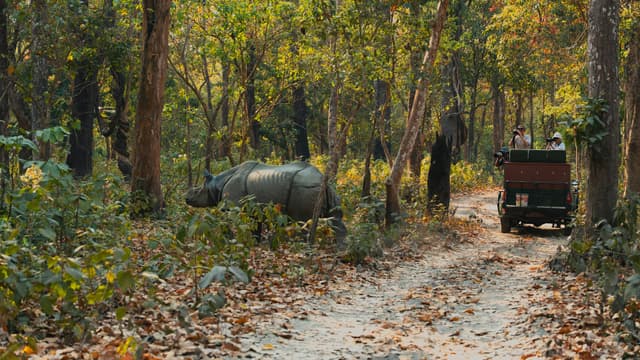
Day 2 is the heart of the Chitwan part of the tour. It starts before sunrise with a dugout canoe on the Rapti River and a short jungle walk, continues after lunch with a jeep safari deep into Chitwan National Park, and ends, time permitting, with a visit to the elephant breeding centre at Khorsor. Realistically you will see one horned rhinos, deer, wild boar, monkeys, crocodiles and dozens of bird species. A tiger is a possibility, not a promise. Here is what each activity is really like.
Why is Chitwan National Park special?
Chitwan National Park was Nepal's first national park and is a UNESCO World Heritage Site. It protects around 900 square kilometres of sal forest, riverine jungle and tall elephant grass along the Rapti, Narayani and Reu rivers. It is the country's stronghold for the greater one horned rhinoceros, whose numbers here have recovered from a few hundred to close to 700 at the last national count, and it holds one of Nepal's main Bengal tiger populations. It is also home to gharial and mugger crocodiles, sloth bears, leopards, gaur, four species of deer and more than 500 recorded bird species. Sauraha, the village where you stay, sits right on the park boundary across the Rapti River.
The Rapti sunset and the Tharu stick dance (Day 1 evening)
Your first evening is deliberately easy. A short walk from most Sauraha hotels brings you to the bank of the Rapti River, where local families, tourists and the occasional rhino from the far bank all watch the same sunset. The light on the river and the jungle silhouette are worth the walk alone.
After dinner you attend a Tharu cultural programme. The Tharu are the indigenous people of the Terai, with their own language, dress and festivals, and the stick dance is their signature performance: rows of men in white striking sticks in fast rhythm to drums, along with the peacock dance and songs. It is not a village visit and it is not a museum. It is a staged show in a community hall, usually around an hour, and audiences are often invited to join in the final dance. Children love it.
The early morning dugout canoe and jungle walk
You are up before dawn for the canoe ride. A guide and a boatman pole a long wooden dugout downstream along the Rapti while mist lifts off the water. This is the best time for crocodiles: mugger crocodiles basking on sandbanks and, if you are lucky, the thin snouted gharial. It is also prime birding, with kingfishers, egrets, storks, herons and sometimes a lesser adjutant or a peacock in the trees. The canoe is quiet and slow, which is exactly the point.
The canoe lands on the park side and you take a short guided walk through the riverine forest with two naturalist guides. Walks are kept short and stay close to the river. Guides brief you on what to do if you meet a rhino, which is rare on this route but not impossible. This is a gentle nature walk, not a trek, and it is fine for older travellers and children who can walk for 45 minutes to an hour on flat ground.
The jeep safari after lunch
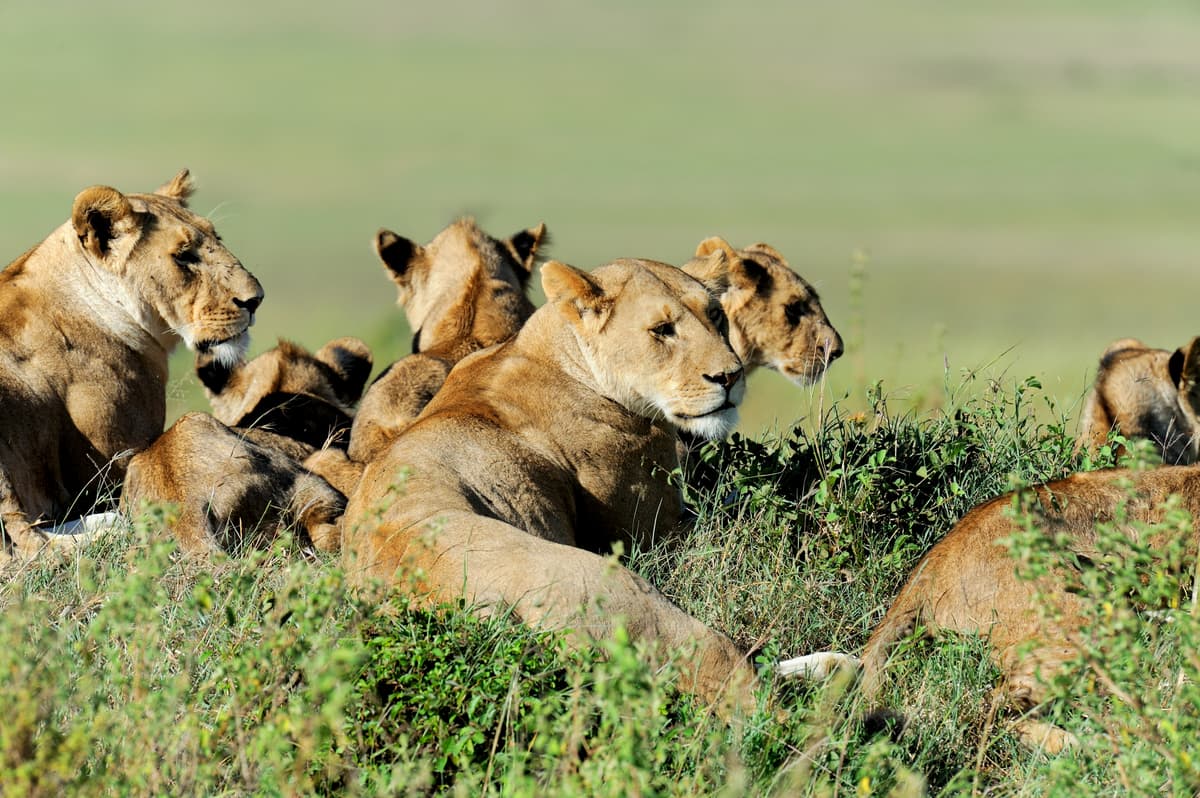
After lunch and a rest in the hot part of the day, you board an open jeep with a guide for the main safari, which runs several hours into the core of the park along forest tracks and across grassland. The guide and driver read tracks, alarm calls and dung to find animals. This is when you have the best chance of seeing rhinos at close range, often a mother and calf standing in a wallow or grazing at the edge of the grass. You will almost certainly see spotted deer, sambar and barking deer, langur and rhesus monkeys, wild boar and peacocks. Bears, leopards and gaur appear from time to time.
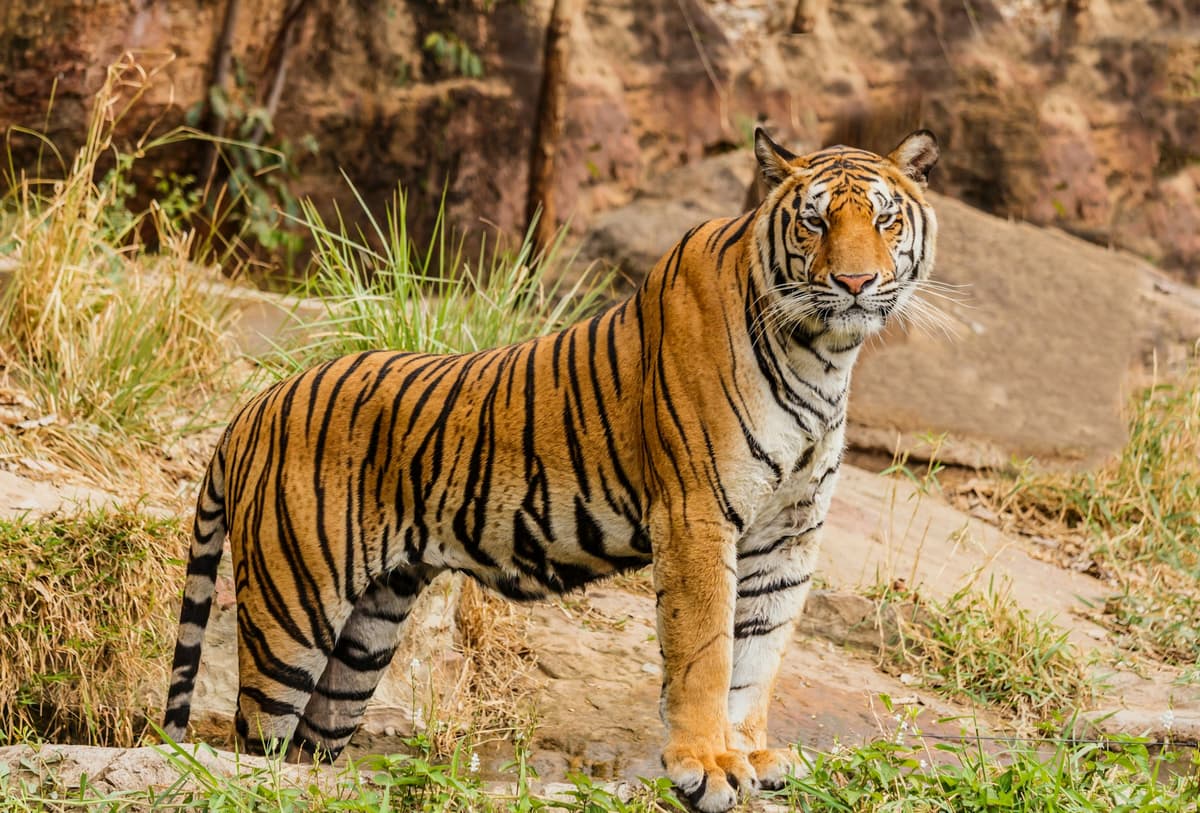
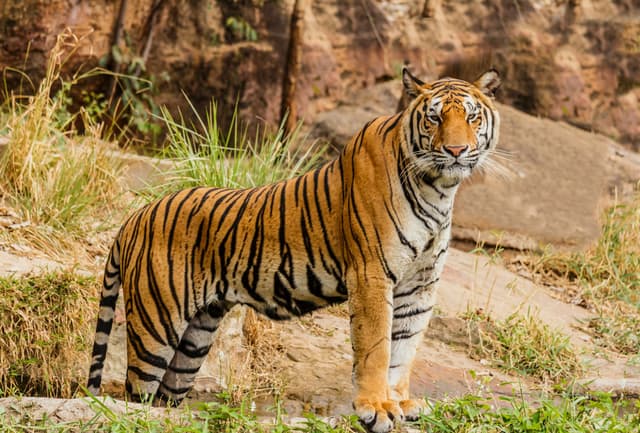
About the tiger: Chitwan has a healthy tiger population, but tigers are secretive and the park is large. Some visitors see one on their first safari; many regular visitors have never seen one. If a tiger is your main goal, plan for extra safari days and a spring visit when the grass has been cut. On a standard Chitwan Pokhara tour, think of the tiger as a bonus and the rhino as the reliable star.
The elephant breeding centre at Khorsor, and our note on elephants
In the late afternoon, if there is time and light, you visit the elephant breeding centre at Khorsor, a short drive and a small footbridge from Sauraha. It is a government run facility where domestic elephants used for park patrol work are bred and raised, and the calves are the main attraction. It is a modest, low key visit of around half an hour.
This tour does not include elephant back safaris or elephant rides. We made that decision deliberately. Elephant rides are still sold in Sauraha, but the welfare concerns around chaining, training and carrying loads are well documented, and a growing number of travellers and operators have moved away from them. The jeep safari and canoe give you a better wildlife experience anyway. If you have questions about this, ask us; we would rather explain than pretend the issue does not exist.
Please also note that this itinerary does not include a Tharu village tour. The cultural show on Day 1 is the Tharu element of the trip. If you would like a village walk or a bicycle ride through the Tharu villages around Sauraha, it can be added on request.
Is Bandipur worth the stop between Chitwan and Pokhara?
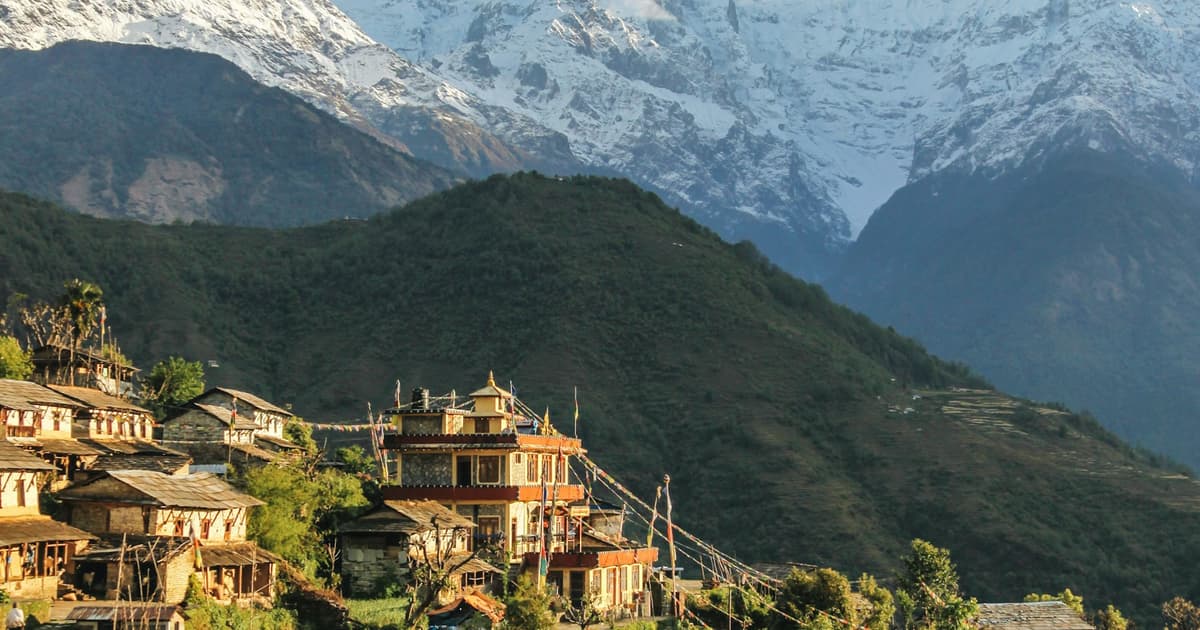
Yes. Bandipur is one of the best preserved Newari towns in Nepal, and it sits almost exactly halfway between Sauraha and Pokhara, which makes it the perfect lunch stop on Day 3. The main bazaar is closed to vehicles, the old brick houses have carved wooden windows and slate roofs, and on a clear day the ridge behind the town looks straight across to the Annapurna, Manaslu and Langtang ranges. It turns a plain transfer day into a highlight.
Bandipur grew rich as a trading post on the old route between Tibet and India. Newari merchants from Bhaktapur settled here in the 19th century, built the fine houses you see today, and left when the Prithvi Highway bypassed the town in the 1970s. That abandonment is what saved it: nobody knocked the old houses down to build concrete. In recent years the town has been carefully restored, and the bazaar now has small guesthouses, cafes and a temple square where children play and elders sit in the sun.
On the tour you have around one and a half to two hours here. That is enough to walk the length of the bazaar, sit on the Tundikhel, the flat grassy viewpoint at the end of the ridge, have lunch at a local restaurant and take photos. If you have older family members in the group, the bazaar is flat and easy. If you have a keen walker, the short climb to Thani Mai temple above the town gives an even wider Himalayan view. Some groups love Bandipur so much they ask to spend a night there; if that appeals, ask Gomayu about a 6 day version of the Chitwan Pokhara itinerary.
What do you see in Pokhara on the Chitwan Pokhara tour?
Pokhara delivers five classic sights on this tour: a boat ride across Phewa Lake to Barahi Temple on the evening you arrive, the Sarangkot sunrise over Annapurna and Machhapuchhre the next morning, and then Patale Chhango (Davis Falls), Gupteshwor Mahadev Cave, Pumdikot and the World Peace Pagoda in the afternoon. All of them are reached by car and short walks. None requires trekking. Together they give you the lake, the mountains, the waterfall, the cave and the two great hilltop viewpoints in a single day and a half.
Phewa Lake and Barahi Temple (Day 3 evening)
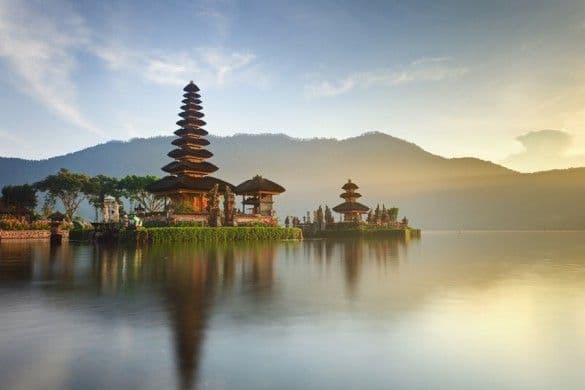
You arrive in Pokhara in the mid afternoon and, after checking in, walk down to the Lakeside boat ghat. Phewa Lake, or Fewa Tal, is the second largest lake in Nepal, and on a still evening the reflection of Machhapuchhre in the water is the image everyone comes for. Wooden boats, with or without a boatman, carry you out to the small island in the lake where Tal Barahi Temple stands.
Barahi Temple is a two storey pagoda dedicated to the goddess Barahi, a form of Durga, and it is a working temple, not a tourist prop. Devotees come across by boat with offerings, particularly on Saturdays, and animal sacrifices are still made on special days, so if you are visiting with young children it is worth knowing that in advance. Please refer to it by its real name, Barahi Temple or Tal Barahi; you may hear tourists call it the island temple, but that is not what it is called. Take a few minutes on the island, then let the boatman drift you back as the light fades. This is one of the gentlest and most beautiful hours of the whole tour.
Sarangkot sunrise over Annapurna and Machhapuchhre (Day 4 morning)
You leave the hotel around 5 am in the dark and drive up the winding road to Sarangkot, a hilltop village at about 1,600 metres on the northern rim of the Pokhara valley. From the viewpoint you watch the first light hit Dhaulagiri in the west, then move across Annapurna South, Annapurna I, Hiunchuli, the sharp fishtail of Machhapuchhre and on to Annapurna II, Lamjung Himal and Manaslu in the east. Below you, Phewa Lake and the whole of Pokhara sit in blue shadow until the sun clears the ridge.
Two honest notes. First, this only works if the sky is clear, which is why autumn and spring are the best seasons. In monsoon and in hazy late spring you may see cloud instead. Second, it is cold at the top before sunrise even in October, so bring a jacket. Sarangkot is also the launch point for Pokhara's paragliding; if you want to fly, tell us in advance and we can arrange it for later in the morning as an optional extra.
Patale Chhango, better known as Davis Falls
After breakfast and a rest, the afternoon starts at Patale Chhango, which foreigners call Davis Falls. The water of the Pardi Khola, the outlet stream of Phewa Lake, drops into a rocky gorge and disappears underground into a tunnel, which is how the Nepali name, meaning underworld waterfall, came about. The English name comes from a story of a foreign visitor who was swept away here in the 1960s. The falls are at their most powerful during and just after the monsoon, and can be a modest trickle in the dry months, so set expectations accordingly. The site has a garden, a few stalls and good railings, and takes about half an hour.
Gupteshwor Mahadev Cave
Directly across the road from Davis Falls is Gupteshwor Mahadev Cave, one of the most visited caves in Nepal. A spiral stairway leads down into the first chamber, which holds a naturally formed Shiva lingam and is treated as a temple, with priests, bells and offerings. A narrower passage continues deeper to a point where you can see and hear the water of Davis Falls thundering through from the other side. The cave is dim, damp and slippery in places, and the second section involves some ducking, so elderly visitors can happily stop at the temple chamber. Devout Hindu family members often rate this as their favourite stop in Pokhara.
Pumdikot Shiva statue and viewpoint
From the cave you drive up to Pumdikot, a hilltop on the western side of Phewa Lake with a large statue of Lord Shiva that was completed in recent years and has quickly become one of Pokhara's most popular pilgrimage and viewpoint spots. The statue sits above a temple complex with 108 small Shiva lingams, and the platform gives you a full view of Phewa Lake, Lakeside, the Pokhara valley and, on a clear day, the Annapurna range. It is a short walk from the car park up to the statue. Pumdikot is a relatively new addition to the standard Pokhara circuit and many older Nepali visitors have not yet seen it, which makes it a nice surprise for parents and grandparents.
World Peace Pagoda (Shanti Stupa)
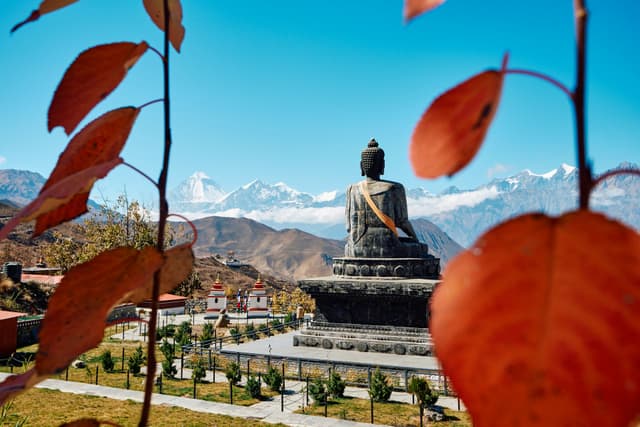
The day ends at the World Peace Pagoda, a white Buddhist stupa on the Anadu ridge on the south shore of Phewa Lake, built with the support of the Japanese Buddhist order Nipponzan Myohoji. Four golden Buddha statues face the four directions, and from the platform the view takes in the whole lake with Sarangkot behind it and the mountains beyond. Late afternoon light is beautiful here. There is a short paved climb from the car park; it is manageable for most, and there are benches on the way. You return to Lakeside for a free evening: a walk along the lakefront, a lakeside dinner and an early night before the drive home.
If your group has a strong interest in temples, ask us about adding Bindhyabasini Temple in the old bazaar; it is a short detour and easily fits before Sarangkot or on the way out of town on Day 5.
When is the best time for a Chitwan Pokhara tour?
October to March is the best window for the Chitwan Pokhara tour, because it combines dry weather, comfortable temperatures in Chitwan and clear skies in Pokhara. Within that, autumn (late September to November) and spring (March to April) give the most reliable mountain views from Sarangkot. The monsoon (June to August) is green and quiet but the peaks are usually hidden and some jungle activities are limited by high water. Here is a month by month guide.
| Months | Chitwan | Pokhara | Verdict |
|---|---|---|---|
| October to November | Dry, warm, grass still tall after monsoon; good wildlife, excellent birding | Crystal clear peaks, mild days, cool nights; peak season | Best overall; book early around Dashain and Tihar |
| December to January | Cool mornings with fog on the Rapti, pleasant days; canoe rides very atmospheric | Clear but cold before dawn at Sarangkot; bring warm layers | Very good, quieter, great value on hotels |
| February to March | Grass cutting improves visibility; rhino and possible tiger sightings improve | Clear mornings, rhododendrons on the hills, warming up | Excellent for wildlife and views |
| April to May | Hot, often above 35 degrees; animals gather at waterholes | Warm with haze building; views often best only at dawn | Good for wildlife, weaker for mountains; go early each day |
| June to August | Monsoon; rivers high, canoe and some walks may be suspended; lush and green | Rain most days, peaks hidden, Davis Falls at full power | Only if this is your only window; expect limits |
| September | Rain easing, jungle fresh, wildlife returning to tracks | Skies clearing by late month | Good late in the month; early September is a gamble |
A specific note for Nepali travellers: the Dashain and Tihar holidays fall in the very best season, and that is exactly when the whole country travels. Pokhara Lakeside hotels and Sauraha resorts fill up, highway traffic doubles and prices rise. If you plan to do the Chitwan Pokhara tour over the festival period, confirm with us at least two to three months ahead so we can lock in hotels and a vehicle. If your dates are flexible, the weeks just after Tihar in November and the whole of December are the sweet spot: same weather, half the crowds.
Who is the Chitwan Pokhara tour suitable for?
The Chitwan Pokhara tour suits almost everyone, because it is a road and sightseeing holiday with no trekking, no altitude and no physically demanding activity. Families with children, couples and honeymooners, groups of friends, parents and grandparents in their sixties and seventies, and relatives visiting Nepal for the first time all do this trip comfortably. The only real requirements are the ability to sit through 5 to 7 hour drives and to walk for short periods on flat or gently sloping ground.
- Families with children: children adore the jeep safari, the canoe, the Tharu dance and the boat to Barahi Temple. The days are structured, the hotels have proper beds and food, and there is always a vehicle nearby if someone is tired. Children under about five may find the long drives hard; a tablet, snacks and a mid day break help.
- Couples and honeymooners: Sauraha at sunset, a lakeside dinner in Pokhara and a private sunrise at Sarangkot make this a natural honeymoon. Ask us about upgrading to a lake view room in Pokhara or a quieter resort on the edge of Sauraha.
- Friends and college groups: a private van, shared rooms and a flexible pace make this an easy group trip. Paragliding at Sarangkot and an extra evening in Lakeside are the usual add ons.
- Elderly parents and grandparents: this is the trip we most often recommend for taking Aama and Buwa on holiday. Every sight is reached by car. The jeep safari and canoe are seated. The cave and the pagoda have steps but they can be taken slowly, and anyone can wait at the entrance. We will choose hotels with ground floor rooms or lifts where possible if you tell us in advance.
- Diaspora families visiting from abroad: if you have a short window in Nepal and want to show your children or partner something beyond Kathmandu, this loop is the most efficient introduction to the Terai and the hills.
Who is it not for? Anyone who wants to trek, anyone chasing a guaranteed tiger sighting, and anyone who cannot tolerate long hill drives at all. For those travellers we would suggest a different itinerary, and we will tell you so.
Where do you stay on the Chitwan Pokhara tour?
You stay two nights in a hotel or resort in Sauraha and two nights in a hotel in Pokhara Lakeside, on a twin sharing basis with breakfast. In Sauraha the typical property is a garden resort with cottage style or block rooms, a restaurant, and staff who organise the safari activities. In Pokhara you stay in the Lakeside area, within walking distance of the lake, the boat ghat and the restaurants. We are honest about what that means in practice.
Sauraha is a jungle village, not a city. Even good resorts have simple rooms, occasional power cuts covered by generators, and insects, because you are next to a national park. Air conditioning matters from March to September and is worth confirming. Hot water is standard. Wi Fi exists but is not fast. Most guests find the atmosphere, the gardens and the food more than make up for it, but if you are expecting a city hotel you will be disappointed.
Pokhara Lakeside is a proper tourist town with a wide range of hotels, from clean budget guesthouses to boutique properties with lake views and rooftop restaurants. Standard Chitwan Pokhara tour packages use mid range hotels a street or two back from the lake; lake view rooms and higher category hotels are available as an upgrade. Tell us your budget and whether you prefer quiet or lively, and we will match you.
Twin sharing means two people per room. Families of three or four can take a triple room or two rooms; solo travellers pay a single supplement or we can try to pair you with another traveller of the same gender. If you have a preferred hotel in either town, tell us and we will price it.
What is the food like in Chitwan and Pokhara?
Food on the Chitwan Pokhara tour is one of its quiet pleasures. In Sauraha you can try Tharu dishes, in Pokhara you get some of the best Thakali sets in the country, and Lakeside adds cafes and restaurants for every taste. Breakfast is included at the hotels; lunches and dinners are usually on your own so that you can eat what you like, and your driver and guide will happily point you to the good places.
- Tharu food in Sauraha: look for dhikri, a steamed rice flour dumpling eaten with spicy chutney; ghonghi, freshwater snails cooked in a rich gravy; sidhra, dried fish curry; and local fish from the Rapti and Narayani. Many resorts serve a Tharu set on request, and a few restaurants in the village specialise in it.
- Thakali sets in Pokhara: the Thakali people of Mustang run some of Pokhara's best kitchens. A Thakali thali comes with rice or buckwheat dhido, black dal, seasonal vegetables, gundruk, mustard greens, a meat curry and sharp timur achar, with unlimited refills. It is the perfect meal after the Sarangkot sunrise.
- Lakeside dining: Lakeside has everything from momo and sekuwa to pizza, Korean, Japanese and continental restaurants, plus bakeries and coffee shops. Lake facing tables at sunset are worth the small wait.
- On the road: highway restaurants around Mugling and Dumre serve dal bhat, noodles and chow mein. Your driver knows which ones are clean and quick. Malekhu, on the Trishuli, is famous for fried fish if you want a snack stop.
Vegetarian travellers are well served everywhere on this route. If anyone in your group has a strict diet, allergy or fasting requirement, tell us at booking and we will brief the hotels.
What should you pack for the Chitwan Pokhara tour?
Pack light and pack for two climates: warm and humid in Chitwan, cool at dawn in Pokhara. Because you travel by private vehicle you do not need to carry anything on your back, so a normal suitcase or duffel is fine. The essentials are neutral coloured clothes for the safari, a warm layer for Sarangkot, comfortable walking shoes, sun and insect protection, and your identity documents.
- Light cotton clothes in green, khaki, brown or grey for the jungle; bright colours and white make animals nervous and photos worse.
- A fleece or light jacket for the pre dawn Sarangkot drive, and a warmer one from December to February.
- Closed walking shoes for the jungle walk, the cave and the pagoda steps; sandals for the hotel and Lakeside.
- Sun hat, sunglasses and sunscreen; the Terai sun is strong even in winter.
- Mosquito repellent and any personal medication, including motion sickness tablets for the highway.
- A small daypack for the safari with water, a scarf against dust in the open jeep, and a camera or phone with a zoom.
- Binoculars if you own them; they transform the canoe ride and the safari.
- A modest outfit for temple visits at Barahi, Gupteshwor and Pumdikot; shoulders and knees covered is respectful and expected by fellow Nepali pilgrims.
- Citizenship card or passport; hotels and the park entry require identification, and Nepali citizens pay the local park fee on presenting citizenship.
- A power bank and some cash in small notes for boat tickets, temple donations and snacks; ATMs are available in Sauraha and Lakeside but not on the highway.
How many days do you need for Chitwan and Pokhara?
Five days and four nights is the minimum that does justice to both places by road, and it is the version this Chitwan Pokhara tour package is built around: two nights in Sauraha, two nights in Pokhara, and three driving days that each still include real sightseeing. Anything shorter means either skipping the jeep safari or arriving in Pokhara too late for the lake, and both are false economies.
If you have more time, a 6 or 7 day extension is easy and makes the trip noticeably more relaxed. The most popular additions are:
- A night in Bandipur between Chitwan and Pokhara, so you see the sunset and the sunrise from the ridge rather than just passing through at lunch.
- A third night in Pokhara for a free day: paragliding, a walk around the north end of Phewa Lake, Begnas Lake, the International Mountain Museum, or simply doing nothing at a lakeside cafe.
- A third night in Chitwan for a second jeep safari, a full day walk with the guides or a Tharu village bicycle ride, which noticeably raises your chances of seeing a tiger, sloth bear or gharial.
- A stop at Manakamana Temple by cable car from Kurintar on the way to or from Kathmandu, a favourite with families and older relatives.
Tell us how many days you have and who is travelling, and we will build the version that fits. There is no extra charge for planning; the quote you get back on WhatsApp is the price of the trip.
Is the Chitwan Pokhara tour worth it?
For most Nepali families, couples and groups of friends, yes, the Chitwan Pokhara tour is worth it, and it is the single most rewarding five day trip you can take from Kathmandu without trekking. You get a genuine wildlife safari in a UNESCO World Heritage park, a preserved heritage town, a lake, a cave, a waterfall, a Shiva statue, a Buddhist stupa and a Himalayan sunrise, all in one loop with one vehicle and no logistics to think about.
The honest counterpoints are these. The drives are long and the highway is not glamorous. Sauraha hotels are simpler than city hotels. Wildlife is wild: rhinos are near certain, tigers are not. Mountain views depend on the sky. If you go in monsoon some activities will be limited. None of these are reasons not to go; they are reasons to go with the right expectations, in the right season, with a company that tells you the truth before you pay.
Compared with flying to Bharatpur and Pokhara separately, the road version is cheaper, keeps your group together in one vehicle, includes Bandipur, and lets you see the country in between. Compared with a public bus, a private car halves the stress and gives you control of every stop. Compared with doing it yourself, a package removes the hotel research, the safari bookings, the boat tickets and the question of what to do if the driver does not turn up. That is the value.
How do you travel responsibly in Chitwan and Pokhara?
Responsible travel on the Chitwan Pokhara tour comes down to a few simple habits: respect the wildlife and the park rules, choose ethical activities, spend money locally and leave the lake and the jungle as clean as you found them. Gomayu builds these into the itinerary, but the daily choices are yours, and they matter because both Sauraha and Pokhara depend on tourism that does not damage what people come to see.
- Stay quiet on the canoe and in the jeep, follow your guide's instructions and never ask the driver to get closer to an animal than the guide allows. A rhino charge is a real risk.
- This tour excludes elephant rides for welfare reasons. If a vendor in Sauraha offers one, you are free to decline.
- Do not feed monkeys or deer, and do not throw anything into the Rapti or Phewa Lake; take your bottles and wrappers back to the hotel.
- At Barahi Temple, Gupteshwor and Pumdikot, dress modestly, remove shoes where required and ask before photographing pilgrims.
- Eat at local restaurants, buy Tharu handicrafts and Pokhara souvenirs from the makers where possible, and tip your driver and safari guides; they are the people who make the trip.
- Keep single use plastic to a minimum. Carry a refillable bottle; most hotels have filtered water.
Why book your Chitwan Pokhara tour with Gomayu?
Gomayu is a Nepali travel company based in Kathmandu that plans trips for Nepali travellers, and the Chitwan Pokhara tour is one of the trips we run most often. We know the highway, the hotels, the safari operators and the boat ghat by name. We tell you what is included and what is not, we do not sell elephant rides, we do not promise tigers, and we answer on WhatsApp in Nepali or English within the day. When something changes on the road, and on the Prithvi Highway something sometimes does, there is a real person in a real Kathmandu office who picks up the phone.
What you get with a Gomayu Chitwan Pokhara tour package: a private car or van with an experienced hill driver for all five days, four nights of twin sharing accommodation with breakfast in Sauraha and Pokhara Lakeside, the Day 2 safari programme with licensed guides, the Tharu cultural show, the Phewa Lake boat to Barahi Temple, the Sarangkot sunrise transfer and the Day 4 sightseeing, and a written itinerary with every inclusion listed before you pay anything. Optional extras such as paragliding, a Bandipur night, a flight back from Pokhara or a Manakamana stop are quoted separately so you can decide.
Ready to plan? Send us a WhatsApp message with your dates, the number of people and whether you are travelling as a family, a couple or a group of friends. We will reply with a clear itinerary and an all inclusive quote in Nepali rupees, with no hidden costs and no obligation. Your Chitwan Pokhara tour from Kathmandu starts with one message.
Price per person
| Group size | Price / person |
|---|---|
| 2 pax | NRs 59,500 /person |
| 3 pax | NRs 47,000 /person |
| 4 pax | NRs 47,000 /person |
| 5 pax | NRs 43,000 /person |
| 6+ pax | NRs 39,500 /person |
Per person · see what’s included
- Prices vary with your travel dates, season and group size.
Chitwan Pokhara Tour
Chitwan Pokhara Tour
5Days
Chitwan jungle and Pokhara lakeside in one road trip
The Chitwan Pokhara tour is Nepal's easiest way to see two very different sides of the country in one short trip. Over five days by road from Kathmandu you swap the wild grasslands and rhino country of Chitwan National Park for the lakes, sunrise viewpoints and mountain air of Pokhara, with the hilltop bazaar of Bandipur on the way.
Designed for Nepali families, couples and groups of friends, this Chitwan Pokhara tour keeps things simple: a private vehicle and driver throughout, comfortable hotels, daily breakfast and lunch, a jungle safari, a Tharu cultural evening and all the Pokhara highlights. No trekking, no camping, just an easy loop you will remember.
Trip highlights
Day-by-day itinerary
Everything below is fully customizable. Add nights, swap activities, or change hotels.
Day1 Kathmandu to Sauraha (Chitwan) & Tharu cultural show
- Morning pickup in Kathmandu and drive south to Sauraha on the edge of Chitwan National Park. Check in, relax by the Rapti river and, in the evening, enjoy the lively Tharu stick-dance cultural show.
Day2 Chitwan jungle day: canoe, jeep safari & optional elephant centre
- Early morning canoe ride on the Rapti river to spot birds, gharial and marsh mugger crocodiles, followed by a guided jungle walk with a naturalist. After lunch, a jeep safari deep into the park in search of one-horned rhino, deer and, if you are lucky, a tiger. If time allows, an optional visit to the elephant breeding centre.
- Activities: Canoe, jungle walk, jeep safari
Day3 Sauraha to Pokhara via Bandipur; evening Barahi Temple boat
- After breakfast, drive north toward Pokhara. On the way, stop at Bandipur, a beautifully restored Newari hill bazaar with mountain views and a car-free main street, for lunch and a stroll. Continue to Pokhara and check in at lakeside. In the evening, take a wooden boat across Phewa Lake to the island Barahi Temple.
Day4 Sarangkot sunrise & Pokhara sightseeing›
- Early drive up to Sarangkot for sunrise over the Annapurna range and Machhapuchhre (Fishtail). Back for breakfast, then after lunch visit Davis Falls (Patale Chhango), the underground Gupteshwor Mahadev Cave, the Pumdikot Shiva statue and viewpoint, and the World Peace Pagoda above the lake.
- Activities: Sarangkot sunrise, Pokhara city sights
Day5 Pokhara back to Kathmandu
- After breakfast and any last lakeside time, drive back to Kathmandu along the Prithvi Highway, following the Trishuli river, with a lunch stop on the way. Drop-off in Kathmandu, where your Chitwan Pokhara tour ends.
Package pricing
The more travellers in your group, the lower the price per person.
| Group size | Price / person |
|---|---|
| 2 pax | NRs 59,500 /person |
| 3 pax | NRs 47,000 /person |
| 4 pax | NRs 47,000 /person |
| 5 pax | NRs 43,000 /person |
| 6+ pax | NRs 39,500 /person |
- Prices vary with your travel dates, season and group size.
Prices are per person · see what’s included.
What's included
| Items | This package |
|---|---|
| Private vehicle + driver | Included |
| 3/4-star hotels & jungle stay | Included |
| Breakfast & lunch daily | Included |
| Chitwan jungle activities | Included |
| Park permits & entry fees | Included |
| Tharu cultural show | Included |
| Pokhara sightseeing | Included |
| Elephant breeding centre | Optional |
| Personal expenses & tips | Not included |
Anything not listed here is not included.
What our travellers say
Real reviews from Google, verified by travelers.
“It was our best decision to choose Gomayu. We had a wonderful experience with GOMAYU during our Thailand trip. Hotels, Location and itinerary all were well planned and was according to our expectations. Response and communication was very good in Thailand as well. You made our trip very smooth, hassle free and stress free from begning to the end of our trip. This trip was memorable, as me and my husband got to celebrate our 20th wedding Anniversary together in the beautiful place of Thailand and credit goes to GOMAYU for all the arrangements . We are very much satisfied with your service and hope to have other trips with you soon. I would happily Recommend GOMAYU to my friends and family for their excellent service and professional support.”
“Me and my family had a great 10 days trip to Vietnam and Bangkok. All thanks to the wonderful service of Gomayu. Thank you so much for making our trip so easy, fun and stress free.”
“We had an unforgettable 5D4N trip to Bali with Gomayu Holidays! From the very beginning, the communication was smooth, clear, and professional. Everything was perfectly organized; airport pickup, hotel check-ins, and daily tours were always on time, with no stress at all. Our stay was split between a beautiful private pool villa in Seminyak and a comfortable room at Grand Mega Resort, both of which exceeded expectations. The itinerary was well-balanced with adventure, culture, and relaxation. We really enjoyed the watersports (banana boat, jet ski, parasailing), the stunning Uluwatu Temple with Kecak dance, and the romantic candlelight dinner at Jimbaran Beach. The Bali swing and tandem ATV ride were absolute highlights and so much fun! Visiting Lempuyang Temple (Gate of Heaven) was magical and very well arranged despite the crowds. We had some spare time to visit the malls and try local food as well. Special thanks to the guide and driver, who was friendly, helpful, super-flexible and always made sure we were comfortable. We didn’t have to worry about anything as everything was well-organized. Highly recommended for anyone planning a hassle-free and memorable Bali trip. Thank you, Gomayu Holidays, for making our holiday truly special!”
“We had a wonderful experience with Gomayau as our travel partner, with everything being well-organized and thoughtfully planned from start to finish, making the entire trip smooth and enjoyable; the overall coordination was excellent, with timely arrangements and great attention to detail, and the team’s consistent support throughout the journey made a real difference, while communication remained easy and reliable, giving us confidence and peace of mind; we truly appreciated the professionalism and dedication in handling logistics and day-to-day planning, which allowed us to fully relax and enjoy the trip, and overall, it was a great experience that we will remember for future travels and would highly recommend to anyone looking for a hassle-free and well-managed trip.”
“Thank you so much Gomayu Holidays. We had an amazing trip. we are extremely satisfied with their service. The itinerary was wonderfully planned and perfectly organized.Highly recommend planning your next vacation with Gomayu Holidays they are truly EXCELLENT. Special heartfelt thank you to Krishtina and Elho from Gomayu Holidays!”
Good to know
Complete travel guide
What is the Chitwan Pokhara tour and why combine the two?
The Chitwan Pokhara tour is a 5 day, 4 night road trip from Kathmandu that joins Nepal's most famous jungle with Nepal's most famous lake town in one easy loop. You spend two nights in Sauraha on the edge of Chitwan National Park for canoe rides, jungle walks and a jeep safari, then drive north through the hilltop bazaar of Bandipur to Pokhara for two nights of lakeside living, a Sarangkot sunrise and the classic city sights. There is no trekking, no camping and no hard walking. A private car or van takes you door to door, and you return to Kathmandu on the fifth day.
Why combine them? Because the two places are completely different and they sit on the same road. Chitwan is flat, hot and wild: rhinos in the grassland, crocodiles on the riverbank, Tharu drums at night. Pokhara is cool, calm and scenic: a still lake, a temple you reach by boat, and a wall of white Himalayan peaks at dawn. Doing both in a single Chitwan and Pokhara tour means you see the Terai and the middle hills in five days, and the drive between them through the Trishuli and Marsyangdi valleys is part of the experience rather than wasted time.
For many Nepali families this is the first proper holiday outside the Valley. For couples it is a gentle honeymoon. For groups of friends it is the trip you finally take after years of saying you will. For relatives visiting from abroad it is the simplest way to show them the Nepal that lives beyond Kathmandu. This guide walks you through every part of the 5 days Chitwan Pokhara tour honestly, so you know exactly what you are booking before you message us.
If you already know you want to go, send Gomayu a WhatsApp message with your travel dates and group size and we will send back a clear quote in Nepali rupees the same day.
How does the Chitwan Pokhara tour from Kathmandu work by road?
The route is a triangle: Kathmandu down to Sauraha in Chitwan, Sauraha up to Pokhara via Bandipur, and Pokhara back to Kathmandu. Each leg is a single day of driving in a private vehicle with stops for tea and lunch. Total driving over the five days is roughly 17 to 19 hours, spread across three travel days, with the two middle days spent entirely on sightseeing. Here is how each leg actually goes.
Day 1: Kathmandu to Sauraha, Chitwan (5 to 6 hours)
You leave Kathmandu in the morning, climb out of the Valley at Thankot and drop down to Naubise, where the road joins the Prithvi Highway. From here the highway follows the Trishuli River west, the same river the rafting companies use, so you get long stretches of green water and steep valley walls on your right. At Mugling the road forks: Pokhara is straight ahead, Chitwan is to the left along the Narayani River. You pass through Narayanghat and Bharatpur, the busy commercial hub of the Terai, and reach Sauraha in the early afternoon.
The change in climate is the first thing you notice. Kathmandu is cool and dusty; Sauraha is warm, green and humid, with rice fields, mustard flowers in season and the flat horizon of the Terai. Once you check in, the evening is free for a walk along the Rapti River, where the sun sets behind the park across the water, followed by a Tharu cultural show featuring the stick dance.
Day 3: Sauraha to Bandipur to Pokhara (5 to 6 hours total)
You drive back up to Mugling and then continue west along the Prithvi Highway toward Pokhara. Around Dumre a side road climbs steeply up to Bandipur, a preserved Newari hill town at roughly 1,000 metres. The detour and the stop take about two hours including lunch and a walk along the car free bazaar. From Bandipur you descend back to the highway and follow the Marsyangdi and then the Seti river valleys into Pokhara, arriving by mid afternoon with time for a boat ride on Phewa Lake before dark.
Day 5: Pokhara to Kathmandu (6 to 7 hours)
The final day is the longest drive. You retrace the Prithvi Highway east from Pokhara through Damauli, Dumre and Mugling, then back along the Trishuli to Naubise and up into the Kathmandu Valley. Leaving Pokhara by 8 am usually gets you home by mid to late afternoon, but traffic on the approach to Kathmandu can add an hour, especially on Fridays, festival weekends and the days around Dashain and Tihar.
What is the road honestly like?
We would rather tell you plainly than have you find out on the day. The Prithvi Highway is a two lane mountain highway, not an expressway. It is paved throughout, but it is winding, busy with trucks and buses, and sections are periodically under widening or repair, which means dust and short delays in dry months and occasional slips in the monsoon. The Mugling to Narayanghat stretch has been widened and is generally smoother than it was a few years ago. The Kathmandu to Mugling stretch is the slowest and most crowded part.
The good news is that a private vehicle makes a big difference. You stop when you want, you choose a clean restaurant for lunch, the driver knows where the roadworks are, and there is no tourist bus timetable to chase. If anyone in your group gets car sick on hill roads, sit in the front, take a motion sickness tablet before Naubise and keep the window slightly open. Children usually sleep through the worst of it.
If you would prefer to skip one or both drives, Gomayu can quote a version with a flight from Pokhara back to Kathmandu on the last day. It costs more but saves the long final leg. Ask us on WhatsApp and we will lay out both options.
What do you actually do on the Chitwan safari day?
Day 2 is the heart of the Chitwan part of the tour. It starts before sunrise with a dugout canoe on the Rapti River and a short jungle walk, continues after lunch with a jeep safari deep into Chitwan National Park, and ends, time permitting, with a visit to the elephant breeding centre at Khorsor. Realistically you will see one horned rhinos, deer, wild boar, monkeys, crocodiles and dozens of bird species. A tiger is a possibility, not a promise. Here is what each activity is really like.
Why is Chitwan National Park special?
Chitwan National Park was Nepal's first national park and is a UNESCO World Heritage Site. It protects around 900 square kilometres of sal forest, riverine jungle and tall elephant grass along the Rapti, Narayani and Reu rivers. It is the country's stronghold for the greater one horned rhinoceros, whose numbers here have recovered from a few hundred to close to 700 at the last national count, and it holds one of Nepal's main Bengal tiger populations. It is also home to gharial and mugger crocodiles, sloth bears, leopards, gaur, four species of deer and more than 500 recorded bird species. Sauraha, the village where you stay, sits right on the park boundary across the Rapti River.
The Rapti sunset and the Tharu stick dance (Day 1 evening)
Your first evening is deliberately easy. A short walk from most Sauraha hotels brings you to the bank of the Rapti River, where local families, tourists and the occasional rhino from the far bank all watch the same sunset. The light on the river and the jungle silhouette are worth the walk alone.
After dinner you attend a Tharu cultural programme. The Tharu are the indigenous people of the Terai, with their own language, dress and festivals, and the stick dance is their signature performance: rows of men in white striking sticks in fast rhythm to drums, along with the peacock dance and songs. It is not a village visit and it is not a museum. It is a staged show in a community hall, usually around an hour, and audiences are often invited to join in the final dance. Children love it.
The early morning dugout canoe and jungle walk
You are up before dawn for the canoe ride. A guide and a boatman pole a long wooden dugout downstream along the Rapti while mist lifts off the water. This is the best time for crocodiles: mugger crocodiles basking on sandbanks and, if you are lucky, the thin snouted gharial. It is also prime birding, with kingfishers, egrets, storks, herons and sometimes a lesser adjutant or a peacock in the trees. The canoe is quiet and slow, which is exactly the point.
The canoe lands on the park side and you take a short guided walk through the riverine forest with two naturalist guides. Walks are kept short and stay close to the river. Guides brief you on what to do if you meet a rhino, which is rare on this route but not impossible. This is a gentle nature walk, not a trek, and it is fine for older travellers and children who can walk for 45 minutes to an hour on flat ground.
The jeep safari after lunch
After lunch and a rest in the hot part of the day, you board an open jeep with a guide for the main safari, which runs several hours into the core of the park along forest tracks and across grassland. The guide and driver read tracks, alarm calls and dung to find animals. This is when you have the best chance of seeing rhinos at close range, often a mother and calf standing in a wallow or grazing at the edge of the grass. You will almost certainly see spotted deer, sambar and barking deer, langur and rhesus monkeys, wild boar and peacocks. Bears, leopards and gaur appear from time to time.
About the tiger: Chitwan has a healthy tiger population, but tigers are secretive and the park is large. Some visitors see one on their first safari; many regular visitors have never seen one. If a tiger is your main goal, plan for extra safari days and a spring visit when the grass has been cut. On a standard Chitwan Pokhara tour, think of the tiger as a bonus and the rhino as the reliable star.
The elephant breeding centre at Khorsor, and our note on elephants
In the late afternoon, if there is time and light, you visit the elephant breeding centre at Khorsor, a short drive and a small footbridge from Sauraha. It is a government run facility where domestic elephants used for park patrol work are bred and raised, and the calves are the main attraction. It is a modest, low key visit of around half an hour.
This tour does not include elephant back safaris or elephant rides. We made that decision deliberately. Elephant rides are still sold in Sauraha, but the welfare concerns around chaining, training and carrying loads are well documented, and a growing number of travellers and operators have moved away from them. The jeep safari and canoe give you a better wildlife experience anyway. If you have questions about this, ask us; we would rather explain than pretend the issue does not exist.
Please also note that this itinerary does not include a Tharu village tour. The cultural show on Day 1 is the Tharu element of the trip. If you would like a village walk or a bicycle ride through the Tharu villages around Sauraha, it can be added on request.
Is Bandipur worth the stop between Chitwan and Pokhara?
Yes. Bandipur is one of the best preserved Newari towns in Nepal, and it sits almost exactly halfway between Sauraha and Pokhara, which makes it the perfect lunch stop on Day 3. The main bazaar is closed to vehicles, the old brick houses have carved wooden windows and slate roofs, and on a clear day the ridge behind the town looks straight across to the Annapurna, Manaslu and Langtang ranges. It turns a plain transfer day into a highlight.
Bandipur grew rich as a trading post on the old route between Tibet and India. Newari merchants from Bhaktapur settled here in the 19th century, built the fine houses you see today, and left when the Prithvi Highway bypassed the town in the 1970s. That abandonment is what saved it: nobody knocked the old houses down to build concrete. In recent years the town has been carefully restored, and the bazaar now has small guesthouses, cafes and a temple square where children play and elders sit in the sun.
On the tour you have around one and a half to two hours here. That is enough to walk the length of the bazaar, sit on the Tundikhel, the flat grassy viewpoint at the end of the ridge, have lunch at a local restaurant and take photos. If you have older family members in the group, the bazaar is flat and easy. If you have a keen walker, the short climb to Thani Mai temple above the town gives an even wider Himalayan view. Some groups love Bandipur so much they ask to spend a night there; if that appeals, ask Gomayu about a 6 day version of the Chitwan Pokhara itinerary.
What do you see in Pokhara on the Chitwan Pokhara tour?
Pokhara delivers five classic sights on this tour: a boat ride across Phewa Lake to Barahi Temple on the evening you arrive, the Sarangkot sunrise over Annapurna and Machhapuchhre the next morning, and then Patale Chhango (Davis Falls), Gupteshwor Mahadev Cave, Pumdikot and the World Peace Pagoda in the afternoon. All of them are reached by car and short walks. None requires trekking. Together they give you the lake, the mountains, the waterfall, the cave and the two great hilltop viewpoints in a single day and a half.
Phewa Lake and Barahi Temple (Day 3 evening)
You arrive in Pokhara in the mid afternoon and, after checking in, walk down to the Lakeside boat ghat. Phewa Lake, or Fewa Tal, is the second largest lake in Nepal, and on a still evening the reflection of Machhapuchhre in the water is the image everyone comes for. Wooden boats, with or without a boatman, carry you out to the small island in the lake where Tal Barahi Temple stands.
Barahi Temple is a two storey pagoda dedicated to the goddess Barahi, a form of Durga, and it is a working temple, not a tourist prop. Devotees come across by boat with offerings, particularly on Saturdays, and animal sacrifices are still made on special days, so if you are visiting with young children it is worth knowing that in advance. Please refer to it by its real name, Barahi Temple or Tal Barahi; you may hear tourists call it the island temple, but that is not what it is called. Take a few minutes on the island, then let the boatman drift you back as the light fades. This is one of the gentlest and most beautiful hours of the whole tour.
Sarangkot sunrise over Annapurna and Machhapuchhre (Day 4 morning)
You leave the hotel around 5 am in the dark and drive up the winding road to Sarangkot, a hilltop village at about 1,600 metres on the northern rim of the Pokhara valley. From the viewpoint you watch the first light hit Dhaulagiri in the west, then move across Annapurna South, Annapurna I, Hiunchuli, the sharp fishtail of Machhapuchhre and on to Annapurna II, Lamjung Himal and Manaslu in the east. Below you, Phewa Lake and the whole of Pokhara sit in blue shadow until the sun clears the ridge.
Two honest notes. First, this only works if the sky is clear, which is why autumn and spring are the best seasons. In monsoon and in hazy late spring you may see cloud instead. Second, it is cold at the top before sunrise even in October, so bring a jacket. Sarangkot is also the launch point for Pokhara's paragliding; if you want to fly, tell us in advance and we can arrange it for later in the morning as an optional extra.
Patale Chhango, better known as Davis Falls
After breakfast and a rest, the afternoon starts at Patale Chhango, which foreigners call Davis Falls. The water of the Pardi Khola, the outlet stream of Phewa Lake, drops into a rocky gorge and disappears underground into a tunnel, which is how the Nepali name, meaning underworld waterfall, came about. The English name comes from a story of a foreign visitor who was swept away here in the 1960s. The falls are at their most powerful during and just after the monsoon, and can be a modest trickle in the dry months, so set expectations accordingly. The site has a garden, a few stalls and good railings, and takes about half an hour.
Gupteshwor Mahadev Cave
Directly across the road from Davis Falls is Gupteshwor Mahadev Cave, one of the most visited caves in Nepal. A spiral stairway leads down into the first chamber, which holds a naturally formed Shiva lingam and is treated as a temple, with priests, bells and offerings. A narrower passage continues deeper to a point where you can see and hear the water of Davis Falls thundering through from the other side. The cave is dim, damp and slippery in places, and the second section involves some ducking, so elderly visitors can happily stop at the temple chamber. Devout Hindu family members often rate this as their favourite stop in Pokhara.
Pumdikot Shiva statue and viewpoint
From the cave you drive up to Pumdikot, a hilltop on the western side of Phewa Lake with a large statue of Lord Shiva that was completed in recent years and has quickly become one of Pokhara's most popular pilgrimage and viewpoint spots. The statue sits above a temple complex with 108 small Shiva lingams, and the platform gives you a full view of Phewa Lake, Lakeside, the Pokhara valley and, on a clear day, the Annapurna range. It is a short walk from the car park up to the statue. Pumdikot is a relatively new addition to the standard Pokhara circuit and many older Nepali visitors have not yet seen it, which makes it a nice surprise for parents and grandparents.
World Peace Pagoda (Shanti Stupa)
The day ends at the World Peace Pagoda, a white Buddhist stupa on the Anadu ridge on the south shore of Phewa Lake, built with the support of the Japanese Buddhist order Nipponzan Myohoji. Four golden Buddha statues face the four directions, and from the platform the view takes in the whole lake with Sarangkot behind it and the mountains beyond. Late afternoon light is beautiful here. There is a short paved climb from the car park; it is manageable for most, and there are benches on the way. You return to Lakeside for a free evening: a walk along the lakefront, a lakeside dinner and an early night before the drive home.
If your group has a strong interest in temples, ask us about adding Bindhyabasini Temple in the old bazaar; it is a short detour and easily fits before Sarangkot or on the way out of town on Day 5.
When is the best time for a Chitwan Pokhara tour?
October to March is the best window for the Chitwan Pokhara tour, because it combines dry weather, comfortable temperatures in Chitwan and clear skies in Pokhara. Within that, autumn (late September to November) and spring (March to April) give the most reliable mountain views from Sarangkot. The monsoon (June to August) is green and quiet but the peaks are usually hidden and some jungle activities are limited by high water. Here is a month by month guide.
| Months | Chitwan | Pokhara | Verdict |
|---|---|---|---|
| October to November | Dry, warm, grass still tall after monsoon; good wildlife, excellent birding | Crystal clear peaks, mild days, cool nights; peak season | Best overall; book early around Dashain and Tihar |
| December to January | Cool mornings with fog on the Rapti, pleasant days; canoe rides very atmospheric | Clear but cold before dawn at Sarangkot; bring warm layers | Very good, quieter, great value on hotels |
| February to March | Grass cutting improves visibility; rhino and possible tiger sightings improve | Clear mornings, rhododendrons on the hills, warming up | Excellent for wildlife and views |
| April to May | Hot, often above 35 degrees; animals gather at waterholes | Warm with haze building; views often best only at dawn | Good for wildlife, weaker for mountains; go early each day |
| June to August | Monsoon; rivers high, canoe and some walks may be suspended; lush and green | Rain most days, peaks hidden, Davis Falls at full power | Only if this is your only window; expect limits |
| September | Rain easing, jungle fresh, wildlife returning to tracks | Skies clearing by late month | Good late in the month; early September is a gamble |
A specific note for Nepali travellers: the Dashain and Tihar holidays fall in the very best season, and that is exactly when the whole country travels. Pokhara Lakeside hotels and Sauraha resorts fill up, highway traffic doubles and prices rise. If you plan to do the Chitwan Pokhara tour over the festival period, confirm with us at least two to three months ahead so we can lock in hotels and a vehicle. If your dates are flexible, the weeks just after Tihar in November and the whole of December are the sweet spot: same weather, half the crowds.
Who is the Chitwan Pokhara tour suitable for?
The Chitwan Pokhara tour suits almost everyone, because it is a road and sightseeing holiday with no trekking, no altitude and no physically demanding activity. Families with children, couples and honeymooners, groups of friends, parents and grandparents in their sixties and seventies, and relatives visiting Nepal for the first time all do this trip comfortably. The only real requirements are the ability to sit through 5 to 7 hour drives and to walk for short periods on flat or gently sloping ground.
- Families with children: children adore the jeep safari, the canoe, the Tharu dance and the boat to Barahi Temple. The days are structured, the hotels have proper beds and food, and there is always a vehicle nearby if someone is tired. Children under about five may find the long drives hard; a tablet, snacks and a mid day break help.
- Couples and honeymooners: Sauraha at sunset, a lakeside dinner in Pokhara and a private sunrise at Sarangkot make this a natural honeymoon. Ask us about upgrading to a lake view room in Pokhara or a quieter resort on the edge of Sauraha.
- Friends and college groups: a private van, shared rooms and a flexible pace make this an easy group trip. Paragliding at Sarangkot and an extra evening in Lakeside are the usual add ons.
- Elderly parents and grandparents: this is the trip we most often recommend for taking Aama and Buwa on holiday. Every sight is reached by car. The jeep safari and canoe are seated. The cave and the pagoda have steps but they can be taken slowly, and anyone can wait at the entrance. We will choose hotels with ground floor rooms or lifts where possible if you tell us in advance.
- Diaspora families visiting from abroad: if you have a short window in Nepal and want to show your children or partner something beyond Kathmandu, this loop is the most efficient introduction to the Terai and the hills.
Who is it not for? Anyone who wants to trek, anyone chasing a guaranteed tiger sighting, and anyone who cannot tolerate long hill drives at all. For those travellers we would suggest a different itinerary, and we will tell you so.
Where do you stay on the Chitwan Pokhara tour?
You stay two nights in a hotel or resort in Sauraha and two nights in a hotel in Pokhara Lakeside, on a twin sharing basis with breakfast. In Sauraha the typical property is a garden resort with cottage style or block rooms, a restaurant, and staff who organise the safari activities. In Pokhara you stay in the Lakeside area, within walking distance of the lake, the boat ghat and the restaurants. We are honest about what that means in practice.
Sauraha is a jungle village, not a city. Even good resorts have simple rooms, occasional power cuts covered by generators, and insects, because you are next to a national park. Air conditioning matters from March to September and is worth confirming. Hot water is standard. Wi Fi exists but is not fast. Most guests find the atmosphere, the gardens and the food more than make up for it, but if you are expecting a city hotel you will be disappointed.
Pokhara Lakeside is a proper tourist town with a wide range of hotels, from clean budget guesthouses to boutique properties with lake views and rooftop restaurants. Standard Chitwan Pokhara tour packages use mid range hotels a street or two back from the lake; lake view rooms and higher category hotels are available as an upgrade. Tell us your budget and whether you prefer quiet or lively, and we will match you.
Twin sharing means two people per room. Families of three or four can take a triple room or two rooms; solo travellers pay a single supplement or we can try to pair you with another traveller of the same gender. If you have a preferred hotel in either town, tell us and we will price it.
What is the food like in Chitwan and Pokhara?
Food on the Chitwan Pokhara tour is one of its quiet pleasures. In Sauraha you can try Tharu dishes, in Pokhara you get some of the best Thakali sets in the country, and Lakeside adds cafes and restaurants for every taste. Breakfast is included at the hotels; lunches and dinners are usually on your own so that you can eat what you like, and your driver and guide will happily point you to the good places.
- Tharu food in Sauraha: look for dhikri, a steamed rice flour dumpling eaten with spicy chutney; ghonghi, freshwater snails cooked in a rich gravy; sidhra, dried fish curry; and local fish from the Rapti and Narayani. Many resorts serve a Tharu set on request, and a few restaurants in the village specialise in it.
- Thakali sets in Pokhara: the Thakali people of Mustang run some of Pokhara's best kitchens. A Thakali thali comes with rice or buckwheat dhido, black dal, seasonal vegetables, gundruk, mustard greens, a meat curry and sharp timur achar, with unlimited refills. It is the perfect meal after the Sarangkot sunrise.
- Lakeside dining: Lakeside has everything from momo and sekuwa to pizza, Korean, Japanese and continental restaurants, plus bakeries and coffee shops. Lake facing tables at sunset are worth the small wait.
- On the road: highway restaurants around Mugling and Dumre serve dal bhat, noodles and chow mein. Your driver knows which ones are clean and quick. Malekhu, on the Trishuli, is famous for fried fish if you want a snack stop.
Vegetarian travellers are well served everywhere on this route. If anyone in your group has a strict diet, allergy or fasting requirement, tell us at booking and we will brief the hotels.
What should you pack for the Chitwan Pokhara tour?
Pack light and pack for two climates: warm and humid in Chitwan, cool at dawn in Pokhara. Because you travel by private vehicle you do not need to carry anything on your back, so a normal suitcase or duffel is fine. The essentials are neutral coloured clothes for the safari, a warm layer for Sarangkot, comfortable walking shoes, sun and insect protection, and your identity documents.
- Light cotton clothes in green, khaki, brown or grey for the jungle; bright colours and white make animals nervous and photos worse.
- A fleece or light jacket for the pre dawn Sarangkot drive, and a warmer one from December to February.
- Closed walking shoes for the jungle walk, the cave and the pagoda steps; sandals for the hotel and Lakeside.
- Sun hat, sunglasses and sunscreen; the Terai sun is strong even in winter.
- Mosquito repellent and any personal medication, including motion sickness tablets for the highway.
- A small daypack for the safari with water, a scarf against dust in the open jeep, and a camera or phone with a zoom.
- Binoculars if you own them; they transform the canoe ride and the safari.
- A modest outfit for temple visits at Barahi, Gupteshwor and Pumdikot; shoulders and knees covered is respectful and expected by fellow Nepali pilgrims.
- Citizenship card or passport; hotels and the park entry require identification, and Nepali citizens pay the local park fee on presenting citizenship.
- A power bank and some cash in small notes for boat tickets, temple donations and snacks; ATMs are available in Sauraha and Lakeside but not on the highway.
How many days do you need for Chitwan and Pokhara?
Five days and four nights is the minimum that does justice to both places by road, and it is the version this Chitwan Pokhara tour package is built around: two nights in Sauraha, two nights in Pokhara, and three driving days that each still include real sightseeing. Anything shorter means either skipping the jeep safari or arriving in Pokhara too late for the lake, and both are false economies.
If you have more time, a 6 or 7 day extension is easy and makes the trip noticeably more relaxed. The most popular additions are:
- A night in Bandipur between Chitwan and Pokhara, so you see the sunset and the sunrise from the ridge rather than just passing through at lunch.
- A third night in Pokhara for a free day: paragliding, a walk around the north end of Phewa Lake, Begnas Lake, the International Mountain Museum, or simply doing nothing at a lakeside cafe.
- A third night in Chitwan for a second jeep safari, a full day walk with the guides or a Tharu village bicycle ride, which noticeably raises your chances of seeing a tiger, sloth bear or gharial.
- A stop at Manakamana Temple by cable car from Kurintar on the way to or from Kathmandu, a favourite with families and older relatives.
Tell us how many days you have and who is travelling, and we will build the version that fits. There is no extra charge for planning; the quote you get back on WhatsApp is the price of the trip.
Is the Chitwan Pokhara tour worth it?
For most Nepali families, couples and groups of friends, yes, the Chitwan Pokhara tour is worth it, and it is the single most rewarding five day trip you can take from Kathmandu without trekking. You get a genuine wildlife safari in a UNESCO World Heritage park, a preserved heritage town, a lake, a cave, a waterfall, a Shiva statue, a Buddhist stupa and a Himalayan sunrise, all in one loop with one vehicle and no logistics to think about.
The honest counterpoints are these. The drives are long and the highway is not glamorous. Sauraha hotels are simpler than city hotels. Wildlife is wild: rhinos are near certain, tigers are not. Mountain views depend on the sky. If you go in monsoon some activities will be limited. None of these are reasons not to go; they are reasons to go with the right expectations, in the right season, with a company that tells you the truth before you pay.
Compared with flying to Bharatpur and Pokhara separately, the road version is cheaper, keeps your group together in one vehicle, includes Bandipur, and lets you see the country in between. Compared with a public bus, a private car halves the stress and gives you control of every stop. Compared with doing it yourself, a package removes the hotel research, the safari bookings, the boat tickets and the question of what to do if the driver does not turn up. That is the value.
How do you travel responsibly in Chitwan and Pokhara?
Responsible travel on the Chitwan Pokhara tour comes down to a few simple habits: respect the wildlife and the park rules, choose ethical activities, spend money locally and leave the lake and the jungle as clean as you found them. Gomayu builds these into the itinerary, but the daily choices are yours, and they matter because both Sauraha and Pokhara depend on tourism that does not damage what people come to see.
- Stay quiet on the canoe and in the jeep, follow your guide's instructions and never ask the driver to get closer to an animal than the guide allows. A rhino charge is a real risk.
- This tour excludes elephant rides for welfare reasons. If a vendor in Sauraha offers one, you are free to decline.
- Do not feed monkeys or deer, and do not throw anything into the Rapti or Phewa Lake; take your bottles and wrappers back to the hotel.
- At Barahi Temple, Gupteshwor and Pumdikot, dress modestly, remove shoes where required and ask before photographing pilgrims.
- Eat at local restaurants, buy Tharu handicrafts and Pokhara souvenirs from the makers where possible, and tip your driver and safari guides; they are the people who make the trip.
- Keep single use plastic to a minimum. Carry a refillable bottle; most hotels have filtered water.
Why book your Chitwan Pokhara tour with Gomayu?
Gomayu is a Nepali travel company based in Kathmandu that plans trips for Nepali travellers, and the Chitwan Pokhara tour is one of the trips we run most often. We know the highway, the hotels, the safari operators and the boat ghat by name. We tell you what is included and what is not, we do not sell elephant rides, we do not promise tigers, and we answer on WhatsApp in Nepali or English within the day. When something changes on the road, and on the Prithvi Highway something sometimes does, there is a real person in a real Kathmandu office who picks up the phone.
What you get with a Gomayu Chitwan Pokhara tour package: a private car or van with an experienced hill driver for all five days, four nights of twin sharing accommodation with breakfast in Sauraha and Pokhara Lakeside, the Day 2 safari programme with licensed guides, the Tharu cultural show, the Phewa Lake boat to Barahi Temple, the Sarangkot sunrise transfer and the Day 4 sightseeing, and a written itinerary with every inclusion listed before you pay anything. Optional extras such as paragliding, a Bandipur night, a flight back from Pokhara or a Manakamana stop are quoted separately so you can decide.
Ready to plan? Send us a WhatsApp message with your dates, the number of people and whether you are travelling as a family, a couple or a group of friends. We will reply with a clear itinerary and an all inclusive quote in Nepali rupees, with no hidden costs and no obligation. Your Chitwan Pokhara tour from Kathmandu starts with one message.
Price per person
| Group size | Price / person |
|---|---|
| 2 pax | NRs 59,500 /person |
| 3 pax | NRs 47,000 /person |
| 4 pax | NRs 47,000 /person |
| 5 pax | NRs 43,000 /person |
| 6+ pax | NRs 39,500 /person |
Per person · see what’s included
- Prices vary with your travel dates, season and group size.