












































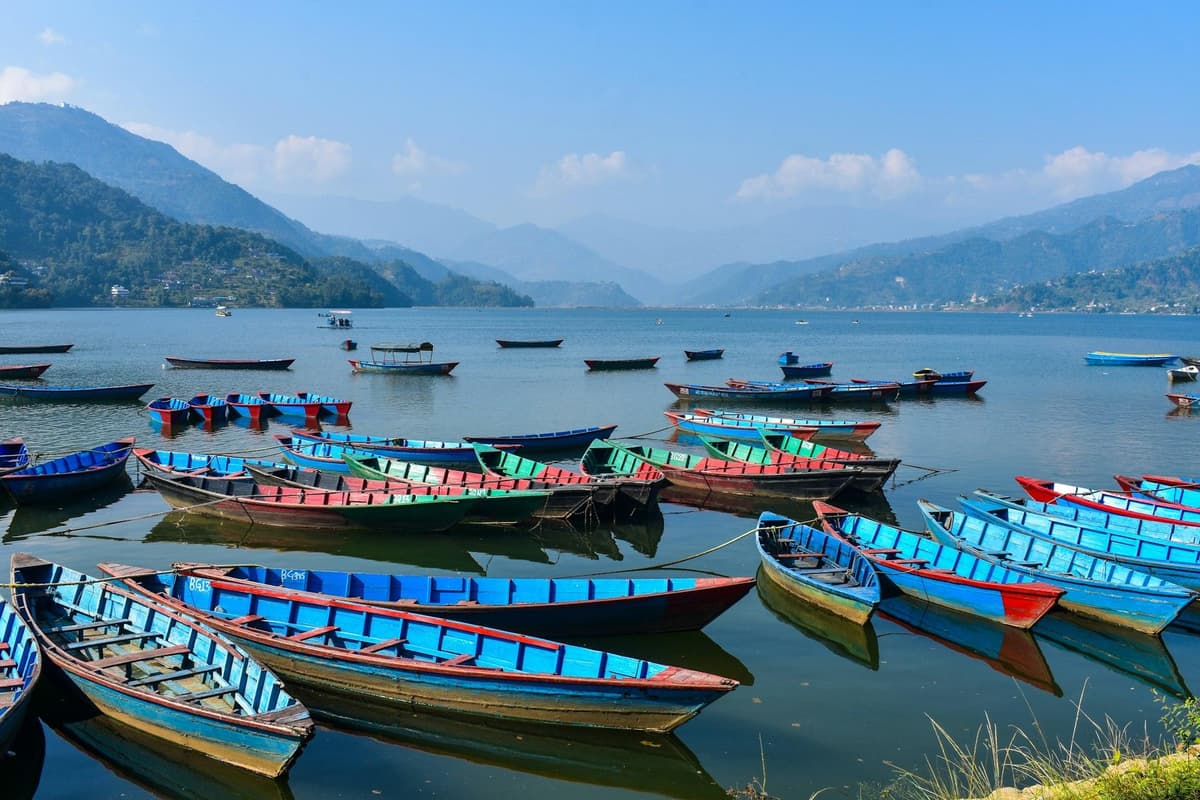
Short answer: the best things to do in Pokhara are a boat ride on Phewa Lake to Tal Barahi temple, the Sarangkot sunrise over the Annapurnas, the World Peace Pagoda, Davis Falls and Gupteshwor Cave, Bindhyabasini temple, the International Mountain Museum, Begnas Lake and an evening at Lakeside. Pokhara is about 200 km west of Kathmandu: 6 to 7 hours by road or about 25 minutes by air.
Pokhara is Nepal's lake city and, since March 2024, its officially declared tourism capital. It sits at roughly 800 m with Machhapuchhre (Fishtail) and the Annapurnas rising straight behind it, and needs no trekking, which makes it an easy holiday for families, couples and NRNs bringing parents home.
If you would rather have it all arranged, our Pokhara tour package covers the main sights by private vehicle, and our Kathmandu team can send you a quote on WhatsApp.
What are the best things to do in Pokhara?
Two full days are enough to see Pokhara's main sights: one for the lake, the island temple and the Peace Pagoda, and one that starts with the Sarangkot sunrise and continues to the falls, caves, temples and museum. Everything below is reached by car, with short walks.
| Place | What it is | Time to allow | Good for |
|---|---|---|---|
| Phewa Lake and Tal Barahi | Boat ride to the island temple | 1 to 2 hours | Everyone, especially couples |
| Sarangkot | Sunrise viewpoint over the Annapurnas | About 3 hours with the drive | Mountain views, photographers |
| World Peace Pagoda | White Buddhist stupa above the lake | 2 hours | Views, a short hike |
| Davis Falls and Gupteshwor Cave | Waterfall and Shiva cave, across the road from each other | 1 to 1.5 hours | Families, pilgrims |
| Bindhyabasini temple | Hilltop Durga temple in the old town | 45 minutes | Pilgrims, elders |
| International Mountain Museum | Himalayan climbing, peoples and nature | 1.5 to 2 hours | Children, rainy days |
| Begnas and Rupa lakes | Quiet lakes east of the city | Half a day | Couples, a slower day |
| Old Bazaar and Seti gorge | Newar trading streets and a deep river gorge | 1 to 2 hours | Culture, walking |
| Lakeside | Cafes, shops and the lakeshore path | Evenings | Everyone |
1. Phewa Lake and Tal Barahi temple
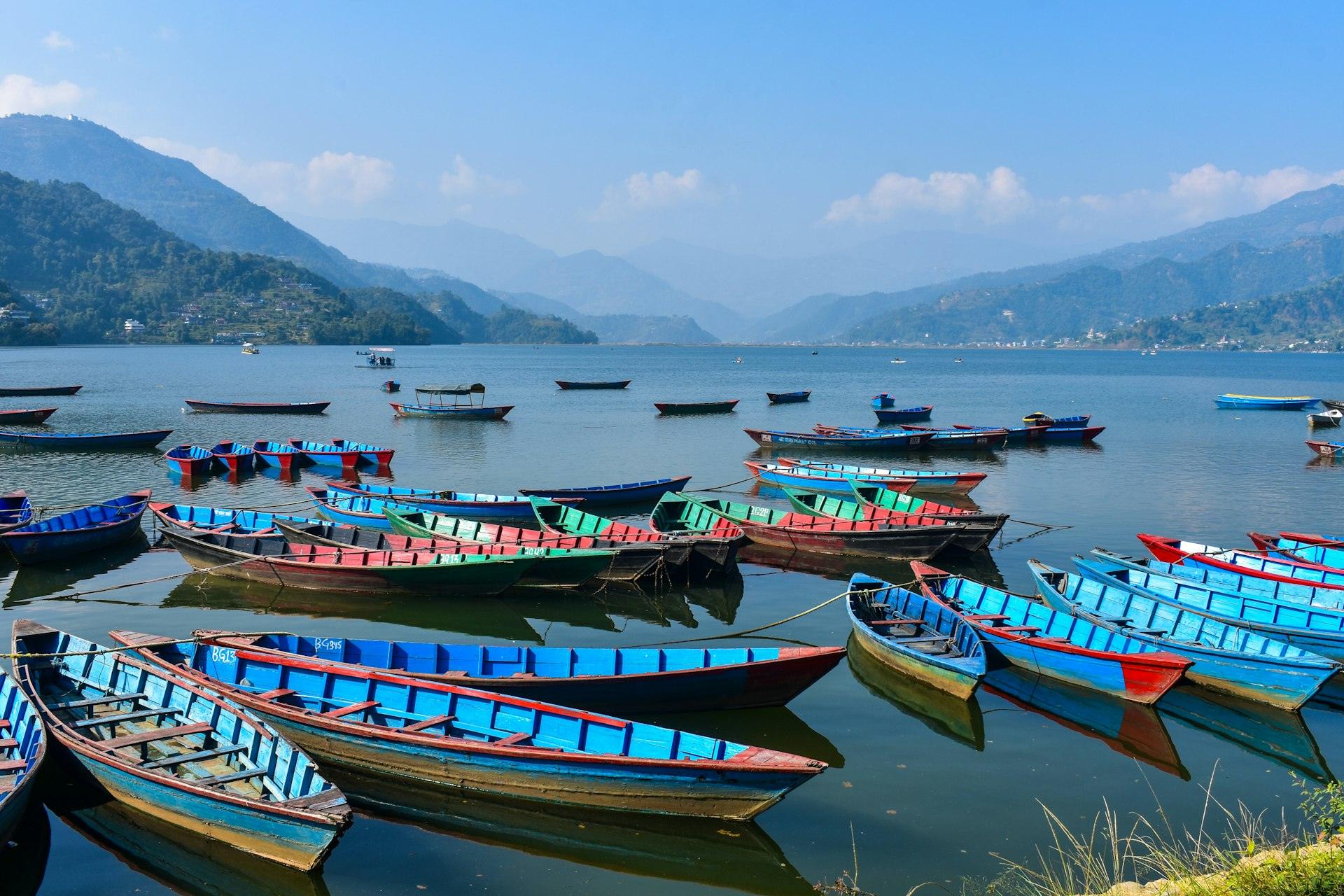
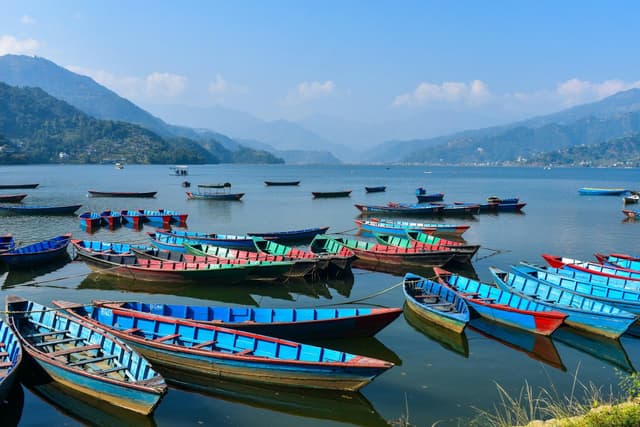
Phewa Lake is the heart of Pokhara and, after Rara, the second-largest lake in Nepal. On a still morning it reflects Machhapuchhre and the Annapurna peaks. Wooden boats leave from the ghats along Lakeside, and the classic trip is to Tal Barahi, the two-storey pagoda temple on a small island and the city's most important religious site. Hire a boat with a boatman or paddle yourself, and wear the life jacket provided. Early morning and the hour before sunset are the calmest times on the water.
2. Sunrise at Sarangkot
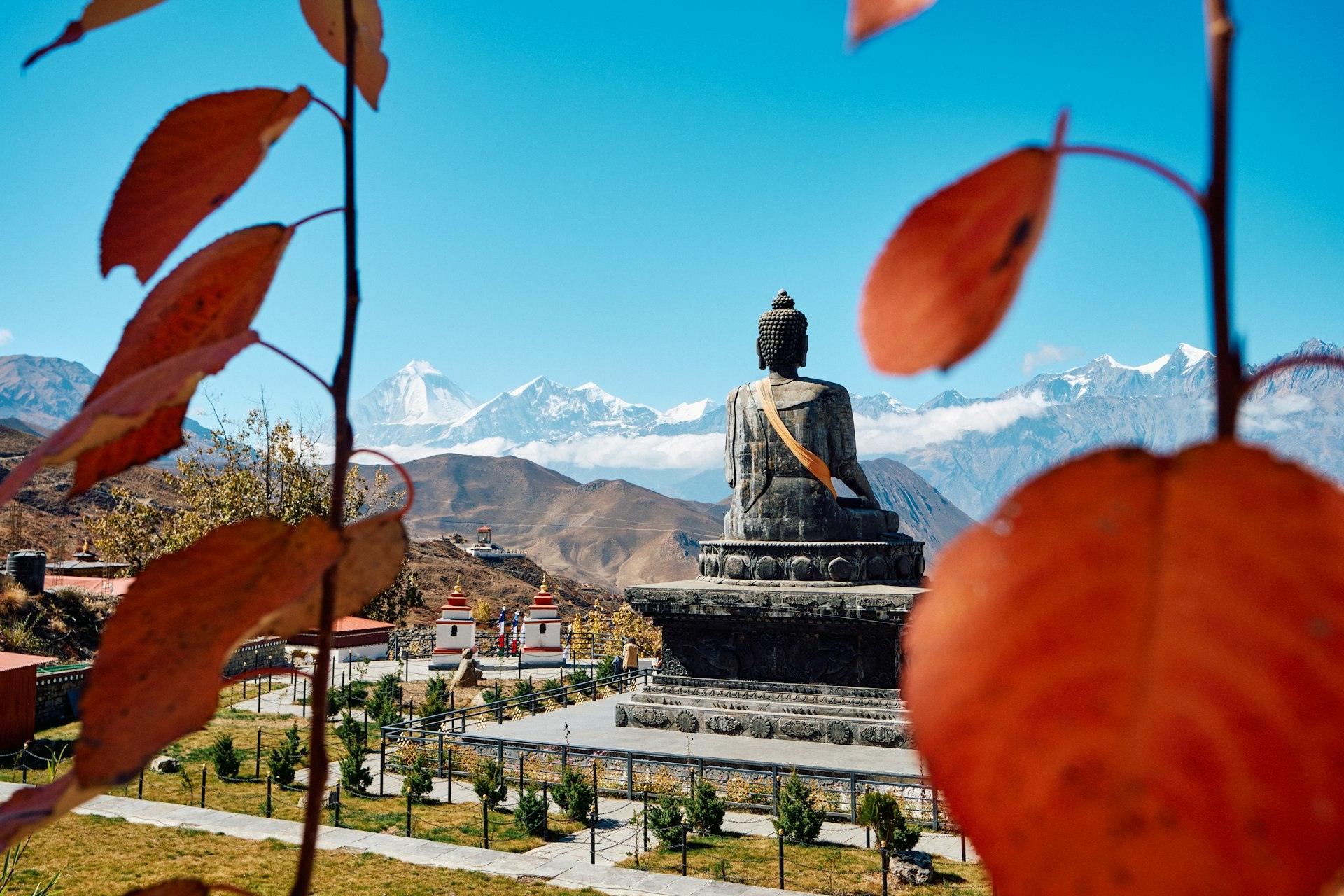
Sarangkot, the hill on the north-west side of Phewa Lake at about 1,600 m, is Pokhara's most famous sunrise viewpoint. On a clear morning the first light turns Machhapuchhre, the Annapurnas, Dhaulagiri to the west and Manaslu to the east pink, then gold. It means leaving Lakeside before dawn, a drive of roughly 30 to 45 minutes and a short climb of steps, so bring a warm layer even in October. From October to April the peaks are out on most mornings; in the monsoon they are often hidden. The Sarangkot sunrise is included on both our Pokhara tour and our Chitwan Pokhara tour.
3. World Peace Pagoda (Shanti Stupa)
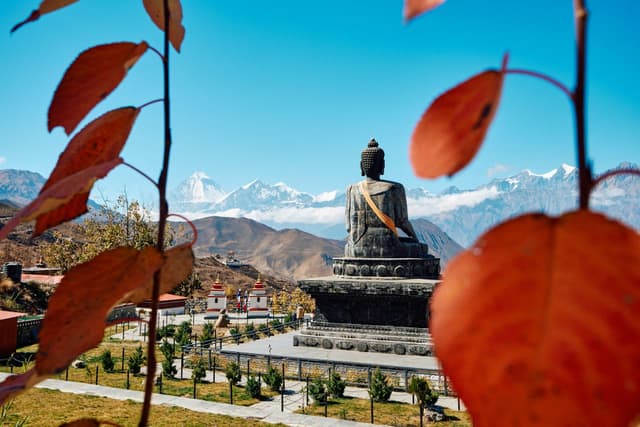
The white World Peace Pagoda stands on Anadu hill on the south side of Phewa Lake, at about 1,100 m. It was built by monks of the Japanese Nipponzan Myohoji order with local supporters and inaugurated in 1999, and it looks over the whole lake and city to the Annapurnas. You can take a boat across the lake and walk up a steep forest path for about an hour, or drive about 25 minutes by road from the Chhorepatan side and walk a much shorter distance. It is a place of prayer, so keep voices low and walk around the stupa clockwise.
4. Davis Falls and Gupteshwor Mahadev Cave
Davis Falls, known locally as Patale Chhango, is where water from Phewa Lake drops into a narrow channel in the rock and seems to vanish underground. Pokhara Metropolitan City's tourism office says it is named after a Swiss visitor who was swept away here in 1961. The falls are most powerful after the monsoon. Across the road, Gupteshwor Mahadev Cave was carved by the same water: steps lead down to a Shiva shrine, and a damp passage beyond leads to a view of the falling water from below. The steps are steep and can be slippery, so take care with elders and young children.
5. Bindhyabasini temple
Bindhyabasini temple, on a small hill in Miruwa in the old part of the city, is dedicated to the goddess Bindhyabasini, a form of Durga, with smaller shrines to Shiva, Ganesh, Saraswati and Hanuman. It is the temple most Pokhara families visit, and it is especially busy around Fulpati and Maha Navami during Dashain and on Shivaratri. Remove your shoes before entering the shrine and dress modestly.
6. International Mountain Museum
The International Mountain Museum, opened in February 2004 in the south of the city, is the best place in Pokhara to understand the Himalaya. Its three halls cover the great peaks and their climbers, the cultures of mountain peoples, and the region's geology and wildlife; outside there is a large replica of Manaslu and a climbing wall. It suits children and rainy afternoons. An entry fee applies.
7. Begnas and Rupa lakes
Phewa is one of a cluster of lakes in the Pokhara Valley that was listed as a Ramsar wetland of international importance in February 2016. Begnas and Rupa, to the east of the city and separated by a forested ridge, are much quieter than Phewa, with paddy fields, fish farms and villages around the shore. Begnas has boats for hire and simple lakeside restaurants serving lake fish; Rupa, the third-largest lake in the valley, is smaller still and very peaceful. Allow half a day by car, or stay a night for the slowest pace in Pokhara.
8. Old Bazaar and the Seti gorge
Before Lakeside existed, Pokhara was a trading town. Newar merchants from Bhaktapur developed the old market in the 1770s, and the lanes around Bhimsen Tole still have brick houses with carved windows and small shrines, with everyday shops and local life away from the tourist strip. Nearby, the Seti river runs through a gorge so deep and narrow that in places you can barely see the milky, glacier-fed water below the bridges. Our Pokhara tour includes a stop at the Seti gorge.
9. Lakeside
Lakeside, along the eastern shore of Phewa Lake, is where most visitors stay and most evenings end: a sunset walk on the lakeshore path, a cafe by the water, and shops selling pashmina, handicrafts and trekking gear.
Other sights if you have more time
- Pumdikot Shiva statue: a large Shiva statue and viewpoint on the hill south of the lake, included on our Chitwan and Pokhara tour.
- Mahendra Cave and Bat Cave: two limestone caves north of the city; bring a torch and good shoes.
- Gurkha Memorial Museum: the story of the Gurkha soldiers, of special interest to families with relatives who served.
Want the main sights planned around your dates, group size and pace? Message our Kathmandu team on WhatsApp for a quote.
What adventure activities can you do in Pokhara?
Pokhara is Nepal's centre for air sports: tandem paragliding from Sarangkot, a long zip-line and short ultralight flights over the lakes are the best known. All are optional add-ons, booked through licensed local operators, paid separately and dependent on the weather on the day.
- Paragliding: tandem flights launch from Sarangkot and land beside Phewa Lake, with a licensed pilot, so no experience is needed. Flights run mostly in the morning and are often cancelled in heavy cloud or rain. Not suitable for pregnant travellers or people with serious heart or back problems.
- Zip-line: a long, fast line runs down from the Sarangkot side towards the valley floor.
- Ultralight flights: short flights in a small open aircraft give a close view of the lakes and, on clear days, the Annapurnas.
- Kayaking: kayaks can be hired on Phewa for a gentler hour on the water.
On our Pokhara tour these fit on the free day, so you can decide once you see the weather. Tell us in advance and we will help you book locally; we do not list fixed rates because they change by season and operator.
What are the best day trips from Pokhara?
Bandipur
Bandipur is a hilltop Newar trading town at about 1,030 m in Tanahun district, reached by a side road from Dumre on the Prithvi Highway. Its main street of old brick houses is car-free, and on a clear day there are views of Dhaulagiri, Annapurna and Manaslu. It is roughly 2 to 3 hours from Pokhara by road, so it is easier as a stop on the way between Kathmandu or Chitwan and Pokhara than as a day trip. Our Chitwan Pokhara tour stops in Bandipur for lunch and a walk on the drive from Sauraha to Pokhara.
Australian Camp and Dhampus
Australian Camp is a ridge-top clearing at about 2,060 m north-west of Pokhara, with close views of Annapurna South, Hiunchuli and Machhapuchhre. Drive 45 minutes to an hour to Kande, then walk uphill for 1.5 to 2 hours. Many stay a night in a simple lodge, then walk down through the Gurung village of Dhampus. It suits fit families and teenagers more than elders. The area is inside the Annapurna Conservation Area: Nepali citizens need no permit, while foreign passport holders need permits and should check current guide rules before going.
Pokhara as the gateway to Mustang
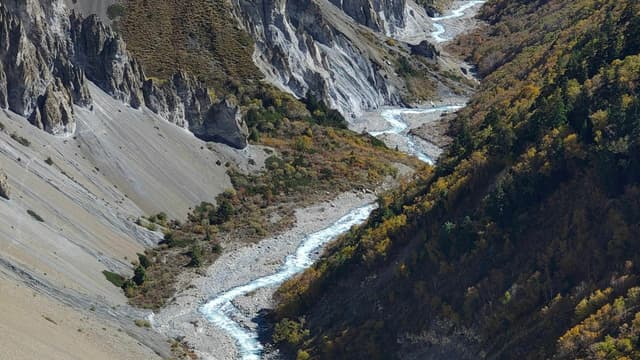
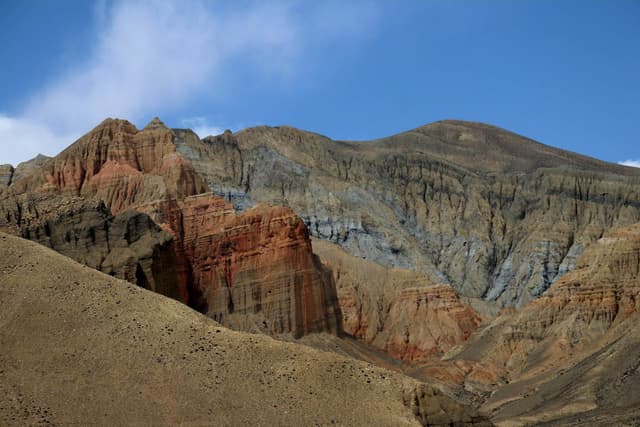
The road up the Kali Gandaki gorge to Jomsom, Kagbeni and Muktinath starts in Pokhara, and flights to Jomsom leave from here. Our Mustang and Muktinath tour spends its first and last nights in Pokhara, so you get a lake evening on each side of the high desert.
How do you get to Pokhara from Kathmandu?
Pokhara is about 200 km west of Kathmandu along the Prithvi Highway: about 6 to 7 hours by private vehicle including breaks, or about 25 minutes by air to Pokhara International Airport.
| Option | Time | Best for | Things to know |
|---|---|---|---|
| Private car or van | About 6 to 7 hours | Families, groups, elders | Stop when you need to; door-to-door; winding road |
| Tourist bus | A little longer than a private car | Solo travellers, couples | Fixed departure times and stops |
| Domestic flight | About 25 minutes | Short trips, travellers who get car-sick | Weather can delay flights; luggage limits apply |
By road
The Prithvi Highway runs west from Kathmandu along the Trishuli river to Mugling, then up the valleys to Pokhara. It is paved but winding and busy, and road works and traffic can slow parts of it, so leave early and check conditions before you set off. A private vehicle lets you stop when you need to; our Pokhara, Chitwan Pokhara and Mustang tours all travel this way.
By air
Flights from Kathmandu land at Pokhara International Airport, which opened on 1 January 2023 on the eastern side of the city and took over most of the old airport's flights. Flying west, sit on the right side of the plane for the mountains. Morning flights are usually the most reliable, but cloud and fog can cause delays, so avoid a tight same-day connection. Many travellers fly one way and drive the other; ask us if you would like that.
How many days do you need in Pokhara?
Plan two full days in Pokhara, which means four days in total by road from Kathmandu. That is how our Pokhara tour is built: a travel day, a sightseeing day with the Sarangkot sunrise, Phewa boating, Davis Falls, Gupteshwor Cave and the Peace Pagoda, a free day, and the drive home.
- Two nights: enough for the highlights if you fly, tight by road.
- Three nights: the main sights plus a free day for paragliding, Begnas Lake or rest.
- Four nights or more: add Australian Camp, a night at Begnas or Bandipur.
- Combined trips: pair Pokhara with Chitwan for lake, mountains and jungle, or use it as the start and end of a Mustang trip.
When is the best time to visit Pokhara?
The best time to visit Pokhara is October to November, followed by February to April. These months are dry enough for boating and give the best chance of clear mountain views. Pokhara is very wet in the monsoon, from June to September, so plan lake and viewpoint days outside those months if you can. Our guide to the best time to visit Nepal has month-by-month detail.
| Season | Months | What to expect in Pokhara |
|---|---|---|
| Autumn | October to November | Clearest views, warm days (about 28.5 °C average high in October), busiest season |
| Winter | December to January | Dry and mostly clear, mild days (about 20.5 °C in January), cold mornings |
| Spring | February to April | Warm and flowering; haze can soften views by April |
| Pre-monsoon | May | Hot and humid, with storms building |
| Monsoon | June to September | Very wet (a typical July brings about 886 mm), mountains usually hidden |
Figures are NOAA station data for Pokhara, 2015 to 2024. Recent monsoons have withdrawn around 10 to 12 October, so early-October mornings can still be cloudy.
Pokhara during Dashain and Tihar
Dashain and Tihar are when most Nepali families travel, and Pokhara is one of the busiest destinations. In 2026, Dashain runs from Ghatasthapana on 11 October to Tika on 21 October, and Tihar from 7 to 11 November. Lakeside hotels, buses and flights fill up before Fulpati and Tika, so book early and travel a day or two before the rush. The weather after Tika is usually excellent.
Where should you stay in Pokhara?
For a first visit, stay at Lakeside: the boats leave from there, it is walkable and it has the widest choice of hotels and restaurants. Gomayu's Pokhara tours stay at Lakeside.
| Area | Feel | Best for | Trade-off |
|---|---|---|---|
| Central Lakeside | Lively, near the boat ghats | First-timers, families, friends | Busier and noisier in peak season |
| North Lakeside and Damside | Quieter ends of the lakeshore | Couples, elders | A longer walk or short taxi to the centre |
| Sarangkot | Hillside, mountain views from the room | Sunrise lovers, honeymooners | Away from restaurants and shops |
| Begnas and Rupa | Rural lakeside, very peaceful | A slow, quiet stay | Half an hour or more from Lakeside |
What should you eat in Pokhara?
Try a Thakali thali (dal bhat with vegetables, pickles and meat or fish), fish from the lakes, and momo; Lakeside also has Indian, Chinese and continental restaurants. Vegetarian food is easy to find, which helps families with elders who prefer home-style meals. Drink bottled or filtered water.
Is Pokhara good for a family trip with children and elders?
Yes. Pokhara is one of the easiest family holidays in Nepal: no altitude, no trekking, and every main sight is reached by car with short walks. A few tips from our team:
- Travel by private vehicle so you can stop whenever a parent needs a rest or a child feels car-sick.
- Take the road to the Peace Pagoda rather than the steep forest path from the lake.
- Gupteshwor Cave has steep, damp steps; elders with knee problems can wait at Davis Falls across the road.
- Sarangkot is optional for elders: it means a pre-dawn start and stairs. The lakeshore at sunrise is a gentle alternative.
- Children enjoy the boat to Tal Barahi, the waterfall, the caves and the Mountain Museum.
- Carry ID: a citizenship certificate or passport for everyone who has one, as hotels ask at check-in.
How should NRNs plan Pokhara on a visit home?
For NRNs and the Nepali diaspora, Pokhara is the simplest way to turn a family visit into a holiday: close to Kathmandu, easy for parents, and short enough to fit between festivals and family duties.
- Festival timing: the weeks around Dashain and Tihar have the best weather but the biggest crowds, so book well ahead. Late November and February to March are calmer.
- Mixed-passport families: Nepali citizens need no permit for anything in this guide. If anyone travels on a foreign passport, tell us when you enquire: entry rates at some sights, domestic airfares and conservation area permits (for example at Australian Camp) differ for foreign passport holders.
- Jet lag: rest a day in Kathmandu before the drive, and save Sarangkot for your second Pokhara morning.
- Several generations, one trip: grandparents can rest at Lakeside while younger family members paraglide, then everyone meets by the lake for dinner.
Hotels, transfers and sightseeing are planned by our Kathmandu team, and every package shows a price for each group size on its page. Compare our domestic trips on the Nepal tour packages page, or send us your dates on WhatsApp and we will suggest the right Pokhara plan for your family.
Frequently asked questions
What is Pokhara famous for?
Pokhara is famous for Phewa Lake and its island Tal Barahi temple, close-up views of Machhapuchhre and the Annapurna range, the Sarangkot sunrise and paragliding. It was declared Nepal's tourism capital in March 2024. It is also the starting point for Annapurna treks and for trips to Mustang, and one of the most popular holiday destinations for Nepali families.
What are the must-see places to visit in Pokhara?
The must-see places to visit in Pokhara are Phewa Lake and Tal Barahi temple, the Sarangkot sunrise viewpoint, the World Peace Pagoda, Davis Falls, Gupteshwor Mahadev Cave, Bindhyabasini temple and the International Mountain Museum. With more time, add Begnas and Rupa lakes, Old Bazaar and the Seti river gorge. Most of these can be covered in two full days by car.
How far is Pokhara from Kathmandu?
Pokhara is about 200 km west of Kathmandu along the Prithvi Highway. By private vehicle the drive takes about 6 to 7 hours including breaks, and tourist buses take a little longer. The flight from Kathmandu to Pokhara International Airport takes about 25 minutes. Many travellers fly one way and drive the other to save time while still seeing the river valleys.
Do Nepali citizens need a permit to visit Pokhara?
No. Nepali citizens need no permit for Pokhara or for any sight or day trip in this guide, including Australian Camp. Carry your citizenship certificate or passport, as hotels ask for ID. Foreign passport holders need no permit for Pokhara city itself, but they do need permits for walks inside the Annapurna Conservation Area, such as Australian Camp and Dhampus.
Is the Sarangkot sunrise worth waking up early for?
Yes, on a clear morning the Sarangkot sunrise is the best mountain view in Pokhara, with Machhapuchhre, the Annapurnas, Dhaulagiri and Manaslu lit up one after another. It means leaving Lakeside before dawn and climbing some steps, so bring a warm layer. From October to April the sky is usually clear; in the monsoon the peaks are often hidden by cloud.
Is paragliding in Pokhara included in a tour package?
Paragliding in Pokhara is usually an optional add-on rather than part of a tour package. On the Gomayu Pokhara tour it fits on the free day: tandem flights launch from Sarangkot and land beside Phewa Lake with a licensed pilot. Flights depend on the weather, so tell us in advance and we will help you book with a local operator.
How many days are enough for Pokhara?
Two full days in Pokhara covers the main sights, so most people plan four days in total by road from Kathmandu: one to get there, one for sightseeing, one free day and one to return. With an extra day or two, add Begnas Lake, Australian Camp or Bandipur, or combine Pokhara with Chitwan for lakes and jungle in one trip.
Is Pokhara good for a honeymoon?
Pokhara is one of Nepal's favourite honeymoon destinations. Couples enjoy a sunset boat on Phewa Lake, the Sarangkot sunrise, dinner by the water at Lakeside and a quiet afternoon at Begnas Lake. For more privacy, choose a hotel at the quieter north end of Lakeside, at Damside or on Sarangkot hill. Tell us it is a honeymoon and we will request a lake-view room where available.
Can you visit Pokhara in the monsoon?
Yes, but expect rain most days in Pokhara from June to September, when the mountains are usually hidden. The upside is green hills, full waterfalls, fewer crowds and indoor options such as the International Mountain Museum. Boating and paragliding can be paused in bad weather, and the highway can be slowed by landslides, so keep plans flexible.