































+977-9709047652
Explore by Country
See all 12 Thailand packages
Most popular pick
See all 12 Thailand packages
See all 8 Vietnam packages
Most popular pick
See all 8 Vietnam packages
See all 4 Indonesia (Bali) packages
Most popular pick
See all 4 Indonesia (Bali) packages
See all 3 Maldives packages
Most popular pick
See all 3 Maldives packages
See all 3 China packages
Most popular pick
See all 3 China packages
See all 2 Sri Lanka packages
Most popular pick
See all 2 Sri Lanka packages
See all 3 Malaysia packages
Most popular pick
See all 3 Malaysia packages
See all 2 Singapore packages
Most popular pick
See all 2 Singapore packages
See all 2 Kenya packages
Most popular pick
See all 2 Kenya packages
See all 4 India packages
Most popular pick
See all 4 India packages
Search Tours or Places
Blog / China

Great Wall of China: Facts, Myths and Visiting Guide

13 min read 27 Jul 2026

The Great Wall of China is the most photographed structure in Asia and probably the most misunderstood one. Almost everything the average traveler believes about it turns out to be wrong, starting with the idea that it is a single wall. This guide sets out what it actually is, what surveyors and historians have measured, which section is worth your one free day, and what it really feels like to walk once your legs are tired.

What the Great Wall actually is

It is not one wall. It is a network of defensive lines built by different states and dynasties over roughly two thousand years, often running parallel to each other, sometimes hundreds of kilometers apart, with long gaps where rivers, cliffs and deserts were treated as the barrier instead.

UNESCO describes the property as a whole military defense system: walls, horse tracks, watchtowers, shelters, forts and passes. Think of overlapping frontier systems built in different centuries against different enemies, not a ribbon of stone laid down by one emperor. The historian Arthur Waldron traced, at book length for Cambridge University Press, how those scattered works became one ancient wall in the modern imagination.

How long is the Great Wall, and what that number measures

The official figure is 21,196.18 kilometers, released in 2012 by China's State Administration of Cultural Heritage after a survey begun in 2007. That number is real, but read what it counted: 43,721 heritage sites, including wall, defense works, passes, related facilities and ruins, across every dynasty that built.

The 2009 survey of the Ming wall shows why this matters. It came to 8,851.8 kilometers, and the breakdown was published: 6,259.6 kilometers of built wall, 359.7 kilometers of trenches, and 2,232.5 kilometers of natural barriers such as hills and rivers counted as part of the line. A quarter of the famous Ming figure is landscape, not masonry. Waldron has put standing solid wall at roughly 2,700 kilometers.

Survival is the other half. Reporting on Chinese survey work puts around 30 percent of the Ming wall as already lost to erosion and human damage, with only about 8.2 percent of the whole in good condition. The restored sections you can walk are the well funded exception.

Who built it and when, dynasty by dynasty

Rival states of the Warring States period, roughly the fifth to third centuries BC, built the first walls against each other. After unification around 220 BC, Qin Shi Huang had earlier northern fortifications joined into one system, the moment most people think of as the beginning.

The Han pushed the line far west. Under Emperor Wudi, a project running toward Lake Lop Nur began around 121 BC, with beacons, towers and forts at fixed intervals guarding the Silk Road corridor. The Northern Wei extended it after 417, and the Northern Qi reportedly recruited some 1.8 million workers in 555 alone. The Sui repaired it repeatedly, the Jin built two lines in the twelfth century, and the Yuan largely let it go.

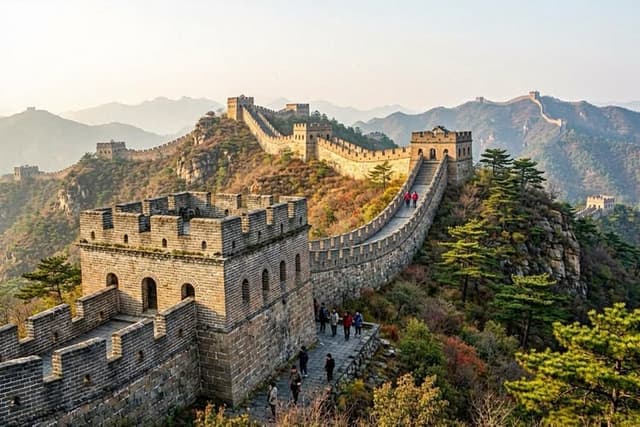
Then the Ming, from 1368 to 1644, rebuilt the eastern frontier in brick and dressed stone from Shanhaiguan on the coast to Jiayuguan in the western desert. Virtually everything a visitor walks on today is Ming. The Qin wall was rammed earth and survives only as eroded ridges in remote country.

The space myth, and why it will not die

You cannot see the Great Wall from the Moon, and you cannot reliably pick it out from low Earth orbit with the naked eye either. This is the most repeated falsehood about the site, and it predates spaceflight entirely, which should be the first clue.

The reason is simple. The wall is only a few meters wide in most places and built from local stone and earth, so it is close to the same color and texture as the ground beside it. NASA's chief scientist for Earth observation, Kamlesh Lulla, said exactly that in NASA's write-up on the question, and Apollo 12's Alan Bean reported that no man made object is visible at lunar distance. China's first astronaut, Yang Liwei, could not see it from orbit either. Small stretches have been photographed from the space station, but only with a long lens and good light, usually after snow gave the wall contrast. Radar picks it out. Eyes do not.

Are there bodies buried in the wall?

Almost certainly not in the way the story suggests. Large numbers of conscripts, convicts and soldiers did die on wall projects across many centuries, and popular sources repeat a figure of around 400,000 deaths. That is an estimate handed down through popular writing, not a documented count.

The image of corpses packed into the masonry comes mainly from folklore, above all the tale of Lady Meng Jiang, whose weeping is said to have collapsed a stretch of wall and revealed her husband's bones. Chinese folklorists classify it as one of the country's four great folktales, seeded in a Spring and Autumn period anecdote and given its Qin setting only centuries later. No archaeological work has found human remains used as structural material inside the wall, and it would have been poor engineering anyway. The forced labor is real enough without the ghost story.

The "New 7 Wonders" claim, and the credential that counts

The Great Wall was named one of the New7Wonders of the World in 2007. It is worth knowing what that was: a global internet and phone poll run by the New7Wonders Foundation, a private initiative launched by Bernard Weber in 2000. An enormous vote, but not a heritage assessment.

UNESCO stated on 9 July 2007 that there is no link whatsoever between its World Heritage programme and that campaign, and that it had been invited to take part and declined, its own process resting on scientific evaluation and permanent monitoring. The credential that matters is older: inscription on the UNESCO World Heritage List in 1987, under five of the ten criteria. Very few properties on Earth meet that many.

Which section of the Great Wall to visit

This decision makes or breaks the day. All six work as day trips and are genuinely different experiences.

Badaling is fully restored and the easiest to reach, since a high speed line serves Badaling Great Wall station, the deepest such station in the world at 102 meters, 20 to 30 minutes from Qinghe or Beijing North. It is also the busiest place on the wall. Mutianyu is the section most first time visitors are happiest with: restored across 23 watchtowers, with a cable car, chairlift and toboggan run down. Towers 4 to 19 are fairly level, which suits families and older travelers, while towers 1 and 23 give you a proper climb.

Jinshanling is the hiker's pick, roughly 10.5 kilometers with 67 towers, part restored and part wild, so you walk from tidy brickwork into crumbling parapet in one afternoon. The classic Jinshanling to Simatai traverse has been closed for years. Simatai is steep and tightly managed, the only section with regular floodlit night opening, bookable up to 10 days ahead, with towers 1 to 10 open by day and only towers 5 to 6 at night. Gubeikou is wild and never renovated, with a rare double layered wall from the Northern Qi and Ming periods. Huanghuacheng is the lakeside one, where part of the wall runs into Haoming Lake.

SectionDistance from BeijingRestored or wildCrowdsBest for
BadalingAbout 70 km, 20 to 30 min by high speed railFully restoredVery heavyShort trips, no car, easiest access
MutianyuAbout 70 km, roughly 90 min by roadFully restored, 23 towersModerateFirst visits, families, mixed fitness
JinshanlingAbout 125 km, roughly 2.5 hoursPart restored, part wildLightHiking and photography
SimataiAbout 140 km, roughly 2.5 hoursRestored, very steepCapped by reservationNight visits, dramatic ridgelines
GubeikouAbout 140 km, roughly 3 hoursWild, unrestoredVery lightExperienced hikers with a guide
HuanghuachengAbout 70 km, roughly 2 hoursPartly restored, lakesideLight to moderateScenery, quieter half day

Wild sections, and the honest warning

Jiankou photographs beautifully and is the section most often described online as the wild one. It is not an official scenic area. Beijing's Great Wall Protection Regulations, in force since 1 March 2026, treat climbing unrestored, non open stretches as prohibited, and enforcement now includes electronic fencing, remote sensing and patrols. Foreign visitors have already been banned from the site for trespassing on undeveloped sections.

The physical risk is real too: loose brick, collapsed parapets, waist high vegetation, drops with nothing between you and the slope, no rescue. Gubeikou and Jinshanling give you most of the same atmosphere legally, with a guide who knows the route.

How to visit the Great Wall from Beijing, and the booking reality

Expect to book ahead with your passport. Badaling moved to real name online ticketing with a daily cap of 65,000 visitors and a seven day advance window, one reservation per document per day, and foreign visitors usually redeem a printed ticket at the service window. Simatai needs booking at least 24 hours ahead. Other sections increasingly work the same way, and quotas sell out on public holidays.

Your options are the high speed train to Badaling, public buses to Mutianyu and Huanghuacheng, a hired car with a driver, or a guided trip. For Jinshanling, Simatai and Gubeikou, a car is the sane choice, because a return by public transport eats the day. Our China tour packages handle the reservations and timing so you are not fighting a booking portal in a foreign script the night before.

Best time of year, and best time of day

Late April to early June and September to October are the good windows. Beijing summers are hot and wet, close to 27 degrees Celsius in July with around 170 mm of rain that month, and the wall offers no shade. January averages around minus 3 degrees Celsius, dry and clear, and a snow dusted wall is stunning, though steps get slippery. Spring brings wind and occasional dust haze from the north.

Time of day matters more than season for crowds. Arrive at opening. Coach groups from central Beijing land between 10am and 2pm, so the first two hours and the last two are the quiet ones. Avoid the first week of October and early May, when holiday traffic peaks.

What it is actually like to walk it

Steeper than the photographs suggest. The wall follows ridgelines rather than cutting through them, so you get sustained climbs and descents, and the steps are wildly inconsistent: some ankle height, some nearer knee height, many worn smooth and sloping. Handrails exist on restored sections, but not everywhere.

A reasonably fit person covers two to three kilometers of restored wall in two to three hours and feels it in the quadriceps the next day. Wear shoes with real grip and carry water, because refill points are at the base. If you have knee trouble, take the cable car both ways at Mutianyu and walk the flatter central stretch. The views are identical.

Photographing the wall

The best pictures are not taken from the wall. They are taken from a tower looking back along a curving ridge, so the wall recedes into layered hills. At Mutianyu, walk toward tower 20 and beyond, then look back. At Jinshanling, the wild eastern stretch gives the classic receding tower line. Simatai has the most dramatic profile. Shoot in the first hour after opening or the last two hours of light, because midday sun flattens the hills into haze and the wall loses its texture. Autumn adds color on the slopes, and snow gives the highest contrast of the year.

On phones, be realistic. A phone handles the wide landscape well, and computational HDR copes with bright sky over shadowed stone better than it used to. What it cannot do is compress distant ridge layers the way a 70 to 200 mm lens does, which is exactly the look most Great Wall photographs you admire were made with. Digital zoom past 3x will not fake it. If a phone is all you have, shoot wide, put a person in the frame for scale, and go easy on the ultrawide, because it makes the drop look smaller than it is.

What to combine it with, and where it fits in a China trip

Treat the wall as one full day, not a morning stop. Pair a nearer section with the Ming Tombs, which sit on the same road out of the city, or pair Simatai with a night at Gubei Water Town so you get the floodlit wall and a slow evening instead of a long drive back in the dark.

In a wider trip, the wall anchors the Beijing leg alongside the Forbidden City, the Temple of Heaven and the Summer Palace. Most travelers then head south, and the Beijing Shanghai Tour is the standard pairing of imperial north with modern coast. With more time, Xi'an, Guilin and Chengdu are the usual additions, and our guide to the best places to visit in China covers how they fit together. A well planned China Holiday Package puts the wall on a morning when the light and the crowds are both in your favor.

Entry paperwork for China, briefly

China has widened visa free entry considerably. Passport holders from 50 countries across Europe, Asia, Oceania and the Americas currently enter visa free for up to 30 days for tourism, business, visiting family, or transit. Separately, a 240 hour visa free transit policy covers 55 nationalities at 60 ports of entry across 24 provincial level regions including Beijing, if you hold a confirmed onward ticket to a third country.

These rules change often. Check your nationality against the National Immigration Administration before you book, and again close to departure. Either way, carry the physical passport you booked wall tickets with, because reservations are checked against it at the gate.

Frequently asked questions about the Great Wall of China

Can you see the Great Wall of China from space?

No. It is only a few meters wide and made from local earth and stone, so it blends into the surrounding ground. NASA has stated the materials are similar in color and texture to the land around them. Astronauts, including China's Yang Liwei, confirmed they could not see it unaided.

How long is the Great Wall of China really?

The official surveyed figure is 21,196.18 kilometers, covering 43,721 heritage sites across all dynasties. The Ming wall alone was measured at 8,851.8 kilometers, but that includes 359.7 kilometers of trenches and 2,232.5 kilometers of natural barriers. Standing, walkable wall is far shorter.

Which is the best section of the Great Wall to visit?

Mutianyu suits most first time visitors: fully restored, roughly 90 minutes from Beijing, with a cable car, chairlift and toboggan, and far fewer people than Badaling. Choose Badaling if you want the train and have little time, or Jinshanling if you want a real hike.

Is the Great Wall of China one continuous wall?

No. It is many walls built by different states and dynasties over about two thousand years, often in parallel or overlapping lines, with large gaps where rivers, cliffs and deserts served as the barrier. UNESCO describes it as a whole military defense system, not a single structure.

Do I need to book Great Wall tickets in advance?

Usually yes, and with your passport. Badaling uses real name online ticketing with a 65,000 daily visitor cap and a seven day booking window, one reservation per document per day. Simatai requires booking at least 24 hours ahead. Quotas do sell out during Chinese public holidays.

When is the best time to visit the Great Wall?

Late April to early June and September to October give the most comfortable weather. Beijing summers are hot and wet, with about 170 mm of rain in July and no shade on the wall. Arrive at opening, since coach groups typically reach the wall between 10am and 2pm.

Tags
Great Wall of ChinaChina Travel GuideBeijingMutianyuBadalingUNESCO World HeritageTravel MythsChina Itinerary
Share
G
Gomayu Team
Writer at Gomayu
Keep reading
Blog / China

Great Wall of China: Facts, Myths and Visiting Guide

13 min read 27 Jul 2026

The Great Wall of China is the most photographed structure in Asia and probably the most misunderstood one. Almost everything the average traveler believes about it turns out to be wrong, starting with the idea that it is a single wall. This guide sets out what it actually is, what surveyors and historians have measured, which section is worth your one free day, and what it really feels like to walk once your legs are tired.

What the Great Wall actually is

It is not one wall. It is a network of defensive lines built by different states and dynasties over roughly two thousand years, often running parallel to each other, sometimes hundreds of kilometers apart, with long gaps where rivers, cliffs and deserts were treated as the barrier instead.

UNESCO describes the property as a whole military defense system: walls, horse tracks, watchtowers, shelters, forts and passes. Think of overlapping frontier systems built in different centuries against different enemies, not a ribbon of stone laid down by one emperor. The historian Arthur Waldron traced, at book length for Cambridge University Press, how those scattered works became one ancient wall in the modern imagination.

How long is the Great Wall, and what that number measures

The official figure is 21,196.18 kilometers, released in 2012 by China's State Administration of Cultural Heritage after a survey begun in 2007. That number is real, but read what it counted: 43,721 heritage sites, including wall, defense works, passes, related facilities and ruins, across every dynasty that built.

The 2009 survey of the Ming wall shows why this matters. It came to 8,851.8 kilometers, and the breakdown was published: 6,259.6 kilometers of built wall, 359.7 kilometers of trenches, and 2,232.5 kilometers of natural barriers such as hills and rivers counted as part of the line. A quarter of the famous Ming figure is landscape, not masonry. Waldron has put standing solid wall at roughly 2,700 kilometers.

Survival is the other half. Reporting on Chinese survey work puts around 30 percent of the Ming wall as already lost to erosion and human damage, with only about 8.2 percent of the whole in good condition. The restored sections you can walk are the well funded exception.
Who built it and when, dynasty by dynasty

Rival states of the Warring States period, roughly the fifth to third centuries BC, built the first walls against each other. After unification around 220 BC, Qin Shi Huang had earlier northern fortifications joined into one system, the moment most people think of as the beginning.

The Han pushed the line far west. Under Emperor Wudi, a project running toward Lake Lop Nur began around 121 BC, with beacons, towers and forts at fixed intervals guarding the Silk Road corridor. The Northern Wei extended it after 417, and the Northern Qi reportedly recruited some 1.8 million workers in 555 alone. The Sui repaired it repeatedly, the Jin built two lines in the twelfth century, and the Yuan largely let it go.

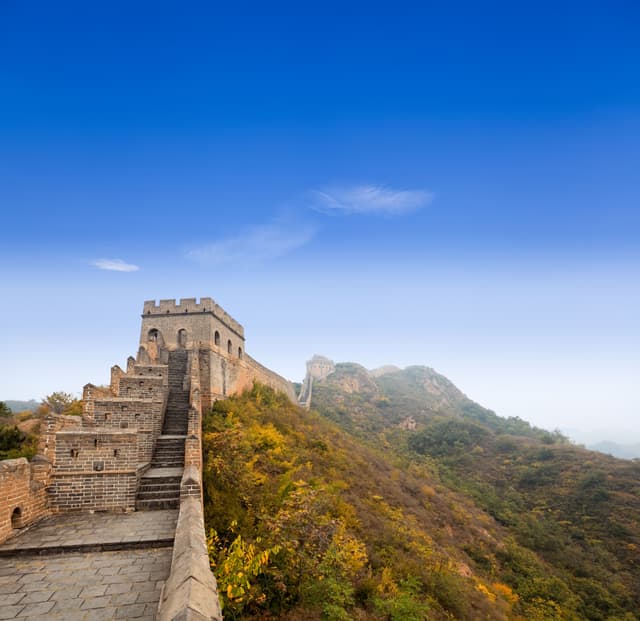
Then the Ming, from 1368 to 1644, rebuilt the eastern frontier in brick and dressed stone from Shanhaiguan on the coast to Jiayuguan in the western desert. Virtually everything a visitor walks on today is Ming. The Qin wall was rammed earth and survives only as eroded ridges in remote country.

The space myth, and why it will not die

You cannot see the Great Wall from the Moon, and you cannot reliably pick it out from low Earth orbit with the naked eye either. This is the most repeated falsehood about the site, and it predates spaceflight entirely, which should be the first clue.

The reason is simple. The wall is only a few meters wide in most places and built from local stone and earth, so it is close to the same color and texture as the ground beside it. NASA's chief scientist for Earth observation, Kamlesh Lulla, said exactly that in NASA's write-up on the question, and Apollo 12's Alan Bean reported that no man made object is visible at lunar distance. China's first astronaut, Yang Liwei, could not see it from orbit either. Small stretches have been photographed from the space station, but only with a long lens and good light, usually after snow gave the wall contrast. Radar picks it out. Eyes do not.

Are there bodies buried in the wall?

Almost certainly not in the way the story suggests. Large numbers of conscripts, convicts and soldiers did die on wall projects across many centuries, and popular sources repeat a figure of around 400,000 deaths. That is an estimate handed down through popular writing, not a documented count.

The image of corpses packed into the masonry comes mainly from folklore, above all the tale of Lady Meng Jiang, whose weeping is said to have collapsed a stretch of wall and revealed her husband's bones. Chinese folklorists classify it as one of the country's four great folktales, seeded in a Spring and Autumn period anecdote and given its Qin setting only centuries later. No archaeological work has found human remains used as structural material inside the wall, and it would have been poor engineering anyway. The forced labor is real enough without the ghost story.

The "New 7 Wonders" claim, and the credential that counts

The Great Wall was named one of the New7Wonders of the World in 2007. It is worth knowing what that was: a global internet and phone poll run by the New7Wonders Foundation, a private initiative launched by Bernard Weber in 2000. An enormous vote, but not a heritage assessment.

UNESCO stated on 9 July 2007 that there is no link whatsoever between its World Heritage programme and that campaign, and that it had been invited to take part and declined, its own process resting on scientific evaluation and permanent monitoring. The credential that matters is older: inscription on the UNESCO World Heritage List in 1987, under five of the ten criteria. Very few properties on Earth meet that many.

Which section of the Great Wall to visit

This decision makes or breaks the day. All six work as day trips and are genuinely different experiences.

Badaling is fully restored and the easiest to reach, since a high speed line serves Badaling Great Wall station, the deepest such station in the world at 102 meters, 20 to 30 minutes from Qinghe or Beijing North. It is also the busiest place on the wall. Mutianyu is the section most first time visitors are happiest with: restored across 23 watchtowers, with a cable car, chairlift and toboggan run down. Towers 4 to 19 are fairly level, which suits families and older travelers, while towers 1 and 23 give you a proper climb.

Jinshanling is the hiker's pick, roughly 10.5 kilometers with 67 towers, part restored and part wild, so you walk from tidy brickwork into crumbling parapet in one afternoon. The classic Jinshanling to Simatai traverse has been closed for years. Simatai is steep and tightly managed, the only section with regular floodlit night opening, bookable up to 10 days ahead, with towers 1 to 10 open by day and only towers 5 to 6 at night. Gubeikou is wild and never renovated, with a rare double layered wall from the Northern Qi and Ming periods. Huanghuacheng is the lakeside one, where part of the wall runs into Haoming Lake.

SectionDistance from BeijingRestored or wildCrowdsBest for
BadalingAbout 70 km, 20 to 30 min by high speed railFully restoredVery heavyShort trips, no car, easiest access
MutianyuAbout 70 km, roughly 90 min by roadFully restored, 23 towersModerateFirst visits, families, mixed fitness
JinshanlingAbout 125 km, roughly 2.5 hoursPart restored, part wildLightHiking and photography
SimataiAbout 140 km, roughly 2.5 hoursRestored, very steepCapped by reservationNight visits, dramatic ridgelines
GubeikouAbout 140 km, roughly 3 hoursWild, unrestoredVery lightExperienced hikers with a guide
HuanghuachengAbout 70 km, roughly 2 hoursPartly restored, lakesideLight to moderateScenery, quieter half day

Wild sections, and the honest warning

Jiankou photographs beautifully and is the section most often described online as the wild one. It is not an official scenic area. Beijing's Great Wall Protection Regulations, in force since 1 March 2026, treat climbing unrestored, non open stretches as prohibited, and enforcement now includes electronic fencing, remote sensing and patrols. Foreign visitors have already been banned from the site for trespassing on undeveloped sections.

The physical risk is real too: loose brick, collapsed parapets, waist high vegetation, drops with nothing between you and the slope, no rescue. Gubeikou and Jinshanling give you most of the same atmosphere legally, with a guide who knows the route.

How to visit the Great Wall from Beijing, and the booking reality

Expect to book ahead with your passport. Badaling moved to real name online ticketing with a daily cap of 65,000 visitors and a seven day advance window, one reservation per document per day, and foreign visitors usually redeem a printed ticket at the service window. Simatai needs booking at least 24 hours ahead. Other sections increasingly work the same way, and quotas sell out on public holidays.

Your options are the high speed train to Badaling, public buses to Mutianyu and Huanghuacheng, a hired car with a driver, or a guided trip. For Jinshanling, Simatai and Gubeikou, a car is the sane choice, because a return by public transport eats the day. Our China tour packages handle the reservations and timing so you are not fighting a booking portal in a foreign script the night before.

Best time of year, and best time of day

Late April to early June and September to October are the good windows. Beijing summers are hot and wet, close to 27 degrees Celsius in July with around 170 mm of rain that month, and the wall offers no shade. January averages around minus 3 degrees Celsius, dry and clear, and a snow dusted wall is stunning, though steps get slippery. Spring brings wind and occasional dust haze from the north.

Time of day matters more than season for crowds. Arrive at opening. Coach groups from central Beijing land between 10am and 2pm, so the first two hours and the last two are the quiet ones. Avoid the first week of October and early May, when holiday traffic peaks.

What it is actually like to walk it

Steeper than the photographs suggest. The wall follows ridgelines rather than cutting through them, so you get sustained climbs and descents, and the steps are wildly inconsistent: some ankle height, some nearer knee height, many worn smooth and sloping. Handrails exist on restored sections, but not everywhere.

A reasonably fit person covers two to three kilometers of restored wall in two to three hours and feels it in the quadriceps the next day. Wear shoes with real grip and carry water, because refill points are at the base. If you have knee trouble, take the cable car both ways at Mutianyu and walk the flatter central stretch. The views are identical.

Photographing the wall

The best pictures are not taken from the wall. They are taken from a tower looking back along a curving ridge, so the wall recedes into layered hills. At Mutianyu, walk toward tower 20 and beyond, then look back. At Jinshanling, the wild eastern stretch gives the classic receding tower line. Simatai has the most dramatic profile. Shoot in the first hour after opening or the last two hours of light, because midday sun flattens the hills into haze and the wall loses its texture. Autumn adds color on the slopes, and snow gives the highest contrast of the year.

On phones, be realistic. A phone handles the wide landscape well, and computational HDR copes with bright sky over shadowed stone better than it used to. What it cannot do is compress distant ridge layers the way a 70 to 200 mm lens does, which is exactly the look most Great Wall photographs you admire were made with. Digital zoom past 3x will not fake it. If a phone is all you have, shoot wide, put a person in the frame for scale, and go easy on the ultrawide, because it makes the drop look smaller than it is.

What to combine it with, and where it fits in a China trip

Treat the wall as one full day, not a morning stop. Pair a nearer section with the Ming Tombs, which sit on the same road out of the city, or pair Simatai with a night at Gubei Water Town so you get the floodlit wall and a slow evening instead of a long drive back in the dark.

In a wider trip, the wall anchors the Beijing leg alongside the Forbidden City, the Temple of Heaven and the Summer Palace. Most travelers then head south, and the Beijing Shanghai Tour is the standard pairing of imperial north with modern coast. With more time, Xi'an, Guilin and Chengdu are the usual additions, and our guide to the best places to visit in China covers how they fit together. A well planned China Holiday Package puts the wall on a morning when the light and the crowds are both in your favor.

Entry paperwork for China, briefly

China has widened visa free entry considerably. Passport holders from 50 countries across Europe, Asia, Oceania and the Americas currently enter visa free for up to 30 days for tourism, business, visiting family, or transit. Separately, a 240 hour visa free transit policy covers 55 nationalities at 60 ports of entry across 24 provincial level regions including Beijing, if you hold a confirmed onward ticket to a third country.

These rules change often. Check your nationality against the National Immigration Administration before you book, and again close to departure. Either way, carry the physical passport you booked wall tickets with, because reservations are checked against it at the gate.

Frequently asked questions about the Great Wall of China

Can you see the Great Wall of China from space?

No. It is only a few meters wide and made from local earth and stone, so it blends into the surrounding ground. NASA has stated the materials are similar in color and texture to the land around them. Astronauts, including China's Yang Liwei, confirmed they could not see it unaided.

How long is the Great Wall of China really?

The official surveyed figure is 21,196.18 kilometers, covering 43,721 heritage sites across all dynasties. The Ming wall alone was measured at 8,851.8 kilometers, but that includes 359.7 kilometers of trenches and 2,232.5 kilometers of natural barriers. Standing, walkable wall is far shorter.

Which is the best section of the Great Wall to visit?

Mutianyu suits most first time visitors: fully restored, roughly 90 minutes from Beijing, with a cable car, chairlift and toboggan, and far fewer people than Badaling. Choose Badaling if you want the train and have little time, or Jinshanling if you want a real hike.

Is the Great Wall of China one continuous wall?

No. It is many walls built by different states and dynasties over about two thousand years, often in parallel or overlapping lines, with large gaps where rivers, cliffs and deserts served as the barrier. UNESCO describes it as a whole military defense system, not a single structure.

Do I need to book Great Wall tickets in advance?

Usually yes, and with your passport. Badaling uses real name online ticketing with a 65,000 daily visitor cap and a seven day booking window, one reservation per document per day. Simatai requires booking at least 24 hours ahead. Quotas do sell out during Chinese public holidays.

When is the best time to visit the Great Wall?

Late April to early June and September to October give the most comfortable weather. Beijing summers are hot and wet, with about 170 mm of rain in July and no shade on the wall. Arrive at opening, since coach groups typically reach the wall between 10am and 2pm.

Tags
Great Wall of ChinaChina Travel GuideBeijingMutianyuBadalingUNESCO World HeritageTravel MythsChina Itinerary
Share
G
Gomayu Team
Writer at Gomayu
Keep reading