






































































China is the trip most people underestimate and then never stop talking about. In a single week you can walk a Ming dynasty wall, cross a province at 350 kilometres an hour, stand under the neon of a city that feels ten years ahead, and eat some of the best food of your life for the price of a coffee back home. This guide pulls together everything a first time visitor needs to plan a trip that works: when to go, the cities worth your days, how the visa and payment systems really function, and the honest mistakes to avoid.
Why China rewards the effort
China asks a little more of a traveller than a beach holiday does. You will set up a payment app, think about internet access, and probably book a couple of sites in advance. In return you get a country with a continuously recorded history of around five thousand years, world class rail, and a scale that is hard to picture until you are standing in it. Tiananmen Square alone is one of the largest public squares on earth, and the Forbidden City behind it holds close to a thousand surviving buildings.
The practical side is better than most people expect. High speed trains connect the major cities and run to the minute. Metro systems in Beijing, Shanghai, Guangzhou and Chengdu are signposted in English. Hotels, roads and public facilities are consistently modern. The friction is almost entirely at the planning stage, and once you clear it the travel itself is smooth.
Best time to visit China
The best time to visit China is autumn, roughly late September to early November, followed by spring from April to early June. Autumn gives dry air, clear skies and comfortable walking weather across the north and east, where most first trips are spent. Spring is the second choice, with mild temperatures and blossom in the palace gardens.
China is large enough that the season changes by region. The table below covers Beijing and Shanghai, the two cities most first trips are built around.
| Season | Weather in Beijing and Shanghai | Crowds |
|---|---|---|
| Spring (Apr to Jun) | Mild and mostly dry, blossom in parks, occasional spring dust in Beijing | Moderate |
| Summer (Jul to Aug) | Hot and humid, afternoon rain in the east and south | Heavy, school holidays |
| Autumn (Sep to Nov) | Clear, dry, cool mornings, the best walking weather of the year | Heavy in early October, then easier |
| Winter (Dec to Mar) | Cold and dry in Beijing with occasional snow, mild in the far south | Light apart from Chinese New Year |
Two periods are genuinely difficult and worth planning around. The Golden Week national holiday from 1 to 7 October fills every major site and sells out rail seats fast. Chinese New Year, which falls between late January and mid February, triggers the largest annual movement of people on earth, closes many small businesses for several days, and jams transport hubs. If your dates are flexible, aim for the weeks after Golden Week or well before the New Year rush.









How many days do you need in China
Seven to nine days is the sweet spot for a first trip, and it is where most travellers land. The mistake is counting calendar days instead of usable days: your arrival day goes to the flight, your last day goes to the airport, and each city change eats roughly half a day even by train.
- Five to six days: one city plus a day trip, for example Beijing and the Great Wall.
- Seven to nine days: two cities linked by high speed rail, most commonly Beijing and Shanghai.
- Ten days or more: add a third leg such as Xi'an, Guilin or Chengdu without rushing.
The cities and regions worth your days
A China trip is normally built as a two or three city route rather than a single base, mixing one historic city, one modern city, and if you have time one landscape leg. Our guide to the best places to visit in China breaks the country down region by region, but here is the short version.
Beijing
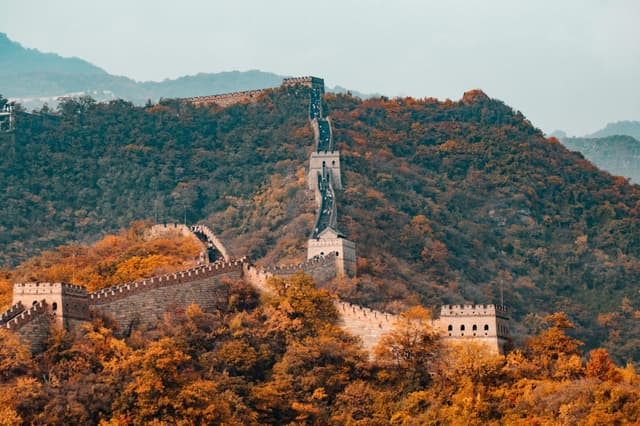
Beijing is the one city almost nobody should skip. It holds the Great Wall of China, the Forbidden City and Tiananmen Square within reach of a single base. The Great Wall is a half day trip: Mutianyu is the usual choice for restored ramparts and a cable car, Badaling is the closest and busiest, and Jinshanling is quieter for a longer walk. Go early, before the mid morning tour buses. The Forbidden City needs a booked entry slot and at least three hours.
Xi'an
Xi'an is the history stop, home to the Terracotta Warriors, thousands of individually modelled figures buried with China's first emperor. The Ming era city wall still runs a complete circuit that you can cycle, and the Muslim Quarter is the best street food in the city and the easiest halal eating in eastern China.
Shanghai
Shanghai is the modern counterweight to Beijing. Walk the Bund at dusk, with 1920s banking houses on one bank and the Pudong skyline on the other. Yu Garden, Nanjing Road and the tree lined French Concession fill the rest. Shanghai also works as a base for day trips to Suzhou and Hangzhou by high speed rail.
Guilin and Yangshuo
This is where China gets beautiful in a way photographs undersell. The Li River cruise runs between Guilin and Yangshuo through the limestone karst peaks printed on the twenty yuan note. Yangshuo is the better place to stay, small and built for cycling through rice fields. For couples it is the strongest argument in the whole country.
Zhangjiajie
Zhangjiajie in Hunan is the sandstone pillar landscape that inspired the floating mountains in Avatar, with a glass bridge, a cliff elevator and Tianmen Mountain nearby. It involves a lot of stairs and cable car queues, so allow two full days to make the detour worthwhile.
Chengdu
Chengdu is the panda city and one of the most relaxed places in the country. Arrive at the Giant Panda Breeding base at opening time, when the animals are active. The city adds teahouses, easygoing evenings and some of the best Sichuan food you will eat.
Beyond the highlights
If you have seen the classic circuit, China still has surprises. The layered sandstone of Rainbow Mountain at Zhangye Danxia in Gansu is one of them, though it helps to know what the colours really look like before you go.
Getting around: high speed rail, metro and flights
China high speed rail is the default way to move between cities, metro handles everything inside them, and domestic flights only make sense over long distances. Trains leave from central stations, run to the minute, and remove the airport time that makes short flights slower than they look.
| Mode | Best for | What to know |
|---|---|---|
| High speed rail | City pairs such as Beijing to Xi'an or Beijing to Shanghai | Book with your passport, which is also your ticket at the gate. Arrive 30 to 40 minutes early for security. |
| Domestic flight | Long hops such as Beijing to Guilin or anything toward the far west | Add airport transfer and check-in at both ends before assuming it is faster. |
| Metro | Getting around inside the major cities | Signage and announcements are in English. Every station has a bag scan. |
For taxis, use a ride hailing app rather than flagging cars, and keep your hotel address saved in Chinese characters, since drivers rarely read the Roman alphabet.
Do you need a visa for China
Most nationalities still need a tourist visa, applied for before departure, though the picture has been changing fast. China has extended unilateral visa free entry to a growing list of countries through the end of 2026, and operates visa free transit of up to 240 hours for many travellers connecting through its airports. Whether you qualify depends entirely on the passport you hold, so check your own nationality's current status against the official rules rather than a travel blog.
If you do need a visa, the standard tourist category is the L visa. You apply at the Chinese embassy or visa application centre covering where you live, complete the application on the official system, and attend in person because fingerprints are collected on site. Typical documents are a passport valid for at least six months with blank pages, photographs in the exact Chinese format, proof of onward travel, and confirmed accommodation. Start the process at least two to three weeks before you travel, and earlier in the autumn peak. The official immigration rules are published by China's National Immigration Administration.
Money: Alipay, WeChat Pay and cash
China runs on Alipay and WeChat Pay, and a traveller without one of them will struggle. Both apps now let foreign visitors link an international Visa or Mastercard, so install one before you fly and test it once. Cash in Chinese Yuan, quoted as CNY or RMB, is legal tender everywhere, but many small vendors no longer keep change, so carry only a modest reserve. Set the app up on home wifi, since verification can take a day and is far harder standing at a metro gate.
Internet in China: eSIM, VPN and the Great Firewall
Google, WhatsApp, Facebook, Instagram and YouTube are blocked inside China by the filtering system commonly called the Great Firewall. The two workable answers are a roaming eSIM bought before you leave, whose data routes outside the mainland so the usual apps keep working, or a VPN installed and tested before departure. Doing nothing and hoping to fix it on arrival is how people lose contact with home for two days, because VPN apps are difficult to download once you are inside the country. Also install WeChat, an offline map, and a translation app with the Chinese pack downloaded.
Food in China
Most visitors adapt to Chinese food quickly, because rice, noodles, chilli and slow cooked meat are familiar territory. What surprises people is how much it changes by region: Sichuan is numbing and hot, Cantonese is mild and steamed, the north leans on wheat and lamb. Vegetarians should learn the phrase for no meat and no meat stock, since a dish described as vegetable is often cooked in lard or chicken stock, and Buddhist vegetarian restaurants are the safe option. Halal food is easier than most expect: look for Lanzhou beef noodle shops, which are everywhere. If the more unusual dishes worry you, our honest look at so called weird Chinese food explains what each one actually tastes like.
Is China safe for travellers
China is one of the safest countries a first time visitor can travel in. Violent crime against tourists is rare, cities are heavily monitored, and walking at night in Beijing, Shanghai or Chengdu is normal. The realistic risks are pickpocketing in crowded markets, traffic, and the tea house and art gallery scams that target foreigners. For a fuller picture, including tap water, air quality and solo travel, read our honest guide to whether China is safe to travel.
Etiquette and practical rules travellers get wrong
A few rules are firm. Tipping is not customary and can cause confusion. Carry your passport at all times, since you need it to enter train stations, check into hotels and buy tickets at major sites. Book ahead for the Forbidden City and the Terracotta Warriors, which run on timed slots that sell out in peak season. Photography of military sites and some government buildings is prohibited and enforced. Beyond that, expect people to be direct rather than rude, and do not read Chinese bluntness as hostility.
First trip mistakes to avoid
- Leaving the visa too late. Biometrics are given in person and the review takes time.
- Landing without a payment app set up and verified.
- Not sorting internet access, an eSIM or a VPN, before departure.
- Packing four cities into seven days and spending the holiday in transit.
- Travelling into Golden Week or Chinese New Year without knowing what those dates mean.
- Assuming English is widely spoken once you leave the hotel lobby.
- Booking nothing in advance for the Forbidden City or the Terracotta Warriors.
Would rather someone else handled the bookings? A China tour package covers hotels, transfers and tours in one plan.
Frequently asked questions
What is the best time to visit China?
Autumn, from late September to early November, is the best window, with dry clear weather across the north and east. Spring, April to early June, is the second choice. Avoid the first week of October, when the Golden Week holiday fills every major site.
How many days do you need for a first trip?
Seven to nine days covers a solid first trip, usually two cities linked by high speed rail. Five to six days suits one city plus a day trip, and ten or more lets you add a third destination.
Is it easy to travel China without speaking Mandarin?
It is manageable with preparation. English is limited outside hotels, airports and major sites, so download a translation app with the offline Chinese pack, keep your hotel address in Chinese characters, and use the camera translation feature for menus and signs.
Can I use my credit card in China?
Foreign cards work at large hotels and international chains but fail often in small shops. The reliable method is to link your card to Alipay or WeChat Pay and pay by app, keeping a little cash as backup.
Do I need a VPN in China?
You need one if you want Google, WhatsApp, Facebook or Instagram, which are blocked. Install and test it before you travel, or use a roaming eSIM whose data routes outside the mainland so those apps keep working without extra software.
More China travel guides
- Places to Visit in China: 12 Best Spots by Region
- Great Wall of China: Facts, Myths and Visiting Guide
- Is It Safe to Travel to China? An Honest Guide
- Weird Chinese Food: What It Really Is and Whether to Try It
- Rainbow Mountain China: The Honest Zhangye Danxia Guide

'/%3E%3C/svg%3E)