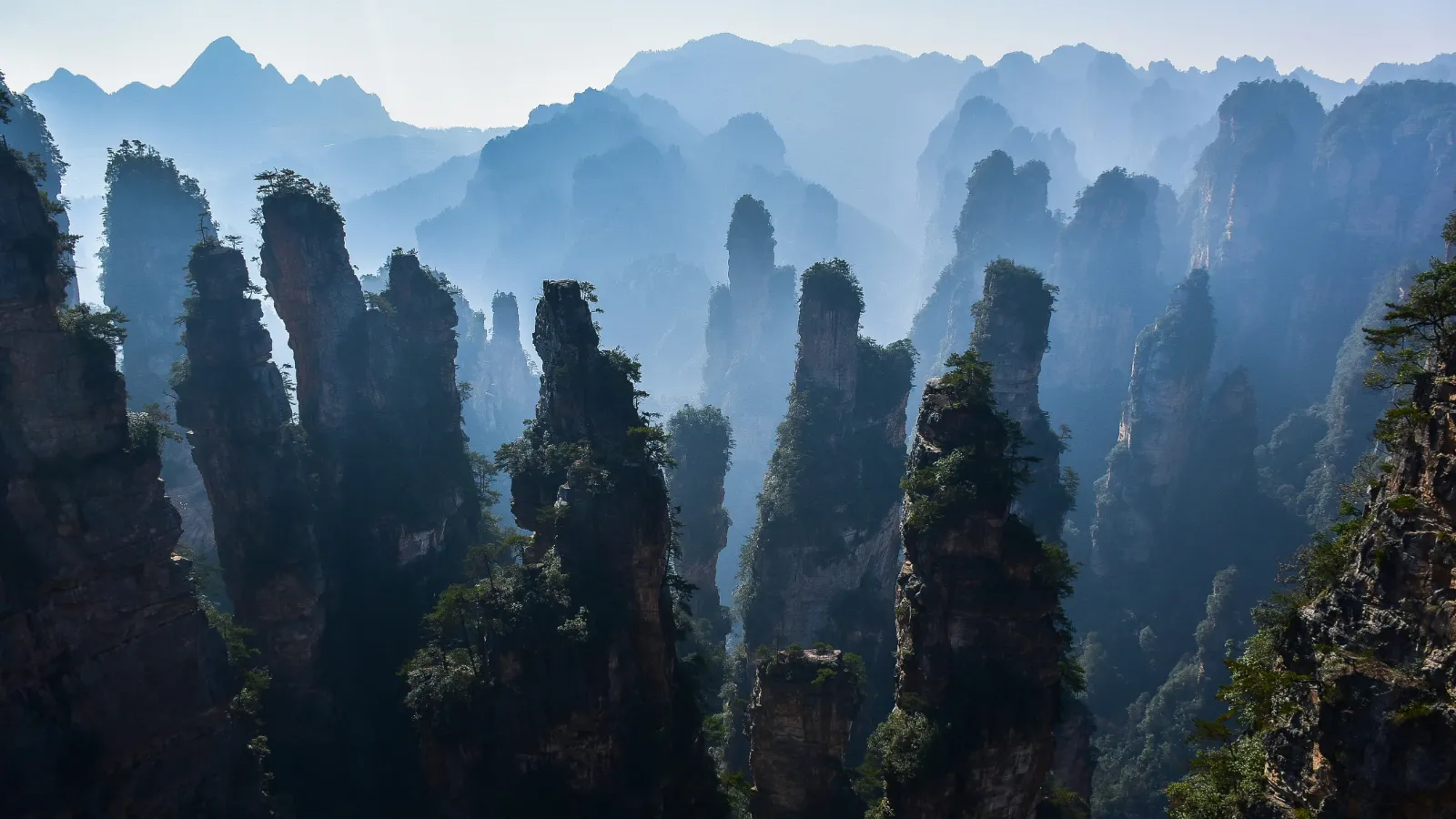
Short answer: Zhangjiajie National Forest Park is the oldest part of the Wulingyuan Scenic and Historic Interest Area in Hunan province, China, a UNESCO World Heritage Site since 1992. It is famous for more than 3,000 quartz sandstone pillars, the peaks people now call the Avatar mountains. Plan two days inside the park, one day for Tianmen Mountain near the city, and half a day for the Grand Canyon glass bridge. The Wulingyuan core ticket is valid for four consecutive days, and every visit needs a real-name booking.
Zhangjiajie is one of those places that looks fake in photographs and somehow looks even stranger in person. This guide explains what the park actually is, which areas are worth your time, how Tianmen Mountain and the glass bridge differ from the forest park itself, and how to plan the trip, including the cable car changes at Tianmen in October 2026. If you are still choosing where to go in China, our guide to the best places to visit in China puts Zhangjiajie in context with the Great Wall, Guilin and the rest.
What is Zhangjiajie National Forest Park?
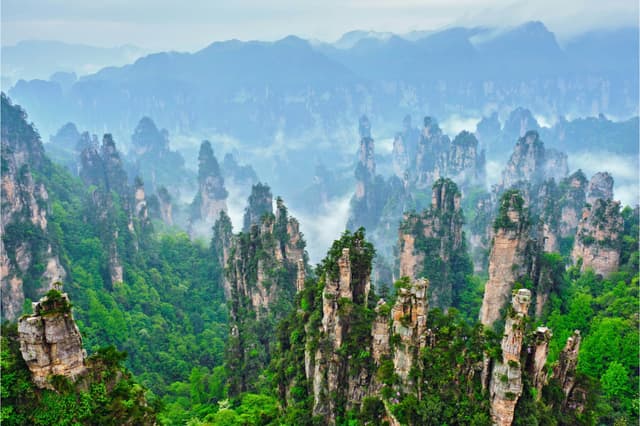
Zhangjiajie National Forest Park is a protected forest and sandstone landscape in northwest Hunan province, and it was China's first national forest park, established in 1982. Today it is one of four linked areas that together make up the Wulingyuan Scenic and Historic Interest Area, which UNESCO inscribed on the World Heritage List in 1992 for its exceptional natural beauty.
Most people use the names loosely. "Zhangjiajie" can mean the city, the national forest park, the whole Wulingyuan area, or the region including Tianmen Mountain.
| Name you will see | What it actually is | Why it matters for planning |
|---|---|---|
| Zhangjiajie city | The prefecture-level city in Hunan, with the airport and main railway stations | Tianmen Mountain starts here; many travellers sleep here the night they arrive |
| Wulingyuan Scenic and Historic Interest Area | The UNESCO-listed area containing the forest park, Suoxi Valley, Tianzi Mountain and Yangjiajie | One core ticket covers this whole area for several days |
| Zhangjiajie National Forest Park | The original 1982 forest park, the southern part of Wulingyuan | Home to Golden Whip Stream, Huangshizhai and the south gate |
| Wulingyuan town | The small town at the east gate, full of hotels and restaurants | The most practical base for park days |
| Tianmen Mountain | A separate scenic area on the edge of Zhangjiajie city | Separate ticket, separate day, roughly an hour by road from Wulingyuan |
| Zhangjiajie Grand Canyon | A separate scenic area in Cili County with the famous glass bridge | Separate ticket; usually a half day |
What makes the landscape so unusual?
UNESCO describes Wulingyuan as having more than 3,000 narrow quartz sandstone pillars and peaks, many of them over 200 metres high. Between them run ravines, gorges, streams, pools and waterfalls, with some 40 caves and two large natural bridges, one of which rises 357 metres above the valley floor. The listed property covers 26,400 hectares, with a further buffer zone around it.
The pillars formed as thick layers of sandstone were cut by water and weathering along vertical cracks over a very long time, leaving isolated towers standing. The forest is dense and humid, and the area is home to threatened species that UNESCO names, including the Asiatic black bear, the dhole and the Chinese water deer. Most visitors will not see those animals, but you will almost certainly meet the macaque monkeys along the valley trails. Keep food out of sight.
Are these the Avatar mountains?
Yes, in the way most people mean it. The peaks of Zhangjiajie are widely linked with the floating mountains of the 2009 film Avatar. In January 2010 local authorities announced that a pillar known as the Southern Sky Column would be called "Avatar Hallelujah Mountain". The renaming was disputed in news reports at the time, and the film's designers have described drawing on several mountain landscapes rather than one place. Today "Hallelujah Mountain" is the name visitors and guides use for the most photographed viewpoint at Yuanjiajie, and that is where you go for the Avatar view.
Zhangjiajie National Forest Park was also designated a UNESCO Global Geopark in 2004, which is a separate programme from World Heritage. Both designations are real; they recognise different things.
Which areas of the park should you see?
For a first visit, the three areas that matter most are Yuanjiajie for the Avatar viewpoints, Tianzi Mountain for the wide panoramas, and Golden Whip Stream for a gentle walk along the valley floor between the pillars. Yangjiajie, Huangshizhai and Ten-Mile Gallery are worth adding if you have a second or third day inside the park.
Eco buses link the main areas once you are inside. The provincial notice sets the entry price on its own, without the eco bus, but the standard core ticket sold to visitors normally bundles park entry with the eco bus pass, so check that yours does. The Bailong Elevator and the Tianzi Mountain cable car are the two big mechanical links between the valley and the plateau, and both are paid separately from the core ticket.
| Area | What you see | How you reach it | Effort | Typical time |
|---|---|---|---|---|
| Yuanjiajie | Hallelujah (Avatar) Mountain viewpoint, First Bridge Under Heaven, Enchantment Terrace (Mihuntai) | Bailong Elevator from the valley, or eco bus across the plateau | Easy; mostly paved paths of 1 to 2 km with limited climbing | 2 to 3 hours |
| Tianzi Mountain | Wide views over pillar forests, Imperial Brush Peaks, Dianjiangtai viewpoint | Tianzi Mountain cable car from the Ten-Mile Gallery side, or eco bus | Easy to moderate | 2 to 3 hours |
| Golden Whip Stream | A flat valley walk beside a clear stream with pillars rising overhead | On foot from the south gate side or from Shuirao Simen | Easy to moderate; flat but long | About 7.5 km; allow 2 to 4 hours |
| Huangshizhai | A high viewing plateau above the south gate with a summit loop | Cable car, or a steep climb of about 3 km on steps | Strenuous if you climb; easy by cable car | 2 to 3 hours |
| Yangjiajie | Natural Great Wall ridge, One Step to Heaven stairs, exposed walkways | Eco bus to the Yangjiajie area | Moderate to hard; steep stairs | Half a day |
| Ten-Mile Gallery | A valley of named rock formations such as the Old Man Gathering Herbs and Three Sisters Peaks | Mini sightseeing train, or a wooden walkway | Easy | About 1 hour |
Trail lengths and walking times in the table are estimates from visitor guides, and paths are rerouted or closed after landslides and storms. Check the park map at the gate on the day.
Yuanjiajie and Hallelujah Mountain
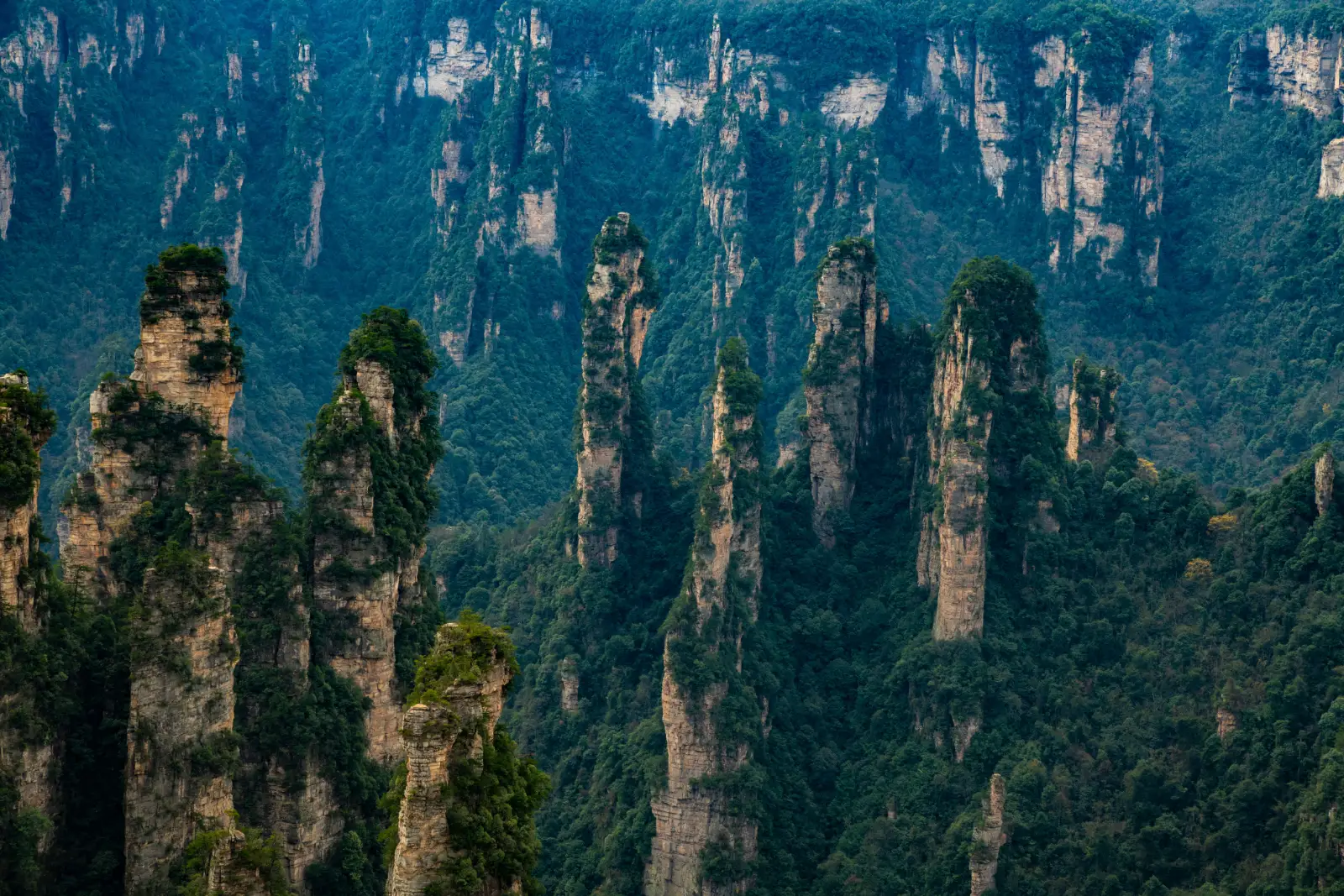
Yuanjiajie is the part of Zhangjiajie that most closely matches the photos you have seen. The paved loop is short and gentle, and it links the Hallelujah Mountain platform, the First Bridge Under Heaven (a natural stone bridge between two pillars) and the Enchantment Terrace, a cluster of viewpoints over a deep basin of towers. Because it is easy and famous, it is also the most crowded part of the park. Arriving early, ideally on the first eco buses of the day, makes a big difference.
The Bailong Elevator
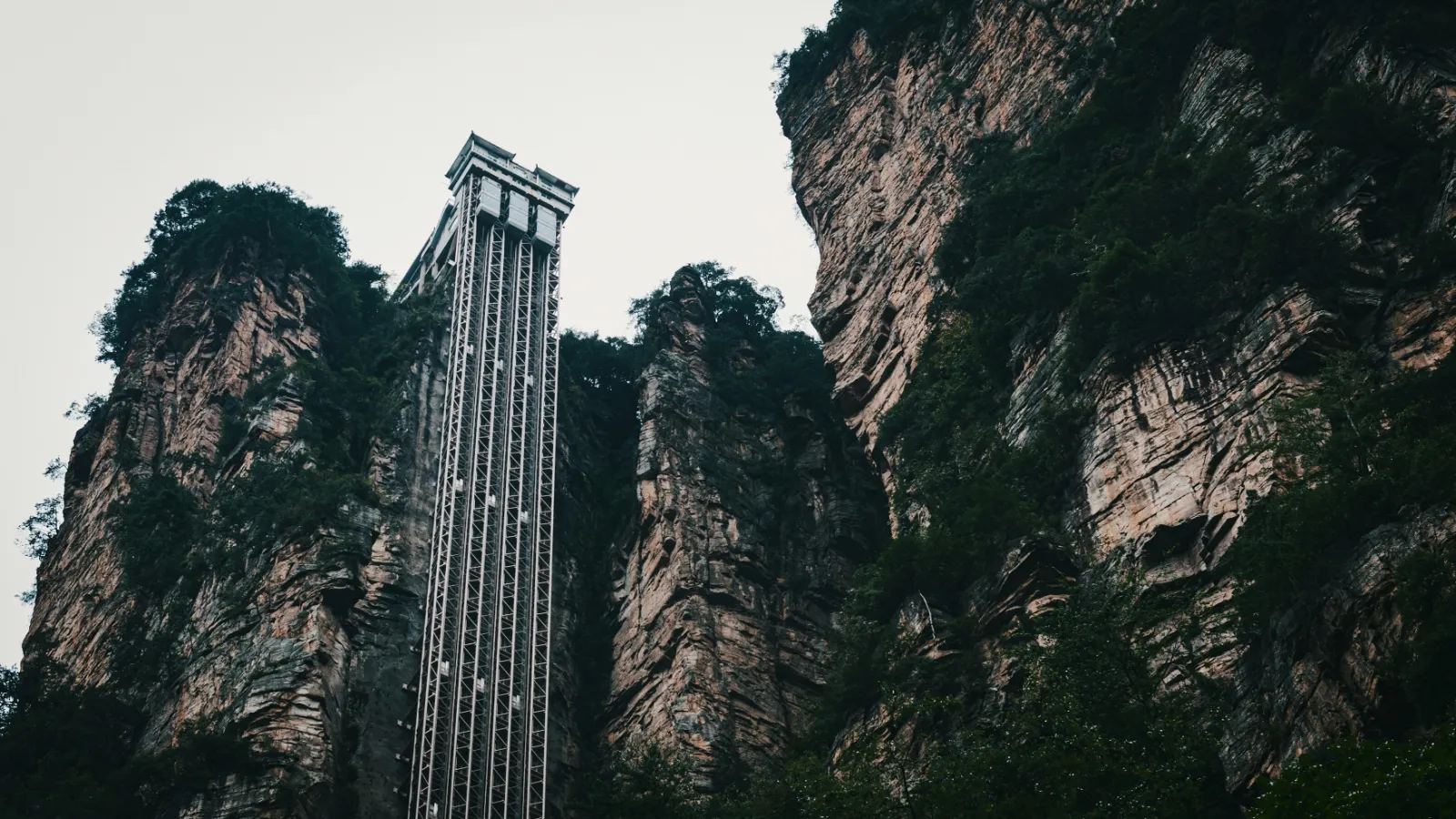
The Bailong Elevator is a glass lift attached to a cliff that carries visitors 326 metres from the valley to the Yuanjiajie plateau. Guinness World Records lists it as the tallest outdoor elevator, with the upper part of the shaft built on the outside of a quartzite cliff. The ride takes under two minutes. It is the easiest way onto the plateau for older travellers, but queues can be long in peak season, and anyone uneasy with heights should know the cabins are glass-sided.
Tianzi Mountain
Tianzi Mountain is the high northern part of Wulingyuan, and its viewpoints look out over huge fields of pillars rather than individual towers. It is the best part of the area for autumn colour and for the "sea of clouds" when low cloud fills the valleys after rain. The Tianzi Mountain cable car links it with the valley near Ten-Mile Gallery.
Golden Whip Stream
Golden Whip Stream is the walk that suits almost everyone. It follows a clear stream for about 7.5 km through the bottom of the valley, on a paved, mostly flat path, with pillars rising on both sides. There are no vehicles on this section, so you walk the whole stretch. Paths can be slippery when wet, and the monkeys here are bold. Many travellers enter from the Shuirao Simen end or walk only the most scenic central section to save time.
Yangjiajie, Huangshizhai and Ten-Mile Gallery
Yangjiajie is the least visited of the plateau areas and the most physical, with a narrow ridge called the Natural Great Wall and steep stair sections. It is a good choice for fit couples and solo travellers who want fewer crowds. Huangshizhai sits above the south gate and gives a classic overview; the cable car makes it easy, while climbing the steps is a serious workout. Ten-Mile Gallery is a gentle valley of named rock formations with a small sightseeing train, useful for families with children or older parents at the end of a long day.
Suoxi Valley, Baofeng Lake and Yellow Dragon Cave
Suoxi Valley is the eastern part of Wulingyuan, near Wulingyuan town. Two attractions often added to Zhangjiajie trips sit in this wider area: Baofeng Lake, a lake set between cliffs that is visited by boat, and Yellow Dragon Cave, a large multi-level karst cave. Check whether your ticket covers them before you go, because they are commonly sold as separate attractions.
What is Tianmen Mountain and the Heaven's Gate?
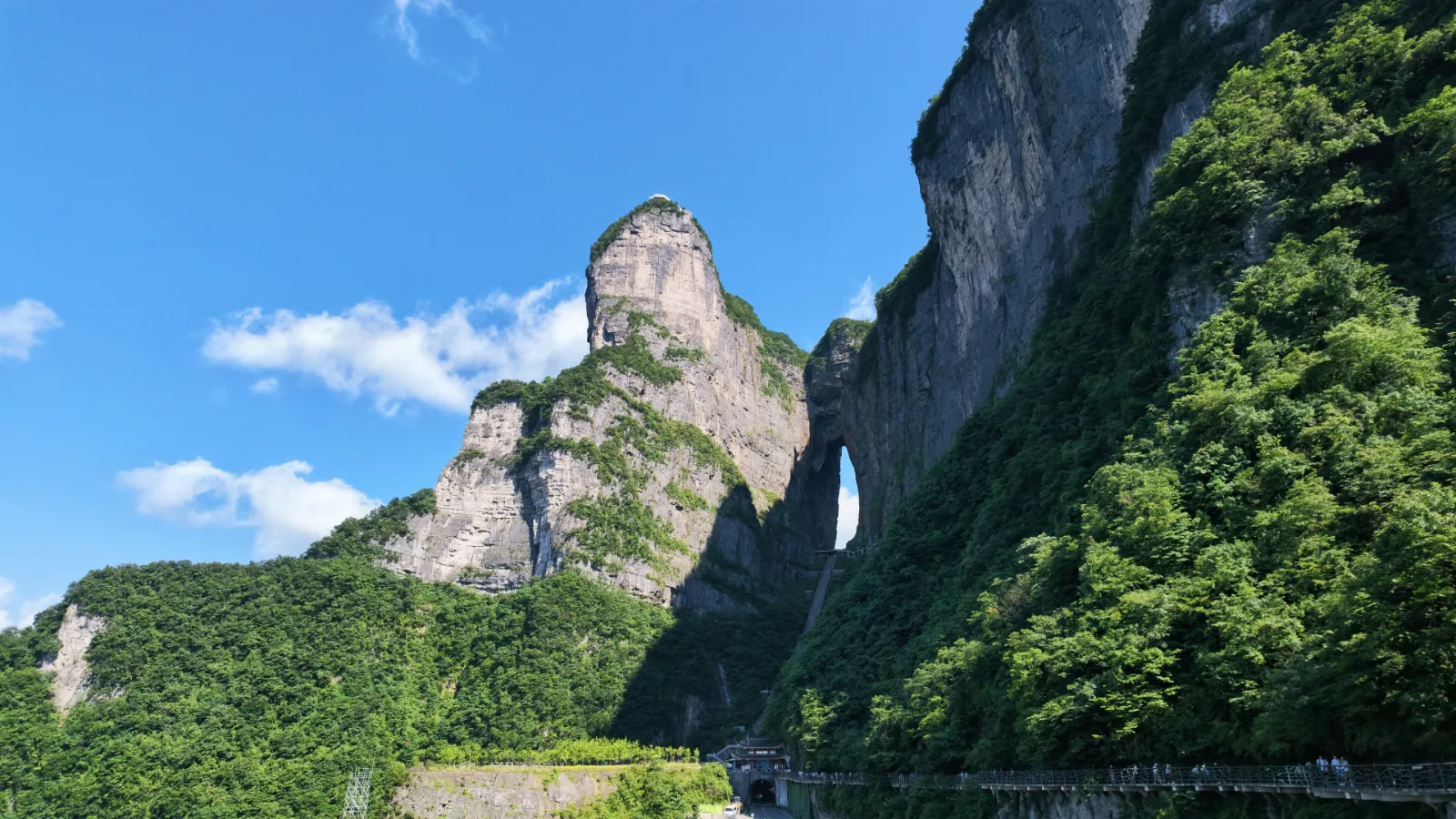
Tianmen Mountain is a separate scenic area on the southern edge of Zhangjiajie city, roughly an hour by road from Wulingyuan, and it is a different kind of experience from the forest park. Its summit stands at about 1,519 metres, and its signature sight is Tianmen Cave, the "Heaven's Gate", a natural arch through the mountain about 131.5 metres high and 57 metres wide. It needs its own ticket and a full day.
Visitors come for four things: the arch itself, the 999 steps that climb up to it, the cliff-edge walkways on the summit (including glass-floored sections), and the road with 99 bends that winds roughly 11 km up the mountainside. Private cars are not allowed on that road; it is ridden by the scenic area's shuttle buses.
Tianmen Mountain cable car: what changed in October 2026?
The long city cableway that made Tianmen famous is currently not carrying passengers. The scenic area announced that from 13 October 2026 all cableway lines would stop for a full upgrade, including the round-trip Lines A and B and the one-way Lines 1 and 2. Only the round-trip Line C, using the Tianmen Cave express cableway, keeps running. No reopening date was given. This followed an earlier step in November 2025, when the upper section of the city cableway (middle station to summit) was suspended for upgrading.
| Route item | Status as announced | What it means for you |
|---|---|---|
| Line C (Tianmen Cave express cableway) | Operating | Enter at the mountain gate, ride the express cableway up to Tianmen Cave, take the 7-level escalator inside the mountain to the summit, then return the same way |
| Lines A and B (round trip using the city cableway) | Suspended from 13 October 2026, no end date announced | The classic ride from the city centre is not available for now |
| Lines 1 and 2 (one-way cableway tickets) | Suspended | Book Line C instead |
| Shuttle buses between the lower cableway station and the mountain gate | Running normally | You can still start from the city side and get to the gate |
| East Line glass walkway on the summit | Closed for maintenance from 12 May 2026 | The Panlong Cliff and West Line glass walkways remained open |
Checked: 15 Oct 2026, source: Hunan Daily Xinhunan, 10 Oct 2026, Xinhunan, 5 Nov 2025 and Hunan Today, May 2026. These are temporary arrangements and will change again, so confirm the current route with the scenic area or your tour operator a few days before your visit.
The 999 steps, the skywalks and the escalators
The 999 steps lead up to the mouth of Tianmen Cave and are steep but short. An escalator runs alongside for those who prefer not to climb. Above the cave, a series of escalators cut through the inside of the mountain carry visitors to the summit, which is how everyone reaches the top while only Line C is running.
On the summit, cliff-edge walkways run along the rock face. Some sections have glass floors, and there are solid boardwalk alternatives on much of the route, so the glass is optional for nervous visitors. Glass sections can close in heavy rain, ice or for maintenance. The summit is noticeably cooler than the city, so carry a layer even in summer.
Is the Zhangjiajie glass bridge worth it?
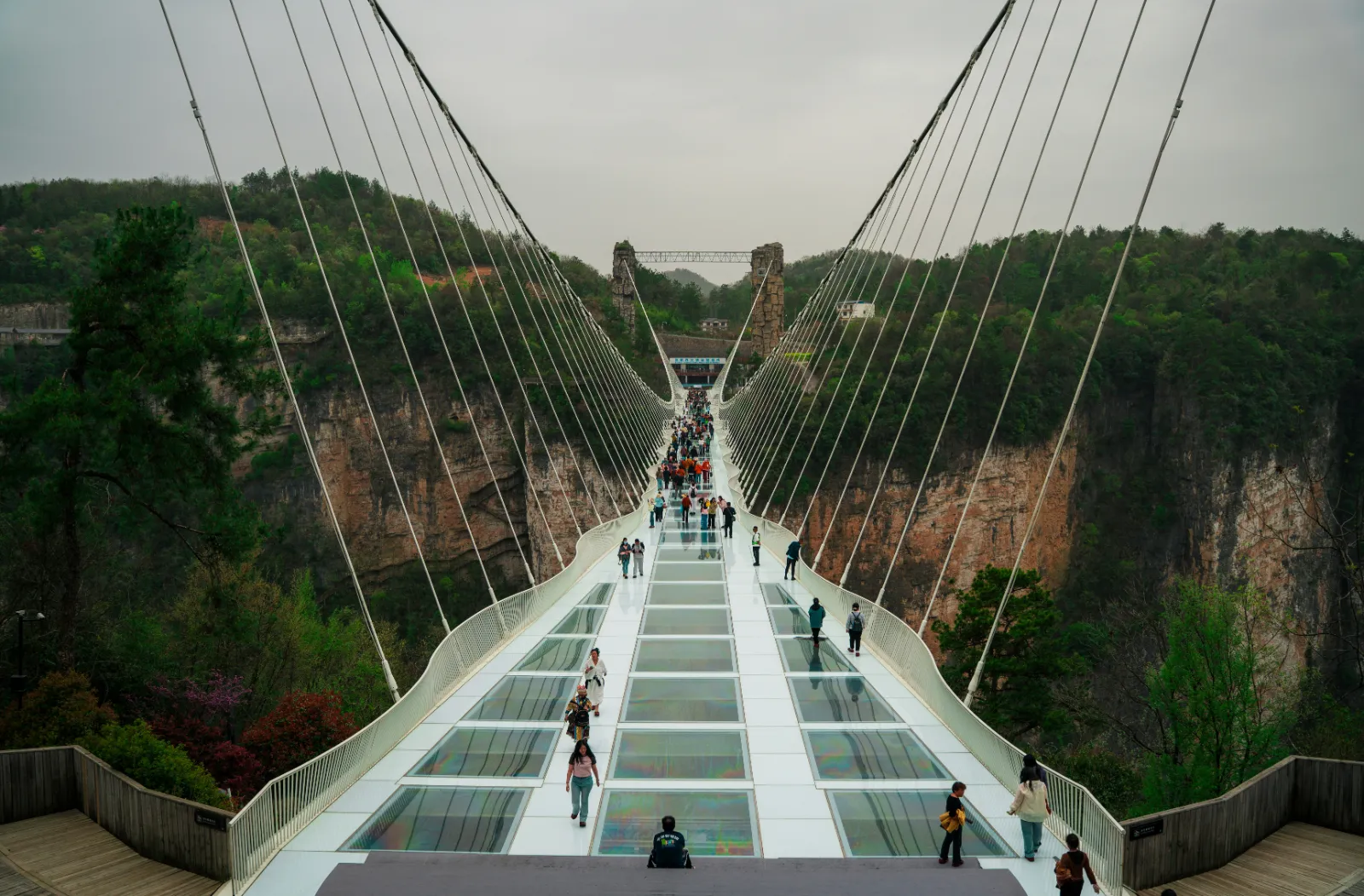
The Zhangjiajie glass bridge is not the same as the glass skywalks on Tianmen Mountain, and it is worth it if you enjoy heights and want a short, dramatic experience; it is not essential if your time is tight, because the pillar landscape of Wulingyuan is the real reason to come. The bridge spans the Zhangjiajie Grand Canyon in Cili County, about 28 km from Wulingyuan, and most visitors pair it with a walk through the canyon below.
| Fact | Detail |
|---|---|
| Location | Zhangjiajie Grand Canyon Scenic Area, Cili County, outside the national forest park |
| Length | About 430 metres |
| Height above the canyon floor | About 300 metres |
| Opened | 20 August 2016; closed after 13 days because of visitor numbers, reopened 30 September 2016 |
| Designer | Israeli architect Haim Dotan |
| Record status | The longest and highest glass-bottomed bridge when it opened; the "longest" title has since passed to newer bridges elsewhere in China |
Is the glass bridge scary?
For most people the first few steps are the scary part, and then it becomes fun. The floor is glass panels set in a steel frame, and you look straight down into the canyon. Visitors are given shoe covers, and running, jumping and sharp objects are not allowed. Travellers with heart conditions, a strong fear of heights or mobility problems should think twice, and the bridge can close in rain or strong wind.
Practical rules at the glass bridge
Glass bridge tickets are booked by passport for a timed entry window, and the same passport is checked at the gate. Security is strict: large bags, tripods and liquids are among the items not allowed, so leave big bags at your hotel. Rain can close the bridge, which makes it the activity to keep flexible.
The canyon walk below the bridge is a pleasant two hours of stairs, waterfalls and cliffs, and it makes the trip feel like more than a photo stop.
How many days do you need in Zhangjiajie?
Three to four days on the ground is the right length for most travellers: two days inside Wulingyuan, one day at Tianmen Mountain, and a half day at the Grand Canyon glass bridge. The four-day validity of the Wulingyuan core ticket fits this neatly. Two days is the minimum for the forest park alone; one day only works if you accept seeing a small part in a rush.
| Time available | What fits realistically | Best for |
|---|---|---|
| 1 day | Yuanjiajie and the Bailong Elevator, with a short stretch of Golden Whip Stream | Travellers passing through who accept a highlights-only visit |
| 2 days | Yuanjiajie, Tianzi Mountain and Golden Whip Stream at a steady pace | Most first-time visitors focused on the Avatar scenery |
| 3 days | Two days in Wulingyuan plus Tianmen Mountain | Couples and families who want the two big sights without rushing |
| 4 days | Two to three days in Wulingyuan, Tianmen Mountain, and the Grand Canyon glass bridge | Photographers, hikers and anyone wanting a buffer for fog or rain |
Build in at least one flexible half day. Fog is part of what makes Zhangjiajie beautiful, but a morning of thick cloud can hide the pillars completely, and cable cars or the glass bridge can pause in bad weather. If you want help with the bigger picture, our China itinerary guide shows how a Zhangjiajie stop sits alongside Beijing, Xi'an or Shanghai.
Where should you stay?
Stay in Wulingyuan town near the east gate for your park days, because it saves an hour or more of travel each morning and lets you catch the first eco buses. Stay in Zhangjiajie city for your Tianmen Mountain day and if you are catching an early flight or train. Many travellers split their nights: city on arrival and before departure, Wulingyuan in between.
How do tickets and real-name booking work?
The Wulingyuan core ticket is valid for four consecutive days from your first entry, and allows repeat entry during that time. The provincial notice prices entry without the eco bus, but the standard ticket sold online and at the gates normally bundles entry with the eco bus pass. Since 1 January 2025 the core area has used a single year-round ticket price, with no separate low-season rate, under a Hunan provincial pricing notice. We do not publish ticket prices here; they are set by the scenic area and can change.
Checked: 15 Oct 2026, source: report on Hunan Development and Reform Commission notice 湘发改价费〔2024〕977号, published 30 Dec 2024.
| Ticket or service | How it works | Tip |
|---|---|---|
| Wulingyuan core ticket | Four consecutive days from first entry; multiple entries; usually sold bundled with the eco bus pass | Plan your park days back to back to use the validity fully |
| Re-entry | Each entry is booked for a time slot and gate; later entries need their own reservation | Reserve the next day's entry the evening before |
| Bailong Elevator | Separate ticket, bought after the core ticket | Go early or late to avoid the longest queues |
| Tianzi Mountain cable car | Separate ticket, bought after the core ticket | Check operation if there is ice, storms or strong wind |
| Tianmen Mountain | Separate real-name, timed ticket by route line | Only Line C was operating as of mid-October 2026 |
| Grand Canyon glass bridge | Separate real-name, timed ticket | Keep this one flexible because rain can close it |
What does real-name booking mean in practice?
Real-name booking means every ticket is tied to a named person and their identity document, and it is checked at the gate. Chinese visitors use their national ID card; foreign visitors, including Nepali passport holders, use their passport. In practice:
- Book with the exact passport details you will carry, including the passport number. A mismatch can mean refused entry.
- Carry the original passport on every park day, not a photocopy or a phone photo.
- Pick a date and a time slot. Arrive inside your slot; tickets can be refused outside it.
- Book ahead in busy periods. Popular dates sell out, especially in the first week of October, the early May holiday and July to August.
- Discounts need originals. Concession tickets for students, seniors or children are usually checked against original documents at the window, not just online.
Official bookings run through the scenic areas' own WeChat mini programs and websites, which are mostly in Chinese and can be hard for foreign visitors to use. Many international travellers book through a licensed tour operator or an established travel app that supports passport bookings. Whichever route you use, confirm that the booking is in your name and passport number.
How do you get to Zhangjiajie?
You reach Zhangjiajie by flying into Zhangjiajie Hehua International Airport (DYG), which sits close to the city centre, or by high-speed train to Zhangjiajie West station. From Kathmandu there is no direct flight to Zhangjiajie, so the usual route is a flight to a major Chinese gateway, then a domestic flight or a high-speed train.
From Kathmandu: which gateway city?
Several Chinese cities have direct flights from Kathmandu, and all of them can connect onward to Zhangjiajie. Our guide to direct flights from Kathmandu lists the current carriers; the summary below reflects routes checked there in October 2026. Airlines change schedules each season, so confirm on the airline's own website.
| Gateway from Kathmandu (KTM) | Carriers | Approx. flying time from KTM | Onward to Zhangjiajie |
|---|---|---|---|
| Chengdu (TFU) | Air China, Sichuan Airlines | About 3 hours | Domestic flight to Zhangjiajie |
| Kunming (KMG) | China Eastern | About 3 hours 15 minutes | Domestic connection, often via another city; check schedules |
| Guangzhou (CAN) | China Southern, Nepal Airlines | About 4 hours 35 minutes | Domestic flight, or high-speed train from Guangzhou South to Zhangjiajie West |
| Shenzhen (SZX) | Himalaya Airlines | About 4 hours 25 minutes | Domestic flight, or high-speed train from Shenzhen North |
| Shanghai Pudong (PVG) | Himalaya Airlines | About 5 hours 20 minutes | Domestic flight to Zhangjiajie |
Before any of this, you will need a Chinese visa as a Nepali passport holder; our China visa guide explains what applies.
By high-speed train
Zhangjiajie West station opened in December 2021 with the Zhangjiajie to Jishou to Huaihua high-speed line, and it connected Zhangjiajie to the national high-speed network. On opening day there were direct trains from Changsha, Guangzhou South and Shenzhen North, plus through trains to Beijing and Shanghai.
| Route | Typical journey time | Notes |
|---|---|---|
| Changsha to Zhangjiajie West | About 2 to 3.5 hours | Many daily trains, stopping at Yiyang and Changde; check which Changsha station your train uses |
| Guangzhou South to Zhangjiajie West | About 5.5 to 6.5 hours | Useful if you fly Kathmandu to Guangzhou |
Journey times come from published timetables (Changsha schedule updated March 2024; Guangzhou times at the line's opening in December 2021) and vary by train. Trains are booked with your passport, and foreign travellers can book through the national railway platform or a travel app. Our China high-speed rail guide covers stations, booking and luggage in more detail.
From the city to the park and Tianmen
| From | To | How | Approx. time |
|---|---|---|---|
| Zhangjiajie city (Central Bus Station) | Wulingyuan | Public bus, taxi or ride-hailing | About 40 minutes to 1 hour |
| Zhangjiajie West station | Wulingyuan | Bus lines, taxi or private transfer | Allow about 1 hour |
| Zhangjiajie city centre | Tianmen Mountain | Walk, taxi or shuttle to the lower cableway station or the mountain gate | Short; the base is in the south of the city |
| Wulingyuan | Grand Canyon glass bridge | Shuttle bus towards Cili, taxi or private transfer | About 40 minutes for roughly 28 km |
China is 2 hours 15 minutes ahead of Nepal, so a morning flight from Kathmandu lands in the afternoon or evening local time. Allow the arrival day for travel and start the park the next morning.
When is the best time to visit Zhangjiajie?
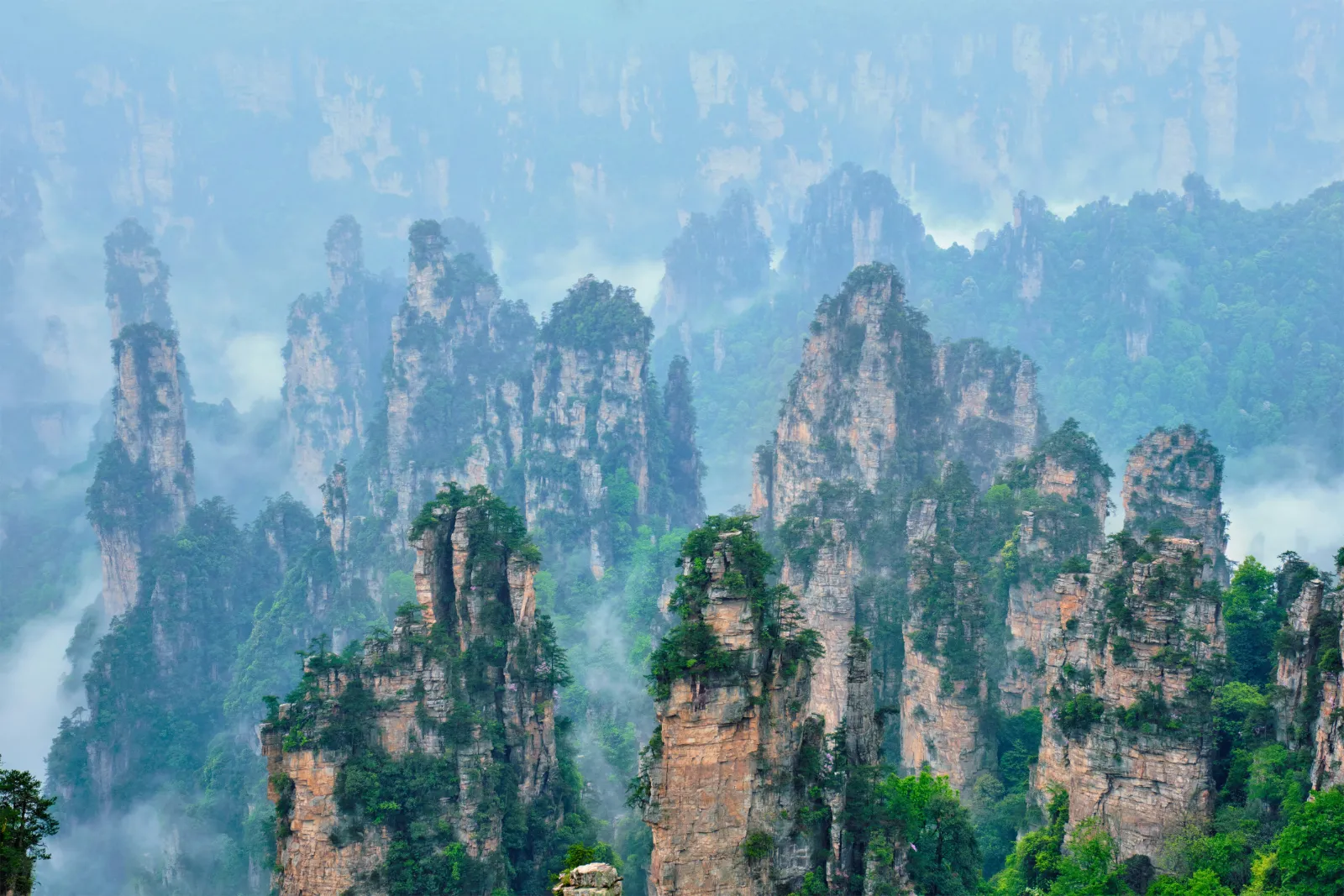
The best time to visit Zhangjiajie is April to early June and September to November, when temperatures are mild and the forest is green or turning gold. October is often called the single best month, but avoid the first week of October, China's National Day holiday, when crowds and queues peak. Mist and the "sea of clouds" can appear in any season after rain; Zhangjiajie is foggy or rainy on more than 200 days a year.
| Season | Weather | Scenery | Crowds |
|---|---|---|---|
| Spring (March to May) | Mild, roughly 15 to 25 °C; rain increases into May | Fresh green forest, frequent mist after rain | Busy during the early May Labour Day holiday |
| Summer (June to August) | Hot and humid, highs around 28 to 33 °C; June is the wettest month | Lush, dramatic cloud on rainy days | Very busy in July and August with Chinese school holidays |
| Autumn (September to November) | Comfortable, highs roughly 18 to 28 °C; drier | Clearer views; autumn colour best around Tianzi Mountain | Peak in the first week of October; quieter afterwards |
| Winter (December to February) | Cold, around 3 to 10 °C; snow most likely mid-January to late February | Snow on the pillars can be beautiful | Quiet, but some cable cars and buses can stop in ice and snow |
Climate figures are averages from a published weather guide and individual years vary. For a month-by-month view across all of China, see our best time to visit China guide.
Can you visit Zhangjiajie during Dashain and Tihar?
Yes, and the timing is often good. Dashain and Tihar usually fall in October and November, which lines up with Zhangjiajie's best autumn weather. The key is to check whether your dates overlap China's National Day holiday in the first week of October. If they do, book park and Tianmen slots well ahead or shift your Zhangjiajie days to the second half of the trip. Families travelling in the school holiday window should also book flights early, because seats out of Kathmandu fill quickly around the festivals. Our guide to Dashain and Tihar holidays abroad has more on planning around the festival calendar.
Is Zhangjiajie suitable for families and older travellers?
Yes, Zhangjiajie works well for families and older travellers if you plan around the mechanical links and choose the flatter areas. The Bailong Elevator, the cable cars and the eco buses remove most of the climbing, Golden Whip Stream is flat, and the whole area is at modest elevation, mostly below about 1,600 metres, so altitude is not a concern. The real challenge is distance on foot and stairs at viewpoints.
| Traveller | Good choices | Things to watch |
|---|---|---|
| Older parents or grandparents | Bailong Elevator to Yuanjiajie, eco buses, Ten-Mile Gallery train, Tianmen by express cableway and escalators | Queues standing in the sun; stairs at many viewpoints; slippery paths after rain |
| Families with young children | Golden Whip Stream in short sections, Ten-Mile Gallery, Yuanjiajie loop | Bold monkeys near snacks; crowds at railings; long days |
What should you know before you go?
Most of what trips people up in Zhangjiajie is payments, apps and packing for wet weather.
- Money: China uses the yuan (CNY, also called renminbi). Mobile payment apps are used almost everywhere; set up a mobile wallet that accepts foreign cards before you leave, and carry some cash as a backup.
- Internet and apps: Many apps used in Nepal do not work normally in China. Download offline maps, a translation app and your booking confirmations before you fly. Our China travel tips cover this in more depth.
- Shoes and rain gear: Wear shoes with good grip, and carry a light rain jacket or poncho; paths are often damp.
- Monkeys: Do not feed them and keep bags closed. They will grab food and plastic bags.
- Food: Hunan food is famously spicy; ask for less chilli if you need it. Our guide to what to eat in China helps with ordering.
How does Zhangjiajie fit into a wider China trip?
Zhangjiajie fits best as the nature chapter of a China trip, usually after a city or two. A common shape is Beijing or Shanghai for history and city life, then a flight or train to Zhangjiajie for three or four days of landscape, often with Changsha or Guangzhou as the link because of the high-speed rail. Travellers from Nepal often enter through Chengdu, Kunming or Guangzhou and build the route from there.
For a city-heavy route, pair this guide with our Great Wall of China guide, and if you like unusual landscapes, the striped hills of China's Rainbow Mountains in Gansu are another natural wonder worth knowing. For the full country overview, including money, apps and culture, start with our China travel guide. If you would rather have the bookings, transfers and real-name tickets arranged for you, you can browse our China tour packages.
Frequently asked questions
What is Zhangjiajie famous for?
Zhangjiajie is famous for more than 3,000 quartz sandstone pillars rising from dense forest in the Wulingyuan Scenic Area of Hunan, China, a UNESCO World Heritage Site since 1992. It is also known for the Bailong Elevator, Tianmen Mountain's Heaven's Gate arch, and the Zhangjiajie Grand Canyon glass bridge.
Are the Avatar mountains in Zhangjiajie?
Yes. The Zhangjiajie pillars are widely known as the Avatar mountains, and the most photographed viewpoint, Hallelujah Mountain at Yuanjiajie, is linked with the film's floating peaks. Local authorities announced the Avatar name for the Southern Sky Column in 2010, though the renaming was disputed at the time.
How many days do you need in Zhangjiajie?
Most travellers need three to four days in Zhangjiajie: two days inside Wulingyuan for Yuanjiajie, Tianzi Mountain and Golden Whip Stream, one day for Tianmen Mountain, and half a day for the glass bridge. The Wulingyuan core ticket is valid for four consecutive days, which suits this plan.
Is the Zhangjiajie glass bridge scary?
The Zhangjiajie glass bridge feels scary for the first few steps because you look straight down about 300 metres into the canyon, but most visitors relax quickly. It is about 430 metres long. People with heart conditions or a strong fear of heights should skip it, and it can close in rain.
What is Tianmen Mountain?
Tianmen Mountain is a separate scenic area beside Zhangjiajie city, famous for Tianmen Cave, a natural arch about 131.5 metres high, plus the 999 steps, cliff walkways and a 99-bend road. From 13 October 2026 only the Line C express cableway was running, while other cableway lines were suspended for upgrading.
How do I get to Zhangjiajie from Nepal?
There is no direct flight from Kathmandu to Zhangjiajie. Most Nepali travellers fly to a Chinese gateway such as Chengdu, Kunming, Guangzhou or Shenzhen, then take a domestic flight to Zhangjiajie Hehua Airport or a high-speed train to Zhangjiajie West station. Changsha to Zhangjiajie West takes about 2 to 3.5 hours by train.
When is the best time to visit Zhangjiajie?
The best time to visit Zhangjiajie is April to early June and September to November, with October often the finest month. Avoid China's National Day holiday in the first week of October and the July to August school holidays if you dislike crowds. Mist can appear in any season after rain.
Is Zhangjiajie suitable for elderly people?
Yes, Zhangjiajie suits elderly travellers who use the Bailong Elevator, cable cars and eco buses and choose flat walks such as Golden Whip Stream or the Ten-Mile Gallery train. The area is at modest elevation, so altitude is not a problem. Expect queues and some stairs at viewpoints, and take care on wet paths.
Do I need to book Zhangjiajie tickets in advance?
Yes, book Zhangjiajie tickets in advance, especially for weekends, the first week of October, early May and July to August. Wulingyuan, Tianmen Mountain and the glass bridge all use real-name, timed bookings, so foreign visitors book with their passport and must carry the same original passport at the gate.
Is the glass bridge inside Zhangjiajie National Forest Park?
No. The famous Zhangjiajie glass bridge spans the Zhangjiajie Grand Canyon in Cili County, a separate scenic area about 28 km from Wulingyuan with its own ticket. Tianmen Mountain has glass-floored cliff walkways, but those are different again from the bridge.
Zhangjiajie kasto thau ho?
Zhangjiajie Chinako Hunan pradeshma parne prakritik thau ho, jaha 3,000 bhanda badhi sandstone ka agla dhunga ka khamba jasta pahad chhan. Yo UNESCO World Heritage Site ho ra "Avatar mountains" ko namle chinincha. Nepalbata jana Chengdu, Kunming wa Guangzhou hudai jana sakincha. Kamtima teen dekhi char din rakhnu ramro huncha.