












































Short answer: The Maldives is an independent island country in the Indian Ocean, in South Asia. It lies southwest of India and Sri Lanka and stretches north to south across the Equator as a long double chain of coral atolls. The country has 1,192 islands, only 187 of them inhabited by local communities, and its capital is Malé. People speak Dhivehi, the state religion is Islam, and the currency is the Maldivian rufiyaa. Most visitors land at Velana International Airport, next to Malé.
The follow up questions are usually the same: is it a country, how many islands are there, what is an atoll, what language do people speak, and how do you reach a resort on its own island. Each answer below is self contained, with key facts from official Maldivian sources. For readers in Nepal we have added what matters from Kathmandu: the time difference, the usual routings and the seasons that line up with Dashain and Tihar. For the full trip picture, our Maldives travel guide is the companion read.
Where are the Maldives?
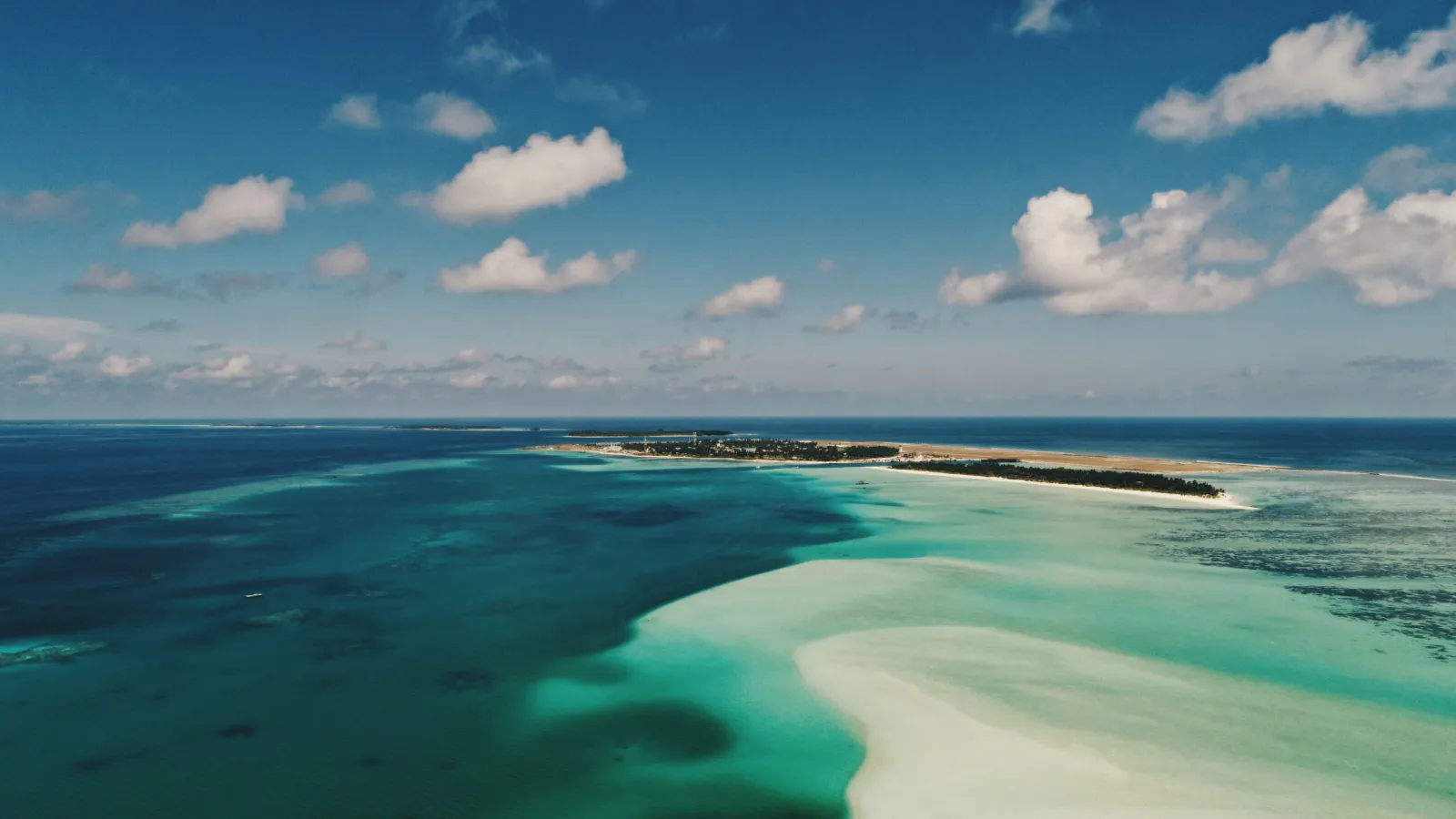
The Maldives sits in the central Indian Ocean, southwest of the southern tip of India and west of Sri Lanka. On a map, put your finger on Kerala in southern India, then move southwest across open sea. The first scattered dots you reach are the northern atolls of the Maldives. Keep following them south and the chain crosses the Equator, ending in Addu Atoll.
According to the Maldives Bureau of Statistics, the country runs from about 7 degrees north to just under 1 degree south of the Equator, and from about 72.5 to 73.8 degrees east. Visit Maldives, the official tourism board, describes the islands as stretching along a length of 871 kilometres. Because the country is long and thin, resorts in the far north and far south are a flight apart, not a boat ride.
The Maldives is part of South Asia. It is a founding member of the South Asian Association for Regional Cooperation (SAARC), set up in Dhaka on 8 December 1985 alongside Bangladesh, Bhutan, India, Nepal, Pakistan and Sri Lanka. So for a Nepali reader, the Maldives is not a faraway exotic country but a fellow SAARC neighbour, and, at about 2,900 kilometres from Kathmandu, closer than Bali.
Maldives quick facts
| Question | Answer |
|---|---|
| Official name | Republic of Maldives |
| Status | Independent country; independence on 26 July 1965 (President's Office) |
| Region | South Asia, central Indian Ocean; founding member of SAARC |
| Capital | Malé (the Constitution names "the island of Male'" as the capital) |
| Number of islands | 1,192 (Maldives Bureau of Statistics, key geographical facts 2024) |
| Inhabited islands | 187, including Malé (Maldives Bureau of Statistics, 2024) |
| Resort islands | 180, including marinas (Maldives Bureau of Statistics, 2024) |
| Atolls | 26 natural atolls (Visit Maldives), organised into 20 administrative atolls (Maldives Bureau of Statistics) |
| Dry land | About 298 square kilometres (Visit Maldives) |
| Population | 515,132 resident population at the 2022 Census (Maldives Bureau of Statistics) |
| National language | Dhivehi, written in the Thaana script; English is widely used in tourism |
| State religion | Islam (Constitution, Article 10) |
| Currency | Maldivian rufiyaa (MVR) |
| Time zone | UTC+5, no daylight saving |
| Time versus Nepal | The Maldives is 45 minutes behind Nepal |
| Main airport | Velana International Airport (MLE), on Hulhulé island next to Malé |
| Country calling code | +960 |
Checked: 15 Oct 2026, sources: Maldives Bureau of Statistics, Statistical Pocketbook of Maldives 2024; Visit Maldives, Discover Maldives pages; Constitution of the Republic of Maldives (2008); President's Office press release of 25 July 2023.
What is around the Maldives?
The Maldives has no land border; its neighbours are all across the sea.
| Neighbour | Direction from the Maldives | Approximate distance from Malé | Why travellers care |
|---|---|---|---|
| Lakshadweep (India), including Minicoy island | North | The Eight Degree Channel separates Minicoy from the northern Maldivian atolls | Often confused with the Maldives on maps; it is Indian territory |
| Kerala, southern India | Northeast | About 600 km to Thiruvananthapuram and about 735 km to Kochi airport | Short flights from southern Indian cities to Malé |
| Sri Lanka | East | About 780 km to Colombo airport | Colombo is the shortest connection from Kathmandu |
Straight line distances between airport coordinates, rounded.
Is the Maldives a country?
Yes. The Maldives is a sovereign, independent country with its own government, constitution, currency, passport and seat at the United Nations. It is not a province, a territory or a resort brand. The Constitution of 2008 describes the Maldives as "a sovereign, independent, democratic Republic based on the principles of Islam" and a unitary state.
The question comes up because the Maldives is often listed next to islands such as Bali or Phuket that belong to larger countries. The difference is that the whole Maldives is made of islands, and all of them are Maldivian territory.
| Country test | The Maldives |
|---|---|
| Own constitution | Yes, the Constitution of the Republic of Maldives (2008) |
| Own head of state | Yes, an elected President |
| Own parliament | Yes, the People's Majlis |
| Own currency | Yes, the Maldivian rufiyaa (MVR) |
| Independence | 26 July 1965, after a period as a British protectorate |
| Regional membership | Founding member of SAARC, like Nepal |
Independence Day on 26 July is a major national holiday. If you are in Malé or on a local island around that date, you will see flags, parades and events.
Is the Maldives part of India?
No. The Maldives is a separate country and is not part of India. The confusion usually comes from Lakshadweep, an Indian union territory of coral islands that lies just north of the Maldives. Lakshadweep's southernmost island, Minicoy, is separated from the Maldives by the Eight Degree Channel. Minicoy has old cultural ties with the Maldives, but it is Indian territory.
How many islands and atolls are there?
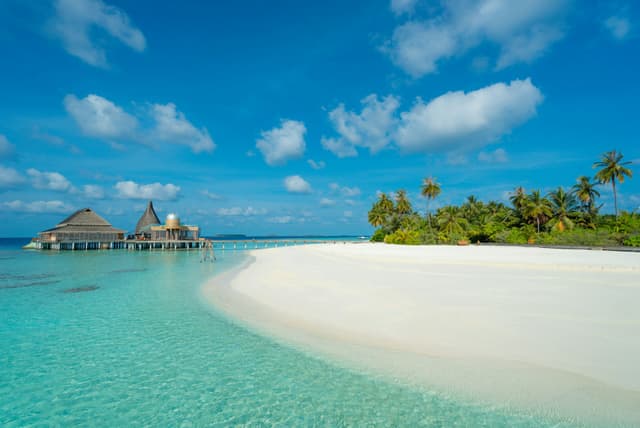
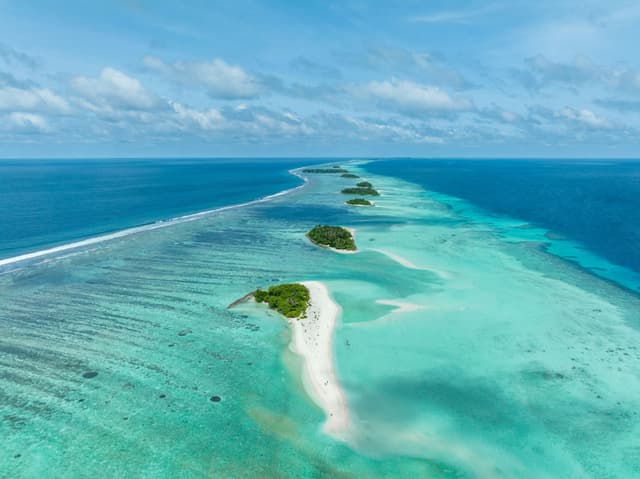
The Maldives has 1,192 islands, according to the Maldives Bureau of Statistics. They are grouped into 26 natural atolls, which the government organises into 20 administrative atolls, with the capital, Malé City, counted separately. Only a small share of the islands have people living on them, and many of the rest are tiny, undeveloped islets on the reef.
Official figures for 2024 break the islands down like this:
| Island type | Number | What it means for a visitor |
|---|---|---|
| All islands | 1,192 | The headline figure for the country |
| Inhabited islands (including Malé) | 187 | Local communities with homes, schools, mosques and harbours; many have guesthouses |
| Resort islands (including marinas) | 180 | Islands developed for tourism, usually one resort per island |
| Uninhabited islands | 825 | Includes small reef islands, picnic islands and islands used for industry or farming |
Checked: 15 Oct 2026, source: Maldives Bureau of Statistics, Statistical Pocketbook of Maldives 2024 (key geographical facts).
You will see other numbers online, such as "about 1,200" or "around 2,000". The first is a rounding of the official count; larger figures usually include sandbanks that only show at low tide. If you need one number to quote, use 1,192 and name the Maldives Bureau of Statistics.
Size is quoted in different ways too. Visit Maldives says the country covers about 90,000 square kilometres, of which only about 298 square kilometres is dry land; the Maldives Bureau of Statistics gives 115,300 square kilometres including sea. Either way, the Maldives is almost all water.
The land is also very low. The World Bank notes that about 80 percent of the Maldives' islands sit less than one metre above sea level, which is why sea level rise is such a serious issue for the country. There are no hills anywhere.
What is an atoll?
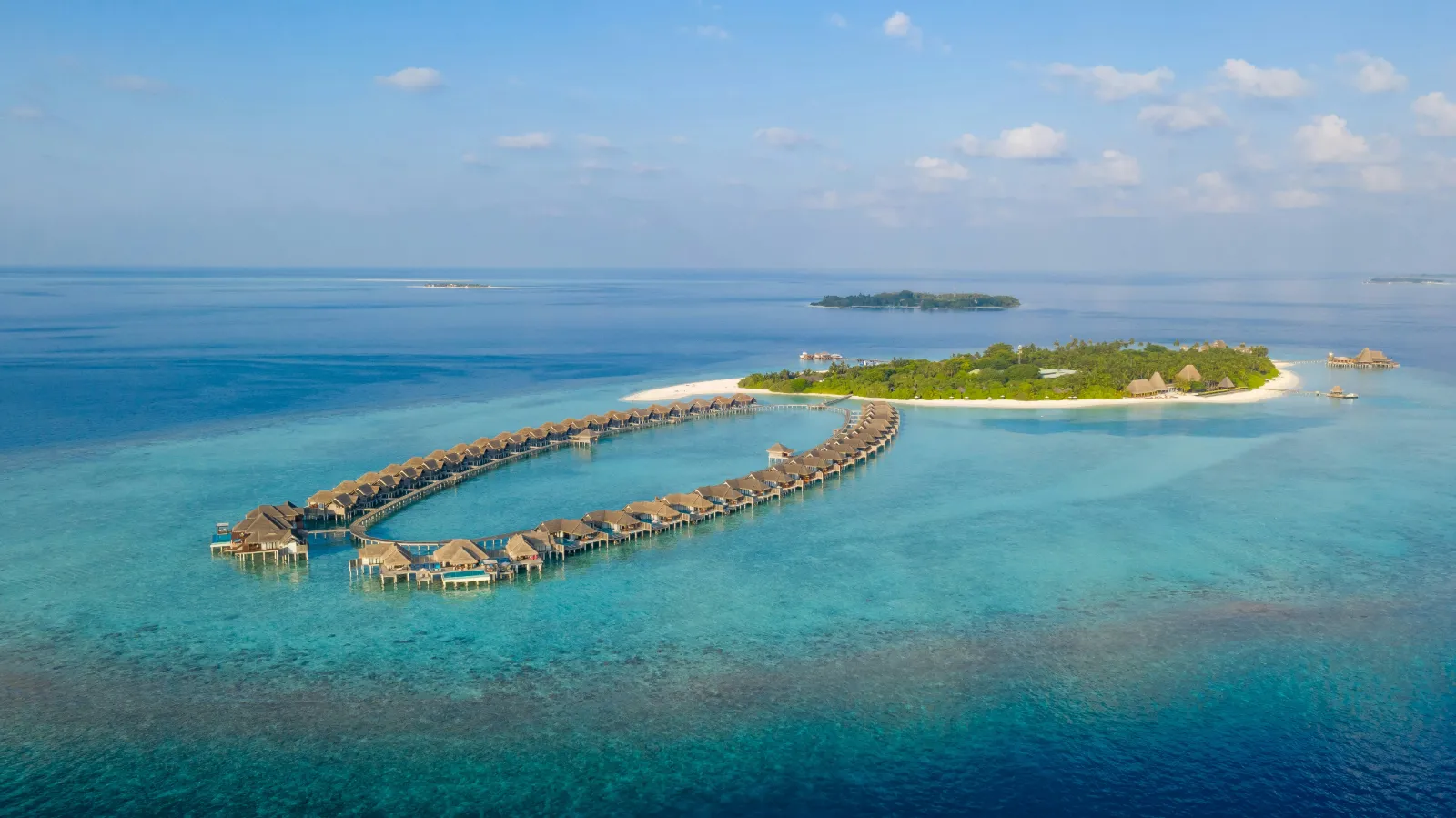
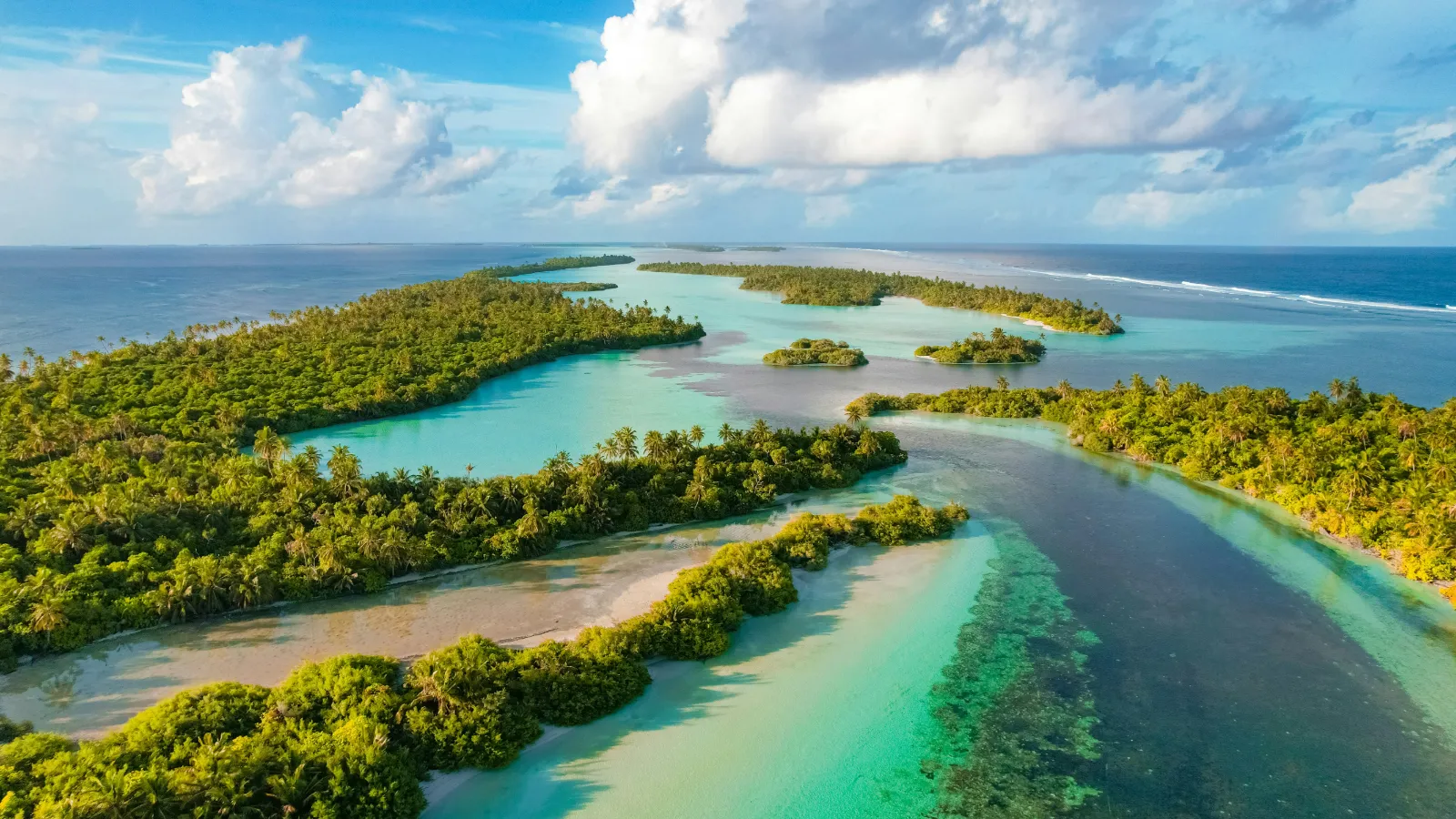
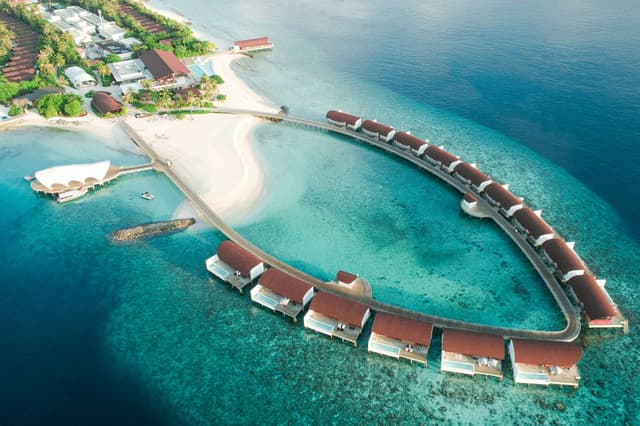
An atoll is a ring shaped coral reef, or a ring of small coral islands, that encloses or nearly encloses a shallow lagoon. In the Maldives, each atoll looks from the air like a necklace of reefs and islands around a calm, turquoise lagoon, with deep blue ocean outside the ring.
The word itself comes from the Maldives. Dictionary.com records that the English word "atoll" came through French, which used it in early descriptions of the Maldive Islands, and is said to come from the Dhivehi word for these reef formations. So when you read about atolls anywhere in the world, from the Pacific to the Indian Ocean, you are using a Maldivian word.
Channels through the reef ring let the ocean flow in and out, bringing nutrients. That is one reason the Maldives is known for manta rays, reef sharks and, in some atolls, whale sharks; Visit Maldives says the reefs are home to about a thousand species of fish.
Natural atolls and administrative atolls
Maldivian sources give two counts, and both are correct:
- 26 natural atolls: the geographical ring reefs that you see on a map. This is the figure Visit Maldives uses.
- 20 administrative atolls: the units used for local government, and the figure the Maldives Bureau of Statistics uses. Some combine or split natural atolls.
So one place can have two names. Administrative atolls have code names taken from letters of the Thaana alphabet, such as Haa Alif in the far north, Kaafu around Malé, and Gaafu Dhaal in the south. Travellers and resorts mix the two: geographical names such as North Malé Atoll, South Malé Atoll or Ari Atoll, and some code names, such as Baa, that have become everyday names in their own right.
A few atolls come up often in trip planning:
| Atoll | Where it is | Often chosen for |
|---|---|---|
| North and South Malé Atolls (Kaafu) | Around the capital and airport | Short speedboat transfers, first trips, local islands such as Maafushi |
| Ari Atoll (Alif Alif and Alif Dhaal) | West of Malé | Diving and snorkelling; South Ari is known for whale sharks |
| Baa Atoll | Northwest of Malé | A UNESCO biosphere reserve, known for manta rays at Hanifaru Bay in season (roughly the southwest monsoon months) |
| Laamu, Huvadhu and Addu | South | Quieter resorts and surf; usually reached by domestic flight |
If you are choosing between atolls or islands for a holiday, our guide to the best islands in the Maldives compares them by budget, marine life and transfer time.
How do resort islands work?
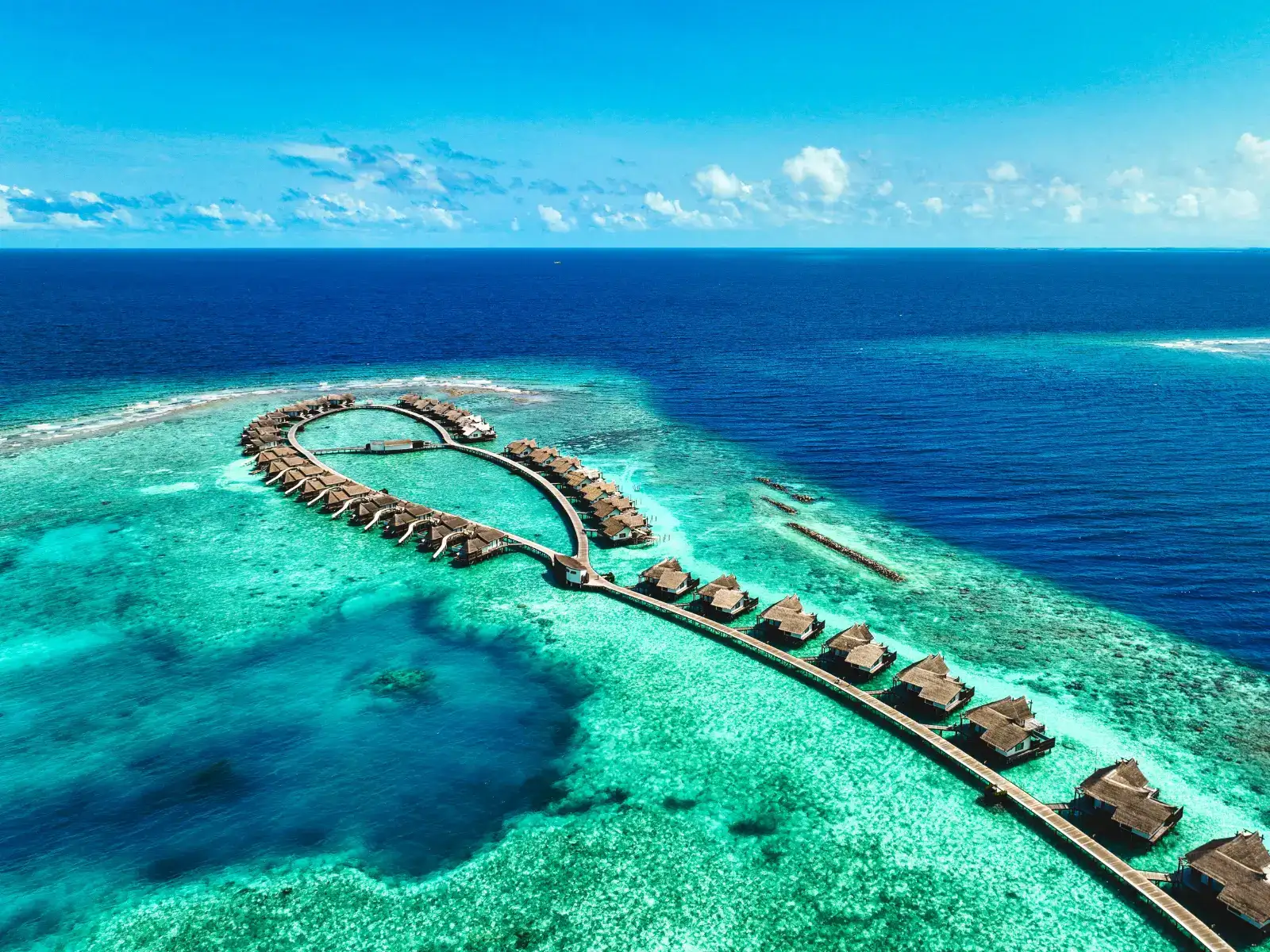
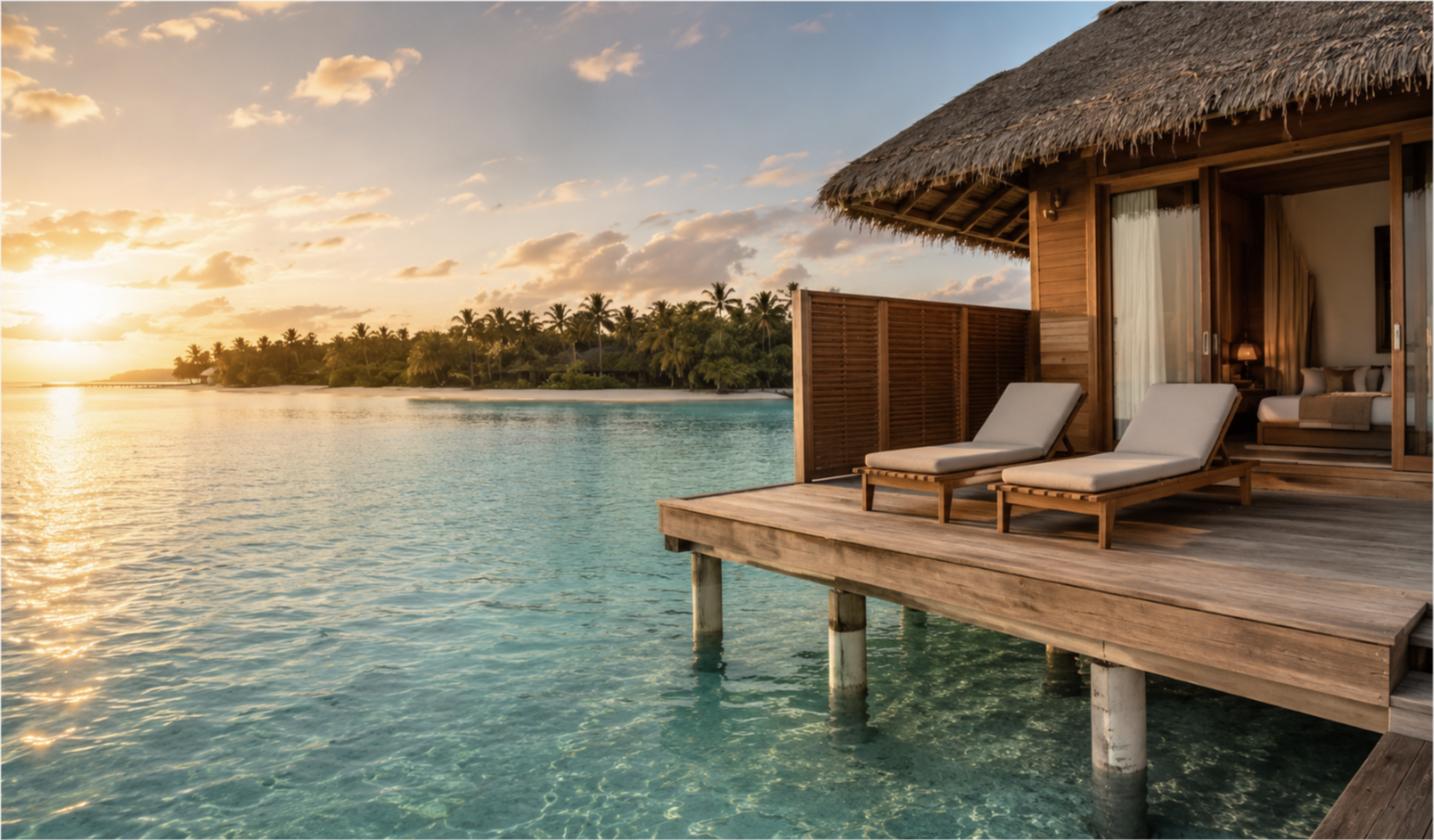
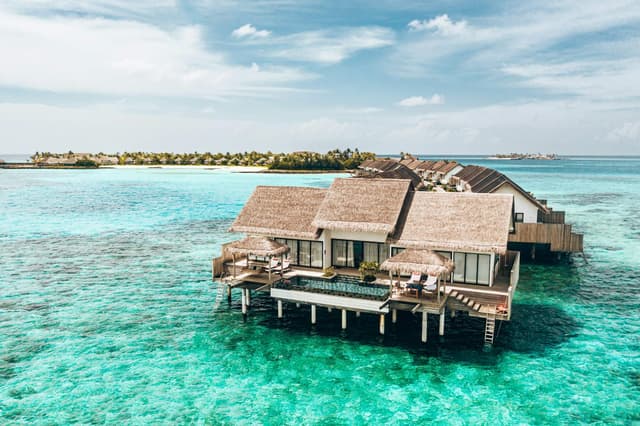
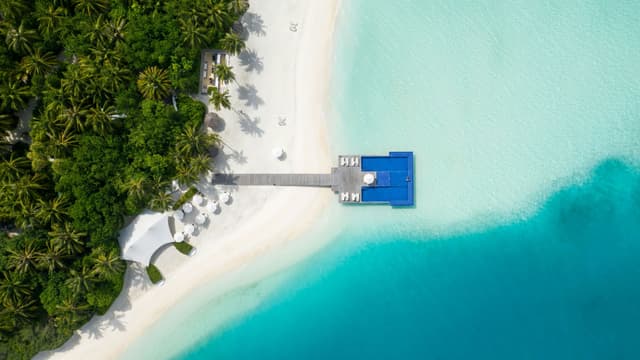
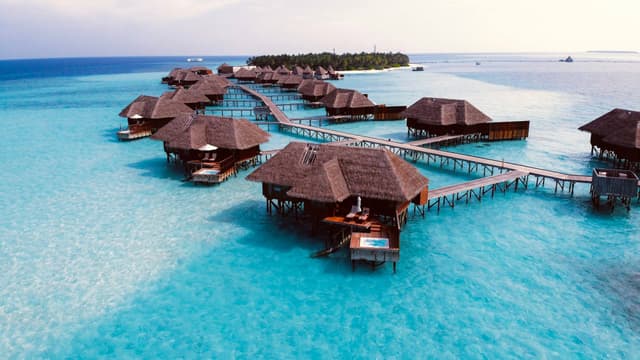
The idea that confuses first time visitors most is the "one island, one resort" model. In most cases, a Maldivian resort is a whole island. The resort runs the beach, restaurants, jetty and often an overwater section, and the only people on the island are guests and staff. There is no town outside the gate.
Tourism is now the main source of income for the Maldives, according to Visit Maldives, and Ministry of Tourism figures reported by the state broadcaster PSM News put arrivals at 2,246,516 in 2025, a record. Since local islands opened up to tourism, travellers also have more choices than resorts alone. The Maldives Bureau of Statistics counted 815 registered guesthouses in operation in 2023, most of them on inhabited islands. Here is how the main stay types compare:
| Stay type | What it is | What daily life feels like | Suits |
|---|---|---|---|
| Resort island | One resort occupying a whole island | Private and self contained; meals, activities and transfers run by the resort; alcohol available | Honeymooners, couples, premium travellers, families |
| Local island guesthouse | Small hotel inside an inhabited Maldivian community | Village life, local cafes, shared excursions; local rules on dress and no alcohol on the island | Budget travellers, friends, repeat visitors |
| Liveaboard (safari vessel) | A boat that moves between dive or surf sites | Days on the water, nights at anchor | Keen divers and surfers |
| City hotel in Malé or Hulhumalé | Hotel near the airport | Urban, practical, close to flights | Overnight stops before or after a seaplane, short business visits |
Within a resort, the next choice is usually between a villa on the beach and a villa over the water. We compare the two in our guide to overwater vs beach villas.
What language do they speak in the Maldives?
The national language of the Maldives is Dhivehi, as set out in Article 11 of the Constitution. Visit Maldives describes it as an Indo-Aryan language with origins in Sanskrit. It is written in its own script, Thaana, which runs from right to left and which Visit Maldives says developed from Arabic numerals around the 16th century.
For visitors, the practical answer is that English is widely spoken. It is used across tourism, in resorts and guesthouses, at the airport and in most shops and cafes that serve visitors, and many younger Maldivians speak it well.
For a Nepali reader there is a small connection: Dhivehi belongs to the same Indo-Aryan family as Nepali and Hindi, through its Sanskrit roots, although the languages are not mutually understandable. Its closest relative is Sinhala, spoken in Sri Lanka.
A few words that are always appreciated:
| Situation | What to say | Note |
|---|---|---|
| Greeting | Assalaamu alaikum | The common Islamic greeting, widely used in the Maldives |
| Thank you | Shukuriyaa | Used in everyday Dhivehi |
What religion is followed in the Maldives?
Islam is the state religion of the Maldives. Article 10 of the Constitution says "The religion of the State of the Maldives is Islam", and Article 9 says a non-Muslim may not become a citizen. Maldivian communities are Muslim, the call to prayer is part of daily life on every inhabited island, and Friday is the main day of congregational prayer.
For visitors, religion shapes a few practical rules, and the difference between resort islands and local islands matters:
- Alcohol: Visit Maldives states that individuals may not import alcohol, but alcohol is available at resorts. It is not sold on inhabited local islands.
- Dress: Visit Maldives asks tourists to respect local culture and dress modestly when visiting or staying on inhabited islands. Resort islands are relaxed about swimwear.
- Ramadan: during the fasting month, life on local islands slows during the day and cafes may change their hours. Resorts usually carry on as normal for guests.
If you are unsure whether a religious item for personal use can be carried, check the official Maldives Customs rules before you travel. Our list of do's and don'ts in the Maldives covers etiquette in more detail.
What is the capital and main airport?
Malé is the capital of the Maldives, and Velana International Airport (code MLE) is the main international gateway. The airport sits on its own island, Hulhulé, right next to Malé. A road bridge, the Sinamalé Bridge, links the airport island with Malé, and the reclaimed island of Hulhumalé is connected by road to the airport as well.
Malé, the capital
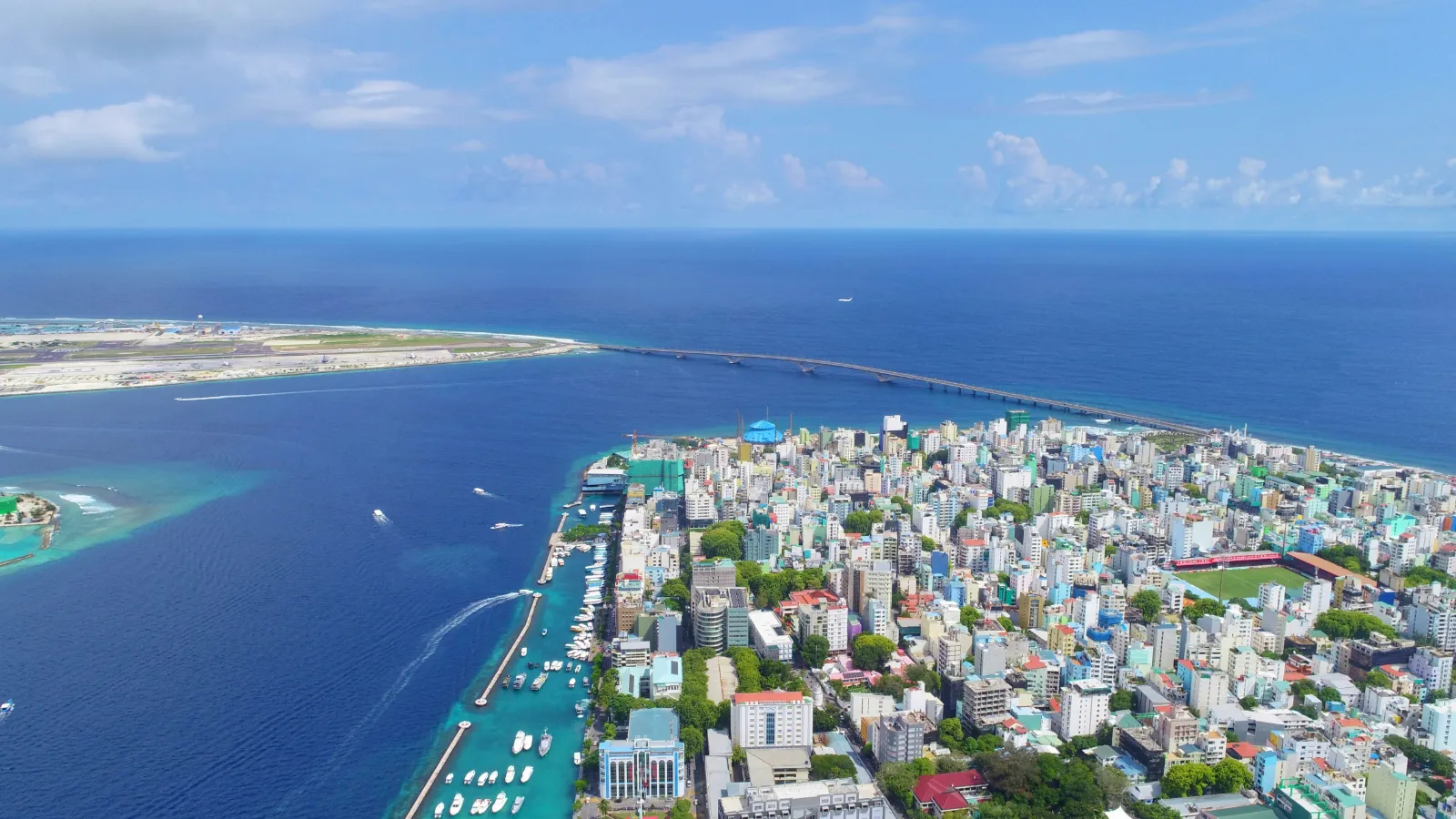
Malé is a small island packed with buildings, roads, markets and harbours. It is the seat of government, the main business centre and home to the country's main public hospital, Indira Gandhi Memorial Hospital. For statistics, Malé City includes Hulhumalé and Villimalé as its wards.
At the 2022 Census, the Malé area held 211,908 people, about 41 percent of the country's resident population of 515,132. Another 46 percent lived on other inhabited islands, about 10 percent on resort islands (mostly resort workers) and about 3 percent on industrial islands.
Most visitors only pass through Malé, but a few hours at the fish market, the local market and the historic Old Friday Mosque (seen from outside) show everyday Maldivian life.
Velana International Airport
Velana International Airport is where almost every international visitor arrives. It was known as Ibrahim Nasir International Airport until it was renamed Velana International Airport on 1 January 2017. Visit Maldives notes that the busiest international traffic comes from Colombo, several Indian cities and Dubai, alongside flights from Europe, the Middle East and Southeast Asia.
The airport is also the hub for onward travel: seaplanes, domestic flights and resort speedboats all leave from the airport island, and your resort normally arranges the transfer and meets you on arrival.
Velana is not the only international airport. Gan International Airport in Addu Atoll serves the far south, and Hanimaadhoo International Airport in the north opened on 9 November 2025, according to the state broadcaster PSM News. For most travellers from Nepal, though, Velana is the arrival point.
Currency and time zone
The currency of the Maldives is the Maldivian rufiyaa (MVR). Visit Maldives says all major credit cards are accepted in the country. Resorts commonly bill international guests in US dollars, so check which currency your extras are charged in. Our guide to the foreign currency limit from Nepal explains how much you can carry.
The Maldives runs on UTC+5, which Visit Maldives describes as 5 hours ahead of GMT. Nepal runs on UTC+5:45, so the Maldives is 45 minutes behind Nepal. Neither country uses daylight saving time, so the gap is the same all year.
| Time in Kathmandu | Time in Malé |
|---|---|
| 6:00 am | 5:15 am |
| 9:00 am | 8:15 am |
| 12:00 noon | 11:15 am |
| 6:00 pm | 5:15 pm |
| 9:00 pm | 8:15 pm |
One local quirk is "island time". Some resorts set their own clocks one or two hours ahead of Malé time to give guests more evening daylight. Not every resort does this, so check with your resort, especially if you have a flight to catch or a family call to make back home in Nepal.
How do you get between islands?
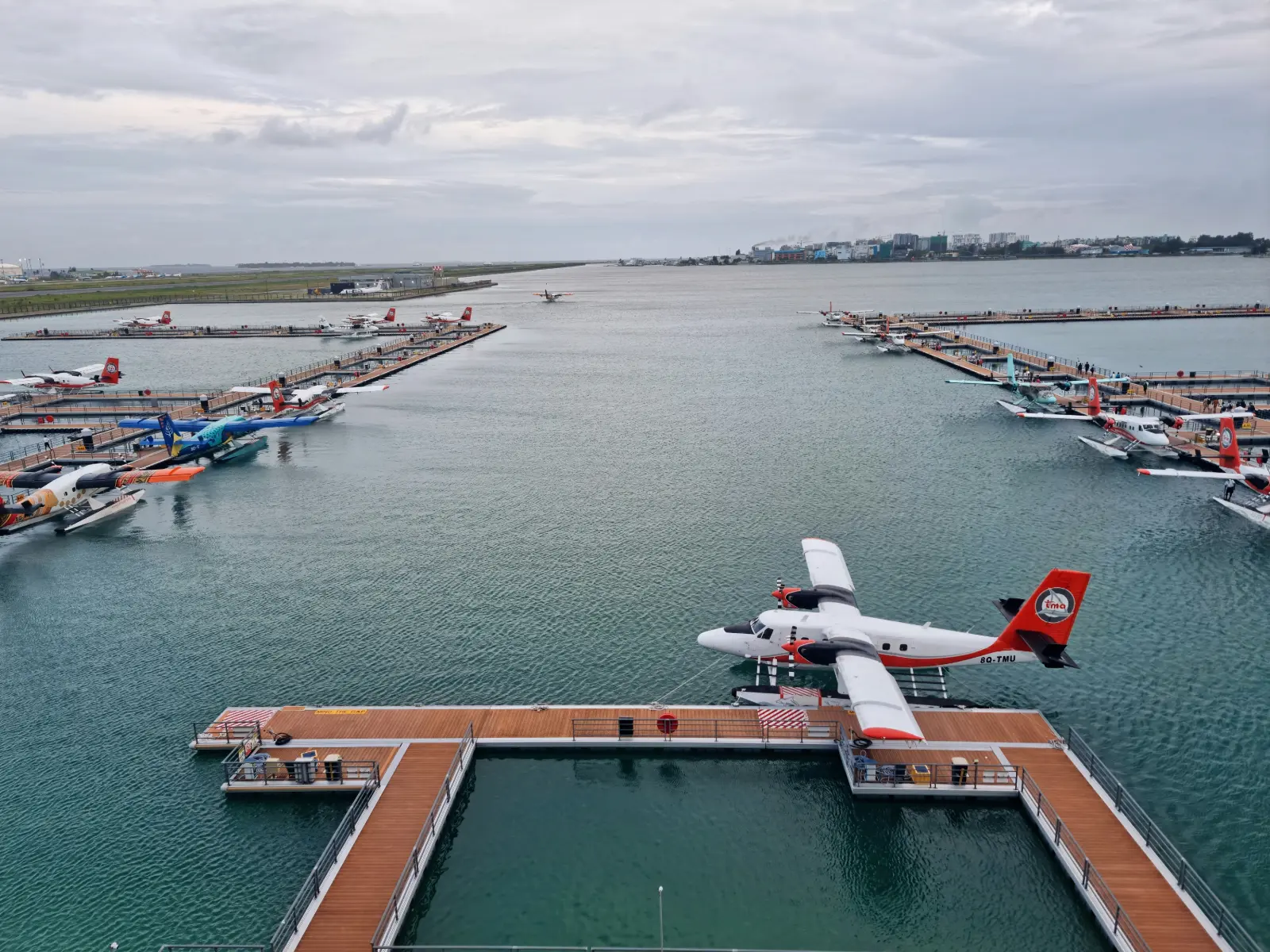
You get between islands in the Maldives by speedboat, seaplane, domestic flight or public ferry. There are no roads between atolls, so every transfer is over water or by air. Which one you use depends almost entirely on where your island is: resorts close to the airport use speedboats, more distant resorts use seaplanes, and resorts in the far north or south usually combine a domestic flight with a short boat ride.
| Transfer type | Typically used for | Good to know |
|---|---|---|
| Speedboat | Resorts and local islands in North and South Malé Atolls, and some nearby atolls | Runs day and night, so late arrivals can usually reach their island the same evening; sea can be choppy in monsoon months |
| Seaplane | Resorts in atolls such as Ari, Baa, Raa, Lhaviyani and others further from Malé | Flies in daylight only; spectacular views over the atolls; light baggage rules may apply, so check with your resort |
| Domestic flight plus boat | Resorts in the far north and south, such as Laamu, Huvadhu or Addu | Flights leave from Velana's domestic terminal to regional airports, then a boat completes the trip |
| Public ferry | Budget travel between Malé and local islands, and within atolls | Scheduled services link many inhabited islands; slower and less frequent; not ideal for tight flight connections |
The government's high speed ferry network, Raajje Transport Link, is run by the Maldives Transport and Contracting Company (MTCC) and has been rolled out zone by zone across the country, according to the President's Office.
The most important planning point for a Nepali traveller is the seaplane daylight rule. Seaplanes fly only in daylight, so if your connecting flight lands in Malé in the late afternoon or evening and your resort is a seaplane ride away, you will usually spend the first night in Hulhumalé or Malé and fly on next morning. On the way home you may need to leave the resort hours before an evening flight, so ask about transfer cut off times before you fix your flights. Our guide on how to get around the Maldives explains each transfer type in more depth.
What is the climate like?
The Maldives has a hot tropical climate all year, with two monsoon seasons rather than summer and winter. The northeast monsoon, called Iruvai in Dhivehi, is the drier, sunnier period, roughly January to March. The southwest monsoon, called Hulhangu, brings more rain and wind, roughly May to the end of November. December and April are transition months.
Those months come from the Maldives Meteorological Service, as reported in December 2025. Visit Maldives uses a simpler split: rain with the southwest monsoon from May to October, and generally sunny weather with the northeast monsoon from November to April. The exact start and end shift from year to year.
Temperatures barely change: Visit Maldives gives an average high of 31.5 degrees Celsius and an average low of 26.4 degrees Celsius, so it feels warm and humid in every month.
| Period | Season | What it means for a traveller from Nepal |
|---|---|---|
| January to March | Iruvai, northeast monsoon | Usually the sunniest, calmest weather and the busiest season; good for winter school holidays and Magh and Falgun wedding season honeymoons |
| May to November | Hulhangu, southwest monsoon | More rain, wind and rougher seas, mixed with plenty of sunny days; resorts are quieter |
| October and November | Late southwest monsoon | Overlaps Dashain and Tihar in most years; weather is mixed, so a flexible plan helps |
| December | Transition | The northeast monsoon usually arrives in the northern and central atolls in the second or third week |
The Dashain and Tihar holidays are the peak travel window for many Nepali families, and in most years they fall in October or November, towards the end of the southwest monsoon. That does not rule out a Maldives trip, but it is worth expecting some rain and choosing a resort with good indoor options, or a speedboat transfer that is less affected by weather. For a month by month view, see our guide to the best time to visit the Maldives.
How far is the Maldives from Nepal?
The Maldives is about 2,900 kilometres from Kathmandu in a straight line, measured between Tribhuvan International Airport and Velana International Airport. There is no nonstop flight between Kathmandu and Malé, so travellers fly with one stop, most often in Colombo, an Indian city such as Delhi or Bengaluru, or a Gulf hub such as Dubai or Doha.
For comparison, Bali is about 5,170 kilometres from Kathmandu. The shortest Maldives routing, via Colombo, is about five hours of flying in total, plus the connection.
The usual routes from Kathmandu
These are the connecting points that have nonstop flights both from Kathmandu and onward to Malé. Flight times are typical scheduled times and vary by airline and season.
| Connecting hub | Nonstop airlines from Kathmandu (as listed) | Kathmandu to hub, typical flight time | Hub to Malé, nonstop airlines and typical flight time |
|---|---|---|---|
| Colombo (CMB) | SriLankan Airlines | About 3 hours 35 minutes to 3 hours 40 minutes | SriLankan Airlines, Emirates, flydubai, Gulf Air, FitsAir and others; about 1 hour 25 minutes to 1 hour 40 minutes |
| Bengaluru (BLR) | Air India Express, Nepal Airlines | About 3 hours to 3 hours 25 minutes | IndiGo; about 1 hour 55 minutes to 2 hours 5 minutes |
| Delhi (DEL) | Air India, IndiGo, Nepal Airlines | About 1 hour 40 minutes to 2 hours 5 minutes | Air India; about 4 hours to 4 hours 20 minutes |
| Dubai (DXB) | flydubai, Himalaya Airlines, Nepal Airlines | About 4 hours 40 minutes to 5 hours 15 minutes | Emirates, flydubai; about 4 hours 10 minutes to 4 hours 25 minutes |
| Doha (DOH) | Qatar Airways, Himalaya Airlines, Nepal Airlines | About 4 hours 30 minutes to 5 hours 50 minutes | Qatar Airways; about 4 hours 35 minutes to 4 hours 40 minutes |
| Kuala Lumpur (KUL) | Malaysia Airlines, Batik Air Malaysia, Himalaya Airlines, Nepal Airlines | About 4 hours 30 minutes to 4 hours 55 minutes | Malaysia Airlines, AirAsia, Batik Air Malaysia; about 4 hours 15 minutes to 4 hours 25 minutes |
Checked: 15 Oct 2026, sources: DirectFlights.com route pages (updated July to October 2026) and FlightConnections airport pages for Kathmandu and Malé. Airlines add and drop routes; always confirm the current schedule before booking.
Colombo is usually the shortest routing, and because SriLankan Airlines flies both legs, the journey can be on one ticket with bags checked through. Indian connections are convenient thanks to frequent Kathmandu flights, while the Gulf routes double back west and suit travellers adding a Dubai or Doha stopover. Our overview of direct flights from Kathmandu explains which destinations need a stop and why.
Visa and entry, in one line
Maldives Immigration grants tourist visas on arrival to visitors of all nationalities who meet its entry requirements, and every foreign arrival must submit the online Traveller Declaration on the official IMUGA portal; Nepali passport holders can read what this means for them on our Maldives visa page and should check the official Maldives Immigration site before booking. Checked: 15 Oct 2026, Maldives High Commission visa and passport information page (published 2 July 2026).
Who the Maldives suits from Nepal
The Maldives fits some travellers from Nepal especially well:
- Honeymooners: the private resort island is the classic picture, and the drier northeast monsoon lines up with the Magh and Falgun wedding season. Our guide to a honeymoon in the Maldives goes into detail.
- Families: shallow lagoons and speedboat resorts near Malé keep things easy with children. See our guide to the Maldives with family.
- Budget travellers: local island guesthouses offer the same water and reefs on a more modest plan.
- The Nepali diaspora: Nepalis living in the Gulf, Malaysia or India can often fly nonstop to Malé, so the Maldives works as a meeting point for a family holiday with relatives flying from Kathmandu.
How to start planning a Maldives trip
Once you know where the Maldives is, the next steps are deciding when to go, whether you want a resort island or a local island, and which atoll suits your transfer and budget. Our main Maldives travel guide, linked at the top of this page, brings together seasons, stay types, culture and safety in one place. If you would rather see how a trip fits together with flights, island stays, transfers and activities already arranged, browse our Maldives tour packages for example routes and durations.
Frequently asked questions
Where is the Maldives located?
The Maldives is located in the central Indian Ocean, in South Asia, southwest of India and Sri Lanka. It is a long chain of coral atolls that runs about 871 kilometres from north to south and crosses the Equator. Its capital, Malé, is about 780 kilometres from Colombo and about 2,900 kilometres from Kathmandu.
Is the Maldives a country?
Yes. The Maldives is an independent country, the Republic of Maldives, with its own constitution, elected President, parliament, currency and immigration rules. It became independent on 26 July 1965 and is a founding member of SAARC, like Nepal. It is not part of India or Sri Lanka.
How many islands are in the Maldives?
The Maldives has 1,192 islands, according to the Maldives Bureau of Statistics. Of these, 187 are inhabited islands including Malé, 180 are resort islands including marinas, and 825 are uninhabited. Figures such as "about 1,200" are roundings, and larger counts usually include sandbanks that are not classed as islands.
What is an atoll?
An atoll is a ring shaped coral reef, or ring of small coral islands, around a shallow lagoon. The Maldives has 26 natural atolls, which the government groups into 20 administrative atolls. The English word "atoll" is itself said to come from Dhivehi, the language of the Maldives.
What language is spoken in the Maldives?
The national language of the Maldives is Dhivehi, an Indo-Aryan language written in the Thaana script from right to left. English is widely spoken in resorts, guesthouses, the airport and most places that serve visitors, so travellers from Nepal can manage comfortably in English.
What is the capital of the Maldives?
Malé is the capital of the Maldives. It is a small, densely built island that held about 41 percent of the country's resident population at the 2022 Census, counting its wards Hulhumalé and Villimalé. Velana International Airport is on the neighbouring island of Hulhulé, linked to Malé by a road bridge.
Is the Maldives part of India?
No. The Maldives is a separate, sovereign country. It is often confused with Lakshadweep, an Indian union territory of coral islands to the north. Lakshadweep's Minicoy island is separated from the Maldives by the Eight Degree Channel, and everything south of that channel belongs to the Maldives.
What religion is followed in the Maldives?
Islam is the state religion of the Maldives under Article 10 of its Constitution, and Maldivian communities are Muslim. Visitors of any faith are welcome. On inhabited local islands, modest dress is expected and alcohol is not sold, while resort islands are more relaxed and serve alcohol to guests.
How far is the Maldives from Nepal?
The Maldives is about 2,900 kilometres from Kathmandu in a straight line. There is no nonstop flight, so travellers from Nepal connect once, most often in Colombo, Delhi, Bengaluru, Dubai, Doha or Kuala Lumpur. Via Colombo, the two flights add up to about five hours in the air, plus the connection time.
What is the time difference between Nepal and the Maldives?
The Maldives is 45 minutes behind Nepal. Maldives time is UTC+5 and Nepal time is UTC+5:45, and neither country uses daylight saving, so the gap stays the same all year. When it is 12:00 noon in Kathmandu, it is 11:15 am in Malé. Some resorts keep their own "island time", so check locally.
Maldives kaha parcha?
Maldives Hind Mahasagar ma parcha, India ra Sri Lanka ko dakshin-paschim tira. Yo 1,192 wota tapu bhayeko swatantra desh ho, rajdhani Malé ho, ra bhasha Dhivehi ho. Kathmandu bata sidha udan chhaina; dherai jaso Colombo, Delhi wa Dubai hudai jana sakinchha. Maldives ko samaya Nepal bhanda 45 minute pachhi chha.