+977-9768558250
Explore by Country
See all 22 Thailand packages
Most popular pick
See all 22 Thailand packages →
See all 11 Vietnam packages
Most popular pick
See all 11 Vietnam packages →
See all 10 Indonesia (Bali) packages
Most popular pick
See all 10 Indonesia (Bali) packages →
See all 7 Maldives packages
Most popular pick
See all 7 Maldives packages →
See all 10 China packages
Most popular pick
See all 10 China packages →
See all 13 Sri Lanka packages
Most popular pick
See all 13 Sri Lanka packages →
See all 9 Malaysia packages
Most popular pick
See all 9 Malaysia packages →
See all 8 Singapore packages
Most popular pick
See all 8 Singapore packages →
See all 2 Kenya packages
Most popular pick
See all 2 Kenya packages →
See all 16 India packages
Most popular pick
See all 16 India packages →
See all 3 Dubai packages
Most popular pick
See all 3 Dubai packages →
See all 7 Nepal packages
Most popular pick
See all 7 Nepal packages →
See all 6 Philippines packages
Most popular pick
See all 6 Philippines packages →
Search Tours or Places
Blog / Singapore

Little India Singapore: Temples, Food and Deepavali Lights

26 min read 28 Oct 2026
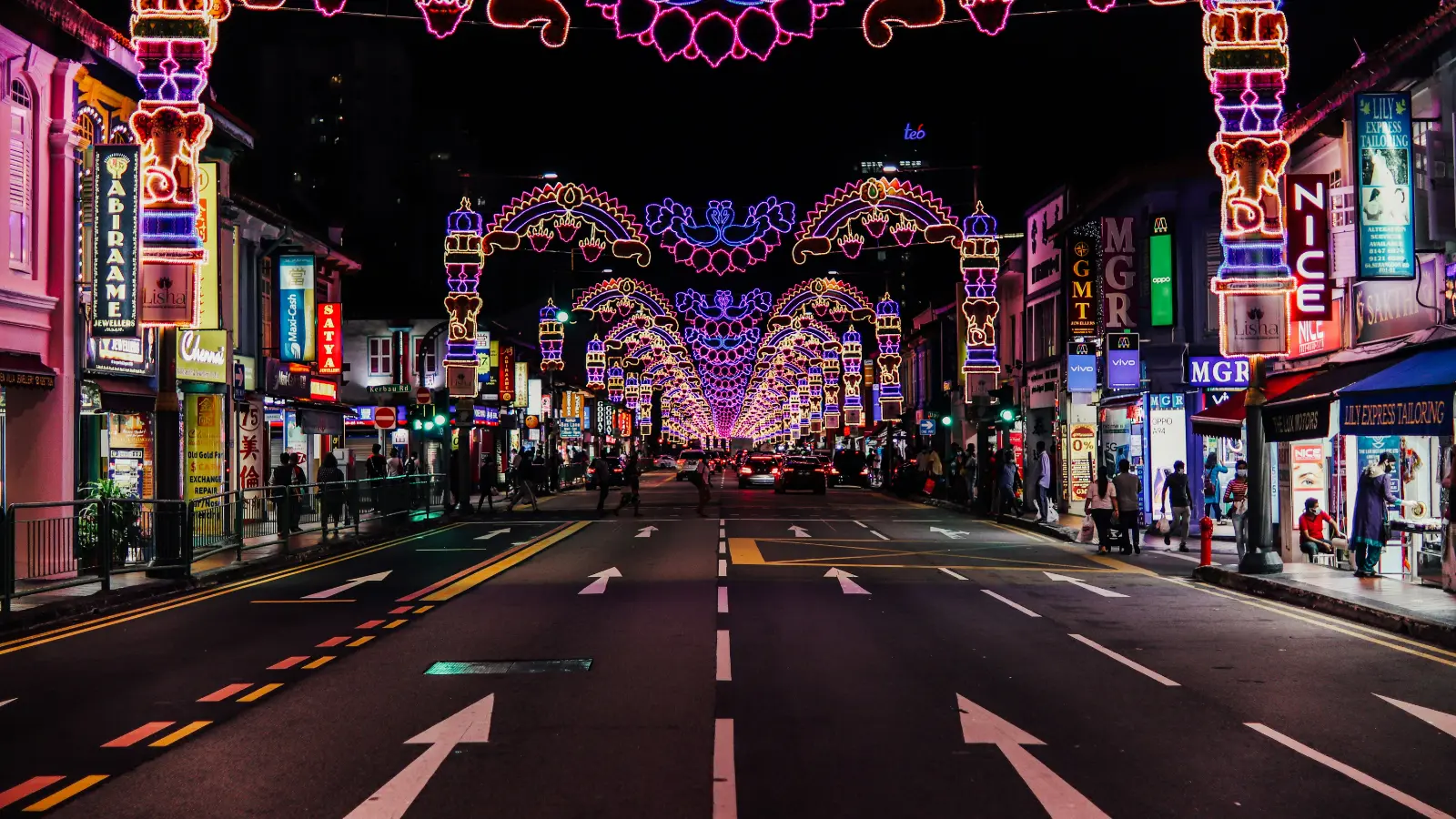
Festive Deepavali light arches glowing over the street in Little India, Singapore at night

Short answer: Little India Singapore is the historic Indian quarter around Serangoon Road, a short MRT ride from the city centre on the North East and Downtown lines. Go for the Sri Veeramakaliamman and Sri Srinivasa Perumal temples, South Indian vegetarian meals on banana leaf, Tekka Centre and the 24 hour Mustafa Centre. In 2026 Deepavali falls on Sunday 8 November, the same day as Laxmi Puja in Nepal, and the Serangoon Road street lights have been switched on nightly since 3 October. Weekday mornings are calmest; Sunday evenings and Deepavali eve are the busiest.

Little India is the one part of Singapore where a visitor from Kathmandu, Delhi or Chennai can feel oddly at home: marigold garlands strung outside flower stalls, the smell of incense and ghee, temple bells, Tamil film songs from shop doorways, and sweet shops stacked with laddoo and murukku before Deepavali. It is also one of the city's most rewarding walks for any visitor, because the temples, food and shops sit within a few streets of each other.

This guide covers what Little India is, which temples to visit and how to behave inside them, the dated Deepavali 2026 light-up, where to eat (including a frank note on which famous names have changed), what to buy at Tekka Centre and Mustafa Centre, how to get there by MRT, and when the area is busiest. For the wider picture of the city, start with our complete Singapore travel guide.

What is Little India in Singapore?
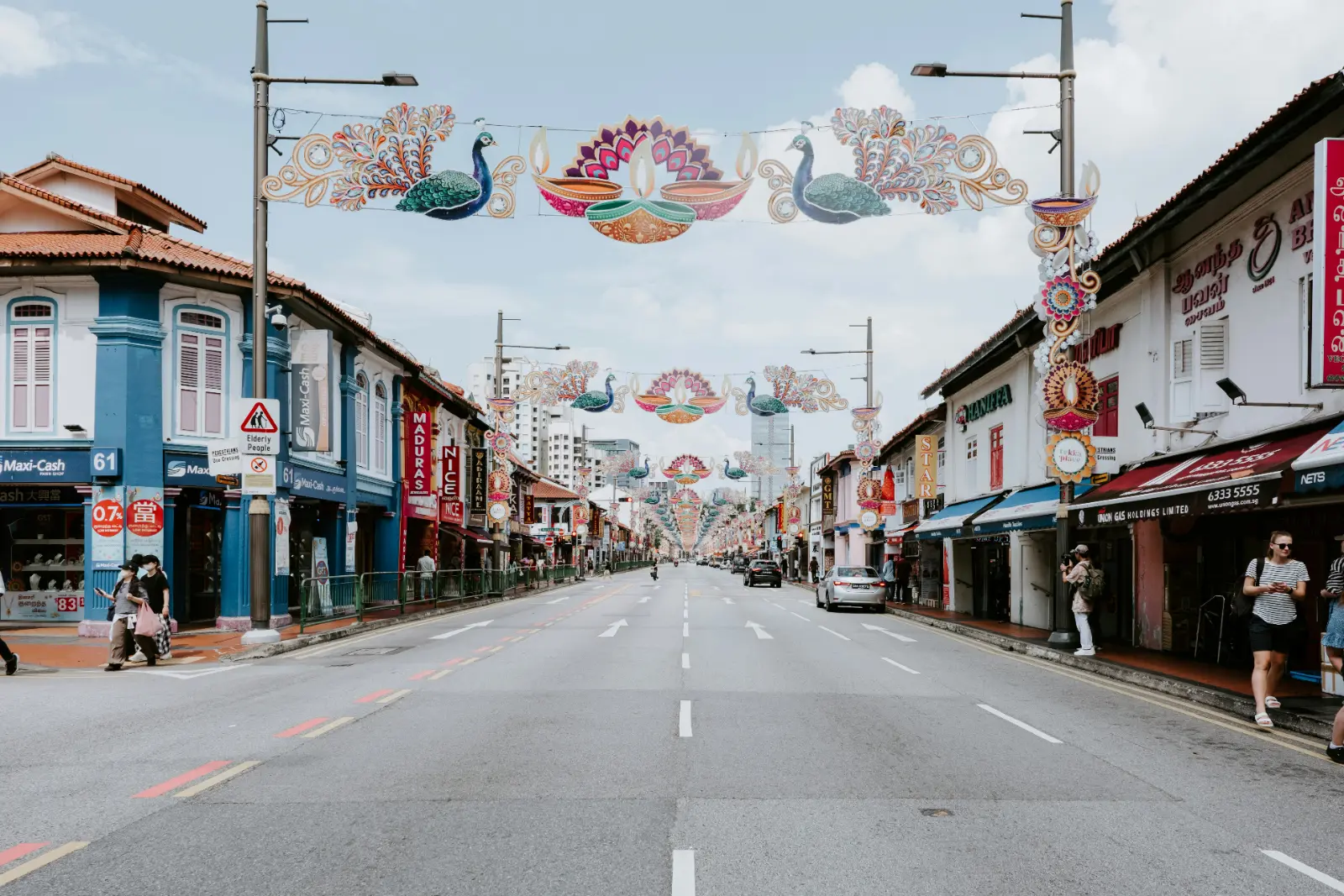
Colourful shophouses under festive street decorations along a road in Little India, Singapore

Little India is Singapore's historic Indian neighbourhood, centred on Serangoon Road and the lanes between it and Race Course Road, just north of the city centre. It is a working community, not a theme park: people shop for groceries, gold, saris and puja items here, temples hold daily worship, and the area fills with families before Deepavali and Thaipusam.

The area's Indian character grew out of work. According to the National Heritage Board's Roots portal, the British set up lime pits and brick kilns along Serangoon Road in the 1820s, and many Indian workers found jobs there. When the kilns closed around 1860, the area turned to cattle, with slaughterhouses, tanneries and milk delivery. In the early 1900s herdsmen from Uttar Pradesh and Bihar settled by the Rochor Canal, and the old Tekka Market was built in 1915 to sell the produce. The name "Little India" itself was only made official in the 1980s, through an effort by the then Singapore Tourist Promotion Board. Checked: 28 Oct 2026, Source: Roots.sg, National Heritage Board.

Today the area is mostly Tamil in flavour, because most of Singapore's Indian community has South Indian roots, but you will also find North Indian, Bengali, Sri Lankan, Bangladeshi and Nepali shops and kitchens. Hindu temples stand a short walk from a Thai Buddhist temple, a Chinese Buddhist temple and several mosques, which is why the Heritage Board's trail through the area includes a "walk of faiths".

Little India at a glance

ItemDetail
Main streetSerangoon Road, with Race Course Road, Campbell Lane, Dunlop Street, Buffalo Road and Syed Alwi Road around it
Nearest MRTLittle India (NE7 on the North East Line, DT12 on the Downtown Line); Farrer Park (NE8) for the northern end and Mustafa Centre; Rochor and Jalan Besar on the Downtown Line also work
Main templesSri Veeramakaliamman, Sri Srinivasa Perumal, Sakya Muni Buddha Gaya, Leong San See
Food anchorTekka Centre hawker centre and the South Indian restaurants on Upper Dickson Road, Race Course Road and Serangoon Road
Shopping anchorsTekka Centre, Little India Arcade, Mustafa Centre, Serangoon Road gold and textile shops
MuseumIndian Heritage Centre, 5 Campbell Lane
Biggest festivalDeepavali (Sunday 8 November 2026), with street light-up and a festival village beforehand
Time neededHalf a day for temples, a meal and shopping; an evening visit for the lights in festival season

If you are still choosing between neighbourhoods, our guide to the best places to visit in Singapore compares Little India with Chinatown, Kampong Glam, Marina Bay and Sentosa, so you can fit it into a wider plan.

Which temples should you visit in Little India?
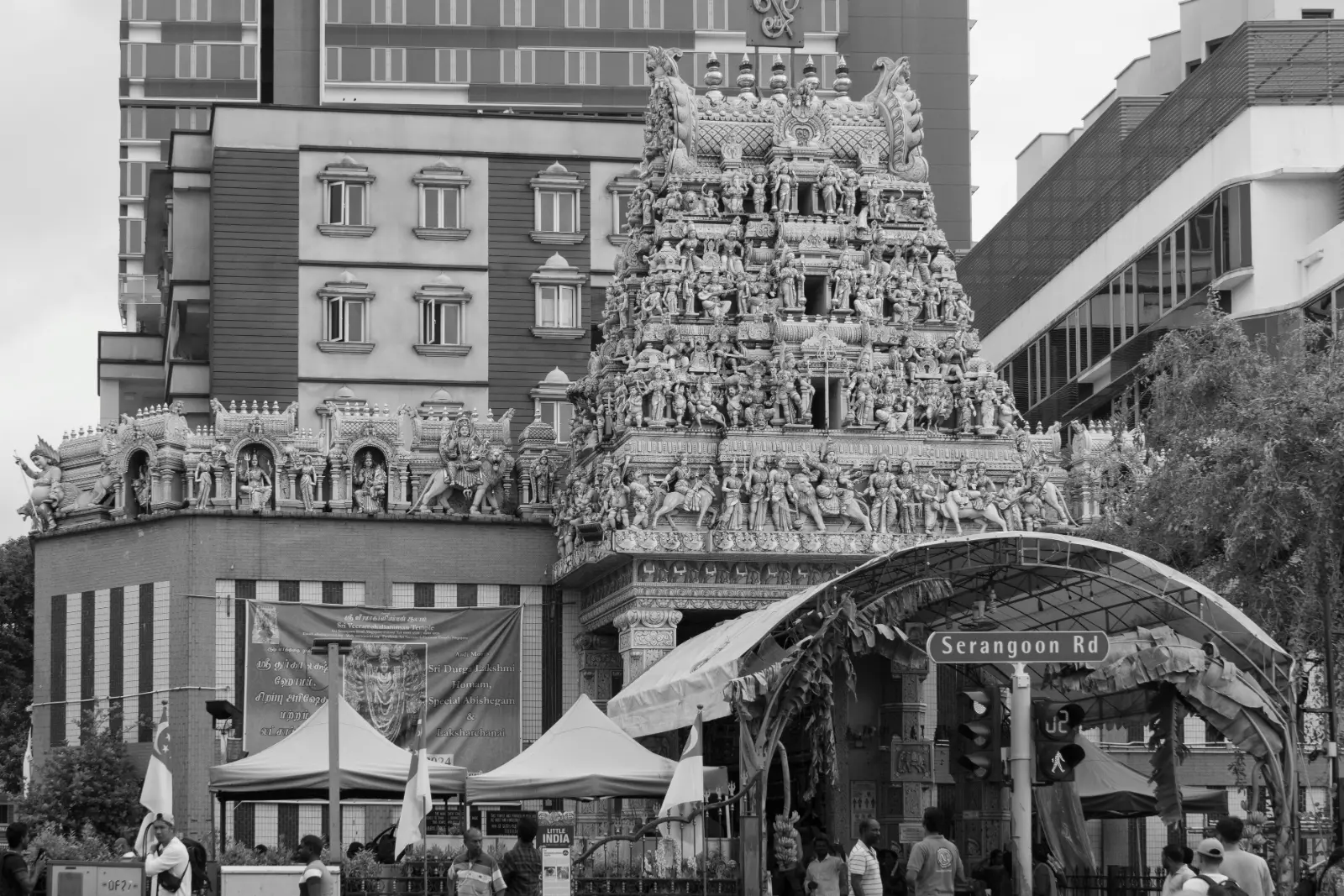
Black and white view of a sculpted Hindu temple gopuram in Little India, Singapore

The four temples most worth your time are Sri Veeramakaliamman and Sri Srinivasa Perumal (both Hindu, on Serangoon Road) and the Sakya Muni Buddha Gaya and Leong San See temples (both Buddhist, on Race Course Road). Together they show how many faiths share this small district, and all four welcome respectful visitors outside prayer times.

Sri Veeramakaliamman Temple

Sri Veeramakaliamman Temple at 141 Serangoon Road is the heart of Little India. It is dedicated to Kali, the fierce form of the goddess, and also honours Parvati with her sons Ganesha and Murugan. A shrine has stood here since 1855, and Bengali labourers built a temple on the site in 1881; it was once known as Soonambu Kambam Kovil, a name linked to the old lime pits. The building follows the South Indian Tamil temple style rather than the style of Kali temples in Bengal, so expect a colourful gopuram (tower gateway) crowded with sculpted figures.

For Nepali visitors, Kali worship will feel familiar, and many families stop here to light a lamp before Deepavali. Visit Singapore notes that photos are allowed but asks visitors to be considerate of worshippers. We could not confirm current opening and puja times from an official temple source on the day of writing, so check the notice at the entrance or the temple's own channels before you go.

Sri Srinivasa Perumal Temple

Sri Srinivasa Perumal Temple, further north on Serangoon Road near Farrer Park MRT, is dedicated to Vishnu in his form as Perumal. The Hindu Endowments Board, which manages it, says the temple was built in 1855, a new temple was completed by 1966, and its tall rajagopuram (main tower entrance) was added in 1979. It is the starting point of the Thaipusam procession each year.

The Hindu Endowments Board lists two daily opening windows: on weekdays 5am to 11am and 6pm to 8.30pm, with slightly longer morning hours at weekends and an earlier evening opening on Saturdays. Checked: 28 Oct 2026, Source: Hindu Endowments Board. The temple is closed between those windows, so plan your walk around them.

Sakya Muni Buddha Gaya Temple

Sakya Muni Buddha Gaya Temple on Race Course Road is often called the Temple of a Thousand Lights, after the many light bulbs that surround its central statue. It was founded in 1927 by Venerable Vutthisasara, a Thai monk, and its main image is a seated Buddha about 15 metres tall. The decoration is strongly Thai in style. Opening hours are commonly listed as 8am to 4.30pm daily; check on the day.

Nepali Buddhist visitors and anyone who knows Lumbini or Bodh Gaya will find the name meaningful, and the temple is a calm contrast to the bustle of Serangoon Road.

Leong San See Temple

Leong San See Temple at 371 Race Course Road, almost opposite Sakya Muni Buddha Gaya, is a Chinese Buddhist temple. The National Heritage Board says it was founded in 1917 by the Reverend Chun Wu and that the present conserved building was completed in 1926 with materials from China. It is dedicated mainly to Guan Yin, the Goddess of Mercy, and also has an altar to Confucius, where students sometimes pray before exams. Opening hours are listed as 6am to 6pm; check on the day.

Little India temples compared

TempleFaith and main deityLocationHistoryVisiting note
Sri VeeramakaliammanHindu; Kali, with Parvati, Ganesha and Murugan141 Serangoon Road, near Little India MRTShrine from 1855; temple built 1881 by Bengali labourersBusiest Hindu temple in the area; check puja times at the entrance
Sri Srinivasa PerumalHindu; Vishnu (Perumal)Serangoon Road, near Farrer Park MRTBuilt 1855; rajagopuram added 1979Weekdays 5am to 11am and 6pm to 8.30pm (HEB, checked 28 Oct 2026)
Sakya Muni Buddha GayaThai Buddhist; seated Buddha about 15 m tallRace Course Road, near Farrer Park MRTFounded 1927 by a Thai monkListed as 8am to 4.30pm; check on the day
Leong San SeeChinese Buddhist; Guan Yin, plus a Confucius altar371 Race Course RoadFounded 1917; present building 1926Listed as 6am to 6pm; check on the day

All four sit within about a 20 minute walk of each other. A simple order is Sri Veeramakaliamman first (near Little India MRT), then up Serangoon Road to Sri Srinivasa Perumal, then across to Race Course Road for the two Buddhist temples, finishing near Farrer Park MRT or Mustafa Centre.
Explore Singapore tour packages
View all →

When are the Deepavali light-ups in Little India?

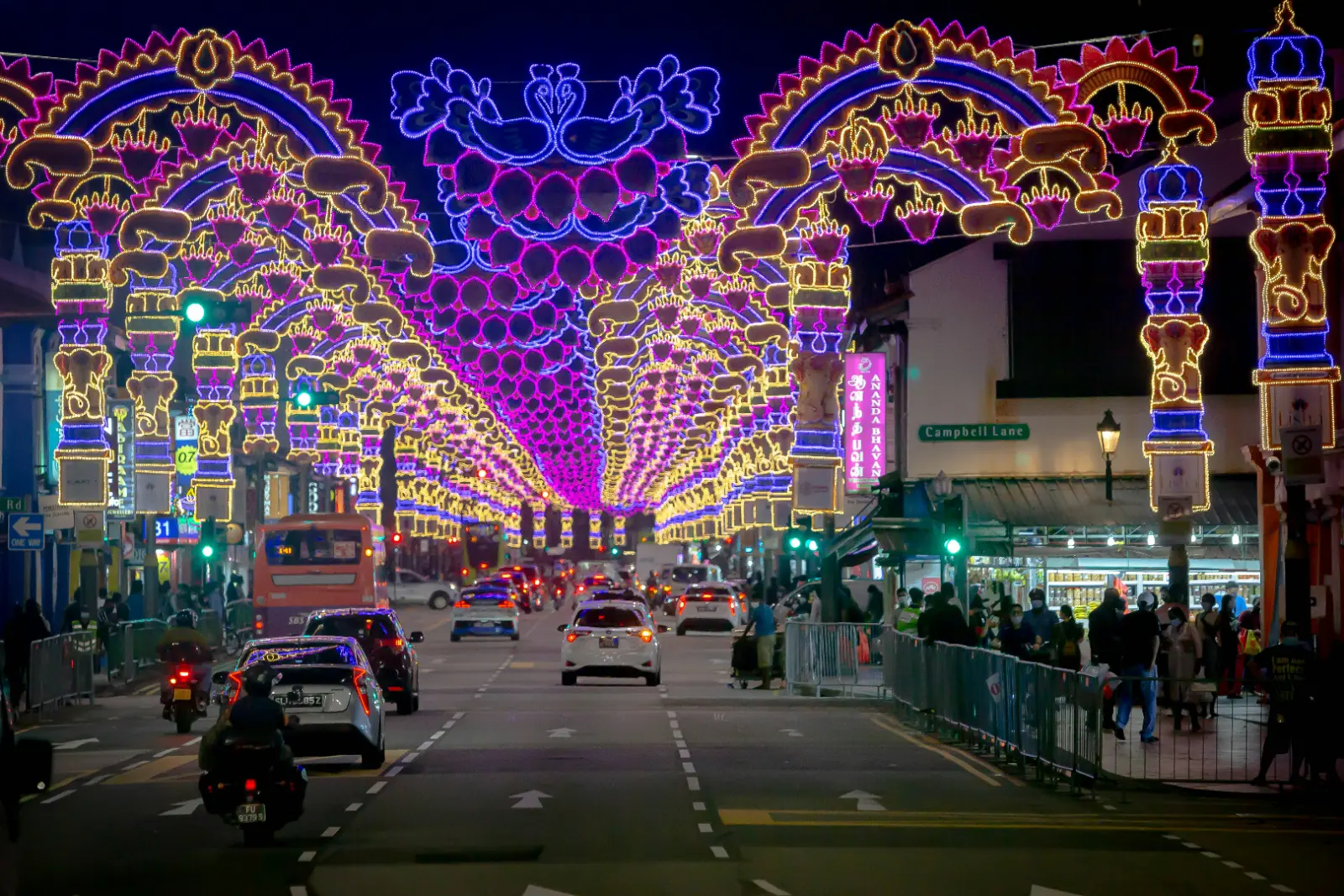
The Little India Deepavali light-up for 2026 was switched on at a ceremony on Birch Road on Saturday 3 October 2026, and the street lights along Serangoon Road come on every night from 7pm to midnight. Deepavali itself falls on Sunday 8 November 2026, a Singapore public holiday, with Monday 9 November as the day in lieu. The light-up and festival programme are run by LISHA, the Little India Shopkeepers and Heritage Association.

Deepavali 2026 in Singapore: key dates

Diwali decorations strung above the street in Little India during the Singapore festival season
WhatDate and time (2026)Source
Street light-up ceremonySaturday 3 October, 7pm, Birch RoadDeepavali.sg (LISHA)
Lights onDaily, 7pm to midnight, "throughout the festival"Deepavali.sg (LISHA)
Light-up routeAbout 2 km of Serangoon RoadLittle Big Red Dot, 2 Oct 2026
Festival Village (bazaar)Campbell Lane, 10 October to 8 November, from 7pm; closes on Deepavali dayLittle Big Red Dot and other event listings citing LISHA
DeepavaliSunday 8 November (public holiday)Ministry of Manpower
Monday in lieuMonday 9 November (public holiday because 8 November is a Sunday)Ministry of Manpower
Lights switched offNot published on Deepavali.sg when we checked; one event listing citing LISHA's press material gives 29 NovemberUnconfirmed; check Deepavali.sg

Checked: 28 Oct 2026, Source: Ministry of Manpower public holidays list and Deepavali.sg street light-up page.

Be honest with yourself about the end date. The official page says only that the lights stay on "throughout the festival". We could not confirm the 2026 switch-off date on an official source, so if you are arriving in late November, check Deepavali.sg before you plan an evening around the lights.

What happens during the festival season

  • Street arches and lights: decorated arches and lit motifs along Serangoon Road, best seen after 7pm. The stretch near Little India MRT and Birch Road is the most photographed.
  • Festival Village on Campbell Lane: stalls selling clay diyas, rangoli powder, garlands, brassware, saris, kurtas and festive sweets. It closes on Deepavali day itself, so shop before 8 November.
  • Cultural programmes: LISHA's Deepavali programme in 2026 included free open-air music nights on the Campbell Lane stage and craft workshops at Tekka Place in October. Listings change, so check Deepavali.sg for what is still on.
  • Temples: special prayers at the Hindu temples in the days around Deepavali, with long queues on the eve and the morning itself.

Tihar and Deepavali in 2026: the overlap for Nepali travellers

In 2026 the two festivals line up neatly: Laxmi Puja in Nepal and Deepavali in Singapore both fall on Sunday 8 November. That means a Nepali family in Singapore that weekend can light diyas at home in the evening, then walk under the Serangoon Road lights, or visit Sri Veeramakaliamman for darshan, on the same night that relatives in Kathmandu are doing Laxmi Puja.

DayNepal (Tihar 2026)Singapore
Saturday 7 NovemberKaag Tihar (some calendars also place Kukur Tihar here)Deepavali eve; last full evening of the Festival Village; heaviest crowds in Little India
Sunday 8 NovemberKukur Tihar and Laxmi Puja (evening)Deepavali, public holiday
Monday 9 NovemberGai TiharPublic holiday in lieu
Tuesday 10 NovemberGoru Tihar, Govardhan Puja and Mha Puja (Nepal Sambat new year)Normal working day
Wednesday 11 NovemberBhai TikaNormal working day; street lights still on

Checked: 28 Oct 2026, Sources: the 2083 calendar of the Nepal Panchanga Nirnayak Bikas Samiti as reported in Nepali media (Kaag Tihar Kartik 21, Laxmi Puja Kartik 22, Bhai Tika Kartik 25), Nepali calendar listings (nepalical.com, katigate.com) and the Ministry of Manpower. Some Indian panchang sites place Kaag and Kukur Tihar a day earlier, so confirm the exact puja day and Bhai Tika sait (auspicious time) with your family's patro or the Nepal Panchanga Nirnayak Samiti announcement. The two festivals do not always land on the same date: Singapore follows the Tamil calendar for Deepavali, and in some years the dates differ by a day, so check every year rather than assuming.

Practical points for diaspora families: if you want to do Bhai Tika with siblings in Singapore, Wednesday 11 November is a working day there, so plan around office hours. Puja items such as diyas, wicks, ghee, marigold garlands, abir and sweets are easy to buy in Little India, and rangoli powder is sold at the festival stalls. For how Tihar travel fits into school and office leave from Nepal, our guide to Dashain and Tihar holidays abroad compares Singapore with other short-haul options.

What should you eat in Little India?

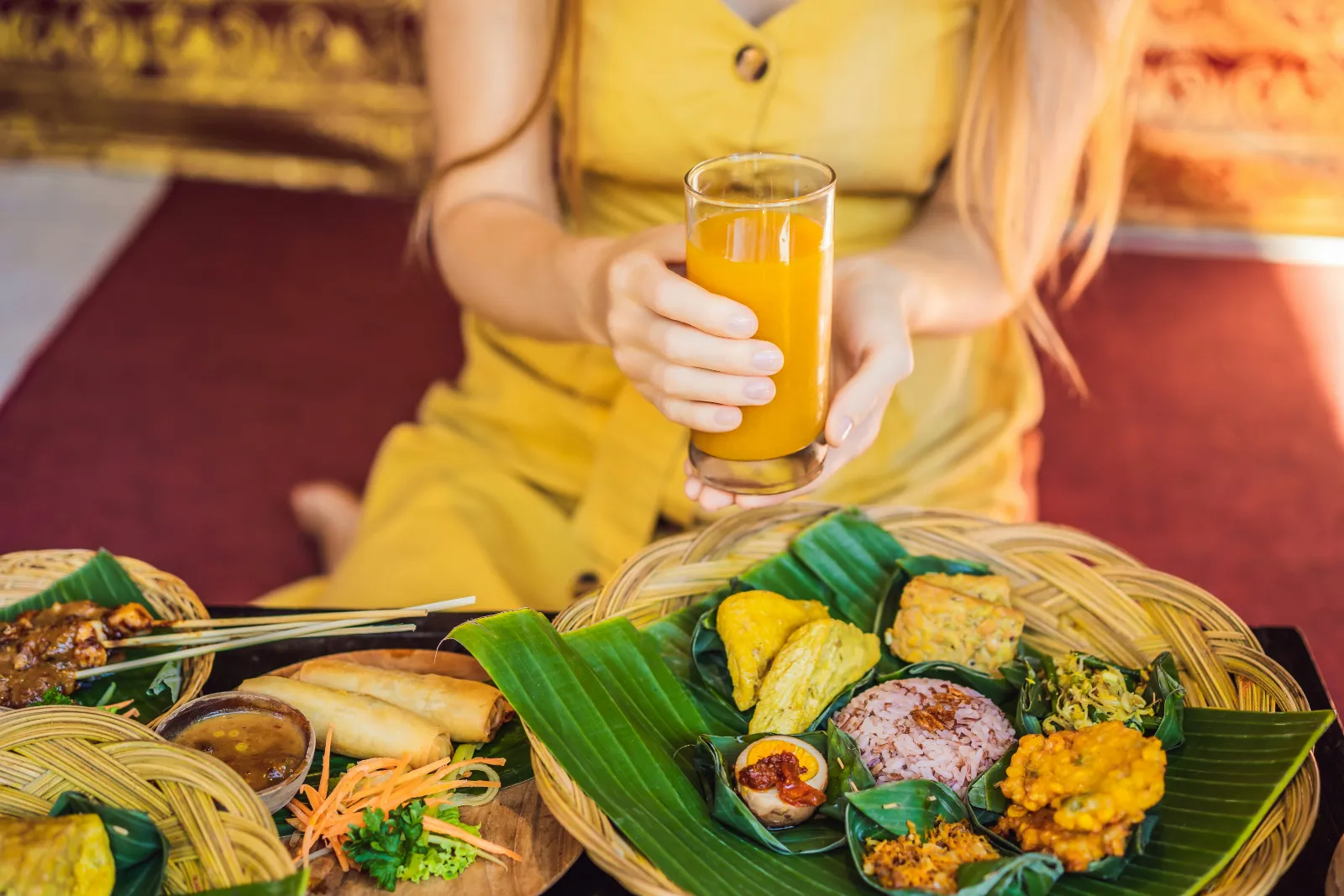
Eat a South Indian vegetarian meal on a banana leaf or a thali at a pure-vegetarian restaurant, try dosa, idli and vadai for breakfast, and go to Tekka Centre for hawker-style biryani, roti prata and teh tarik. Little India is the easiest place in Singapore for strict vegetarians, because many restaurants here are fully vegetarian rather than simply offering a few meatless dishes.

Dishes to look for

Colourful meal of rice and side dishes served on a fresh banana leaf with a cold drink
DishWhat it isVegetarian?Good to know
Banana-leaf mealRice served on a banana leaf with sambar, rasam, two or three vegetable dishes, papadum, pickle and curdYes at vegetarian restaurants; some places add meat or fish sidesEat with the right hand if you like; fold the leaf towards you when finished to show you enjoyed it
ThaliA steel tray with rice, chapati or poori, dal, vegetables, curd and a sweetUsually, at vegetarian restaurantsFamiliar to Nepali diners as a cousin of dal bhat tarkari
Masala dosaThin fermented rice and lentil crepe with spiced potato, served with chutneys and sambarYesPaper dosa is the extra-large, very thin version
Idli and vadaiSteamed rice cakes and savoury lentil doughnutsYesThe classic South Indian breakfast
Roti prataFlaky griddled flatbread with curryPlain or egg prata; check the curryAsk for dal or vegetable curry if you avoid meat
BiryaniSpiced rice, usually with mutton or chickenVegetable versions existCommon at Tekka Centre and Indian Muslim restaurants
Teh tarik and masala tea"Pulled" sweet milk tea, or spiced milk teaYesThe closest thing in Singapore to a Kathmandu chiya break
Indian sweetsLaddoo, jalebi, barfi, murukku and moreMostly vegetarianSweet shops are busiest in the week before Deepavali

Vegetarian restaurants and where to eat

These are long-running names that Singapore food media have recommended; we have not eaten at each one recently, and opening hours change, so check recent reviews before you go.

  • Ananda Bhavan: a vegetarian restaurant group operating since 1924, with its original branch on Selegie Road and other outlets in the area. Known for prata and dosa.
  • Madras New Woodlands: 14 Upper Dickson Road. South Indian vegetarian, known for lighter dishes such as pongal and paper dosa, and thali sets.
  • Gokul Vegetarian: Upper Dickson Road. A long-running vegetarian restaurant with North and South Indian dishes and mock-meat versions of popular favourites. If you need Jain-style food without onion or garlic, ask the staff.
  • Banana Leaf Apolo: Little India Arcade area on Serangoon Road. Not vegetarian (it is famous for fish-head curry), but every dish is served on banana leaf, and there are vegetable sides.
  • Tekka Centre hawker centre: the ground floor of Tekka Centre has many Indian stalls for biryani, prata, dosa and tea at hawker prices, alongside Chinese and Malay stalls.

A note on Komala Vilas: the famous vegetarian restaurant at 76 to 78 Serangoon Road, open since 1947 and still listed in many guides, has been shut since 19 January 2026 behind a "closed for renovation" notice. By October 2026 no reopening or new location had been announced, and local reports said the Serangoon Road shophouse was set to become a jewellery showroom. Checked: 28 Oct 2026, Sources: Tabla (March 2026) and Wake Up Singapore (14 October 2026). Treat it as closed unless you see a confirmed reopening.

Strict vegetarians should also know that "no meat" in a general hawker dish does not always mean no fish sauce, shrimp paste or lard. Our guide to the best food in Singapore explains how to spot dedicated vegetarian and halal stalls across the city.

Nepali food in and near Little India

Singapore has a small Nepali community, including families linked to the Gurkha Contingent of the Singapore Police Force, and a handful of restaurants in and around Little India serve momo, sekuwa and dal bhat alongside North Indian food. Singapore food sites have reviewed places such as Gurkha Palace on Chander Road and Amber Tandoor near Serangoon Road over the years. We could not confirm their current status, so check a recent map listing or reviews before you go.

What can you shop for at Tekka Centre and Mustafa Centre?

Tekka Centre is the place for fresh produce, spices, Indian clothing and tailoring, while Mustafa Centre is a huge department store for almost everything else: gold, electronics, groceries, spices, cosmetics, luggage and souvenirs. Serangoon Road, Little India Arcade and Campbell Lane fill the gaps with gold shops, saris, flower garlands and puja items.

Tekka Centre

Tekka Centre at 665 Buffalo Road sits next to Little India MRT. It opened in the early 1980s on a site across the road from the old 1915 Tekka Market and was renamed Tekka Centre in 2000. The ground floor holds the hawker centre and a large wet market with fresh vegetables, fish, meat and spices, and the upper level has shops selling saris, salwar suits, kurtas, fabric and tailoring. The name comes from the Hokkien for the bamboo that once grew along the Rochor Canal.

Mustafa Centre

Mustafa Centre at 145 Syed Alwi Road is open 24 hours a day. It returned to round-the-clock opening on 6 September 2024, after shorter hours during and after the pandemic. Checked: 28 Oct 2026, Sources: Time Out Singapore listing and reports of the September 2024 change. The store spreads across two connected buildings: one with jewellery, household appliances and the supermarket, the other with clothing, electronics, toys and much more. It also has a money changer and a rooftop restaurant.

Mustafa is popular with Nepali travellers for practical shopping before the flight home: gold jewellery, watches, phones and accessories, chocolates, dry fruit, spices and Indian groceries. Allow at least two hours, because the layout is famously maze-like. Late night is the calmest time, which makes it handy after a late dinner.

Little India shopping guide

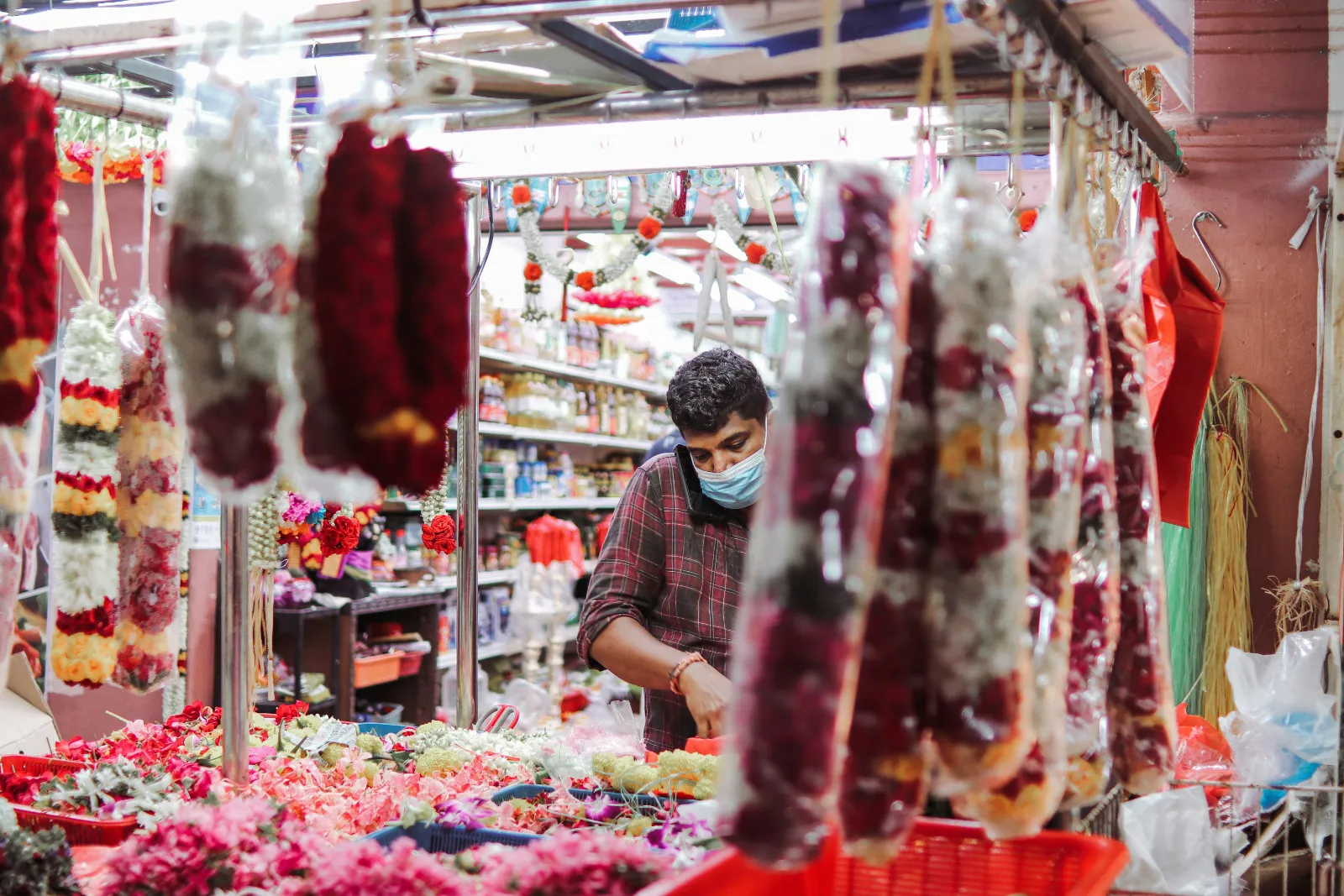
Jasmine and marigold flower garlands hanging at a shop in Little India, Singapore
WhereBest forHours and tips
Tekka Centre, 665 Buffalo RoadFresh produce, spices, saris, Punjabi suits, tailoring, hawker foodWet market is best in the morning; individual shops set their own hours
Mustafa Centre, 145 Syed Alwi RoadGold, electronics, groceries, spices, cosmetics, luggage, souvenirsOpen 24 hours (checked 28 Oct 2026); late night is quietest
Serangoon RoadGold and jewellery shops, sari and textile shops, sweet shops, puja goodsBusiest in the weeks before Deepavali
Little India Arcade, 48 Serangoon RoadHenna, bangles, incense, small souvenirs, snacksA compact restored row of shophouses opposite Tekka Centre
Campbell LaneFestival Village stalls in season: diyas, rangoli, garlands, brassware, clothesFestival Village runs 10 October to 8 November 2026, from 7pm
Flower stalls near Serangoon RoadJasmine and marigold garlands for temple offeringsBuy just before a temple visit so the flowers stay fresh

Indian Heritage Centre

The Indian Heritage Centre at 5 Campbell Lane is the National Heritage Board's museum of the Indian community in Singapore and Southeast Asia, opened in 2015 with more than 440 artefacts in its collection. Its official visitor page lists opening hours of 10am to 6pm, Tuesday to Sunday, with last admission at 5.30pm, and it is closed every Monday, including public holidays that fall on a Monday. That matters in 2026: the Deepavali day in lieu, Monday 9 November, is a Monday. Admission is free for Singapore citizens and permanent residents; other visitors pay an admission fee, which is listed on the official site. Checked: 28 Oct 2026, Source: Indian Heritage Centre.

For the rest of the city's shopping, from Orchard Road malls to Changi duty free, see our Singapore shopping guide.

How do you get to Little India?

Take the MRT to Little India station, which is served by both the North East Line (NE7) and the Downtown Line (DT12). Farrer Park (NE8), one stop north, is better for Mustafa Centre, Sri Srinivasa Perumal Temple and the Race Course Road temples. Rochor and Jalan Besar on the Downtown Line are also within walking distance of parts of the area.

Starting fromSimplest route by MRTChanges
Changi AirportChangi Airport station to Expo, then the Downtown Line to Little IndiaOne change, at Expo
Marina Bay (Bayfront)Downtown Line from Bayfront to Little IndiaNone
ChinatownNorth East Line or Downtown Line from Chinatown to Little IndiaNone
Orchard RoadNorth South Line to Dhoby Ghaut, then the North East Line one stop to Little IndiaOne change, at Dhoby Ghaut
Bugis or Kampong GlamDowntown Line from Bugis to Little India, or walk about 20 minutesNone
Sentosa or HarbourFrontNorth East Line from HarbourFront to Little IndiaNone

The Indian Heritage Centre recommends Exit E of Little India station; Tekka Centre is right beside the station. Little India station has six exits, so check the signs to the street you want.

Getting to Singapore from Nepal

From Kathmandu, Singapore Airlines flies nonstop to Singapore Changi in roughly five hours, and other airlines connect through Kuala Lumpur, Bangkok or Delhi. Our Kathmandu to Singapore flight guide explains the direct and one-stop options in detail. Entry rules for Nepali passport holders change from time to time, so check our Singapore visa page before you book.

What etiquette should visitors follow at temples?

Dress modestly with shoulders and knees covered, remove your shoes before entering, keep your voice low, ask before photographing people or the inner shrine, and never walk in front of someone who is praying. These basics apply at the Hindu, Buddhist and Chinese temples in Little India alike.

DoDo not
Cover shoulders and knees; carry a light shawl or scarfWear very short shorts, sleeveless tops or beachwear
Leave shoes at the rack outside; socks are usually fineWalk onto the temple floor in footwear
Walk clockwise around shrines at Hindu templesTouch the deities or step into the inner sanctum
Use your right hand to receive prasad (blessed food), holy ash or waterPoint the soles of your feet at a shrine when sitting
Ask before photographing worshippers or priestsUse flash or film during prayers
Make a small donation in the box if you wishBring meat, eggs or alcohol into a Hindu temple
Stand aside during processions and aratiBlock the doorway or the path in front of the main shrine

Most Nepali Hindu visitors will already know these customs from Pashupatinath or Dakshinkali; the difference is that Tamil temples in Singapore can be stricter about photographing the inner shrine, and some display their own rules at the door. Follow the signs. Many temples close for some hours in the middle of the day, as the Hindu Endowments Board timings for Sri Srinivasa Perumal show, so a morning or early evening visit usually works best. For wider manners, from chewing gum rules to eating on the MRT, see our dos and don'ts in Singapore.

Public drinking rules in Little India

Singapore bans drinking alcohol in public places from 10.30pm to 7am every day, and Little India is a designated Liquor Control Zone with stricter limits at weekends and around public holidays. The Singapore Police Force publishes a no public drinking period for Little India each Deepavali eve. Checked: 28 Oct 2026, Sources: Ministry of Home Affairs and Singapore Police Force Deepavali advisory. The simple rule for visitors is not to drink on the street here.

When is Little India busiest, and when should you go?

Little India is busiest on Sunday afternoons and evenings, on Deepavali eve and during the weeks of shopping before Deepavali, and around Thaipusam. It is calmest on weekday mornings. For temples and photos, go on a weekday morning; for the festival atmosphere, go on a weekday evening after 7pm during the light-up.

TimeCrowdsBest for
Weekday morning (about 8am to 11am)LowTemples, the wet market at Tekka Centre, breakfast dosa, quiet photos
Weekday eveningModerateDinner and the Deepavali lights without the weekend crush
SaturdayModerate to highShopping; the Festival Village in season
Sunday afternoon and eveningVery highAtmosphere only; many migrant workers spend their day off here, and streets and the MRT get packed
Deepavali eve (Saturday 7 November 2026)Extremely highFestival buzz; expect crossings to close and heavy traffic on Serangoon Road
Deepavali day (Sunday 8 November 2026)High at temples, quieter in shopsTemple visits; many family-run shops close for the holiday
Late night, any dayLowMustafa Centre, which is open 24 hours

Weather in October and November

Deepavali season coincides with Singapore's inter-monsoon period, when the National Environment Agency typically forecasts thundery showers on many afternoons, sometimes running into the evening. Carry a small umbrella, plan temples and outdoor walks for the morning, and keep indoor stops such as Tekka Centre, the Indian Heritage Centre and Mustafa Centre for the wettest hours.

Is Little India safe?

Little India is generally safe at any hour, including late at night, and Singapore is one of the safer cities in Asia. The main risk is pickpocketing in very dense crowds, which is why the Singapore Police Force advises Deepavali visitors to keep bags closed and carried in front, and not to keep wallets in back pockets. In an emergency, dial 999 for the police.

Planning your visit

  • Half day: start at Sri Veeramakaliamman in the morning, walk to Sri Srinivasa Perumal and the Race Course Road temples, then lunch on a banana leaf and finish at Tekka Centre.
  • Evening in festival season: arrive around 7pm when the lights come on, walk Serangoon Road, browse the Festival Village on Campbell Lane if it is still running, and end with dinner or a late visit to Mustafa Centre.
  • Families with children: go on a weekday evening rather than Sunday or Deepavali eve, agree a meeting point (Tekka Centre is easy to find), and use the Indian Heritage Centre for a cool, quiet hour if it is open.
  • Older parents: the temples have steps and stone floors that get hot in the afternoon; mornings are kinder, and taxis can drop close to Serangoon Road outside festival nights.

If you would rather have flights, hotel and city transfers arranged as one trip, see our Singapore tour packages, and add a Little India evening during Deepavali season to your own plans.

Frequently asked questions

When is Deepavali 2026 in Singapore?

Deepavali 2026 in Singapore is on Sunday 8 November 2026, according to the Ministry of Manpower's public holiday list. Because it falls on a Sunday, Monday 9 November 2026 is the public holiday in lieu. In Nepal, Laxmi Puja falls on the same Sunday this year, so Tihar and Deepavali line up closely in 2026.

How long do the Little India Deepavali lights stay up?

The Little India Deepavali lights were switched on on 3 October 2026 and come on nightly from 7pm to midnight "throughout the festival", according to Deepavali.sg. The official page did not give a switch-off date when we checked on 28 October 2026; one event listing citing LISHA gives 29 November. Check Deepavali.sg if you arrive after Deepavali.

Is Deepavali a public holiday in Singapore?

Yes. Deepavali is one of Singapore's gazetted public holidays. In 2026 it falls on Sunday 8 November, so Monday 9 November is a public holiday in lieu. Many family-run shops in Little India close on Deepavali day, while temples are very busy, and some attractions such as the Indian Heritage Centre close on Mondays.

Is Mustafa Centre open 24 hours?

Yes. Mustafa Centre at 145 Syed Alwi Road in Little India returned to 24 hour opening on 6 September 2024 and was still listed as open around the clock when we checked on 28 October 2026. Late night is the quietest time to shop there. The nearest MRT stations are Farrer Park and Jalan Besar.

Can tourists enter Sri Veeramakaliamman Temple?

Yes. Tourists of any faith can enter Sri Veeramakaliamman Temple on Serangoon Road outside special ceremonies. Remove your shoes, cover shoulders and knees, keep quiet, and ask before photographing worshippers. Visit Singapore allows photos but asks visitors to be considerate. Check opening and puja times at the entrance, as they vary through the day.

Is Little India good for vegetarian food?

Yes. Little India in Singapore is the easiest place in the city for strict vegetarians, with several fully vegetarian South Indian restaurants serving banana-leaf meals, thali, dosa and idli. Madras New Woodlands and Gokul Vegetarian on Upper Dickson Road are two long-running names. Note that Komala Vilas on Serangoon Road has been closed since January 2026, with no reopening announced.

Is Little India safe at night?

Yes, Little India in Singapore is generally safe at night, and Mustafa Centre stays open 24 hours. The main risk is pickpocketing in dense crowds on Sunday evenings and Deepavali eve, so keep bags closed and in front of you. Public drinking is restricted in Little India, especially at weekends and around holidays. Dial 999 for police.

What is the best day of the week to visit Little India?

A weekday, Tuesday to Friday, is the best time to visit Little India in Singapore. Mornings suit temples and the Tekka wet market; evenings suit the Deepavali lights. Avoid Sunday afternoons and evenings if you dislike crowds, and remember the Indian Heritage Centre is closed on Mondays.

Which MRT station serves Little India?

Little India MRT station serves the area on both the North East Line (NE7) and the Downtown Line (DT12), next to Tekka Centre. Farrer Park (NE8) is better for Mustafa Centre, Sri Srinivasa Perumal Temple and the Race Course Road temples. From Changi Airport, change once at Expo to the Downtown Line.

Can I find Nepali food in Singapore?

Yes, but there are only a handful of Nepali restaurants in Singapore, mostly in and around Little India, serving momo, sekuwa and dal bhat beside North Indian dishes. Places such as Gurkha Palace on Chander Road have been reviewed in Singapore food media, but listings change, so check a recent map listing or reviews before you go.

Singapore ma Tihar ra Deepavali sangai manaauna milcha?

Milcha. Yo barsha (2026) Laxmi Puja ra Singapore ko Deepavali dubai Aitabar 8 November ma pareko chha, tyasaile Little India ko batti herna, mandir ma darshan garna ra puja saman kinna sajilo hunchha. Bhai Tika Budhabar 11 November ma ho, Singapore ma tyo kaam garne din ho. (Yes. In 2026 Laxmi Puja and Singapore's Deepavali both fall on Sunday 8 November, so you can see the lights, visit temples and buy puja items; Bhai Tika on Wednesday 11 November is a working day in Singapore.)

Tags
Singapore
Share
G
Gomayu Team
Writer at Gomayu
Keep reading
Blog / Singapore
Little India Singapore: Temples, Food and Deepavali Lights
26 min read 28 Oct 2026
Festive Deepavali light arches glowing over the street in Little India, Singapore at night

Short answer: Little India Singapore is the historic Indian quarter around Serangoon Road, a short MRT ride from the city centre on the North East and Downtown lines. Go for the Sri Veeramakaliamman and Sri Srinivasa Perumal temples, South Indian vegetarian meals on banana leaf, Tekka Centre and the 24 hour Mustafa Centre. In 2026 Deepavali falls on Sunday 8 November, the same day as Laxmi Puja in Nepal, and the Serangoon Road street lights have been switched on nightly since 3 October. Weekday mornings are calmest; Sunday evenings and Deepavali eve are the busiest.

Little India is the one part of Singapore where a visitor from Kathmandu, Delhi or Chennai can feel oddly at home: marigold garlands strung outside flower stalls, the smell of incense and ghee, temple bells, Tamil film songs from shop doorways, and sweet shops stacked with laddoo and murukku before Deepavali. It is also one of the city's most rewarding walks for any visitor, because the temples, food and shops sit within a few streets of each other.

This guide covers what Little India is, which temples to visit and how to behave inside them, the dated Deepavali 2026 light-up, where to eat (including a frank note on which famous names have changed), what to buy at Tekka Centre and Mustafa Centre, how to get there by MRT, and when the area is busiest. For the wider picture of the city, start with our complete Singapore travel guide.

What is Little India in Singapore?

Colourful shophouses under festive street decorations along a road in Little India, Singapore

Little India is Singapore's historic Indian neighbourhood, centred on Serangoon Road and the lanes between it and Race Course Road, just north of the city centre. It is a working community, not a theme park: people shop for groceries, gold, saris and puja items here, temples hold daily worship, and the area fills with families before Deepavali and Thaipusam.

The area's Indian character grew out of work. According to the National Heritage Board's Roots portal, the British set up lime pits and brick kilns along Serangoon Road in the 1820s, and many Indian workers found jobs there. When the kilns closed around 1860, the area turned to cattle, with slaughterhouses, tanneries and milk delivery. In the early 1900s herdsmen from Uttar Pradesh and Bihar settled by the Rochor Canal, and the old Tekka Market was built in 1915 to sell the produce. The name "Little India" itself was only made official in the 1980s, through an effort by the then Singapore Tourist Promotion Board. Checked: 28 Oct 2026, Source: Roots.sg, National Heritage Board.

Today the area is mostly Tamil in flavour, because most of Singapore's Indian community has South Indian roots, but you will also find North Indian, Bengali, Sri Lankan, Bangladeshi and Nepali shops and kitchens. Hindu temples stand a short walk from a Thai Buddhist temple, a Chinese Buddhist temple and several mosques, which is why the Heritage Board's trail through the area includes a "walk of faiths".

Little India at a glance

ItemDetail
Main streetSerangoon Road, with Race Course Road, Campbell Lane, Dunlop Street, Buffalo Road and Syed Alwi Road around it
Nearest MRTLittle India (NE7 on the North East Line, DT12 on the Downtown Line); Farrer Park (NE8) for the northern end and Mustafa Centre; Rochor and Jalan Besar on the Downtown Line also work
Main templesSri Veeramakaliamman, Sri Srinivasa Perumal, Sakya Muni Buddha Gaya, Leong San See
Food anchorTekka Centre hawker centre and the South Indian restaurants on Upper Dickson Road, Race Course Road and Serangoon Road
Shopping anchorsTekka Centre, Little India Arcade, Mustafa Centre, Serangoon Road gold and textile shops
MuseumIndian Heritage Centre, 5 Campbell Lane
Biggest festivalDeepavali (Sunday 8 November 2026), with street light-up and a festival village beforehand
Time neededHalf a day for temples, a meal and shopping; an evening visit for the lights in festival season

If you are still choosing between neighbourhoods, our guide to the best places to visit in Singapore compares Little India with Chinatown, Kampong Glam, Marina Bay and Sentosa, so you can fit it into a wider plan.

Which temples should you visit in Little India?

Black and white view of a sculpted Hindu temple gopuram in Little India, Singapore

The four temples most worth your time are Sri Veeramakaliamman and Sri Srinivasa Perumal (both Hindu, on Serangoon Road) and the Sakya Muni Buddha Gaya and Leong San See temples (both Buddhist, on Race Course Road). Together they show how many faiths share this small district, and all four welcome respectful visitors outside prayer times.

Sri Veeramakaliamman Temple

Sri Veeramakaliamman Temple at 141 Serangoon Road is the heart of Little India. It is dedicated to Kali, the fierce form of the goddess, and also honours Parvati with her sons Ganesha and Murugan. A shrine has stood here since 1855, and Bengali labourers built a temple on the site in 1881; it was once known as Soonambu Kambam Kovil, a name linked to the old lime pits. The building follows the South Indian Tamil temple style rather than the style of Kali temples in Bengal, so expect a colourful gopuram (tower gateway) crowded with sculpted figures.

For Nepali visitors, Kali worship will feel familiar, and many families stop here to light a lamp before Deepavali. Visit Singapore notes that photos are allowed but asks visitors to be considerate of worshippers. We could not confirm current opening and puja times from an official temple source on the day of writing, so check the notice at the entrance or the temple's own channels before you go.

Sri Srinivasa Perumal Temple

Sri Srinivasa Perumal Temple, further north on Serangoon Road near Farrer Park MRT, is dedicated to Vishnu in his form as Perumal. The Hindu Endowments Board, which manages it, says the temple was built in 1855, a new temple was completed by 1966, and its tall rajagopuram (main tower entrance) was added in 1979. It is the starting point of the Thaipusam procession each year.

The Hindu Endowments Board lists two daily opening windows: on weekdays 5am to 11am and 6pm to 8.30pm, with slightly longer morning hours at weekends and an earlier evening opening on Saturdays. Checked: 28 Oct 2026, Source: Hindu Endowments Board. The temple is closed between those windows, so plan your walk around them.

Sakya Muni Buddha Gaya Temple

Sakya Muni Buddha Gaya Temple on Race Course Road is often called the Temple of a Thousand Lights, after the many light bulbs that surround its central statue. It was founded in 1927 by Venerable Vutthisasara, a Thai monk, and its main image is a seated Buddha about 15 metres tall. The decoration is strongly Thai in style. Opening hours are commonly listed as 8am to 4.30pm daily; check on the day.

Nepali Buddhist visitors and anyone who knows Lumbini or Bodh Gaya will find the name meaningful, and the temple is a calm contrast to the bustle of Serangoon Road.

Leong San See Temple

Leong San See Temple at 371 Race Course Road, almost opposite Sakya Muni Buddha Gaya, is a Chinese Buddhist temple. The National Heritage Board says it was founded in 1917 by the Reverend Chun Wu and that the present conserved building was completed in 1926 with materials from China. It is dedicated mainly to Guan Yin, the Goddess of Mercy, and also has an altar to Confucius, where students sometimes pray before exams. Opening hours are listed as 6am to 6pm; check on the day.

Little India temples compared

TempleFaith and main deityLocationHistoryVisiting note
Sri VeeramakaliammanHindu; Kali, with Parvati, Ganesha and Murugan141 Serangoon Road, near Little India MRTShrine from 1855; temple built 1881 by Bengali labourersBusiest Hindu temple in the area; check puja times at the entrance
Sri Srinivasa PerumalHindu; Vishnu (Perumal)Serangoon Road, near Farrer Park MRTBuilt 1855; rajagopuram added 1979Weekdays 5am to 11am and 6pm to 8.30pm (HEB, checked 28 Oct 2026)
Sakya Muni Buddha GayaThai Buddhist; seated Buddha about 15 m tallRace Course Road, near Farrer Park MRTFounded 1927 by a Thai monkListed as 8am to 4.30pm; check on the day
Leong San SeeChinese Buddhist; Guan Yin, plus a Confucius altar371 Race Course RoadFounded 1917; present building 1926Listed as 6am to 6pm; check on the day

All four sit within about a 20 minute walk of each other. A simple order is Sri Veeramakaliamman first (near Little India MRT), then up Serangoon Road to Sri Srinivasa Perumal, then across to Race Course Road for the two Buddhist temples, finishing near Farrer Park MRT or Mustafa Centre.
Explore Singapore tour packages
View all →

When are the Deepavali light-ups in Little India?

The Little India Deepavali light-up for 2026 was switched on at a ceremony on Birch Road on Saturday 3 October 2026, and the street lights along Serangoon Road come on every night from 7pm to midnight. Deepavali itself falls on Sunday 8 November 2026, a Singapore public holiday, with Monday 9 November as the day in lieu. The light-up and festival programme are run by LISHA, the Little India Shopkeepers and Heritage Association.

Deepavali 2026 in Singapore: key dates
Diwali decorations strung above the street in Little India during the Singapore festival season
WhatDate and time (2026)Source
Street light-up ceremonySaturday 3 October, 7pm, Birch RoadDeepavali.sg (LISHA)
Lights onDaily, 7pm to midnight, "throughout the festival"Deepavali.sg (LISHA)
Light-up routeAbout 2 km of Serangoon RoadLittle Big Red Dot, 2 Oct 2026
Festival Village (bazaar)Campbell Lane, 10 October to 8 November, from 7pm; closes on Deepavali dayLittle Big Red Dot and other event listings citing LISHA
DeepavaliSunday 8 November (public holiday)Ministry of Manpower
Monday in lieuMonday 9 November (public holiday because 8 November is a Sunday)Ministry of Manpower
Lights switched offNot published on Deepavali.sg when we checked; one event listing citing LISHA's press material gives 29 NovemberUnconfirmed; check Deepavali.sg

Checked: 28 Oct 2026, Source: Ministry of Manpower public holidays list and Deepavali.sg street light-up page.

Be honest with yourself about the end date. The official page says only that the lights stay on "throughout the festival". We could not confirm the 2026 switch-off date on an official source, so if you are arriving in late November, check Deepavali.sg before you plan an evening around the lights.

What happens during the festival season

  • Street arches and lights: decorated arches and lit motifs along Serangoon Road, best seen after 7pm. The stretch near Little India MRT and Birch Road is the most photographed.
  • Festival Village on Campbell Lane: stalls selling clay diyas, rangoli powder, garlands, brassware, saris, kurtas and festive sweets. It closes on Deepavali day itself, so shop before 8 November.
  • Cultural programmes: LISHA's Deepavali programme in 2026 included free open-air music nights on the Campbell Lane stage and craft workshops at Tekka Place in October. Listings change, so check Deepavali.sg for what is still on.
  • Temples: special prayers at the Hindu temples in the days around Deepavali, with long queues on the eve and the morning itself.

Tihar and Deepavali in 2026: the overlap for Nepali travellers

In 2026 the two festivals line up neatly: Laxmi Puja in Nepal and Deepavali in Singapore both fall on Sunday 8 November. That means a Nepali family in Singapore that weekend can light diyas at home in the evening, then walk under the Serangoon Road lights, or visit Sri Veeramakaliamman for darshan, on the same night that relatives in Kathmandu are doing Laxmi Puja.

DayNepal (Tihar 2026)Singapore
Saturday 7 NovemberKaag Tihar (some calendars also place Kukur Tihar here)Deepavali eve; last full evening of the Festival Village; heaviest crowds in Little India
Sunday 8 NovemberKukur Tihar and Laxmi Puja (evening)Deepavali, public holiday
Monday 9 NovemberGai TiharPublic holiday in lieu
Tuesday 10 NovemberGoru Tihar, Govardhan Puja and Mha Puja (Nepal Sambat new year)Normal working day
Wednesday 11 NovemberBhai TikaNormal working day; street lights still on

Checked: 28 Oct 2026, Sources: the 2083 calendar of the Nepal Panchanga Nirnayak Bikas Samiti as reported in Nepali media (Kaag Tihar Kartik 21, Laxmi Puja Kartik 22, Bhai Tika Kartik 25), Nepali calendar listings (nepalical.com, katigate.com) and the Ministry of Manpower. Some Indian panchang sites place Kaag and Kukur Tihar a day earlier, so confirm the exact puja day and Bhai Tika sait (auspicious time) with your family's patro or the Nepal Panchanga Nirnayak Samiti announcement. The two festivals do not always land on the same date: Singapore follows the Tamil calendar for Deepavali, and in some years the dates differ by a day, so check every year rather than assuming.

Practical points for diaspora families: if you want to do Bhai Tika with siblings in Singapore, Wednesday 11 November is a working day there, so plan around office hours. Puja items such as diyas, wicks, ghee, marigold garlands, abir and sweets are easy to buy in Little India, and rangoli powder is sold at the festival stalls. For how Tihar travel fits into school and office leave from Nepal, our guide to Dashain and Tihar holidays abroad compares Singapore with other short-haul options.

What should you eat in Little India?

Eat a South Indian vegetarian meal on a banana leaf or a thali at a pure-vegetarian restaurant, try dosa, idli and vadai for breakfast, and go to Tekka Centre for hawker-style biryani, roti prata and teh tarik. Little India is the easiest place in Singapore for strict vegetarians, because many restaurants here are fully vegetarian rather than simply offering a few meatless dishes.

Dishes to look for
Colourful meal of rice and side dishes served on a fresh banana leaf with a cold drink
DishWhat it isVegetarian?Good to know
Banana-leaf mealRice served on a banana leaf with sambar, rasam, two or three vegetable dishes, papadum, pickle and curdYes at vegetarian restaurants; some places add meat or fish sidesEat with the right hand if you like; fold the leaf towards you when finished to show you enjoyed it
ThaliA steel tray with rice, chapati or poori, dal, vegetables, curd and a sweetUsually, at vegetarian restaurantsFamiliar to Nepali diners as a cousin of dal bhat tarkari
Masala dosaThin fermented rice and lentil crepe with spiced potato, served with chutneys and sambarYesPaper dosa is the extra-large, very thin version
Idli and vadaiSteamed rice cakes and savoury lentil doughnutsYesThe classic South Indian breakfast
Roti prataFlaky griddled flatbread with curryPlain or egg prata; check the curryAsk for dal or vegetable curry if you avoid meat
BiryaniSpiced rice, usually with mutton or chickenVegetable versions existCommon at Tekka Centre and Indian Muslim restaurants
Teh tarik and masala tea"Pulled" sweet milk tea, or spiced milk teaYesThe closest thing in Singapore to a Kathmandu chiya break
Indian sweetsLaddoo, jalebi, barfi, murukku and moreMostly vegetarianSweet shops are busiest in the week before Deepavali

Vegetarian restaurants and where to eat

These are long-running names that Singapore food media have recommended; we have not eaten at each one recently, and opening hours change, so check recent reviews before you go.

  • Ananda Bhavan: a vegetarian restaurant group operating since 1924, with its original branch on Selegie Road and other outlets in the area. Known for prata and dosa.
  • Madras New Woodlands: 14 Upper Dickson Road. South Indian vegetarian, known for lighter dishes such as pongal and paper dosa, and thali sets.
  • Gokul Vegetarian: Upper Dickson Road. A long-running vegetarian restaurant with North and South Indian dishes and mock-meat versions of popular favourites. If you need Jain-style food without onion or garlic, ask the staff.
  • Banana Leaf Apolo: Little India Arcade area on Serangoon Road. Not vegetarian (it is famous for fish-head curry), but every dish is served on banana leaf, and there are vegetable sides.
  • Tekka Centre hawker centre: the ground floor of Tekka Centre has many Indian stalls for biryani, prata, dosa and tea at hawker prices, alongside Chinese and Malay stalls.

A note on Komala Vilas: the famous vegetarian restaurant at 76 to 78 Serangoon Road, open since 1947 and still listed in many guides, has been shut since 19 January 2026 behind a "closed for renovation" notice. By October 2026 no reopening or new location had been announced, and local reports said the Serangoon Road shophouse was set to become a jewellery showroom. Checked: 28 Oct 2026, Sources: Tabla (March 2026) and Wake Up Singapore (14 October 2026). Treat it as closed unless you see a confirmed reopening.

Strict vegetarians should also know that "no meat" in a general hawker dish does not always mean no fish sauce, shrimp paste or lard. Our guide to the best food in Singapore explains how to spot dedicated vegetarian and halal stalls across the city.

Nepali food in and near Little India

Singapore has a small Nepali community, including families linked to the Gurkha Contingent of the Singapore Police Force, and a handful of restaurants in and around Little India serve momo, sekuwa and dal bhat alongside North Indian food. Singapore food sites have reviewed places such as Gurkha Palace on Chander Road and Amber Tandoor near Serangoon Road over the years. We could not confirm their current status, so check a recent map listing or reviews before you go.

What can you shop for at Tekka Centre and Mustafa Centre?

Tekka Centre is the place for fresh produce, spices, Indian clothing and tailoring, while Mustafa Centre is a huge department store for almost everything else: gold, electronics, groceries, spices, cosmetics, luggage and souvenirs. Serangoon Road, Little India Arcade and Campbell Lane fill the gaps with gold shops, saris, flower garlands and puja items.

Tekka Centre

Tekka Centre at 665 Buffalo Road sits next to Little India MRT. It opened in the early 1980s on a site across the road from the old 1915 Tekka Market and was renamed Tekka Centre in 2000. The ground floor holds the hawker centre and a large wet market with fresh vegetables, fish, meat and spices, and the upper level has shops selling saris, salwar suits, kurtas, fabric and tailoring. The name comes from the Hokkien for the bamboo that once grew along the Rochor Canal.

Mustafa Centre

Mustafa Centre at 145 Syed Alwi Road is open 24 hours a day. It returned to round-the-clock opening on 6 September 2024, after shorter hours during and after the pandemic. Checked: 28 Oct 2026, Sources: Time Out Singapore listing and reports of the September 2024 change. The store spreads across two connected buildings: one with jewellery, household appliances and the supermarket, the other with clothing, electronics, toys and much more. It also has a money changer and a rooftop restaurant.

Mustafa is popular with Nepali travellers for practical shopping before the flight home: gold jewellery, watches, phones and accessories, chocolates, dry fruit, spices and Indian groceries. Allow at least two hours, because the layout is famously maze-like. Late night is the calmest time, which makes it handy after a late dinner.

Little India shopping guide
Jasmine and marigold flower garlands hanging at a shop in Little India, Singapore
WhereBest forHours and tips
Tekka Centre, 665 Buffalo RoadFresh produce, spices, saris, Punjabi suits, tailoring, hawker foodWet market is best in the morning; individual shops set their own hours
Mustafa Centre, 145 Syed Alwi RoadGold, electronics, groceries, spices, cosmetics, luggage, souvenirsOpen 24 hours (checked 28 Oct 2026); late night is quietest
Serangoon RoadGold and jewellery shops, sari and textile shops, sweet shops, puja goodsBusiest in the weeks before Deepavali
Little India Arcade, 48 Serangoon RoadHenna, bangles, incense, small souvenirs, snacksA compact restored row of shophouses opposite Tekka Centre
Campbell LaneFestival Village stalls in season: diyas, rangoli, garlands, brassware, clothesFestival Village runs 10 October to 8 November 2026, from 7pm
Flower stalls near Serangoon RoadJasmine and marigold garlands for temple offeringsBuy just before a temple visit so the flowers stay fresh

Indian Heritage Centre

The Indian Heritage Centre at 5 Campbell Lane is the National Heritage Board's museum of the Indian community in Singapore and Southeast Asia, opened in 2015 with more than 440 artefacts in its collection. Its official visitor page lists opening hours of 10am to 6pm, Tuesday to Sunday, with last admission at 5.30pm, and it is closed every Monday, including public holidays that fall on a Monday. That matters in 2026: the Deepavali day in lieu, Monday 9 November, is a Monday. Admission is free for Singapore citizens and permanent residents; other visitors pay an admission fee, which is listed on the official site. Checked: 28 Oct 2026, Source: Indian Heritage Centre.

For the rest of the city's shopping, from Orchard Road malls to Changi duty free, see our Singapore shopping guide.

How do you get to Little India?

Take the MRT to Little India station, which is served by both the North East Line (NE7) and the Downtown Line (DT12). Farrer Park (NE8), one stop north, is better for Mustafa Centre, Sri Srinivasa Perumal Temple and the Race Course Road temples. Rochor and Jalan Besar on the Downtown Line are also within walking distance of parts of the area.

Starting fromSimplest route by MRTChanges
Changi AirportChangi Airport station to Expo, then the Downtown Line to Little IndiaOne change, at Expo
Marina Bay (Bayfront)Downtown Line from Bayfront to Little IndiaNone
ChinatownNorth East Line or Downtown Line from Chinatown to Little IndiaNone
Orchard RoadNorth South Line to Dhoby Ghaut, then the North East Line one stop to Little IndiaOne change, at Dhoby Ghaut
Bugis or Kampong GlamDowntown Line from Bugis to Little India, or walk about 20 minutesNone
Sentosa or HarbourFrontNorth East Line from HarbourFront to Little IndiaNone

The Indian Heritage Centre recommends Exit E of Little India station; Tekka Centre is right beside the station. Little India station has six exits, so check the signs to the street you want.

Getting to Singapore from Nepal

From Kathmandu, Singapore Airlines flies nonstop to Singapore Changi in roughly five hours, and other airlines connect through Kuala Lumpur, Bangkok or Delhi. Our Kathmandu to Singapore flight guide explains the direct and one-stop options in detail. Entry rules for Nepali passport holders change from time to time, so check our Singapore visa page before you book.

What etiquette should visitors follow at temples?

Dress modestly with shoulders and knees covered, remove your shoes before entering, keep your voice low, ask before photographing people or the inner shrine, and never walk in front of someone who is praying. These basics apply at the Hindu, Buddhist and Chinese temples in Little India alike.

DoDo not
Cover shoulders and knees; carry a light shawl or scarfWear very short shorts, sleeveless tops or beachwear
Leave shoes at the rack outside; socks are usually fineWalk onto the temple floor in footwear
Walk clockwise around shrines at Hindu templesTouch the deities or step into the inner sanctum
Use your right hand to receive prasad (blessed food), holy ash or waterPoint the soles of your feet at a shrine when sitting
Ask before photographing worshippers or priestsUse flash or film during prayers
Make a small donation in the box if you wishBring meat, eggs or alcohol into a Hindu temple
Stand aside during processions and aratiBlock the doorway or the path in front of the main shrine

Most Nepali Hindu visitors will already know these customs from Pashupatinath or Dakshinkali; the difference is that Tamil temples in Singapore can be stricter about photographing the inner shrine, and some display their own rules at the door. Follow the signs. Many temples close for some hours in the middle of the day, as the Hindu Endowments Board timings for Sri Srinivasa Perumal show, so a morning or early evening visit usually works best. For wider manners, from chewing gum rules to eating on the MRT, see our dos and don'ts in Singapore.

Public drinking rules in Little India

Singapore bans drinking alcohol in public places from 10.30pm to 7am every day, and Little India is a designated Liquor Control Zone with stricter limits at weekends and around public holidays. The Singapore Police Force publishes a no public drinking period for Little India each Deepavali eve. Checked: 28 Oct 2026, Sources: Ministry of Home Affairs and Singapore Police Force Deepavali advisory. The simple rule for visitors is not to drink on the street here.

When is Little India busiest, and when should you go?

Little India is busiest on Sunday afternoons and evenings, on Deepavali eve and during the weeks of shopping before Deepavali, and around Thaipusam. It is calmest on weekday mornings. For temples and photos, go on a weekday morning; for the festival atmosphere, go on a weekday evening after 7pm during the light-up.

TimeCrowdsBest for
Weekday morning (about 8am to 11am)LowTemples, the wet market at Tekka Centre, breakfast dosa, quiet photos
Weekday eveningModerateDinner and the Deepavali lights without the weekend crush
SaturdayModerate to highShopping; the Festival Village in season
Sunday afternoon and eveningVery highAtmosphere only; many migrant workers spend their day off here, and streets and the MRT get packed
Deepavali eve (Saturday 7 November 2026)Extremely highFestival buzz; expect crossings to close and heavy traffic on Serangoon Road
Deepavali day (Sunday 8 November 2026)High at temples, quieter in shopsTemple visits; many family-run shops close for the holiday
Late night, any dayLowMustafa Centre, which is open 24 hours

Weather in October and November

Deepavali season coincides with Singapore's inter-monsoon period, when the National Environment Agency typically forecasts thundery showers on many afternoons, sometimes running into the evening. Carry a small umbrella, plan temples and outdoor walks for the morning, and keep indoor stops such as Tekka Centre, the Indian Heritage Centre and Mustafa Centre for the wettest hours.

Is Little India safe?

Little India is generally safe at any hour, including late at night, and Singapore is one of the safer cities in Asia. The main risk is pickpocketing in very dense crowds, which is why the Singapore Police Force advises Deepavali visitors to keep bags closed and carried in front, and not to keep wallets in back pockets. In an emergency, dial 999 for the police.

Planning your visit

  • Half day: start at Sri Veeramakaliamman in the morning, walk to Sri Srinivasa Perumal and the Race Course Road temples, then lunch on a banana leaf and finish at Tekka Centre.
  • Evening in festival season: arrive around 7pm when the lights come on, walk Serangoon Road, browse the Festival Village on Campbell Lane if it is still running, and end with dinner or a late visit to Mustafa Centre.
  • Families with children: go on a weekday evening rather than Sunday or Deepavali eve, agree a meeting point (Tekka Centre is easy to find), and use the Indian Heritage Centre for a cool, quiet hour if it is open.
  • Older parents: the temples have steps and stone floors that get hot in the afternoon; mornings are kinder, and taxis can drop close to Serangoon Road outside festival nights.

If you would rather have flights, hotel and city transfers arranged as one trip, see our Singapore tour packages, and add a Little India evening during Deepavali season to your own plans.

Frequently asked questions

When is Deepavali 2026 in Singapore?

Deepavali 2026 in Singapore is on Sunday 8 November 2026, according to the Ministry of Manpower's public holiday list. Because it falls on a Sunday, Monday 9 November 2026 is the public holiday in lieu. In Nepal, Laxmi Puja falls on the same Sunday this year, so Tihar and Deepavali line up closely in 2026.

How long do the Little India Deepavali lights stay up?

The Little India Deepavali lights were switched on on 3 October 2026 and come on nightly from 7pm to midnight "throughout the festival", according to Deepavali.sg. The official page did not give a switch-off date when we checked on 28 October 2026; one event listing citing LISHA gives 29 November. Check Deepavali.sg if you arrive after Deepavali.

Is Deepavali a public holiday in Singapore?

Yes. Deepavali is one of Singapore's gazetted public holidays. In 2026 it falls on Sunday 8 November, so Monday 9 November is a public holiday in lieu. Many family-run shops in Little India close on Deepavali day, while temples are very busy, and some attractions such as the Indian Heritage Centre close on Mondays.

Is Mustafa Centre open 24 hours?

Yes. Mustafa Centre at 145 Syed Alwi Road in Little India returned to 24 hour opening on 6 September 2024 and was still listed as open around the clock when we checked on 28 October 2026. Late night is the quietest time to shop there. The nearest MRT stations are Farrer Park and Jalan Besar.

Can tourists enter Sri Veeramakaliamman Temple?

Yes. Tourists of any faith can enter Sri Veeramakaliamman Temple on Serangoon Road outside special ceremonies. Remove your shoes, cover shoulders and knees, keep quiet, and ask before photographing worshippers. Visit Singapore allows photos but asks visitors to be considerate. Check opening and puja times at the entrance, as they vary through the day.

Is Little India good for vegetarian food?

Yes. Little India in Singapore is the easiest place in the city for strict vegetarians, with several fully vegetarian South Indian restaurants serving banana-leaf meals, thali, dosa and idli. Madras New Woodlands and Gokul Vegetarian on Upper Dickson Road are two long-running names. Note that Komala Vilas on Serangoon Road has been closed since January 2026, with no reopening announced.

Is Little India safe at night?

Yes, Little India in Singapore is generally safe at night, and Mustafa Centre stays open 24 hours. The main risk is pickpocketing in dense crowds on Sunday evenings and Deepavali eve, so keep bags closed and in front of you. Public drinking is restricted in Little India, especially at weekends and around holidays. Dial 999 for police.

What is the best day of the week to visit Little India?

A weekday, Tuesday to Friday, is the best time to visit Little India in Singapore. Mornings suit temples and the Tekka wet market; evenings suit the Deepavali lights. Avoid Sunday afternoons and evenings if you dislike crowds, and remember the Indian Heritage Centre is closed on Mondays.

Which MRT station serves Little India?

Little India MRT station serves the area on both the North East Line (NE7) and the Downtown Line (DT12), next to Tekka Centre. Farrer Park (NE8) is better for Mustafa Centre, Sri Srinivasa Perumal Temple and the Race Course Road temples. From Changi Airport, change once at Expo to the Downtown Line.

Can I find Nepali food in Singapore?

Yes, but there are only a handful of Nepali restaurants in Singapore, mostly in and around Little India, serving momo, sekuwa and dal bhat beside North Indian dishes. Places such as Gurkha Palace on Chander Road have been reviewed in Singapore food media, but listings change, so check a recent map listing or reviews before you go.

Singapore ma Tihar ra Deepavali sangai manaauna milcha?

Milcha. Yo barsha (2026) Laxmi Puja ra Singapore ko Deepavali dubai Aitabar 8 November ma pareko chha, tyasaile Little India ko batti herna, mandir ma darshan garna ra puja saman kinna sajilo hunchha. Bhai Tika Budhabar 11 November ma ho, Singapore ma tyo kaam garne din ho. (Yes. In 2026 Laxmi Puja and Singapore's Deepavali both fall on Sunday 8 November, so you can see the lights, visit temples and buy puja items; Bhai Tika on Wednesday 11 November is a working day in Singapore.)
Tags
Singapore
Share
G
Gomayu Team
Writer at Gomayu
Keep reading