












































+977-9768558250
Explore by Country
See all 22 Thailand packages
Most popular pick
See all 22 Thailand packages →
See all 11 Vietnam packages
Most popular pick
See all 11 Vietnam packages →
See all 10 Indonesia (Bali) packages
Most popular pick
See all 10 Indonesia (Bali) packages →
See all 7 Maldives packages
Most popular pick
See all 7 Maldives packages →
See all 10 China packages
Most popular pick
See all 10 China packages →
See all 13 Sri Lanka packages
Most popular pick
See all 13 Sri Lanka packages →
See all 9 Malaysia packages
Most popular pick
See all 9 Malaysia packages →
See all 8 Singapore packages
Most popular pick
See all 8 Singapore packages →
See all 2 Kenya packages
Most popular pick
See all 2 Kenya packages →
See all 16 India packages
Most popular pick
See all 16 India packages →
See all 3 Dubai packages
Most popular pick
See all 3 Dubai packages →
See all 7 Nepal packages
Most popular pick
See all 7 Nepal packages →
See all 6 Philippines packages
Most popular pick
See all 6 Philippines packages →
Search Tours or Places
Blog / Indonesia

Monkey Forest Ubud: Visiting Tips, Hours and Safety Rules

34 min read 06 Nov 2026
Close view of a long tailed macaque in the green Sacred Monkey Forest Sanctuary in Ubud

Short answer: Monkey Forest Ubud, officially the Sacred Monkey Forest Sanctuary (Mandala Suci Wenara Wana), is a 12.5 hectare temple forest in central Ubud that is home to more than 1,000 long tailed macaques. It opens daily from 9am to 6pm with last entry at 5pm (Checked: 6 Nov 2026, monkeyforestubud.com). It is safe for most visitors who follow the rules: carry no food, drinks or plastic bags, do not touch or feed the monkeys, avoid staring into their eyes, and stay calm if one climbs on you. If a monkey bites or scratches you, wash the wound with soap and water for 15 minutes and get medical care the same day.

The Ubud Monkey Forest is one of the most visited sights in Bali, and it deserves the attention: moss covered temples from the 14th century, giant banyan trees, a ravine with a holy spring, and macaques going about their day all around you. It is also where many visitors have their closest encounter with monkeys, and trouble usually starts with a snack in a pocket or a hand reaching out to touch a monkey for a photo. This guide explains what the sanctuary is, how to visit safely and respectfully, what to leave at your hotel, what to do after a bite, and how the three temples inside fit into Balinese Hindu life.

It sits under our wider guide to the best things to do in Ubud, and if you are still shaping the whole trip, the complete Bali travel guide covers money, transport and when to go. Hours, rules and health advice change, so anything time sensitive below carries a "Checked" note with its source. Nepali travellers will find extra notes on routing from Kathmandu, Dashain and Tihar timing, and travelling with children and elderly parents.

Ubud Monkey Forest at a glanceDetails
Official nameSacred Monkey Forest Sanctuary, in Balinese Mandala Suci Wenara Wana (also spelled Wanara Wana)
Also known asMonkey Forest Ubud, Ubud Monkey Forest
LocationJalan Monkey Forest, Padangtegal, Ubud, Gianyar Regency, Bali
Who runs itMandala Suci Wenara Wana management, on land belonging to Padangtegal village
SizeAbout 12.5 hectares (around 30.8 acres)
MonkeysBalinese long tailed macaques (Macaca fascicularis), more than 1,000 in seven groups
TemplesPura Dalem Agung Padangtegal, Pura Beji, Pura Prajapati
Opening hours9am to 6pm daily, last entrance 5pm
Time neededRoughly 1 to 2 hours (our planning estimate, not an official figure)
On siteLobby with ticketing, lockers and the Wenara cafe, first aid clinic, animal clinic, toilets, open stage, parking
Checked6 Nov 2026, official sanctuary website

What is the Sacred Monkey Forest Sanctuary?

The Sacred Monkey Forest Sanctuary in Ubud is a nature reserve and Hindu temple complex in the village of Padangtegal, at the southern end of Jalan Monkey Forest in central Ubud. The sanctuary's own history page describes it as a sacred place since the 14th century, believed to house spiritual forces and guardian spirits, and a recognised conservation area since the 20th century. The Bali Provincial Government's Love Bali tourism portal describes it the same way, as a nature reserve and temple complex in Padangtegal with three temples, managed by the Mandala Suci Wenara Wana management to protect its sanctity.

The forest is not a zoo or a theme park. It belongs to the village. Wikipedia, citing the sanctuary's earlier official pages, notes that the forest is owned by Padangtegal village and that village members sit on its governing council. The sanctuary's visitor page puts it simply: residents see the forest as a spiritual, economic, educational and conservation centre for their village. Asked why the monkeys live here, the sanctuary's FAQ answers that they are protected by local people and given plenty of food.

The idea behind it: Tri Hita Karana

The sanctuary says its mission is to conserve the area according to Tri Hita Karana, a Balinese Hindu philosophy that translates roughly as "three causes of well being". The three relationships it asks people to keep in harmony are between humans and God, between humans and other humans, and between humans and their environment. You can see this in practice in two rituals the sanctuary mentions: Tumpek Kandang, when animals receive blessings, and Tumpek Uduh, when trees and plants are honoured. If you want the wider background on these ideas, our guide to Balinese Hinduism and Agama Hindu Dharma explains how they shape daily life on the island.

The forest itself

The sanctuary covers about 12.5 hectares of tall trees, ravines and a stream. Working with Udayana University in Denpasar, the sanctuary identified 115 tree species (its visitor page now cites a higher figure of 186), several of them holy. The Majegan tree is used only for building shrines, the leaves of the Berigin are used in cremation ceremonies, and the Pule Bandak is believed to hold the spirit of the forest. Masks for temple use are carved from small pieces of Pule Bandak wood, taken on an auspicious day after a priest asks the tree spirit's permission, and the tree is never cut down for them. A new section of forest was planted in the 1990s because the monkey population was growing.

The monkeys: facts from the sanctuary

The monkeys are Balinese long tailed macaques, scientific name Macaca fascicularis, a species the sanctuary notes was assessed as Endangered on the IUCN Red List in 2022. The official FAQ gives a population of about 1,054, divided into seven groups. Other pages on the same site quote around 1,030 and around 1,260, so the honest summary is "more than 1,000". The animals are fed by staff, mainly sweet potato, at least nine times a day, with bananas, papaya leaves, corn, cucumber, coconut and seasonal fruit.

Monkey factWhat the sanctuary says
SpeciesBalinese long tailed macaque, Macaca fascicularis
PopulationAbout 1,054 (official FAQ), other site pages cite about 1,030 to 1,260
GroupsSeven: Cemetery, Central, Michelin, East, Temple, South and New Forest
Group sizeAbout 140 to 171 monkeys each
Adult weightFemales 2.5 to 5.7 kg, males 3.5 to 8 kg
LifespanMales up to about 15 years, females up to about 20 years
DietMainly sweet potato, fed by staff at least nine times a day
ActiveDuring the day, sleeping in the forest trees at night
BreedingAll year, with more mating from May to August; usually one infant
Health monitoringWith the Primate Research Center of Udayana University

Because the groups have territories, you will sometimes see noisy squabbles between groups, for example when some groups have to cross another group's territory to reach the river in the dry season. Staff carry slingshots to warn off a monkey that is misbehaving. These are normal parts of a semi wild population, and the sanctuary is clear that the macaques are not pets.

What are the Monkey Forest Ubud opening hours, and how do you get there?

The Monkey Forest Ubud is open every day from 9am to 6pm, and the last entrance is at 5pm (Checked: 6 Nov 2026, official visit page). Tickets are sold at the lobby, which is next to the central parking area, and through the booking link on the official website. We do not list ticket prices here because they change; check the official site or ask at the counter on the day.

Hours boxDetails (Checked: 6 Nov 2026)
OpenDaily, 9am to 6pm
Last entrance5pm
Balinese dance at the open stageSaturday and Sunday, 11am and 4pm (Lubdaka dance on Saturdays, Frog dance on Sundays)
Monkey feeding by staffAt least nine times a day, through the day
Main entranceLobby beside the central parking area, Jalan Monkey Forest
LockersIn the lobby, for bags and anything the monkeys might grab
Sourcemonkeyforestubud.com (visit, culture and guidelines pages)

Opening hours can change for ceremonies, storms or maintenance. After trees fell during a storm in December 2024, for example, the forest was temporarily closed while police investigated. If you are visiting on a festival day or in bad weather, check the official website or social channels the same morning.

Getting there within Ubud

The sanctuary sits at the southern end of Jalan Monkey Forest, the busy street of cafes, shops and guesthouses that runs south from the main road near Ubud Palace. Many people staying in central Ubud simply walk down the street to the lobby. If you come by car or scooter, there is a central parking area at the lobby and a parking building on the sanctuary's map. Traffic around Ubud's one way streets is slow in the late morning and late afternoon, so allow extra time if you are being dropped off by a driver.

Getting there from the airport and from Kathmandu

Ubud is inland, in the hills of Gianyar Regency. The drive from I Gusti Ngurah Rai International Airport passes through busy south Bali traffic, so allow plenty of time, especially in the afternoon. There are no nonstop flights from Kathmandu to Bali; travellers from Nepal connect through a hub such as Kuala Lumpur, Bangkok or Singapore, so most arrive tired and reach Ubud on the first evening. That makes the Monkey Forest a good, gentle first morning activity: it is close to most Ubud hotels and does not need an early alarm. Nepali passport holders should check current entry rules well before booking; our Indonesia visa page covers the details.
Explore Indonesia (Bali) tour packages
View all →

Is the Monkey Forest Ubud safe to visit?

Two long tailed macaques grooming each other on a wooden railing in Ubud Monkey Forest

Yes, the Monkey Forest Ubud is safe for the great majority of visitors, provided you follow the sanctuary's guidelines. Most problems start when a visitor carries food, touches a monkey, holds a shiny object out in the open, or panics when a monkey jumps on them. The sanctuary's own FAQ says monkeys "sometimes" bite when visitors touch or play with them, and its guidelines warn that incidents outside the rules are at the visitor's own risk.

The macaques here are used to people, which is exactly why they are bold. They know that bags, pockets and hands can hold food, and they are quick. A monkey climbing onto your shoulder is usually curious or hunting for a snack, not attacking. Staff are posted around the forest, and there is a first aid clinic on site if anything goes wrong.

Our honest view of the risks, based on the sanctuary's guidelines and official health advice:

RiskHow likelyHow to avoid it
Monkey grabs a bag, bottle, sunglasses or jewelleryCommon if items are visibleUse the lobby lockers, keep small items zipped away, carry nothing in your hands
Monkey climbs on youFairly commonStay calm, stand up, walk slowly, ask staff for help
Scratch or biteUncommon, usually linked to touching, feeding or foodNever touch or feed, no food or drinks, avoid eye contact
Falling branches in stormsRare but seriousDo not visit in strong wind or heavy storms, stay alert on paths
Slips on wet stone paths and stepsModerate in the wet seasonWear shoes with grip, hold handrails, take it slowly
Heat and dehydrationModerate at middayDrink water before you go in and after you leave, visit early

Natural hazards: the December 2024 tree fall

The sanctuary's guidelines include a reminder that branches may fall and that the forest can present natural hazards. That warning is not theoretical. On 10 December 2024, during strong winds and heavy rain, trees came down near the Prajapati temple; two foreign visitors lost their lives and another was seriously injured, according to the Indonesian National Police. Bali police urged everyone to avoid outdoor activities during bad weather, and the forest was closed for a time while the incident was investigated. The practical lesson is simple: tall old trees are part of what makes the forest special, so avoid visiting during storms or strong winds, which are more frequent in Bali's wet season.

For the wider picture on scooters, scams, health and natural risks across the island, read our honest guide to whether Bali is safe to travel.

What rules should visitors follow at the Ubud Monkey Forest?

The Ubud Monkey Forest publishes a short set of guidelines that protect both you and the monkeys: keep your distance, do not touch or feed the monkeys, avoid eye contact, stay calm, watch your children, bring no food, drinks or plastic, dress respectfully, and keep out of sacred areas. The checklist below follows the official guidelines and FAQ, with the reason behind each one.

RuleWhat it means in practiceWhy it matters
Keep a safe distanceDo not touch the monkeys or try to pick one up, including babiesThe sanctuary says monkeys sometimes bite when visitors touch or play with them
Interaction only with staff supervisionNo feeding or play unless a trained staff member is directing itPrevents aggressive behaviour around food
Avoid direct eye contactLook at monkeys sideways, not straight into their eyesStaring can be read as a threat
Stay calmIf a monkey jumps on you, do not run or scream; walk slowlyPanic can turn curiosity into a scuffle
Take care of your childrenKeep children close and stop them playing with monkeysChildren are at monkey eye level and move quickly
No food or drinksDo not bring snacks, fruit, sweets or drinks into the forestMonkeys grab anything edible, which can lead to aggression
Mind small objectsHide toys, jewellery, beads and anything that looks like peanutsMonkeys are attracted to small, shiny or rattling items
Dress respectfullyAvoid revealing clothingThe forest is a sacred Hindu site
Respect sacred spacesFollow signs and stay out of restricted zones and temple interiorsThe temples are for prayer by the local community
No plasticLeave plastic bags and single use plastic behindMonkeys play with and swallow plastic, and it pollutes the forest
Watch your surroundingsWalk carefully and stay alert for falling branchesThe forest has natural hazards

How Bali's rules for foreign visitors apply here

Since March 2025, foreign visitors in Bali are also covered by the Governor of Bali's Circular No. 7 of 2025, a list of obligations and prohibitions for international tourists, reported by the state news agency ANTARA on 24 March 2025. Several points apply directly at the Monkey Forest because it is a temple site:

  • Respect the sanctity of temples, sacred statues (pratima) and religious symbols.
  • Dress modestly and appropriately, especially at sacred places and tourist attractions.
  • Do not enter the main and middle parts of a temple unless you are there to pray.
  • Do not climb sacred trees, which in this forest includes the large banyan and other holy trees.
  • Do not behave in a way that defiles a sacred place, and do not litter or use single use plastic.
  • Follow the specific rules of each attraction, which here means the sanctuary's guidelines above.

Our guide to dos and don'ts in Bali covers temple etiquette, offerings on the pavement and other local customs in more depth.

What should you not bring to the Monkey Forest?

Do not bring food, drinks, plastic bags or loose small objects into the Monkey Forest. The sanctuary prohibits food and drinks, does not allow plastic bags, and warns that monkeys are drawn to toys, jewellery, beads and anything that looks like peanuts. Lockers in the lobby let you store what you do not need, so the easiest approach is to walk in with as little as possible.

Leave at the hotel or in a lockerCarry only if securedFine to bring
Snacks, fruit, biscuits, sweets, chewing gumPhone (in a zipped pocket or on a wrist strap)Comfortable shoes with grip
Drinks, including water bottles in side pocketsCamera (strap around your neck or wrist)Light clothing that covers shoulders and knees
Plastic bags of any kindWallet and passport copy (inside a closed bag worn in front)Insect repellent applied before you go in
Dangling earrings, necklaces, bangles, hair clipsPrescription glasses (consider a retaining cord)A small rain layer in the wet season
Children's toys and anything that rattlesHat (better left behind if loose)Patience and a calm approach
Sunglasses perched on your headCar or scooter keys (zipped away)Sunscreen applied before you go in

A tip from experience: empty your pockets and day bag before you leave the hotel. Wrappers that smell of food, a forgotten packet of biscuits from the flight, or a sweet in a child's pocket are what monkeys find. If you must carry a bag, wear a small one in front with every zip fully closed, and avoid open tote bags.

Can you feed the monkeys at the Monkey Forest Ubud?

Long tailed macaques eating sweet potato pieces scattered on a stone platform in Ubud

No. Visitors are not allowed to feed the monkeys at the Monkey Forest Ubud. The sanctuary's FAQ states that feeding is not allowed for safety reasons, that only staff feed the monkeys, and that feeding peanuts is forbidden for the monkeys' health. Staff feed them mainly sweet potato, at least nine times a day, so the animals are not hungry and do not need anything from you.

You may still see visitors who ignore the rule. Feeding causes trouble because it teaches monkeys to approach people for food, and a monkey that expects food and does not get it, or sees food pulled back, can grab or scratch. The only interaction the sanctuary allows is under the direct supervision of trained staff, such as the monkey selfie activity that its FAQ describes inside the forest. If you want a photo, ask a staff member rather than tempting a monkey closer yourself, and keep a good distance as the FAQ advises.

Why the "no food" rule includes drinks

Macaques recognise drink bottles and cans, and a bottle in a side pocket is an easy target. Once a monkey has a plastic bottle it may bite through it or carry it off, which is both a hazard for you and a plastic problem for the forest. Drink before you go in, and buy water again at the lobby cafe when you come out.

What should you do if a monkey jumps on you?

If a monkey jumps on you in the Ubud Monkey Forest, stay calm, stand up straight and walk slowly away; the monkey will usually jump off after a moment. That is the sanctuary's own advice. Do not shout, flap your arms, run, or try to pull the monkey off, and ask the nearest staff member for help.

  1. Freeze the panic, not your body. Breathe, and keep your hands down and open so nothing looks like food.
  2. Do not grab or push the monkey. Pulling at it is the quickest route to a scratch.
  3. Avoid eye contact. Look ahead or down, not into the monkey's face.
  4. Walk slowly. Steady movement usually makes the monkey lose interest and hop off.
  5. Let go of what it has taken. If it snatches sunglasses or a hat, do not chase or tug. Tell staff, who know how to recover items.
  6. Check your skin afterwards. Even a small scratch that breaks the skin needs washing and a medical check, as explained below.

What should you do if a monkey bites or scratches you?

If a monkey bites or scratches you in Bali, wash the wound immediately with soap and water for at least 15 minutes, then get medical attention the same day, starting with the sanctuary's first aid clinic. This follows the World Health Organization's rabies fact sheet (updated 17 September 2026), which says to "immediately and always wash the wound with water and soap for at least 15 minutes and seek medical attention." Do not wait to see whether the wound looks bad: the decision about rabies treatment belongs to a doctor, and it is time sensitive.

Bite and scratch first aid steps

  1. Wash at once. Scrub the wound under running water with soap for a full 15 minutes. Use a watch or phone timer; 15 minutes feels long.
  2. Rinse eyes, nose or mouth if splashed. If monkey saliva gets into your eyes or mouth, rinse with clean water for 15 minutes, as advised by the US CDC's guidance on B virus.
  3. Go to the first aid clinic. The sanctuary's FAQ says a professional nurse at its clinic will treat you depending on the case. Tell the nearest staff member and they will direct you.
  4. See a doctor the same day. Go to a clinic or hospital and say clearly that you were bitten or scratched by a macaque. Ask whether you need rabies post exposure prophylaxis (PEP), and mention the macaque contact so the doctor can also consider B virus, as CDC advises.
  5. Keep every record. Note the date and time, which part of the forest you were in, and keep the vaccination card and receipts for insurance.
  6. Finish the course. Rabies PEP is a series of doses over days to weeks. If your trip ends before the course does, carry the record home so a doctor in Nepal or wherever you live can give the remaining doses on schedule.
  7. Tell your doctor at home. CDC advises telling your doctor about any animal injury when you get back home, even if you were treated in Bali.

How doctors decide on rabies treatment

WHO groups contact with a possibly rabid animal into three categories. This is the framework a doctor in Bali or Nepal will use, so it helps to know it, but it is not a substitute for being seen.

WHO categoryType of contactWhat WHO recommends
Category ITouching or feeding animals, licks on intact skinWash exposed skin; no PEP needed
Category IINibbling of uncovered skin, minor scratches or abrasions without bleedingWound washing and immediate vaccination
Category IIIBites or scratches that break the skin, or saliva on broken skin or mucous membranesWound washing, immediate vaccination, and rabies immunoglobulin or monoclonal antibodies where indicated

Two facts from WHO explain why this matters. Once symptoms of rabies appear, the disease is virtually 100% fatal. Prompt washing and PEP, on the other hand, prevent it. That is why every health authority gives the same advice: do not take chances with a bite or a scratch that breaks the skin.

Does Bali have rabies?

Yes. Rabies is present in Bali, mainly carried by dogs. The US CDC's travel health page for Indonesia (last reviewed 25 August 2026) says dogs infected with rabies are commonly found in Indonesia, and that rabies vaccines are typically available throughout most of the country if an exposure happens. Locally, the Bali Provincial Health Office recorded 45,365 bites from animals that can carry rabies and seven rabies deaths between January and August 2026, as reported by ANTARA on 12 August 2026. The head of disease prevention and control at the office, I Gusti Ayu Raka Susanti, said the deaths were mainly among people who did not report their bites to a health facility, and urged everyone bitten to go to a health facility straight away.

What about the monkeys themselves? The sanctuary's FAQ says the monkeys are healthy, are monitored with the Primate Research Center of Udayana University, and cites 14 years of research by anthropologist Dr Agustin Fuentes of the University of Notre Dame that, in the sanctuary's words, never found a case of rabies in any monkey in Bali. That is the sanctuary's own statement, which we have not independently verified, and it does not change what WHO and CDC tell you to do after a bite. Doctors assess every animal bite on its own merits, the monkeys share the island with dogs, and a macaque bite carries a separate, extremely rare risk called B virus, which CDC says can pass from infected macaques to people through bites and scratches. In short: wash, then see a doctor, every time.

Do you need a rabies vaccine before visiting Bali?

Not everyone needs a rabies vaccine before visiting Bali, but it is worth discussing with a doctor or travel clinic before you go. The US CDC says pre exposure vaccination may be recommended for Indonesia, depending on whether your activities increase your risk of animal contact and whether you might struggle to get prompt treatment after a bite. WHO adds that pre exposure vaccination does not replace post exposure care: if you are bitten, you still need wound washing and medical assessment, though the treatment is simpler.

TravellerPoints to raise with your doctor
Short holiday in Ubud and the south, staying near townsClinics are close by, but ask whether pre exposure vaccination makes sense for you
Families with young childrenChildren are more likely to touch animals and less likely to report a scratch
Long stays, volunteering, cycling, trekking or remote islandsHigher chance of animal contact and slower access to treatment
Anyone planning several monkey sites (Ubud, Uluwatu, Sangeh)More time around macaques
Previously vaccinated travellersBring your vaccination record; it affects what a doctor gives you after a bite

Pre exposure vaccination is a course, not a single jab, so ask about it well before your departure date rather than in the final week. Whatever you decide, buy travel insurance that covers medical treatment, because rabies treatment after a bite can involve several hospital visits.

What temples are inside the Ubud Monkey Forest?

Carved stone temple gate and thatched shrines inside the Sacred Monkey Forest Sanctuary in Ubud

There are three temples inside the Ubud Monkey Forest: Pura Dalem Agung Padangtegal (the main temple, dedicated to Shiva), Pura Beji (the holy spring temple, dedicated to the goddess Gangga), and Pura Prajapati (the cremation temple, dedicated to Brahma Prajapati). According to the sanctuary, analysis of the Pura Purana, a palm leaf manuscript recording the temples' history, dates them to around the middle of the 14th century. All three are working temples used by the local community, open for prayer only, so visitors view them from outside.

TempleAlso calledWhereWorshipVisitor access
Pura Dalem Agung PadangtegalMain Temple, Great Temple of ShivaSouthwest of the forestHyang Widhi as Shiva, "the Recycler" or "the Transformer"Prayer only; view from outside
Pura BejiHoly Spring Temple, Beji TempleNorthwestHyang Widhi as the goddess Gangga; used for purification (melukat) before ceremoniesPrayer only; view from outside
Pura PrajapatiCremation TempleNortheast, beside the cemeteryHyang Widhi as Brahma Prajapati, "ruler of souls"Prayer only; view from outside

Source: the sanctuary's sacred places page and FAQ, Checked: 6 Nov 2026.

The cemetery and the journey of the soul

Next to Pura Prajapati is the village cemetery of Padangtegal. It is used only temporarily: bodies are buried here until the village holds a mass cremation (Ngaben), which the sanctuary says takes place every five years. Many of the statues and structures along the paths tell the story of the soul's journey after death in Balinese Hindu belief. The sanctuary describes animal statues that welcome the soul, a long narrow wooden bridge representing the trembling bridge the soul must cross, a split stone gate (Candi Terbelah), and a cave called Durgama that holds a lingga and a relief of Durga. Near the lobby stand a tiger statue linked to Durga and a statue of Dewi Sri, the rice goddess, holding rice stalks.

Other landmarks you will pass

  • Central Point and the great banyan: a huge banyan tree at the heart of the forest, which the sanctuary says is at least 100 years old. Paths branch from here to all three temples, and there is a pond where monkeys play and bathe.
  • The dragon bridge: a bridge marked on the sanctuary's map and a favourite stop for photos on the walk between the temples.
  • The holy spring pool: near Pura Beji, where some visitors toss coins in the belief that their wish will come true.
  • The wooden path and new forest: the area planted in the 1990s to give the growing monkey population more space.
  • Open stage: next to the cafe, used for the weekend dance performances.

A note for Hindu visitors from Nepal and India

Hindu travellers from Nepal often feel at home here: Shiva, Durga, Brahma and the goddess Ganga (Gangga in Bali) are all honoured, and offerings of flowers and incense look familiar. Balinese Hinduism has its own temple customs, though, and the sanctuary is explicit that its temples are for prayer in the Balinese way and for the local community. Being Hindu does not by itself give access to the inner courtyards. Admire the gates from outside, follow staff directions, and if you would like to take part in a temple ceremony during your trip, ask your guide or hotel about temples elsewhere where visitors in proper temple dress are welcome. Our guide to the best temples in Bali lists the ones most open to respectful visitors.

When is the best time to visit the Monkey Forest Ubud?

The best time to visit the Monkey Forest Ubud is soon after it opens at 9am, on a dry day. Mornings are usually cooler, the light under the trees is softer for photos, and you finish before the midday heat; in our experience the paths also feel calmer early on. Avoid visiting during storms or strong wind, when falling branches are a real hazard.

Time of dayWhat to expectGood for
9am to 10:30amCooler air, often fewer peopleFamilies, photographers, anyone who dislikes crowds
10:30am to 3pmOften busier and hotter, as day trips from the south arriveCombining with lunch in central Ubud
3pm to 5pmLight softens, crowds thin a little; last entry at 5pmA relaxed walk before dinner
Weekend, 11am or 4pmBalinese dance at the open stageSeeing a short cultural performance as part of the visit

Which season?

Bali is broadly drier from around April to October and wetter from around November to March, though the pattern varies year to year. The Monkey Forest is shaded and worth visiting in any season; in the wet season it is greener and quieter, but paths are slippery and afternoon storms are more likely. Plan your visit for the morning in the rainy months, and keep a flexible day in hand in case of a storm. For month by month detail, see our guide to the best time to visit Bali.

Dashain, Tihar and festival days

For travellers from Nepal, the long Dashain and Tihar holidays, which fall between late September and November depending on the lunar calendar, are a popular time for a Bali trip, and school holidays add families to the mix. That window overlaps the end of Bali's drier months and the start of the wetter season, so morning visits matter even more. Book your Ubud stay early for those dates, because demand from Nepal and from other markets rises together.

Balinese festivals also affect the Monkey Forest. On Nyepi, Bali's Day of Silence, the whole island shuts down, so plan around it. Temple anniversaries (odalan) and the five yearly mass cremation in Padangtegal bring ceremonies to the forest; these are special to witness from a respectful distance, but parts of the forest may be busier or restricted. If your dates are fixed, check the official website shortly before you go.

Is the Ubud Monkey Forest suitable for children?

Yes, the Ubud Monkey Forest is suitable for children who can follow simple rules and stay close to an adult. The sanctuary specifically asks parents to take care of their children and stop them playing with the monkeys. Children are at monkey eye level, often carry snacks or toys, and react quickly, so they need closer supervision than adults.

AgeFamily suitability note
Babies in carriersPossible with a front or back carrier; keep dummies, teething toys and bottles hidden. Uneven paths can make prams awkward, so ask at the lobby about routes.
Toddlers (1 to 4)The hardest age: curious, quick and likely to reach out. Hold hands the whole time, or consider a shorter visit near the entrance.
Children (5 to 12)Usually the best age. Brief them before you go: no touching, no food, no staring, walk slowly if a monkey climbs on you.
TeenagersFine, but remind them that selfies close to monkeys are how most scratches happen.

A simple family briefing

  • Check every pocket for sweets, biscuits and wrappers before leaving the hotel.
  • Leave toys, hair clips and dangling accessories behind.
  • Agree a rule: monkeys are to watch, not to touch, even the babies.
  • Teach the "statue walk": if a monkey climbs on you, stand tall and walk slowly to a grown up or staff member.
  • Tell children to report any scratch at once, however small, so you can wash it straight away.
  • Carry a small first aid kit and know where the first aid clinic is.

Travelling with elderly parents

Many families from Nepal travel with parents or grandparents. The forest is manageable for most older visitors at a slow pace, but some paths slope down into the ravine and stone surfaces get slippery after rain. Shoes with grip, a walking stick if they normally use one, and regular rests help. The sanctuary lists toilets around the forest and a first aid clinic on site, and you can keep the visit short by staying near the Central Point and the main temple.

How long do you need at the Monkey Forest, and what else is nearby?

Carved stone gate of Ubud Palace, Puri Saren Agung, with visitors gathered outside

As a rough guide, plan about one to two hours in the Monkey Forest Ubud, enough to walk the main loop past the three temples, the dragon bridge and the banyan tree, watch the monkeys, and perhaps see a weekend dance. Photographers and families who like to linger can easily stay longer. Because the forest is at the end of Jalan Monkey Forest, it fits neatly into a half day in central Ubud.

Combine withWhy it pairs well
Ubud Palace (Puri Saren Agung)At the top of Jalan Monkey Forest; carved royal gates in the heart of town
Ubud Art MarketOpposite the palace; crafts, sarongs and souvenirs
Campuhan Ridge WalkA gentle ridge walk on the west side of town, best early or late in the day
Cafes on Jalan Monkey Forest and Jalan HanomanLunch after a morning visit, with plenty of vegetarian choice
Tegalalang rice terraces or Tirta EmpulFurther north; better as a separate morning by car

If you are planning the rest of the island, our round up of things to do in Bali covers beaches, temples, volcano sunrises and island trips beyond Ubud.

What should Nepali travellers know before visiting the Ubud Monkey Forest?

Nepali travellers will find the Ubud Monkey Forest familiar in some ways and different in others. If you have walked up to Swayambhunath in Kathmandu, you already know how bold temple monkeys can be. The species is different (Swayambhu's monkeys are rhesus macaques, Ubud's are long tailed macaques), but the same rules work: no food, nothing loose, no staring, and calm, slow movement.

  • The Hindu connection is real, but the customs are Balinese. Shiva, Durga and Gangga are worshipped here, yet the temples are for local prayer only. View them from outside.
  • Dress as you would for a temple at home. Shoulders and knees covered is a safe choice, and it keeps you within both the sanctuary's guidelines and Bali's rules for foreign visitors.
  • Take bites seriously. Many Nepali families know the anti rabies routine from home. Apply the same caution in Bali: wash for 15 minutes and see a doctor the same day, then carry the vaccination record back to Nepal to finish the course.
  • Insurance matters. Buy travel insurance that covers medical treatment before you leave Kathmandu; it covers you for bites, slips and the island's bigger risks such as scooter accidents.
  • Plan the Dashain and Tihar rush. These are the peak weeks for departures from Nepal, so book flights and Ubud hotels early and schedule the Monkey Forest for a morning.
  • Vegetarian food is easy in Ubud. Central Ubud has many vegetarian and vegan cafes, which helps families who keep a vegetarian diet or fast on certain days.
  • Money: Bali uses the Indonesian rupiah (IDR). The Governor's circular asks foreign visitors to exchange money only at authorised banks or licensed money changers.

Ubud and the Monkey Forest work well for honeymooners who want culture alongside beaches, families with school age children, and diaspora Nepalis meeting relatives from home for a holiday together. Travellers who would rather have hotels, transfers and Ubud sightseeing arranged as one trip can look at Bali tour packages.

Frequently asked questions

Is Ubud Monkey Forest safe?

Yes, the Ubud Monkey Forest is safe for most visitors who follow the sanctuary's guidelines. Problems usually start with food, touching a monkey or panicking when one climbs on you. Carry no food or plastic, keep small items zipped away, avoid eye contact and walk slowly. Avoid visiting in storms or strong wind, when branches can fall.

What should I not bring to Monkey Forest?

Do not bring food, drinks, plastic bags, loose jewellery, toys or sunglasses perched on your head to the Ubud Monkey Forest. The sanctuary prohibits food and drinks and does not allow plastic bags. Lockers in the lobby let you store what you do not need, so walk in with as little as possible and every zip closed.

What if a monkey bites me in Bali?

If a monkey bites or scratches you in Bali, wash the wound with soap and running water for at least 15 minutes, as WHO advises. Then go to the Ubud Monkey Forest first aid clinic and see a doctor the same day to ask about rabies post exposure treatment. Keep your vaccination record and complete every dose.

Do I need a rabies vaccine for Bali?

Rabies vaccination before a Bali trip is not required for entry, but the US CDC says it may be recommended depending on your activities and access to care. Discuss it with a doctor or travel clinic well before departure. Even if vaccinated, you still need wound washing and medical assessment after any bite in Bali.

How long does Monkey Forest take?

As a rough guide, plan about one to two hours at the Ubud Monkey Forest; the sanctuary does not publish an official visit length. That covers the main loop past the three temples, the dragon bridge and the great banyan tree, with time to watch the monkeys. Add time if you want to see the weekend Balinese dance at 11am or 4pm on the open stage.

Can children visit Monkey Forest?

Yes, children can visit the Ubud Monkey Forest, but they need close supervision. The sanctuary asks parents to look after their children and stop them playing with monkeys. Check pockets for snacks, leave toys behind, hold toddlers' hands and brief older children: no touching, no food, no staring, and report any scratch at once.

Can I feed the monkeys?

No. Visitors are not allowed to feed the monkeys at the Ubud Monkey Forest, and feeding peanuts is forbidden for the monkeys' health. Staff feed the macaques, mainly sweet potato, at least nine times a day. Feeding teaches monkeys to approach people for food and is a common trigger for scratches and bites.

What time does Monkey Forest open?

The Ubud Monkey Forest opens daily from 9am to 6pm, with the last entrance at 5pm (Checked: 6 Nov 2026, official sanctuary website). Hours can change for ceremonies, storms or maintenance, so check the official site on the morning of your visit, especially on Balinese festival days such as Nyepi.

Are there temples inside Monkey Forest?

Yes, the Ubud Monkey Forest has three 14th century temples: Pura Dalem Agung Padangtegal, the main temple for Shiva; Pura Beji, the holy spring temple for the goddess Gangga; and Pura Prajapati, the cremation temple beside the village cemetery. All three are for prayer by the local community, so visitors view them from outside.

Ubud Monkey Forest kasto cha? What is it like for Nepali visitors?

The Ubud Monkey Forest is a cool, shaded temple forest with more than 1,000 macaques, carved gates and a holy spring, and an easy, rewarding visit if you follow the rules. If you know the monkeys at Swayambhunath, expect similar boldness. Go early, carry nothing edible, dress modestly and plan one to two hours.

Can Hindu visitors from Nepal pray inside the Monkey Forest temples?

The temples in the Ubud Monkey Forest are used for prayer in the Balinese tradition by the local Padangtegal community, and the sanctuary asks visitors to view them from outside. Being Hindu does not by itself give access to the inner courtyards. Follow staff directions, and ask your guide about temples elsewhere that welcome respectful visitors.

What should I wear to the Ubud Monkey Forest?

Wear modest, comfortable clothing to the Ubud Monkey Forest, ideally covering shoulders and knees, because it is a sacred Hindu site and the sanctuary discourages revealing clothing. Choose shoes with good grip for stone paths and slopes, skip dangling jewellery, and carry a light rain layer in the wet season.

Tags
BaliIndonesiaUbudMonkey Forest
Share
G
Gomayu Team
Writer at Gomayu
Keep reading
Blog / Indonesia
Monkey Forest Ubud: Visiting Tips, Hours and Safety Rules
34 min read 06 Nov 2026
Close view of a long tailed macaque in the green Sacred Monkey Forest Sanctuary in Ubud

Short answer: Monkey Forest Ubud, officially the Sacred Monkey Forest Sanctuary (Mandala Suci Wenara Wana), is a 12.5 hectare temple forest in central Ubud that is home to more than 1,000 long tailed macaques. It opens daily from 9am to 6pm with last entry at 5pm (Checked: 6 Nov 2026, monkeyforestubud.com). It is safe for most visitors who follow the rules: carry no food, drinks or plastic bags, do not touch or feed the monkeys, avoid staring into their eyes, and stay calm if one climbs on you. If a monkey bites or scratches you, wash the wound with soap and water for 15 minutes and get medical care the same day.

The Ubud Monkey Forest is one of the most visited sights in Bali, and it deserves the attention: moss covered temples from the 14th century, giant banyan trees, a ravine with a holy spring, and macaques going about their day all around you. It is also where many visitors have their closest encounter with monkeys, and trouble usually starts with a snack in a pocket or a hand reaching out to touch a monkey for a photo. This guide explains what the sanctuary is, how to visit safely and respectfully, what to leave at your hotel, what to do after a bite, and how the three temples inside fit into Balinese Hindu life.

It sits under our wider guide to the best things to do in Ubud, and if you are still shaping the whole trip, the complete Bali travel guide covers money, transport and when to go. Hours, rules and health advice change, so anything time sensitive below carries a "Checked" note with its source. Nepali travellers will find extra notes on routing from Kathmandu, Dashain and Tihar timing, and travelling with children and elderly parents.

Ubud Monkey Forest at a glanceDetails
Official nameSacred Monkey Forest Sanctuary, in Balinese Mandala Suci Wenara Wana (also spelled Wanara Wana)
Also known asMonkey Forest Ubud, Ubud Monkey Forest
LocationJalan Monkey Forest, Padangtegal, Ubud, Gianyar Regency, Bali
Who runs itMandala Suci Wenara Wana management, on land belonging to Padangtegal village
SizeAbout 12.5 hectares (around 30.8 acres)
MonkeysBalinese long tailed macaques (Macaca fascicularis), more than 1,000 in seven groups
TemplesPura Dalem Agung Padangtegal, Pura Beji, Pura Prajapati
Opening hours9am to 6pm daily, last entrance 5pm
Time neededRoughly 1 to 2 hours (our planning estimate, not an official figure)
On siteLobby with ticketing, lockers and the Wenara cafe, first aid clinic, animal clinic, toilets, open stage, parking
Checked6 Nov 2026, official sanctuary website

What is the Sacred Monkey Forest Sanctuary?

The Sacred Monkey Forest Sanctuary in Ubud is a nature reserve and Hindu temple complex in the village of Padangtegal, at the southern end of Jalan Monkey Forest in central Ubud. The sanctuary's own history page describes it as a sacred place since the 14th century, believed to house spiritual forces and guardian spirits, and a recognised conservation area since the 20th century. The Bali Provincial Government's Love Bali tourism portal describes it the same way, as a nature reserve and temple complex in Padangtegal with three temples, managed by the Mandala Suci Wenara Wana management to protect its sanctity.

The forest is not a zoo or a theme park. It belongs to the village. Wikipedia, citing the sanctuary's earlier official pages, notes that the forest is owned by Padangtegal village and that village members sit on its governing council. The sanctuary's visitor page puts it simply: residents see the forest as a spiritual, economic, educational and conservation centre for their village. Asked why the monkeys live here, the sanctuary's FAQ answers that they are protected by local people and given plenty of food.

The idea behind it: Tri Hita Karana

The sanctuary says its mission is to conserve the area according to Tri Hita Karana, a Balinese Hindu philosophy that translates roughly as "three causes of well being". The three relationships it asks people to keep in harmony are between humans and God, between humans and other humans, and between humans and their environment. You can see this in practice in two rituals the sanctuary mentions: Tumpek Kandang, when animals receive blessings, and Tumpek Uduh, when trees and plants are honoured. If you want the wider background on these ideas, our guide to Balinese Hinduism and Agama Hindu Dharma explains how they shape daily life on the island.

The forest itself

The sanctuary covers about 12.5 hectares of tall trees, ravines and a stream. Working with Udayana University in Denpasar, the sanctuary identified 115 tree species (its visitor page now cites a higher figure of 186), several of them holy. The Majegan tree is used only for building shrines, the leaves of the Berigin are used in cremation ceremonies, and the Pule Bandak is believed to hold the spirit of the forest. Masks for temple use are carved from small pieces of Pule Bandak wood, taken on an auspicious day after a priest asks the tree spirit's permission, and the tree is never cut down for them. A new section of forest was planted in the 1990s because the monkey population was growing.

The monkeys: facts from the sanctuary

The monkeys are Balinese long tailed macaques, scientific name Macaca fascicularis, a species the sanctuary notes was assessed as Endangered on the IUCN Red List in 2022. The official FAQ gives a population of about 1,054, divided into seven groups. Other pages on the same site quote around 1,030 and around 1,260, so the honest summary is "more than 1,000". The animals are fed by staff, mainly sweet potato, at least nine times a day, with bananas, papaya leaves, corn, cucumber, coconut and seasonal fruit.

Monkey factWhat the sanctuary says
SpeciesBalinese long tailed macaque, Macaca fascicularis
PopulationAbout 1,054 (official FAQ), other site pages cite about 1,030 to 1,260
GroupsSeven: Cemetery, Central, Michelin, East, Temple, South and New Forest
Group sizeAbout 140 to 171 monkeys each
Adult weightFemales 2.5 to 5.7 kg, males 3.5 to 8 kg
LifespanMales up to about 15 years, females up to about 20 years
DietMainly sweet potato, fed by staff at least nine times a day
ActiveDuring the day, sleeping in the forest trees at night
BreedingAll year, with more mating from May to August; usually one infant
Health monitoringWith the Primate Research Center of Udayana University

Because the groups have territories, you will sometimes see noisy squabbles between groups, for example when some groups have to cross another group's territory to reach the river in the dry season. Staff carry slingshots to warn off a monkey that is misbehaving. These are normal parts of a semi wild population, and the sanctuary is clear that the macaques are not pets.

What are the Monkey Forest Ubud opening hours, and how do you get there?

The Monkey Forest Ubud is open every day from 9am to 6pm, and the last entrance is at 5pm (Checked: 6 Nov 2026, official visit page). Tickets are sold at the lobby, which is next to the central parking area, and through the booking link on the official website. We do not list ticket prices here because they change; check the official site or ask at the counter on the day.

Hours boxDetails (Checked: 6 Nov 2026)
OpenDaily, 9am to 6pm
Last entrance5pm
Balinese dance at the open stageSaturday and Sunday, 11am and 4pm (Lubdaka dance on Saturdays, Frog dance on Sundays)
Monkey feeding by staffAt least nine times a day, through the day
Main entranceLobby beside the central parking area, Jalan Monkey Forest
LockersIn the lobby, for bags and anything the monkeys might grab
Sourcemonkeyforestubud.com (visit, culture and guidelines pages)

Opening hours can change for ceremonies, storms or maintenance. After trees fell during a storm in December 2024, for example, the forest was temporarily closed while police investigated. If you are visiting on a festival day or in bad weather, check the official website or social channels the same morning.

Getting there within Ubud

The sanctuary sits at the southern end of Jalan Monkey Forest, the busy street of cafes, shops and guesthouses that runs south from the main road near Ubud Palace. Many people staying in central Ubud simply walk down the street to the lobby. If you come by car or scooter, there is a central parking area at the lobby and a parking building on the sanctuary's map. Traffic around Ubud's one way streets is slow in the late morning and late afternoon, so allow extra time if you are being dropped off by a driver.

Getting there from the airport and from Kathmandu

Ubud is inland, in the hills of Gianyar Regency. The drive from I Gusti Ngurah Rai International Airport passes through busy south Bali traffic, so allow plenty of time, especially in the afternoon. There are no nonstop flights from Kathmandu to Bali; travellers from Nepal connect through a hub such as Kuala Lumpur, Bangkok or Singapore, so most arrive tired and reach Ubud on the first evening. That makes the Monkey Forest a good, gentle first morning activity: it is close to most Ubud hotels and does not need an early alarm. Nepali passport holders should check current entry rules well before booking; our Indonesia visa page covers the details.
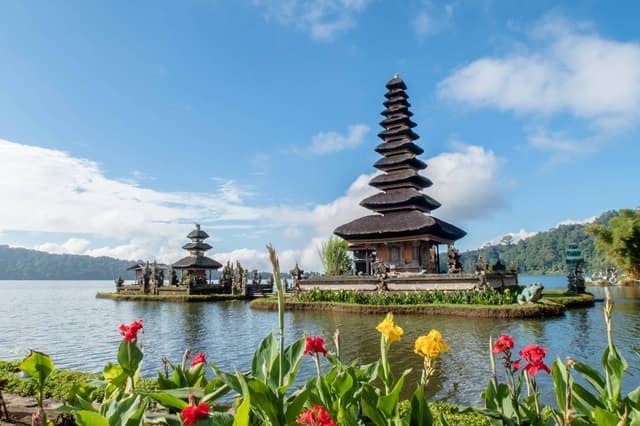
Explore Indonesia (Bali) tour packages
View all →

Is the Monkey Forest Ubud safe to visit?
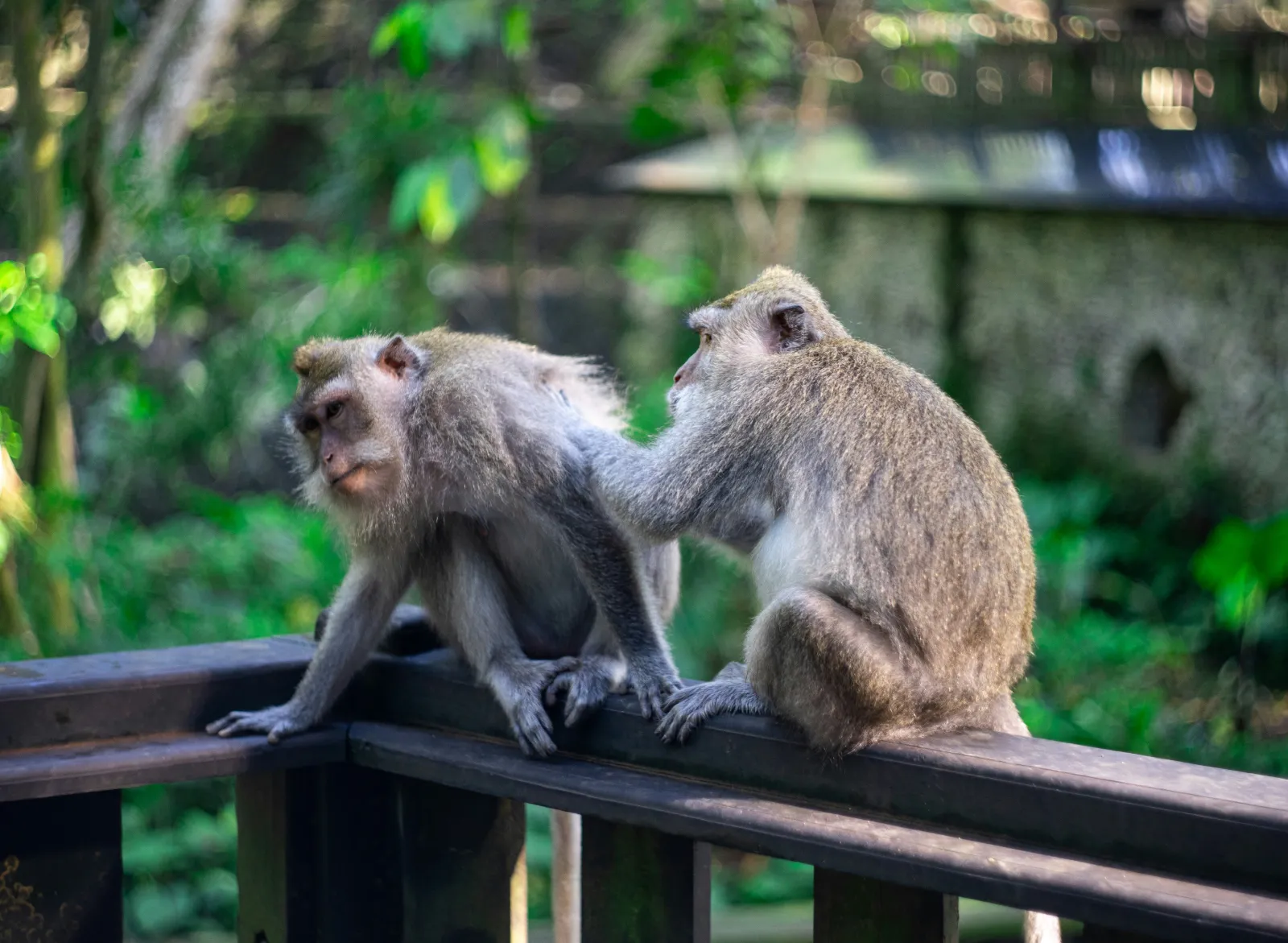
Two long tailed macaques grooming each other on a wooden railing in Ubud Monkey Forest

Yes, the Monkey Forest Ubud is safe for the great majority of visitors, provided you follow the sanctuary's guidelines. Most problems start when a visitor carries food, touches a monkey, holds a shiny object out in the open, or panics when a monkey jumps on them. The sanctuary's own FAQ says monkeys "sometimes" bite when visitors touch or play with them, and its guidelines warn that incidents outside the rules are at the visitor's own risk.

The macaques here are used to people, which is exactly why they are bold. They know that bags, pockets and hands can hold food, and they are quick. A monkey climbing onto your shoulder is usually curious or hunting for a snack, not attacking. Staff are posted around the forest, and there is a first aid clinic on site if anything goes wrong.

Our honest view of the risks, based on the sanctuary's guidelines and official health advice:

RiskHow likelyHow to avoid it
Monkey grabs a bag, bottle, sunglasses or jewelleryCommon if items are visibleUse the lobby lockers, keep small items zipped away, carry nothing in your hands
Monkey climbs on youFairly commonStay calm, stand up, walk slowly, ask staff for help
Scratch or biteUncommon, usually linked to touching, feeding or foodNever touch or feed, no food or drinks, avoid eye contact
Falling branches in stormsRare but seriousDo not visit in strong wind or heavy storms, stay alert on paths
Slips on wet stone paths and stepsModerate in the wet seasonWear shoes with grip, hold handrails, take it slowly
Heat and dehydrationModerate at middayDrink water before you go in and after you leave, visit early

Natural hazards: the December 2024 tree fall

The sanctuary's guidelines include a reminder that branches may fall and that the forest can present natural hazards. That warning is not theoretical. On 10 December 2024, during strong winds and heavy rain, trees came down near the Prajapati temple; two foreign visitors lost their lives and another was seriously injured, according to the Indonesian National Police. Bali police urged everyone to avoid outdoor activities during bad weather, and the forest was closed for a time while the incident was investigated. The practical lesson is simple: tall old trees are part of what makes the forest special, so avoid visiting during storms or strong winds, which are more frequent in Bali's wet season.

For the wider picture on scooters, scams, health and natural risks across the island, read our honest guide to whether Bali is safe to travel.

What rules should visitors follow at the Ubud Monkey Forest?

The Ubud Monkey Forest publishes a short set of guidelines that protect both you and the monkeys: keep your distance, do not touch or feed the monkeys, avoid eye contact, stay calm, watch your children, bring no food, drinks or plastic, dress respectfully, and keep out of sacred areas. The checklist below follows the official guidelines and FAQ, with the reason behind each one.

RuleWhat it means in practiceWhy it matters
Keep a safe distanceDo not touch the monkeys or try to pick one up, including babiesThe sanctuary says monkeys sometimes bite when visitors touch or play with them
Interaction only with staff supervisionNo feeding or play unless a trained staff member is directing itPrevents aggressive behaviour around food
Avoid direct eye contactLook at monkeys sideways, not straight into their eyesStaring can be read as a threat
Stay calmIf a monkey jumps on you, do not run or scream; walk slowlyPanic can turn curiosity into a scuffle
Take care of your childrenKeep children close and stop them playing with monkeysChildren are at monkey eye level and move quickly
No food or drinksDo not bring snacks, fruit, sweets or drinks into the forestMonkeys grab anything edible, which can lead to aggression
Mind small objectsHide toys, jewellery, beads and anything that looks like peanutsMonkeys are attracted to small, shiny or rattling items
Dress respectfullyAvoid revealing clothingThe forest is a sacred Hindu site
Respect sacred spacesFollow signs and stay out of restricted zones and temple interiorsThe temples are for prayer by the local community
No plasticLeave plastic bags and single use plastic behindMonkeys play with and swallow plastic, and it pollutes the forest
Watch your surroundingsWalk carefully and stay alert for falling branchesThe forest has natural hazards

How Bali's rules for foreign visitors apply here

Since March 2025, foreign visitors in Bali are also covered by the Governor of Bali's Circular No. 7 of 2025, a list of obligations and prohibitions for international tourists, reported by the state news agency ANTARA on 24 March 2025. Several points apply directly at the Monkey Forest because it is a temple site:

  • Respect the sanctity of temples, sacred statues (pratima) and religious symbols.
  • Dress modestly and appropriately, especially at sacred places and tourist attractions.
  • Do not enter the main and middle parts of a temple unless you are there to pray.
  • Do not climb sacred trees, which in this forest includes the large banyan and other holy trees.
  • Do not behave in a way that defiles a sacred place, and do not litter or use single use plastic.
  • Follow the specific rules of each attraction, which here means the sanctuary's guidelines above.

Our guide to dos and don'ts in Bali covers temple etiquette, offerings on the pavement and other local customs in more depth.

What should you not bring to the Monkey Forest?

Do not bring food, drinks, plastic bags or loose small objects into the Monkey Forest. The sanctuary prohibits food and drinks, does not allow plastic bags, and warns that monkeys are drawn to toys, jewellery, beads and anything that looks like peanuts. Lockers in the lobby let you store what you do not need, so the easiest approach is to walk in with as little as possible.

Leave at the hotel or in a lockerCarry only if securedFine to bring
Snacks, fruit, biscuits, sweets, chewing gumPhone (in a zipped pocket or on a wrist strap)Comfortable shoes with grip
Drinks, including water bottles in side pocketsCamera (strap around your neck or wrist)Light clothing that covers shoulders and knees
Plastic bags of any kindWallet and passport copy (inside a closed bag worn in front)Insect repellent applied before you go in
Dangling earrings, necklaces, bangles, hair clipsPrescription glasses (consider a retaining cord)A small rain layer in the wet season
Children's toys and anything that rattlesHat (better left behind if loose)Patience and a calm approach
Sunglasses perched on your headCar or scooter keys (zipped away)Sunscreen applied before you go in

A tip from experience: empty your pockets and day bag before you leave the hotel. Wrappers that smell of food, a forgotten packet of biscuits from the flight, or a sweet in a child's pocket are what monkeys find. If you must carry a bag, wear a small one in front with every zip fully closed, and avoid open tote bags.

Can you feed the monkeys at the Monkey Forest Ubud?
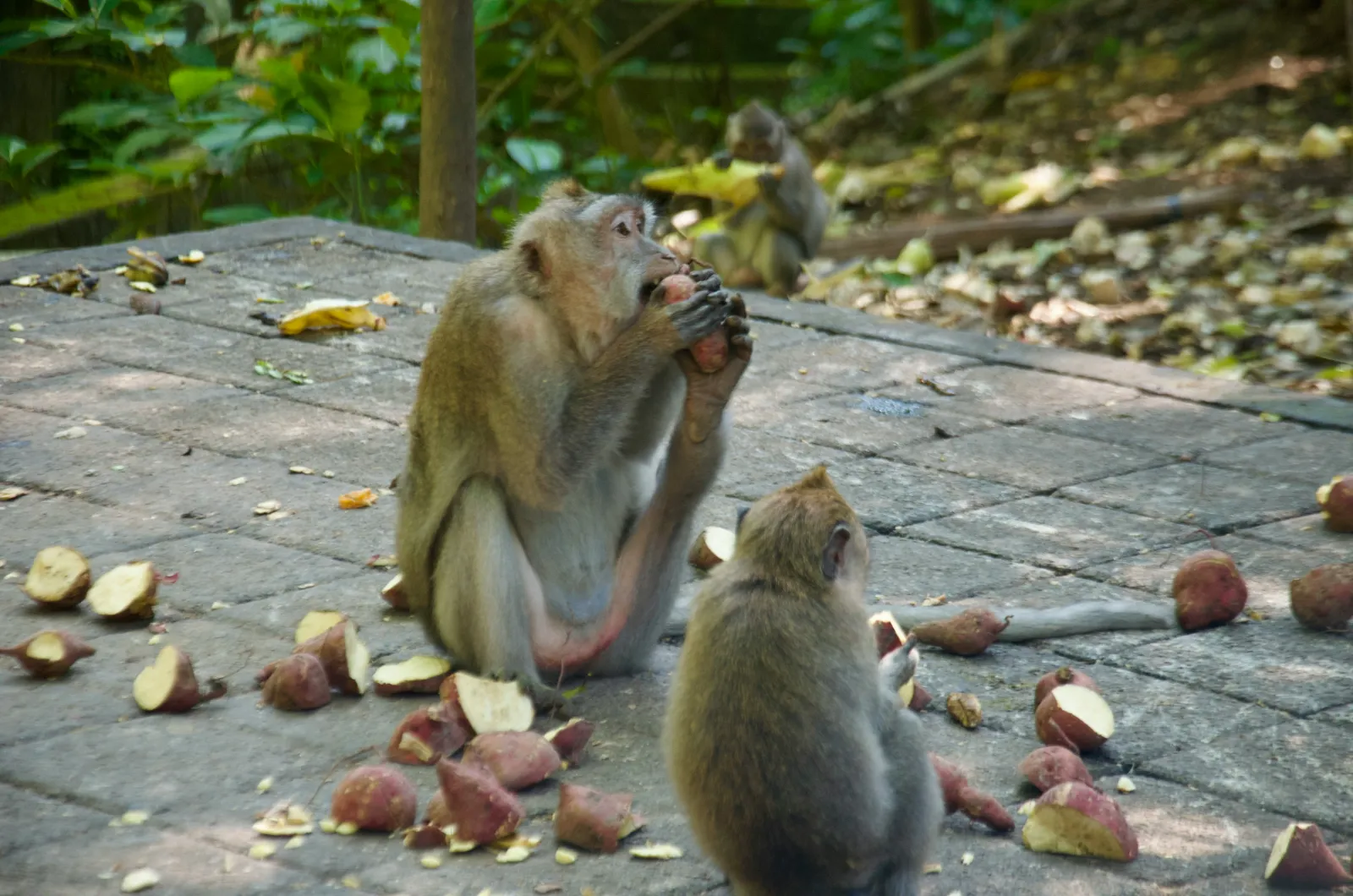
Long tailed macaques eating sweet potato pieces scattered on a stone platform in Ubud

No. Visitors are not allowed to feed the monkeys at the Monkey Forest Ubud. The sanctuary's FAQ states that feeding is not allowed for safety reasons, that only staff feed the monkeys, and that feeding peanuts is forbidden for the monkeys' health. Staff feed them mainly sweet potato, at least nine times a day, so the animals are not hungry and do not need anything from you.

You may still see visitors who ignore the rule. Feeding causes trouble because it teaches monkeys to approach people for food, and a monkey that expects food and does not get it, or sees food pulled back, can grab or scratch. The only interaction the sanctuary allows is under the direct supervision of trained staff, such as the monkey selfie activity that its FAQ describes inside the forest. If you want a photo, ask a staff member rather than tempting a monkey closer yourself, and keep a good distance as the FAQ advises.

Why the "no food" rule includes drinks

Macaques recognise drink bottles and cans, and a bottle in a side pocket is an easy target. Once a monkey has a plastic bottle it may bite through it or carry it off, which is both a hazard for you and a plastic problem for the forest. Drink before you go in, and buy water again at the lobby cafe when you come out.

What should you do if a monkey jumps on you?

If a monkey jumps on you in the Ubud Monkey Forest, stay calm, stand up straight and walk slowly away; the monkey will usually jump off after a moment. That is the sanctuary's own advice. Do not shout, flap your arms, run, or try to pull the monkey off, and ask the nearest staff member for help.

  1. Freeze the panic, not your body. Breathe, and keep your hands down and open so nothing looks like food.
  2. Do not grab or push the monkey. Pulling at it is the quickest route to a scratch.
  3. Avoid eye contact. Look ahead or down, not into the monkey's face.
  4. Walk slowly. Steady movement usually makes the monkey lose interest and hop off.
  5. Let go of what it has taken. If it snatches sunglasses or a hat, do not chase or tug. Tell staff, who know how to recover items.
  6. Check your skin afterwards. Even a small scratch that breaks the skin needs washing and a medical check, as explained below.

What should you do if a monkey bites or scratches you?

If a monkey bites or scratches you in Bali, wash the wound immediately with soap and water for at least 15 minutes, then get medical attention the same day, starting with the sanctuary's first aid clinic. This follows the World Health Organization's rabies fact sheet (updated 17 September 2026), which says to "immediately and always wash the wound with water and soap for at least 15 minutes and seek medical attention." Do not wait to see whether the wound looks bad: the decision about rabies treatment belongs to a doctor, and it is time sensitive.

Bite and scratch first aid steps

  1. Wash at once. Scrub the wound under running water with soap for a full 15 minutes. Use a watch or phone timer; 15 minutes feels long.
  2. Rinse eyes, nose or mouth if splashed. If monkey saliva gets into your eyes or mouth, rinse with clean water for 15 minutes, as advised by the US CDC's guidance on B virus.
  3. Go to the first aid clinic. The sanctuary's FAQ says a professional nurse at its clinic will treat you depending on the case. Tell the nearest staff member and they will direct you.
  4. See a doctor the same day. Go to a clinic or hospital and say clearly that you were bitten or scratched by a macaque. Ask whether you need rabies post exposure prophylaxis (PEP), and mention the macaque contact so the doctor can also consider B virus, as CDC advises.
  5. Keep every record. Note the date and time, which part of the forest you were in, and keep the vaccination card and receipts for insurance.
  6. Finish the course. Rabies PEP is a series of doses over days to weeks. If your trip ends before the course does, carry the record home so a doctor in Nepal or wherever you live can give the remaining doses on schedule.
  7. Tell your doctor at home. CDC advises telling your doctor about any animal injury when you get back home, even if you were treated in Bali.

How doctors decide on rabies treatment

WHO groups contact with a possibly rabid animal into three categories. This is the framework a doctor in Bali or Nepal will use, so it helps to know it, but it is not a substitute for being seen.

WHO categoryType of contactWhat WHO recommends
Category ITouching or feeding animals, licks on intact skinWash exposed skin; no PEP needed
Category IINibbling of uncovered skin, minor scratches or abrasions without bleedingWound washing and immediate vaccination
Category IIIBites or scratches that break the skin, or saliva on broken skin or mucous membranesWound washing, immediate vaccination, and rabies immunoglobulin or monoclonal antibodies where indicated

Two facts from WHO explain why this matters. Once symptoms of rabies appear, the disease is virtually 100% fatal. Prompt washing and PEP, on the other hand, prevent it. That is why every health authority gives the same advice: do not take chances with a bite or a scratch that breaks the skin.

Does Bali have rabies?

Yes. Rabies is present in Bali, mainly carried by dogs. The US CDC's travel health page for Indonesia (last reviewed 25 August 2026) says dogs infected with rabies are commonly found in Indonesia, and that rabies vaccines are typically available throughout most of the country if an exposure happens. Locally, the Bali Provincial Health Office recorded 45,365 bites from animals that can carry rabies and seven rabies deaths between January and August 2026, as reported by ANTARA on 12 August 2026. The head of disease prevention and control at the office, I Gusti Ayu Raka Susanti, said the deaths were mainly among people who did not report their bites to a health facility, and urged everyone bitten to go to a health facility straight away.

What about the monkeys themselves? The sanctuary's FAQ says the monkeys are healthy, are monitored with the Primate Research Center of Udayana University, and cites 14 years of research by anthropologist Dr Agustin Fuentes of the University of Notre Dame that, in the sanctuary's words, never found a case of rabies in any monkey in Bali. That is the sanctuary's own statement, which we have not independently verified, and it does not change what WHO and CDC tell you to do after a bite. Doctors assess every animal bite on its own merits, the monkeys share the island with dogs, and a macaque bite carries a separate, extremely rare risk called B virus, which CDC says can pass from infected macaques to people through bites and scratches. In short: wash, then see a doctor, every time.

Do you need a rabies vaccine before visiting Bali?

Not everyone needs a rabies vaccine before visiting Bali, but it is worth discussing with a doctor or travel clinic before you go. The US CDC says pre exposure vaccination may be recommended for Indonesia, depending on whether your activities increase your risk of animal contact and whether you might struggle to get prompt treatment after a bite. WHO adds that pre exposure vaccination does not replace post exposure care: if you are bitten, you still need wound washing and medical assessment, though the treatment is simpler.

TravellerPoints to raise with your doctor
Short holiday in Ubud and the south, staying near townsClinics are close by, but ask whether pre exposure vaccination makes sense for you
Families with young childrenChildren are more likely to touch animals and less likely to report a scratch
Long stays, volunteering, cycling, trekking or remote islandsHigher chance of animal contact and slower access to treatment
Anyone planning several monkey sites (Ubud, Uluwatu, Sangeh)More time around macaques
Previously vaccinated travellersBring your vaccination record; it affects what a doctor gives you after a bite

Pre exposure vaccination is a course, not a single jab, so ask about it well before your departure date rather than in the final week. Whatever you decide, buy travel insurance that covers medical treatment, because rabies treatment after a bite can involve several hospital visits.

What temples are inside the Ubud Monkey Forest?
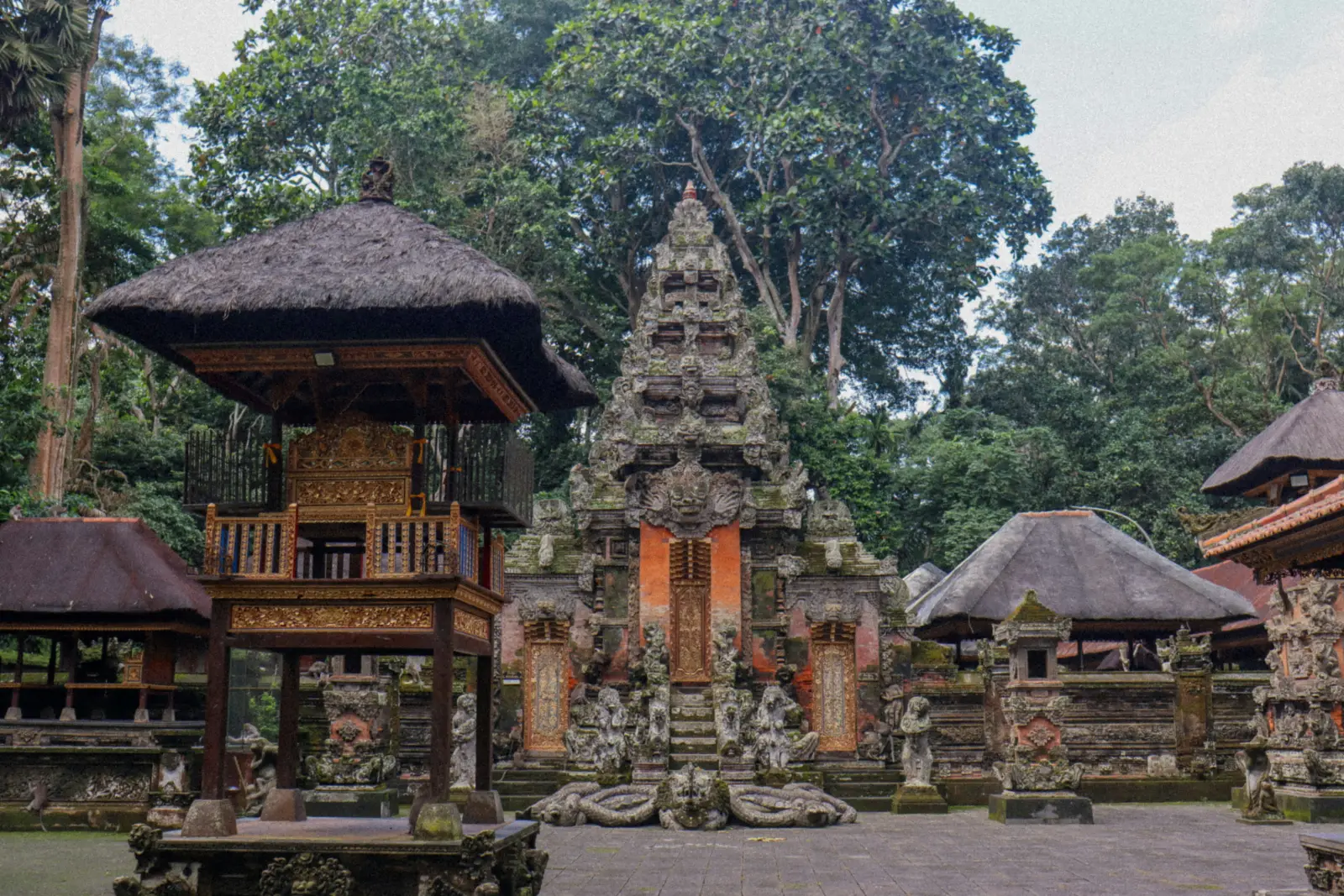
Carved stone temple gate and thatched shrines inside the Sacred Monkey Forest Sanctuary in Ubud

There are three temples inside the Ubud Monkey Forest: Pura Dalem Agung Padangtegal (the main temple, dedicated to Shiva), Pura Beji (the holy spring temple, dedicated to the goddess Gangga), and Pura Prajapati (the cremation temple, dedicated to Brahma Prajapati). According to the sanctuary, analysis of the Pura Purana, a palm leaf manuscript recording the temples' history, dates them to around the middle of the 14th century. All three are working temples used by the local community, open for prayer only, so visitors view them from outside.

TempleAlso calledWhereWorshipVisitor access
Pura Dalem Agung PadangtegalMain Temple, Great Temple of ShivaSouthwest of the forestHyang Widhi as Shiva, "the Recycler" or "the Transformer"Prayer only; view from outside
Pura BejiHoly Spring Temple, Beji TempleNorthwestHyang Widhi as the goddess Gangga; used for purification (melukat) before ceremoniesPrayer only; view from outside
Pura PrajapatiCremation TempleNortheast, beside the cemeteryHyang Widhi as Brahma Prajapati, "ruler of souls"Prayer only; view from outside

Source: the sanctuary's sacred places page and FAQ, Checked: 6 Nov 2026.

The cemetery and the journey of the soul

Next to Pura Prajapati is the village cemetery of Padangtegal. It is used only temporarily: bodies are buried here until the village holds a mass cremation (Ngaben), which the sanctuary says takes place every five years. Many of the statues and structures along the paths tell the story of the soul's journey after death in Balinese Hindu belief. The sanctuary describes animal statues that welcome the soul, a long narrow wooden bridge representing the trembling bridge the soul must cross, a split stone gate (Candi Terbelah), and a cave called Durgama that holds a lingga and a relief of Durga. Near the lobby stand a tiger statue linked to Durga and a statue of Dewi Sri, the rice goddess, holding rice stalks.

Other landmarks you will pass

  • Central Point and the great banyan: a huge banyan tree at the heart of the forest, which the sanctuary says is at least 100 years old. Paths branch from here to all three temples, and there is a pond where monkeys play and bathe.
  • The dragon bridge: a bridge marked on the sanctuary's map and a favourite stop for photos on the walk between the temples.
  • The holy spring pool: near Pura Beji, where some visitors toss coins in the belief that their wish will come true.
  • The wooden path and new forest: the area planted in the 1990s to give the growing monkey population more space.
  • Open stage: next to the cafe, used for the weekend dance performances.

A note for Hindu visitors from Nepal and India

Hindu travellers from Nepal often feel at home here: Shiva, Durga, Brahma and the goddess Ganga (Gangga in Bali) are all honoured, and offerings of flowers and incense look familiar. Balinese Hinduism has its own temple customs, though, and the sanctuary is explicit that its temples are for prayer in the Balinese way and for the local community. Being Hindu does not by itself give access to the inner courtyards. Admire the gates from outside, follow staff directions, and if you would like to take part in a temple ceremony during your trip, ask your guide or hotel about temples elsewhere where visitors in proper temple dress are welcome. Our guide to the best temples in Bali lists the ones most open to respectful visitors.

When is the best time to visit the Monkey Forest Ubud?

The best time to visit the Monkey Forest Ubud is soon after it opens at 9am, on a dry day. Mornings are usually cooler, the light under the trees is softer for photos, and you finish before the midday heat; in our experience the paths also feel calmer early on. Avoid visiting during storms or strong wind, when falling branches are a real hazard.

Time of dayWhat to expectGood for
9am to 10:30amCooler air, often fewer peopleFamilies, photographers, anyone who dislikes crowds
10:30am to 3pmOften busier and hotter, as day trips from the south arriveCombining with lunch in central Ubud
3pm to 5pmLight softens, crowds thin a little; last entry at 5pmA relaxed walk before dinner
Weekend, 11am or 4pmBalinese dance at the open stageSeeing a short cultural performance as part of the visit

Which season?

Bali is broadly drier from around April to October and wetter from around November to March, though the pattern varies year to year. The Monkey Forest is shaded and worth visiting in any season; in the wet season it is greener and quieter, but paths are slippery and afternoon storms are more likely. Plan your visit for the morning in the rainy months, and keep a flexible day in hand in case of a storm. For month by month detail, see our guide to the best time to visit Bali.

Dashain, Tihar and festival days

For travellers from Nepal, the long Dashain and Tihar holidays, which fall between late September and November depending on the lunar calendar, are a popular time for a Bali trip, and school holidays add families to the mix. That window overlaps the end of Bali's drier months and the start of the wetter season, so morning visits matter even more. Book your Ubud stay early for those dates, because demand from Nepal and from other markets rises together.

Balinese festivals also affect the Monkey Forest. On Nyepi, Bali's Day of Silence, the whole island shuts down, so plan around it. Temple anniversaries (odalan) and the five yearly mass cremation in Padangtegal bring ceremonies to the forest; these are special to witness from a respectful distance, but parts of the forest may be busier or restricted. If your dates are fixed, check the official website shortly before you go.

Is the Ubud Monkey Forest suitable for children?

Yes, the Ubud Monkey Forest is suitable for children who can follow simple rules and stay close to an adult. The sanctuary specifically asks parents to take care of their children and stop them playing with the monkeys. Children are at monkey eye level, often carry snacks or toys, and react quickly, so they need closer supervision than adults.

AgeFamily suitability note
Babies in carriersPossible with a front or back carrier; keep dummies, teething toys and bottles hidden. Uneven paths can make prams awkward, so ask at the lobby about routes.
Toddlers (1 to 4)The hardest age: curious, quick and likely to reach out. Hold hands the whole time, or consider a shorter visit near the entrance.
Children (5 to 12)Usually the best age. Brief them before you go: no touching, no food, no staring, walk slowly if a monkey climbs on you.
TeenagersFine, but remind them that selfies close to monkeys are how most scratches happen.

A simple family briefing

  • Check every pocket for sweets, biscuits and wrappers before leaving the hotel.
  • Leave toys, hair clips and dangling accessories behind.
  • Agree a rule: monkeys are to watch, not to touch, even the babies.
  • Teach the "statue walk": if a monkey climbs on you, stand tall and walk slowly to a grown up or staff member.
  • Tell children to report any scratch at once, however small, so you can wash it straight away.
  • Carry a small first aid kit and know where the first aid clinic is.

Travelling with elderly parents

Many families from Nepal travel with parents or grandparents. The forest is manageable for most older visitors at a slow pace, but some paths slope down into the ravine and stone surfaces get slippery after rain. Shoes with grip, a walking stick if they normally use one, and regular rests help. The sanctuary lists toilets around the forest and a first aid clinic on site, and you can keep the visit short by staying near the Central Point and the main temple.

How long do you need at the Monkey Forest, and what else is nearby?
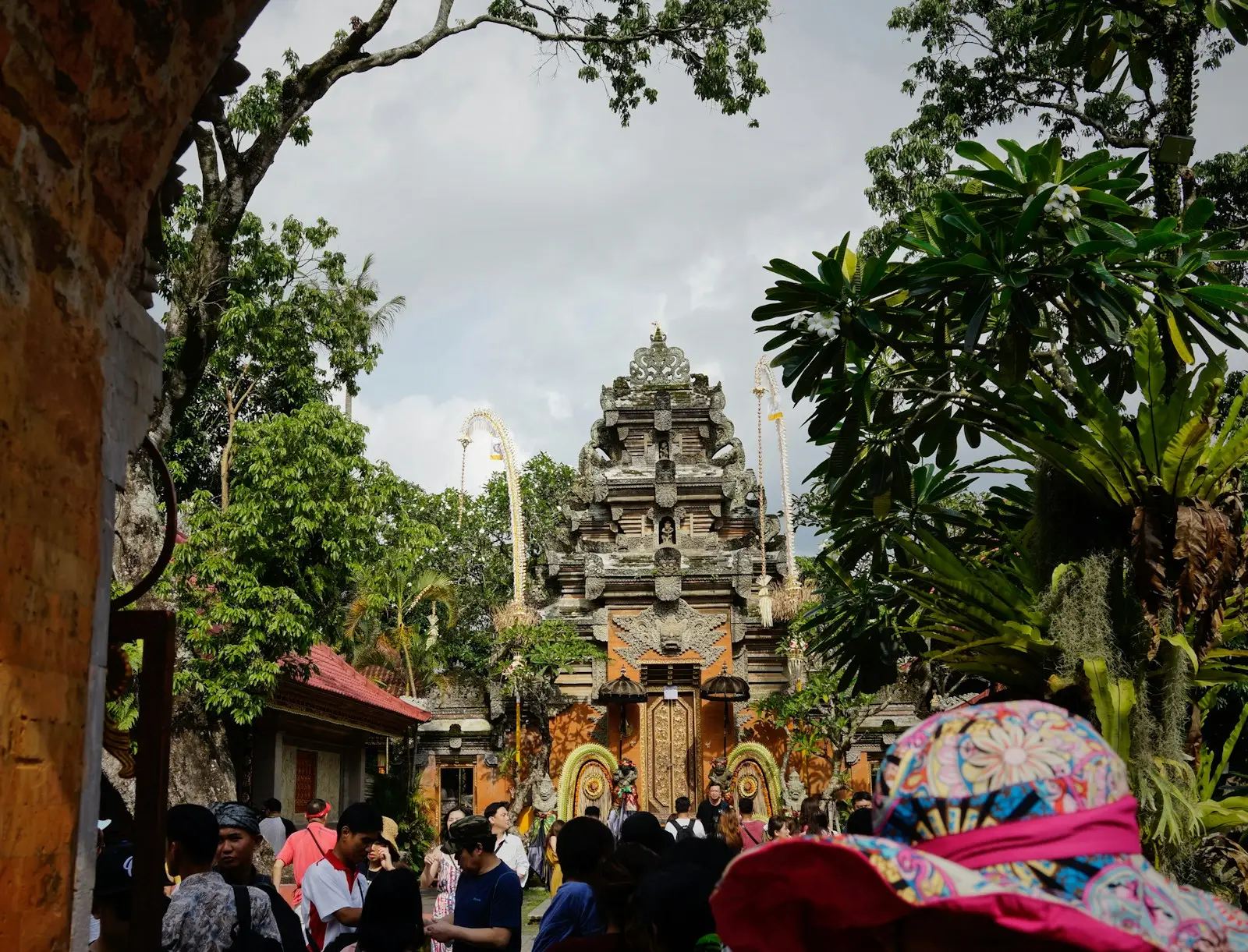
Carved stone gate of Ubud Palace, Puri Saren Agung, with visitors gathered outside

As a rough guide, plan about one to two hours in the Monkey Forest Ubud, enough to walk the main loop past the three temples, the dragon bridge and the banyan tree, watch the monkeys, and perhaps see a weekend dance. Photographers and families who like to linger can easily stay longer. Because the forest is at the end of Jalan Monkey Forest, it fits neatly into a half day in central Ubud.

Combine withWhy it pairs well
Ubud Palace (Puri Saren Agung)At the top of Jalan Monkey Forest; carved royal gates in the heart of town
Ubud Art MarketOpposite the palace; crafts, sarongs and souvenirs
Campuhan Ridge WalkA gentle ridge walk on the west side of town, best early or late in the day
Cafes on Jalan Monkey Forest and Jalan HanomanLunch after a morning visit, with plenty of vegetarian choice
Tegalalang rice terraces or Tirta EmpulFurther north; better as a separate morning by car

If you are planning the rest of the island, our round up of things to do in Bali covers beaches, temples, volcano sunrises and island trips beyond Ubud.

What should Nepali travellers know before visiting the Ubud Monkey Forest?

Nepali travellers will find the Ubud Monkey Forest familiar in some ways and different in others. If you have walked up to Swayambhunath in Kathmandu, you already know how bold temple monkeys can be. The species is different (Swayambhu's monkeys are rhesus macaques, Ubud's are long tailed macaques), but the same rules work: no food, nothing loose, no staring, and calm, slow movement.

  • The Hindu connection is real, but the customs are Balinese. Shiva, Durga and Gangga are worshipped here, yet the temples are for local prayer only. View them from outside.
  • Dress as you would for a temple at home. Shoulders and knees covered is a safe choice, and it keeps you within both the sanctuary's guidelines and Bali's rules for foreign visitors.
  • Take bites seriously. Many Nepali families know the anti rabies routine from home. Apply the same caution in Bali: wash for 15 minutes and see a doctor the same day, then carry the vaccination record back to Nepal to finish the course.
  • Insurance matters. Buy travel insurance that covers medical treatment before you leave Kathmandu; it covers you for bites, slips and the island's bigger risks such as scooter accidents.
  • Plan the Dashain and Tihar rush. These are the peak weeks for departures from Nepal, so book flights and Ubud hotels early and schedule the Monkey Forest for a morning.
  • Vegetarian food is easy in Ubud. Central Ubud has many vegetarian and vegan cafes, which helps families who keep a vegetarian diet or fast on certain days.
  • Money: Bali uses the Indonesian rupiah (IDR). The Governor's circular asks foreign visitors to exchange money only at authorised banks or licensed money changers.

Ubud and the Monkey Forest work well for honeymooners who want culture alongside beaches, families with school age children, and diaspora Nepalis meeting relatives from home for a holiday together. Travellers who would rather have hotels, transfers and Ubud sightseeing arranged as one trip can look at Bali tour packages.

Frequently asked questions

Is Ubud Monkey Forest safe?

Yes, the Ubud Monkey Forest is safe for most visitors who follow the sanctuary's guidelines. Problems usually start with food, touching a monkey or panicking when one climbs on you. Carry no food or plastic, keep small items zipped away, avoid eye contact and walk slowly. Avoid visiting in storms or strong wind, when branches can fall.

What should I not bring to Monkey Forest?

Do not bring food, drinks, plastic bags, loose jewellery, toys or sunglasses perched on your head to the Ubud Monkey Forest. The sanctuary prohibits food and drinks and does not allow plastic bags. Lockers in the lobby let you store what you do not need, so walk in with as little as possible and every zip closed.

What if a monkey bites me in Bali?

If a monkey bites or scratches you in Bali, wash the wound with soap and running water for at least 15 minutes, as WHO advises. Then go to the Ubud Monkey Forest first aid clinic and see a doctor the same day to ask about rabies post exposure treatment. Keep your vaccination record and complete every dose.

Do I need a rabies vaccine for Bali?

Rabies vaccination before a Bali trip is not required for entry, but the US CDC says it may be recommended depending on your activities and access to care. Discuss it with a doctor or travel clinic well before departure. Even if vaccinated, you still need wound washing and medical assessment after any bite in Bali.

How long does Monkey Forest take?

As a rough guide, plan about one to two hours at the Ubud Monkey Forest; the sanctuary does not publish an official visit length. That covers the main loop past the three temples, the dragon bridge and the great banyan tree, with time to watch the monkeys. Add time if you want to see the weekend Balinese dance at 11am or 4pm on the open stage.

Can children visit Monkey Forest?

Yes, children can visit the Ubud Monkey Forest, but they need close supervision. The sanctuary asks parents to look after their children and stop them playing with monkeys. Check pockets for snacks, leave toys behind, hold toddlers' hands and brief older children: no touching, no food, no staring, and report any scratch at once.

Can I feed the monkeys?

No. Visitors are not allowed to feed the monkeys at the Ubud Monkey Forest, and feeding peanuts is forbidden for the monkeys' health. Staff feed the macaques, mainly sweet potato, at least nine times a day. Feeding teaches monkeys to approach people for food and is a common trigger for scratches and bites.

What time does Monkey Forest open?

The Ubud Monkey Forest opens daily from 9am to 6pm, with the last entrance at 5pm (Checked: 6 Nov 2026, official sanctuary website). Hours can change for ceremonies, storms or maintenance, so check the official site on the morning of your visit, especially on Balinese festival days such as Nyepi.

Are there temples inside Monkey Forest?

Yes, the Ubud Monkey Forest has three 14th century temples: Pura Dalem Agung Padangtegal, the main temple for Shiva; Pura Beji, the holy spring temple for the goddess Gangga; and Pura Prajapati, the cremation temple beside the village cemetery. All three are for prayer by the local community, so visitors view them from outside.

Ubud Monkey Forest kasto cha? What is it like for Nepali visitors?

The Ubud Monkey Forest is a cool, shaded temple forest with more than 1,000 macaques, carved gates and a holy spring, and an easy, rewarding visit if you follow the rules. If you know the monkeys at Swayambhunath, expect similar boldness. Go early, carry nothing edible, dress modestly and plan one to two hours.

Can Hindu visitors from Nepal pray inside the Monkey Forest temples?

The temples in the Ubud Monkey Forest are used for prayer in the Balinese tradition by the local Padangtegal community, and the sanctuary asks visitors to view them from outside. Being Hindu does not by itself give access to the inner courtyards. Follow staff directions, and ask your guide about temples elsewhere that welcome respectful visitors.

What should I wear to the Ubud Monkey Forest?

Wear modest, comfortable clothing to the Ubud Monkey Forest, ideally covering shoulders and knees, because it is a sacred Hindu site and the sanctuary discourages revealing clothing. Choose shoes with good grip for stone paths and slopes, skip dangling jewellery, and carry a light rain layer in the wet season.
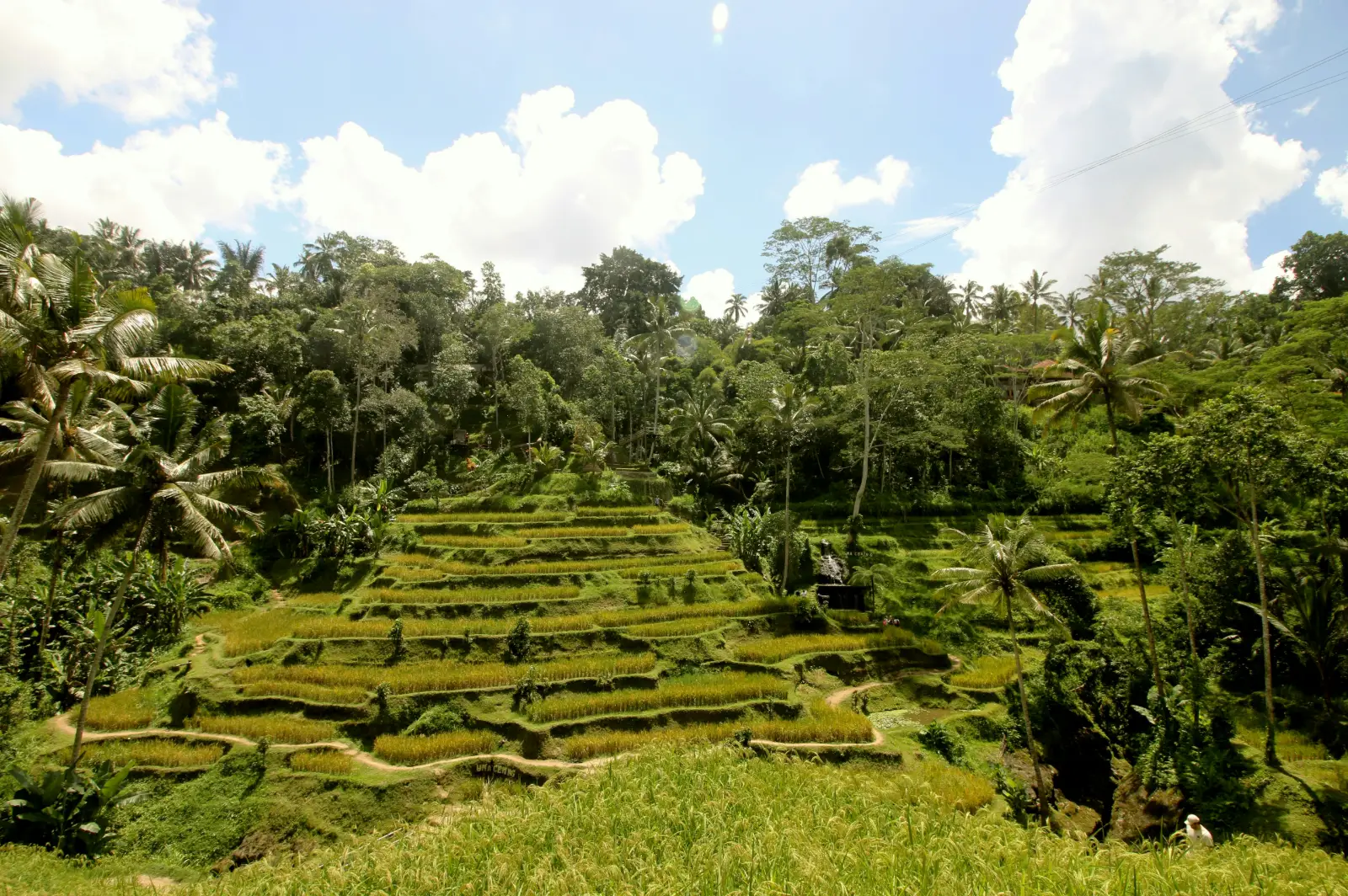
Tags
BaliIndonesiaUbudMonkey Forest
Share
G
Gomayu Team
Writer at Gomayu
Keep reading