Short answer: Bangkok street food is best eaten in the evening in Yaowarat (Chinatown), around Banglamphu near Khao San Road, and in the boat noodle lanes at Victory Monument, plus the fresh and night markets. Start with pad thai, som tam, tom yum goong, khao man gai, grilled moo ping and mango sticky rice. Vegetarians should look for the yellow jay (เจ) sign. If you avoid beef, say mai sai neua wua (ไม่ใส่เนื้อวัว), and remember that many pavement stalls take Monday off.
This guide is for curious eaters, and that includes vegetarians and travellers who keep a no-beef or no-pork diet. Most guides skip those needs, but they matter to Nepali, Indian and Muslim travellers, among many others. Below you will find a dish guide with vegetarian and spice markers, a table of the best eating areas with their usual days, Thai phrases in Thai script with simple romanisation, and honest hygiene advice. You will not find prices. Stall prices change too often to print, and the question that matters on the pavement is what is in the bowl. For the wider picture of the country, start with our complete Thailand travel guide.
What should you eat in Bangkok?
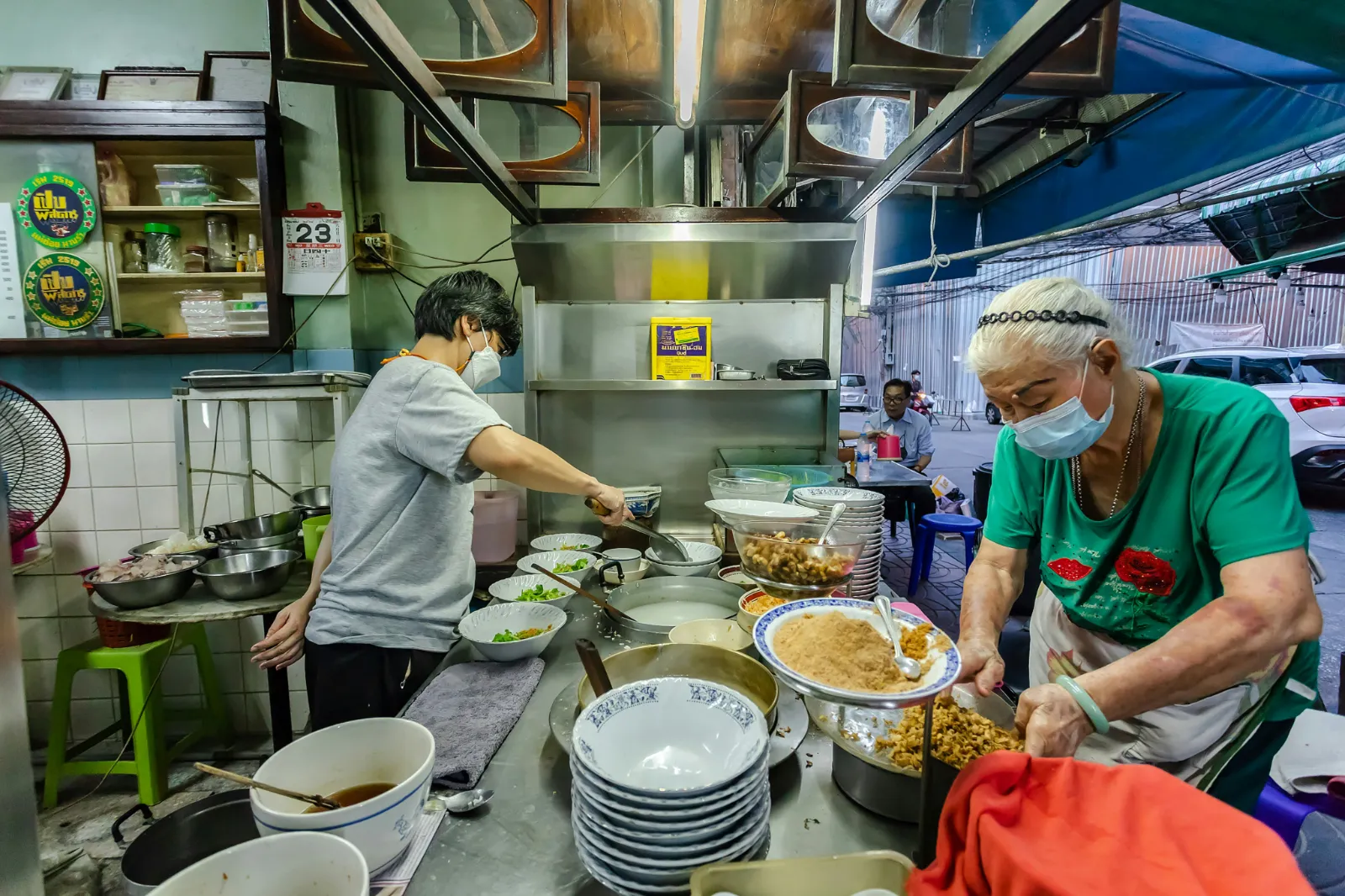
Eat a mix of central Thai, Isan (northeastern) and Thai Chinese dishes, because that mix is what Bangkok street cooking really is. Pad thai, som tam, tom yum goong, khao man gai, moo ping, boat noodles, pad kra pao and the Chinatown noodle soups cover most of what you will see on the pavement. Each stall usually cooks one or two things well, so it pays to walk, look and point rather than hunt for a single place that does everything.
Bangkok cuisine leans heavily on Chinese technique, which is why so much comes from a wok or a noodle pot. Isan migrants brought papaya salad, grilled chicken and sticky rice. The city also has Muslim, Indian and southern Thai cooks. If you want to understand how the four regional Thai kitchens differ before you go, our guide to Thai food and its regional cuisines explains the logic behind the menus. The list below sticks to what you will actually meet on a Bangkok pavement.
Pad thai (ผัดไทย)
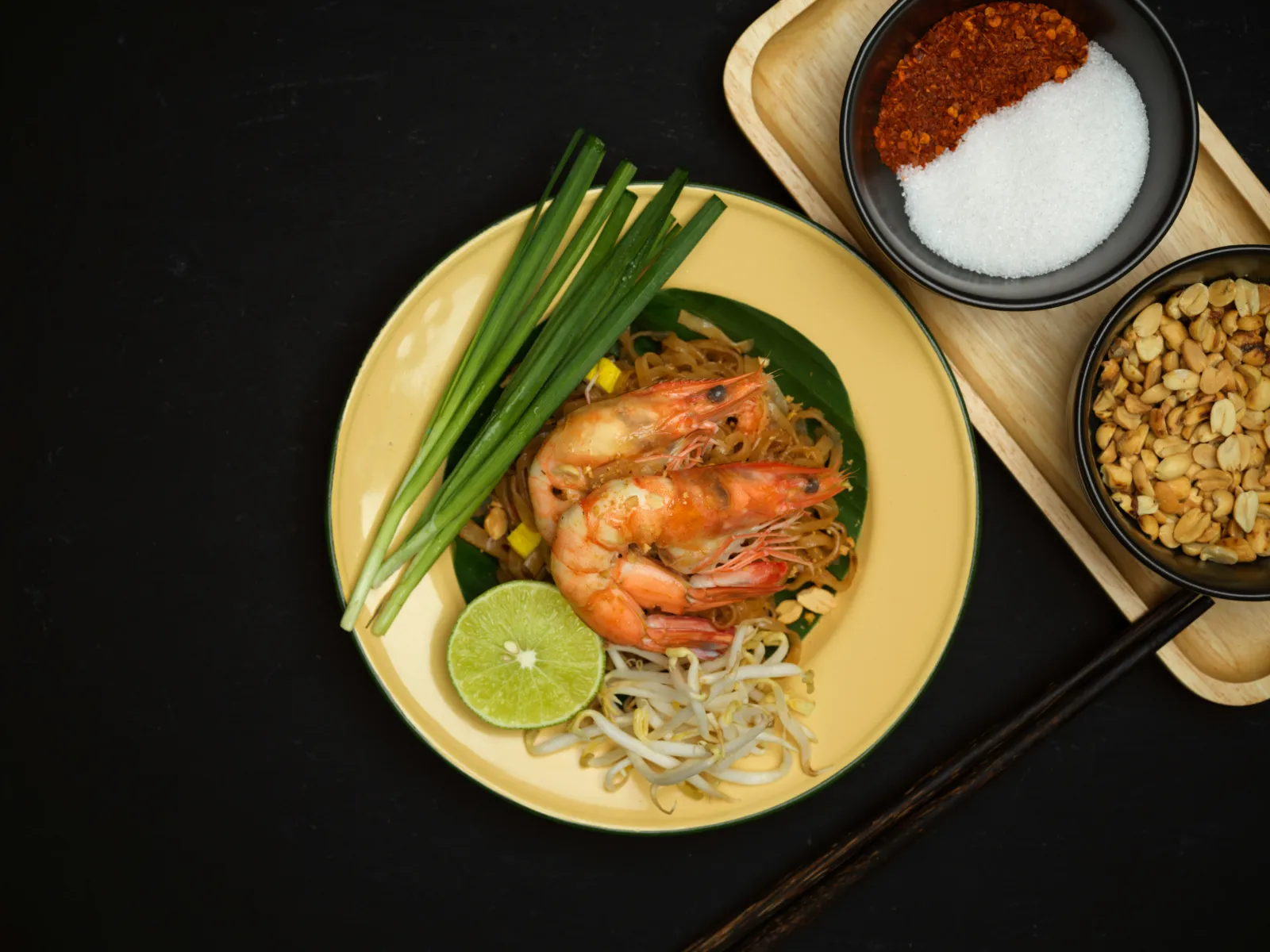
Pad thai is stir-fried rice noodles with tamarind, egg, tofu, bean sprouts, garlic chives and peanuts, usually with prawns or chicken. It is mild unless you add chilli, so it is a safe first meal for anyone nervous about heat. It is also one of the easiest dishes to make vegetarian: ask for tofu only and no fish sauce. The sauce and dried shrimp are where the animal products hide. Pad thai counts as a street classic, though Thai people eat it less often than visitors assume. Noodle soups and rice dishes are the everyday food.
Som tam (ส้มตำ)
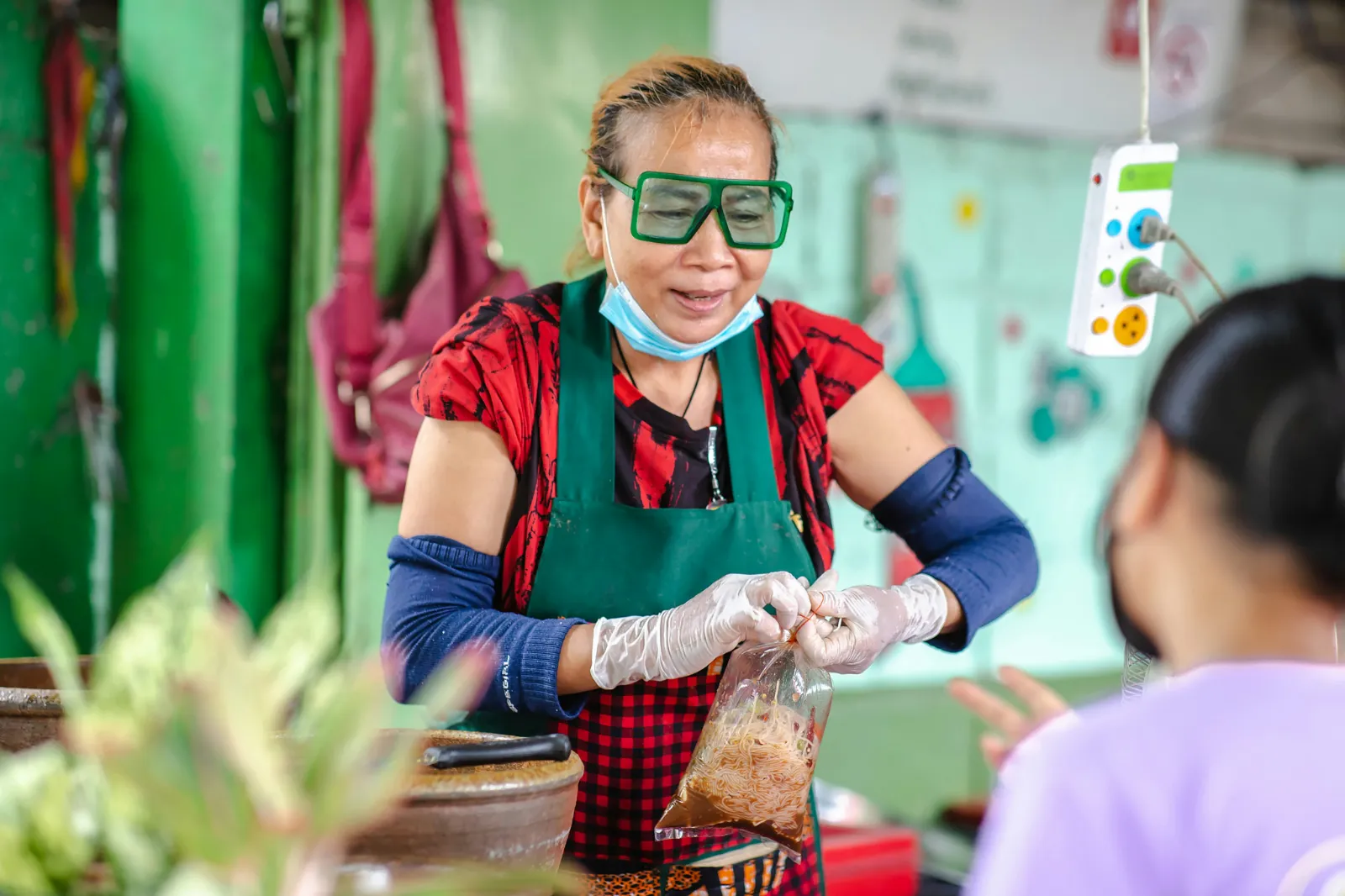
Som tam is shredded green papaya pounded in a clay mortar with lime, chilli, garlic, tomatoes, long beans, palm sugar and fish sauce, often with dried shrimp or salted crab. It comes from Isan and it is often very hot. Ask for one chilli, or for mai phet (not spicy), and watch the vendor pound it in front of you. Som tam Thai is the sweeter, peanut version. Som tam Lao or som tam pu pla ra uses fermented fish and salted crab and has a much stronger taste. A som tam jay without fish sauce or shrimp is possible at many stalls if you ask clearly.
Tom yum goong (ต้มยำกุ้ง)
Tom yum goong is a hot and sour prawn soup with lemongrass, galangal, kaffir lime leaves, lime juice and chilli, either clear (nam sai) or creamy with evaporated milk or chilli paste (nam khon). Thailand's government reports that Tom Yum Kung was inscribed on UNESCO's Representative List of the Intangible Cultural Heritage of Humanity on 3 December 2024 (Thailand.go.th). On the street you will find it at made-to-order stir-fry stalls rather than at single-dish carts. A mushroom version (tom yum hed) exists, but the base usually still contains fish sauce unless it is a jay kitchen.
Khao man gai (ข้าวมันไก่)
Khao man gai is poached chicken on rice cooked in chicken fat and stock, served with a cup of clear soup and a sauce of fermented soybean, ginger, garlic and chilli. It is Bangkok's version of Hainanese chicken rice, and it is mild, filling and good at breakfast or lunch. Look for stalls with whole chickens hanging in a glass case. A fried chicken version (khao man gai tod) is common too. It is not suitable for vegetarians, but it is a good beef-free and pork-free choice, although some stalls also sell pork, so it is worth checking.
Moo ping (หมูปิ้ง) and gai yang (ไก่ย่าง)
Moo ping is grilled pork on a skewer, marinated with garlic, coriander root, pepper and a little sugar, and eaten with a bag of sticky rice, often as a morning snack. Gai yang is grilled marinated chicken from Isan, served with sticky rice, som tam and a tamarind and chilli dip. Grilled food over charcoal is one of the most reliable street meals, because it is cooked hot and in front of you. If you avoid pork, gai yang is the obvious swap. Skewer carts often sell both, so check which one you are pointing at.
Boat noodles (ก๋วยเตี๋ยวเรือ)
Boat noodles, kuay teow ruea, are small bowls of rice noodles in a dark, rich broth seasoned with dark soy sauce and spices and thickened with pig or cow blood. Wikipedia's entry notes that the dish "contains both pork and beef", that it was first sold from boats on Bangkok's canals, and that the Victory Monument area is now its best-known home (Wikipedia, Boat noodles). The bowls are small, so people order several. For anyone avoiding beef or pork, boat noodles are one of the dishes to treat with care, because both meats may come from the same pot of broth.
Pad kra pao (ผัดกะเพรา)
Pad kra pao is minced meat stir-fried with holy basil, garlic and chilli, served on rice with a fried egg (kai dao) on top. It is one of the most common lunches in Bangkok offices and food courts, and it is usually hot. Pork and chicken are standard, beef appears at some stalls, and a tofu or mushroom version is easy to request. Ask for kai dao if you want the crispy egg. Ask for phet nit noi if you want only a little heat.
Guay jub and the Chinatown noodle soups
Guay jub (ก๋วยจั๊บ) is rolled rice noodles in a peppery broth, usually with crispy pork belly and pork offal, and it is a Yaowarat signature. Next to it you will find fish ball noodles, wonton egg noodles, yen ta fo (pink noodle soup with fermented tofu, fish balls and squid) and duck noodles. These soups are mild and comforting. Most of them are built on pork bones or pork, which matters for anyone who does not eat pork. Fish ball and duck soups may use a pork stock too, so ask before ordering.
Oyster omelette, crab omelette and wok dishes
Hoy tod (หอยทอด) is a crisp omelette with mussels or oysters fried on a flat griddle with a starch batter and bean sprouts. Bangkok's most famous wok cook, Jay Fai, is known for a much grander crab omelette. Around Chinatown and Banglamphu, made-to-order stalls cook khao pad (fried rice), stir-fried morning glory, garlic pepper prawns and seafood with curry powder. These are the stalls where you can steer the dish: no meat, no egg, less chilli, extra vegetables.
Khao kha moo (ข้าวขาหมู) and jok (โจ๊ก)
Khao kha moo is pork leg braised in soy and five spice, sliced over rice with pickled mustard greens, a boiled egg and a garlic and chilli vinegar. Jok is a smooth rice porridge, usually with pork balls, ginger and an egg, eaten in the early morning. Both are mild and comforting. Both are pork dishes, so skip them if you avoid pork.
Dish guide: ingredients, vegetarian options and spice
Use this table to scan quickly. "Veg possible" means a stall can usually make a vegetarian version if you ask clearly. It does not mean the default dish is vegetarian. The spice level is the usual default, and every cook can make a dish milder or hotter.
| Dish (Thai) | Main ingredients | Veg possible? | Beef or pork note | Usual spice |
|---|---|---|---|---|
| Pad thai (ผัดไทย) | Rice noodles, tamarind, egg, tofu, bean sprouts, peanuts, prawns or chicken | Yes, ask for tofu and no fish sauce | Rarely beef or pork | Mild |
| Som tam (ส้มตำ) | Green papaya, lime, chilli, garlic, fish sauce, dried shrimp or crab | Yes, as som tam jay | None by default | Hot |
| Tom yum goong (ต้มยำกุ้ง) | Prawns, lemongrass, galangal, lime leaf, chilli, lime | Partly, tom yum hed with mushrooms (base may hold fish sauce) | None by default | Hot |
| Khao man gai (ข้าวมันไก่) | Poached chicken, rice cooked in chicken stock, soybean ginger sauce | No | Chicken only, stalls may also sell pork | Mild, sauce is hot |
| Moo ping (หมูปิ้ง) | Grilled pork skewers, sticky rice | No | Pork | Mild |
| Gai yang (ไก่ย่าง) | Grilled marinated chicken, sticky rice, dipping sauce | No | Chicken | Mild, dip is hot |
| Boat noodles (ก๋วยเตี๋ยวเรือ) | Rice noodles, dark spiced broth, blood, meatballs | No | Pork and beef | Medium |
| Pad kra pao (ผัดกะเพรา) | Minced meat, holy basil, chilli, garlic, rice, fried egg | Yes, with tofu or mushroom | Pork or chicken usual, beef at some stalls | Hot |
| Guay jub (ก๋วยจั๊บ) | Rolled rice noodles, peppery broth, crispy pork, offal | No | Pork | Mild, peppery |
| Hoy tod (หอยทอด) | Mussels or oysters, egg, starch batter, bean sprouts | No | None by default | Mild |
| Khao kha moo (ข้าวขาหมู) | Braised pork leg, rice, egg, pickled greens | No | Pork | Mild |
| Khao pad (ข้าวผัด) | Fried rice with egg, onion and a choice of meat or seafood | Yes, vegetable fried rice | Depends on your choice | Mild |
| Pad pak ruam (ผัดผักรวม) | Mixed stir-fried vegetables, garlic, oyster sauce | Yes, ask for no oyster sauce | None by default | Mild |
Where are the best Bangkok street food areas?
The best Bangkok street food areas are Yaowarat (Chinatown) in the evening, Banglamphu around Khao San Road and Soi Rambuttri, the boat noodle shops near Victory Monument, Phahurat for Indian food, and the city's fresh and night markets. Go in the evening for Chinatown and Banglamphu, and at lunch or early evening for Victory Monument. Avoid planning your big street food night for a Monday, for the reasons explained in the next section.
Bangkok is big and the traffic is slow, so group your eating by area. Our area by area guide to places to visit in Bangkok shows how to pair each food district with nearby sights, such as an afternoon at Wat Arun on the Chao Phraya followed by an evening in Chinatown just across the river.
| Area | Getting there | Best time | What to eat | Good for |
|---|---|---|---|---|
| Yaowarat (Chinatown) | MRT Wat Mangkon (Blue Line) | Evening, after the shops close | Guay jub, seafood, crab fried rice, fried dough, Chinese desserts | First night, groups, families |
| Banglamphu, Khao San, Soi Rambuttri | No MRT or BTS station in the area; river boat to Phra Arthit pier or by road | Evening | Pad thai carts, noodle soups, wok stalls, roti, fruit | Backpackers, late eaters |
| Victory Monument | BTS Victory Monument (N3), Sukhumvit Line | Lunch to early evening | Boat noodles in small bowls | Noodle lovers, not for no-beef or no-pork diets |
| Phahurat (Little India) | Walk from the western end of Chinatown | Daytime | North Indian snacks, sweets, vegetarian meals | Vegetarians, Nepali and Indian travellers |
| Or Tor Kor Market | MRT Kamphaeng Phet | Morning to lunch | Fruit, curries over rice, Thai sweets | Clean, calm first taste of Thai produce |
| Chatuchak Weekend Market | MRT Kamphaeng Phet or Chatuchak Park, BTS Mo Chit | Saturday and Sunday daytime | Coconut ice cream, grilled snacks, drinks | Shopping and grazing in one trip |
Yaowarat: Bangkok Chinatown after dark
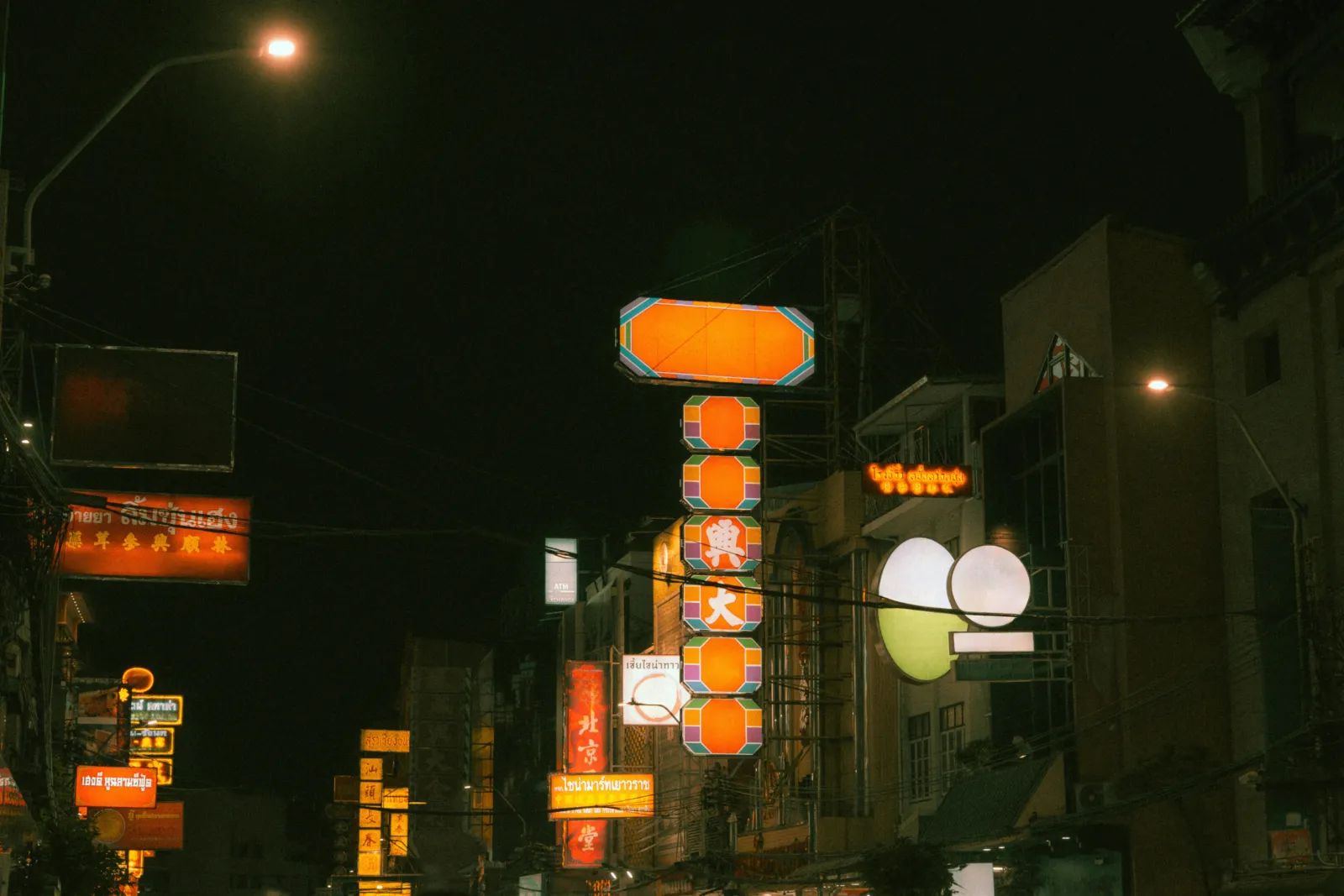
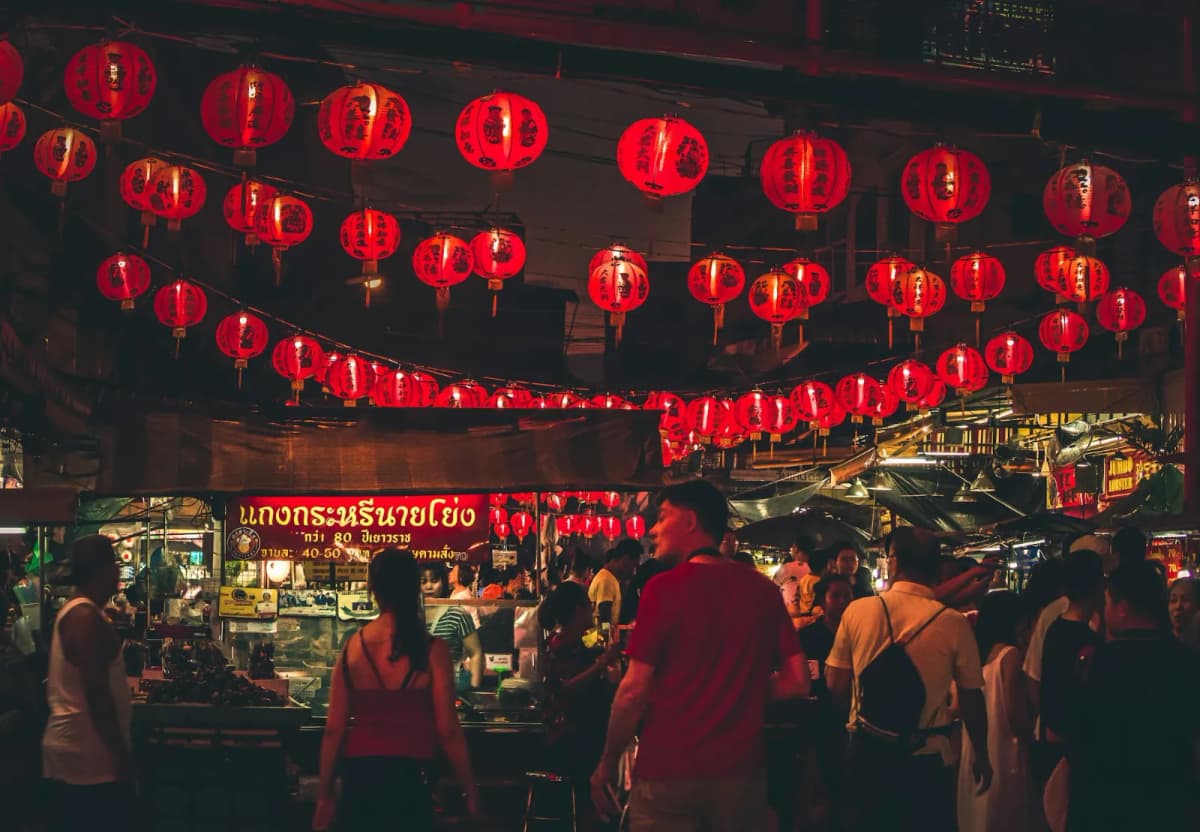
Yaowarat Road is Bangkok's best known street food street, and it comes alive in the evening when the gold shops close and the stalls set up. The Tourism Authority of Thailand describes how, "after the business hours, Yaowarat turns more vivid when street food vendors set up their stalls" (TAT). TAT News lists dim sum, noodles and omelettes among the evening street food and confirms that the MRT Blue Line now stops at Wat Mangkon, in the middle of Chinatown (TAT News, June 2024).
How to do it well:
- Walk the main road once before buying anything, then work the side lanes, where the queues are more local.
- Share. Order one plate at each stall and split it, so you can try six or seven things instead of two.
- Look for the queue of Thai customers, not the stall with the most signs. A long line at a single-dish cart is the best quality signal you will get.
- Expect crowds on Friday to Sunday nights. Weeknights other than Monday are calmer.
- During the Vegetarian Festival in September or October, Yaowarat turns into a giant jay food fair, which is the easiest time of year for vegetarians to eat here.
Banglamphu, Khao San Road and Soi Rambuttri
Banglamphu, the old neighbourhood around Khao San Road, is the second great street food district, and it is better than the Khao San strip itself suggests. Khao San is loud and aimed at backpackers, with pad thai carts, fruit shakes and roti. The real eating is in the lanes around it: Soi Rambuttri, Tanao Road, Phra Athit Road and the streets towards the Democracy Monument, where long-running noodle, duck, fish ball and stir-fry shops sit side by side. Time Out Bangkok's round-up of Banglamphu stalls, for example, places a fish ball noodle shop in an alley off Tanao Road (Time Out Bangkok).
This is also where Bangkok's most famous street cook works. Jay Fai, on Maha Chai Road in Phra Nakhon, holds one MICHELIN Star in the 2026 MICHELIN Guide Thailand and is listed under the cuisine type "Street Food, Thai". The Michelin section further down explains what that means for you.
Victory Monument: the boat noodle lanes
Victory Monument is the place to try boat noodles. The area sits on Khlong Samsen, which according to Wikipedia "was once home to hundreds of boat vendors selling kuaitiao ruea", and it later became a centre for long-running boat noodle shops. It is served by Victory Monument BTS station (N3) on the Sukhumvit Line (Wikipedia, Victory Monument). The shops sit along the canal near the monument. Bowls are small and people stack the empties, so order two or three to start. This is a transport hub, not a tourist zone, so it gives you a good look at how Bangkok office workers and students eat. If you do not eat beef or pork, enjoy the walk but eat elsewhere, because the broths usually contain both.
Night markets and fresh markets
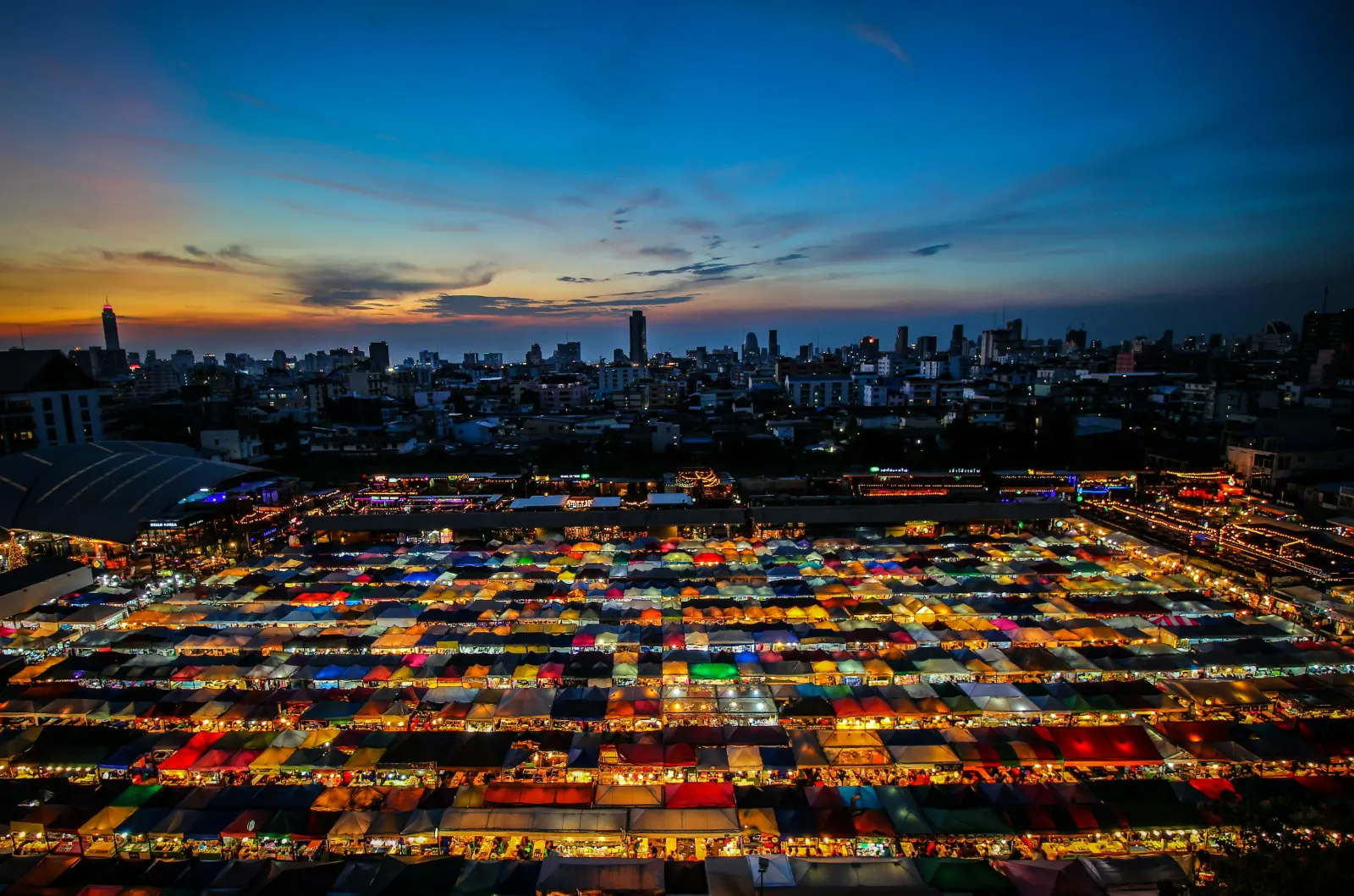
Markets are the easiest way to sample many dishes in one place, especially with children or older parents who need seating and toilets. Night markets are about grilled skewers, fried snacks, fruit and drinks, and they usually run from late afternoon until late. Fresh markets are best in the morning, when breakfast dishes, curries over rice and fruit are freshest. Bangkok's branded night markets open, close and move often, so check before you go. Our honest guide to which Thailand markets are worth your time tracks which ones are still running, and our Bangkok shopping guide covers markets where shopping, rather than food, is the main event.
Phahurat: Little India next to Chinatown
Phahurat is Bangkok's Little India, a textile district on the western edge of Chinatown. Time Out Bangkok describes "tiny stalls selling authentic Indian delicacies" in its alleys and notes that it is home to the Shri Guru Singh Sabha, Thailand's first Sikh gurdwara (Time Out Bangkok). For Nepali and Indian travellers this is the most useful food stop in the city. You will find samosa, chole, dal, roti, Indian sweets and vegetarian kitchens, and explaining a vegetarian or no-beef diet is easier here than anywhere else in the city. The Bangkok Post reported that the Bangkok City Council plans to develop Phahurat further as a Little India destination, with festivals, markets and better footpaths (Bangkok Post).










Are Bangkok's street stalls closed on Mondays?
Many pavement stalls do not trade on Mondays. City Hall has used Monday as a cleaning and non-trading day for vendors in regulated pavement zones. In July 2025, The Nation reported that district offices were told to make sure vendors clean their trading areas "daily after business hours, or every Monday", which it called "a designated non-trading day" (The Nation, 4 July 2025). Thai newspaper Daily News reported the same weekly rule in August 2024: vendors in the city's approved spots must stop trading every Monday and clean the areas where they sell (Daily News). Not every vendor follows it, and side streets vary. Shophouse restaurants, food courts and markets keep their own hours, so you can still eat very well on a Monday, but a Yaowarat pavement crawl is better on another night.
The same report sets out other rules the Bangkok Metropolitan Administration (BMA) applies to street vendors:
- Vendors must clean the pavement after closing every day.
- Food stalls must install grease traps and wash their utensils and equipment regularly.
- Vendors must keep proper registration, ID cards and QR codes.
- Selling is allowed only in approved trading zones and "lenient zones". The city reviews these zones and can cancel them.
The number of approved spots has been shrinking. The Nation reported 86 lenient zones with 4,500 vendors in 2022, against 59 lenient zones with 3,771 vendors in 2025. In May 2026 an AFP report, carried by The Jakarta Post, said BMA data showed that the estimated number of mobile vendors had fallen by more than 60 percent since 2022. It said enforcement mainly targets main roads with heavy foot traffic, while side streets and backpacker areas have had more flexibility. It also reported that the city has opened five hawker centres in recent years, the newest beside Lumphini Park in April 2026 (The Jakarta Post, 3 May 2026).
What this means for your trip:
- Street food is not banned. It is being pushed off busy main roads and into side lanes, markets and hawker centres.
- A stall from an old video may have moved. Check recent map reviews before crossing the city for one vendor.
- Monday is the weakest day for pavement stalls. Use it for markets, food courts or a restaurant meal.
- Rules can change quickly. Checked: 5 Nov 2026, sources as linked above.
Does Bangkok street food have Michelin recognition?
Yes. The MICHELIN Guide Thailand includes street food vendors, and Bangkok's best known example is Jay Fai, which holds one star in the 2026 guide. Michelin's page calls Jay Fai "a street food icon" and singles out the "signature crispy, golden-brown crab omelettes", along with stir-fried prawns in yellow curry and noodle dishes (MICHELIN Guide, Jay Fai). When we checked on 5 Nov 2026, the listing showed it open Wednesday to Saturday. Days change, so confirm on the guide before you go, and expect a long wait.
The Bib Gourmand list is more useful for most travellers. It recognises places serving "high-quality food at exceptional value for money". The 2026 Thailand list, announced on 20 November 2025, has 137 venues, including 13 new entries. Of these, 44 are in Bangkok and the surrounding provinces, and the selection ranges "from upscale restaurants to simple eateries and street food vendors" (MICHELIN Guide, Bib Gourmand Thailand 2026). In practice:
- A Michelin listing tells you a stall is consistent. It does not make an unlisted stall worse. Many excellent cooks have no listing.
- Listed stalls often get queues and sometimes raise their prices. Arrive early or go on a weekday.
- Use the guide's own website for current opening days. Older articles and social posts go out of date quickly.
What can vegetarians eat in Bangkok?
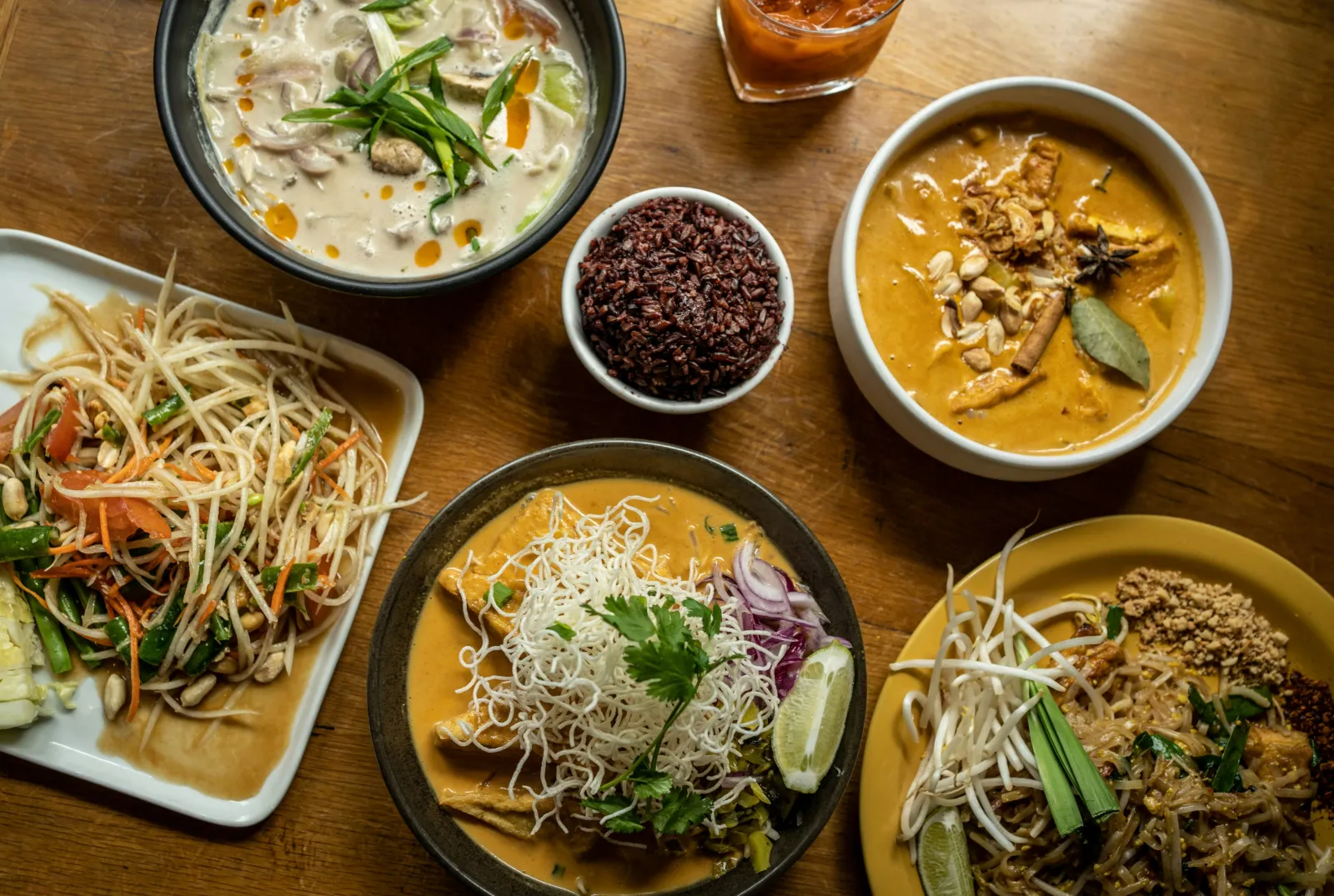
Vegetarians can eat well in Bangkok by looking for jay (เจ) food, which is vegan and also leaves out garlic and onion, and by ordering at made-to-order stalls that can cook without meat or fish sauce. The safest options are jay restaurants and stalls marked with a yellow flag or sign showing the Thai letters เจ, Indian vegetarian kitchens in Phahurat, and simple dishes such as vegetable fried rice, tofu pad kra pao and stir-fried morning glory. Ask every time, because fish sauce, shrimp paste and oyster sauce are in almost everything.
Jay versus mangsawirat: two words that matter
Thai has two words that both get translated as "vegetarian", and they are not the same.
- Jay (เจ) is Chinese-style Buddhist vegetarian food. Thai newspaper Thairath explains that jay food avoids meat and all animal products, including eggs, lard, butter and milk, and also forbids pungent vegetables such as garlic (Thairath). In practice, jay food is vegan and free of onion and garlic.
- Mangsawirat (มังสวิรัติ) means vegetarian in the broader sense. It excludes meat, but depending on the cook it may include egg, milk or seasoning that contains fish.
For most Nepali and Indian vegetarians, asking for jay is the safer choice, because it rules out the hidden fish sauce. Thai learners' sites note that people often use เจ for both diets in everyday speech (Pickup Thai). If you eat dairy and like onion and garlic, a jay meal is still fine. It is simply stricter than you need.
The yellow flags and the Vegetarian Festival
Jay kitchens put up yellow flags or signs marked เจ, often next to a red Chinese character. The Bangkok Post describes "yellow flags with a red Chinese character" that "flutter all around town" at the start of the vegetarian festival. It says jay food is prepared without meat, "including eggs, dairy products or honey", and without "garlic, onion and chives" (Bangkok Post). The festival follows the Chinese lunar calendar, so its dates move each year, usually into September or October. In 2026 the vegetarian observance ran from 10 to 18 October, with the Yaowarat festival running from 9 to 18 October around the Chinatown Gate at Odeon Circle (The Nation; Time Out Bangkok).
This timing often lands close to Dashain and Tihar, when many Nepali families travel. If you are a vegetarian family planning a festival holiday, a trip that overlaps the Vegetarian Festival makes Bangkok unusually easy. The flip side is that Yaowarat is extremely crowded on those nights.
Vegetarian dishes to ask for
- Pad pak ruam (ผัดผักรวม): mixed stir-fried vegetables. Ask for no oyster sauce.
- Pad kra pao tao hu (ผัดกะเพราเต้าหู้): holy basil stir fry with tofu. Ask for no fish sauce.
- Khao pad jay (ข้าวผัดเจ): vegetable fried rice without egg. Leave out the "jay" if you eat egg.
- Pad thai jay: tofu pad thai without fish sauce or dried shrimp.
- Som tam jay: papaya salad without fish sauce, dried shrimp or crab.
- Green or red curry jay at jay stalls, where the paste is made without shrimp paste.
- Fresh fruit, roti with banana, sticky rice with mango and coconut milk desserts.
Hidden ingredients to ask about
| Ingredient | Thai | Where it hides |
|---|---|---|
| Fish sauce | น้ำปลา (nam pla) | Almost every stir fry, soup, salad and dip |
| Shrimp paste | กะปิ (kapi) | Curry pastes, chilli dips (nam prik) |
| Oyster sauce | น้ำมันหอย (nam man hoi) | Vegetable stir fries, noodles |
| Dried shrimp | กุ้งแห้ง (kung haeng) | Som tam, pad thai |
| Egg | ไข่ (khai) | Pad thai, fried rice, noodles, desserts |
| Pork or chicken stock | น้ำซุป (nam soup) | Noodle soups, even "vegetable" soups |
| Lard | น้ำมันหมู (nam man moo) | Some Chinese-style fried dishes and older stalls |
How do you avoid beef or pork in Bangkok?
Say clearly what you do not eat, use the right Thai word, and choose dishes that do not use the meat by default. For beef, say mai sai neua wua (ไม่ใส่เนื้อวัว, "do not add beef") or mai kin neua wua (ไม่กินเนื้อวัว, "I do not eat beef"). For pork, say mai sai moo (ไม่ใส่หมู). Avoid boat noodles if beef is your concern, and avoid most Chinatown noodle soups if pork is.
Why "neua" alone is not enough
Many phrase lists tell you to say mai sai neua for "no beef". That is half right. The word เนื้อ (neua) means flesh or meat in general. In everyday speech it is also used for beef. Wiktionary lists both "meat" and "(colloquial) beef" as senses of the word (Wiktionary, เนื้อ). The unambiguous word for beef is เนื้อวัว (neua wua), literally "cow meat", and that is how language guides list beef (Fluent in 3 Months). Add wua and there is no confusion. If you want no meat at all, say mai sai neua sat (ไม่ใส่เนื้อสัตว์), "do not add animal meat".
Phrase table: vegetarian, no beef and no pork
Show the Thai script on your phone if your pronunciation is uncertain. Thai is tonal and our romanisation is simplified. Add khrap (ครับ) at the end if you are male and kha (ค่ะ) if you are female, to sound polite.
| You want to say | Thai script | Say it like |
|---|---|---|
| Vegan, Chinese Buddhist style (no meat, egg, dairy, garlic or onion) | เจ | jay |
| I eat jay food | ผม/ฉัน กินเจ | phom (male) / chan (female) kin jay |
| Vegetarian (may include egg or dairy) | มังสวิรัติ | mang-sa-wi-rat |
| Do not add meat | ไม่ใส่เนื้อสัตว์ | mai sai neua sat |
| Do not add beef | ไม่ใส่เนื้อวัว | mai sai neua wua |
| I do not eat beef | ผม/ฉัน ไม่กินเนื้อวัว | phom / chan mai kin neua wua |
| Do not add pork | ไม่ใส่หมู | mai sai moo |
| Do not add fish sauce | ไม่ใส่น้ำปลา | mai sai nam pla |
| Do not add egg | ไม่ใส่ไข่ | mai sai khai |
| Do not add oyster sauce | ไม่ใส่น้ำมันหอย | mai sai nam man hoi |
| Is there beef in this? | มีเนื้อวัวไหม | mee neua wua mai |
Dishes that often contain beef
- Boat noodles: the broth commonly combines pork and beef.
- Kuay teow neua (ก๋วยเตี๋ยวเนื้อ): beef noodle soup, with stewed or sliced beef and beef balls.
- Massaman curry: often made with beef, though chicken is common too.
- Khao soi: the northern curry noodle soup, sold in Bangkok, is usually chicken or beef.
- Grilled skewers: beef skewers sit next to pork and chicken at many carts.
- Halal stalls: halal means no pork, but it does not mean no beef. Muslim-run stalls often serve beef curries and beef soups.
Dishes that often contain pork
- Most Thai Chinese noodle soups in Yaowarat, including guay jub, wonton noodles and many fish ball soups made with pork stock.
- Moo ping, khao kha moo, khao moo daeng (red roast pork) and jok.
- Sai krok Isan (fermented sausage) and many grilled sausages.
- Crispy pork belly (moo krob) added to stir fries such as kana moo krob.
The simplest beef-free and pork-free choices are seafood, chicken, egg and vegetable dishes from made-to-order stalls, plus khao man gai, gai yang and som tam. For travellers who avoid pork, a halal sign at a Muslim-run stall is a useful signal, though not for beef, as noted above.
Is street food in Bangkok safe?
Bangkok street food is generally safe if you choose busy stalls, eat food cooked to order and served hot, and are careful with raw seafood, uncovered cut fruit and dishes that have sat at room temperature. Most stomach trouble comes from heat, spice and new bacteria rather than from dramatically unsafe food. A few simple habits cut the risk a lot.
Hygiene tips that actually work
The World Health Organization's Five Keys to Safer Food are: keep clean, separate raw and cooked, cook thoroughly, keep food at safe temperatures, and use safe water and raw materials. On a Bangkok pavement, that looks like this:
- Pick the busy stall. High turnover means ingredients do not sit for hours.
- Watch it cooked. Wok dishes, grilled skewers and boiling noodle soups are the safest choices.
- Eat it hot. Steam rising off the plate is a good sign. Lukewarm curry from a tray that has been out since morning is a poor one.
- Look at the raw and cooked separation. Raw meat should not share a board or tray with ready-to-eat food.
- Be careful with raw dishes. Raw prawn salads (goong chae nam pla), raw crab in som tam and undercooked cockles carry the most risk.
- Peel your own fruit, or buy it cut in front of you from a cart with ice underneath, not from an uncovered tray.
- Drink sealed bottled water or filtered water. If ice worries you, order drinks mai sai nam khaeng (ไม่ใส่น้ำแข็ง), "no ice".
- Carry hand sanitiser and tissues. Many stalls have no hand basin.
- Go easy on the first day. Let your stomach adjust to the chilli and the heat before a full Chinatown crawl.
Clean Food Good Taste and other signals
Thailand's Ministry of Public Health has run the Clean Food Good Taste project since 1999. Food vendors that meet its criteria can display the Clean Food Good Taste logo (TAT News). The sign is a plus, but plenty of good stalls do not have it. A queue of Thai customers, a clean wok station and food cooked hot still matter more. The BMA rules above, such as grease traps, utensil washing and vendor registration, are meant to raise the minimum standard in the zones they cover.
Allergies, spice and sensitive stomachs
- Peanuts are sprinkled on pad thai, som tam Thai and many salads. Say mai sai thua (ไม่ใส่ถั่ว), "no peanuts", and carry a written allergy card in Thai if your allergy is serious.
- Shellfish hides in shrimp paste, dried shrimp and fish sauce. A shellfish allergy needs a written card, not a spoken phrase.
- Spice: ask for mai phet (ไม่เผ็ด, not spicy) or phet nit noi (เผ็ดนิดหน่อย, a little spicy). Thai "a little" can still be hot by Kathmandu standards, but many Nepali travellers handle Thai chilli well.
- MSG: if you prefer to avoid it, say mai sai phong chu rot (ไม่ใส่ผงชูรส).
For etiquette beyond the food stall, such as temple dress and behaviour around monks, read our guide to do's and don'ts in Thailand.
What are the must-try desserts and drinks?
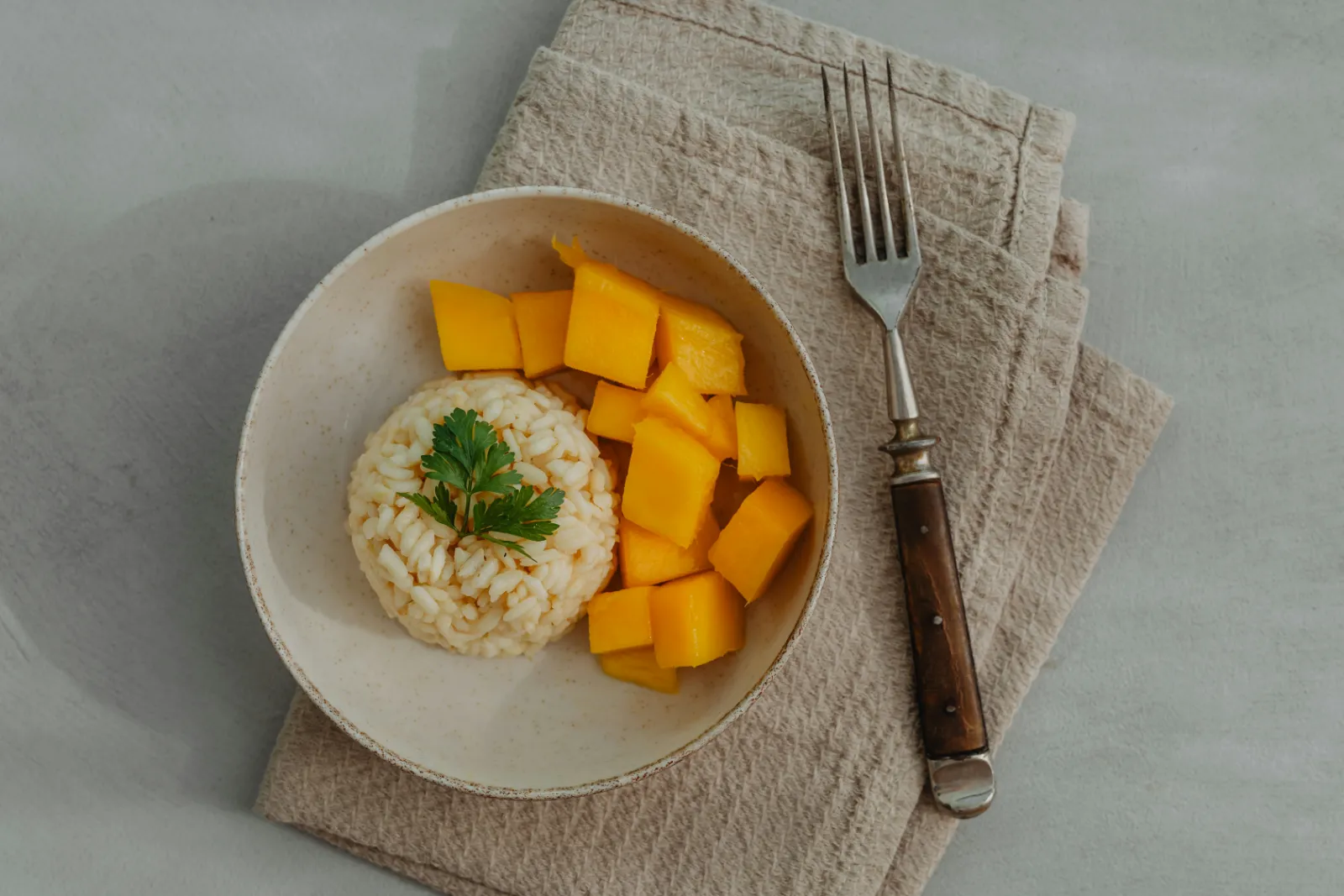
The must-try Bangkok desserts are mango sticky rice, coconut pancakes (khanom krok), banana roti, Chinese-style sweets in Yaowarat and coconut ice cream. The must-try drinks are Thai iced tea, iced coffee (oliang), fresh coconut water and sugarcane juice. Most Thai desserts are built on rice, coconut, palm sugar and fruit, so many are naturally egg-free. Roti and anything with condensed milk are the exceptions.
Mango sticky rice (ข้าวเหนียวมะม่วง)
Mango sticky rice, khao niao mamuang, is sweet sticky rice cooked with coconut milk, served with ripe mango slices and a salty coconut cream on top, sometimes with crisp mung beans. Thai PBS World names the Nam Dok Mai mango, prized for its fibreless flesh, and the older Ok Rong variety, and says the dish is at its best in April and May, when mango orchards peak (Thai PBS World). It is sold year round, but it is noticeably better in the hot season. It is vegetarian, contains no egg and is usually dairy-free, because the cream is coconut.
Other sweets and drinks
| Dessert or drink | Thai | What it is | Veg note |
|---|---|---|---|
| Khanom krok | ขนมครก | Small coconut and rice flour pancakes cooked in a dimpled pan | Usually vegan |
| Banana roti | โรตี | Fried flatbread with banana, often with egg, sugar and condensed milk | Vegetarian, contains egg and dairy unless you ask |
| Bua loy | บัวลอย | Rice flour balls in warm coconut milk | Vegan, sometimes served with egg |
| Pa thong ko | ปาท่องโก๋ | Chinese fried dough sticks, dipped in pandan custard or condensed milk | Vegetarian, dips may contain egg or dairy |
| Coconut ice cream | ไอศกรีมกะทิ | Coconut milk ice cream served in a coconut shell or bun | Often dairy-free, some versions add milk |
| Thai iced tea | ชาเย็น (cha yen) | Strong spiced black tea with sugar and condensed or evaporated milk | Contains dairy |
| Thai iced coffee | โอเลี้ยง (oliang) | Strong black iced coffee brewed with grains, sweetened | Vegan when served black |
| Coconut water | น้ำมะพร้าว (nam maphrao) | Drunk straight from a young coconut | Vegan |
| Sugarcane juice | น้ำอ้อย (nam oi) | Pressed fresh, served over ice | Vegan, ask for no ice if unsure |
Yaowarat is the best place in the city for Chinese sweets: ginger soup with sesame dumplings, grass jelly, bird's nest drinks and sweet soy milk. TAT's Chinatown guide, linked above, points to the area's Chinese dessert shops. For Nepali visitors used to milky chiya, Thai iced tea will feel familiar but much sweeter. Ask for wan noi (หวานน้อย), "less sweet".
How do you order and pay at street stalls?
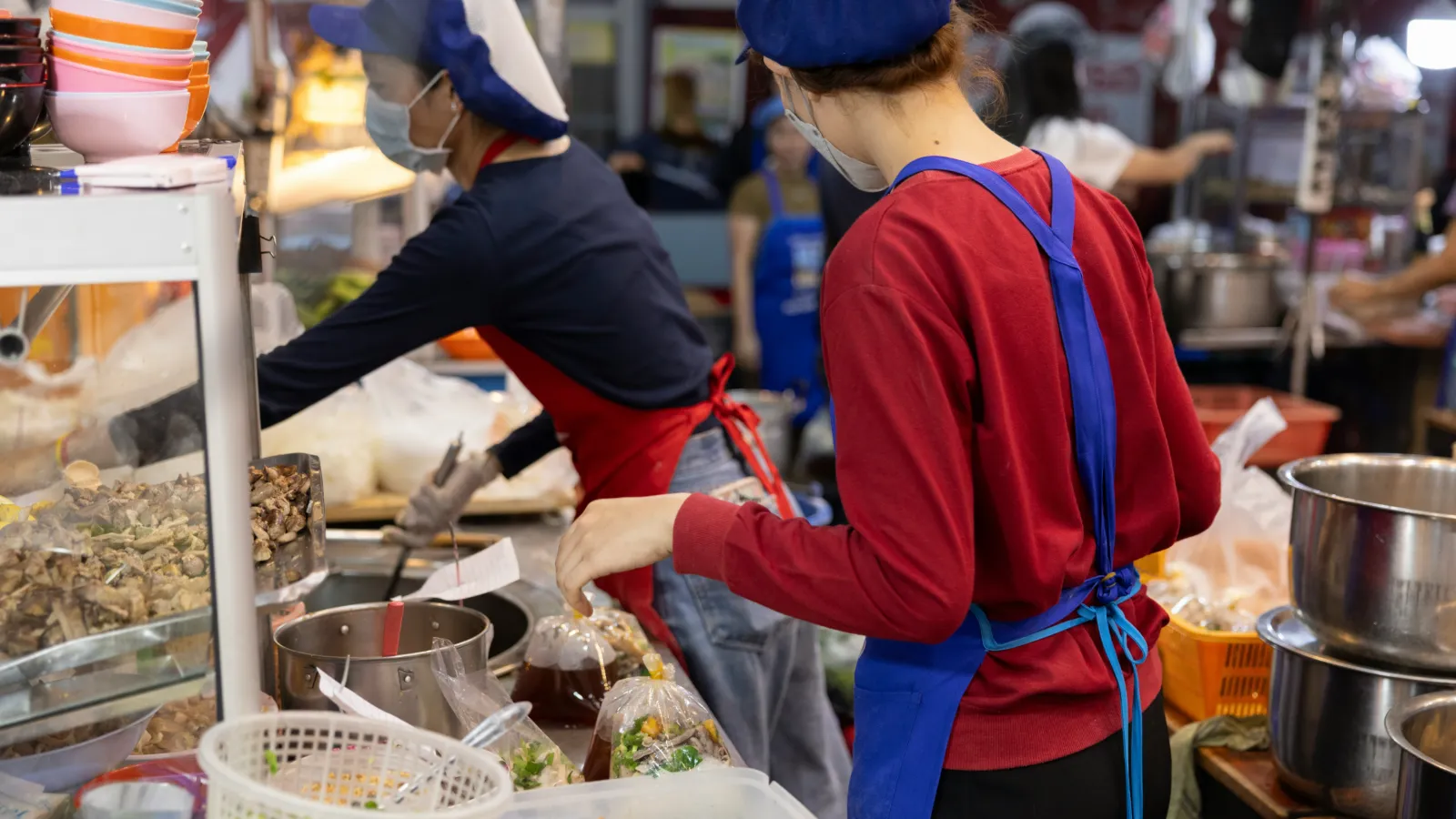
Order by pointing at the dish or at another customer's plate, saying an nee (อันนี้, "this one"), and holding up fingers for the number. Then say whether you will eat at the stall or take it away, and pay cash after you eat, or when you collect a takeaway. You do not need much Thai, but a few words make every order smoother and help you avoid getting the wrong meat.
The ordering routine, step by step
- Find a seat first if the stall has stools, or join the queue if it is takeaway only.
- Point and say an nee. Many stalls have a photo board or a short menu on the wall.
- Choose your protein if asked. You will hear moo (pork), gai (chicken), neua (beef), goong (prawn), talay (seafood) or tao hu (tofu).
- State your diet and spice level using the phrases above, before the cook starts.
- Say where you will eat. Kin tee nee (กินที่นี่) means eat here. Sai thung (ใส่ถุง) means put it in a bag to take away.
- Season it yourself. The condiment caddy on the table usually holds fish sauce with chilli, dried chilli flakes, sugar and chillies in vinegar. Thai people season noodle soups to taste.
- Pay. Ask tao rai (เท่าไหร่, how much) or check bin (เช็คบิล, the bill) and pay the cook or the person at the till.
Phrase table: ordering and paying
| English | Thai script | Say it like |
|---|---|---|
| This one | อันนี้ | an nee |
| Not spicy | ไม่เผ็ด | mai phet |
| A little spicy | เผ็ดนิดหน่อย | phet nit noi |
| Less sweet | หวานน้อย | wan noi |
| No ice | ไม่ใส่น้ำแข็ง | mai sai nam khaeng |
| Eat here | กินที่นี่ | kin tee nee |
| Take away (in a bag) | ใส่ถุง | sai thung |
| How much? | เท่าไหร่ | tao rai |
| The bill, please | เช็คบิล | check bin |
| Delicious | อร่อย | a-roi |
| Thank you | ขอบคุณครับ / ค่ะ | khop khun khrap / kha |
Paying: cash, QR codes and small notes
- Carry small notes and coins in Thai baht. Stalls struggle to change large notes, especially early in the evening.
- QR codes are everywhere, but they are usually PromptPay, Thailand's real-time payment system, which runs under the oversight of the Bank of Thailand (Wikipedia, PromptPay). Paying by QR normally needs a Thai bank app or a foreign app that supports Thai QR. Do not rely on it as a visitor.
- Cards are rarely accepted at street stalls. Food courts and malls are the exception.
- Tipping is not expected at street stalls. Leaving your small change is a kind gesture, not a rule.
- Prices are fixed. Do not bargain over food, even in markets where you might bargain for souvenirs.
Street food is the cheapest way to eat in Bangkok, but how far your money goes depends on where and how you eat. Our guide on whether Thailand is expensive shows how food fits into a realistic daily budget without fixing numbers that change every season.
At the table, Thai people eat rice dishes with a fork and spoon, use chopsticks for noodle soups, and roll sticky rice into small balls with the right hand. Share tables when it is busy, and give up your stool once you finish if there is a queue.
How should Nepali travellers plan a Bangkok food trip?
Base yourself near the old city or along the MRT Blue Line, plan two or three evening food walks (Chinatown, Banglamphu and a night market), keep one meal a day at Phahurat or a jay kitchen if you are vegetarian, and avoid Monday for pavement stalls. Bangkok is a short hop from Kathmandu by air, so it works for a long weekend as well as a longer holiday.
A few tips for Nepali and diaspora families:
- Vegetarian grandparents: plan meals around Phahurat, jay restaurants and hotel breakfasts, and use street food as an extra. Write the jay phrase on a card for them.
- No-beef households: the big risk is boat noodles and beef noodle soups. Teach everyone to say mai kin neua wua and to check before ordering any noodle soup.
- Children: khao man gai, pad thai, fried rice, gai yang, grilled sweetcorn, fruit and roti are reliable, mild choices.
- Spice lovers: som tam, pad kra pao and tom yum will feel like home if you grew up with achar and khursani. Thai chilli is fresh and sharp rather than slow-burning.
- Festival travel: during Dashain and Tihar the flights fill up early, and if the dates line up with the Vegetarian Festival, Yaowarat will be packed. Go early in the evening.
- Heat: Bangkok is hot all year, and hottest from about March to May. Drink water between stalls and eat in the evening when it cools down.
If you prefer a ready-made trip with your evenings left free for food walks in Chinatown and Banglamphu, see our Thailand tour packages.
Frequently asked questions
What is the most famous street food in Bangkok?
Pad thai is the best known Bangkok street food internationally, but locals eat noodle soups, khao man gai, pad kra pao and som tam far more often. For a famous name, Jay Fai on Maha Chai Road holds one MICHELIN Star in the 2026 guide for its crab omelette and wok dishes. Mango sticky rice is the best known Bangkok dessert.
Is Thai food vegetarian friendly?
Thai food is vegetarian friendly if you know what to ask for. Most dishes use fish sauce, shrimp paste or oyster sauce by default, so a plain vegetable dish is often not vegetarian. In Bangkok, look for jay (เจ) kitchens with yellow signs, order at made-to-order stalls, and visit Phahurat for Indian vegetarian food.
How do I say no beef in Thai?
Say mai sai neua wua (ไม่ใส่เนื้อวัว), which means "do not add beef", or mai kin neua wua (ไม่กินเนื้อวัว), "I do not eat beef". Include the word wua (cow), because neua on its own can mean meat in general as well as beef. Showing the Thai script on your phone removes any doubt.
Is street food safe in Bangkok?
Bangkok street food is generally safe when you choose busy stalls, eat food cooked to order and served hot, and take care with raw seafood, uncovered cut fruit and food left at room temperature. Drink bottled or filtered water, carry hand sanitiser, and take the first day easy while your stomach adjusts to the spice and heat.
Where is Bangkok Chinatown street food?
Bangkok's Chinatown street food runs along Yaowarat Road and its side lanes in Samphanthawong district. The nearest station is MRT Wat Mangkon on the Blue Line. Stalls set up in the evening after the shops close. Friday to Sunday nights are the busiest, and Monday is the weakest night because pavement vendors are expected to stop for cleaning.
What does jay mean on food stalls?
Jay (เจ) marks Chinese-style Buddhist vegetarian food in Thailand. It contains no meat, fish, eggs, dairy or honey, and it also leaves out pungent vegetables such as garlic and onion. Jay stalls and restaurants display yellow flags or signs marked เจ, and they multiply during the annual Vegetarian Festival in September or October.
Is Thai food very spicy?
Some Thai dishes are very spicy, especially som tam, pad kra pao, larb and tom yum, but many street foods are mild, including pad thai, khao man gai, fried rice, guay jub and grilled chicken. Ask for mai phet (not spicy) or phet nit noi (a little spicy), and add chilli yourself from the condiment caddy.
Can I find Indian food in Bangkok?
Yes. Phahurat, Bangkok's Little India next to Chinatown, has Indian food stalls, sweet shops and vegetarian kitchens, and it is home to Thailand's first Sikh gurdwara. It is the easiest place in Bangkok for Nepali and Indian travellers to find dal, roti, chole and familiar vegetarian meals.
What is mango sticky rice?
Mango sticky rice, khao niao mamuang, is sweet sticky rice cooked with coconut milk, served with ripe mango and a salty coconut cream topping. It is vegetarian and usually egg-free and dairy-free. It is sold all year in Bangkok, but it is at its best in April and May, when Thai mangoes such as Nam Dok Mai are in season.
Are Bangkok street food stalls open on Mondays?
Many pavement stalls in Bangkok do not trade on Mondays. City Hall has set Monday as a cleaning and non-trading day for vendors in regulated zones, as The Nation reported in July 2025. Restaurants, food courts and markets keep their own hours, so plan Chinatown and Banglamphu pavement crawls for other nights.
Bangkok ma veg khana paincha?
Yes, you can find vegetarian food in Bangkok. Ask for jay (เจ) food, which has no meat, egg, dairy, garlic or onion, or go to Phahurat (Little India) for dal, roti and Indian sweets. At normal stalls, say mai sai neua sat (no meat) and mai sai nam pla (no fish sauce), because fish sauce is in most dishes.