+977-9768558250
Explore by Country
See all 22 Thailand packages
Most popular pick
See all 22 Thailand packages →
See all 11 Vietnam packages
Most popular pick
See all 11 Vietnam packages →
See all 10 Indonesia (Bali) packages
Most popular pick
See all 10 Indonesia (Bali) packages →
See all 7 Maldives packages
Most popular pick
See all 7 Maldives packages →
See all 10 China packages
Most popular pick
See all 10 China packages →
See all 13 Sri Lanka packages
Most popular pick
See all 13 Sri Lanka packages →
See all 9 Malaysia packages
Most popular pick
See all 9 Malaysia packages →
See all 8 Singapore packages
Most popular pick
See all 8 Singapore packages →
See all 2 Kenya packages
Most popular pick
See all 2 Kenya packages →
See all 16 India packages
Most popular pick
See all 16 India packages →
See all 3 Dubai packages
Most popular pick
See all 3 Dubai packages →
See all 7 Nepal packages
Most popular pick
See all 7 Nepal packages →
See all 6 Philippines packages
Most popular pick
See all 6 Philippines packages →
Search Tours or Places
Blog / Malaysia

Batu Caves Malaysia: Temple Steps, Dress Code and Thaipusam

29 min read 27 Oct 2026
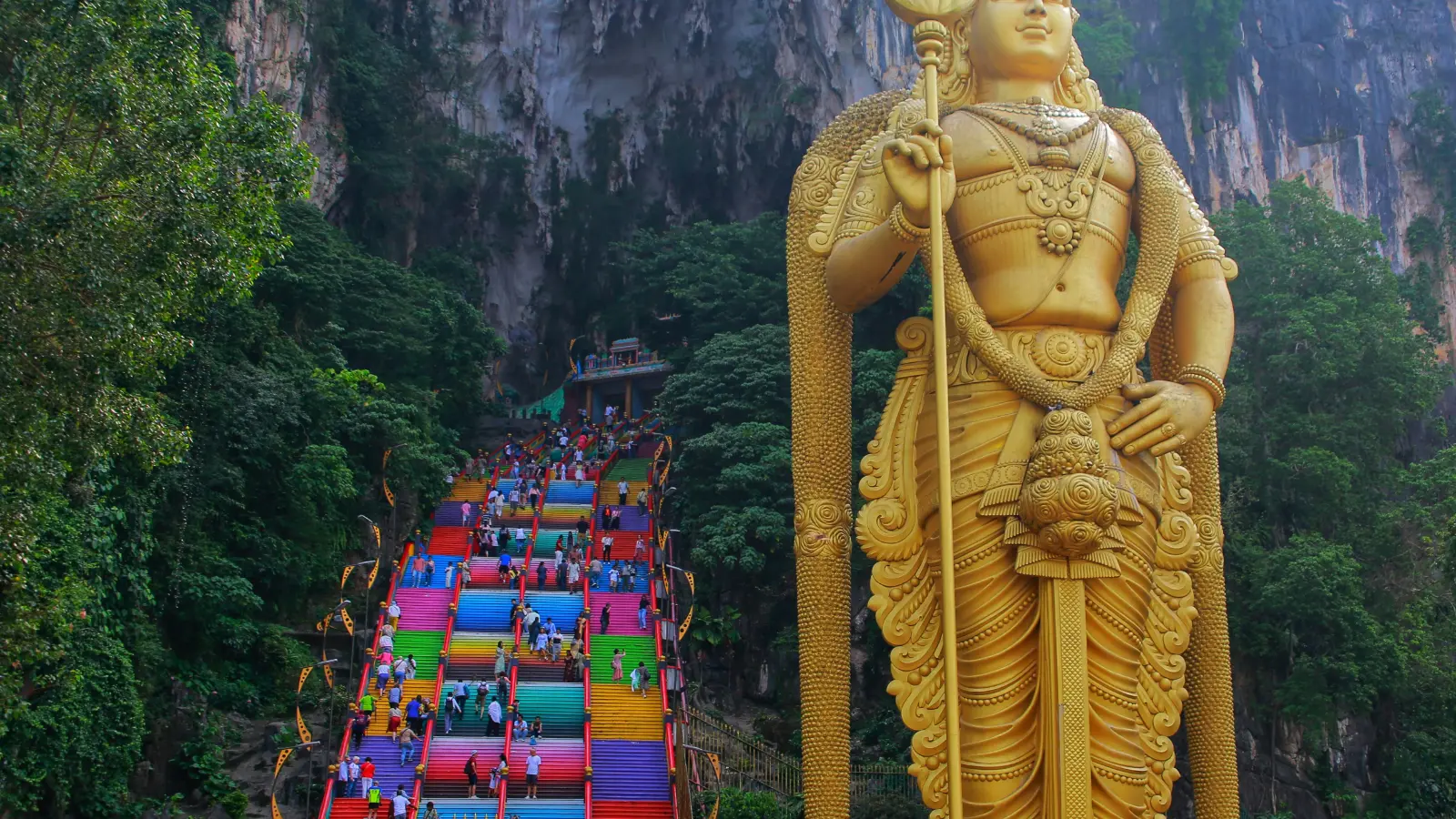
Golden Lord Murugan statue beside the rainbow painted staircase at Batu Caves near Kuala Lumpur

Short answer: Batu Caves, Malaysia, is a Hindu temple complex inside a limestone hill about 13 km north of central Kuala Lumpur, dedicated to Lord Murugan. You climb 272 rainbow painted steps, watched over by a 42.7 metre gold statue of Murugan, to reach the Temple Cave. Cover your shoulders and knees, take the KTM Komuter train from KL Sentral (roughly half an hour), arrive before 8am to beat the heat and crowds, and know that Thaipusam 2027 falls on Friday 22 January 2027, when the site fills with hundreds of thousands of devotees.

This guide is for first time visitors to Kuala Lumpur, for families travelling with elderly parents or small children, and especially for Hindu travellers from Nepal and the Nepali diaspora who want to visit Batu Caves as a place of worship rather than only a photo stop. It covers what the caves are, how to get there, what to wear, how hard the climb really is, which caves are open, how Thaipusam works, the best time of day to go, and the temple etiquette that will feel both familiar and slightly different if you grew up visiting temples in Nepal.

Batu Caves is usually one stop on a wider Malaysia trip. If you are still shaping the bigger plan, start with our complete Malaysia travel guide, then come back here for the detail on this one landmark.

Batu Caves Malaysia at a glance: what do you need to know?

Here is the whole site on one screen. Volatile details (hours, cave access, escalator status) are marked with the date we checked them, because they have changed more than once in recent years.

ItemWhat to know
LocationGombak district, Selangor, about 13 km north of central Kuala Lumpur
What it isLimestone hill with cave temples; main shrine is the Sri Subramaniar Swamy Temple to Lord Murugan inside the Temple Cave
Steps to Temple Cave272 steps, built in 1940, repainted in rainbow colours in August 2018
Murugan statue42.7 metres (140 ft), gold painted, unveiled January 2006
Time needed1.5 to 2 hours for the Temple Cave; 2.5 to 3 hours if you add Ramayana Cave and the ground level shrines
Dress codeShoulders and knees covered; shoes off inside shrines
Opening patternEarly morning to evening every day; recent visitor reports give roughly 6am or 7am to about 8.30pm or 9pm, with longer hours on festival days. No official timetable was accessible to us. Checked: 27 Oct 2026, visitor reports (including a September 2026 update) and Selangor tourism listing
Nearest stationBatu Caves (KTM Komuter), the northern terminus of the Batu Caves to Pulau Sebang line
EscalatorPlanned but not confirmed as operating; the stairs remain the only way up to the Temple Cave. Checked: 27 Oct 2026, Malay Mail (31 Jan 2026)
Biggest festivalThaipusam, next on Friday 22 January 2027. Checked: 27 Oct 2026, Prime Minister's Department 2027 holiday schedule

What are the Batu Caves and why are they sacred?
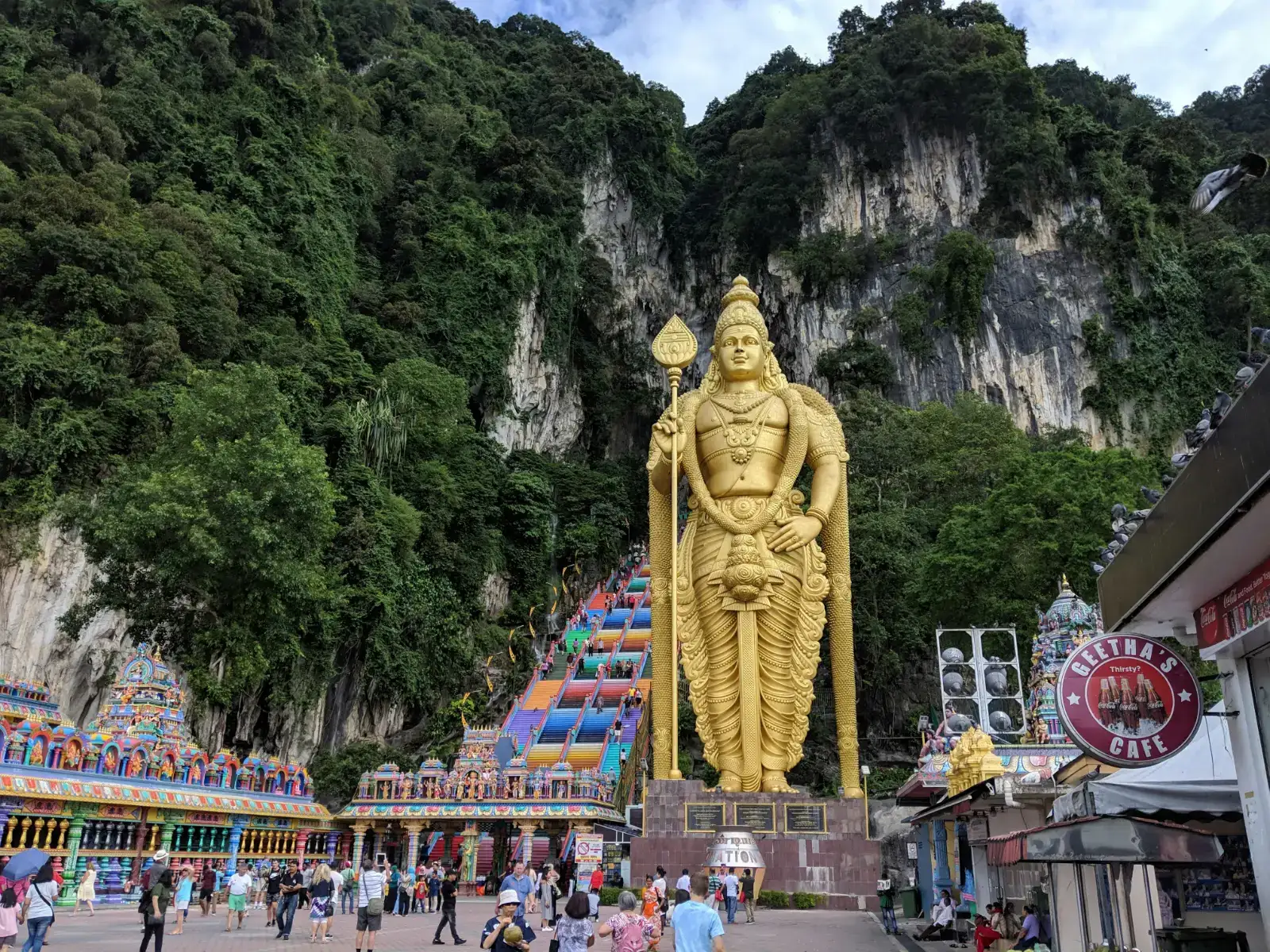
Lord Murugan statue at the foot of the Batu Caves limestone hill with visitors below

The Batu Caves are a set of caves in a limestone hill that geologists date to more than 400 million years old, and they are sacred because the largest cave holds one of the most important Murugan temples outside India. For Tamil Hindus in Malaysia, and for many Hindus across Southeast Asia, Batu Caves is a pilgrimage site first and a tourist attraction second.

Who is Lord Murugan?

Lord Murugan is the Tamil name for the deity known in North India and Nepal as Kartikeya, Skanda or Kumar: the son of Shiva and Parvati and the brother of Ganesh. In Tamil tradition he is the beloved god of the Tamil land, a young warrior who carries the vel, a divine spear given to him by his mother Parvati to defeat the demon Soorapadman. Many Nepali Hindus know Kartikeya mainly from stories and from his peacock mount; at Batu Caves you see how central he is to Tamil devotion, with dedicated priests, daily pujas and a festival built around him.

The story of Batu Caves as a temple begins with K. Thamboosamy, a Tamil trader in nineteenth century Kuala Lumpur, who is said to have been inspired by the shape of the main cave entrance, which reminded him of the tip of a vel. The Murugan temple inside the cave was completed in 1891, and the annual Thaipusam celebration here began in 1892. The site is managed today by the Sri Maha Mariamman Temple Devasthanam, the trust that also runs the old Sri Maha Mariamman Temple in Kuala Lumpur's Chinatown.

The gold statue

The gold statue of Lord Murugan at the foot of the steps stands 42.7 metres (140 ft) tall. It took about three years to build, using roughly 350 tonnes of steel, 1,550 cubic metres of concrete and 300 litres of gold paint, and it was unveiled during Thaipusam in January 2006. It is often described as the tallest statue in Malaysia, and it is now the second tallest Murugan statue in the world, after the Muthumalai Murugan statue (about 44.5 metres) in Salem, Tamil Nadu. Some older guides call the Batu Caves statue the tallest Murugan statue; that was true until the Salem statue was completed and is no longer the case.

The rainbow steps

The 272 concrete steps to the Temple Cave were built in 1940. For decades they were plain, and in August 2018 they were repainted in bands of bright colour, which turned them into one of the most photographed staircases in Asia. The colours fade and get touched up, so do not be surprised if your photos look a little different from the famous 2018 images.

FactDetailSource
Age of the limestoneMore than 400 million yearsGeological summaries of the Batu Caves hill
Temple completed1891Temple history
First Thaipusam here1892Temple history
Steps built1940, 272 stepsTemple history
Steps repaintedAugust 2018, rainbow coloursNew Straits Times, 27 Aug 2018
Murugan statue42.7 m, unveiled 29 Jan 2006Temple and press records
Hanuman statue15 m, at the Ramayana Cave entranceTemple records

Batu Caves is one of the stops we cover in our wider round up of things to do in Kuala Lumpur, which is a good place to see how it fits with the Petronas Towers, Merdeka Square and the food streets.
Explore Malaysia tour packages
View all →

How do you get to Batu Caves from Kuala Lumpur?

The simplest way to reach Batu Caves from Kuala Lumpur is the KTM Komuter train from KL Sentral to Batu Caves station, which takes roughly half an hour and drops you a short walk from the foot of the steps. Grab (the main ride hailing app in Malaysia) and organised tours are the alternatives, and each suits a different kind of traveller.

By KTM Komuter train

Batu Caves station is the northern end of the KTM Komuter line that runs south through Kuala Lumpur towards Pulau Sebang and Tampin. From KL Sentral the train calls at Kuala Lumpur, Bank Negara, Putra, Sentul, Batu Kentonmen, Kampung Batu and Taman Wahyu before reaching Batu Caves, which is the last stop, so you cannot miss it. Buy a ticket at the station counter or machine, or use a Touch 'n Go card.

KTMB issued new timetables for this line in 2026 (weekday timetable effective 27 April 2026, weekend and public holiday timetable effective 1 May 2026), and services were briefly disrupted in March 2026 by overhead line damage further south. From 18 April 2026 until about the end of December 2026, KTMB is also running a restructured schedule on this route because of track upgrading south of Kuala Lumpur, with fewer peak hour trains (KTMB said intervals of about 15 to 30 minutes) and the southern section suspended in the middle of the day; the KL Sentral to Batu Caves section was not reported as suspended. Frequency is lower than on the LRT and MRT lines, so check the next departure on the official KTMB timetable page before you head to the platform. Checked: 27 Oct 2026, KTMB.

By Grab or taxi

A Grab ride from central Kuala Lumpur usually takes about 20 to 40 minutes depending on traffic. It is the easiest choice for elderly parents, families with small children and anyone who wants to save their legs for the stairs. Ask to be dropped at the main entrance near the gold statue. On Thaipusam and on busy weekends, roads around the temple are closed or jammed, and the train is more reliable.

By coach tour

Half day city tours often combine Batu Caves with a craft or pewter factory and city sights, while day tours often pair it with Genting Highlands. Tours suit travellers who want a guide to explain the temple or who do not want to deal with transport at all. The trade off is a fixed schedule: tours often arrive mid morning, which is the hottest and busiest window.

OptionJourney time from the cityBest forWatch out for
KTM Komuter from KL SentralRoughly 30 to 40 minutes, plus waiting timeIndependent travellers, couples, budget travellersGaps between trains; check the timetable first
Grab or taxiAbout 20 to 40 minutes, traffic dependentElderly parents, small children, early starts before trains are frequentHeavy traffic at rush hour and festival road closures
Coach or private tourVaries by itineraryFirst time visitors who want a guide, groupsMid morning arrival in peak heat; limited time on site

Checked: 27 Oct 2026, KTMB route and timetable notices, Wikipedia line summary, visitor reports. We do not publish fares; they change and are shown at the station.

Getting to Kuala Lumpur from Kathmandu

Kuala Lumpur is one of the easier Southeast Asian cities to reach from Nepal. Several airlines fly nonstop between Kathmandu and Kuala Lumpur, with flying times of roughly 4.5 to 5 hours, and schedules change by season. Our guide to direct flights from Kathmandu lists the current nonstop routes. Nepali passport holders need a visa for Malaysia and should also check the Malaysia Digital Arrival Card (MDAC) requirement before flying; see our Malaysia visa guidance for the current position.

What is the dress code at Batu Caves?

The Batu Caves dress code asks every visitor, man or woman, to cover their shoulders and knees, and to remove footwear before entering any shrine. In practice this means trousers, a long skirt or a dress below the knee, and a top with sleeves. It is a working temple, and dressing modestly is a sign of respect rather than a tourist rule.

How strictly is it enforced?

Enforcement at Batu Caves has varied over the years. Visitor reports from 2024 to 2026 differ: some say staff at the foot of the steps stop people in shorts and short skirts, others say plenty of people in shorts walked up without being stopped. Do not plan around luck. If you arrive dressed modestly, you will never be turned back, you will not need to spend time finding a cover up, and you will feel more comfortable inside the Temple Cave among worshippers.

Can you rent or buy a sarong there?

Yes, cover ups are available near the foot of the steps. Recent reports disagree on whether they are rented with a refundable deposit or simply sold, and the arrangement has changed over time, so treat it as a backup rather than a plan. The easiest approach is to carry a light shawl or scarf for your shoulders and a wrap or sarong you can tie over shorts. Checked: 27 Oct 2026, visitor reports from 2024 to 2026; we could not find a current official notice from the temple.

TravellerWearAvoid
WomenKurta and leggings, long skirt, loose trousers, sari or salwar kameez; light shawl for shouldersShort skirts, shorts, sleeveless or strappy tops, very sheer fabrics
MenLong trousers or a dhoti, T shirt or shirt with sleevesShorts above the knee, vests and tank tops
ChildrenLight trousers or knee length clothing; a hat for the climbVery short shorts (older children are expected to dress like adults inside shrines)
EveryoneShoes or sandals with grip that slip off easily; small bag that zips shutLoose plastic bags of food (monkeys), high heels, flip flops with no grip

A practical Nepal tip: the cotton kurta suruwal or kurta and leggings that many Nepali women already pack for temple visits is ideal here. It covers what needs covering, it breathes in 30 degree humidity, and it does not draw a second look from anyone at the gate.

How many steps are there and how hard is the climb?

Close view of the colourful painted steps and gateway shrine at Batu Caves in Selangor

There are 272 steps from the foot of the hill to the Temple Cave, and for most healthy adults the climb takes about 10 to 20 minutes with a couple of pauses. The steps are steep and fairly narrow, the air is hot and humid, and there is little shade, so the climb is harder than the number suggests, especially after 10am.

Handrails run up the staircase and there are natural landings where people stop to catch their breath and take photos of the city behind them. Going down is easier on the lungs but harder on the knees, and the steps can be slippery after rain. Coming down slowly, holding the rail, is normal and nobody will hurry you.

Is there an escalator or lift?

Not yet, as far as we could confirm. An escalator to the Temple Cave was announced in 2024, and in January 2026 the Selangor government and the temple management said they had reached an understanding to proceed once technical requirements and a land licence issue were resolved. At the end of January 2026 the temple chairman said he expected the issues to be settled by July 2026. We could not find any confirmation that construction has finished or that an escalator is running. Until you see an official announcement, assume the 272 steps are the only way up to the Temple Cave. Checked: 27 Oct 2026, The Star (18 Jan 2026), Malay Mail (31 Jan 2026).

The good news for anyone who cannot climb: the Ramayana Cave, the Hanuman temple, the gold statue and several ground level shrines are all at the base of the hill, so a visit is still worthwhile without going up.

How hard is it for elderly parents and small children?

WhoDifficultyOur honest advice
Fit adultsModerate, mainly because of heatGo early, carry water, take one or two breaks
Parents in their 60s, reasonably activeChallenging but usually doableStart before 8am, climb slowly using the rail, plan rests at the landings, and let them set the pace
Parents with knee, heart or breathing problemsHard; the descent is often the worst part for kneesCheck with their doctor before the trip; consider worship at the ground level shrines and the Ramayana Cave instead
Children who walk confidently (about 5 and up)Fine for most, with breaksHold hands near the monkeys and on the descent
Toddlers and babiesNot possible with a pramUse a baby carrier, not a stroller; one adult can stay at the base
Wheelchair usersTemple Cave not accessibleThe base area, statue and Ramayana Cave are at ground level

Families travelling with grandparents and young children will find more planning ideas in our guide to Malaysia with family.

What is inside Temple Cave, Ramayana Cave and Cave Villa?

Daylight streaming through the roof opening into Temple Cave above the shrine at Batu Caves

The Temple Cave at the top of the steps is the heart of Batu Caves, holding the main Murugan shrine under a huge open roofed cavern. At the foot of the hill, the Ramayana Cave tells the story of the Ramayana in painted statues, and Cave Villa combines art galleries with an animal exhibit. The Dark Cave, an ecological site halfway up, has had very limited or no public access for years.

Temple Cave

Once you step into the Temple Cave, the temperature drops a little and the scale opens up: a vast limestone chamber with natural light falling through openings in the roof. Shrines to Lord Murugan and other deities sit inside the cavern, with priests performing pujas through the day. You will hear bells and chanting, smell camphor and incense, and see families making offerings. Entry to the Temple Cave itself has traditionally been without a ticket, and donation boxes are placed at the shrines.

Ramayana Cave

The Ramayana Cave sits at ground level to the left as you face the main steps, behind a 15 metre green statue of Lord Hanuman and the Hanuman temple. Inside, colourful statues and painted panels tell episodes of the Ramayana, including a giant sleeping Kumbhakarna. There are some steps inside the cave itself. A separate entry fee is charged. For Nepali visitors who grew up with the Ramayana through Janakpur and Sita's story, this cave is often the surprise favourite, and it is much quieter than the main steps.

Cave Villa

Cave Villa is a ground level cave complex with Hindu art, galleries and a small reptile and animal exhibit, also with a separate entry fee. Visitor opinion is mixed, mainly because of how some animals are kept. It is optional; skip it if you are short of time or uncomfortable with captive animals.

Dark Cave

The Dark Cave, whose sealed entrance you pass partway up the main steps, is a protected ecological site that was run with the Malaysian Nature Society (MNS) for guided educational and adventure tours. Public tours stopped in early 2019. The MNS website now says the Dark Cave reopened to the public as part of Visit Selangor Year 2025, but visitor reports from early 2026 describe the entrance as closed, and one traveller reported that MNS said by phone in February 2026 that there were no plans to reopen. We cannot confirm that tours are running today. If the Dark Cave matters to you, contact MNS directly before planning around it; otherwise treat it as closed. Checked: 27 Oct 2026, Malaysian Nature Society Dark Cave page and 2026 visitor reports.

Cave or siteWhereAccess statusTicketed?Climb needed
Temple Cave (Murugan shrine)Top of 272 stepsOpen dailyNo ticket; donations welcomeYes, 272 steps
Ramayana CaveGround level, left of main steps, behind Hanuman statueOpen dailyYes, separate feeShort climb inside
Cave VillaGround level, near the entranceOpenYes, separate feeMinimal
Dark CavePartway up the main stepsUnclear; closed to regular visitors since 2019, MNS claims a 2025 reopening that we could not confirmTours only, if runningPartial climb
Gold Murugan statue and ground shrinesBase of the hillOpen dailyNo ticketNone

Checked: 27 Oct 2026, MNS, Selangor tourism listing and 2025 to 2026 visitor reports. We do not quote ticket prices; they are shown at each cave entrance.

Monkeys: are they dangerous?

The long tailed macaques at Batu Caves are wild animals, and while most visits pass without trouble, they do snatch food, bags and phones, and they can scratch or bite if handled or provoked. Macaques can carry diseases, including rabies and herpes B, so any bite or scratch needs prompt medical attention.

  • Do not feed the monkeys, even if you see others doing it.
  • Keep food, drinks and plastic bags inside a zipped bag; a visible water bottle or snack invites a grab.
  • Hold phones and cameras firmly, and keep sunglasses in a case.
  • Do not crouch for close up selfies or stare at a monkey; give them space on the railings.
  • If a monkey grabs something, let go. Fighting over a bag is how people get hurt.
  • Keep small children close and holding your hand on the steps.
  • If you are bitten or scratched, wash the wound well with soap and water and go to a clinic or hospital the same day.

This is also a good reason to buy travel insurance before leaving Nepal; a precautionary rabies course abroad is not something you want to pay for unexpectedly.

When is Thaipusam at Batu Caves and what happens?

Devotee in saffron clothing carrying an offering pot up the Batu Caves staircase

Thaipusam 2027 falls on Friday 22 January 2027, according to Malaysia's official 2027 public holiday schedule from the Prime Minister's Department. It is a state public holiday in Kuala Lumpur, Putrajaya, Selangor, Johor, Negeri Sembilan, Perak and Penang, and Batu Caves hosts the largest Thaipusam gathering in Malaysia.

Thaipusam 2027 date box
Thaipusam day: Friday 22 January 2027
Silver chariot procession: in recent years it has left the Sri Maha Mariamman Temple in Kuala Lumpur's Chinatown around 9pm two nights before Thaipusam and reached Batu Caves the next day, on the eve of the festival. On that pattern, expect a departure on the evening of Wednesday 20 January 2027; the 2027 times had not been announced when we checked, so confirm nearer the date
Public holiday in: Kuala Lumpur, Putrajaya, Selangor, Johor, Negeri Sembilan, Perak, Penang
Checked: 27 Oct 2026, Prime Minister's Department 2027 holiday schedule

What is Thaipusam?

Thaipusam takes its name from the Tamil month of Thai and Pusam, the star (nakshatra) that rises around the full moon in that month. It marks the occasion when Parvati gave Murugan the vel to defeat the demon Soorapadman, and it is a day of thanksgiving and fulfilment of vows. Because it follows the lunar calendar, the date moves each year, usually landing in late January or early February. In 2026 it fell on 1 February; in 2027 it comes earlier, on 22 January.

What happens at Batu Caves

Preparations start weeks before. Many devotees keep a period of fasting, prayer and vegetarian food leading up to the day. Before the festival, a silver chariot carrying the deity leaves the Sri Maha Mariamman Temple on Jalan Tun H.S. Lee in Kuala Lumpur around 9pm and travels through the night to Batu Caves, arriving on the eve of Thaipusam (in 2026 it set off on the night of 30 January for the 1 February festival), with devotees walking behind it and free food and drink stalls (thaneer panthal) along the route. In 2026 the Kuala Lumpur authorities closed and diverted a series of road junctions in stages for the procession.

On the day itself, devotees climb the 272 steps carrying offerings. Many carry pots of milk (paal kudam) on their heads, and some carry the kavadi, an ornate frame decorated with peacock feathers and flowers. Some devotees pierce their skin, cheeks or tongues with small vel shaped skewers as an act of penance, in a trance state they describe as devotion rather than pain. Drums, chanting and the smell of camphor fill the air from before dawn.

Should you go at Thaipusam?

Go at Thaipusam ifVisit on another day if
You are a Hindu devotee who wants to witness or take part in Murugan worship at its most intenseYou are travelling with elderly parents, toddlers or anyone who struggles in crowds and heat
You are comfortable in very dense crowds for several hoursYou want photos of the steps and statue without crowds
You can arrive by train or on foot and accept road closuresYour trip depends on tight timings or a road transfer
You are happy to watch respectfully from the side and not block devoteesYou are sensitive to scenes of body piercing

Crowds at Batu Caves during Thaipusam have been reported in the hundreds of thousands in past years, and hotel demand in Kuala Lumpur rises around the festival. If you want to go, book accommodation early, stay near a KTM Komuter station, keep valuables to a minimum, drink plenty of water and agree a meeting point with your group in case you are separated. The days just before and after Thaipusam are a calmer way to see the decorations and the festive atmosphere.

For Nepali travellers, a late January Thaipusam falls well outside the Dashain and Tihar rush of October and November, when flights and hotels from Kathmandu are in highest demand. If you are planning around Nepali festivals instead, our guide to Dashain and Tihar holidays abroad covers that season, and our best time to visit Malaysia guide explains the weather on each coast.

What is the best time of day to visit Batu Caves?

The best time to visit Batu Caves is early morning, ideally before 8am, when the steps are coolest, the light is soft and the tour buses have not yet arrived. Late afternoon is the second best window. Midday is the hottest and busiest time and the hardest for older visitors.

Time slotHeatCrowdsGood for
Opening to 8amCoolestLightElderly parents, morning puja, photos without crowds
8am to 10amWarming upBuildingMost independent visitors; still comfortable
10am to 3pmHottest, strong sun on the stepsBusiest, tour groupsOnly if your schedule allows nothing else
3pm to closingEasing, afternoon showers possibleModerateSecond best option; softer evening light
Weekends and public holidaysSame patternHeavier all dayChoose a weekday if you can
Thaipusam periodHot, very crowdedExtremeDevotees and festival watchers only

Kuala Lumpur gets rain in every month, with frequent afternoon thunderstorms. If storms are forecast, a morning visit also reduces the chance of climbing slick steps in the rain.

How long to spend

Plan about 1.5 to 2 hours for the climb, the Temple Cave and the statue. Add 30 to 45 minutes for the Ramayana Cave and another 30 minutes if you want to eat at the base. Most people fit Batu Caves into a morning and spend the afternoon in the city, which is how we suggest it in our Malaysia itinerary guide.

Food at the base

The area at the foot of the hill has small South Indian eateries and stalls, many serving vegetarian food such as thosai (dosa), idli, vadai and banana leaf rice. For vegetarian Nepali travellers and elderly parents who prefer familiar food, this is one of the easiest meals of the trip. Kuala Lumpur's Brickfields area near KL Sentral has many more options; see what to eat in Malaysia for dishes to look for.

What should Hindu visitors from Nepal know about etiquette here?

Hindu visitors from Nepal will find temple etiquette at Batu Caves broadly familiar: shoes off, modest dress, respect for the shrine and the priests. The main differences are that this is a Tamil Shaivite temple with its own rituals, songs and offerings, it is open to visitors of all faiths, and it is also a major tourist site, so worship and sightseeing happen side by side.

Familiar and different

PracticeTypical at temples in NepalAt Batu Caves
Name of the deityKartikeya or Kumar, son of Shiva and ParvatiMurugan (also Subramaniar or Skanda), the central deity of the site
ShoesRemoved before the temple areaRemoved before entering shrines; you can walk the steps in shoes
Who may enterSome major temples restrict entry for non-Hindus (for example the inner courtyard of Pashupatinath)Visitors of all faiths may enter the Temple Cave if dressed modestly; some inner sanctum areas are for priests only
OfferingsFlowers, rice, sindur, diyo, prasadFlowers, coconuts, fruit, milk and camphor are common; offerings are sold near the steps
PujaLed by priests in Nepali and SanskritLed by Tamil priests, with Tamil hymns and Sanskrit mantras; bell and camphor aarti are the same idea
Prasad and vibhutiTika and prasad from the priestHoly ash (vibhuti) and sometimes sandal paste or kumkum offered after the aarti
LanguageNepaliTamil and English are both widely understood; a polite "vanakkam" with folded hands is welcome

Practical etiquette checklist

  • Remove shoes before every shrine; carry a small cloth bag for them or leave them in the shoe areas.
  • Do not step in front of people who are praying or making offerings, and do not stand between a devotee and the shrine.
  • Ask before photographing worshippers, priests, or anyone in the middle of a ritual. Photos of the cave, steps and statue are fine.
  • Do not use flash inside the shrines, and do not fly drones.
  • Walk clockwise around shrines where there is space, as you would at home.
  • Accept prasad and vibhuti with the right hand.
  • Many devotees avoid meat on the day of a temple visit; carrying non-vegetarian food up to the shrines is best avoided.
  • Keep voices low inside the Temple Cave, even though the steps outside are noisy.

Making it a pilgrimage, not only a photo stop

If you are visiting as a devotee, go early and time your visit for a morning puja; ask at the temple office or the priests at the top which times the main pujas are held that day, as these are not published reliably online. Buy flowers or a coconut near the steps and offer them at the main shrine. Many Nepali families pair Batu Caves with the Sri Maha Mariamman Temple in Chinatown, which is the starting point of the Thaipusam chariot and a beautiful temple in its own right. Hindu travellers who enjoy seeing how their faith is practised abroad may also like our piece on Hinduism in Bali, where the same gods appear in a very different form.

How does Batu Caves fit into a Malaysia trip?

Batu Caves fits best into a half day from Kuala Lumpur, either early morning with the city in the afternoon or as part of a day trip that continues to Genting Highlands. It works for almost every kind of traveller: couples on a Kuala Lumpur and Langkawi honeymoon, families on a school holiday break, solo budget travellers on the train, and diaspora Nepalis bringing parents on their first trip abroad.

TravellerHow to fit Batu Caves in
First time visitors (3 to 4 nights in KL)Morning at Batu Caves, afternoon at Merdeka Square and Chinatown, evening at the Petronas Towers
Families with elderly parentsGrab there before 8am; parents choose climb or ground level shrines; back to the hotel by midday
Hindu pilgrimsEarly morning puja at Batu Caves, then the Sri Maha Mariamman Temple in Chinatown
Couples and honeymoonersSunrise visit for photos, then a slow day in the city before flying on to an island
Thaipusam visitorsWatch the chariot leave Chinatown two nights before; reach Batu Caves by train early on the day

Malaysia is generally a comfortable country for Nepali travellers, and our guide to whether Malaysia is safe covers common scams, transport and health tips. For the rest of the country, see our pick of the best places in Malaysia, from Penang and Langkawi to Borneo, and our list of things to do across Malaysia.

If you would rather have flights, hotels and transfers arranged as one trip, you can browse our Malaysia tour packages and use this guide to decide when in your Kuala Lumpur days Batu Caves fits best.

Frequently asked questions

How long do you need at Batu Caves?

Most visitors need about 1.5 to 2 hours at Batu Caves to climb the 272 steps, see the Temple Cave and view the Murugan statue. Add 30 to 45 minutes for the Ramayana Cave and time for a meal at the base. With travel from central Kuala Lumpur, plan a half day.

Can you wear shorts to Batu Caves?

You should not wear short shorts or short skirts to Batu Caves. The temple asks visitors to cover shoulders and knees. Enforcement has varied, and cover ups are available near the steps, but arriving in knee length or longer clothing with sleeves is the respectful and reliable choice.

Is the Batu Caves climb suitable for elderly parents or small children?

The Batu Caves climb of 272 steep steps suits reasonably active older adults and children who walk confidently, if they go early and rest at the landings. Parents with knee, heart or breathing problems should check with a doctor first and may prefer the ground level shrines and Ramayana Cave.

Is there an easier way up for people who cannot climb stairs?

Not at present. An escalator to the Batu Caves Temple Cave has been planned since 2024, but as of 27 Oct 2026 we found no confirmation that it is operating. The gold statue, Hanuman temple, Ramayana Cave and ground level shrines need no long climb.

Are the monkeys at Batu Caves dangerous?

The macaques at Batu Caves are usually not aggressive if left alone, but they snatch food, bags and phones and can bite or scratch. Do not feed them, keep food zipped away and let go if one grabs something. Seek medical care the same day after any bite or scratch.

Which train goes to Batu Caves from KL Sentral?

The KTM Komuter train on the Batu Caves to Pulau Sebang line runs from KL Sentral to Batu Caves station, the last stop, in roughly half an hour. Trains are less frequent than city metro lines, so check the official KTMB timetable before you travel.

When is Thaipusam 2027?

Thaipusam 2027 falls on Friday 22 January 2027, according to Malaysia's official 2027 public holiday schedule. In recent years the silver chariot procession has left Kuala Lumpur's Sri Maha Mariamman Temple two nights before Thaipusam and reached Batu Caves on the eve of the festival; confirm the 2027 times nearer the date. Expect very large crowds and road closures.

Can non-Hindus enter the temples at Batu Caves?

Yes. Visitors of all faiths can enter the Temple Cave and the ground level shrines at Batu Caves, provided they dress modestly, remove shoes inside shrines and behave respectfully. Some inner sanctum areas are reserved for priests, and worshippers should not be disturbed during prayers.

Is photography allowed inside the caves?

Photography of the steps, statue and cave interiors is generally allowed at Batu Caves. Avoid flash inside shrines, do not fly drones, and always ask before photographing worshippers, priests or anyone performing a ritual, especially during Thaipusam.

What is the best time of day to visit Batu Caves?

The best time to visit Batu Caves is before 8am, when it is cooler and less crowded. Late afternoon is the next best option. Avoid midday, when the sun on the steps is strongest and tour groups arrive, especially if you are travelling with older parents.

Batu Caves jana k lagaune?

Batu Caves jada kum (kandh) ra ghunda dhakine lugaa lagaunus: kurta suruwal, lamo skirt wa paint, ani bahula bhayeko top. Mandir bhitra jutta kholnu parchha, tesaile sajilai khulne chappal lagaunus. Ek wota halka sawl wa sarong saathma bokda sajilo hunchha. (English: Wear clothes that cover your shoulders and knees, with easy to remove footwear, and carry a light shawl or sarong.)

Tags
Malaysia
Share
G
Gomayu Team
Writer at Gomayu
Keep reading
Blog / Malaysia
Batu Caves Malaysia: Temple Steps, Dress Code and Thaipusam
29 min read 27 Oct 2026
Golden Lord Murugan statue beside the rainbow painted staircase at Batu Caves near Kuala Lumpur

Short answer: Batu Caves, Malaysia, is a Hindu temple complex inside a limestone hill about 13 km north of central Kuala Lumpur, dedicated to Lord Murugan. You climb 272 rainbow painted steps, watched over by a 42.7 metre gold statue of Murugan, to reach the Temple Cave. Cover your shoulders and knees, take the KTM Komuter train from KL Sentral (roughly half an hour), arrive before 8am to beat the heat and crowds, and know that Thaipusam 2027 falls on Friday 22 January 2027, when the site fills with hundreds of thousands of devotees.

This guide is for first time visitors to Kuala Lumpur, for families travelling with elderly parents or small children, and especially for Hindu travellers from Nepal and the Nepali diaspora who want to visit Batu Caves as a place of worship rather than only a photo stop. It covers what the caves are, how to get there, what to wear, how hard the climb really is, which caves are open, how Thaipusam works, the best time of day to go, and the temple etiquette that will feel both familiar and slightly different if you grew up visiting temples in Nepal.

Batu Caves is usually one stop on a wider Malaysia trip. If you are still shaping the bigger plan, start with our complete Malaysia travel guide, then come back here for the detail on this one landmark.

Batu Caves Malaysia at a glance: what do you need to know?

Here is the whole site on one screen. Volatile details (hours, cave access, escalator status) are marked with the date we checked them, because they have changed more than once in recent years.

ItemWhat to know
LocationGombak district, Selangor, about 13 km north of central Kuala Lumpur
What it isLimestone hill with cave temples; main shrine is the Sri Subramaniar Swamy Temple to Lord Murugan inside the Temple Cave
Steps to Temple Cave272 steps, built in 1940, repainted in rainbow colours in August 2018
Murugan statue42.7 metres (140 ft), gold painted, unveiled January 2006
Time needed1.5 to 2 hours for the Temple Cave; 2.5 to 3 hours if you add Ramayana Cave and the ground level shrines
Dress codeShoulders and knees covered; shoes off inside shrines
Opening patternEarly morning to evening every day; recent visitor reports give roughly 6am or 7am to about 8.30pm or 9pm, with longer hours on festival days. No official timetable was accessible to us. Checked: 27 Oct 2026, visitor reports (including a September 2026 update) and Selangor tourism listing
Nearest stationBatu Caves (KTM Komuter), the northern terminus of the Batu Caves to Pulau Sebang line
EscalatorPlanned but not confirmed as operating; the stairs remain the only way up to the Temple Cave. Checked: 27 Oct 2026, Malay Mail (31 Jan 2026)
Biggest festivalThaipusam, next on Friday 22 January 2027. Checked: 27 Oct 2026, Prime Minister's Department 2027 holiday schedule

What are the Batu Caves and why are they sacred?

Lord Murugan statue at the foot of the Batu Caves limestone hill with visitors below

The Batu Caves are a set of caves in a limestone hill that geologists date to more than 400 million years old, and they are sacred because the largest cave holds one of the most important Murugan temples outside India. For Tamil Hindus in Malaysia, and for many Hindus across Southeast Asia, Batu Caves is a pilgrimage site first and a tourist attraction second.

Who is Lord Murugan?

Lord Murugan is the Tamil name for the deity known in North India and Nepal as Kartikeya, Skanda or Kumar: the son of Shiva and Parvati and the brother of Ganesh. In Tamil tradition he is the beloved god of the Tamil land, a young warrior who carries the vel, a divine spear given to him by his mother Parvati to defeat the demon Soorapadman. Many Nepali Hindus know Kartikeya mainly from stories and from his peacock mount; at Batu Caves you see how central he is to Tamil devotion, with dedicated priests, daily pujas and a festival built around him.

The story of Batu Caves as a temple begins with K. Thamboosamy, a Tamil trader in nineteenth century Kuala Lumpur, who is said to have been inspired by the shape of the main cave entrance, which reminded him of the tip of a vel. The Murugan temple inside the cave was completed in 1891, and the annual Thaipusam celebration here began in 1892. The site is managed today by the Sri Maha Mariamman Temple Devasthanam, the trust that also runs the old Sri Maha Mariamman Temple in Kuala Lumpur's Chinatown.

The gold statue

The gold statue of Lord Murugan at the foot of the steps stands 42.7 metres (140 ft) tall. It took about three years to build, using roughly 350 tonnes of steel, 1,550 cubic metres of concrete and 300 litres of gold paint, and it was unveiled during Thaipusam in January 2006. It is often described as the tallest statue in Malaysia, and it is now the second tallest Murugan statue in the world, after the Muthumalai Murugan statue (about 44.5 metres) in Salem, Tamil Nadu. Some older guides call the Batu Caves statue the tallest Murugan statue; that was true until the Salem statue was completed and is no longer the case.

The rainbow steps

The 272 concrete steps to the Temple Cave were built in 1940. For decades they were plain, and in August 2018 they were repainted in bands of bright colour, which turned them into one of the most photographed staircases in Asia. The colours fade and get touched up, so do not be surprised if your photos look a little different from the famous 2018 images.

FactDetailSource
Age of the limestoneMore than 400 million yearsGeological summaries of the Batu Caves hill
Temple completed1891Temple history
First Thaipusam here1892Temple history
Steps built1940, 272 stepsTemple history
Steps repaintedAugust 2018, rainbow coloursNew Straits Times, 27 Aug 2018
Murugan statue42.7 m, unveiled 29 Jan 2006Temple and press records
Hanuman statue15 m, at the Ramayana Cave entranceTemple records

Batu Caves is one of the stops we cover in our wider round up of things to do in Kuala Lumpur, which is a good place to see how it fits with the Petronas Towers, Merdeka Square and the food streets.
Explore Malaysia tour packages
View all →

How do you get to Batu Caves from Kuala Lumpur?

The simplest way to reach Batu Caves from Kuala Lumpur is the KTM Komuter train from KL Sentral to Batu Caves station, which takes roughly half an hour and drops you a short walk from the foot of the steps. Grab (the main ride hailing app in Malaysia) and organised tours are the alternatives, and each suits a different kind of traveller.

By KTM Komuter train

Batu Caves station is the northern end of the KTM Komuter line that runs south through Kuala Lumpur towards Pulau Sebang and Tampin. From KL Sentral the train calls at Kuala Lumpur, Bank Negara, Putra, Sentul, Batu Kentonmen, Kampung Batu and Taman Wahyu before reaching Batu Caves, which is the last stop, so you cannot miss it. Buy a ticket at the station counter or machine, or use a Touch 'n Go card.

KTMB issued new timetables for this line in 2026 (weekday timetable effective 27 April 2026, weekend and public holiday timetable effective 1 May 2026), and services were briefly disrupted in March 2026 by overhead line damage further south. From 18 April 2026 until about the end of December 2026, KTMB is also running a restructured schedule on this route because of track upgrading south of Kuala Lumpur, with fewer peak hour trains (KTMB said intervals of about 15 to 30 minutes) and the southern section suspended in the middle of the day; the KL Sentral to Batu Caves section was not reported as suspended. Frequency is lower than on the LRT and MRT lines, so check the next departure on the official KTMB timetable page before you head to the platform. Checked: 27 Oct 2026, KTMB.

By Grab or taxi

A Grab ride from central Kuala Lumpur usually takes about 20 to 40 minutes depending on traffic. It is the easiest choice for elderly parents, families with small children and anyone who wants to save their legs for the stairs. Ask to be dropped at the main entrance near the gold statue. On Thaipusam and on busy weekends, roads around the temple are closed or jammed, and the train is more reliable.

By coach tour

Half day city tours often combine Batu Caves with a craft or pewter factory and city sights, while day tours often pair it with Genting Highlands. Tours suit travellers who want a guide to explain the temple or who do not want to deal with transport at all. The trade off is a fixed schedule: tours often arrive mid morning, which is the hottest and busiest window.

OptionJourney time from the cityBest forWatch out for
KTM Komuter from KL SentralRoughly 30 to 40 minutes, plus waiting timeIndependent travellers, couples, budget travellersGaps between trains; check the timetable first
Grab or taxiAbout 20 to 40 minutes, traffic dependentElderly parents, small children, early starts before trains are frequentHeavy traffic at rush hour and festival road closures
Coach or private tourVaries by itineraryFirst time visitors who want a guide, groupsMid morning arrival in peak heat; limited time on site

Checked: 27 Oct 2026, KTMB route and timetable notices, Wikipedia line summary, visitor reports. We do not publish fares; they change and are shown at the station.

Getting to Kuala Lumpur from Kathmandu

Kuala Lumpur is one of the easier Southeast Asian cities to reach from Nepal. Several airlines fly nonstop between Kathmandu and Kuala Lumpur, with flying times of roughly 4.5 to 5 hours, and schedules change by season. Our guide to direct flights from Kathmandu lists the current nonstop routes. Nepali passport holders need a visa for Malaysia and should also check the Malaysia Digital Arrival Card (MDAC) requirement before flying; see our Malaysia visa guidance for the current position.

What is the dress code at Batu Caves?

The Batu Caves dress code asks every visitor, man or woman, to cover their shoulders and knees, and to remove footwear before entering any shrine. In practice this means trousers, a long skirt or a dress below the knee, and a top with sleeves. It is a working temple, and dressing modestly is a sign of respect rather than a tourist rule.

How strictly is it enforced?

Enforcement at Batu Caves has varied over the years. Visitor reports from 2024 to 2026 differ: some say staff at the foot of the steps stop people in shorts and short skirts, others say plenty of people in shorts walked up without being stopped. Do not plan around luck. If you arrive dressed modestly, you will never be turned back, you will not need to spend time finding a cover up, and you will feel more comfortable inside the Temple Cave among worshippers.

Can you rent or buy a sarong there?

Yes, cover ups are available near the foot of the steps. Recent reports disagree on whether they are rented with a refundable deposit or simply sold, and the arrangement has changed over time, so treat it as a backup rather than a plan. The easiest approach is to carry a light shawl or scarf for your shoulders and a wrap or sarong you can tie over shorts. Checked: 27 Oct 2026, visitor reports from 2024 to 2026; we could not find a current official notice from the temple.

TravellerWearAvoid
WomenKurta and leggings, long skirt, loose trousers, sari or salwar kameez; light shawl for shouldersShort skirts, shorts, sleeveless or strappy tops, very sheer fabrics
MenLong trousers or a dhoti, T shirt or shirt with sleevesShorts above the knee, vests and tank tops
ChildrenLight trousers or knee length clothing; a hat for the climbVery short shorts (older children are expected to dress like adults inside shrines)
EveryoneShoes or sandals with grip that slip off easily; small bag that zips shutLoose plastic bags of food (monkeys), high heels, flip flops with no grip

A practical Nepal tip: the cotton kurta suruwal or kurta and leggings that many Nepali women already pack for temple visits is ideal here. It covers what needs covering, it breathes in 30 degree humidity, and it does not draw a second look from anyone at the gate.

How many steps are there and how hard is the climb?
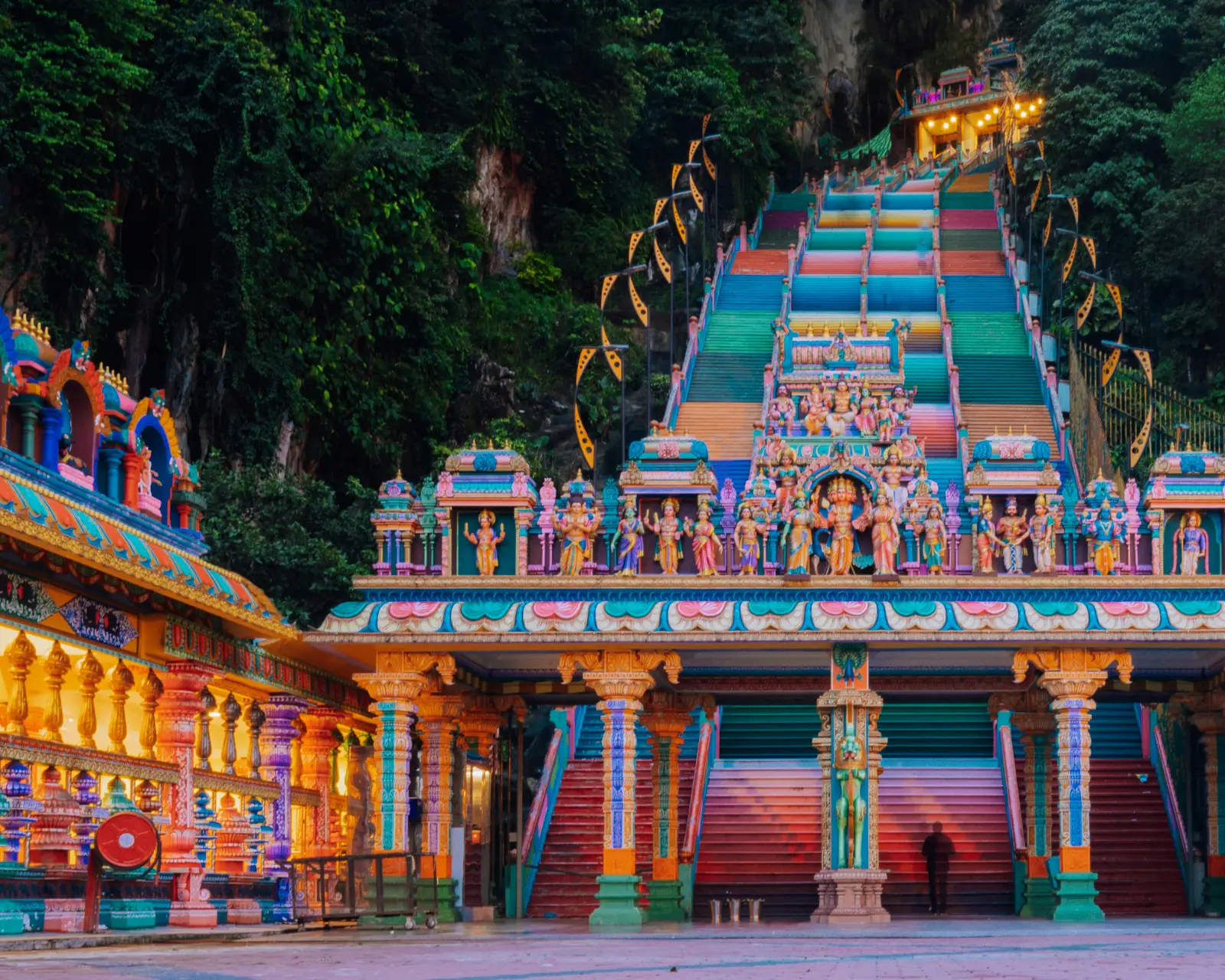
Close view of the colourful painted steps and gateway shrine at Batu Caves in Selangor

There are 272 steps from the foot of the hill to the Temple Cave, and for most healthy adults the climb takes about 10 to 20 minutes with a couple of pauses. The steps are steep and fairly narrow, the air is hot and humid, and there is little shade, so the climb is harder than the number suggests, especially after 10am.

Handrails run up the staircase and there are natural landings where people stop to catch their breath and take photos of the city behind them. Going down is easier on the lungs but harder on the knees, and the steps can be slippery after rain. Coming down slowly, holding the rail, is normal and nobody will hurry you.

Is there an escalator or lift?

Not yet, as far as we could confirm. An escalator to the Temple Cave was announced in 2024, and in January 2026 the Selangor government and the temple management said they had reached an understanding to proceed once technical requirements and a land licence issue were resolved. At the end of January 2026 the temple chairman said he expected the issues to be settled by July 2026. We could not find any confirmation that construction has finished or that an escalator is running. Until you see an official announcement, assume the 272 steps are the only way up to the Temple Cave. Checked: 27 Oct 2026, The Star (18 Jan 2026), Malay Mail (31 Jan 2026).

The good news for anyone who cannot climb: the Ramayana Cave, the Hanuman temple, the gold statue and several ground level shrines are all at the base of the hill, so a visit is still worthwhile without going up.

How hard is it for elderly parents and small children?

WhoDifficultyOur honest advice
Fit adultsModerate, mainly because of heatGo early, carry water, take one or two breaks
Parents in their 60s, reasonably activeChallenging but usually doableStart before 8am, climb slowly using the rail, plan rests at the landings, and let them set the pace
Parents with knee, heart or breathing problemsHard; the descent is often the worst part for kneesCheck with their doctor before the trip; consider worship at the ground level shrines and the Ramayana Cave instead
Children who walk confidently (about 5 and up)Fine for most, with breaksHold hands near the monkeys and on the descent
Toddlers and babiesNot possible with a pramUse a baby carrier, not a stroller; one adult can stay at the base
Wheelchair usersTemple Cave not accessibleThe base area, statue and Ramayana Cave are at ground level

Families travelling with grandparents and young children will find more planning ideas in our guide to Malaysia with family.

What is inside Temple Cave, Ramayana Cave and Cave Villa?
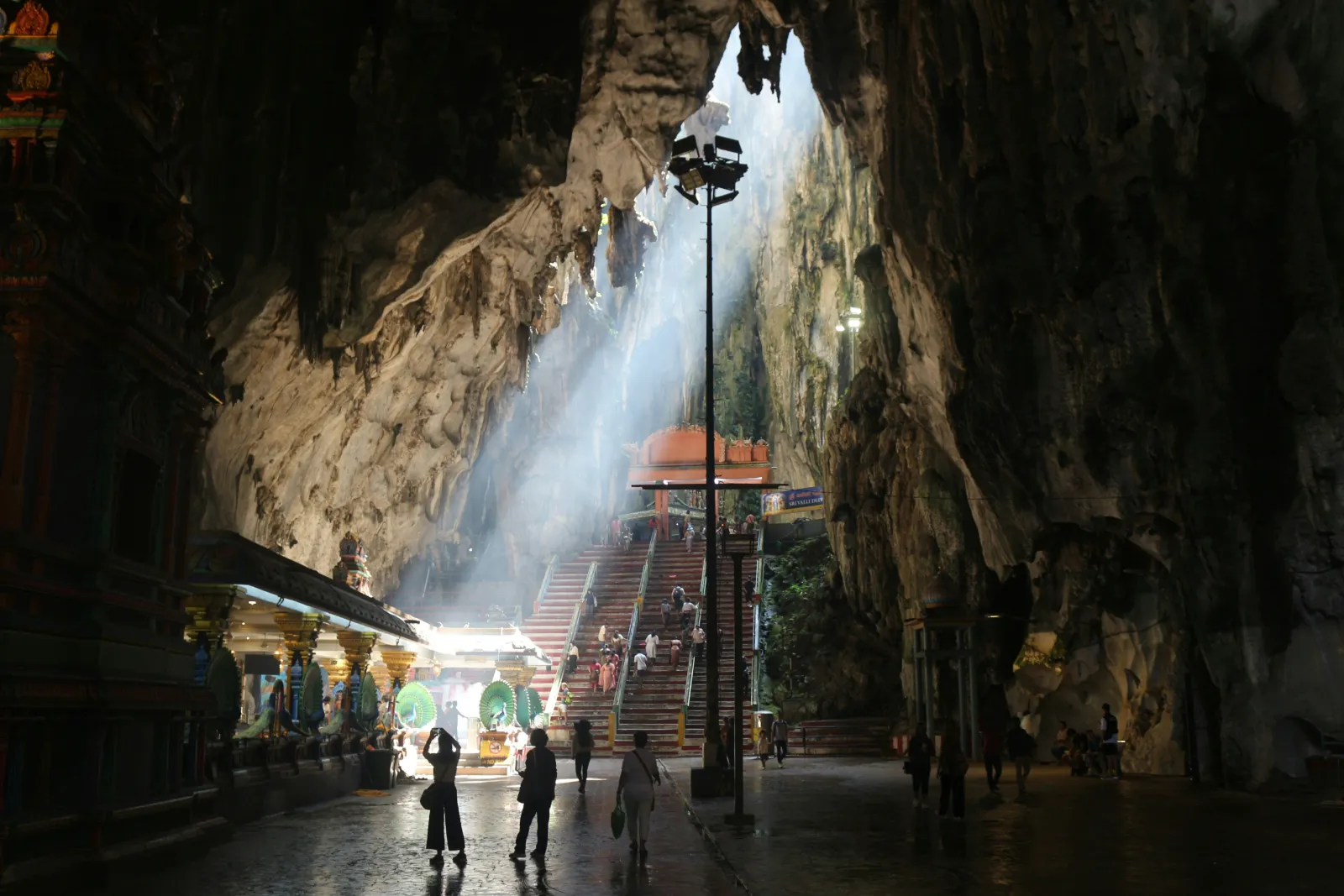
Daylight streaming through the roof opening into Temple Cave above the shrine at Batu Caves

The Temple Cave at the top of the steps is the heart of Batu Caves, holding the main Murugan shrine under a huge open roofed cavern. At the foot of the hill, the Ramayana Cave tells the story of the Ramayana in painted statues, and Cave Villa combines art galleries with an animal exhibit. The Dark Cave, an ecological site halfway up, has had very limited or no public access for years.

Temple Cave

Once you step into the Temple Cave, the temperature drops a little and the scale opens up: a vast limestone chamber with natural light falling through openings in the roof. Shrines to Lord Murugan and other deities sit inside the cavern, with priests performing pujas through the day. You will hear bells and chanting, smell camphor and incense, and see families making offerings. Entry to the Temple Cave itself has traditionally been without a ticket, and donation boxes are placed at the shrines.

Ramayana Cave

The Ramayana Cave sits at ground level to the left as you face the main steps, behind a 15 metre green statue of Lord Hanuman and the Hanuman temple. Inside, colourful statues and painted panels tell episodes of the Ramayana, including a giant sleeping Kumbhakarna. There are some steps inside the cave itself. A separate entry fee is charged. For Nepali visitors who grew up with the Ramayana through Janakpur and Sita's story, this cave is often the surprise favourite, and it is much quieter than the main steps.

Cave Villa

Cave Villa is a ground level cave complex with Hindu art, galleries and a small reptile and animal exhibit, also with a separate entry fee. Visitor opinion is mixed, mainly because of how some animals are kept. It is optional; skip it if you are short of time or uncomfortable with captive animals.

Dark Cave

The Dark Cave, whose sealed entrance you pass partway up the main steps, is a protected ecological site that was run with the Malaysian Nature Society (MNS) for guided educational and adventure tours. Public tours stopped in early 2019. The MNS website now says the Dark Cave reopened to the public as part of Visit Selangor Year 2025, but visitor reports from early 2026 describe the entrance as closed, and one traveller reported that MNS said by phone in February 2026 that there were no plans to reopen. We cannot confirm that tours are running today. If the Dark Cave matters to you, contact MNS directly before planning around it; otherwise treat it as closed. Checked: 27 Oct 2026, Malaysian Nature Society Dark Cave page and 2026 visitor reports.

Cave or siteWhereAccess statusTicketed?Climb needed
Temple Cave (Murugan shrine)Top of 272 stepsOpen dailyNo ticket; donations welcomeYes, 272 steps
Ramayana CaveGround level, left of main steps, behind Hanuman statueOpen dailyYes, separate feeShort climb inside
Cave VillaGround level, near the entranceOpenYes, separate feeMinimal
Dark CavePartway up the main stepsUnclear; closed to regular visitors since 2019, MNS claims a 2025 reopening that we could not confirmTours only, if runningPartial climb
Gold Murugan statue and ground shrinesBase of the hillOpen dailyNo ticketNone

Checked: 27 Oct 2026, MNS, Selangor tourism listing and 2025 to 2026 visitor reports. We do not quote ticket prices; they are shown at each cave entrance.

Monkeys: are they dangerous?

The long tailed macaques at Batu Caves are wild animals, and while most visits pass without trouble, they do snatch food, bags and phones, and they can scratch or bite if handled or provoked. Macaques can carry diseases, including rabies and herpes B, so any bite or scratch needs prompt medical attention.

  • Do not feed the monkeys, even if you see others doing it.
  • Keep food, drinks and plastic bags inside a zipped bag; a visible water bottle or snack invites a grab.
  • Hold phones and cameras firmly, and keep sunglasses in a case.
  • Do not crouch for close up selfies or stare at a monkey; give them space on the railings.
  • If a monkey grabs something, let go. Fighting over a bag is how people get hurt.
  • Keep small children close and holding your hand on the steps.
  • If you are bitten or scratched, wash the wound well with soap and water and go to a clinic or hospital the same day.

This is also a good reason to buy travel insurance before leaving Nepal; a precautionary rabies course abroad is not something you want to pay for unexpectedly.

When is Thaipusam at Batu Caves and what happens?
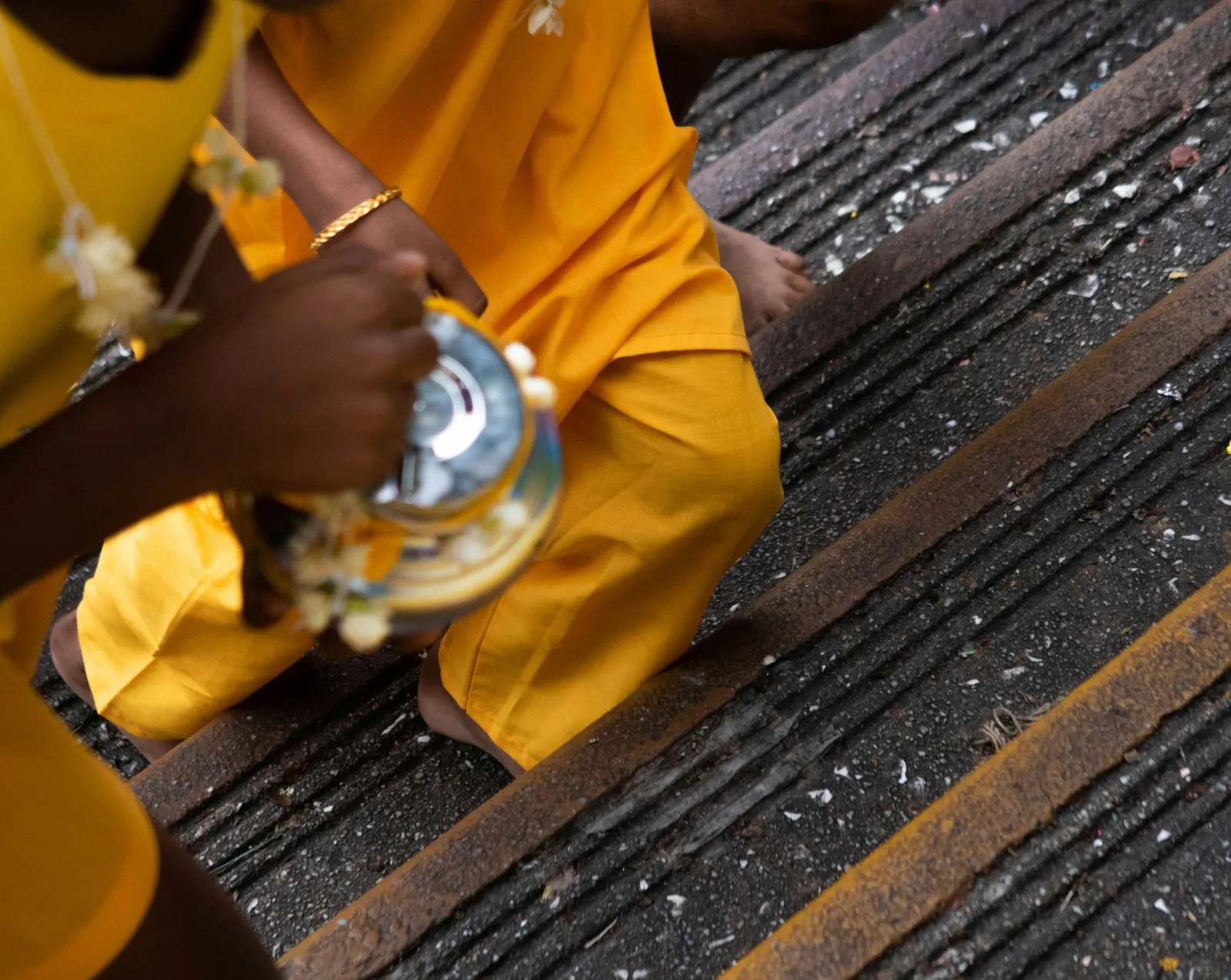
Devotee in saffron clothing carrying an offering pot up the Batu Caves staircase

Thaipusam 2027 falls on Friday 22 January 2027, according to Malaysia's official 2027 public holiday schedule from the Prime Minister's Department. It is a state public holiday in Kuala Lumpur, Putrajaya, Selangor, Johor, Negeri Sembilan, Perak and Penang, and Batu Caves hosts the largest Thaipusam gathering in Malaysia.

Thaipusam 2027 date box
Thaipusam day: Friday 22 January 2027
Silver chariot procession: in recent years it has left the Sri Maha Mariamman Temple in Kuala Lumpur's Chinatown around 9pm two nights before Thaipusam and reached Batu Caves the next day, on the eve of the festival. On that pattern, expect a departure on the evening of Wednesday 20 January 2027; the 2027 times had not been announced when we checked, so confirm nearer the date
Public holiday in: Kuala Lumpur, Putrajaya, Selangor, Johor, Negeri Sembilan, Perak, Penang
Checked: 27 Oct 2026, Prime Minister's Department 2027 holiday schedule

What is Thaipusam?

Thaipusam takes its name from the Tamil month of Thai and Pusam, the star (nakshatra) that rises around the full moon in that month. It marks the occasion when Parvati gave Murugan the vel to defeat the demon Soorapadman, and it is a day of thanksgiving and fulfilment of vows. Because it follows the lunar calendar, the date moves each year, usually landing in late January or early February. In 2026 it fell on 1 February; in 2027 it comes earlier, on 22 January.

What happens at Batu Caves

Preparations start weeks before. Many devotees keep a period of fasting, prayer and vegetarian food leading up to the day. Before the festival, a silver chariot carrying the deity leaves the Sri Maha Mariamman Temple on Jalan Tun H.S. Lee in Kuala Lumpur around 9pm and travels through the night to Batu Caves, arriving on the eve of Thaipusam (in 2026 it set off on the night of 30 January for the 1 February festival), with devotees walking behind it and free food and drink stalls (thaneer panthal) along the route. In 2026 the Kuala Lumpur authorities closed and diverted a series of road junctions in stages for the procession.

On the day itself, devotees climb the 272 steps carrying offerings. Many carry pots of milk (paal kudam) on their heads, and some carry the kavadi, an ornate frame decorated with peacock feathers and flowers. Some devotees pierce their skin, cheeks or tongues with small vel shaped skewers as an act of penance, in a trance state they describe as devotion rather than pain. Drums, chanting and the smell of camphor fill the air from before dawn.

Should you go at Thaipusam?

Go at Thaipusam ifVisit on another day if
You are a Hindu devotee who wants to witness or take part in Murugan worship at its most intenseYou are travelling with elderly parents, toddlers or anyone who struggles in crowds and heat
You are comfortable in very dense crowds for several hoursYou want photos of the steps and statue without crowds
You can arrive by train or on foot and accept road closuresYour trip depends on tight timings or a road transfer
You are happy to watch respectfully from the side and not block devoteesYou are sensitive to scenes of body piercing

Crowds at Batu Caves during Thaipusam have been reported in the hundreds of thousands in past years, and hotel demand in Kuala Lumpur rises around the festival. If you want to go, book accommodation early, stay near a KTM Komuter station, keep valuables to a minimum, drink plenty of water and agree a meeting point with your group in case you are separated. The days just before and after Thaipusam are a calmer way to see the decorations and the festive atmosphere.

For Nepali travellers, a late January Thaipusam falls well outside the Dashain and Tihar rush of October and November, when flights and hotels from Kathmandu are in highest demand. If you are planning around Nepali festivals instead, our guide to Dashain and Tihar holidays abroad covers that season, and our best time to visit Malaysia guide explains the weather on each coast.

What is the best time of day to visit Batu Caves?

The best time to visit Batu Caves is early morning, ideally before 8am, when the steps are coolest, the light is soft and the tour buses have not yet arrived. Late afternoon is the second best window. Midday is the hottest and busiest time and the hardest for older visitors.

Time slotHeatCrowdsGood for
Opening to 8amCoolestLightElderly parents, morning puja, photos without crowds
8am to 10amWarming upBuildingMost independent visitors; still comfortable
10am to 3pmHottest, strong sun on the stepsBusiest, tour groupsOnly if your schedule allows nothing else
3pm to closingEasing, afternoon showers possibleModerateSecond best option; softer evening light
Weekends and public holidaysSame patternHeavier all dayChoose a weekday if you can
Thaipusam periodHot, very crowdedExtremeDevotees and festival watchers only

Kuala Lumpur gets rain in every month, with frequent afternoon thunderstorms. If storms are forecast, a morning visit also reduces the chance of climbing slick steps in the rain.

How long to spend

Plan about 1.5 to 2 hours for the climb, the Temple Cave and the statue. Add 30 to 45 minutes for the Ramayana Cave and another 30 minutes if you want to eat at the base. Most people fit Batu Caves into a morning and spend the afternoon in the city, which is how we suggest it in our Malaysia itinerary guide.

Food at the base

The area at the foot of the hill has small South Indian eateries and stalls, many serving vegetarian food such as thosai (dosa), idli, vadai and banana leaf rice. For vegetarian Nepali travellers and elderly parents who prefer familiar food, this is one of the easiest meals of the trip. Kuala Lumpur's Brickfields area near KL Sentral has many more options; see what to eat in Malaysia for dishes to look for.

What should Hindu visitors from Nepal know about etiquette here?

Hindu visitors from Nepal will find temple etiquette at Batu Caves broadly familiar: shoes off, modest dress, respect for the shrine and the priests. The main differences are that this is a Tamil Shaivite temple with its own rituals, songs and offerings, it is open to visitors of all faiths, and it is also a major tourist site, so worship and sightseeing happen side by side.

Familiar and different

PracticeTypical at temples in NepalAt Batu Caves
Name of the deityKartikeya or Kumar, son of Shiva and ParvatiMurugan (also Subramaniar or Skanda), the central deity of the site
ShoesRemoved before the temple areaRemoved before entering shrines; you can walk the steps in shoes
Who may enterSome major temples restrict entry for non-Hindus (for example the inner courtyard of Pashupatinath)Visitors of all faiths may enter the Temple Cave if dressed modestly; some inner sanctum areas are for priests only
OfferingsFlowers, rice, sindur, diyo, prasadFlowers, coconuts, fruit, milk and camphor are common; offerings are sold near the steps
PujaLed by priests in Nepali and SanskritLed by Tamil priests, with Tamil hymns and Sanskrit mantras; bell and camphor aarti are the same idea
Prasad and vibhutiTika and prasad from the priestHoly ash (vibhuti) and sometimes sandal paste or kumkum offered after the aarti
LanguageNepaliTamil and English are both widely understood; a polite "vanakkam" with folded hands is welcome

Practical etiquette checklist

  • Remove shoes before every shrine; carry a small cloth bag for them or leave them in the shoe areas.
  • Do not step in front of people who are praying or making offerings, and do not stand between a devotee and the shrine.
  • Ask before photographing worshippers, priests, or anyone in the middle of a ritual. Photos of the cave, steps and statue are fine.
  • Do not use flash inside the shrines, and do not fly drones.
  • Walk clockwise around shrines where there is space, as you would at home.
  • Accept prasad and vibhuti with the right hand.
  • Many devotees avoid meat on the day of a temple visit; carrying non-vegetarian food up to the shrines is best avoided.
  • Keep voices low inside the Temple Cave, even though the steps outside are noisy.

Making it a pilgrimage, not only a photo stop

If you are visiting as a devotee, go early and time your visit for a morning puja; ask at the temple office or the priests at the top which times the main pujas are held that day, as these are not published reliably online. Buy flowers or a coconut near the steps and offer them at the main shrine. Many Nepali families pair Batu Caves with the Sri Maha Mariamman Temple in Chinatown, which is the starting point of the Thaipusam chariot and a beautiful temple in its own right. Hindu travellers who enjoy seeing how their faith is practised abroad may also like our piece on Hinduism in Bali, where the same gods appear in a very different form.

How does Batu Caves fit into a Malaysia trip?

Batu Caves fits best into a half day from Kuala Lumpur, either early morning with the city in the afternoon or as part of a day trip that continues to Genting Highlands. It works for almost every kind of traveller: couples on a Kuala Lumpur and Langkawi honeymoon, families on a school holiday break, solo budget travellers on the train, and diaspora Nepalis bringing parents on their first trip abroad.

TravellerHow to fit Batu Caves in
First time visitors (3 to 4 nights in KL)Morning at Batu Caves, afternoon at Merdeka Square and Chinatown, evening at the Petronas Towers
Families with elderly parentsGrab there before 8am; parents choose climb or ground level shrines; back to the hotel by midday
Hindu pilgrimsEarly morning puja at Batu Caves, then the Sri Maha Mariamman Temple in Chinatown
Couples and honeymoonersSunrise visit for photos, then a slow day in the city before flying on to an island
Thaipusam visitorsWatch the chariot leave Chinatown two nights before; reach Batu Caves by train early on the day

Malaysia is generally a comfortable country for Nepali travellers, and our guide to whether Malaysia is safe covers common scams, transport and health tips. For the rest of the country, see our pick of the best places in Malaysia, from Penang and Langkawi to Borneo, and our list of things to do across Malaysia.

If you would rather have flights, hotels and transfers arranged as one trip, you can browse our Malaysia tour packages and use this guide to decide when in your Kuala Lumpur days Batu Caves fits best.

Frequently asked questions

How long do you need at Batu Caves?

Most visitors need about 1.5 to 2 hours at Batu Caves to climb the 272 steps, see the Temple Cave and view the Murugan statue. Add 30 to 45 minutes for the Ramayana Cave and time for a meal at the base. With travel from central Kuala Lumpur, plan a half day.

Can you wear shorts to Batu Caves?

You should not wear short shorts or short skirts to Batu Caves. The temple asks visitors to cover shoulders and knees. Enforcement has varied, and cover ups are available near the steps, but arriving in knee length or longer clothing with sleeves is the respectful and reliable choice.

Is the Batu Caves climb suitable for elderly parents or small children?

The Batu Caves climb of 272 steep steps suits reasonably active older adults and children who walk confidently, if they go early and rest at the landings. Parents with knee, heart or breathing problems should check with a doctor first and may prefer the ground level shrines and Ramayana Cave.

Is there an easier way up for people who cannot climb stairs?

Not at present. An escalator to the Batu Caves Temple Cave has been planned since 2024, but as of 27 Oct 2026 we found no confirmation that it is operating. The gold statue, Hanuman temple, Ramayana Cave and ground level shrines need no long climb.

Are the monkeys at Batu Caves dangerous?

The macaques at Batu Caves are usually not aggressive if left alone, but they snatch food, bags and phones and can bite or scratch. Do not feed them, keep food zipped away and let go if one grabs something. Seek medical care the same day after any bite or scratch.

Which train goes to Batu Caves from KL Sentral?

The KTM Komuter train on the Batu Caves to Pulau Sebang line runs from KL Sentral to Batu Caves station, the last stop, in roughly half an hour. Trains are less frequent than city metro lines, so check the official KTMB timetable before you travel.

When is Thaipusam 2027?

Thaipusam 2027 falls on Friday 22 January 2027, according to Malaysia's official 2027 public holiday schedule. In recent years the silver chariot procession has left Kuala Lumpur's Sri Maha Mariamman Temple two nights before Thaipusam and reached Batu Caves on the eve of the festival; confirm the 2027 times nearer the date. Expect very large crowds and road closures.

Can non-Hindus enter the temples at Batu Caves?

Yes. Visitors of all faiths can enter the Temple Cave and the ground level shrines at Batu Caves, provided they dress modestly, remove shoes inside shrines and behave respectfully. Some inner sanctum areas are reserved for priests, and worshippers should not be disturbed during prayers.

Is photography allowed inside the caves?

Photography of the steps, statue and cave interiors is generally allowed at Batu Caves. Avoid flash inside shrines, do not fly drones, and always ask before photographing worshippers, priests or anyone performing a ritual, especially during Thaipusam.

What is the best time of day to visit Batu Caves?

The best time to visit Batu Caves is before 8am, when it is cooler and less crowded. Late afternoon is the next best option. Avoid midday, when the sun on the steps is strongest and tour groups arrive, especially if you are travelling with older parents.

Batu Caves jana k lagaune?

Batu Caves jada kum (kandh) ra ghunda dhakine lugaa lagaunus: kurta suruwal, lamo skirt wa paint, ani bahula bhayeko top. Mandir bhitra jutta kholnu parchha, tesaile sajilai khulne chappal lagaunus. Ek wota halka sawl wa sarong saathma bokda sajilo hunchha. (English: Wear clothes that cover your shoulders and knees, with easy to remove footwear, and carry a light shawl or sarong.)
Tags
Malaysia
Share
G
Gomayu Team
Writer at Gomayu
Keep reading