












































Short answer: The easiest Hindu temples abroad for a Nepali traveller are a Bali Hindu temple such as Besakih or Uluwatu, Batu Caves and the Sri Mahamariamman temples in Malaysia, Sri Veeramakaliamman and Sri Srinivasa Perumal in Singapore's Little India, the Hindu Temple in Jebel Ali, Dubai, and the BAPS Hindu Mandir in Abu Dhabi. Bali follows its own tradition, Agama Hindu Dharma, while the Malaysian and Singapore temples are mostly Tamil and the UAE temples serve the wider Indian community. Every one of them asks for covered shoulders and knees. Bali temples also expect a sarong and sash, and the Abu Dhabi mandir will not let you in without an online booking made after you land in the UAE.
This guide is for Nepali Hindu travellers, families taking parents on their first trip abroad, and Nepalis living overseas who want to keep up darshan, puja and festival days wherever they are. It explains which temples are worth the journey, how Balinese and Tamil practice compare with what you grew up with in Nepal, what to wear, which rules are strict and which are only requests, and which festival dates for late 2026 and 2027 are already confirmed. Opening hours and entry rules change, so every volatile detail carries the date we checked it and the source.
If you are still choosing a country, our guide to the best travel destinations for Nepalese travelers compares paperwork, flight time and season for each one. This page is about the temples.
Which Hindu temples can Nepali travellers visit abroad?
With one flight or a single connection from Kathmandu, Nepali travellers can reach working Hindu temples in Indonesia, Malaysia, Singapore and the United Arab Emirates, plus the great pilgrimage temples of India. They are living places of worship with daily puja, not museums, and most welcome visitors of any faith who dress modestly and follow the posted rules.
The table below gives the main temple in each place, its presiding deity, the best time to go and the dress rule. Deities are named the way the temple names them; where Nepal uses a different name for the same god, the next column says so.
| Country | Temple | Main deity (Nepali name) | Best time | Dress |
|---|---|---|---|---|
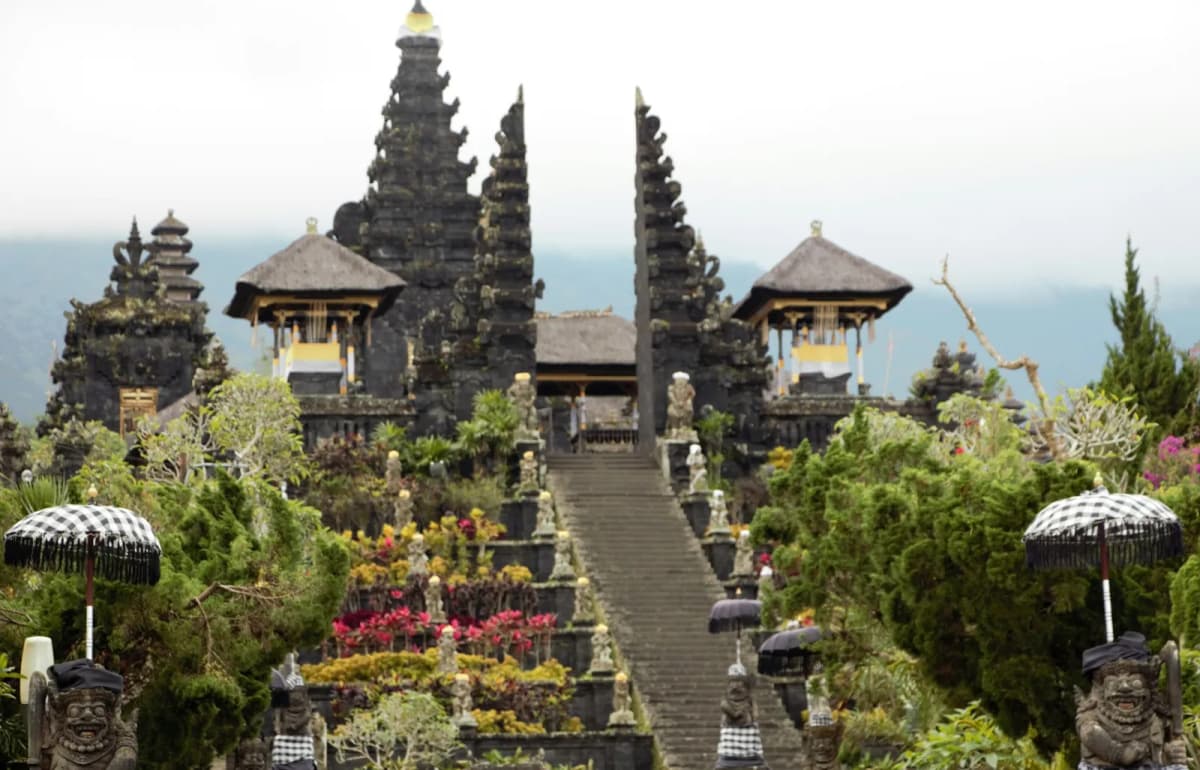
| Indonesia (Bali) | Pura Besakih, Karangasem | Sang Hyang Widhi Wasa in the form of the Trimurti (Brahma, Vishnu, Shiva) | Early morning, outside major ceremonies | Sarong and sash, shoulders covered |
| Indonesia (Bali) | Pura Luhur Uluwatu, Bukit peninsula | Sea temple honouring the divine in its Balinese forms | Late afternoon and sunset | Sarong and sash |
| Indonesia (Java) | Prambanan, near Yogyakarta | Shiva, Vishnu and Brahma | Morning, before the heat | Modest clothing; it is a heritage site |
| Malaysia | Batu Caves, Selangor | Lord Murugan (Kartikeya, Kumar) | Before 8am; Thaipusam for the festival | Shoulders and knees covered (requested), shoes off in shrines |
| Malaysia | Sri Mahamariamman Temple, Kuala Lumpur | Mariamman, a form of the Devi | Morning or evening puja | Modest clothing, shoes off |
| Singapore | Sri Veeramakaliamman Temple, Little India | Kali | Weekday mornings; Deepavali for the lights | Shoulders and knees covered, shoes off |
| Singapore | Sri Srinivasa Perumal Temple, Serangoon Road | Vishnu as Perumal (Balaji, Venkateshwara) | Inside the morning or evening opening window | Shoulders and knees covered, shoes off |
| UAE (Dubai) | Hindu Temple Dubai, Jebel Ali | Shiva as the main deity, with many others | Weekday mornings; avoid festival peaks | Modest clothing |
| UAE (Abu Dhabi) | BAPS Hindu Mandir, Abu Mureikha | Swaminarayan, with shrines to Radha Krishna, Sita Rama, Shiva Parvati and others | Tuesday to Sunday; closed Mondays | Strict: no shorts, sleeveless or tight clothing |
For many Nepali families the appeal is that these temples sit inside ordinary holiday destinations. You can combine a morning at Batu Caves with a day in Kuala Lumpur, evening aarti in Little India with Gardens by the Bay, or a mandir visit with a Dubai shopping trip. India remains the place for full pilgrimage circuits, and we point to those guides at the end.
How is Balinese Hinduism similar to and different from Nepal's?
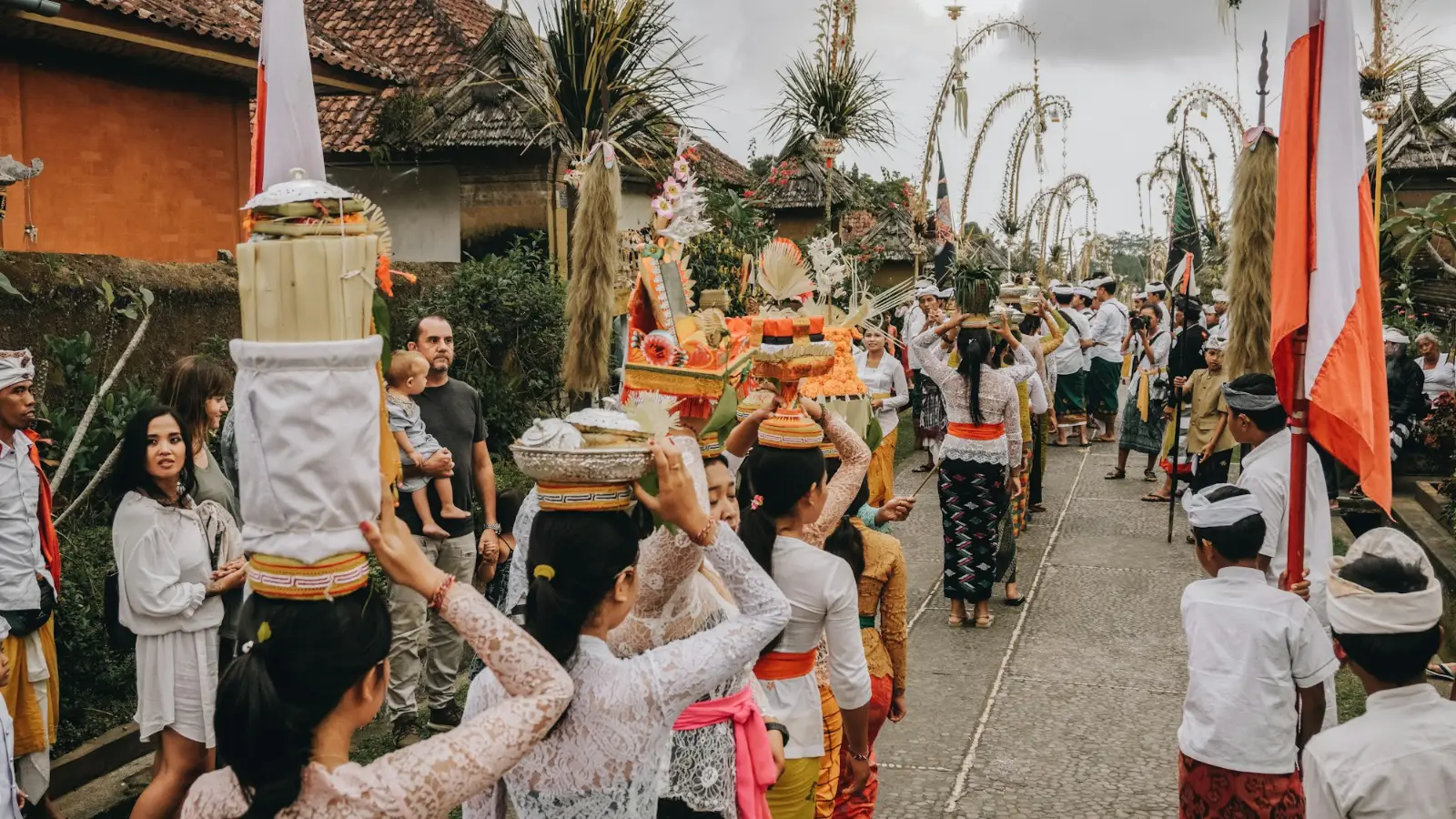
Balinese Hinduism, officially called Agama Hindu Dharma, shares the great gods, the idea of dharma and karma, and many Sanskrit terms with Nepali Hinduism, but it is a separate tradition with its own calendar, temple layout, priesthood and festivals. A Nepali visitor will recognise Shiva, Vishnu, Brahma and Saraswati in Bali, and will also find practices that have no direct parallel at home.
Balinese practice grew over many centuries on top of older ancestor and spirit worship, with Hindu and Buddhist ideas arriving through the courts of Java. In the twentieth century Balinese leaders also had to describe their religion in terms that fitted Indonesian law, which recognises belief in one supreme God. That is why Balinese Hindus speak of a single supreme divinity, Sang Hyang Widhi Wasa (often written Sanghyang Widhi Wasa), with the Trimurti as its manifestations. Our longer guide to Bali Hinduism and Agama Hindu Dharma covers that history, the Tri Hita Karana philosophy and the two Balinese calendars in detail.
The comparison below is descriptive, not a ranking. Both traditions are complete in themselves.
| Aspect | Bali (Agama Hindu Dharma) | Nepal |
|---|---|---|
| Official or common name | Agama Hindu Dharma, a recognised religion in Indonesia | Sanatan Dharma or simply Hindu dharma |
| Supreme divinity | Sang Hyang Widhi Wasa, the one supreme principle | Brahman; devotion often centres on Shiva, Vishnu or the Devi |
| Trimurti | Brahma, Vishnu and Shiva as manifestations of Sang Hyang Widhi Wasa; linked to the three village temples | Brahma, Vishnu and Shiva, with Shiva (Pashupatinath) and Vishnu (Narayan) especially prominent |
| Temple form | Pura: open walled courtyards with shrines and tiered meru towers, no enclosed sanctum to enter | Mandir: pagoda, shikhara or stupa style buildings, often with a garbhagriha holding the murti |
| Daily offering | Canang sari, small palm leaf trays of flowers placed on shrines, steps and streets | Flowers, rice, abir and diyo at the home shrine and local temple |
| Ritual calendar | The 210 day pawukon cycle plus the lunisolar saka calendar | Lunar tithis set by the Nepali panchanga, alongside the Bikram Sambat civil calendar |
| Victory of good festival | Galungan: dharma over adharma, when ancestral spirits visit; Kuningan ten days later | Dashain: Durga's victory over Mahishasura, with tika and jamara on Bijaya Dashami |
| Saraswati day | Hari Raya Saraswati on the last day of the pawukon cycle; books and lontar manuscripts are honoured and not read that day | Saraswati Puja on Basanta Panchami, when students honour books and pens |
| New year | Nyepi, the saka new year, a full day of silence across the island | Nepal Sambat and the Bikram Sambat new year in Baisakh, both festive rather than silent |
| Who leads ritual | Pedanda (high priests) and pemangku (temple priests) | Purohit and pujari, often from priestly families |
Two points are worth knowing before you go. First, Galungan and Dashain are different festivals. Both are about good overcoming evil, but Galungan follows the 210 day Balinese cycle and centres on ancestors returning to family compounds, while Dashain follows the lunar calendar and centres on Durga and the blessing of elders. Second, the inner courtyard of a Balinese temple is for worshippers in full Balinese dress. A Nepali Hindu is welcome to pray, but you do it the Balinese way, in Balinese clothes, ideally with a local family or a temple priest guiding you.

Which Bali Hindu temple should you visit first?
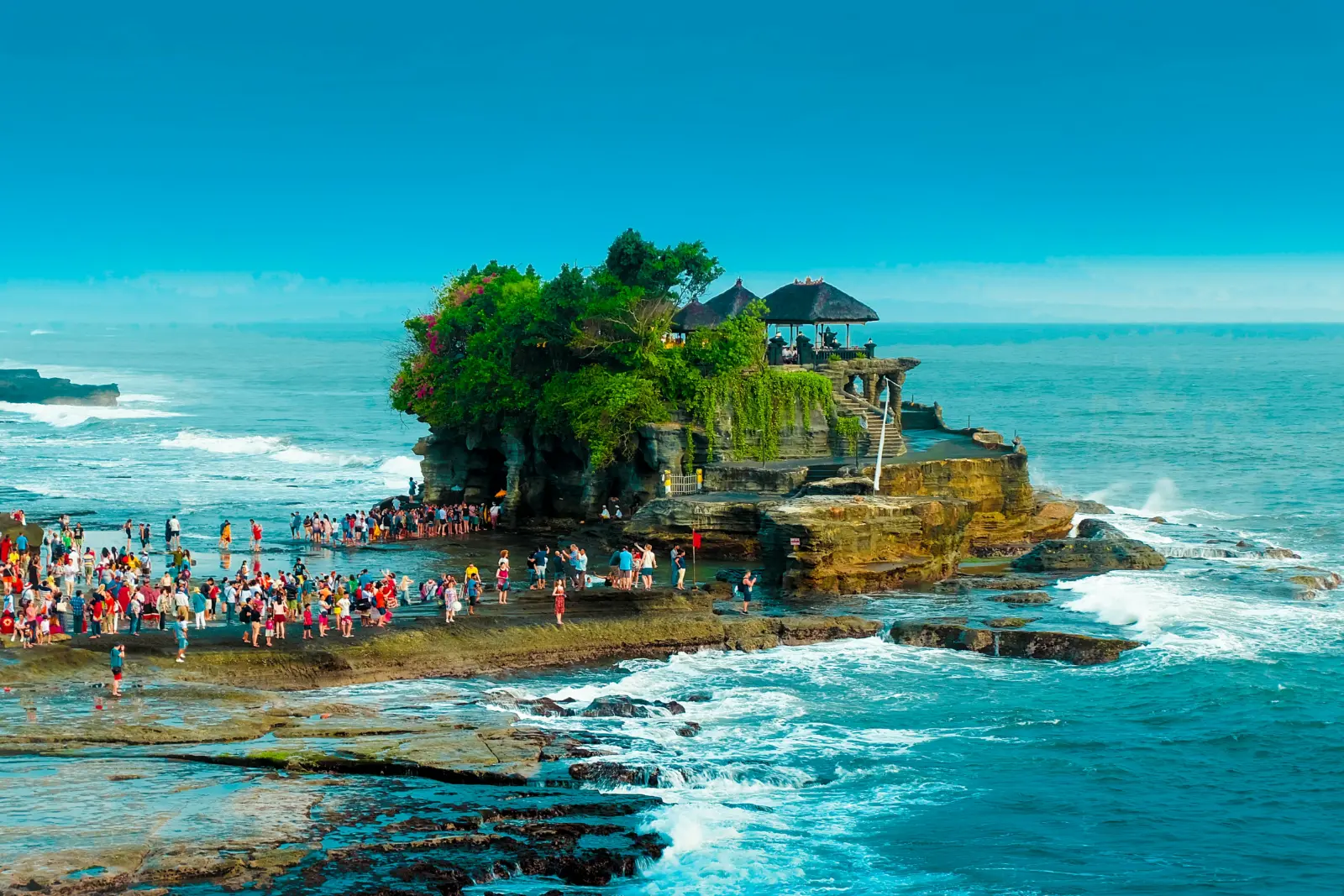
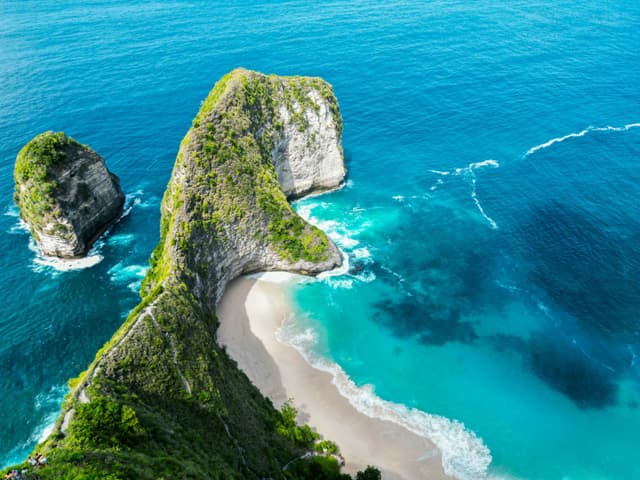
For a first visit, Pura Besakih on the slopes of Mount Agung is the Bali Hindu temple that best shows the scale of Balinese religion, and Uluwatu or Tanah Lot are the most rewarding at sunset. If you have time for only two, pair Besakih for its sacred weight with Tirta Empul for the purification ritual, or Uluwatu for its clifftop setting and Kecak dance.
We keep this section short because our full guide to the best temples in Bali already explains each one. Here is the quick version for a Hindu traveller.
| Temple | What it is | Why a Nepali Hindu might go |
|---|---|---|
| Besakih | The mother temple, a complex of more than twenty temples on Mount Agung | The spiritual centre of Balinese Hinduism, the nearest Bali equivalent to visiting Pashupatinath |
| Uluwatu | Clifftop sea temple on the Bukit peninsula | One of the island's key directional temples, with the Kecak dance retelling the Ramayana |
| Tanah Lot | Sea temple on an offshore rock | A famous view; visitors watch from the shore rather than entering the shrine |
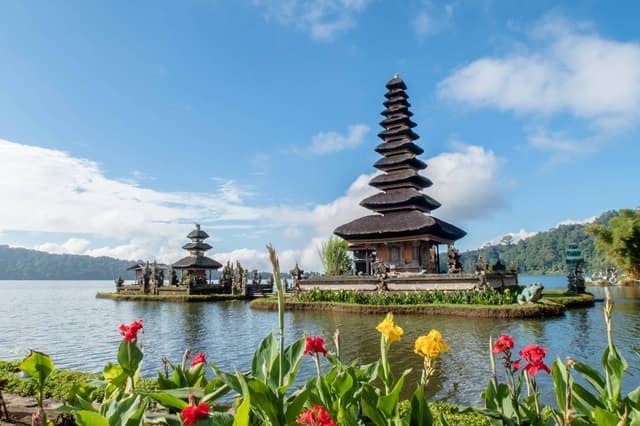
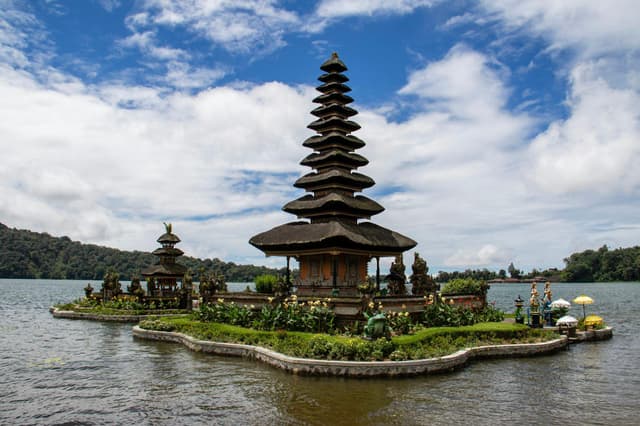
| Ulun Danu Beratan | Lake temple in the cool highlands | Dedicated to the goddess of the lake, important to the rice irrigation system |
| Tirta Empul | Holy spring temple near Ubud | Melukat, a purification bath under the stone spouts, familiar to anyone who has bathed at a Nepali dhara on a festival day |
Ubud makes a convenient base for the central Bali temples such as Tirta Empul. For visas, money and getting around the island, see the Bali travel guide.
Is there a Hindu temple in Indonesia outside Bali?
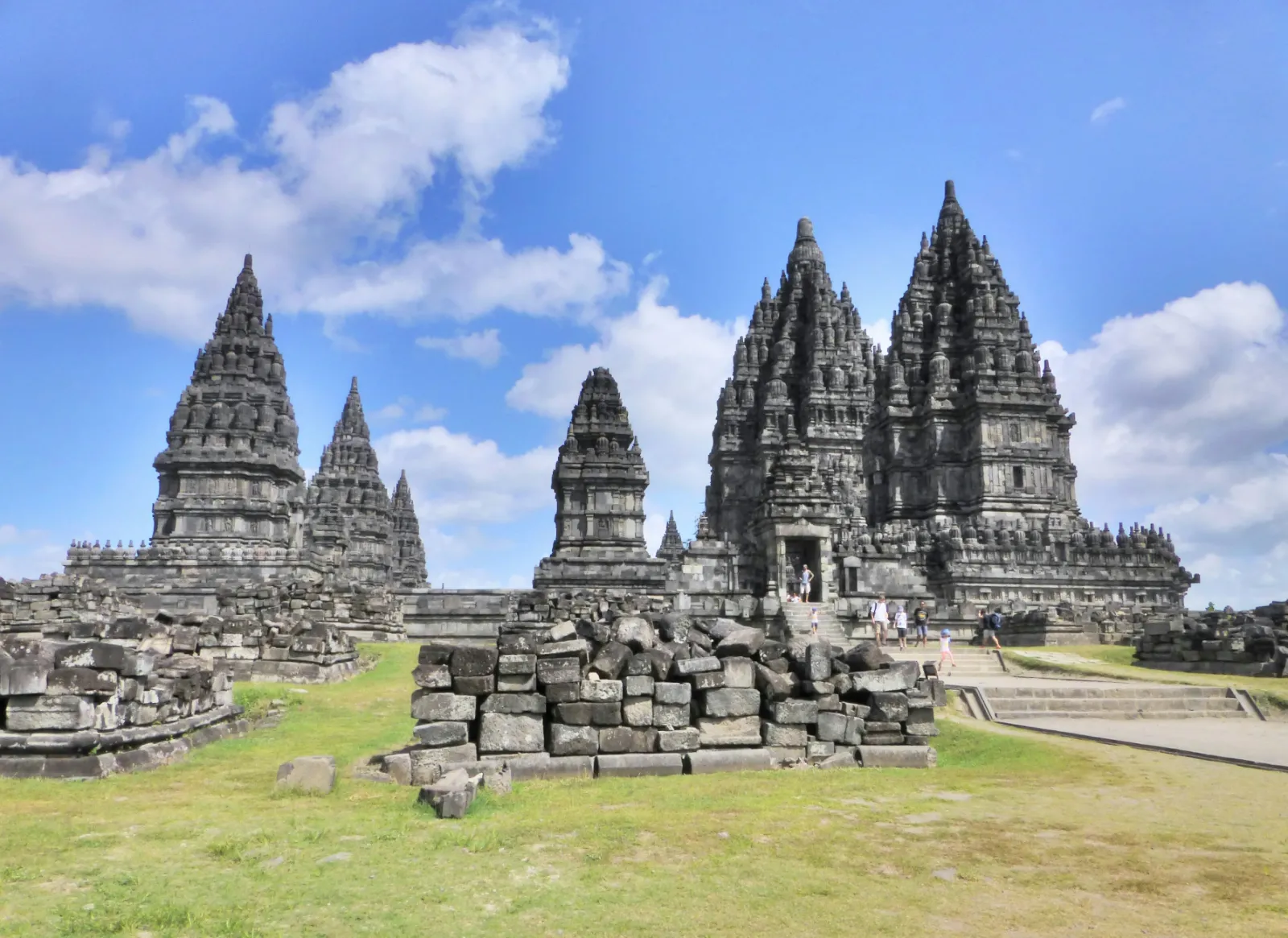
Yes. The best known Indonesia Hindu temple outside Bali is Prambanan on Java, between Yogyakarta and Central Java. UNESCO describes the Prambanan compound as having three central temples dedicated to Shiva, Vishnu and Brahma, and dates the main temple, Loro Jonggrang, to the ninth century (UNESCO World Heritage Centre). Prambanan is a protected heritage site rather than a busy place of daily worship, so it suits travellers interested in history and carving as much as puja.
Nepali passport holders need an Indonesian visa for Bali and Java; see our Indonesia visa page for the current position. Holders of other passports should check the official site for their passport.
What is Batu Caves and when is Thaipusam?
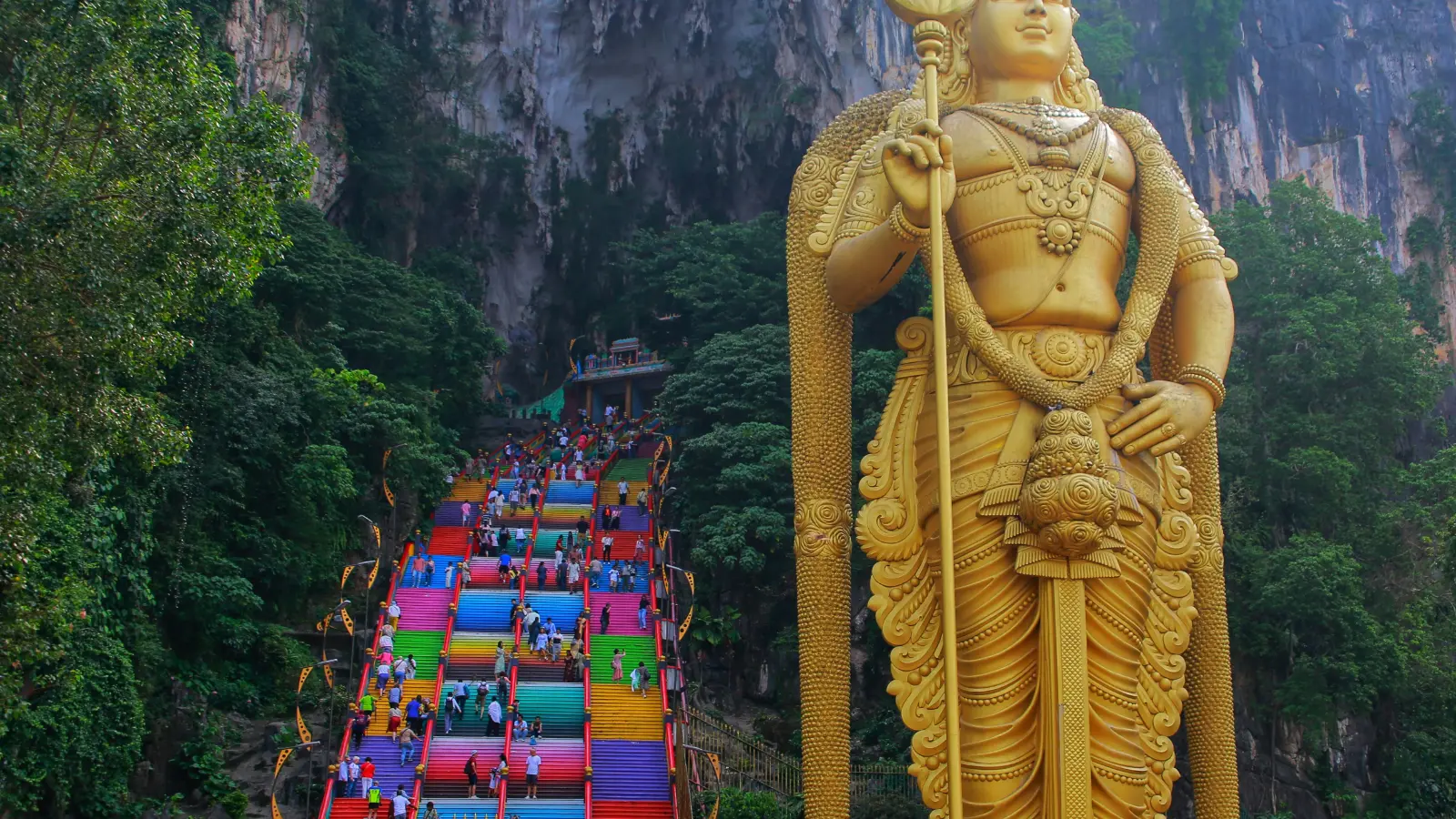
Batu Caves is a Hindu temple complex inside a limestone hill just north of Kuala Lumpur, dedicated to Lord Murugan, the god Nepal knows as Kartikeya or Kumar. You climb 272 painted steps beside a giant gold statue of Murugan to the Temple Cave. Thaipusam 2027 falls on Friday 22 January 2027, when hundreds of thousands of devotees fill the site.
Tourism Malaysia describes the climb as "272 steps to be exact" and the golden statue as more than 140 feet tall, and suggests arriving before 8am to avoid the crowds (Tourism Malaysia). The main shrine inside the Temple Cave belongs to the Sri Subramaniar Swamy temple, run by the same temple board that manages the Sri Mahamariamman Temple in Kuala Lumpur.
For Nepali Hindus the deity is the surprise. Kartikeya is honoured in Nepal, but he is rarely the centre of a family's devotion. In Tamil tradition Murugan, carrying the vel spear given by his mother Parvati, is one of the most loved gods of all, and Batu Caves is one of his most important temples outside India. Seeing a whole festival built around Ganesh's brother can be a moving experience for a Nepali visitor.
Practical points for families:
- The climb: 272 steep, narrow steps with handrails and little shade. Take it slowly and stop when you need to; the descent is harder on the knees.
- Elderly parents: the gold statue, the Ramayana Cave and several shrines are at ground level, so parents who cannot climb can still have darshan. Ask their doctor before the trip if they have heart, breathing or knee problems.
- Monkeys: long tailed macaques on the steps snatch food and plastic bags. Keep prasad and snacks out of sight.
- Getting there: the KTM Komuter train runs from KL Sentral to Batu Caves station, a short walk from the steps.
Our full Batu Caves guide covers the caves, train timetable changes, the long discussed escalator and what to expect at Thaipusam, step by step.
When is Thaipusam in 2027?
Thaipusam is held on the full moon day of the Tamil month of Thai, usually in late January or early February, to honour Murugan. Devotees carry kavadi (decorated frames, sometimes attached through piercings) and pal kudam (milk pots) as vows. In Malaysia's official 2027 holiday list, Thaipusam falls on Friday 22 January 2027 and is a holiday in Selangor, where Batu Caves stands, and in Kuala Lumpur and several other states including Penang. Checked: 4 November 2026, Malaysia 2027 public holiday list announced by the Prime Minister's Department, as circulated by the Federation of Malaysian Manufacturers (FMM notice GI 15 of 2026).
Thaipusam is moving and unforgettable, but it is also extremely crowded, hot and loud. Go with a plan: arrive by train well before dawn, wear light modest clothes, carry water, and do not stand in the path of kavadi bearers or film people in trance without asking. Families with small children or elderly parents often prefer to visit Batu Caves on an ordinary weekday morning and watch Thaipusam on a smaller scale in Penang or Singapore.
Which other Hindu temples in Malaysia are worth a visit?
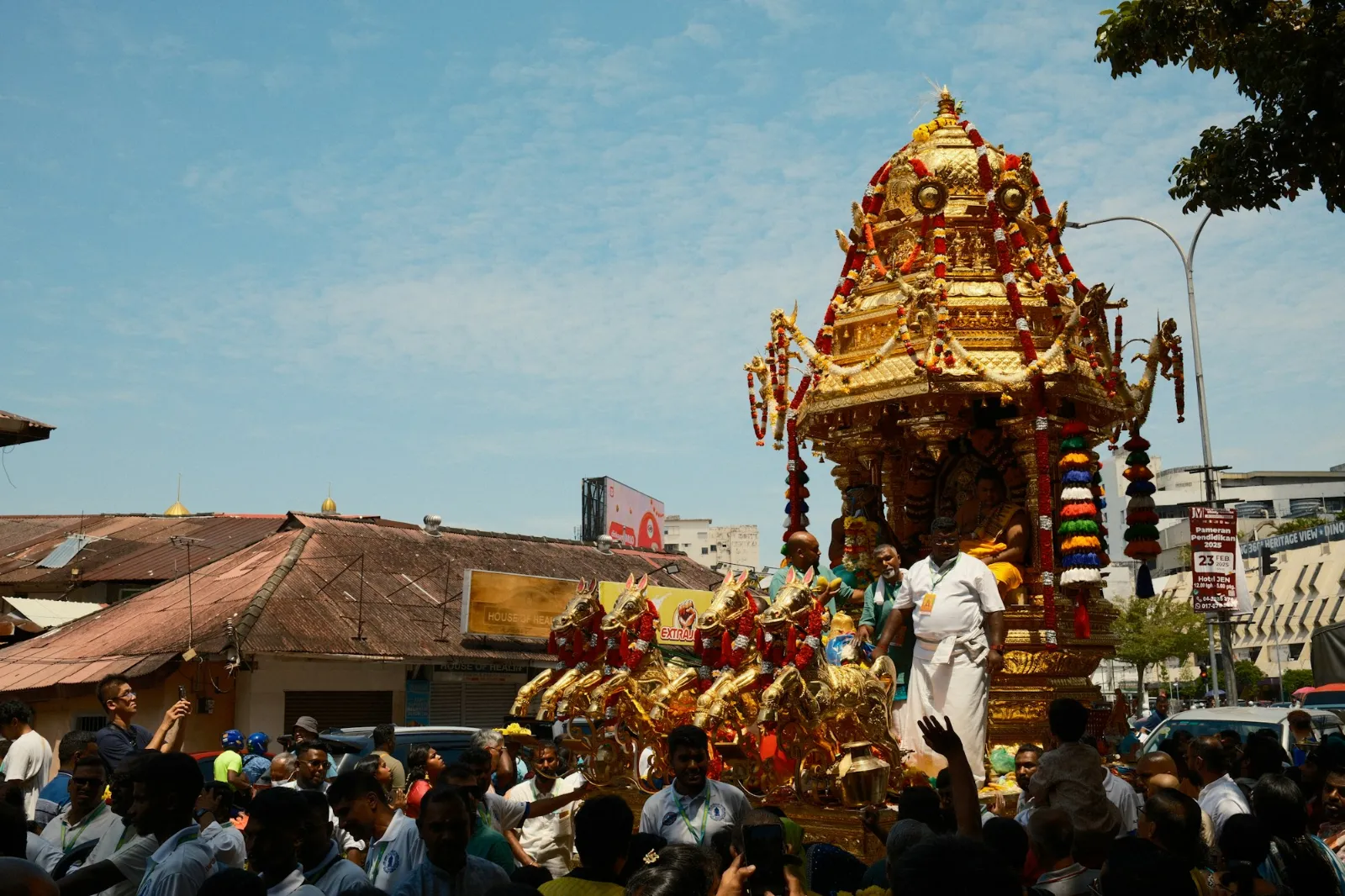
Beyond Batu Caves, the most rewarding Hindu temples in Malaysia are the Sri Mahamariamman Temple in Kuala Lumpur's Chinatown and the Thaipusam temples of George Town, Penang. Both are short walks from places most visitors already go.
- Sri Mahamariamman Temple, Kuala Lumpur: founded in 1873 by K. Thamboosamy Pillai on Jalan Tun H.S. Lee and widely described as the oldest functioning Hindu temple in Malaysia. Its silver chariot carries Murugan through the city to Batu Caves on the eve of Thaipusam (Wikipedia).
- Sri Mahamariamman Temple, George Town: on Lebuh Queen in Penang's Little India, described by The Star as the oldest Hindu temple in Penang. At Thaipusam its golden chariot, first used in 2017, carries the vel, while a silver chariot shipped from Tamil Nadu in 1894 carries Murugan from Lebuh Penang.
- Arulmigu Sri Balathandayuthapani Waterfall Hilltop Temple, Penang: the end point of the Penang procession, reached by a climb of 513 steps (The Star, 31 January 2026).
For the rest of the country, read our Malaysia travel guide. Nepali passport holders need a visa for Malaysia and should also check the Malaysia Digital Arrival Card requirement; Nepal is on the Malaysian Immigration Department's list of countries whose citizens must apply for a visa. Checked: 4 November 2026, Immigration Department of Malaysia visa requirement by country page. Our Malaysia visa page has the current position.
Flying is simple: four airlines run nonstop between Kathmandu and Kuala Lumpur, with flights of a little under five hours, according to the Gomayu team's schedule check on 27 October 2026.
Which Hindu temples are in Singapore's Little India?
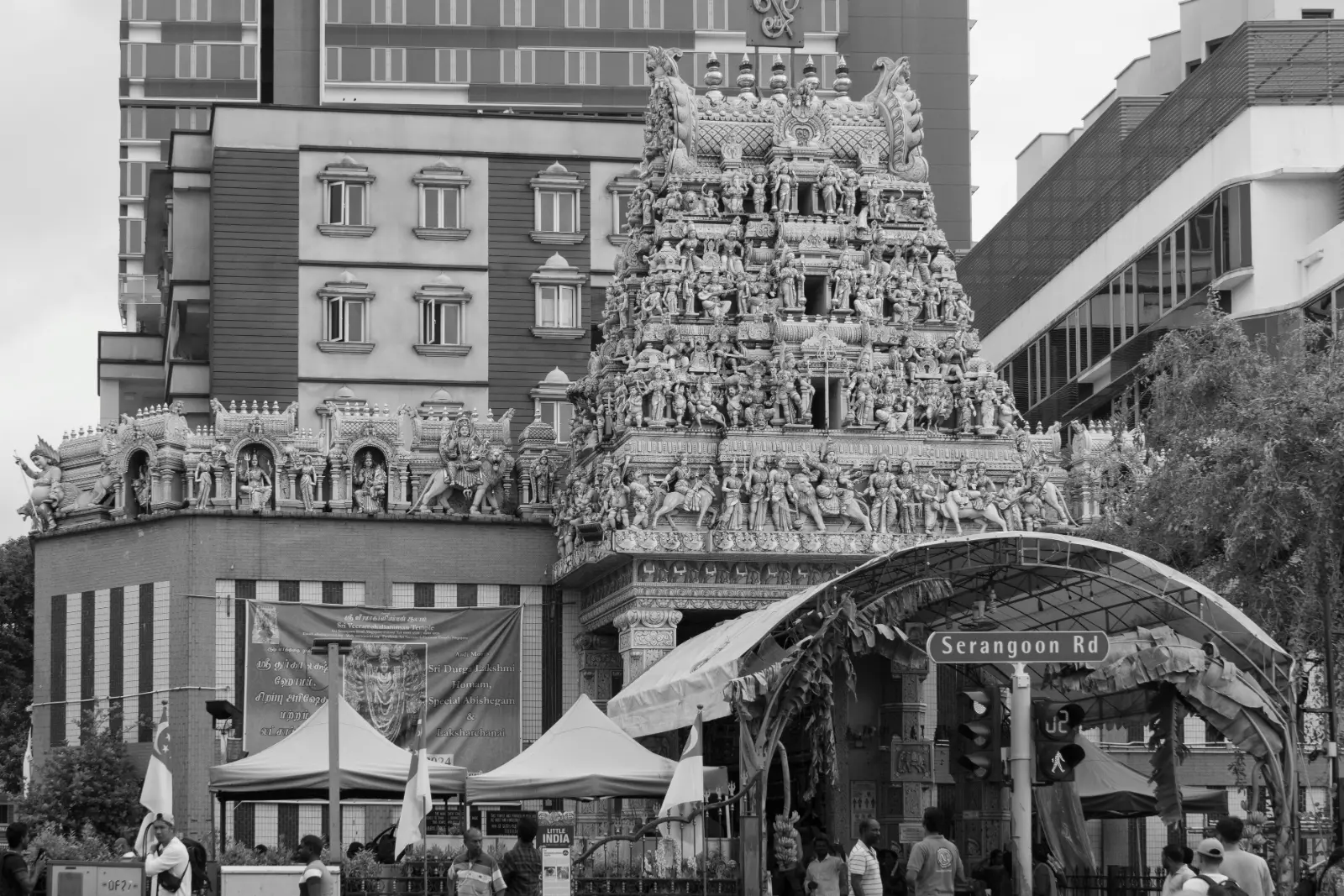
The two Hindu temples most visitors see in Singapore's Little India are Sri Veeramakaliamman Temple, dedicated to Kali, and Sri Srinivasa Perumal Temple, dedicated to Vishnu, both on Serangoon Road. A short ride away, Sri Mariamman Temple in Chinatown is Singapore's oldest Hindu temple, and Sri Thendayuthapani Temple on Tank Road is where the Thaipusam procession ends.
| Temple | Deity | Area | Useful to know |
|---|---|---|---|
| Sri Veeramakaliamman | Kali | Serangoon Road, Little India | A shrine stood here from 1855; photos allowed if you are considerate of worshippers (Visit Singapore) |
| Sri Srinivasa Perumal | Vishnu as Perumal | Serangoon Road, near Farrer Park | Built 1855, new temple completed 1966, rajagopuram added 1979; start of the Thaipusam procession |
| Sri Mariamman | Mariamman | 244 South Bridge Road, Chinatown | Singapore's oldest Hindu temple; fire walking festival (Theemithi) in October or November |
| Sri Thendayuthapani | Murugan | Tank Road, near Fort Canning | End point of the roughly four kilometre Thaipusam procession |
Sri Veeramakaliamman Temple will feel familiar to anyone who has visited Dakshinkali or done Kali puja at home. Visit Singapore notes that the shrine was erected as early as 1855 by Indian pioneers and that its interior is filled with statues of the goddess Kali (Visit Singapore). We could not find current puja times from an official temple source, so check the notice at the entrance before you plan a visit around a specific aarti.
Sri Srinivasa Perumal Temple is run by the Hindu Endowments Board, which lists two opening windows on weekdays: 5am to 11am and 6pm to 8.30pm, with slightly different times at weekends. The temple is closed between the two windows, so a midday walk will find the doors shut. Checked: 4 November 2026, Hindu Endowments Board, Sri Srinivasa Perumal Temple page.
Sri Mariamman Temple in Chinatown is described by Singapore's National Heritage Board as the country's oldest Hindu temple; its founder Naraina Pillai arrived with Raffles in 1819, the site was granted in 1823 and a wood and attap structure stood there by 1827 (Roots.sg, National Heritage Board). Its Theemithi festival, in which devotees walk across burning coals in honour of Draupadi, is one of the most striking Hindu events in Southeast Asia.
Singapore's Thaipusam procession runs from Sri Srinivasa Perumal Temple on Serangoon Road to Sri Thendayuthapani Temple on Tank Road, a route of about four kilometres, with devotees carrying kavadi and milk pots (Roots.sg, Thaipusam). Thaipusam is not a public holiday in Singapore, so the procession happens around normal city life.
Our Little India Singapore guide has the full walking route, banana leaf restaurants, Mustafa Centre and the Deepavali light-up. For the rest of the city, see the Singapore travel guide. Nepal is not on Singapore's list of countries whose citizens need a visa, and every visitor must submit the SG Arrival Card within three days before arriving. Checked: 4 November 2026, Immigration and Checkpoints Authority. See our Singapore visa page for the current position.
Can you visit the Hindu temple in Dubai?
Yes. The Hindu Temple Dubai in Jebel Ali has been open to people of all faiths since October 2022, and the BAPS Hindu Mandir in Abu Dhabi, off the main highway between Dubai and Abu Dhabi, has been open to the public since March 2024. The two work very differently: Jebel Ali is a community temple, while the Abu Dhabi mandir runs a strict booking and security system.
Hindu Temple Dubai, Jebel Ali
The Hindu Temple Dubai stands in the Jebel Ali Worship Village, which Gulf News reported houses nine religious shrines, beside a Sikh gurdwara and several churches. It was opened on 4 October 2022 by Sheikh Nahyan bin Mubarak Al Nahyan, the UAE Minister of Tolerance and Coexistence, and Gulf News reported 16 deities in the temple, with the Guru Granth Sahib also kept there (Gulf News, 4 October 2022). Press reports before the opening, including one carried by Zawya, described Shiva as the main deity on the central podium.
It replaced Dubai's oldest Hindu temple. The historic Shiva temple in Bur Dubai, part of the Sindhi Guru Darbar complex, closed on 3 January 2024, and devotees were asked to go to Jebel Ali instead (The National, 3 January 2024). Some older travel articles still send visitors to Bur Dubai, so check the date of anything you read.
Visiting rules have changed since opening. At launch, Gulf News reported a QR code appointment system, and The National reported opening hours of 6.30am to 8.30pm daily (The National, 4 October 2022). In January 2024 the temple's general manager told Khaleej Times that tour groups did not need advance bookings, and that the temple received about 40,000 devotees on New Year's Day, with separate queues for families, people aged 80 and above, pregnant women, mothers with infants and people with disabilities (Khaleej Times, 4 January 2024). When we checked, the temple's own website showed only a holding page, so we cannot confirm today's hours or whether booking is needed. Checked: 4 November 2026, hindutempledubai.com. Ask your hotel or check the temple's current social channels before you go, and avoid Diwali, New Year and weekend peaks if you want a quiet darshan.
BAPS Hindu Mandir, Abu Dhabi
The BAPS Hindu Mandir is the first traditional carved stone Hindu temple in the UAE. It was consecrated on 14 February 2024 and opened to the public on 1 March 2024, with seven shikhars representing the seven emirates, an exterior of pink sandstone from Rajasthan and a white marble interior (Wikipedia). Its shrines honour Swaminarayan, Radha Krishna, Sita Rama, Shiva and Parvati with Ganesh and Kartikeya, Venkateshwara and Padmavati, Jagannath, and Ayyappan.
The mandir's rules are the strictest of any temple in this guide. These are the official visitor rules:
| Rule | What the mandir says |
|---|---|
| Opening days and hours | Tuesday to Sunday, 9am to 8pm; closed on Mondays |
| Ganga Aarti | Weekdays 7.30pm; weekends and holidays 6.45pm and 7.30pm |
| Registration | Mandatory for every visitor individually; unregistered visitors are denied entry; show the QR code pass at the gate |
| When to book | Only after arriving in the UAE |
| Identity | Physical government ID (Emirates ID or passport), checked against the pass |
| Dress | No shorts, skirts above the knee or sleeveless tops; no tight or transparent clothing; no provocative or political designs |
| Cover ups | Sarongs (long cloths) can be bought at the front desk |
| Photography | Phone photos and video for personal, non commercial use; no professional cameras, video cameras or selfie sticks |
| Not allowed inside | Food, drinks including water, fruit and flowers; drones; tobacco and vapes; pets |
| Access | Wheelchairs on request; people of determination get priority at entry |
Checked: 4 November 2026, BAPS Hindu Mandir visitor information.
Two rules catch Nepali visitors out. The first is the booking timing: you cannot book from Kathmandu before you fly, only once you are in the UAE, so plan to book on your phone the day before. The second is flowers and fruit. At home you would never go to a mandir empty handed, but here offerings brought from outside are not allowed through security, so leave your mala and prasad items at the hotel.
The mandir sits at Abu Mureikha, off the Sheikh Maktoum Bin Rashid Road (E11) between Dubai and Abu Dhabi. Most visitors go by taxi or with a hired car and driver; the mandir lists Exit 366 on the E11. Our Dubai travel guide covers getting around the emirates, and nonstop flights link Kathmandu and Dubai every day. Nepali passport holders need a UAE visa arranged before travel; Gomayu does not have a separate UAE visa page, so see our visa services page. Holders of other passports should check the official site for their passport.
What is the dress code and etiquette?
At every Hindu temple in this guide, cover your shoulders and knees, take off your shoes before entering a shrine, keep your voice low and never walk between a worshipper and the deity. Bali adds a sarong and sash; the Abu Dhabi mandir adds pre-registration and a ban on bringing in food and flowers. Everything else is ordinary temple manners that any Nepali family already knows.
Dress rules by temple
| Place | Rule | How strict | Source |
|---|---|---|---|
| Bali temples | Modest clothing covering shoulders and knees; sarong and sash usually provided at the entrance | Strict at the gate of major temples | Indonesia Tourism (indonesia.travel) |
| Bali inner courtyards | Foreign visitors may not enter the main and middle sacred areas unless they are worshippers in Balinese attire | Set out in a provincial circular | Bali Governor's Circular Letter No. 7 of 2025 |
| Batu Caves | Shoulders and knees covered; the temple has called its dress notice a request rather than a rule | Enforcement varies by day | The Star (2013); visitor reports |
| Singapore temples | Modest clothing, shoes off before the shrine | Expected; rarely policed | General temple practice; no official dress notice found online |
| Hindu Temple Dubai | Modest clothing | Expected | No current official notice found |
| BAPS Abu Dhabi | No shorts, short skirts, sleeveless, tight or transparent clothing | Strict: security refuses entry | mandir.ae |
Indonesia's tourism board advises visitors to Bali temples to "wear modest clothing that covers the shoulders and knees" and notes that "sarongs and sashes are usually provided at the entrance" (Indonesia Travel). Women in shorts can enter the outer areas of most visitor temples once they tie on the sarong over them; the sarong is the rule, not what is underneath. Still, long trousers or a long skirt under the sarong are more comfortable and more respectful.
At Batu Caves the position is softer. In 2013 the temple works committee chairman told The Star the dress notice was a request asking visitors to show respect, and that the temple would not stop anyone entering (The Star, 15 August 2013). Visitor reports since then vary, with some people asked to cover up at the foot of the steps. Dress modestly and you will never have a problem.
The menstruation rule at Balinese temples
Balinese temples ask women who are menstruating not to enter the sacred areas, a rule that applies equally to Balinese women and is understood locally as a matter of ritual purity. Bali's Governor's Circular Letter No. 7 of 2025 for foreign tourists repeats it: the provincial tourism office summarises the circular as barring visitors from the main and middle temple areas (utamaning mandala and madyaning mandala) unless they are worshippers in traditional Balinese attire, and adds that "menstruating women are also prohibited from entering these areas" (Bali Provincial Tourism Office, 8 April 2025). It is not checked at the gate and depends on visitors' honesty. Many Nepali women will already know a similar custom from home, and the respectful choice is simply to wait in the outer courtyard or plan temple days around it.
Etiquette checklist
- Shoes: remove them before any shrine, inner courtyard or cave sanctum, and wear shoes you can slip off easily.
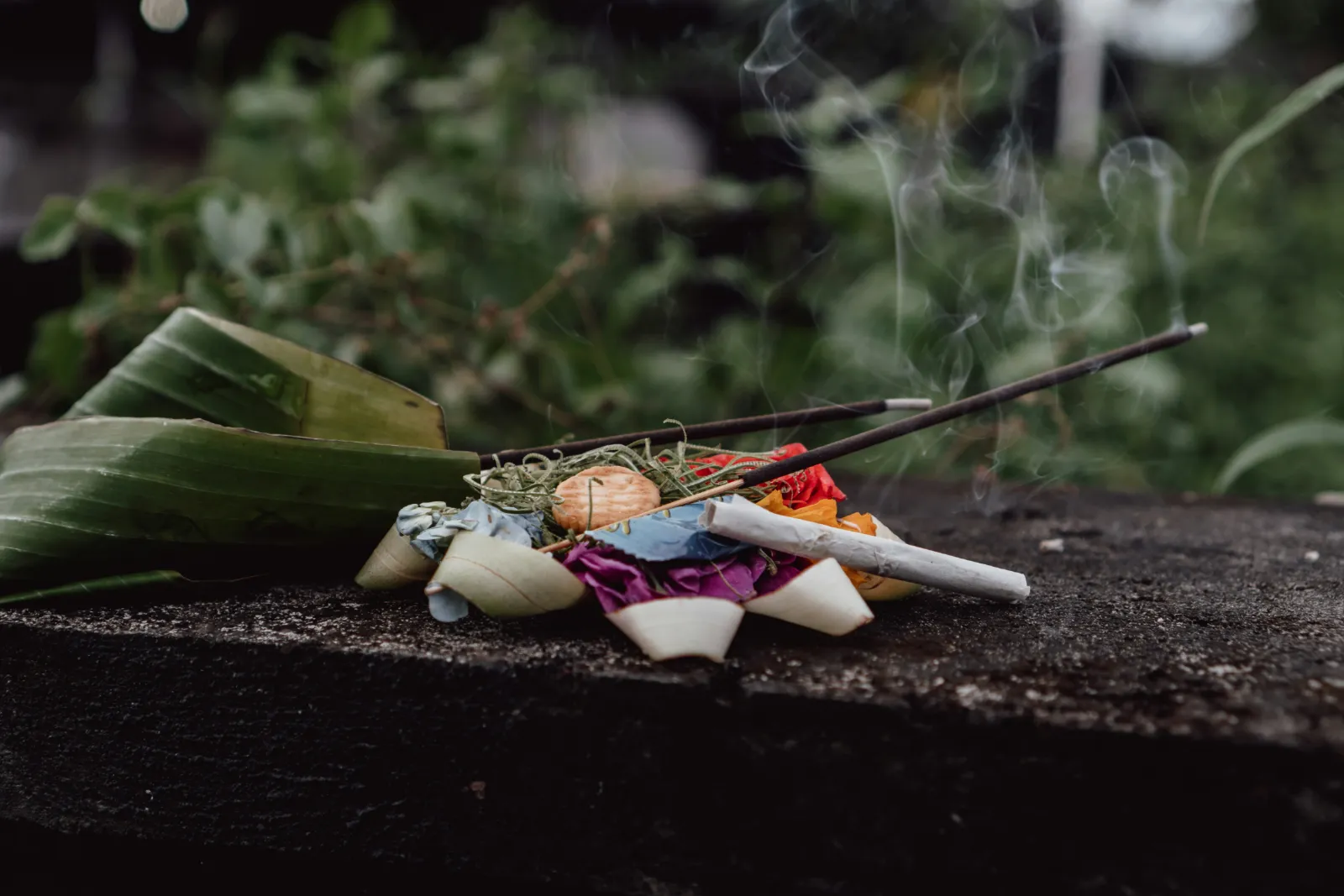
- Offerings in Bali: do not step on, over or around canang sari carelessly, and never move one for a photo. Walk around them.
- Your own offerings: flowers, fruit and coconut are welcome at Tamil temples in Malaysia and Singapore, usually bought from stalls outside. They are not allowed into the Abu Dhabi mandir.
- Photography: phone photos are allowed for personal use at the BAPS mandir and are welcome at Sri Veeramakaliamman if you are considerate. Do not photograph the main murti inside a sanctum unless a sign or priest says you may, and always ask before photographing people at prayer.
- Prasad and tika: accept prasad and tilak or vibhuti with the right hand. Tamil temples often give sacred ash or kumkum rather than the rice tika you know from Nepal.
- Circling: at Tamil temples, walk clockwise around shrines, as you would at home.
- Priests: in Bali, keep your head lower than a seated priest and never walk in front of someone praying.
- Drones: leave them in the hotel; they are banned at the Abu Dhabi mandir and unwelcome near ceremonies everywhere.
- Donations: use the official hundi or donation box, not people who approach you outside.
Which festivals are worth timing a trip for?
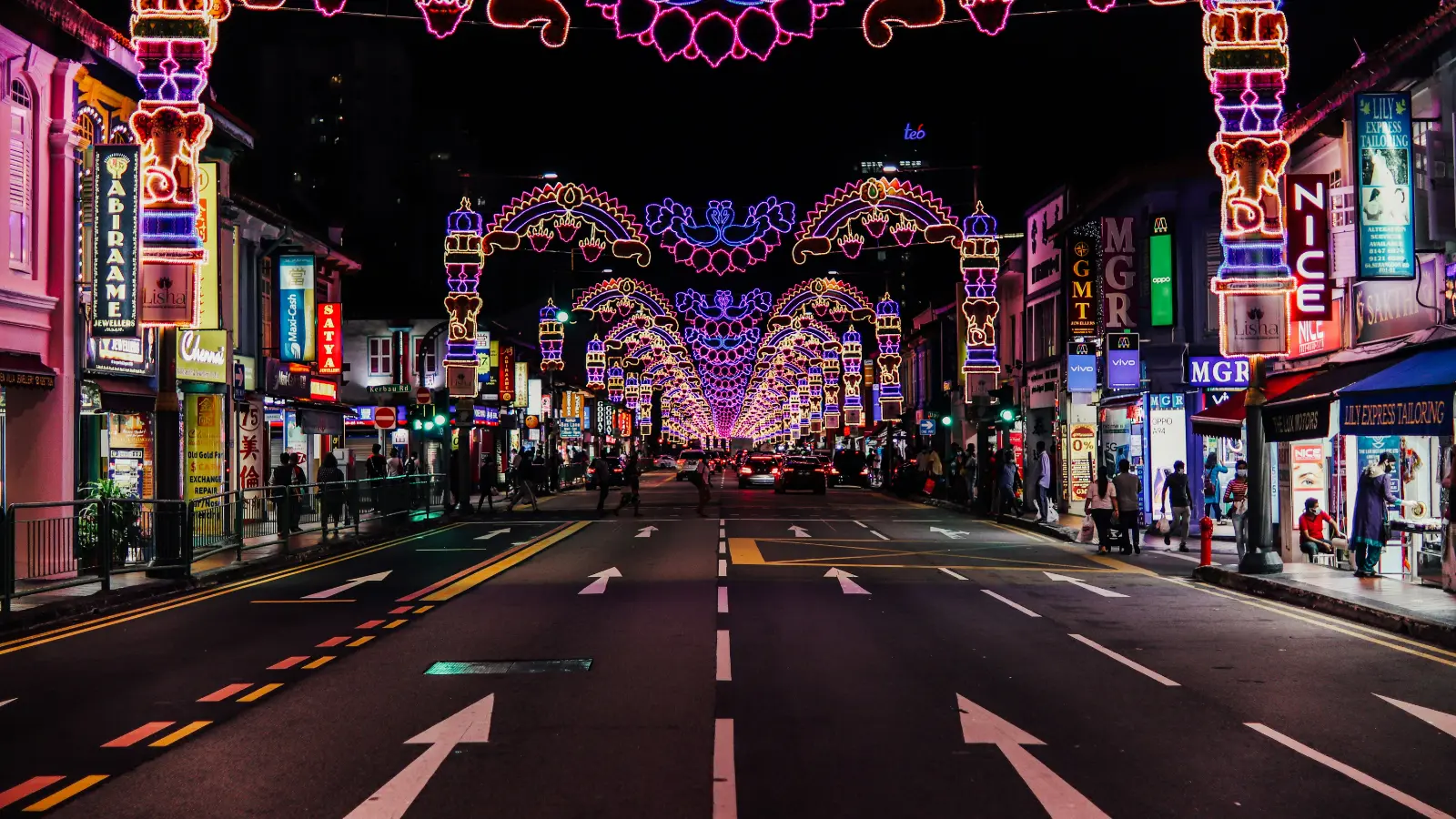
The festivals most worth planning around are Galungan and Nyepi in Bali, Thaipusam in Malaysia and Singapore, and Deepavali in Singapore and Malaysia, which lines up closely with Tihar in Nepal. Dates from government holiday lists are marked with their source; Balinese dates marked expected follow the ritual calendar cycle and had no official 2027 notice when we checked.
| Festival | Where | Date | What it means for a visitor | Source |
|---|---|---|---|---|
| Deepavali 2026 | Singapore | Sunday 8 November 2026; Monday 9 November is a public holiday if your rest day is Sunday | Little India lights, temple queues on the eve and the morning | Ministry of Manpower |
| Deepavali 2026 | Malaysia | Sunday 8 November 2026, with Monday 9 November as the replacement holiday in states with a Sunday rest day | Open houses, temple crowds in Kuala Lumpur and Penang | Prime Minister's Department 2026 list (marked subject to change) |
| Galungan | Bali | Wednesday 13 January 2027 (expected) | Penjor bamboo poles on every road, families at temples, some closures | Expected from the Balinese pawukon calendar |
| Kuningan | Bali | Saturday 23 January 2027 (expected) | Busy temples, ceremonial dress | Expected from the Balinese pawukon calendar |
| Thaipusam | Malaysia | Friday 22 January 2027 | Batu Caves and Penang at their busiest; state holiday in Selangor | Prime Minister's Department 2027 list |
| Nyepi (Saka 1949) | Bali | Monday 8 March 2027 | A full day of silence; the airport closes and visitors stay in their hotel | Indonesia's joint ministerial decree on 2027 holidays |
| Galungan | Bali | Wednesday 11 August 2027 (expected) | Second Galungan of 2027, 210 days after January | Expected from the Balinese pawukon calendar |
| Deepavali 2027 | Singapore | Thursday 28 October 2027 | Light-up in the weeks before | Ministry of Manpower |
| Deepavali 2027 | Malaysia | Thursday 28 October 2027 | National holiday in most states | Prime Minister's Department 2027 list (marked subject to change) |
Checked: 4 November 2026, Singapore Ministry of Manpower public holidays; Ministry of State Secretariat of Indonesia, 2027 holiday decree; Malaysia 2027 list via the FMM notice linked in the Thaipusam section above; Malaysia 2026 Deepavali from the Prime Minister's Department 2026 list, with school holiday dates reported by SAYS. The Galungan and Kuningan dates for 2027 are expected rather than officially announced: they follow the 210 day pawukon cycle on from Galungan on 17 June 2026 and match published Balinese calendars (Galungan dates list), but we found no official 2027 notice for them. Thaipusam 2027 in Singapore was not yet announced on an official page when we checked; it usually falls on the same day as in Malaysia.
Tihar and Deepavali for Nepali families abroad
In 2026, Deepavali in Singapore and Malaysia falls on Sunday 8 November, the same day as Laxmi Puja in the published Nepali calendar for 2083. A family in Singapore that weekend can light diyo at home, then walk under the Serangoon Road lights or visit Sri Veeramakaliamman, while relatives in Kathmandu do Laxmi Puja. The two festivals do not always fall on the same date, because Tamil communities follow the Tamil calendar, so confirm Bhai Tika and the puja muhurta with your family's patro each year. For Tihar break planning from Nepal, see our guide to Dashain and Tihar holidays abroad.
Should you plan a Bali trip around Nyepi or Galungan?
Galungan is a beautiful time to be in Bali: roads lined with penjor, families in white and gold walking to temple, and offerings everywhere. Some temples close to visitors on the main days, so it is better for watching village life than for a temple checklist. Nyepi is different. On Monday 8 March 2027 the whole island stops for 24 hours, the airport closes and you stay inside your hotel. Avoid flying in or out that day; if you are already there, treat it as a quiet day of reflection, and watch the ogoh-ogoh parades the night before.
How do these temples fit into a trip from Nepal?
The temples in this guide fit easily into ordinary holidays: Batu Caves and the Kuala Lumpur temples need half a day, Little India and Chinatown in Singapore one day, the Dubai and Abu Dhabi temples a day between them, and a Bali temple circuit two or three days. Flight time, visa paperwork and festival crowds decide how comfortable the trip is, especially with elderly parents.
| Destination | From Kathmandu | Entry requirement for Nepali passports | Time needed for temples |
|---|---|---|---|
| Kuala Lumpur and Batu Caves | Nonstop, about 4 hours 35 minutes to 4 hours 55 minutes | Visa required; Malaysia Digital Arrival Card | Half a day |
| Singapore | One nonstop daily on Singapore Airlines, or one connection | Not on the visa required list; SG Arrival Card | One day |
| Dubai and Abu Dhabi | Nonstop daily, about 4 hours 40 minutes to 5 hours 15 minutes | UAE visa before travel | One day for both temples |
| Bali | No direct flight; one stop, usually Kuala Lumpur, Bangkok or Singapore | Indonesian visa | Two to three days |
Flight details come from Gomayu's flight guides, checked by our team in late October 2026; the Kathmandu to Bali flight guide explains the one stop routings in full. Schedules change by season, so confirm before you book.
A few practical tips for Nepali families:
- Carry a light shawl and a sarong in your day bag. They solve the dress question at every temple in this guide.
- Plan around opening windows. Tamil temples close in the middle of the day and reopen in the evening; the Abu Dhabi mandir closes on Mondays.
- Pick the right day for parents. Batu Caves is easier for older people on a weekday morning than at Thaipusam, and the Abu Dhabi mandir offers wheelchairs on request.
- Keep your passport with you on the Abu Dhabi day; the mandir checks your physical ID against your booking.
- Vegetarian food is easy near the Tamil temples: banana leaf meals in Little India and Brickfields, and temple canteens on festival days.
What about India's pilgrimage temples?
For a full pilgrimage rather than temple visits on a holiday, India is still the first choice for most Nepali Hindus, and Nepali citizens do not need a visa to visit India. Our Kashi Vishwanath darshan guide explains queues and the corridor in Varanasi, and the Char Dham Yatra guide covers Yamunotri, Gangotri, Kedarnath and Badrinath in the Himalaya.
Frequently asked questions
Is Bali a Hindu island?
Yes. Bali is the only province of Muslim majority Indonesia where most people are Hindu, and Balinese Hinduism, officially Agama Hindu Dharma, shapes daily life through family shrines, village temples and canang sari offerings. Bali also has Muslim, Christian and Buddhist communities, and visitors of every faith are welcome at temples that receive guests.
Is Balinese Hinduism the same as Nepali Hinduism?
No. Balinese Hinduism shares the Trimurti, Saraswati, dharma, karma and many Sanskrit terms with Nepali Hinduism, but it has its own supreme divinity, Sang Hyang Widhi Wasa, a 210 day ritual calendar, open courtyard temples and festivals such as Galungan and Nyepi. Galungan and Dashain both celebrate good over evil but are separate festivals.
When is Thaipusam at Batu Caves?
Thaipusam at Batu Caves in 2027 falls on Friday 22 January 2027, according to Malaysia's official 2027 public holiday list, and it is a state holiday in Selangor. Devotees start arriving the night before, and the site is busiest from before dawn. Families wanting a quiet visit should choose an ordinary weekday morning instead.
Is there a Hindu temple in Dubai?
Yes. The Hindu Temple Dubai in Jebel Ali has been open to people of all faiths since October 2022, with Shiva as the main deity among 16 deities. It replaced the old Bur Dubai Shiva temple, which closed in January 2024. The BAPS Hindu Mandir in Abu Dhabi, opened in March 2024, is the other major Hindu temple in the UAE.
Can women in shorts enter Bali temples?
Women in shorts can usually enter the outer areas of visitor temples in Bali once they wrap the sarong and sash provided at the entrance, because the sarong is what the rule requires. Long trousers or a skirt under the sarong are more comfortable and respectful. The inner courtyards are for worshippers in Balinese dress only.
Do I need a sarong in Bali temples?
Yes. Every visitor to a Bali Hindu temple, man or woman, is expected to wear a sarong and a sash tied at the waist, with shoulders covered. Temples that receive visitors usually lend or rent them at the gate, but carrying your own sarong saves time and is useful when you visit several temples in a day.
Which Hindu temple is famous in Singapore?
The most famous Hindu temple in Singapore is Sri Veeramakaliamman in Little India, dedicated to Kali, followed by Sri Srinivasa Perumal on Serangoon Road, dedicated to Vishnu, and Sri Mariamman in Chinatown, which Singapore's National Heritage Board calls the country's oldest Hindu temple. Sri Thendayuthapani on Tank Road is the end point of Thaipusam.
Can I do puja abroad as a tourist?
Yes, at most Hindu temples abroad a visiting Nepali Hindu can join darshan and aarti and request an archana at the temple counter, as local devotees do. In Bali, praying in the inner courtyard is reserved for worshippers in full Balinese dress, so go with a local family or temple priest. At the BAPS Abu Dhabi mandir you cannot bring outside flowers or fruit.
Is photography allowed inside the temples?
Photography rules differ by temple. The BAPS Hindu Mandir in Abu Dhabi allows phone photos and video for personal use but bans professional cameras and selfie sticks, and Visit Singapore says photos are welcome at Sri Veeramakaliamman if you respect worshippers. Avoid photographing the main murti inside a sanctum, and ask before photographing anyone at prayer.
Do I need to book before visiting the BAPS Hindu Mandir in Abu Dhabi?
Yes. The BAPS Hindu Mandir in Abu Dhabi requires every visitor to register individually and show a QR code pass with physical ID, and the booking can only be made after you arrive in the UAE. The mandir is open Tuesday to Sunday from 9am to 8pm and closed on Mondays, as checked on 4 November 2026.
Bali ma Hindu mandir kun kun cha?
Bali has thousands of Hindu temples, called pura. The best known for visitors are Besakih, the mother temple on Mount Agung; Uluwatu on the sea cliffs; Tanah Lot on an offshore rock; Ulun Danu Beratan on a highland lake; and Tirta Empul, the holy spring temple near Ubud where people take a purification bath called melukat.