





































































+977-9768558250
Explore by Country
See all 22 Thailand packages
Most popular pick
See all 22 Thailand packages →
See all 11 Vietnam packages
Most popular pick
See all 11 Vietnam packages →
See all 10 Indonesia (Bali) packages
Most popular pick
See all 10 Indonesia (Bali) packages →
See all 7 Maldives packages
Most popular pick
See all 7 Maldives packages →
See all 10 China packages
Most popular pick
See all 10 China packages →
See all 13 Sri Lanka packages
Most popular pick
See all 13 Sri Lanka packages →
See all 9 Malaysia packages
Most popular pick
See all 9 Malaysia packages →
See all 8 Singapore packages
Most popular pick
See all 8 Singapore packages →
See all 2 Kenya packages
Most popular pick
See all 2 Kenya packages →
See all 16 India packages
Most popular pick
See all 16 India packages →
See all 3 Dubai packages
Most popular pick
See all 3 Dubai packages →
See all 7 Nepal packages
Most popular pick
See all 7 Nepal packages →
See all 6 Philippines packages
Most popular pick
See all 6 Philippines packages →
Search Tours or Places
Blog / Vietnam

Hanoi to Ninh Binh: Trang An, Tam Coc and How to Get There

34 min read 05 Nov 2026
Small pavilion on calm water beneath steep limestone cliffs at Trang An in Ninh Binh

Short answer: Hanoi to Ninh Binh is about 90 kilometres by road, roughly 2 to 2.5 hours by train, bus or limousine van, and the trip is easy to do in a day. The two big draws are the rowing boat rides at Trang An and Tam Coc, which take you through river caves between limestone towers. Add the climb at Hang Mua, Bai Dinh Pagoda or the old capital at Hoa Lu, and you have one of the best short trips from the Vietnamese capital. Stay one night if you want the quiet morning light and more than one boat ride.

This guide explains which boat ride to pick, how to get there and whether Ninh Binh can replace a Ha Long Bay cruise. Facts are checked against the Ninh Binh tourism authorities, UNESCO and Vietnam's national tourism bodies, with the date we checked them.

Why visit Ninh Binh from Hanoi?

Ninh Binh is worth visiting from Hanoi because it puts some of the most striking scenery in Vietnam within a short ride of the capital. You get karst towers, slow river caves, rice fields, a thousand year old royal capital and large Buddhist pagodas, all close together and all reachable without a flight or an overnight boat.

The heart of the area is the Trang An Landscape Complex, which UNESCO inscribed on the World Heritage List in 2014 as a mixed cultural and natural site. The Ninh Binh tourism portal calls it the first mixed heritage site of Vietnam and Southeast Asia. UNESCO's listing for site 1438 describes "a spectacular landscape of limestone karst peaks permeated with valleys", with rock towers reaching up to about 200 metres, cave passages linking the waterways, and archaeological traces of people living here for more than 30,000 years. The core area covers 6,226 hectares, with a buffer zone of 6,026 hectares around it.

That combination is what makes Ninh Binh different from a pure nature stop. On the same trip you can sit in a sampan rowed by a local guide, climb to a viewpoint over the valley, and stand in the temple of a king who ruled Vietnam more than a thousand years ago. Many people know the area as "Ha Long Bay on land", and the nickname is fair: the limestone towers are the same family of landforms, but here they rise out of rice fields and rivers instead of the sea.

For travellers coming from Nepal, the landscape is genuinely new. Nepal's hills are tall and steep, but they are not limestone tower karst, and there is nothing quite like rowing through a cave tunnel under a mountain. The rice fields will feel more familiar, although the timing is different: the famous gold of Tam Coc arrives in late May and early June, around the time Nepal is preparing to plant paddy for Asar.

If you are still planning the wider trip, our Vietnam travel guide covers money, transport and the basics, and the guide to things to do in Hanoi shows how Ninh Binh fits alongside the Old Quarter, the lakes and the city's food.

Ninh Binh at a glanceDetail
Where it isSouth of Hanoi, near the southern edge of the Red River Delta
Distance from HanoiAbout 90 km by road (about 115 km by rail)
Travel timeRoughly 2 to 2.5 hours by train, bus or car
UNESCO statusTrang An Landscape Complex, mixed World Heritage site, inscribed 2014
Main experiencesRowing boat rides at Trang An and Tam Coc, Hang Mua viewpoint, Bai Dinh Pagoda, Hoa Lu ancient capital
Golden rice seasonMid May to early June, per the Ninh Binh tourism portal
Day trip possible?Yes, but one night gives a much calmer visit

Ninh Binh after the 2025 province merger

Ninh Binh is now a much larger province than older guidebooks describe. On 12 June 2025 Vietnam's National Assembly passed Resolution 202/2025/QH15, which merged Ha Nam, Nam Dinh and Ninh Binh into one province that keeps the name Ninh Binh. According to the text of the resolution, the new province covers 3,942.62 square kilometres with a population of 4,412,264, and the new provincial governments started work on 1 July 2025.

At the same time, Vietnam removed the district level of local government. Tuoi Tre News reported that all district level units stopped operating nationwide from 1 July 2025. For visitors nothing changes on the ground, but older addresses that mention districts such as Gia Vien or Hoa Lu may now be written differently on bookings and maps, so search by the name of the sight or hotel.

What is the difference between Trang An and Tam Coc?

Rowing boats in a long line on a green river between limestone karsts in Ninh Binh

Trang An is the bigger, longer boat trip with several route choices, more caves and temple stops along the way. Tam Coc is shorter and simpler: one river, three caves and rice fields on both banks. If you only have time for one, Trang An gives more variety, while Tam Coc is at its best in the golden rice weeks of late May and early June.

Both are rowing boat rides in small sampans that hold a handful of passengers plus the rower. Both pass through caves low enough that you will duck your head. Neither boat has a roof, which matters more than people expect: in summer the sun on open water is strong, and in light rain you will get damp. The Ninh Binh tourism portal advises a hat, comfortable clothes and following the rower's instructions, and asks visitors to wear the life jacket provided.

FeatureTrang AnTam Coc
Type of tripRowing boat on a network of rivers and lakes inside the karstRowing boat along the Ngo Dong River
Route choiceFour routes listed by the provincial tourism portalOne out and back route
Boat timeAbout 3 hours on routes 1, 2 and 3; about 1.5 to 2 hours on route 4About 2 hours to the three caves and back
CavesBetween 3 and 9 caves depending on route3 caves: Ca, Hai and Ba
Temple stops2 or 3 spiritual sites per route where you can step offNo temple stops on the water; Bich Dong Pagoda and Thai Vi Temple are nearby by road
SceneryEnclosed karst valleys, lakes, forest and cliffsRice fields between karst towers, more open views
Best seasonGood year roundBest in the golden rice weeks, mid May to early June
TicketTicket needed, bought at the Trang An wharfTicket needed, bought at the Tam Coc wharf
Best forFirst time visitors who want the full karst and cave experienceShorter visits, rice field photography, a gentler ride

Checked: 5 Nov 2026, against the Ninh Binh tourism portal pages for Trang An (updated 28 March 2025) and Tam Coc (updated 11 November 2024). Routes and timings can change, so confirm at the wharf.

Trang An boat routes and how long they take

Trang An currently offers four boat routes, according to the Ninh Binh tourism portal's Trang An page. Routes 1, 2 and 3 each take about three hours. Route 4 takes about 1.5 to 2 hours and is designed for visitors with less time. You choose your route at the wharf, and every route ends back where it started.

RouteStart and end points namedApproximate timeCavesSpiritual sitesNotable stops
Route 1Den Trinh to Quy Hau CaveAbout 3 hours93Den Trinh, Tran Temple and Khong Temple; the most caves of any route
Route 2Lam Cave to Vu Lam PalaceAbout 3 hours43Cao Son Temple and Suoi Tien Temple
Route 3Den Trinh to Vu Lam PalaceAbout 3 hours33Dot Cave, described as the longest cave in Trang An at over 1,000 metres; Van Cave; Suoi Tien Temple
Route 4Lam Cave to Vu Lam PalaceAbout 1.5 to 2 hours42Cao Son Temple and Vang Cave, a shorter loop

A small caution: older pages on the same provincial website list fewer routes and different cave counts, so treat these numbers as a guide and ask at the ticket counter which routes are running that day.

How to choose between them:

  • Want the classic Trang An experience? Route 1 has the most caves and includes Tran Temple, so it is the usual pick for first time visitors with a full morning or afternoon.
  • Interested in temples and festivals? Routes 2 and 3 both pass Suoi Tien Temple. The provincial portal notes that Trang An holds a festival for the deity worshipped there on the 17th and 18th days of the third lunar month, which falls in spring.
  • Like long cave tunnels? Route 3 goes through Dot Cave, the longest in the complex.
  • Short on time, or travelling with small children or older parents? Route 4 is the shortest, and three hours sitting low in a small boat is a lot for some people.

Film fans may know Trang An from Hollywood. Vietnam's national tourism administration reported in 2017 that Kong: Skull Island was filmed partly in Ninh Binh in February 2016, and that a tribal village set built for the film inside the Trang An complex was opening to tourists. Reports from 2019 said the film set had been dismantled to protect the heritage area, so ask locally what remains rather than planning your visit around it.

The Tam Coc boat ride

The Tam Coc boat ride follows the Ngo Dong River through three caves and back, and takes about two hours, according to the Ninh Binh tourism portal's Tam Coc page. Tam Coc means "three caves", and all three were carved by the Ngo Dong River cutting through the mountains.

  • Hang Ca (the first cave): about 127 metres long, with an entrance more than 20 metres wide and stalactites inside. It is the largest of the three.
  • Hang Hai (the second cave): about 60 metres long, nearly 1 kilometre further on, with oddly shaped stalactites on the ceiling.
  • Hang Ba (the third cave): about 50 metres long, with a low stone arch ceiling.

The real appeal of Tam Coc is the stretch between the caves, where the river runs through rice fields with karst towers on both sides. The portal notes that the view changes with the rice season, from green rice to golden rice to fields of silver water. This is why timing matters so much more at Tam Coc than at Trang An. In the golden weeks, the valley is at its most photogenic. Outside them, the fields can look bare, and Trang An usually feels like the stronger choice.

So which one should you choose?

Choose Trang An for your only boat ride or outside the rice season, and Tam Coc in late May or early June or when time is short. With a night in Ninh Binh you can do both, and they feel different enough to justify it.

If you are...PickWhy
On a first visit with one boat ride onlyTrang An, route 1Most caves, temple stops, the full UNESCO landscape
Visiting in late May or early JuneTam CocGolden rice fields along the river
Travelling with young kids or elderly parentsTam Coc or Trang An route 4Shorter time sitting in a small boat
A photographerBoth, at different times of dayTrang An for cliffs and caves, Tam Coc for fields
On a tight day tripTrang An route 4 or Tam CocLeaves time for Hang Mua or Bai Dinh
Explore Vietnam tour packages
View all →

What else can you see in Ninh Binh?

Beyond the boat rides, the three sights most visitors add are Hang Mua for the view, Bai Dinh Pagoda for its scale, and Hoa Lu for its history. All three sit inside or beside the Trang An Landscape Complex and are short drives or bicycle rides from the boat wharves.

Hang Mua: how many steps to the top?
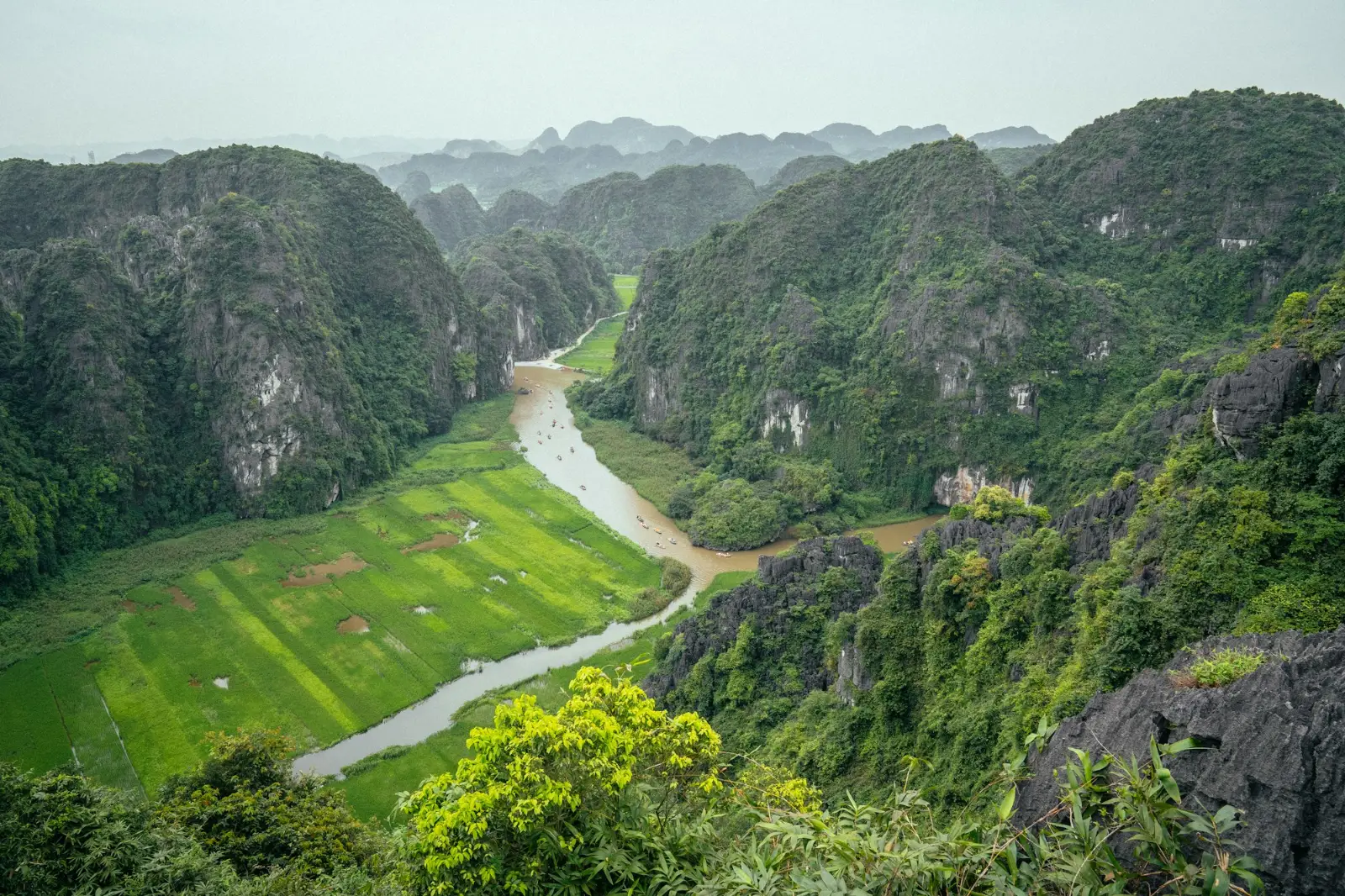
View from Mua Cave over a winding river, rice fields and karst hills in Ninh Binh

Hang Mua has about 500 stone steps to the summit of Ngoa Long Mountain, but official sources do not agree on the exact number. The Ninh Binh Department of Tourism says 486 steps, the provincial tourism portal says 500, and Vietnam Airlines' travel guide says nearly 500. Expect somewhere between 486 and 500 steep, uneven steps.

The reward is the view in the photo above: the Ngo Dong River curling through the Tam Coc rice fields between karst towers, and on a clear day a long way across the Trang An landscape. The summit area is small and rocky, and it gets busy around sunset. The cave itself, at the foot of the mountain, is small; the name Mua means "dance", and the provincial tourism department links it to a legend that a Tran king came here to watch music and dance performances.

Practical points for the climb:

  • The steps are steep, uneven in places and have no shade near the top. Go early in the morning or late in the afternoon, and carry water.
  • Wear shoes with grip. Sandals with no back strap are a bad idea on the stone, especially after rain.
  • If knees or breathing are a concern, the lower viewpoints and the lotus pond at the base are still rewarding. Older parents can wait below while the rest of the group climbs.
  • Hang Mua is about 3.5 kilometres from the Tam Coc landscape, per the Department of Tourism, so it pairs naturally with the Tam Coc boat ride.
  • A ticket is needed to enter the Hang Mua area.

The provincial portal also mentions a lotus field near Hang Mua that is at its best in lotus season, which Vietnam Airlines' guide places in June and July.

What is Bai Dinh Pagoda?

Aerial view of Bai Dinh Pagoda halls with curved roofs among green forest in Ninh Binh

Bai Dinh Pagoda is a very large Buddhist complex on a hillside in Ninh Binh, built around an ancient pagoda. According to the Ninh Binh Department of Tourism, the old pagoda was founded in 1136 by the Zen monk Nguyen Minh Khong, and the modern expansion began in 2003. The department lists several records for the site, including its largest bronze Buddha statue and largest bronze bell, and 500 Arhat statues, which it calls the most in ASEAN.

Bai Dinh sits about 18 kilometres from Ninh Binh city, according to the same page, so it is a separate drive from the Tam Coc and Hang Mua area rather than a short walk. The complex is spread out on a slope, with long covered corridors lined with the Arhat statues, big halls and a tall stupa, so expect a lot of walking and some stairs.

Visitor notes:

  • Dress modestly. This is an active place of worship. Cover shoulders and knees, remove hats in the halls, and speak quietly.
  • Crowds come in waves. Weekends, Vietnamese public holidays and the weeks after Tet bring very large numbers of pilgrims. Weekday mornings are calmer.
  • For Nepali visitors: Bai Dinh follows the Mahayana Buddhist tradition common in Vietnam. The architecture, with its curved tiled roofs and wooden halls, looks quite different from Tibetan style gompas or Newar bahals in the Kathmandu Valley, which is part of what makes it interesting to compare.

Hoa Lu, Vietnam's ancient capital

Hoa Lu was the capital of Vietnam for 41 years in the late 10th and early 11th centuries, under the Dinh and Early Le dynasties. Vietnam's national tourism administration explains that the Dinh dynasty ruled from Hoa Lu from 968 to 980 and the Early Le dynasty from 980 to 1009. Dinh Bo Linh, crowned as King Dinh Tien Hoang, named the country Dai Co Viet. In 1010, King Ly Thai To moved the capital to Thang Long, which is today's Hanoi.

UNESCO notes that Hoa Lu was "strategically established" inside this karst landscape, and the ring of limestone towers is easy to picture as natural defences. Today the main things to see are two temples built on the old palace foundations, one for King Dinh Tien Hoang and one for King Le Dai Hanh, about 500 metres apart. They are smaller and quieter than Bai Dinh, with carved stone and wood, and they give the landscape a human story: the same cliffs you see from the boat once protected a royal court.

Hoa Lu is a good stop for anyone who likes history, and for families who want a shorter, flatter visit between the boat ride and the climb. A ticket is needed for the temple area.

Van Long Wetland Nature Reserve

Van Long is a quieter alternative to the main boat rides, with boats crossing a protected wetland between limestone hills. According to Vietnam's national tourism administration, the reserve covers 2,736 hectares, was recognised in 2019 as Vietnam's 9th Ramsar wetland of international importance, and holds the largest remaining population of the critically endangered Delacour's langur. Seeing the langurs is not guaranteed, but the calm water and the absence of crowds are the main appeal.

Bich Dong Pagoda and Thai Vi Temple

Two smaller historic sites sit close to Tam Coc. Bich Dong Pagoda is built into a karst mountainside and is traditionally called "Nam Thien De Nhi Dong", the second most beautiful cave in the southern sky. Thai Vi Temple is about 2 kilometres from the Tam Coc boat station by country roads, according to the provincial tourism portal. Both are easy additions by bicycle if you are staying near Tam Coc.

SightWhat it isEffortGood for
Hang MuaViewpoint over Tam Coc and the river, about 486 to 500 stepsHighViews, photos, active travellers
Bai Dinh PagodaLarge Buddhist complex around a pagoda founded in 1136Medium, lots of walkingCulture, architecture, pilgrims
Hoa Lu templesTemples of the Dinh and Early Le kings on the old capital siteLowHistory, families, older travellers
Van LongBoat trip on a Ramsar listed wetlandLowQuiet nature, wildlife watchers
Bich Dong PagodaPagoda set into a karst mountainsideMedium, some stairsAdd on near Tam Coc
Thai Vi TempleHistoric temple about 2 km from the Tam Coc wharfLowCyclists, history lovers

How do you get from Hanoi to Ninh Binh?

The quickest ways to get from Hanoi to Ninh Binh are a limousine van with hotel pickup, a private car, or the train from Hanoi Station, each taking roughly 2 to 2.5 hours. Ninh Binh is about 90 kilometres south of Hanoi by road, according to both Vietnam Airlines' Hanoi to Ninh Binh travel guide and the Ninh Binh tourism portal, though the portal's Tam Coc page gives about 100 kilometres from central Hanoi, depending on where you start and finish. The rail distance is about 115 kilometres.

OptionApproximate timeLeaves fromArrives atBest for
TrainJust over 2 hours on the timetableHanoi StationNinh Binh Station, in the cityTravellers who like rail, a fixed schedule and no road traffic
Limousine vanAbout 1.5 to 2 hours, longer with pickups and trafficHotel pickup in the Old Quarter, or a fixed officeA fixed drop point or your hotelMost independent travellers
Public busAbout 2 to 2.5 hoursHanoi bus stations such as Giap BatNinh Binh bus stationBudget travellers comfortable with local transport
Private car with driverAbout 1.5 to 2 hours in light trafficYour hotelAnywhere you chooseFamilies, older travellers, groups
MotorbikeAbout 2 to 2.5 hoursHanoiAnywhere you chooseExperienced riders only

Checked: 5 Nov 2026. Road times from Vietnam Airlines' Hanoi to Ninh Binh guide; train times from a published copy of the Vietnam Railways timetable for November 2026 travel. Traffic around Hanoi can add a lot of time at rush hour and before holidays.

Is there a train from Hanoi to Ninh Binh?

Yes. Ninh Binh is a stop on the main North to South railway, and several trains a day leave Hanoi Station and call at Ninh Binh Station. Timetables published for November 2026 travel show journey times of just over two hours, with departures spread from early morning to late evening. Many of these are long distance trains heading south, so you are travelling on one short segment of a much longer route.

Book and check times on dsvn.vn, the official online ticketing site of Vietnam Railways, because train numbers and times change with each new timetable. A few practical notes:

  • Ninh Binh Station is in the city, so you will need a taxi or hotel pickup to reach Tam Coc or Trang An.
  • Morning trains suit a day trip. Evening trains arrive late, which only works if you have a hotel booked.
  • Seat classes vary. A soft seat is enough for a journey this short.
  • The total door to door time is often longer than by limousine van, because you have to get to the station and then from Ninh Binh Station to the sights. Vietnam Airlines' guide also notes that the overall train journey can take longer than going by road.

Limousine vans and buses

Limousine vans are the most popular way for independent travellers to go from Hanoi to Ninh Binh. These are minivans with fewer, larger seats than a standard bus, and many operators collect passengers from hotels in the Old Quarter and drop them in Ninh Binh city, Tam Coc or at their hotel. The drive takes about 1.5 to 2 hours, but pickups around the Old Quarter can add time at the start.

Public buses leave from Hanoi's bus stations, including Giap Bat in the south of the city, and take about 2 to 2.5 hours with stops. They are cheaper but less convenient, since you need to reach the bus station first and then get from Ninh Binh bus station to the sights.

Private car, tour or motorbike

A private car with a driver is the most flexible option and the easiest for families, older travellers and small groups. You can leave early, stop where you like and visit Bai Dinh, which is further from the other sights, without worrying about connections.

Riding a motorbike from Hanoi is only for experienced riders who hold the right licence for Vietnam. The routes out of Hanoi carry heavy traffic, including trucks, and Vietnam Airlines' guide specifically mentions congestion around Giap Bat. If you want the freedom of two wheels, a better idea is to take a van or train to Ninh Binh and then hire a bicycle or motorbike locally.

Getting around once you arrive

The main sights in Ninh Binh are spread out, so plan how you will move between them. Tam Coc, Hang Mua and the Tam Coc wharf are close together, and many visitors cycle between them on quiet rural roads. Trang An is a short drive away. Bai Dinh is further, about 18 kilometres from Ninh Binh city, so it needs a car, taxi or motorbike.

Coming from Nepal: reaching Hanoi first

Most Nepali travellers reach Hanoi from Kathmandu with at least one connection, for example through Bangkok or Kuala Lumpur, and then go on to Ninh Binh by road or rail. It makes sense to build at least one full rest day in Hanoi before a long Ninh Binh day, rather than heading south straight off an overnight flight. Nepali passport holders need a visa for Vietnam, so check our Vietnam visa page for the current position before you book anything.

Is a day trip enough or should you stay overnight?

A day trip from Hanoi to Ninh Binh is enough to see one boat ride and one or two other sights, and many people do exactly that. Staying one night is better if you want to avoid the midday crowds, see the karst in soft morning or evening light, do both Trang An and Tam Coc, or travel at a slower pace with children or older parents.

The problem with a day trip is time on the road. With roughly two hours each way, plus pickups, you get something like five or six hours on the ground, and a three hour Trang An route uses half of that. It is doable, but it is a long day, and you reach the wharves at the same late morning hour as most other day trippers.

QuestionDay trip from HanoiOne night in Ninh Binh
Boat ridesUsually one: Trang An or Tam CocBoth, at quieter times of day
Other sightsOne or two of Hang Mua, Bai Dinh or Hoa LuMost of them, without rushing
Light and crowdsMidday light, busiest hoursEarly morning and sunset, fewer people
Time on the roadAbout 4 hours or more in totalSame total, split over two days
Hang Mua at sunsetHard to fit before the drive backEasy
Best forTight schedules, travellers who prefer one base in HanoiPhotographers, families, couples, slower travellers

How to make a day trip work well:

  • Leave Hanoi early. The earlier you reach the wharf, the quieter the river.
  • Pick one boat ride, not two. Trang An or Tam Coc, depending on the season, then add one sight.
  • Group sights by area. Tam Coc and Hang Mua sit together; Trang An and Hoa Lu are close to each other; Bai Dinh is further away.

Where to stay for one night:

  • Tam Coc village: homestays, guesthouses and small hotels among the rice fields, close to Hang Mua and the Tam Coc wharf. The most atmospheric choice.
  • Near Trang An: quieter resorts and hotels set in the countryside, good for couples and families who want space.
  • Ninh Binh city: ordinary city hotels near the train and bus stations. Convenient for transport, less scenic.

Two nights is worth it if you want to add Van Long, cycle the back roads and enjoy the countryside rather than tick off sights. For how Ninh Binh fits into one or two weeks in the country, our Vietnam itinerary guide shows how many days each region needs.

Should you choose Ninh Binh or Ha Long Bay?

Cruise boats sailing among green limestone karst islands in Ha Long Bay, northern Vietnam

Choose Ninh Binh if you want a day trip, calm water, rice fields, caves and history. Choose Ha Long Bay if you want a night on a boat at sea with kayaking, beaches and sunrise among the islands. If you have the time, do both: they are different enough that most travellers do not feel they saw the same thing twice.

The question of Ninh Binh vs Ha Long Bay comes up in almost every northern Vietnam plan, because both are famous for limestone karst. The difference is the setting. Ha Long Bay is a seascape: UNESCO describes the Ha Long Bay and Cat Ba Archipelago site as the most extensive and best known example of marine invaded tower karst, with 1,133 islands and islets across 65,650 hectares. Ninh Binh is the same kind of rock on land, with rivers, caves and fields between the towers, and human history woven through it.

Ninh Binh or Ha Long? A decision table

What matters to youNinh BinhHa Long Bay
SettingKarst towers among rivers, caves and rice fieldsKarst islands rising from the sea
Distance from HanoiAbout 90 km, roughly 2 hoursAbout 170 km, roughly 2.5 hours on the expressway
How you see itSmall rowing boat, bicycle, on footCruise boat, kayak, small tender boats
Ideal lengthDay trip works; one night is betterOne night on a cruise is the usual recommendation
UNESCO statusTrang An Landscape Complex, mixed site, 2014Ha Long Bay and Cat Ba Archipelago, first recognised 1994, extended 2023
Culture and historyAncient capital Hoa Lu, temples, Bai Dinh PagodaFloating fishing villages, show caves
Physical effortLow, unless you climb Hang MuaLow; kayaking and a short island climb are optional
Motion sickness riskVery low on calm river waterPossible in wind, though the bay is sheltered
Weather riskRain and summer heat make boats less pleasantStorms can close the bay to boats, most often in summer
Best seasonYear round; golden rice mid May to early JuneOctober to April for calmer water and clearer skies
SleepingHomestays, hotels and resorts on landA cabin on a cruise boat, or a hotel on land
Best forDay trippers, families, history lovers, photographersCouples, honeymooners, anyone who wants a night at sea

A simple way to decide:

  • Only one day free in Hanoi? Ninh Binh. A Ha Long day trip spends a lot of the day in the van and leaves only a few hours on the water.
  • Honeymoon or a special trip? A Ha Long Bay cruise gives you a night among the islands, which is hard to match. Our Ha Long Bay guide explains cruises, routes and the quieter Lan Ha side.
  • Travelling with someone who gets seasick, or with very young children? Ninh Binh's calm rivers are easier.
  • Visiting in the hot, stormy summer? Ninh Binh has no sea closures, though the heat on an open boat is real. Ha Long cruises can be cancelled at short notice in storms.
  • Four or more days in the north? Do both. Ninh Binh and Ha Long are in different directions from Hanoi, so many people return to Hanoi in between or use a transfer that links them.

Both regularly appear on lists of the best places to visit in Vietnam, and for good reason. The right choice depends less on which is "better" and more on whether you want land or sea, a day or a night.

When is the best time to visit Ninh Binh?

Wooden walkway across a green lotus pond with limestone karsts behind in Ninh Binh

The best time to visit Ninh Binh for the famous golden rice fields at Tam Coc is mid May to early June. For comfortable weather, spring and autumn are the most pleasant, while summer is hot and wet and winter is cool and often grey. Trang An's boat rides run year round, so Ninh Binh is worth visiting in any month.

The rice timing is the detail most people care about. The Ninh Binh tourism portal names the ripe rice season, mid May to early June, as the best time for Tam Coc, and Vietnam Airlines' guide puts the ripening in May and June. A VnExpress report from 2 June 2023 described the Tam Coc rice at its peak gold in the first days of June, with farmers already harvesting ripe rice in parts of the valleys. The province has also run a tourism week around this season; the 2023 edition, themed "The Golden Color of Tam Coc, Trang An", ran from 27 May to 4 June. The exact days move a little each year with the weather and the crop, so treat late May to early June as the window and check recent photos or news before you travel.

For weather, Vietnam's official tourism board, Vietnam.travel, describes northern Vietnam as cool and often misty in winter, with Hanoi lows of around 10 degrees from late December to March, and hot, humid and rainy in summer, with Hanoi's rainy season peaking from June to August. It names April to June and September to December as the best windows for Hanoi. Ninh Binh is close enough to Hanoi to follow the same broad pattern.

MonthWeather (northern Vietnam pattern)Tam Coc rice and lotusNotes
JanuaryCool, often grey and mistyBefore the golden stageBring a jacket; Tet may fall late January or February
FebruaryCool, often greyBefore the golden stageVery busy at Bai Dinh around and after Tet
MarchStill cool, can be mistyBefore the golden stageSpring festival season at temples and pagodas
AprilWarming up; start of a good weather windowBefore the golden stageTrang An's Suoi Tien festival falls on the 17th and 18th days of the third lunar month, usually April or early May
MayHot, more humidRice turns gold from mid MayStart of the golden window at Tam Coc
JuneHot, humid, rainy season begins in earnestGolden rice in early June, then harvest; lotus season startsPeak photography window early in the month
JulyHot, humid, heavy showersLotus season continuesGo early or late in the day; strong sun on open boats
AugustHot, wet, storms possibleAfter the main golden seasonBoats run, but plan for rain and heat
SeptemberWarm, still some rain; start of the autumn windowAfter the main golden seasonFewer visitors than spring
OctoberWarm days, within the autumn windowAfter the main golden seasonPopular with Nepali travellers over Dashain and Tihar
NovemberMild, within the autumn windowAfter the main golden seasonVery comfortable for Hang Mua and cycling
DecemberCool, often grey and mistyAfter the main golden seasonQuiet season; dress in layers

Weather column summarises Vietnam.travel's description of the northern climate; rice and lotus timing from the Ninh Binh tourism portal and Vietnam Airlines. Checked: 5 Nov 2026.

A note for Nepali travellers planning around Dashain and Tihar: October is one of the most comfortable months in northern Vietnam for walking and cycling, and Trang An is lovely then. Just do not expect the golden rice photos you see online; that is a late May and early June scene. Our guide to the best time to visit Vietnam covers how the north, centre and south differ month by month.

What should you know before visiting Ninh Binh?

The most useful things to know before you go are simple: bring sun protection for the open boats, wear grippy shoes for Hang Mua, dress modestly for temples and pagodas, and carry some cash for small purchases. Here is the rest of what helps, including notes for Nepali and family travellers.

What to bring

  • Hat, sunscreen and water. The boats are open and the sun on the water is strong, even on a hazy day.
  • Shoes with grip. For the Hang Mua steps and temple stairs.
  • A light rain jacket and a zip bag. For showers in the warmer months, and to keep your phone and passport dry on the boat.
  • Clothes that cover shoulders and knees. For Bai Dinh, Hoa Lu and the temples on the Trang An routes.
  • Some Vietnamese dong in cash. Handy for drinks, snacks and small purchases in rural areas, where card acceptance is less reliable than in Hanoi.

Food in Ninh Binh, including for vegetarians

Ninh Binh's best known local dish is mountain goat, and the provincial tourism portal also lists Yen Mac spring rolls among the specialities. For Nepali travellers, goat is a familiar meat, and local restaurants serve it in many forms, from grilled to stewed. If you avoid beef, ask before ordering dishes like pho, since beef pho is the default in much of northern Vietnam.

Vegetarians will find it easier than they might fear. Vietnam's Buddhist tradition means vegetarian food, often called com chay, is understood, and the restaurants in Tam Coc that serve travellers usually have vegetable, tofu and egg dishes. Learning the word "chay" (vegetarian) helps. Our guide to what to eat in Vietnam lists more dishes to look for and to avoid.

Is Ninh Binh good for families?

Yes, Ninh Binh is one of the most family friendly trips from Hanoi. The boat rides are calm, life jackets are provided, and children usually love ducking through the caves. A few things help:

  • Choose a shorter boat ride, such as Tam Coc or Trang An route 4, for very young children.
  • Keep children seated in the boat; the boats are small and sit low in the water.
  • Bring snacks, water and hats, since there is little shade on the water.
  • Older parents can enjoy the boats, Hoa Lu and Bai Dinh at their own pace and skip the Hang Mua climb.
  • Staying one night means less time in the van in a single day, which makes a big difference with children.

In the heritage area, take your rubbish with you, as the provincial portal asks, and ask before photographing people working in the fields.

For more ideas across the country, from cities to caves and beaches, see our guide to things to do in Vietnam.

How does Ninh Binh fit into a Vietnam trip?

Ninh Binh works best as one part of a northern Vietnam trip built around Hanoi, usually alongside a Ha Long Bay cruise. A common pattern is two or three days for Hanoi, one or two for Ninh Binh and one or two for Ha Long, before flying on to central or southern Vietnam, or flying home.

If you would prefer to have the transport, hotels and boat rides arranged together, you can compare Vietnam tour packages to see what a planned trip covers.

Frequently asked questions

How far is Ninh Binh from Hanoi?

Ninh Binh is about 90 kilometres south of Hanoi by road, according to Vietnam Airlines and the Ninh Binh tourism portal, though some sources give around 100 kilometres from central Hanoi. The rail distance is about 115 kilometres. Most travellers reach Ninh Binh from Hanoi in roughly 2 to 2.5 hours by train, limousine van, bus or private car.

Is Trang An better than Tam Coc?

Trang An is usually the better choice for a first visit to Ninh Binh, with four route options, more caves and temple stops, and good scenery all year. Tam Coc is shorter, at about two hours, and is at its best when the rice turns gold from mid May to early June. If you stay overnight, do both.

Can I do Ninh Binh as a day trip from Hanoi?

Yes. A Ninh Binh day trip from Hanoi comfortably covers one boat ride, at Trang An or Tam Coc, plus one or two sights such as Hang Mua, Hoa Lu or Bai Dinh. Expect about four hours of travel in total. Staying one night lets you see the area in quieter morning light and do both boat rides.

Is Ninh Binh better than Ha Long Bay?

Neither is simply better. Ninh Binh suits day trips, calm river boats, rice fields and history, and is closer to Hanoi. Ha Long Bay suits travellers who want an overnight cruise among sea islands with kayaking and sunrise on deck. With four or more days in northern Vietnam, most travellers enjoy doing both Ninh Binh and Ha Long Bay.

How many steps is Hang Mua?

Hang Mua in Ninh Binh has roughly 486 to 500 stone steps to the top of Ngoa Long Mountain. The Ninh Binh Department of Tourism gives 486, the provincial tourism portal gives 500 and Vietnam Airlines says nearly 500. The steps are steep and uneven, so go early or late in the day, wear grippy shoes and carry water.

Is there a train from Hanoi to Ninh Binh?

Yes. Ninh Binh is on Vietnam's main North to South railway, and several trains a day run from Hanoi Station to Ninh Binh Station. Timetables for November 2026 show a journey of just over two hours. Check current times and book on dsvn.vn, the official Vietnam Railways ticketing site.

When are the Tam Coc rice fields golden?

The Tam Coc rice fields in Ninh Binh are golden from about mid May to early June, according to the Ninh Binh tourism portal, with the brightest gold often in the first days of June before the harvest. The exact days shift a little each year, so check recent photos or local news before you travel for the rice.

Is Ninh Binh good for families?

Yes. Ninh Binh is one of the easiest trips from Hanoi for families, with calm rowing boat rides, life jackets provided and caves children enjoy. Pick a shorter ride such as Tam Coc or Trang An route 4 for young children, bring hats and water for the open boats, and let older parents skip the steep Hang Mua climb.

What is Bai Dinh Pagoda?

Bai Dinh Pagoda is a large Buddhist complex in Ninh Binh built around an old pagoda founded in 1136, with a modern expansion that began in 2003. The Ninh Binh Department of Tourism lists record bronze Buddha and bronze bell castings there, plus 500 Arhat statues. It is about 18 kilometres from Ninh Binh city.

Do I need tickets for Trang An, Tam Coc and Hang Mua?

Yes. Trang An, Tam Coc and Hang Mua in Ninh Binh each need their own ticket, bought on site at the wharf or entrance, and the temple areas at Hoa Lu also need a ticket. Check the current rules, including any child tickets, at the counter, as they can change.

Ninh Binh kasari jane?

From Hanoi, the easiest way to reach Ninh Binh is a limousine van with Old Quarter hotel pickup, a private car, or a train from Hanoi Station to Ninh Binh Station, each taking roughly 2 to 2.5 hours. Travellers from Nepal usually fly from Kathmandu to Hanoi with one connection first, then continue to Ninh Binh by road or rail.


Tags
VietnamNinh BinhHanoi
Share
G
Gomayu Team
Writer at Gomayu
Keep reading
Blog / Vietnam
Hanoi to Ninh Binh: Trang An, Tam Coc and How to Get There
34 min read 05 Nov 2026
Small pavilion on calm water beneath steep limestone cliffs at Trang An in Ninh Binh

Short answer: Hanoi to Ninh Binh is about 90 kilometres by road, roughly 2 to 2.5 hours by train, bus or limousine van, and the trip is easy to do in a day. The two big draws are the rowing boat rides at Trang An and Tam Coc, which take you through river caves between limestone towers. Add the climb at Hang Mua, Bai Dinh Pagoda or the old capital at Hoa Lu, and you have one of the best short trips from the Vietnamese capital. Stay one night if you want the quiet morning light and more than one boat ride.

This guide explains which boat ride to pick, how to get there and whether Ninh Binh can replace a Ha Long Bay cruise. Facts are checked against the Ninh Binh tourism authorities, UNESCO and Vietnam's national tourism bodies, with the date we checked them.

Why visit Ninh Binh from Hanoi?

Ninh Binh is worth visiting from Hanoi because it puts some of the most striking scenery in Vietnam within a short ride of the capital. You get karst towers, slow river caves, rice fields, a thousand year old royal capital and large Buddhist pagodas, all close together and all reachable without a flight or an overnight boat.

The heart of the area is the Trang An Landscape Complex, which UNESCO inscribed on the World Heritage List in 2014 as a mixed cultural and natural site. The Ninh Binh tourism portal calls it the first mixed heritage site of Vietnam and Southeast Asia. UNESCO's listing for site 1438 describes "a spectacular landscape of limestone karst peaks permeated with valleys", with rock towers reaching up to about 200 metres, cave passages linking the waterways, and archaeological traces of people living here for more than 30,000 years. The core area covers 6,226 hectares, with a buffer zone of 6,026 hectares around it.

That combination is what makes Ninh Binh different from a pure nature stop. On the same trip you can sit in a sampan rowed by a local guide, climb to a viewpoint over the valley, and stand in the temple of a king who ruled Vietnam more than a thousand years ago. Many people know the area as "Ha Long Bay on land", and the nickname is fair: the limestone towers are the same family of landforms, but here they rise out of rice fields and rivers instead of the sea.

For travellers coming from Nepal, the landscape is genuinely new. Nepal's hills are tall and steep, but they are not limestone tower karst, and there is nothing quite like rowing through a cave tunnel under a mountain. The rice fields will feel more familiar, although the timing is different: the famous gold of Tam Coc arrives in late May and early June, around the time Nepal is preparing to plant paddy for Asar.

If you are still planning the wider trip, our Vietnam travel guide covers money, transport and the basics, and the guide to things to do in Hanoi shows how Ninh Binh fits alongside the Old Quarter, the lakes and the city's food.

Ninh Binh at a glanceDetail
Where it isSouth of Hanoi, near the southern edge of the Red River Delta
Distance from HanoiAbout 90 km by road (about 115 km by rail)
Travel timeRoughly 2 to 2.5 hours by train, bus or car
UNESCO statusTrang An Landscape Complex, mixed World Heritage site, inscribed 2014
Main experiencesRowing boat rides at Trang An and Tam Coc, Hang Mua viewpoint, Bai Dinh Pagoda, Hoa Lu ancient capital
Golden rice seasonMid May to early June, per the Ninh Binh tourism portal
Day trip possible?Yes, but one night gives a much calmer visit

Ninh Binh after the 2025 province merger

Ninh Binh is now a much larger province than older guidebooks describe. On 12 June 2025 Vietnam's National Assembly passed Resolution 202/2025/QH15, which merged Ha Nam, Nam Dinh and Ninh Binh into one province that keeps the name Ninh Binh. According to the text of the resolution, the new province covers 3,942.62 square kilometres with a population of 4,412,264, and the new provincial governments started work on 1 July 2025.

At the same time, Vietnam removed the district level of local government. Tuoi Tre News reported that all district level units stopped operating nationwide from 1 July 2025. For visitors nothing changes on the ground, but older addresses that mention districts such as Gia Vien or Hoa Lu may now be written differently on bookings and maps, so search by the name of the sight or hotel.

What is the difference between Trang An and Tam Coc?

Rowing boats in a long line on a green river between limestone karsts in Ninh Binh

Trang An is the bigger, longer boat trip with several route choices, more caves and temple stops along the way. Tam Coc is shorter and simpler: one river, three caves and rice fields on both banks. If you only have time for one, Trang An gives more variety, while Tam Coc is at its best in the golden rice weeks of late May and early June.

Both are rowing boat rides in small sampans that hold a handful of passengers plus the rower. Both pass through caves low enough that you will duck your head. Neither boat has a roof, which matters more than people expect: in summer the sun on open water is strong, and in light rain you will get damp. The Ninh Binh tourism portal advises a hat, comfortable clothes and following the rower's instructions, and asks visitors to wear the life jacket provided.

FeatureTrang AnTam Coc
Type of tripRowing boat on a network of rivers and lakes inside the karstRowing boat along the Ngo Dong River
Route choiceFour routes listed by the provincial tourism portalOne out and back route
Boat timeAbout 3 hours on routes 1, 2 and 3; about 1.5 to 2 hours on route 4About 2 hours to the three caves and back
CavesBetween 3 and 9 caves depending on route3 caves: Ca, Hai and Ba
Temple stops2 or 3 spiritual sites per route where you can step offNo temple stops on the water; Bich Dong Pagoda and Thai Vi Temple are nearby by road
SceneryEnclosed karst valleys, lakes, forest and cliffsRice fields between karst towers, more open views
Best seasonGood year roundBest in the golden rice weeks, mid May to early June
TicketTicket needed, bought at the Trang An wharfTicket needed, bought at the Tam Coc wharf
Best forFirst time visitors who want the full karst and cave experienceShorter visits, rice field photography, a gentler ride

Checked: 5 Nov 2026, against the Ninh Binh tourism portal pages for Trang An (updated 28 March 2025) and Tam Coc (updated 11 November 2024). Routes and timings can change, so confirm at the wharf.

Trang An boat routes and how long they take

Trang An currently offers four boat routes, according to the Ninh Binh tourism portal's Trang An page. Routes 1, 2 and 3 each take about three hours. Route 4 takes about 1.5 to 2 hours and is designed for visitors with less time. You choose your route at the wharf, and every route ends back where it started.

RouteStart and end points namedApproximate timeCavesSpiritual sitesNotable stops
Route 1Den Trinh to Quy Hau CaveAbout 3 hours93Den Trinh, Tran Temple and Khong Temple; the most caves of any route
Route 2Lam Cave to Vu Lam PalaceAbout 3 hours43Cao Son Temple and Suoi Tien Temple
Route 3Den Trinh to Vu Lam PalaceAbout 3 hours33Dot Cave, described as the longest cave in Trang An at over 1,000 metres; Van Cave; Suoi Tien Temple
Route 4Lam Cave to Vu Lam PalaceAbout 1.5 to 2 hours42Cao Son Temple and Vang Cave, a shorter loop

A small caution: older pages on the same provincial website list fewer routes and different cave counts, so treat these numbers as a guide and ask at the ticket counter which routes are running that day.

How to choose between them:

  • Want the classic Trang An experience? Route 1 has the most caves and includes Tran Temple, so it is the usual pick for first time visitors with a full morning or afternoon.
  • Interested in temples and festivals? Routes 2 and 3 both pass Suoi Tien Temple. The provincial portal notes that Trang An holds a festival for the deity worshipped there on the 17th and 18th days of the third lunar month, which falls in spring.
  • Like long cave tunnels? Route 3 goes through Dot Cave, the longest in the complex.
  • Short on time, or travelling with small children or older parents? Route 4 is the shortest, and three hours sitting low in a small boat is a lot for some people.

Film fans may know Trang An from Hollywood. Vietnam's national tourism administration reported in 2017 that Kong: Skull Island was filmed partly in Ninh Binh in February 2016, and that a tribal village set built for the film inside the Trang An complex was opening to tourists. Reports from 2019 said the film set had been dismantled to protect the heritage area, so ask locally what remains rather than planning your visit around it.

The Tam Coc boat ride

The Tam Coc boat ride follows the Ngo Dong River through three caves and back, and takes about two hours, according to the Ninh Binh tourism portal's Tam Coc page. Tam Coc means "three caves", and all three were carved by the Ngo Dong River cutting through the mountains.

  • Hang Ca (the first cave): about 127 metres long, with an entrance more than 20 metres wide and stalactites inside. It is the largest of the three.
  • Hang Hai (the second cave): about 60 metres long, nearly 1 kilometre further on, with oddly shaped stalactites on the ceiling.
  • Hang Ba (the third cave): about 50 metres long, with a low stone arch ceiling.

The real appeal of Tam Coc is the stretch between the caves, where the river runs through rice fields with karst towers on both sides. The portal notes that the view changes with the rice season, from green rice to golden rice to fields of silver water. This is why timing matters so much more at Tam Coc than at Trang An. In the golden weeks, the valley is at its most photogenic. Outside them, the fields can look bare, and Trang An usually feels like the stronger choice.

So which one should you choose?

Choose Trang An for your only boat ride or outside the rice season, and Tam Coc in late May or early June or when time is short. With a night in Ninh Binh you can do both, and they feel different enough to justify it.

If you are...PickWhy
On a first visit with one boat ride onlyTrang An, route 1Most caves, temple stops, the full UNESCO landscape
Visiting in late May or early JuneTam CocGolden rice fields along the river
Travelling with young kids or elderly parentsTam Coc or Trang An route 4Shorter time sitting in a small boat
A photographerBoth, at different times of dayTrang An for cliffs and caves, Tam Coc for fields
On a tight day tripTrang An route 4 or Tam CocLeaves time for Hang Mua or Bai Dinh
Explore Vietnam tour packages
View all →

What else can you see in Ninh Binh?

Beyond the boat rides, the three sights most visitors add are Hang Mua for the view, Bai Dinh Pagoda for its scale, and Hoa Lu for its history. All three sit inside or beside the Trang An Landscape Complex and are short drives or bicycle rides from the boat wharves.

Hang Mua: how many steps to the top?

View from Mua Cave over a winding river, rice fields and karst hills in Ninh Binh

Hang Mua has about 500 stone steps to the summit of Ngoa Long Mountain, but official sources do not agree on the exact number. The Ninh Binh Department of Tourism says 486 steps, the provincial tourism portal says 500, and Vietnam Airlines' travel guide says nearly 500. Expect somewhere between 486 and 500 steep, uneven steps.

The reward is the view in the photo above: the Ngo Dong River curling through the Tam Coc rice fields between karst towers, and on a clear day a long way across the Trang An landscape. The summit area is small and rocky, and it gets busy around sunset. The cave itself, at the foot of the mountain, is small; the name Mua means "dance", and the provincial tourism department links it to a legend that a Tran king came here to watch music and dance performances.

Practical points for the climb:

  • The steps are steep, uneven in places and have no shade near the top. Go early in the morning or late in the afternoon, and carry water.
  • Wear shoes with grip. Sandals with no back strap are a bad idea on the stone, especially after rain.
  • If knees or breathing are a concern, the lower viewpoints and the lotus pond at the base are still rewarding. Older parents can wait below while the rest of the group climbs.
  • Hang Mua is about 3.5 kilometres from the Tam Coc landscape, per the Department of Tourism, so it pairs naturally with the Tam Coc boat ride.
  • A ticket is needed to enter the Hang Mua area.

The provincial portal also mentions a lotus field near Hang Mua that is at its best in lotus season, which Vietnam Airlines' guide places in June and July.

What is Bai Dinh Pagoda?

Aerial view of Bai Dinh Pagoda halls with curved roofs among green forest in Ninh Binh

Bai Dinh Pagoda is a very large Buddhist complex on a hillside in Ninh Binh, built around an ancient pagoda. According to the Ninh Binh Department of Tourism, the old pagoda was founded in 1136 by the Zen monk Nguyen Minh Khong, and the modern expansion began in 2003. The department lists several records for the site, including its largest bronze Buddha statue and largest bronze bell, and 500 Arhat statues, which it calls the most in ASEAN.

Bai Dinh sits about 18 kilometres from Ninh Binh city, according to the same page, so it is a separate drive from the Tam Coc and Hang Mua area rather than a short walk. The complex is spread out on a slope, with long covered corridors lined with the Arhat statues, big halls and a tall stupa, so expect a lot of walking and some stairs.

Visitor notes:

  • Dress modestly. This is an active place of worship. Cover shoulders and knees, remove hats in the halls, and speak quietly.
  • Crowds come in waves. Weekends, Vietnamese public holidays and the weeks after Tet bring very large numbers of pilgrims. Weekday mornings are calmer.
  • For Nepali visitors: Bai Dinh follows the Mahayana Buddhist tradition common in Vietnam. The architecture, with its curved tiled roofs and wooden halls, looks quite different from Tibetan style gompas or Newar bahals in the Kathmandu Valley, which is part of what makes it interesting to compare.

Hoa Lu, Vietnam's ancient capital

Hoa Lu was the capital of Vietnam for 41 years in the late 10th and early 11th centuries, under the Dinh and Early Le dynasties. Vietnam's national tourism administration explains that the Dinh dynasty ruled from Hoa Lu from 968 to 980 and the Early Le dynasty from 980 to 1009. Dinh Bo Linh, crowned as King Dinh Tien Hoang, named the country Dai Co Viet. In 1010, King Ly Thai To moved the capital to Thang Long, which is today's Hanoi.

UNESCO notes that Hoa Lu was "strategically established" inside this karst landscape, and the ring of limestone towers is easy to picture as natural defences. Today the main things to see are two temples built on the old palace foundations, one for King Dinh Tien Hoang and one for King Le Dai Hanh, about 500 metres apart. They are smaller and quieter than Bai Dinh, with carved stone and wood, and they give the landscape a human story: the same cliffs you see from the boat once protected a royal court.

Hoa Lu is a good stop for anyone who likes history, and for families who want a shorter, flatter visit between the boat ride and the climb. A ticket is needed for the temple area.

Van Long Wetland Nature Reserve

Van Long is a quieter alternative to the main boat rides, with boats crossing a protected wetland between limestone hills. According to Vietnam's national tourism administration, the reserve covers 2,736 hectares, was recognised in 2019 as Vietnam's 9th Ramsar wetland of international importance, and holds the largest remaining population of the critically endangered Delacour's langur. Seeing the langurs is not guaranteed, but the calm water and the absence of crowds are the main appeal.

Bich Dong Pagoda and Thai Vi Temple

Two smaller historic sites sit close to Tam Coc. Bich Dong Pagoda is built into a karst mountainside and is traditionally called "Nam Thien De Nhi Dong", the second most beautiful cave in the southern sky. Thai Vi Temple is about 2 kilometres from the Tam Coc boat station by country roads, according to the provincial tourism portal. Both are easy additions by bicycle if you are staying near Tam Coc.

SightWhat it isEffortGood for
Hang MuaViewpoint over Tam Coc and the river, about 486 to 500 stepsHighViews, photos, active travellers
Bai Dinh PagodaLarge Buddhist complex around a pagoda founded in 1136Medium, lots of walkingCulture, architecture, pilgrims
Hoa Lu templesTemples of the Dinh and Early Le kings on the old capital siteLowHistory, families, older travellers
Van LongBoat trip on a Ramsar listed wetlandLowQuiet nature, wildlife watchers
Bich Dong PagodaPagoda set into a karst mountainsideMedium, some stairsAdd on near Tam Coc
Thai Vi TempleHistoric temple about 2 km from the Tam Coc wharfLowCyclists, history lovers

How do you get from Hanoi to Ninh Binh?

The quickest ways to get from Hanoi to Ninh Binh are a limousine van with hotel pickup, a private car, or the train from Hanoi Station, each taking roughly 2 to 2.5 hours. Ninh Binh is about 90 kilometres south of Hanoi by road, according to both Vietnam Airlines' Hanoi to Ninh Binh travel guide and the Ninh Binh tourism portal, though the portal's Tam Coc page gives about 100 kilometres from central Hanoi, depending on where you start and finish. The rail distance is about 115 kilometres.

OptionApproximate timeLeaves fromArrives atBest for
TrainJust over 2 hours on the timetableHanoi StationNinh Binh Station, in the cityTravellers who like rail, a fixed schedule and no road traffic
Limousine vanAbout 1.5 to 2 hours, longer with pickups and trafficHotel pickup in the Old Quarter, or a fixed officeA fixed drop point or your hotelMost independent travellers
Public busAbout 2 to 2.5 hoursHanoi bus stations such as Giap BatNinh Binh bus stationBudget travellers comfortable with local transport
Private car with driverAbout 1.5 to 2 hours in light trafficYour hotelAnywhere you chooseFamilies, older travellers, groups
MotorbikeAbout 2 to 2.5 hoursHanoiAnywhere you chooseExperienced riders only

Checked: 5 Nov 2026. Road times from Vietnam Airlines' Hanoi to Ninh Binh guide; train times from a published copy of the Vietnam Railways timetable for November 2026 travel. Traffic around Hanoi can add a lot of time at rush hour and before holidays.

Is there a train from Hanoi to Ninh Binh?

Yes. Ninh Binh is a stop on the main North to South railway, and several trains a day leave Hanoi Station and call at Ninh Binh Station. Timetables published for November 2026 travel show journey times of just over two hours, with departures spread from early morning to late evening. Many of these are long distance trains heading south, so you are travelling on one short segment of a much longer route.

Book and check times on dsvn.vn, the official online ticketing site of Vietnam Railways, because train numbers and times change with each new timetable. A few practical notes:

  • Ninh Binh Station is in the city, so you will need a taxi or hotel pickup to reach Tam Coc or Trang An.
  • Morning trains suit a day trip. Evening trains arrive late, which only works if you have a hotel booked.
  • Seat classes vary. A soft seat is enough for a journey this short.
  • The total door to door time is often longer than by limousine van, because you have to get to the station and then from Ninh Binh Station to the sights. Vietnam Airlines' guide also notes that the overall train journey can take longer than going by road.

Limousine vans and buses

Limousine vans are the most popular way for independent travellers to go from Hanoi to Ninh Binh. These are minivans with fewer, larger seats than a standard bus, and many operators collect passengers from hotels in the Old Quarter and drop them in Ninh Binh city, Tam Coc or at their hotel. The drive takes about 1.5 to 2 hours, but pickups around the Old Quarter can add time at the start.

Public buses leave from Hanoi's bus stations, including Giap Bat in the south of the city, and take about 2 to 2.5 hours with stops. They are cheaper but less convenient, since you need to reach the bus station first and then get from Ninh Binh bus station to the sights.

Private car, tour or motorbike

A private car with a driver is the most flexible option and the easiest for families, older travellers and small groups. You can leave early, stop where you like and visit Bai Dinh, which is further from the other sights, without worrying about connections.

Riding a motorbike from Hanoi is only for experienced riders who hold the right licence for Vietnam. The routes out of Hanoi carry heavy traffic, including trucks, and Vietnam Airlines' guide specifically mentions congestion around Giap Bat. If you want the freedom of two wheels, a better idea is to take a van or train to Ninh Binh and then hire a bicycle or motorbike locally.

Getting around once you arrive

The main sights in Ninh Binh are spread out, so plan how you will move between them. Tam Coc, Hang Mua and the Tam Coc wharf are close together, and many visitors cycle between them on quiet rural roads. Trang An is a short drive away. Bai Dinh is further, about 18 kilometres from Ninh Binh city, so it needs a car, taxi or motorbike.

Coming from Nepal: reaching Hanoi first

Most Nepali travellers reach Hanoi from Kathmandu with at least one connection, for example through Bangkok or Kuala Lumpur, and then go on to Ninh Binh by road or rail. It makes sense to build at least one full rest day in Hanoi before a long Ninh Binh day, rather than heading south straight off an overnight flight. Nepali passport holders need a visa for Vietnam, so check our Vietnam visa page for the current position before you book anything.

Is a day trip enough or should you stay overnight?

A day trip from Hanoi to Ninh Binh is enough to see one boat ride and one or two other sights, and many people do exactly that. Staying one night is better if you want to avoid the midday crowds, see the karst in soft morning or evening light, do both Trang An and Tam Coc, or travel at a slower pace with children or older parents.

The problem with a day trip is time on the road. With roughly two hours each way, plus pickups, you get something like five or six hours on the ground, and a three hour Trang An route uses half of that. It is doable, but it is a long day, and you reach the wharves at the same late morning hour as most other day trippers.

QuestionDay trip from HanoiOne night in Ninh Binh
Boat ridesUsually one: Trang An or Tam CocBoth, at quieter times of day
Other sightsOne or two of Hang Mua, Bai Dinh or Hoa LuMost of them, without rushing
Light and crowdsMidday light, busiest hoursEarly morning and sunset, fewer people
Time on the roadAbout 4 hours or more in totalSame total, split over two days
Hang Mua at sunsetHard to fit before the drive backEasy
Best forTight schedules, travellers who prefer one base in HanoiPhotographers, families, couples, slower travellers

How to make a day trip work well:

  • Leave Hanoi early. The earlier you reach the wharf, the quieter the river.
  • Pick one boat ride, not two. Trang An or Tam Coc, depending on the season, then add one sight.
  • Group sights by area. Tam Coc and Hang Mua sit together; Trang An and Hoa Lu are close to each other; Bai Dinh is further away.

Where to stay for one night:

  • Tam Coc village: homestays, guesthouses and small hotels among the rice fields, close to Hang Mua and the Tam Coc wharf. The most atmospheric choice.
  • Near Trang An: quieter resorts and hotels set in the countryside, good for couples and families who want space.
  • Ninh Binh city: ordinary city hotels near the train and bus stations. Convenient for transport, less scenic.

Two nights is worth it if you want to add Van Long, cycle the back roads and enjoy the countryside rather than tick off sights. For how Ninh Binh fits into one or two weeks in the country, our Vietnam itinerary guide shows how many days each region needs.

Should you choose Ninh Binh or Ha Long Bay?

Cruise boats sailing among green limestone karst islands in Ha Long Bay, northern Vietnam

Choose Ninh Binh if you want a day trip, calm water, rice fields, caves and history. Choose Ha Long Bay if you want a night on a boat at sea with kayaking, beaches and sunrise among the islands. If you have the time, do both: they are different enough that most travellers do not feel they saw the same thing twice.

The question of Ninh Binh vs Ha Long Bay comes up in almost every northern Vietnam plan, because both are famous for limestone karst. The difference is the setting. Ha Long Bay is a seascape: UNESCO describes the Ha Long Bay and Cat Ba Archipelago site as the most extensive and best known example of marine invaded tower karst, with 1,133 islands and islets across 65,650 hectares. Ninh Binh is the same kind of rock on land, with rivers, caves and fields between the towers, and human history woven through it.

Ninh Binh or Ha Long? A decision table

What matters to youNinh BinhHa Long Bay
SettingKarst towers among rivers, caves and rice fieldsKarst islands rising from the sea
Distance from HanoiAbout 90 km, roughly 2 hoursAbout 170 km, roughly 2.5 hours on the expressway
How you see itSmall rowing boat, bicycle, on footCruise boat, kayak, small tender boats
Ideal lengthDay trip works; one night is betterOne night on a cruise is the usual recommendation
UNESCO statusTrang An Landscape Complex, mixed site, 2014Ha Long Bay and Cat Ba Archipelago, first recognised 1994, extended 2023
Culture and historyAncient capital Hoa Lu, temples, Bai Dinh PagodaFloating fishing villages, show caves
Physical effortLow, unless you climb Hang MuaLow; kayaking and a short island climb are optional
Motion sickness riskVery low on calm river waterPossible in wind, though the bay is sheltered
Weather riskRain and summer heat make boats less pleasantStorms can close the bay to boats, most often in summer
Best seasonYear round; golden rice mid May to early JuneOctober to April for calmer water and clearer skies
SleepingHomestays, hotels and resorts on landA cabin on a cruise boat, or a hotel on land
Best forDay trippers, families, history lovers, photographersCouples, honeymooners, anyone who wants a night at sea

A simple way to decide:

  • Only one day free in Hanoi? Ninh Binh. A Ha Long day trip spends a lot of the day in the van and leaves only a few hours on the water.
  • Honeymoon or a special trip? A Ha Long Bay cruise gives you a night among the islands, which is hard to match. Our Ha Long Bay guide explains cruises, routes and the quieter Lan Ha side.
  • Travelling with someone who gets seasick, or with very young children? Ninh Binh's calm rivers are easier.
  • Visiting in the hot, stormy summer? Ninh Binh has no sea closures, though the heat on an open boat is real. Ha Long cruises can be cancelled at short notice in storms.
  • Four or more days in the north? Do both. Ninh Binh and Ha Long are in different directions from Hanoi, so many people return to Hanoi in between or use a transfer that links them.

Both regularly appear on lists of the best places to visit in Vietnam, and for good reason. The right choice depends less on which is "better" and more on whether you want land or sea, a day or a night.

When is the best time to visit Ninh Binh?

Wooden walkway across a green lotus pond with limestone karsts behind in Ninh Binh

The best time to visit Ninh Binh for the famous golden rice fields at Tam Coc is mid May to early June. For comfortable weather, spring and autumn are the most pleasant, while summer is hot and wet and winter is cool and often grey. Trang An's boat rides run year round, so Ninh Binh is worth visiting in any month.

The rice timing is the detail most people care about. The Ninh Binh tourism portal names the ripe rice season, mid May to early June, as the best time for Tam Coc, and Vietnam Airlines' guide puts the ripening in May and June. A VnExpress report from 2 June 2023 described the Tam Coc rice at its peak gold in the first days of June, with farmers already harvesting ripe rice in parts of the valleys. The province has also run a tourism week around this season; the 2023 edition, themed "The Golden Color of Tam Coc, Trang An", ran from 27 May to 4 June. The exact days move a little each year with the weather and the crop, so treat late May to early June as the window and check recent photos or news before you travel.

For weather, Vietnam's official tourism board, Vietnam.travel, describes northern Vietnam as cool and often misty in winter, with Hanoi lows of around 10 degrees from late December to March, and hot, humid and rainy in summer, with Hanoi's rainy season peaking from June to August. It names April to June and September to December as the best windows for Hanoi. Ninh Binh is close enough to Hanoi to follow the same broad pattern.

MonthWeather (northern Vietnam pattern)Tam Coc rice and lotusNotes
JanuaryCool, often grey and mistyBefore the golden stageBring a jacket; Tet may fall late January or February
FebruaryCool, often greyBefore the golden stageVery busy at Bai Dinh around and after Tet
MarchStill cool, can be mistyBefore the golden stageSpring festival season at temples and pagodas
AprilWarming up; start of a good weather windowBefore the golden stageTrang An's Suoi Tien festival falls on the 17th and 18th days of the third lunar month, usually April or early May
MayHot, more humidRice turns gold from mid MayStart of the golden window at Tam Coc
JuneHot, humid, rainy season begins in earnestGolden rice in early June, then harvest; lotus season startsPeak photography window early in the month
JulyHot, humid, heavy showersLotus season continuesGo early or late in the day; strong sun on open boats
AugustHot, wet, storms possibleAfter the main golden seasonBoats run, but plan for rain and heat
SeptemberWarm, still some rain; start of the autumn windowAfter the main golden seasonFewer visitors than spring
OctoberWarm days, within the autumn windowAfter the main golden seasonPopular with Nepali travellers over Dashain and Tihar
NovemberMild, within the autumn windowAfter the main golden seasonVery comfortable for Hang Mua and cycling
DecemberCool, often grey and mistyAfter the main golden seasonQuiet season; dress in layers

Weather column summarises Vietnam.travel's description of the northern climate; rice and lotus timing from the Ninh Binh tourism portal and Vietnam Airlines. Checked: 5 Nov 2026.

A note for Nepali travellers planning around Dashain and Tihar: October is one of the most comfortable months in northern Vietnam for walking and cycling, and Trang An is lovely then. Just do not expect the golden rice photos you see online; that is a late May and early June scene. Our guide to the best time to visit Vietnam covers how the north, centre and south differ month by month.

What should you know before visiting Ninh Binh?

The most useful things to know before you go are simple: bring sun protection for the open boats, wear grippy shoes for Hang Mua, dress modestly for temples and pagodas, and carry some cash for small purchases. Here is the rest of what helps, including notes for Nepali and family travellers.

What to bring

  • Hat, sunscreen and water. The boats are open and the sun on the water is strong, even on a hazy day.
  • Shoes with grip. For the Hang Mua steps and temple stairs.
  • A light rain jacket and a zip bag. For showers in the warmer months, and to keep your phone and passport dry on the boat.
  • Clothes that cover shoulders and knees. For Bai Dinh, Hoa Lu and the temples on the Trang An routes.
  • Some Vietnamese dong in cash. Handy for drinks, snacks and small purchases in rural areas, where card acceptance is less reliable than in Hanoi.

Food in Ninh Binh, including for vegetarians

Ninh Binh's best known local dish is mountain goat, and the provincial tourism portal also lists Yen Mac spring rolls among the specialities. For Nepali travellers, goat is a familiar meat, and local restaurants serve it in many forms, from grilled to stewed. If you avoid beef, ask before ordering dishes like pho, since beef pho is the default in much of northern Vietnam.

Vegetarians will find it easier than they might fear. Vietnam's Buddhist tradition means vegetarian food, often called com chay, is understood, and the restaurants in Tam Coc that serve travellers usually have vegetable, tofu and egg dishes. Learning the word "chay" (vegetarian) helps. Our guide to what to eat in Vietnam lists more dishes to look for and to avoid.

Is Ninh Binh good for families?

Yes, Ninh Binh is one of the most family friendly trips from Hanoi. The boat rides are calm, life jackets are provided, and children usually love ducking through the caves. A few things help:

  • Choose a shorter boat ride, such as Tam Coc or Trang An route 4, for very young children.
  • Keep children seated in the boat; the boats are small and sit low in the water.
  • Bring snacks, water and hats, since there is little shade on the water.
  • Older parents can enjoy the boats, Hoa Lu and Bai Dinh at their own pace and skip the Hang Mua climb.
  • Staying one night means less time in the van in a single day, which makes a big difference with children.

In the heritage area, take your rubbish with you, as the provincial portal asks, and ask before photographing people working in the fields.

For more ideas across the country, from cities to caves and beaches, see our guide to things to do in Vietnam.

How does Ninh Binh fit into a Vietnam trip?

Ninh Binh works best as one part of a northern Vietnam trip built around Hanoi, usually alongside a Ha Long Bay cruise. A common pattern is two or three days for Hanoi, one or two for Ninh Binh and one or two for Ha Long, before flying on to central or southern Vietnam, or flying home.

If you would prefer to have the transport, hotels and boat rides arranged together, you can compare Vietnam tour packages to see what a planned trip covers.

Frequently asked questions

How far is Ninh Binh from Hanoi?

Ninh Binh is about 90 kilometres south of Hanoi by road, according to Vietnam Airlines and the Ninh Binh tourism portal, though some sources give around 100 kilometres from central Hanoi. The rail distance is about 115 kilometres. Most travellers reach Ninh Binh from Hanoi in roughly 2 to 2.5 hours by train, limousine van, bus or private car.

Is Trang An better than Tam Coc?

Trang An is usually the better choice for a first visit to Ninh Binh, with four route options, more caves and temple stops, and good scenery all year. Tam Coc is shorter, at about two hours, and is at its best when the rice turns gold from mid May to early June. If you stay overnight, do both.

Can I do Ninh Binh as a day trip from Hanoi?

Yes. A Ninh Binh day trip from Hanoi comfortably covers one boat ride, at Trang An or Tam Coc, plus one or two sights such as Hang Mua, Hoa Lu or Bai Dinh. Expect about four hours of travel in total. Staying one night lets you see the area in quieter morning light and do both boat rides.

Is Ninh Binh better than Ha Long Bay?

Neither is simply better. Ninh Binh suits day trips, calm river boats, rice fields and history, and is closer to Hanoi. Ha Long Bay suits travellers who want an overnight cruise among sea islands with kayaking and sunrise on deck. With four or more days in northern Vietnam, most travellers enjoy doing both Ninh Binh and Ha Long Bay.

How many steps is Hang Mua?

Hang Mua in Ninh Binh has roughly 486 to 500 stone steps to the top of Ngoa Long Mountain. The Ninh Binh Department of Tourism gives 486, the provincial tourism portal gives 500 and Vietnam Airlines says nearly 500. The steps are steep and uneven, so go early or late in the day, wear grippy shoes and carry water.

Is there a train from Hanoi to Ninh Binh?

Yes. Ninh Binh is on Vietnam's main North to South railway, and several trains a day run from Hanoi Station to Ninh Binh Station. Timetables for November 2026 show a journey of just over two hours. Check current times and book on dsvn.vn, the official Vietnam Railways ticketing site.

When are the Tam Coc rice fields golden?

The Tam Coc rice fields in Ninh Binh are golden from about mid May to early June, according to the Ninh Binh tourism portal, with the brightest gold often in the first days of June before the harvest. The exact days shift a little each year, so check recent photos or local news before you travel for the rice.

Is Ninh Binh good for families?

Yes. Ninh Binh is one of the easiest trips from Hanoi for families, with calm rowing boat rides, life jackets provided and caves children enjoy. Pick a shorter ride such as Tam Coc or Trang An route 4 for young children, bring hats and water for the open boats, and let older parents skip the steep Hang Mua climb.

What is Bai Dinh Pagoda?

Bai Dinh Pagoda is a large Buddhist complex in Ninh Binh built around an old pagoda founded in 1136, with a modern expansion that began in 2003. The Ninh Binh Department of Tourism lists record bronze Buddha and bronze bell castings there, plus 500 Arhat statues. It is about 18 kilometres from Ninh Binh city.

Do I need tickets for Trang An, Tam Coc and Hang Mua?

Yes. Trang An, Tam Coc and Hang Mua in Ninh Binh each need their own ticket, bought on site at the wharf or entrance, and the temple areas at Hoa Lu also need a ticket. Check the current rules, including any child tickets, at the counter, as they can change.

Ninh Binh kasari jane?

From Hanoi, the easiest way to reach Ninh Binh is a limousine van with Old Quarter hotel pickup, a private car, or a train from Hanoi Station to Ninh Binh Station, each taking roughly 2 to 2.5 hours. Travellers from Nepal usually fly from Kathmandu to Hanoi with one connection first, then continue to Ninh Binh by road or rail.

Tags
VietnamNinh BinhHanoi
Share
G
Gomayu Team
Writer at Gomayu
Keep reading