



























































+977-9709047652
Explore by Country
See all 22 Thailand packages
Most popular pick
See all 22 Thailand packages →
See all 11 Vietnam packages
Most popular pick
See all 11 Vietnam packages →
See all 10 Indonesia (Bali) packages
Most popular pick
See all 10 Indonesia (Bali) packages →
See all 7 Maldives packages
Most popular pick
See all 7 Maldives packages →
See all 10 China packages
Most popular pick
See all 10 China packages →
See all 13 Sri Lanka packages
Most popular pick
See all 13 Sri Lanka packages →
See all 9 Malaysia packages
Most popular pick
See all 9 Malaysia packages →
See all 8 Singapore packages
Most popular pick
See all 8 Singapore packages →
See all 2 Kenya packages
Most popular pick
See all 2 Kenya packages →
See all 16 India packages
Most popular pick
See all 16 India packages →
See all 3 Dubai packages
Most popular pick
See all 3 Dubai packages →
See all 7 Nepal packages
Most popular pick
See all 7 Nepal packages →
See all 6 Philippines packages
Most popular pick
See all 6 Philippines packages →
Search Tours or Places
Blog / Vietnam

Things to Do in Hanoi: Old Quarter, Lakes and Day Trips

30 min read 08 Oct 2026
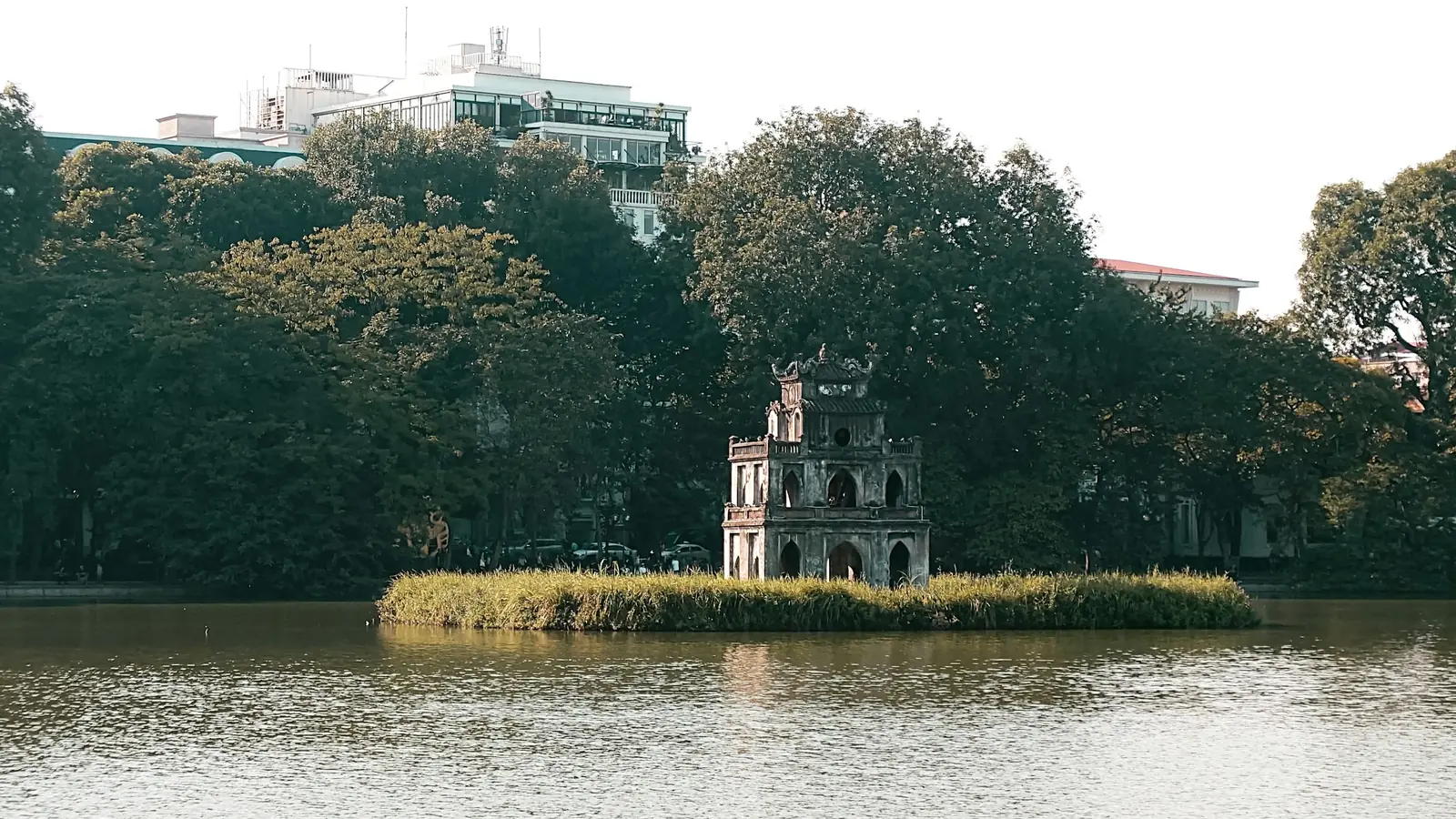
Turtle Tower on its small islet in Hoan Kiem Lake, central Hanoi, framed by trees

Short answer: The best things to do in Hanoi are walking around Hoan Kiem Lake and the Old Quarter, visiting the Temple of Literature and the Ho Chi Minh Mausoleum complex, eating your way through bun cha, pho and egg coffee, and taking a day or overnight trip to Ha Long Bay or Ninh Binh. Plan two to three full days for the city itself, plus time for day trips.

Hanoi is the capital of Vietnam and the natural starting point for the north of the country: the limestone bays, the rice terraces of Sapa and the river caves of Ninh Binh are all reached from here. The city itself is compact, walkable around the centre, and much older than it looks at first glance. It was founded as Thang Long in 1010 and celebrated its 1,000th anniversary in 2010. This guide is for first-time visitors. It lists the sights worth your time, explains what has changed recently (Train Street access, the Mausoleum closure), and sets out the easy day trips by travel time. It is not a day-by-day plan; for that, see our Vietnam itinerary ideas.

Checked: 8 Oct 2026. Opening hours, closures and access rules in this guide were checked against official or major news sources on this date (sources listed in each section). Hanoi changes quickly, so confirm anything time-sensitive a day or two before you go.

What are the best things to do in Hanoi?

The best things to do in Hanoi fall into four groups: the lakes and the Old Quarter around Hoan Kiem, the historic Ba Dinh district (Temple of Literature, Mausoleum, One Pillar Pagoda, Imperial Citadel), the food, and the day trips into the countryside. Most first-time visitors can cover the city highlights in two to three days at a comfortable pace.

The table below is a quick planner. "Time needed" is the time on site, not including travel across town. Hours change, so treat them as a guide and check the notes in each section.

AttractionAreaTime neededBest time of day
Hoan Kiem Lake, The Huc Bridge and Ngoc Son TempleHoan Kiem45 minutes to 1 hourEarly morning or evening
Old Quarter street walkHoan KiemHalf a day (or several short walks)Morning and after dark
Hanoi Train StreetOld Quarter edge and Kham Thien / Le Duan1 hour around a train timeEvening train times
Temple of Literature (Van Mieu Quoc Tu Giam)Dong Da / Ba Dinh border1 to 1.5 hoursOpening time, 8:00
Ho Chi Minh Mausoleum and Ba Dinh SquareBa Dinh1.5 to 2 hours with the groundsMorning only (see closure note)
One Pillar PagodaBa Dinh15 to 20 minutesCombine with the Mausoleum
Imperial Citadel of Thang LongBa Dinh1 to 1.5 hoursMorning or late afternoon
Tran Quoc Pagoda and West LakeTay Ho1 to 2 hoursLate afternoon for sunset
Hoa Lo Prison MuseumHoan Kiem1 to 1.5 hoursAny time it is open
Vietnam Museum of EthnologyCau GiayAbout 2 hoursMorning (closed Mondays)
Long Bien BridgeRed River, north of the Old Quarter30 to 45 minutesSunset
Water puppet showHoan KiemAbout 45 to 50 minutesEvening

If you are building a wider Vietnam trip, Hanoi pairs well with the central coast and Ho Chi Minh City; our guide to the best cities in Vietnam compares them side by side, and the Vietnam travel guide covers money, SIM cards and general planning.

1. Walk around Hoan Kiem Lake and cross The Huc Bridge
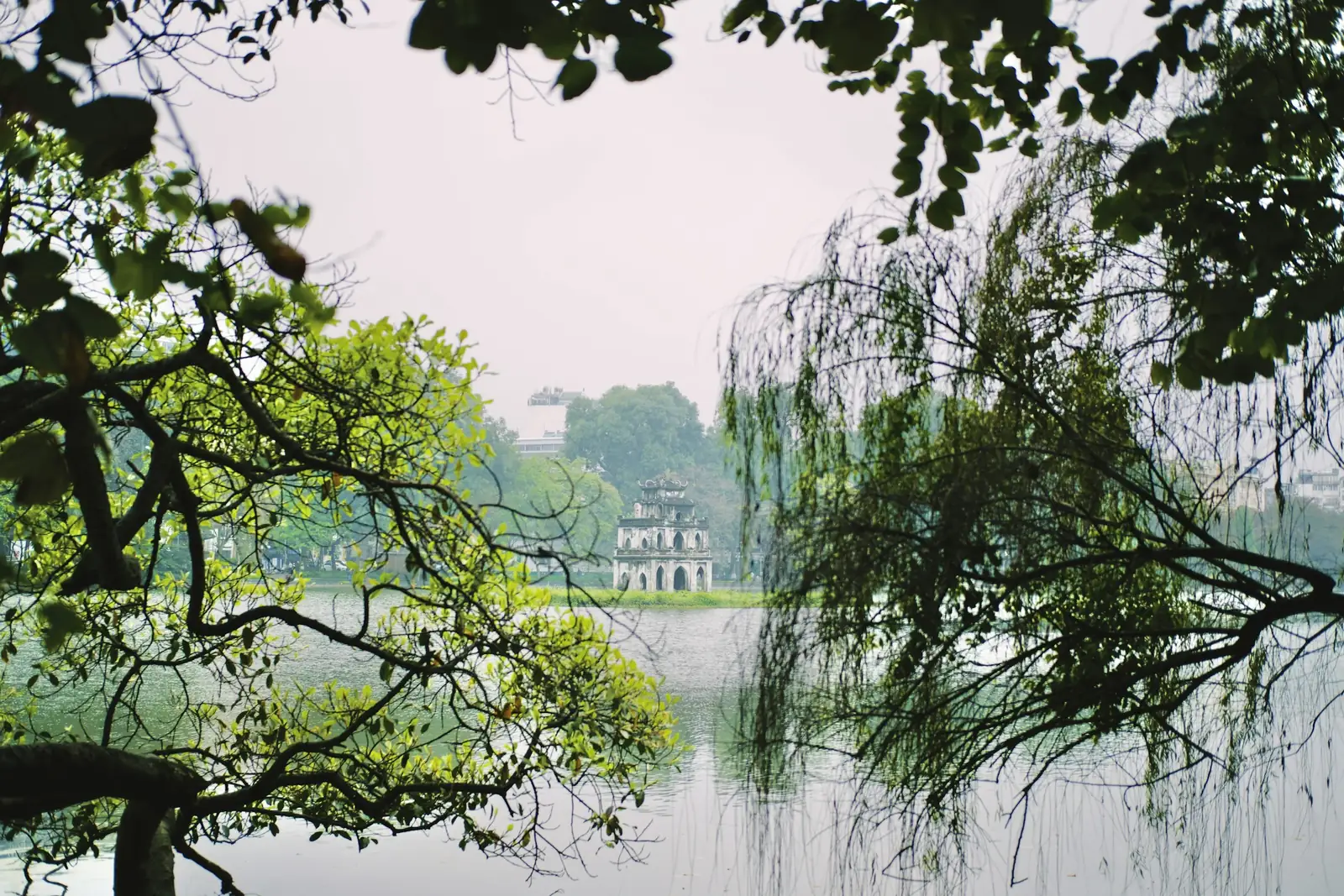
Willow branches framing Turtle Tower across the calm water of Hoan Kiem Lake in Hanoi

Hoan Kiem Lake is the centre of Hanoi in every sense, and a walk around it is the easiest first thing to do on arrival. The loop is under 2 km and takes about 30 to 40 minutes at an easy pace. The name means "Lake of the Returned Sword", from the legend of Emperor Le Loi returning a magic sword to a golden turtle in the lake after defeating Ming invaders in the 15th century. The small Turtle Tower on an islet in the south of the lake is one of the city's best-known symbols.

On the north side, the red wooden The Huc Bridge leads to Ngoc Son Temple (Temple of the Jade Mountain) on Jade Island. There is a small entry charge for the temple. Inside you will find a preserved giant soft-shell turtle from the lake, a reminder of the legend.

  • Go early: around dawn, local people jog, dance and do tai chi along the shore. It is the best free show in Hanoi.
  • Go on a weekend evening: the streets around the lake become a pedestrian zone on Friday, Saturday and Sunday evenings, with street performers, families and food stalls. Start times have varied by season since the scheme began, so check locally.
  • Photos: The Huc Bridge is lit up after dark and looks best from the lakeside path just west of the bridge.

2. Watch the sunset at West Lake and Tran Quoc Pagoda
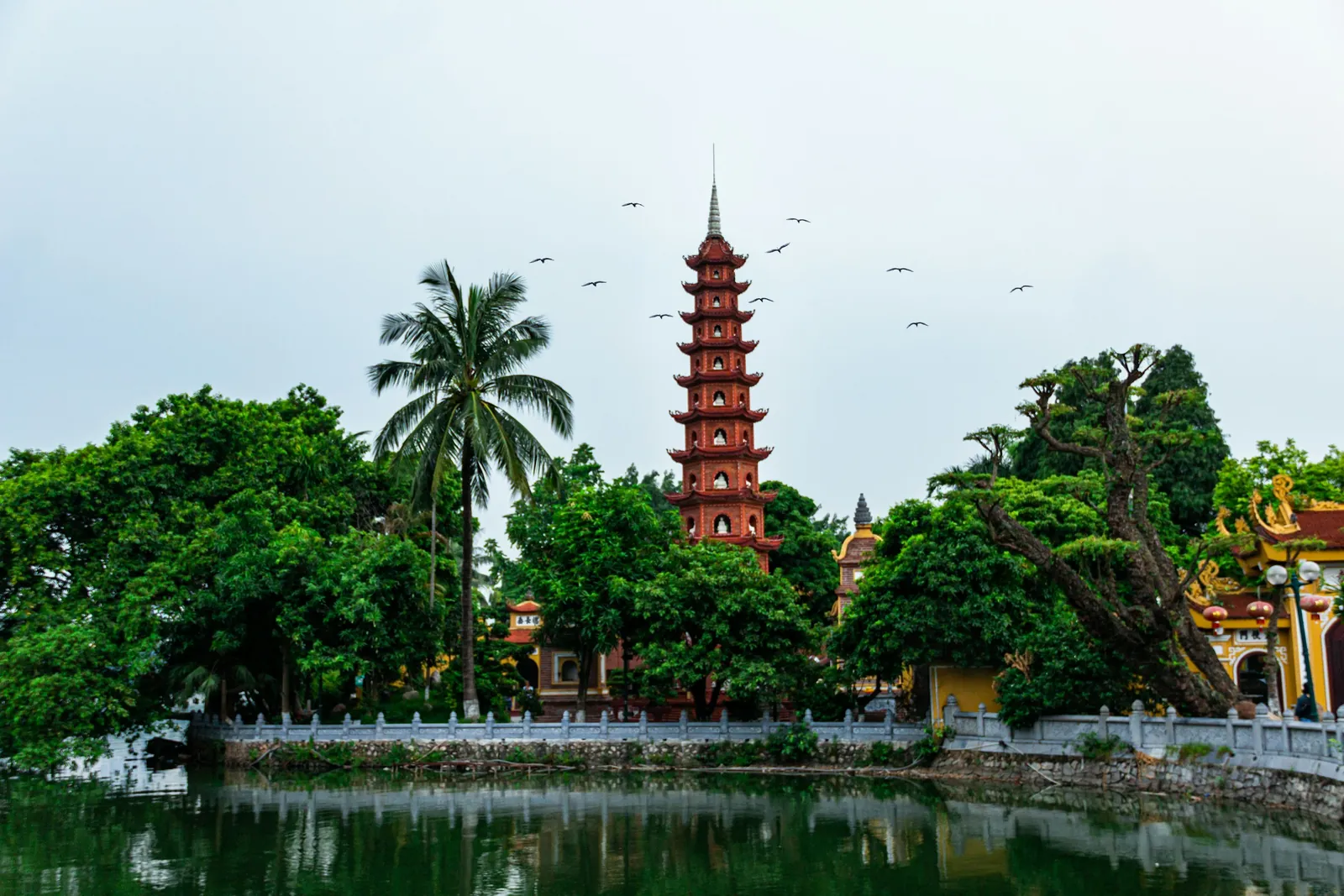
Red brick tower of Tran Quoc Pagoda rising above the trees on West Lake, Hanoi

West Lake (Ho Tay) is Hanoi's largest lake, a short Grab ride north of the Old Quarter, and it feels calmer and more open than the centre. Its main sight is Tran Quoc Pagoda, regarded as the oldest Buddhist pagoda in Hanoi. Its origins are traced to the 6th century, and it was moved to its present small islet in the 17th century. The 11-storey red brick stupa is the photograph everyone takes.

Tran Quoc Pagoda is an active place of worship and usually open from early morning to late afternoon. Dress modestly (shoulders and knees covered), speak quietly and do not step over the thresholds of the shrine halls. After the pagoda, walk along Thanh Nien Road between West Lake and Truc Bach Lake, or find a lakeside cafe for sunset. Quan Thanh Temple, a Taoist temple with a large bronze statue, is a few minutes away on the corner of Truc Bach Lake.

Buddhist visitors from Nepal often find Hanoi's pagodas familiar in spirit and different in style: Vietnamese Buddhism is mainly Mahayana with strong Chinese influence, and many pagodas mix Buddhist altars with shrines to local guardian spirits.

3. Walk Long Bien Bridge at sunset

Long Bien Bridge is the long steel bridge across the Red River just north of the Old Quarter, completed in the early 1900s during French rule. It survived heavy bombing during the Vietnam War, and its patched-up spans are part of its story. Today it carries trains, motorbikes and bicycles, with narrow pedestrian walkways on the sides.

Walk out from the Old Quarter end for 15 to 20 minutes for wide views over the river and the banana plantations on the sandbanks below. Stay on the pedestrian path: walking on the railway tracks is prohibited and dangerous, because trains still use the bridge. Below the bridge, Long Bien wholesale market is busiest late at night and before dawn, if you want a glimpse of the city's food supply chain.

4. See a water puppet show

Water puppetry (mua roi nuoc) is a folk art from the rice-growing villages of the Red River Delta, where puppeteers stood waist-deep in water behind a screen and moved wooden puppets across the surface. The best-known venue is the Thang Long Water Puppet Theatre on the north-east side of Hoan Kiem Lake. Shows last about 45 to 50 minutes, with live traditional music, and the scenes (fishing, rice planting, dragons, festivals) work well for children and for anyone who does not speak Vietnamese.

Shows sell out in high season, including the Dashain and Tihar weeks when many Nepali families travel, so book a day ahead. The front rows can get a few splashes.

Want help fitting these into your dates? Message the Gomayu team on WhatsApp for a quote on a Hanoi and northern Vietnam trip; we will tell you honestly what fits and what does not.

What is there to see in Hanoi's Old Quarter?

Hanoi's Old Quarter is a dense grid of narrow streets just north of Hoan Kiem Lake, where many streets are still named after the goods once sold there. It is the best place in the city to walk, eat and watch everyday life, and most first-time visitors stay in or near it. Expect motorbikes on every street, pavements used as kitchens and parking, and something to look at in every doorway.

The area is often called the "36 streets", although today there are far more than 36. Many street names start with "Hang", meaning goods or merchandise. Some trades have moved on; others are still clearly visible.

Which Old Quarter streets should you walk?

Street or spotName meansWhat you will find today
Hang GaiHempSilk shops, tailors, embroidery and souvenir stores
Hang BacSilverJewellery workshops; one of the oldest streets in the quarter
Hang MaPaper goodsPaper lanterns, decorations and votive paper offerings; very colourful before Mid-Autumn Festival and Tet
Ma MayRattanRestored traditional tube house (a narrow, deep merchant house), cafes and guesthouses
Ta HienNamed after a scholar"Beer street": small stools, draught beer and loud evenings
Lan OngNamed after a famous physicianTraditional herbal medicine shops; you will smell it before you see it
Hang DaoPeach (dyed silk)Clothes shops; start of the weekend night market route
Dong Xuan MarketMarket nameLarge covered wholesale market for clothes, fabric, dry goods and kitchenware
O Quan ChuongGateThe last surviving gate of the old citadel walls
Bach Ma Temple (Hang Buom)White Horse TempleOne of the oldest temples in the city, dedicated to a guardian spirit

How should you explore the Old Quarter?

  • Walk in two short sessions rather than one long one: a morning walk for markets and breakfast stalls, and an evening walk when the lights are on and street food is at its best.
  • Use a landmark to orient yourself: Hoan Kiem Lake is south, Dong Xuan Market is north, and the elevated railway (Train Street side) runs along the western edge.
  • Weekend night market: on Friday to Sunday evenings a night market runs from Hang Dao street north toward Dong Xuan Market. It is mostly clothes, souvenirs and snacks, and very crowded.
  • Crossing the road: walk at a slow, steady pace and do not stop suddenly or run. Motorbikes flow around predictable pedestrians. Our Vietnam dos and don'ts covers this and other local etiquette.
  • St Joseph's Cathedral sits just west of the lake, a neo-Gothic church from the 1880s. The lanes around it are full of cafes and are a good place to rest.

Families with children or older parents should plan short loops with cafe stops: the pavements are often blocked by parked bikes, so you end up walking in the road more than you expect.

Explore Vietnam tour packages
View all →

Can you still visit Hanoi Train Street?

Visitors at cafe tables along the railway track on Hanoi Train Street under lanterns

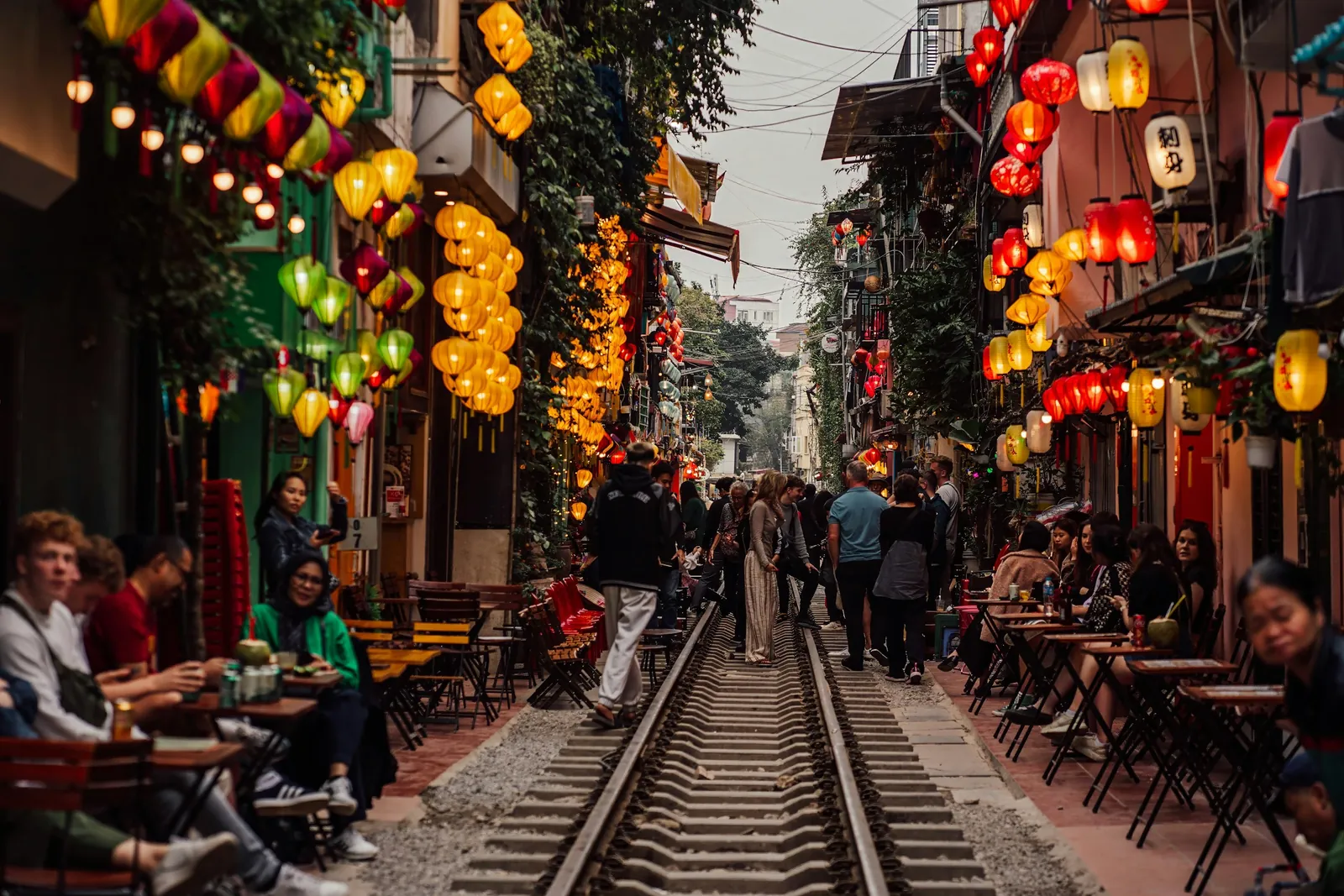
Yes, as of the latest reports, visitors can still see trains pass through Hanoi Train Street, but access is controlled and the situation keeps changing. Police and local authorities have repeatedly cleared the track area, fined cafes that let customers sit too close to the rails, and in 2026 a plan was announced to stop passenger trains on the Old Quarter section altogether. Check the current situation before you go.

Train Street is the nickname for the narrow residential streets where the railway line runs only a metre or two from house fronts. Cafes along the track became famous on social media, and the crowds created real safety problems. Authorities closed it to tourists in 2019, it later reopened to visitors through track-side cafes, and enforcement has tightened and relaxed several times since.

Train Street status box. Checked: 8 Oct 2026.

  • August 2026: a tourist filming close to the tracks on the Kham Thien section was hit by a passing train (she was not injured). Police fined the cafe for letting a customer sit dangerously close to the tracks and deployed officers to the area. Source: VnExpress International, 11 Aug 2026.
  • March 2026: the Ministry of Construction set out a plan with Hanoi to stop freight trains on the stretch from Hanoi Station through Long Bien to Gia Lam and to cut passenger services there; if fully carried out, no passenger trains would run between Hanoi Station and Long Bien Station (the Old Quarter side). The city was asked to finish the work before July 2026. Source: VnExpress International, 5 Mar 2026.
  • What we could not confirm: whether the rerouting has actually taken effect as of today. Independent travel reports from mid-2026 still described trains running. Ask your hotel or a track-side cafe on the day.

How do you visit Train Street safely?

SectionWhereWhat to expect
Old Quarter side (Phung Hung / Tran Phu area)Between Hanoi Station and Long BienThe most famous cafes and murals; most affected by the 2026 plan to end passenger trains; entry often only through a cafe
South side (Le Duan / Kham Thien)South of Hanoi StationNarrow lanes with cafes; site of the August 2026 incident and increased police presence
  • Sit where the cafe staff tell you and move back when they say a train is coming. Never stand on the rails for a photo.
  • Do not rely on a fixed timetable from a website. Train times change, and if the rerouting has taken effect there may be no trains on the Old Quarter section at all.
  • If the street is closed by police, respect it. The murals on Phung Hung street, next to the elevated railway arches, are still worth a look from the pavement.
  • With children, we suggest skipping the track-side experience and viewing from a distance; the margin for error is very small.

Which temples and museums are worth it?

The Temple of Literature, the Ho Chi Minh Mausoleum complex with One Pillar Pagoda, the Imperial Citadel of Thang Long, Hoa Lo Prison and the Vietnam Museum of Ethnology are the five most rewarding cultural visits in Hanoi. Most of them sit in or near the Ba Dinh district, so you can group them into one or two mornings.

SiteUsual hours (check before you go)ClosedSource
Temple of Literature8:00 to 17:00 daily; night tour 18:30 to 22:00 on Wednesday, Saturday and SundayNo regular closing day listedvanmieu.gov.vn (official)
Ho Chi Minh MausoleumMornings only: 7:30 start (1 Apr to 31 Oct), 8:00 start (1 Nov to 31 Mar)Mondays and Fridays; closed 4 Sep to 2 Nov 2026 for maintenanceTuoi Tre, Viet Nam News, Aug 2026
Imperial Citadel of Thang Long8:00 to 17:00Open every day, per the official sitehoangthanhthanglong.vn (official)
Hoa Lo Prison Museum8:00 to 17:00Open every day, including holidays and Tethoalo.vn (official)
Vietnam Museum of Ethnology8:30 to 17:30MondaysVietnam National Authority of Tourism (vietnam.travel)

5. Temple of Literature (Van Mieu Quoc Tu Giam)

Visitors walking along the stone path to a gate inside the Temple of Literature, Hanoi

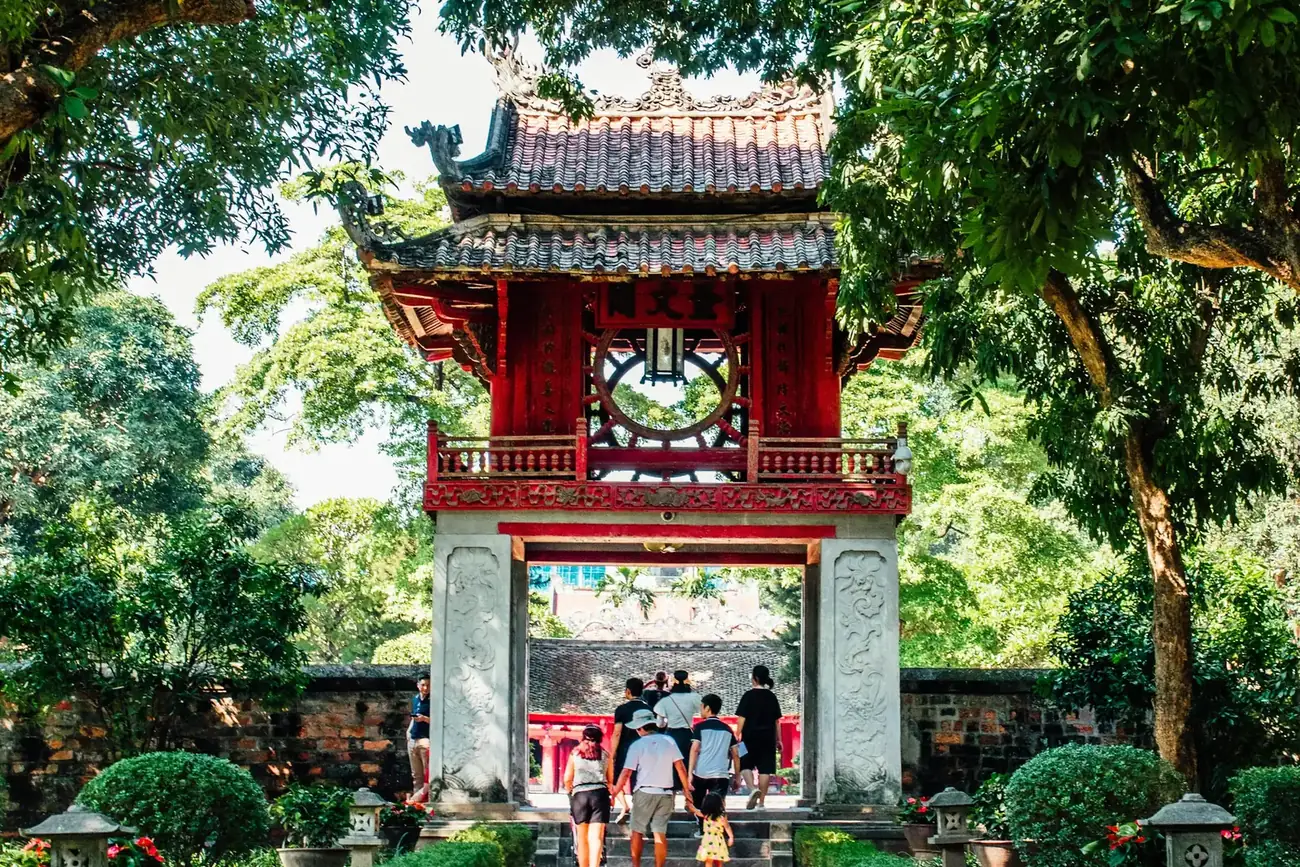
The Temple of Literature is Hanoi's most rewarding historic site and the one to choose if you only have time for one. It was founded in 1070 as a temple to Confucius, and in 1076 it became home to the Imperial Academy, often described as Vietnam's first university. The walled complex is laid out in five courtyards that you walk through in order, from the busy street outside to the quiet inner sanctuary.

Look for the Khue Van Cac (Constellation of Literature pavilion), a two-tier gate pavilion that is a symbol of Hanoi, and the 82 stone stelae standing on carved stone turtles. The stelae record the names of scholars who passed the royal doctoral examinations between the 15th and 18th centuries, and they are recognised in UNESCO's Memory of the World programme. Students still visit before exams to pray for good results, so you may see young people in graduation gowns posing for photos.

Hours: 8:00 to 17:00 daily (Checked: 8 Oct 2026, official site vanmieu.gov.vn). The official site also lists a night tour from 18:30 to 22:00 on Wednesday, Saturday and Sunday evenings (Checked: 8 Oct 2026, vanmieu.gov.vn); older press reports gave different evenings, so confirm on the official site before you go. Arrive at opening time to avoid tour groups. Dress code: shoulders and knees covered, hats off inside the shrines.

6. Ho Chi Minh Mausoleum and Ba Dinh Square

The Ho Chi Minh Mausoleum holds the preserved body of President Ho Chi Minh, the founder of modern Vietnam, and stands on Ba Dinh Square, where he read the declaration of independence on 2 September 1945. It is one of the most important sites in the country for Vietnamese visitors, and the atmosphere is formal and respectful.

Mausoleum closure. Checked: 8 Oct 2026. The Mausoleum is closed for periodic maintenance from 4 September to 2 November 2026 and reopens on 3 November 2026 (sources: Tuoi Tre News, 9 Aug 2026; Viet Nam News, 10 Aug 2026). If you travel over Dashain (Tika is 21 October 2026), you will not be able to go inside. Tihar travellers (Bhai Tika falls in mid-November) should find it open again.

Regular schedule: open on Tuesday, Wednesday, Thursday, Saturday and Sunday mornings; closed on Mondays and Fridays. From 1 April to 31 October visits start at 7:30 and run to about 10:30 on weekdays (a little later at weekends and on holidays). From 1 November to 31 March visits start at 8:00 and run to about 11:00 (Saturdays to 11:30). It also opens on a few national days, such as 2 September and the first day of the Lunar New Year, even if they fall on a Monday or Friday. The Mausoleum closes for a maintenance period of about two months most years, and the dates change, so always check.

Rules visitors are expected to follow: modest clothing (no shorts above the knee, sleeveless tops or short skirts), no hats inside, no talking, no hands in pockets, and no photography inside. Bags and cameras are checked in before you join the queue. Queues can be long on weekends and holidays.

Even when the Mausoleum itself is closed, you can usually see Ba Dinh Square from outside. The grounds behind it contain the Presidential Palace (viewed from outside), Ho Chi Minh's stilt house and the Ho Chi Minh Museum; access to these can also be affected by events and maintenance, so ask on the day.

7. One Pillar Pagoda

One Pillar Pagoda (Chua Mot Cot) is a tiny wooden shrine that stands on a single stone pillar rising out of a square lotus pond, designed to look like a lotus flower growing from the water. It was first built in 1049 under Emperor Ly Thai Tong. The French destroyed it in 1954 as they withdrew, and it was rebuilt soon after. It is next to the Mausoleum grounds, so most people visit both together.

The visit itself takes only 15 to 20 minutes. Climb the short stairs to see the altar to Quan Am (the bodhisattva of compassion), and look at the neighbouring Dien Huu Pagoda, which is quieter and has a pretty courtyard garden.

8. Imperial Citadel of Thang Long

The Imperial Citadel of Thang Long was the political centre of Vietnamese dynasties for more than a thousand years and was added to the UNESCO World Heritage List in 2010. What survives above ground is limited (the Doan Mon gate, the Kinh Thien palace foundations and its dragon-carved steps, the Princess Pagoda and the Hanoi Flag Tower nearby), but the excavated archaeological site across the road shows layers of the old city stacked on top of each other. There are also underground bunkers used by Vietnam's military command during the war. The official site lists it as open 8:00 to 17:00 every day (Checked: 8 Oct 2026, hoangthanhthanglong.vn).

9. Hoa Lo Prison Museum

Hoa Lo Prison was built by the French colonial government in the 1890s to hold Vietnamese political prisoners, and later held American pilots during the Vietnam War, who called it the "Hanoi Hilton". Only part of the original prison remains; the rest of the site was redeveloped. The exhibits, including cells and a guillotine, are serious and may upset young children. It is open 8:00 to 17:00 every day, including holidays (Checked: 8 Oct 2026, hoalo.vn). Allow 1 to 1.5 hours, and expect the displays to present the Vietnamese state's account of history.

10. Vietnam Museum of Ethnology

The Vietnam Museum of Ethnology in Cau Giay district explains the lives of Vietnam's 54 officially recognised ethnic groups, with clothing, tools, ritual objects and, outside, full-size traditional houses you can walk into, including a tall Bahnar communal house. It is the best museum in Hanoi for families and the best preparation for a trip to Sapa or the northern mountains. It is about 30 minutes from the Old Quarter by Grab, depending on traffic. It opens 8:30 to 17:30 and is closed on Mondays (Checked: 8 Oct 2026, Vietnam National Authority of Tourism).

What should you eat in Hanoi?

Bun cha served with rice noodles, fresh herbs and a bowl of dipping broth with pork

Hanoi is known for bun cha (grilled pork with rice noodles), pho, cha ca (turmeric fish with dill), banh cuon (steamed rice rolls) and egg coffee. Northern Vietnamese food is less sweet and less chilli-hot than food in the south, and it is built around broth, fresh herbs and rice noodles. Much of the best food is sold from small specialist shops that cook one dish only.

DishWhat it isWhen locals eat itNotes for Nepali travellers
Pho bo / pho gaRice noodle soup with beef (bo) or chicken (ga)BreakfastAsk for pho ga if you do not eat beef
Bun chaGrilled pork patties and slices in a sweet and sour dipping broth, with rice noodles and herbsLunchPork; the classic Hanoi lunch
Cha caFish fried with turmeric and dill at the table, eaten with noodles and peanutsLunch or dinnerGood choice if you avoid red meat
Banh cuonThin steamed rice sheets rolled with minced pork and mushroomBreakfastLight, similar in idea to a soft momo wrapper
Bun thangDelicate chicken noodle soup with shredded egg and pork rollBreakfast or lunchMild; good for children
XoiSticky rice with toppings such as mung bean or shallotsBreakfastVegetarian versions available
Ca phe trung (egg coffee)Strong coffee topped with whipped egg yolk and sugarAny timeCreated in Hanoi in the 1940s; rich, like a dessert
CheSweet soups and desserts with beans, jelly and coconutAfternoon or eveningUsually vegetarian

Tips for eating well in Hanoi

  • Vegetarians: look for "chay" (vegetarian) restaurants, many of them linked to Buddhist pagodas. Fish sauce is used in many ordinary dishes, so say clearly that you want no meat and no fish sauce.
  • No beef: say "khong an thit bo" (I do not eat beef). Pho is beef by default; pho ga is the chicken version.
  • Indian food: there are several Indian restaurants in and around the Old Quarter, useful for older family members who prefer familiar food after a few days.
  • Street stalls: choose busy stalls with high turnover and food cooked in front of you. Our guide to what to eat in Vietnam covers dishes from the whole country.
  • Payment: the currency is the Vietnamese dong (VND). Small stalls are cash or QR only; carry small notes.

Which day trips can you take from Hanoi?

The easiest day trips from Hanoi are Ninh Binh (Trang An, Tam Coc and Mua Cave) at about 1.5 to 2.5 hours each way, Bat Trang ceramic village and Duong Lam ancient village closer in, and Ha Long Bay at about two and a half to three and a half hours each way. Ha Long Bay can be done in a day but is much better as an overnight cruise. Sapa is too far for a day trip.

DestinationTravel time each way (road)Day trip?Why go
Bat Trang ceramic villageAbout 30 to 40 minutesHalf dayPottery workshops; try the wheel yourself; good with kids
Duong Lam ancient villageAbout 1.5 hoursHalf to full dayLaterite stone houses and old communal halls; quiet rural feel
Ninh Binh (Trang An, Tam Coc, Mua Cave)About 1.5 hours by car, up to 2.5 hours by bus (about 90 to 95 km)Yes, full day (overnight is easier)Rowing boats through limestone caves and rice fields; Trang An is a UNESCO World Heritage site
Perfume Pagoda (Huong Pagoda)About 2 hours plus boat and cable carFull dayPilgrimage site in limestone caves; very crowded during the spring festival after Tet
Ha Long BayAbout 2.5 to 3.5 hours (roughly 170 km)Possible but long; overnight cruise recommendedThousands of limestone islands; UNESCO World Heritage site
Lan Ha BayAbout 2.5 to 3 hoursOvernight preferredQuieter neighbour of Ha Long, with kayaking
SapaAbout 5.5 to 6 hours by bus, or overnight train to Lao Cai (about 8 hours) plus about 1 hour by roadNo, plan at least two nightsRice terraces, ethnic minority villages, Fansipan

Travel times: Checked 8 Oct 2026 from transport guides updated in 2026; traffic, weather and holiday crowds can add an hour or more.

11. Ninh Binh: the best single day trip

Rowing boats on a green river between limestone karsts and forest in Ninh Binh

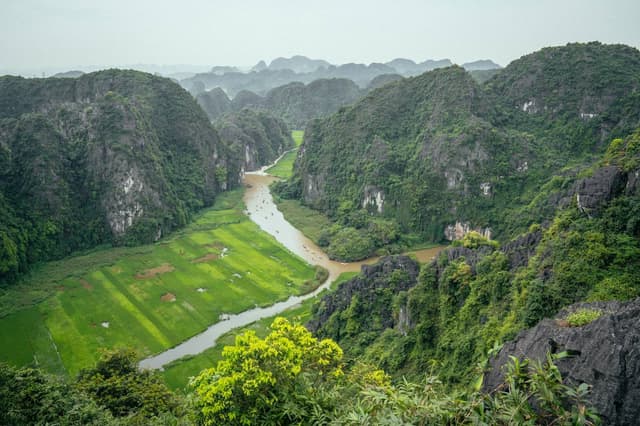
Ninh Binh is the best single day trip from Hanoi for most first-time visitors. Its landscape of rice paddies, rivers and sheer limestone peaks has earned it the nickname "Ha Long Bay on land". At Trang An (part of the Trang An Landscape Complex, a UNESCO World Heritage site since 2014) or Tam Coc, local rowers take you by small boat through caves and between the cliffs. The climb of around 500 steps to the viewpoint at Mua Cave gives the classic panorama. It is a long day; staying one night in Ninh Binh lets you see it in the soft morning light without rushing.

12. Ha Long Bay: day trip or overnight?

Cruise boats sailing between limestone islands in Ha Long Bay under a blue sky

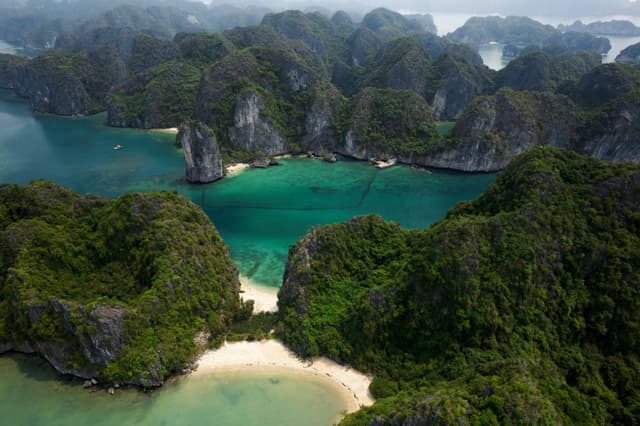
Ha Long Bay is northern Vietnam's most famous landscape, a UNESCO World Heritage site of limestone islands rising from green water. A day trip is possible, with roughly 5 to 7 hours on the road in total, but you get only a few hours on the water. An overnight cruise lets you see the bay at sunset and early morning, kayak, and visit a cave without rushing back. Our full Ha Long Bay guide compares day trips, cruises and the quieter Lan Ha Bay. Cruises can be cancelled in storms, which matters most in the July to October period.

When is the best time to visit Hanoi?

The best time to visit Hanoi is October to early December, when the air is dry and mild, followed by March to April. Hanoi has four seasons, unlike southern Vietnam: a hot, humid and rainy summer (May to September), a cool and often grey winter (December to February), and two pleasant shoulder seasons. October and November line up well with Dashain and Tihar holidays.

MonthAverage daily mean (°C)Average rainfall (mm)What to expect
January16.420Coolest month; grey skies, damp cold; cold snaps can drop below 10°C
February17.220Cool; Tet (Lunar New Year) often falls now and many shops close for several days
March20.036Light drizzle and humidity; spring flowers
April23.9104Warm and pleasant; good shoulder month
May27.4165Heat builds; storms start
June28.9264Hot and humid; heavy showers
July29.2254Hottest; storms can disrupt Ha Long cruises
August28.6274Wettest month; heavy rain
September27.5228Still wet; 2 September is National Day
October24.9155Rain eases; autumn begins; Dashain timing
November21.561Dry, mild and clear; one of the best months; Tihar timing
December18.220Cool and dry; bring layers

Climate figures are 1991 to 2020 averages for the Lang station in central Hanoi (World Meteorological Organization and Vietnam Institute for Building Science and Technology). Checked: 8 Oct 2026. Individual years vary.

Is Hanoi cold in winter?

Yes, Hanoi feels cold in winter, colder than many visitors expect from a Southeast Asian city. Average daily temperatures in January are around 16°C, and during cold spells driven by the north-east monsoon Hanoi can drop to 7 to 8°C in the early morning (National Center for Hydro-Meteorological Forecasting, reported December 2023). Most homes and many small hotels have no central heating, and the damp air makes it feel colder. In the northern mountains it is colder still: during the same cold spell Sa Pa fell below 4°C and frost formed on the upper slopes of Fansipan.

For Nepali travellers, a Hanoi winter feels much like a Kathmandu winter: pack a warm jacket, a sweater and closed shoes for December to February, and proper winter clothing for Sapa.

Is Hanoi good for a Dashain or Tihar holiday?

Yes. October and November are among the best months for Hanoi, with mild days and less rain than summer, and Hanoi is easy to combine with Ha Long Bay and Ninh Binh in a one to two week holiday. Two points for 2026: the Ho Chi Minh Mausoleum is closed until 2 November, and Vietnam's own long holidays (Tet in late January or February, and the 30 April and 1 May and 2 September holidays) are busier and pricier for hotels and transport. For month-by-month advice across the whole country, see the best time to visit Vietnam.

How do you get around Hanoi?

The easiest way to get around Hanoi is on foot in the Old Quarter and Hoan Kiem area, and by Grab (car or motorbike) for longer trips across the city. Taxis, city buses and two metro lines also run, but for most visitors walking plus ride-hailing covers almost everything.

OptionBest forTips
WalkingOld Quarter, Hoan Kiem Lake, French QuarterCross roads slowly and steadily; wear comfortable shoes
Grab (car or bike)Ba Dinh sights, West Lake, Museum of Ethnology, airportPrice shown before you book; pay in cash or by card in the app
Other ride-hailing appsSame as GrabBe and Xanh SM (electric taxis) also operate in Hanoi
Metered taxisLonger rides, groups with luggageUse well-known companies; make sure the meter is on
MetroLimited routesLine 2A (Cat Linh to Ha Dong area) and the elevated part of Line 3 (Nhon to Cau Giay) operate; neither reaches the Old Quarter yet
CycloA short slow ride for the experienceAgree the route and duration before you set off
Rented motorbikeNot recommended for first-time visitorsTraffic is dense; check licence and insurance rules first

Grab and walking tips

  • Install Grab before you land and check it works with your card, or plan to pay cash. A local SIM or eSIM makes everything easier.
  • Use the pickup pin carefully in the Old Quarter: drivers cannot stop everywhere in the narrow one-way streets. Walk to the nearest bigger street if needed.
  • Grab Bike (a motorbike with a driver) is fast and cheap but not ideal with luggage, small children or in heavy rain; choose Grab Car for those.
  • Keep your phone and bag on the side away from the road when walking; snatch thefts from passing motorbikes are not common but do happen.
  • Night walking: the Old Quarter stays busy until late, especially at weekends. Use Grab back to your hotel if you are staying further out.

Getting to Hanoi from Kathmandu

Hanoi's airport is Noi Bai International Airport (HAN), north of the city; the road transfer to the Old Quarter usually takes about 45 minutes to an hour, longer at rush hour. There is no nonstop flight between Kathmandu and Hanoi at the time of writing; common routings connect once via Bangkok, Kuala Lumpur or Kolkata (Checked: 8 Oct 2026, Skyscanner route listing). Check the visa and entry rules for your passport with the official Vietnamese government source before you travel.

If you want flights, hotels, a Ha Long cruise and transfers arranged together, see our Vietnam tour packages, or message the Gomayu team on WhatsApp for a quote. To see what else the country offers beyond the capital, read things to do in Vietnam.

Frequently asked questions

What is Hanoi famous for?

Hanoi is famous for its Old Quarter of trade streets, Hoan Kiem Lake, the Temple of Literature, the Ho Chi Minh Mausoleum and its food, especially pho, bun cha and egg coffee. As Vietnam's capital for most of the last thousand years, Hanoi is also the gateway to Ha Long Bay, Ninh Binh and Sapa.

Is Hanoi Train Street open to tourists?

Hanoi Train Street has been reachable through track-side cafes, but access is controlled and changes often. Police fined a cafe after a tourist was struck in August 2026, and a plan to end passenger trains on the Old Quarter section was announced in March 2026. Check locally on the day and follow staff instructions (Checked: 8 Oct 2026).

How many days do you need in Hanoi?

Two to three full days are enough for Hanoi's main sights: Hoan Kiem Lake, the Old Quarter, the Temple of Literature, the Ba Dinh area and a food walk. Add one full day for Ninh Binh and one or two nights for a Ha Long Bay cruise. Sapa needs at least two more nights.

What is the best time to visit Hanoi?

The best time to visit Hanoi is October to early December, when it is dry and mild, and March to April. June to August is hot, humid and wet, and January and February are cool and grey. October and November fit well with Dashain and Tihar holidays from Nepal.

Is Hanoi cold in winter?

Yes. Hanoi averages around 16°C in January and cold spells can bring early mornings of 7 to 8°C, with damp air and little indoor heating. Sapa and the northern mountains get much colder, with occasional frost. Pack a warm jacket and layers for a Hanoi trip between December and February.

Can you visit Ha Long Bay from Hanoi in a day?

Yes, you can visit Ha Long Bay from Hanoi in a day, but it is about 2.5 to 3.5 hours each way by road, so you spend more time travelling than on the water. An overnight cruise from Ha Long or Lan Ha Bay is far more relaxed and lets you see the bay at sunset and sunrise.

What food is Hanoi known for?

Hanoi is known for pho (rice noodle soup), bun cha (grilled pork with noodles), cha ca (turmeric and dill fish), banh cuon (steamed rice rolls) and egg coffee. Vegetarian travellers can look for "chay" restaurants, and pho ga (chicken) is an easy choice for anyone in Hanoi who does not eat beef.

Is the Old Quarter safe at night?

Hanoi's Old Quarter is generally busy and safe at night, with crowds on the streets until late, especially at weekends. The main risks are traffic, occasional bag or phone snatching from motorbikes and overcharging. Keep valuables away from the road side, agree prices first, and use Grab to get back to your hotel.

Is Grab available in Hanoi?

Yes, Grab works across Hanoi for cars, motorbike taxis and food delivery, and it is the easiest way to reach sights outside the Old Quarter such as West Lake and the Museum of Ethnology. Be and Xanh SM electric taxis also operate in Hanoi. Install the app and set up payment before you arrive.

Hanoi ma k k herne?

Hanoi ma pahila Hoan Kiem Lake ra Old Quarter ghumnus, ani Temple of Literature, Ho Chi Minh Mausoleum (2026 ma 3 November dekhi matra khulcha), One Pillar Pagoda ra Tran Quoc Pagoda herna sakinchha. Bun cha, pho ra egg coffee khana nabirsanus. Ninh Binh ek din ma, Ha Long Bay overnight cruise ma ramro huncha.

Tags
Vietnam
Share
G
Gomayu Team
Writer at Gomayu
Keep reading
Blog / Vietnam
Things to Do in Hanoi: Old Quarter, Lakes and Day Trips
30 min read 08 Oct 2026
Turtle Tower on its small islet in Hoan Kiem Lake, central Hanoi, framed by trees

Short answer: The best things to do in Hanoi are walking around Hoan Kiem Lake and the Old Quarter, visiting the Temple of Literature and the Ho Chi Minh Mausoleum complex, eating your way through bun cha, pho and egg coffee, and taking a day or overnight trip to Ha Long Bay or Ninh Binh. Plan two to three full days for the city itself, plus time for day trips.

Hanoi is the capital of Vietnam and the natural starting point for the north of the country: the limestone bays, the rice terraces of Sapa and the river caves of Ninh Binh are all reached from here. The city itself is compact, walkable around the centre, and much older than it looks at first glance. It was founded as Thang Long in 1010 and celebrated its 1,000th anniversary in 2010. This guide is for first-time visitors. It lists the sights worth your time, explains what has changed recently (Train Street access, the Mausoleum closure), and sets out the easy day trips by travel time. It is not a day-by-day plan; for that, see our Vietnam itinerary ideas.

Checked: 8 Oct 2026. Opening hours, closures and access rules in this guide were checked against official or major news sources on this date (sources listed in each section). Hanoi changes quickly, so confirm anything time-sensitive a day or two before you go.

What are the best things to do in Hanoi?

The best things to do in Hanoi fall into four groups: the lakes and the Old Quarter around Hoan Kiem, the historic Ba Dinh district (Temple of Literature, Mausoleum, One Pillar Pagoda, Imperial Citadel), the food, and the day trips into the countryside. Most first-time visitors can cover the city highlights in two to three days at a comfortable pace.

The table below is a quick planner. "Time needed" is the time on site, not including travel across town. Hours change, so treat them as a guide and check the notes in each section.

AttractionAreaTime neededBest time of day
Hoan Kiem Lake, The Huc Bridge and Ngoc Son TempleHoan Kiem45 minutes to 1 hourEarly morning or evening
Old Quarter street walkHoan KiemHalf a day (or several short walks)Morning and after dark
Hanoi Train StreetOld Quarter edge and Kham Thien / Le Duan1 hour around a train timeEvening train times
Temple of Literature (Van Mieu Quoc Tu Giam)Dong Da / Ba Dinh border1 to 1.5 hoursOpening time, 8:00
Ho Chi Minh Mausoleum and Ba Dinh SquareBa Dinh1.5 to 2 hours with the groundsMorning only (see closure note)
One Pillar PagodaBa Dinh15 to 20 minutesCombine with the Mausoleum
Imperial Citadel of Thang LongBa Dinh1 to 1.5 hoursMorning or late afternoon
Tran Quoc Pagoda and West LakeTay Ho1 to 2 hoursLate afternoon for sunset
Hoa Lo Prison MuseumHoan Kiem1 to 1.5 hoursAny time it is open
Vietnam Museum of EthnologyCau GiayAbout 2 hoursMorning (closed Mondays)
Long Bien BridgeRed River, north of the Old Quarter30 to 45 minutesSunset
Water puppet showHoan KiemAbout 45 to 50 minutesEvening

If you are building a wider Vietnam trip, Hanoi pairs well with the central coast and Ho Chi Minh City; our guide to the best cities in Vietnam compares them side by side, and the Vietnam travel guide covers money, SIM cards and general planning.

1. Walk around Hoan Kiem Lake and cross The Huc Bridge

Willow branches framing Turtle Tower across the calm water of Hoan Kiem Lake in Hanoi

Hoan Kiem Lake is the centre of Hanoi in every sense, and a walk around it is the easiest first thing to do on arrival. The loop is under 2 km and takes about 30 to 40 minutes at an easy pace. The name means "Lake of the Returned Sword", from the legend of Emperor Le Loi returning a magic sword to a golden turtle in the lake after defeating Ming invaders in the 15th century. The small Turtle Tower on an islet in the south of the lake is one of the city's best-known symbols.

On the north side, the red wooden The Huc Bridge leads to Ngoc Son Temple (Temple of the Jade Mountain) on Jade Island. There is a small entry charge for the temple. Inside you will find a preserved giant soft-shell turtle from the lake, a reminder of the legend.

  • Go early: around dawn, local people jog, dance and do tai chi along the shore. It is the best free show in Hanoi.
  • Go on a weekend evening: the streets around the lake become a pedestrian zone on Friday, Saturday and Sunday evenings, with street performers, families and food stalls. Start times have varied by season since the scheme began, so check locally.
  • Photos: The Huc Bridge is lit up after dark and looks best from the lakeside path just west of the bridge.

2. Watch the sunset at West Lake and Tran Quoc Pagoda

Red brick tower of Tran Quoc Pagoda rising above the trees on West Lake, Hanoi

West Lake (Ho Tay) is Hanoi's largest lake, a short Grab ride north of the Old Quarter, and it feels calmer and more open than the centre. Its main sight is Tran Quoc Pagoda, regarded as the oldest Buddhist pagoda in Hanoi. Its origins are traced to the 6th century, and it was moved to its present small islet in the 17th century. The 11-storey red brick stupa is the photograph everyone takes.

Tran Quoc Pagoda is an active place of worship and usually open from early morning to late afternoon. Dress modestly (shoulders and knees covered), speak quietly and do not step over the thresholds of the shrine halls. After the pagoda, walk along Thanh Nien Road between West Lake and Truc Bach Lake, or find a lakeside cafe for sunset. Quan Thanh Temple, a Taoist temple with a large bronze statue, is a few minutes away on the corner of Truc Bach Lake.

Buddhist visitors from Nepal often find Hanoi's pagodas familiar in spirit and different in style: Vietnamese Buddhism is mainly Mahayana with strong Chinese influence, and many pagodas mix Buddhist altars with shrines to local guardian spirits.

3. Walk Long Bien Bridge at sunset

Long Bien Bridge is the long steel bridge across the Red River just north of the Old Quarter, completed in the early 1900s during French rule. It survived heavy bombing during the Vietnam War, and its patched-up spans are part of its story. Today it carries trains, motorbikes and bicycles, with narrow pedestrian walkways on the sides.

Walk out from the Old Quarter end for 15 to 20 minutes for wide views over the river and the banana plantations on the sandbanks below. Stay on the pedestrian path: walking on the railway tracks is prohibited and dangerous, because trains still use the bridge. Below the bridge, Long Bien wholesale market is busiest late at night and before dawn, if you want a glimpse of the city's food supply chain.

4. See a water puppet show

Water puppetry (mua roi nuoc) is a folk art from the rice-growing villages of the Red River Delta, where puppeteers stood waist-deep in water behind a screen and moved wooden puppets across the surface. The best-known venue is the Thang Long Water Puppet Theatre on the north-east side of Hoan Kiem Lake. Shows last about 45 to 50 minutes, with live traditional music, and the scenes (fishing, rice planting, dragons, festivals) work well for children and for anyone who does not speak Vietnamese.

Shows sell out in high season, including the Dashain and Tihar weeks when many Nepali families travel, so book a day ahead. The front rows can get a few splashes.

Want help fitting these into your dates? Message the Gomayu team on WhatsApp for a quote on a Hanoi and northern Vietnam trip; we will tell you honestly what fits and what does not.

What is there to see in Hanoi's Old Quarter?

Hanoi's Old Quarter is a dense grid of narrow streets just north of Hoan Kiem Lake, where many streets are still named after the goods once sold there. It is the best place in the city to walk, eat and watch everyday life, and most first-time visitors stay in or near it. Expect motorbikes on every street, pavements used as kitchens and parking, and something to look at in every doorway.

The area is often called the "36 streets", although today there are far more than 36. Many street names start with "Hang", meaning goods or merchandise. Some trades have moved on; others are still clearly visible.

Which Old Quarter streets should you walk?

Street or spotName meansWhat you will find today
Hang GaiHempSilk shops, tailors, embroidery and souvenir stores
Hang BacSilverJewellery workshops; one of the oldest streets in the quarter
Hang MaPaper goodsPaper lanterns, decorations and votive paper offerings; very colourful before Mid-Autumn Festival and Tet
Ma MayRattanRestored traditional tube house (a narrow, deep merchant house), cafes and guesthouses
Ta HienNamed after a scholar"Beer street": small stools, draught beer and loud evenings
Lan OngNamed after a famous physicianTraditional herbal medicine shops; you will smell it before you see it
Hang DaoPeach (dyed silk)Clothes shops; start of the weekend night market route
Dong Xuan MarketMarket nameLarge covered wholesale market for clothes, fabric, dry goods and kitchenware
O Quan ChuongGateThe last surviving gate of the old citadel walls
Bach Ma Temple (Hang Buom)White Horse TempleOne of the oldest temples in the city, dedicated to a guardian spirit

How should you explore the Old Quarter?

  • Walk in two short sessions rather than one long one: a morning walk for markets and breakfast stalls, and an evening walk when the lights are on and street food is at its best.
  • Use a landmark to orient yourself: Hoan Kiem Lake is south, Dong Xuan Market is north, and the elevated railway (Train Street side) runs along the western edge.
  • Weekend night market: on Friday to Sunday evenings a night market runs from Hang Dao street north toward Dong Xuan Market. It is mostly clothes, souvenirs and snacks, and very crowded.
  • Crossing the road: walk at a slow, steady pace and do not stop suddenly or run. Motorbikes flow around predictable pedestrians. Our Vietnam dos and don'ts covers this and other local etiquette.
  • St Joseph's Cathedral sits just west of the lake, a neo-Gothic church from the 1880s. The lanes around it are full of cafes and are a good place to rest.

Families with children or older parents should plan short loops with cafe stops: the pavements are often blocked by parked bikes, so you end up walking in the road more than you expect.
Explore Vietnam tour packages
View all →

Can you still visit Hanoi Train Street?
Visitors at cafe tables along the railway track on Hanoi Train Street under lanterns

Yes, as of the latest reports, visitors can still see trains pass through Hanoi Train Street, but access is controlled and the situation keeps changing. Police and local authorities have repeatedly cleared the track area, fined cafes that let customers sit too close to the rails, and in 2026 a plan was announced to stop passenger trains on the Old Quarter section altogether. Check the current situation before you go.

Train Street is the nickname for the narrow residential streets where the railway line runs only a metre or two from house fronts. Cafes along the track became famous on social media, and the crowds created real safety problems. Authorities closed it to tourists in 2019, it later reopened to visitors through track-side cafes, and enforcement has tightened and relaxed several times since.

Train Street status box. Checked: 8 Oct 2026.

  • August 2026: a tourist filming close to the tracks on the Kham Thien section was hit by a passing train (she was not injured). Police fined the cafe for letting a customer sit dangerously close to the tracks and deployed officers to the area. Source: VnExpress International, 11 Aug 2026.
  • March 2026: the Ministry of Construction set out a plan with Hanoi to stop freight trains on the stretch from Hanoi Station through Long Bien to Gia Lam and to cut passenger services there; if fully carried out, no passenger trains would run between Hanoi Station and Long Bien Station (the Old Quarter side). The city was asked to finish the work before July 2026. Source: VnExpress International, 5 Mar 2026.
  • What we could not confirm: whether the rerouting has actually taken effect as of today. Independent travel reports from mid-2026 still described trains running. Ask your hotel or a track-side cafe on the day.

How do you visit Train Street safely?

SectionWhereWhat to expect
Old Quarter side (Phung Hung / Tran Phu area)Between Hanoi Station and Long BienThe most famous cafes and murals; most affected by the 2026 plan to end passenger trains; entry often only through a cafe
South side (Le Duan / Kham Thien)South of Hanoi StationNarrow lanes with cafes; site of the August 2026 incident and increased police presence
  • Sit where the cafe staff tell you and move back when they say a train is coming. Never stand on the rails for a photo.
  • Do not rely on a fixed timetable from a website. Train times change, and if the rerouting has taken effect there may be no trains on the Old Quarter section at all.
  • If the street is closed by police, respect it. The murals on Phung Hung street, next to the elevated railway arches, are still worth a look from the pavement.
  • With children, we suggest skipping the track-side experience and viewing from a distance; the margin for error is very small.

Which temples and museums are worth it?

The Temple of Literature, the Ho Chi Minh Mausoleum complex with One Pillar Pagoda, the Imperial Citadel of Thang Long, Hoa Lo Prison and the Vietnam Museum of Ethnology are the five most rewarding cultural visits in Hanoi. Most of them sit in or near the Ba Dinh district, so you can group them into one or two mornings.

SiteUsual hours (check before you go)ClosedSource
Temple of Literature8:00 to 17:00 daily; night tour 18:30 to 22:00 on Wednesday, Saturday and SundayNo regular closing day listedvanmieu.gov.vn (official)
Ho Chi Minh MausoleumMornings only: 7:30 start (1 Apr to 31 Oct), 8:00 start (1 Nov to 31 Mar)Mondays and Fridays; closed 4 Sep to 2 Nov 2026 for maintenanceTuoi Tre, Viet Nam News, Aug 2026
Imperial Citadel of Thang Long8:00 to 17:00Open every day, per the official sitehoangthanhthanglong.vn (official)
Hoa Lo Prison Museum8:00 to 17:00Open every day, including holidays and Tethoalo.vn (official)
Vietnam Museum of Ethnology8:30 to 17:30MondaysVietnam National Authority of Tourism (vietnam.travel)

5. Temple of Literature (Van Mieu Quoc Tu Giam)
Visitors walking along the stone path to a gate inside the Temple of Literature, Hanoi

The Temple of Literature is Hanoi's most rewarding historic site and the one to choose if you only have time for one. It was founded in 1070 as a temple to Confucius, and in 1076 it became home to the Imperial Academy, often described as Vietnam's first university. The walled complex is laid out in five courtyards that you walk through in order, from the busy street outside to the quiet inner sanctuary.

Look for the Khue Van Cac (Constellation of Literature pavilion), a two-tier gate pavilion that is a symbol of Hanoi, and the 82 stone stelae standing on carved stone turtles. The stelae record the names of scholars who passed the royal doctoral examinations between the 15th and 18th centuries, and they are recognised in UNESCO's Memory of the World programme. Students still visit before exams to pray for good results, so you may see young people in graduation gowns posing for photos.

Hours: 8:00 to 17:00 daily (Checked: 8 Oct 2026, official site vanmieu.gov.vn). The official site also lists a night tour from 18:30 to 22:00 on Wednesday, Saturday and Sunday evenings (Checked: 8 Oct 2026, vanmieu.gov.vn); older press reports gave different evenings, so confirm on the official site before you go. Arrive at opening time to avoid tour groups. Dress code: shoulders and knees covered, hats off inside the shrines.

6. Ho Chi Minh Mausoleum and Ba Dinh Square

The Ho Chi Minh Mausoleum holds the preserved body of President Ho Chi Minh, the founder of modern Vietnam, and stands on Ba Dinh Square, where he read the declaration of independence on 2 September 1945. It is one of the most important sites in the country for Vietnamese visitors, and the atmosphere is formal and respectful.

Mausoleum closure. Checked: 8 Oct 2026. The Mausoleum is closed for periodic maintenance from 4 September to 2 November 2026 and reopens on 3 November 2026 (sources: Tuoi Tre News, 9 Aug 2026; Viet Nam News, 10 Aug 2026). If you travel over Dashain (Tika is 21 October 2026), you will not be able to go inside. Tihar travellers (Bhai Tika falls in mid-November) should find it open again.

Regular schedule: open on Tuesday, Wednesday, Thursday, Saturday and Sunday mornings; closed on Mondays and Fridays. From 1 April to 31 October visits start at 7:30 and run to about 10:30 on weekdays (a little later at weekends and on holidays). From 1 November to 31 March visits start at 8:00 and run to about 11:00 (Saturdays to 11:30). It also opens on a few national days, such as 2 September and the first day of the Lunar New Year, even if they fall on a Monday or Friday. The Mausoleum closes for a maintenance period of about two months most years, and the dates change, so always check.

Rules visitors are expected to follow: modest clothing (no shorts above the knee, sleeveless tops or short skirts), no hats inside, no talking, no hands in pockets, and no photography inside. Bags and cameras are checked in before you join the queue. Queues can be long on weekends and holidays.

Even when the Mausoleum itself is closed, you can usually see Ba Dinh Square from outside. The grounds behind it contain the Presidential Palace (viewed from outside), Ho Chi Minh's stilt house and the Ho Chi Minh Museum; access to these can also be affected by events and maintenance, so ask on the day.

7. One Pillar Pagoda

One Pillar Pagoda (Chua Mot Cot) is a tiny wooden shrine that stands on a single stone pillar rising out of a square lotus pond, designed to look like a lotus flower growing from the water. It was first built in 1049 under Emperor Ly Thai Tong. The French destroyed it in 1954 as they withdrew, and it was rebuilt soon after. It is next to the Mausoleum grounds, so most people visit both together.

The visit itself takes only 15 to 20 minutes. Climb the short stairs to see the altar to Quan Am (the bodhisattva of compassion), and look at the neighbouring Dien Huu Pagoda, which is quieter and has a pretty courtyard garden.

8. Imperial Citadel of Thang Long

The Imperial Citadel of Thang Long was the political centre of Vietnamese dynasties for more than a thousand years and was added to the UNESCO World Heritage List in 2010. What survives above ground is limited (the Doan Mon gate, the Kinh Thien palace foundations and its dragon-carved steps, the Princess Pagoda and the Hanoi Flag Tower nearby), but the excavated archaeological site across the road shows layers of the old city stacked on top of each other. There are also underground bunkers used by Vietnam's military command during the war. The official site lists it as open 8:00 to 17:00 every day (Checked: 8 Oct 2026, hoangthanhthanglong.vn).

9. Hoa Lo Prison Museum

Hoa Lo Prison was built by the French colonial government in the 1890s to hold Vietnamese political prisoners, and later held American pilots during the Vietnam War, who called it the "Hanoi Hilton". Only part of the original prison remains; the rest of the site was redeveloped. The exhibits, including cells and a guillotine, are serious and may upset young children. It is open 8:00 to 17:00 every day, including holidays (Checked: 8 Oct 2026, hoalo.vn). Allow 1 to 1.5 hours, and expect the displays to present the Vietnamese state's account of history.

10. Vietnam Museum of Ethnology

The Vietnam Museum of Ethnology in Cau Giay district explains the lives of Vietnam's 54 officially recognised ethnic groups, with clothing, tools, ritual objects and, outside, full-size traditional houses you can walk into, including a tall Bahnar communal house. It is the best museum in Hanoi for families and the best preparation for a trip to Sapa or the northern mountains. It is about 30 minutes from the Old Quarter by Grab, depending on traffic. It opens 8:30 to 17:30 and is closed on Mondays (Checked: 8 Oct 2026, Vietnam National Authority of Tourism).

What should you eat in Hanoi?
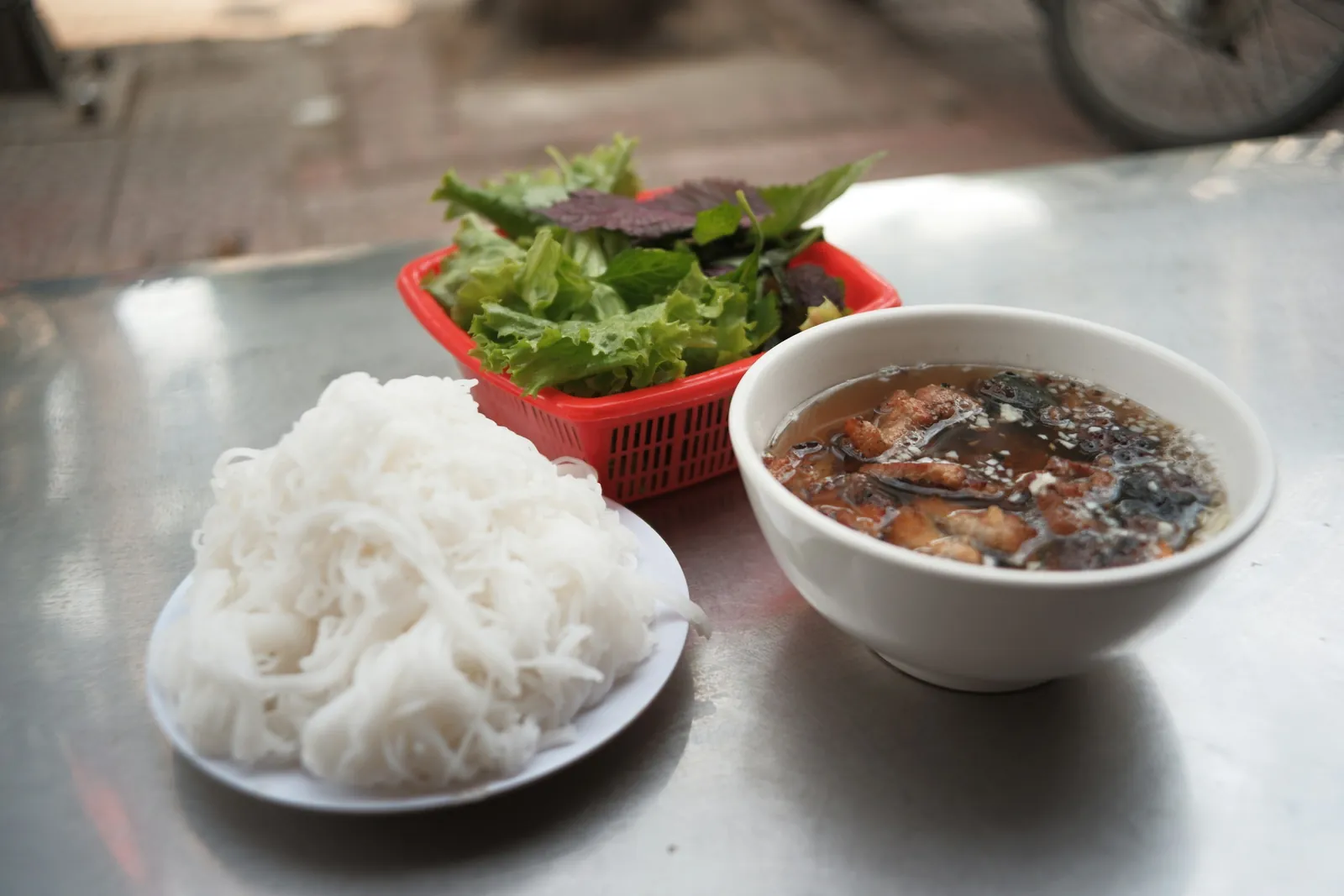
Bun cha served with rice noodles, fresh herbs and a bowl of dipping broth with pork

Hanoi is known for bun cha (grilled pork with rice noodles), pho, cha ca (turmeric fish with dill), banh cuon (steamed rice rolls) and egg coffee. Northern Vietnamese food is less sweet and less chilli-hot than food in the south, and it is built around broth, fresh herbs and rice noodles. Much of the best food is sold from small specialist shops that cook one dish only.

DishWhat it isWhen locals eat itNotes for Nepali travellers
Pho bo / pho gaRice noodle soup with beef (bo) or chicken (ga)BreakfastAsk for pho ga if you do not eat beef
Bun chaGrilled pork patties and slices in a sweet and sour dipping broth, with rice noodles and herbsLunchPork; the classic Hanoi lunch
Cha caFish fried with turmeric and dill at the table, eaten with noodles and peanutsLunch or dinnerGood choice if you avoid red meat
Banh cuonThin steamed rice sheets rolled with minced pork and mushroomBreakfastLight, similar in idea to a soft momo wrapper
Bun thangDelicate chicken noodle soup with shredded egg and pork rollBreakfast or lunchMild; good for children
XoiSticky rice with toppings such as mung bean or shallotsBreakfastVegetarian versions available
Ca phe trung (egg coffee)Strong coffee topped with whipped egg yolk and sugarAny timeCreated in Hanoi in the 1940s; rich, like a dessert
CheSweet soups and desserts with beans, jelly and coconutAfternoon or eveningUsually vegetarian

Tips for eating well in Hanoi

  • Vegetarians: look for "chay" (vegetarian) restaurants, many of them linked to Buddhist pagodas. Fish sauce is used in many ordinary dishes, so say clearly that you want no meat and no fish sauce.
  • No beef: say "khong an thit bo" (I do not eat beef). Pho is beef by default; pho ga is the chicken version.
  • Indian food: there are several Indian restaurants in and around the Old Quarter, useful for older family members who prefer familiar food after a few days.
  • Street stalls: choose busy stalls with high turnover and food cooked in front of you. Our guide to what to eat in Vietnam covers dishes from the whole country.
  • Payment: the currency is the Vietnamese dong (VND). Small stalls are cash or QR only; carry small notes.

Which day trips can you take from Hanoi?

The easiest day trips from Hanoi are Ninh Binh (Trang An, Tam Coc and Mua Cave) at about 1.5 to 2.5 hours each way, Bat Trang ceramic village and Duong Lam ancient village closer in, and Ha Long Bay at about two and a half to three and a half hours each way. Ha Long Bay can be done in a day but is much better as an overnight cruise. Sapa is too far for a day trip.

DestinationTravel time each way (road)Day trip?Why go
Bat Trang ceramic villageAbout 30 to 40 minutesHalf dayPottery workshops; try the wheel yourself; good with kids
Duong Lam ancient villageAbout 1.5 hoursHalf to full dayLaterite stone houses and old communal halls; quiet rural feel
Ninh Binh (Trang An, Tam Coc, Mua Cave)About 1.5 hours by car, up to 2.5 hours by bus (about 90 to 95 km)Yes, full day (overnight is easier)Rowing boats through limestone caves and rice fields; Trang An is a UNESCO World Heritage site
Perfume Pagoda (Huong Pagoda)About 2 hours plus boat and cable carFull dayPilgrimage site in limestone caves; very crowded during the spring festival after Tet
Ha Long BayAbout 2.5 to 3.5 hours (roughly 170 km)Possible but long; overnight cruise recommendedThousands of limestone islands; UNESCO World Heritage site
Lan Ha BayAbout 2.5 to 3 hoursOvernight preferredQuieter neighbour of Ha Long, with kayaking
SapaAbout 5.5 to 6 hours by bus, or overnight train to Lao Cai (about 8 hours) plus about 1 hour by roadNo, plan at least two nightsRice terraces, ethnic minority villages, Fansipan

Travel times: Checked 8 Oct 2026 from transport guides updated in 2026; traffic, weather and holiday crowds can add an hour or more.

11. Ninh Binh: the best single day trip

Rowing boats on a green river between limestone karsts and forest in Ninh Binh

Ninh Binh is the best single day trip from Hanoi for most first-time visitors. Its landscape of rice paddies, rivers and sheer limestone peaks has earned it the nickname "Ha Long Bay on land". At Trang An (part of the Trang An Landscape Complex, a UNESCO World Heritage site since 2014) or Tam Coc, local rowers take you by small boat through caves and between the cliffs. The climb of around 500 steps to the viewpoint at Mua Cave gives the classic panorama. It is a long day; staying one night in Ninh Binh lets you see it in the soft morning light without rushing.

12. Ha Long Bay: day trip or overnight?

Cruise boats sailing between limestone islands in Ha Long Bay under a blue sky

Ha Long Bay is northern Vietnam's most famous landscape, a UNESCO World Heritage site of limestone islands rising from green water. A day trip is possible, with roughly 5 to 7 hours on the road in total, but you get only a few hours on the water. An overnight cruise lets you see the bay at sunset and early morning, kayak, and visit a cave without rushing back. Our full Ha Long Bay guide compares day trips, cruises and the quieter Lan Ha Bay. Cruises can be cancelled in storms, which matters most in the July to October period.

When is the best time to visit Hanoi?

The best time to visit Hanoi is October to early December, when the air is dry and mild, followed by March to April. Hanoi has four seasons, unlike southern Vietnam: a hot, humid and rainy summer (May to September), a cool and often grey winter (December to February), and two pleasant shoulder seasons. October and November line up well with Dashain and Tihar holidays.

MonthAverage daily mean (°C)Average rainfall (mm)What to expect
January16.420Coolest month; grey skies, damp cold; cold snaps can drop below 10°C
February17.220Cool; Tet (Lunar New Year) often falls now and many shops close for several days
March20.036Light drizzle and humidity; spring flowers
April23.9104Warm and pleasant; good shoulder month
May27.4165Heat builds; storms start
June28.9264Hot and humid; heavy showers
July29.2254Hottest; storms can disrupt Ha Long cruises
August28.6274Wettest month; heavy rain
September27.5228Still wet; 2 September is National Day
October24.9155Rain eases; autumn begins; Dashain timing
November21.561Dry, mild and clear; one of the best months; Tihar timing
December18.220Cool and dry; bring layers

Climate figures are 1991 to 2020 averages for the Lang station in central Hanoi (World Meteorological Organization and Vietnam Institute for Building Science and Technology). Checked: 8 Oct 2026. Individual years vary.

Is Hanoi cold in winter?

Yes, Hanoi feels cold in winter, colder than many visitors expect from a Southeast Asian city. Average daily temperatures in January are around 16°C, and during cold spells driven by the north-east monsoon Hanoi can drop to 7 to 8°C in the early morning (National Center for Hydro-Meteorological Forecasting, reported December 2023). Most homes and many small hotels have no central heating, and the damp air makes it feel colder. In the northern mountains it is colder still: during the same cold spell Sa Pa fell below 4°C and frost formed on the upper slopes of Fansipan.

For Nepali travellers, a Hanoi winter feels much like a Kathmandu winter: pack a warm jacket, a sweater and closed shoes for December to February, and proper winter clothing for Sapa.

Is Hanoi good for a Dashain or Tihar holiday?

Yes. October and November are among the best months for Hanoi, with mild days and less rain than summer, and Hanoi is easy to combine with Ha Long Bay and Ninh Binh in a one to two week holiday. Two points for 2026: the Ho Chi Minh Mausoleum is closed until 2 November, and Vietnam's own long holidays (Tet in late January or February, and the 30 April and 1 May and 2 September holidays) are busier and pricier for hotels and transport. For month-by-month advice across the whole country, see the best time to visit Vietnam.

How do you get around Hanoi?

The easiest way to get around Hanoi is on foot in the Old Quarter and Hoan Kiem area, and by Grab (car or motorbike) for longer trips across the city. Taxis, city buses and two metro lines also run, but for most visitors walking plus ride-hailing covers almost everything.

OptionBest forTips
WalkingOld Quarter, Hoan Kiem Lake, French QuarterCross roads slowly and steadily; wear comfortable shoes
Grab (car or bike)Ba Dinh sights, West Lake, Museum of Ethnology, airportPrice shown before you book; pay in cash or by card in the app
Other ride-hailing appsSame as GrabBe and Xanh SM (electric taxis) also operate in Hanoi
Metered taxisLonger rides, groups with luggageUse well-known companies; make sure the meter is on
MetroLimited routesLine 2A (Cat Linh to Ha Dong area) and the elevated part of Line 3 (Nhon to Cau Giay) operate; neither reaches the Old Quarter yet
CycloA short slow ride for the experienceAgree the route and duration before you set off
Rented motorbikeNot recommended for first-time visitorsTraffic is dense; check licence and insurance rules first

Grab and walking tips

  • Install Grab before you land and check it works with your card, or plan to pay cash. A local SIM or eSIM makes everything easier.
  • Use the pickup pin carefully in the Old Quarter: drivers cannot stop everywhere in the narrow one-way streets. Walk to the nearest bigger street if needed.
  • Grab Bike (a motorbike with a driver) is fast and cheap but not ideal with luggage, small children or in heavy rain; choose Grab Car for those.
  • Keep your phone and bag on the side away from the road when walking; snatch thefts from passing motorbikes are not common but do happen.
  • Night walking: the Old Quarter stays busy until late, especially at weekends. Use Grab back to your hotel if you are staying further out.

Getting to Hanoi from Kathmandu

Hanoi's airport is Noi Bai International Airport (HAN), north of the city; the road transfer to the Old Quarter usually takes about 45 minutes to an hour, longer at rush hour. There is no nonstop flight between Kathmandu and Hanoi at the time of writing; common routings connect once via Bangkok, Kuala Lumpur or Kolkata (Checked: 8 Oct 2026, Skyscanner route listing). Check the visa and entry rules for your passport with the official Vietnamese government source before you travel.

If you want flights, hotels, a Ha Long cruise and transfers arranged together, see our Vietnam tour packages, or message the Gomayu team on WhatsApp for a quote. To see what else the country offers beyond the capital, read things to do in Vietnam.

Frequently asked questions

What is Hanoi famous for?

Hanoi is famous for its Old Quarter of trade streets, Hoan Kiem Lake, the Temple of Literature, the Ho Chi Minh Mausoleum and its food, especially pho, bun cha and egg coffee. As Vietnam's capital for most of the last thousand years, Hanoi is also the gateway to Ha Long Bay, Ninh Binh and Sapa.

Is Hanoi Train Street open to tourists?

Hanoi Train Street has been reachable through track-side cafes, but access is controlled and changes often. Police fined a cafe after a tourist was struck in August 2026, and a plan to end passenger trains on the Old Quarter section was announced in March 2026. Check locally on the day and follow staff instructions (Checked: 8 Oct 2026).

How many days do you need in Hanoi?

Two to three full days are enough for Hanoi's main sights: Hoan Kiem Lake, the Old Quarter, the Temple of Literature, the Ba Dinh area and a food walk. Add one full day for Ninh Binh and one or two nights for a Ha Long Bay cruise. Sapa needs at least two more nights.

What is the best time to visit Hanoi?

The best time to visit Hanoi is October to early December, when it is dry and mild, and March to April. June to August is hot, humid and wet, and January and February are cool and grey. October and November fit well with Dashain and Tihar holidays from Nepal.

Is Hanoi cold in winter?

Yes. Hanoi averages around 16°C in January and cold spells can bring early mornings of 7 to 8°C, with damp air and little indoor heating. Sapa and the northern mountains get much colder, with occasional frost. Pack a warm jacket and layers for a Hanoi trip between December and February.

Can you visit Ha Long Bay from Hanoi in a day?

Yes, you can visit Ha Long Bay from Hanoi in a day, but it is about 2.5 to 3.5 hours each way by road, so you spend more time travelling than on the water. An overnight cruise from Ha Long or Lan Ha Bay is far more relaxed and lets you see the bay at sunset and sunrise.

What food is Hanoi known for?

Hanoi is known for pho (rice noodle soup), bun cha (grilled pork with noodles), cha ca (turmeric and dill fish), banh cuon (steamed rice rolls) and egg coffee. Vegetarian travellers can look for "chay" restaurants, and pho ga (chicken) is an easy choice for anyone in Hanoi who does not eat beef.

Is the Old Quarter safe at night?

Hanoi's Old Quarter is generally busy and safe at night, with crowds on the streets until late, especially at weekends. The main risks are traffic, occasional bag or phone snatching from motorbikes and overcharging. Keep valuables away from the road side, agree prices first, and use Grab to get back to your hotel.

Is Grab available in Hanoi?

Yes, Grab works across Hanoi for cars, motorbike taxis and food delivery, and it is the easiest way to reach sights outside the Old Quarter such as West Lake and the Museum of Ethnology. Be and Xanh SM electric taxis also operate in Hanoi. Install the app and set up payment before you arrive.

Hanoi ma k k herne?

Hanoi ma pahila Hoan Kiem Lake ra Old Quarter ghumnus, ani Temple of Literature, Ho Chi Minh Mausoleum (2026 ma 3 November dekhi matra khulcha), One Pillar Pagoda ra Tran Quoc Pagoda herna sakinchha. Bun cha, pho ra egg coffee khana nabirsanus. Ninh Binh ek din ma, Ha Long Bay overnight cruise ma ramro huncha.
Tags
Vietnam
Share
G
Gomayu Team
Writer at Gomayu
Keep reading