












































Short answer: Rajasthan is India's largest state and one of its most popular heritage regions, famous for forts, palaces and the Thar Desert. The classic circuit links Jaipur (the Pink City), Udaipur (the City of Lakes), Jodhpur (the Blue City) and Jaisalmer (the Golden City), with Pushkar, Ranthambore, Chittorgarh and Kumbhalgarh as popular additions. Go between October and March, when daytime highs sit around 23 to 32°C instead of 40°C and above in May. Allow 7 to 10 days for the four main cities, and around 14 days to add the smaller towns.
Rajasthan covers roughly 342,000 square kilometres of north-west India and holds four UNESCO World Heritage listings.
What are the best places to visit in Rajasthan?
The four headline cities each have a distinct character, colour and pace. Most first-time visitors choose two to four of them, then add a smaller town, a wildlife park or a lake retreat depending on interests and time. The table summarises the essentials.
| Place | Nickname | Best known for | Suggested time |
|---|---|---|---|
| Jaipur | Pink City | Amber Fort, Hawa Mahal, City Palace, Jantar Mantar, bazaars | 2 to 3 days |
| Udaipur | City of Lakes | Lake Pichola, City Palace, sunset boat rides, old-city lanes | 2 to 3 days |
| Jodhpur | Blue City | Mehrangarh Fort, blue old town, Clock Tower market | 1 to 2 days |
| Jaisalmer | Golden City | Living sandstone fort, carved havelis, Thar Desert dunes | 2 days including a desert night |
| Pushkar | Holy lake town | Brahma Temple, 52 bathing ghats, camel fair | 1 to 2 days |
| Ranthambore | Tiger reserve | Tiger safaris, hilltop Ranthambore Fort | 1 to 2 days (2 to 4 safaris) |
| Chittorgarh | Fort of sacrifice | One of India's largest forts, Vijay Stambha tower | Half day to 1 day |
| Kumbhalgarh | Great Wall of India | 36 km of fort walls in the Aravalli hills | Half day to 1 day |
| Bikaner | Camel country | Junagarh Fort, Karni Mata Temple, Bikaneri bhujia | 1 day |
| Bundi | City of stepwells | Taragarh Fort, Chitrashala murals, Raniji ki Baori | 1 to 2 days |
| Shekhawati | Open-air art gallery | Painted havelis in Mandawa, Nawalgarh and Fatehpur | 1 to 2 days |
| Mount Abu | Rajasthan's only hill station | Dilwara Jain temples, Nakki Lake, cooler air | 1 to 2 days |
Jaipur: the Pink City
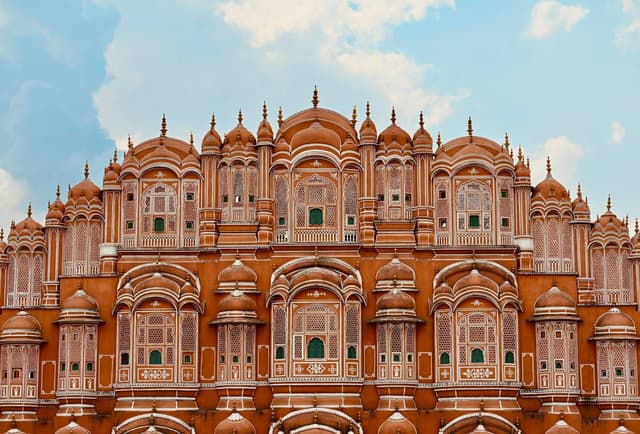
Jaipur, the state capital, was founded in 1727 by Maharaja Sawai Jai Singh II and laid out on a grid, which is rare for an Indian city of its age. The old city was painted its terracotta pink in 1876 to welcome the Prince of Wales, and the walled city itself is now a UNESCO World Heritage Site. Key sights are Amber (Amer) Fort on a ridge 11 km north of the centre, the honeycomb facade of Hawa Mahal with its 953 small windows, the royal City Palace, the astronomical instruments of Jantar Mantar, Nahargarh Fort for sunset views, and the Albert Hall Museum. Jaipur is also a corner of the route in our Golden Triangle India guide.
Udaipur: the City of Lakes
Udaipur was founded in 1559 by Maharana Udai Singh II as the new capital of Mewar. The City Palace complex stretches along the eastern shore of Lake Pichola, while the Lake Palace (now a hotel) and Jag Mandir sit on islands in the water. Visitors come for sunset boat rides, the evening folk dance show at Bagore ki Haveli, the Jagdish Temple and rooftop views across the lake. Udaipur also makes a convenient base for day trips to Kumbhalgarh, the Ranakpur Jain temple and Chittorgarh.
Jodhpur: the Blue City
Jodhpur sits on the edge of the Thar Desert and is dominated by Mehrangarh Fort, begun by Rao Jodha in 1459 and rising about 120 metres above the city. Its museum holds palanquins, armour, textiles and painted palace rooms. Below the fort, many old-city houses are washed in blue. Other highlights are the marble Jaswant Thada memorial, the art deco Umaid Bhawan Palace and Sardar Market around the Clock Tower.
Jaisalmer: the Golden City
Jaisalmer Fort was founded in 1156 by Rawal Jaisal and is built from honey-coloured sandstone that glows at sunset. It is one of the few living forts in the world: shops, homes, guesthouses and Jain temples still operate inside the walls. In town, the carved facades of Patwon ki Haveli and Salim Singh ki Haveli are worth an hour each, and Gadisar Lake is lovely at dawn. The Sam Sand Dunes lie roughly 40 km west, and the quieter Khuri dunes are a similar distance to the south-west.
Pushkar, Ranthambore and the forts of Mewar
- Pushkar: a small pilgrimage town around a sacred lake with 52 ghats and one of the very few temples in India dedicated to Lord Brahma. Meat, eggs and alcohol are not served in the town. It lies about 15 km from Ajmer, whose Ajmer Sharif Dargah is one of South Asia's most important Sufi shrines.
- Ranthambore National Park: near Sawai Madhopur, it is one of the best places in India to see wild Bengal tigers, with the 10th century Ranthambore Fort inside the park.
- Chittorgarh Fort: spread over about 700 acres on a plateau, with the nine-storey Vijay Stambha (about 37 metres tall), the Jain Kirti Stambha and Padmini's Palace. Plan about four hours with a vehicle inside the fort.
- Kumbhalgarh Fort: built between 1443 and 1458 under Rana Kumbha at around 1,100 metres in the Aravallis. Its 36 km wall is often called the Great Wall of India, and it is the birthplace of Maharana Pratap.
Offbeat Rajasthan: Bundi, Bikaner, Shekhawati and Mount Abu
Bundi has deep stepwells and mural-covered palace rooms with far fewer crowds than Jaipur. Bikaner offers the well-preserved Junagarh Fort and, 30 km away in Deshnoke, the Karni Mata Temple, famous for its resident rats. Shekhawati, three to four hours north of Jaipur, is a cluster of merchant towns whose havelis are covered in 18th and 19th century frescoes. Mount Abu, near the Gujarat border, is the state's only hill station and home to the marble Dilwara Jain temples; nearby Guru Shikhar, at about 1,722 metres, is the highest point in the Aravalli range.
Which Rajasthan sites are UNESCO World Heritage listed?
Rajasthan has four UNESCO World Heritage listings, and one of them covers six separate forts. Visiting them is an easy way to prioritise if you have limited time.
| UNESCO listing | Year inscribed | What it includes | Nearest base |
|---|---|---|---|
| Keoladeo National Park | 1985 | Wetland bird sanctuary, famous for winter migratory birds | Bharatpur (on the way from Agra) |
| Jantar Mantar, Jaipur | 2010 | 18th century astronomical instruments, including a giant sundial | Jaipur |
| Hill Forts of Rajasthan | 2013 | Chittorgarh, Kumbhalgarh, Ranthambore, Gagron, Amber and Jaisalmer forts | Various |
| Jaipur City | 2019 | The planned walled city with its bazaars and temples | Jaipur |
The UNESCO listing for the Hill Forts of Rajasthan explains why the six forts were chosen together: they show how Rajput rulers used hills, rivers, forests and deserts for defence between the 5th and 18th centuries.
When is the best time to visit Rajasthan?
The best time to visit Rajasthan is October to March. Days are dry and warm, nights are cool, and this is when most festivals take place. December and January are the coolest months, with night temperatures in Jaipur and Jaisalmer close to 8 to 10°C and colder in the desert, so pack a warm layer. April to June is extremely hot, with highs above 40°C in most cities. The monsoon from late June to September brings rain mainly to the east and south (Udaipur and Mount Abu turn green), while the far west stays relatively dry.
| Month | Jaipur (min to max °C) | Jaipur rain (mm) | Jaisalmer (min to max °C) | Travel verdict |
|---|---|---|---|---|
| January | 9 to 23 | 6 | 9 to 24 | Excellent, cold nights |
| February | 12 to 27 | 9 | 12 to 27 | Excellent |
| March | 18 to 33 | 4 | 18 to 33 | Good, warming up |
| April | 23 to 38 | 6 | 24 to 39 | Hot, sightsee early |
| May | 27 to 42 | 20 | 26 to 42 | Very hot, avoid the desert |
| June | 28 to 40 | 50 | 28 to 41 | Very hot, first rains |
| July | 26 to 36 | 180 | 27 to 38 | Monsoon, humid |
| August | 25 to 33 | 190 | 26 to 37 | Monsoon, Udaipur at its greenest |
| September | 24 to 35 | 65 | 25 to 37 | Rains easing, low prices |
| October | 20 to 35 | 25 | 22 to 37 | Good, warm days |
| November | 15 to 30 | 3 | 16 to 31 | Excellent, fair season |
| December | 10 to 25 | 4 | 11 to 25 | Excellent, busiest |
Figures are long-term averages (source: Climates to Travel), so individual years vary. Udaipur is slightly milder thanks to its altitude of about 600 metres, and it receives around 675 mm of rain a year, most of it in July and August. Peak demand runs from late October to early January, especially around Diwali, Christmas and New Year, when heritage hotels and desert camps fill early. For how Rajasthan compares with the rest of the country season by season, see our best time to visit India guide.
Which festivals are worth planning a Rajasthan trip around?
Rajasthan has one of India's richest festival calendars. Most events follow the Hindu lunar calendar, so dates move each year. The table lists the main events and their usual timing.
| Festival | Where | Usual timing | What happens |
|---|---|---|---|
| Pushkar Camel Fair | Pushkar | October or November, ending on Kartik Purnima (17 to 24 November 2026) | Livestock trading, camel contests, folk music, pilgrims bathing in the lake |
| Makar Sankranti kite festival | Jaipur and across the state | 14 January | Rooftop kite flying across the old city |
| Jaipur Literature Festival | Jaipur | Late January (15 to 19 January in 2026) | One of the world's largest free literary festivals |
| Desert Festival | Jaisalmer and Sam dunes | January or February around the Magh full moon (30 January to 1 February in 2026) | Camel races, turban tying, Mr Desert contest, folk performances |
| Bikaner Camel Festival | Bikaner | January | Camel parades, dances and contests |
| Holi | Statewide, lively in Pushkar and Jaipur | February or March | Festival of colours |
| Gangaur and Mewar Festival | Jaipur, Udaipur | March or April, just after Holi | Processions of women honouring the goddess Gauri |
| Teej | Jaipur especially | July or August (monsoon) | Swings, green clothes, ghewar sweets, a royal procession |
| Marwar Festival and RIFF | Jodhpur | October, around Sharad Purnima | Folk music, with the Rajasthan International Folk Festival at Mehrangarh |
| Diwali | Statewide | October or November | Lamps, fireworks, illuminated forts and bazaars |
The Pushkar dates above are those published by India's official tourism portal, Incredible India. Always confirm festival dates on the Rajasthan Tourism official website before booking, because some events are shortened, moved or reorganised at short notice. Rooms in Pushkar during the fair and Jaisalmer during the Desert Festival book out months ahead.
What are the Rajasthan monument entry fees in 2026?
Entry fees differ for Indian and foreign visitors. At monuments run by the Archaeological Survey of India (ASI), such as Chittorgarh and Kumbhalgarh, citizens of SAARC and BIMSTEC countries (including Nepal, Bangladesh, Bhutan, Sri Lanka and Thailand) pay the Indian rate, and children under 15 enter free. State-run and privately managed sites set their own rules, so carry your passport or ID and ask at the counter. The figures below were gathered from recent published rates as of 2026 and can change without notice.
| Monument | Managed by | Indian visitors (₹) | Foreign visitors (₹) |
|---|---|---|---|
| Amber Fort, Jaipur | Rajasthan state | 100 | 500 |
| Hawa Mahal, Jaipur | Rajasthan state | 50 | 200 |
| Jantar Mantar, Jaipur | Rajasthan state | 50 | 200 |
| Nahargarh Fort, Jaipur | Rajasthan state | 50 | 200 |
| Albert Hall Museum, Jaipur | Rajasthan state | 50 | 300 |
| Jaipur composite ticket (6 sites, 2 days) | Rajasthan state | 400 | 1,000 |
| City Palace, Jaipur | Royal family trust | 200 | 700 |
| Mehrangarh Fort, Jodhpur | Mehrangarh Museum Trust | 100 | 600 |
| Chittorgarh Fort | ASI | 40 | 600 |
| Kumbhalgarh Fort | ASI | 40 | 600 |
The Jaipur composite ticket covers Amber Fort, Hawa Mahal, Jantar Mantar, Albert Hall, Nahargarh and Isarlat, and is worth buying if you plan to see at least three of them. Entering Jaisalmer Fort's streets is free as it is a living town, but the palace museum inside charges separately. Audio guides, camera fees, evening light shows and the lift at Mehrangarh are extra. Ranthambore safaris are priced per seat and include the park permit: roughly ₹1,500 to 2,500 for Indians and ₹3,500 to 4,500 for foreigners as of 2026, depending on whether you take a 20-seat canter or a 6-seat jeep. Permits open about 90 days ahead and popular zones sell out, and the park is closed to safaris during the monsoon.
How do you get to Rajasthan and travel between cities?
Most international visitors arrive through Delhi, which is about 280 km, or five to six hours by road, from Jaipur. Jaipur International Airport (JAI) has direct flights from several Gulf cities and many Indian metros. Udaipur (UDR) and Jodhpur (JDH) have good domestic links, while Jaisalmer (JSA), Bikaner (BKB) and Kishangarh (KQH, useful for Ajmer and Pushkar) have more limited or seasonal schedules. Few flights link Rajasthan cities to each other.
A note for travellers from South Asia: citizens of Nepal and Bhutan do not need a visa for India. Nepali travellers usually fly Kathmandu to Delhi or Jaipur via Delhi, or cross overland at a border point such as Sunauli, and should carry a valid passport or other accepted identity document. Most other nationalities need an Indian e-Visa arranged before travel; check the latest rules on the official portal. Our India travel guide covers entry, money and connectivity in more detail.
| Route | Approx. road distance | Approx. drive time | Rail option |
|---|---|---|---|
| Delhi to Jaipur | 280 km | 5 to 6 hours | Frequent trains, including Vande Bharat services, fastest around 4 to 5 hours |
| Agra to Jaipur | 240 km | 4 to 5 hours | Several daily trains |
| Jaipur to Pushkar | 145 km | 2.5 to 3 hours | Train to Ajmer, then 15 km by road |
| Jaipur to Ranthambore (Sawai Madhopur) | 160 km | 3 to 3.5 hours | Frequent trains, about 2 hours |
| Jaipur to Jodhpur | 335 km | 5.5 to 6 hours | Several trains, around 5 to 6 hours |
| Jaipur to Udaipur | 395 km | 6.5 to 7 hours | Daily trains, often overnight |
| Jodhpur to Jaisalmer | 285 km | 5 hours | Daily trains, about 5 to 6 hours |
| Jodhpur to Udaipur via Ranakpur | 250 to 260 km | 5 to 6 hours with a temple stop | No convenient direct train |
| Udaipur to Chittorgarh | 115 km | 2 hours | Trains available |
| Udaipur to Kumbhalgarh | 85 km | 2 to 2.5 hours | Road only |
| Jaisalmer to Bikaner | 330 km | 5.5 to 6 hours | Limited trains |
Treat drive times as guides. The main ways to get around are:
- Private car with driver: the most popular choice for multi-city trips, because it allows photo stops, detours to Ranakpur or Kuldhara and door-to-door transfers.
- Trains: Indian Railways connects every major Rajasthan city. The Jodhpur to Delhi Cantonment Vande Bharat Express, which began in September 2025, stops at Jaipur and runs six days a week. The Jaipur to Udaipur Vande Bharat was withdrawn in February 2026, but regular express trains still link the two cities. Book on the official IRCTC platform, ideally several weeks ahead in the winter season.
- Palace on Wheels: a luxury train that loops over 7 nights through Jaipur, Sawai Madhopur, Chittorgarh, Udaipur, Jaisalmer, Jodhpur and Bharatpur before Agra and Delhi, mainly between September and April.
- Buses: state-run RSRTC and private sleeper buses are the cheapest option and cover almost every town, though comfort varies.
- Within cities: app-based taxis work well in Jaipur, Udaipur and Jodhpur. Auto-rickshaws are everywhere; agree the fare before you start.
For a wider look at trains, domestic flights and apps across the country, read our guide on how to get around India.
How many days do you need in Rajasthan?
Seven to ten days is the sweet spot for Jaipur, Udaipur, Jodhpur and Jaisalmer at a comfortable pace, including a night in the desert. Five days suits two cities, usually Jaipur plus Udaipur or Jodhpur. Two weeks lets you add Pushkar, Ranthambore, a Mewar fort and a quieter town such as Bundi.
| Trip length | What fits comfortably | Best for |
|---|---|---|
| 3 to 4 days | Jaipur plus a day trip, or Jaipur with Pushkar or Ranthambore | Adding Rajasthan to a Golden Triangle trip |
| 5 to 6 days | Jaipur and Udaipur, or Jaipur and Jodhpur | Couples and short breaks |
| 7 to 10 days | Jaipur, Jodhpur, Jaisalmer and Udaipur | A classic first visit |
| 12 to 16 days | The four main cities plus Pushkar, Ranthambore, Chittorgarh or Kumbhalgarh, and Bundi or Shekhawati | Slow travel, photography, festivals |
Our how many days in India guide helps if you are combining Rajasthan with Delhi, Agra, Varanasi or Kerala, and our India itinerary guide shows how the state slots into longer routes.
What can you do in the Thar Desert?
The Thar Desert covers most of western Rajasthan, and Jaisalmer is the easiest place to experience it. The standard experience is a late afternoon drive to the dunes, a camel ride at sunset, a folk music and dance programme with dinner, and a night in a tented camp or, for the adventurous, under the stars on the sand. The main options are:
- Sam Sand Dunes: about 40 km from Jaisalmer, with the tallest and most photogenic dunes, but also the most camps, jeeps and noise in peak season.
- Khuri: a quieter village with smaller camps and a more traditional feel.
- Non-touristy camel safaris: multi-hour or overnight camel treks that stop at small villages, offered by operators in Jaisalmer and Bikaner.
- Jeep safaris and activities: dune bashing, quad bikes and parasailing are widely sold; check safety standards and insurance before you sign up.
Desert nights from December to February can drop close to freezing, so a fleece, hat and socks are essential. Read recent reviews of camps for cleanliness and noise.
What should you eat in Rajasthan?
Rajasthani food was shaped by scarce water and fresh produce, so it relies on lentils, millet, gram flour, ghee, dried beans and berries. A thali is the best way to taste many dishes at once.
| Dish | What it is | Where to try it |
|---|---|---|
| Dal baati churma | Baked wheat balls with lentils and a sweet crumbled mix, soaked in ghee | Everywhere, the signature dish |
| Laal maas | Fiery red mutton curry with Mathania chillies | Jaipur and Jodhpur |
| Gatte ki sabzi | Gram flour dumplings in a yoghurt curry | Most thali restaurants |
| Ker sangri | Desert berries and beans cooked with spices | Jaisalmer, Bikaner, Jodhpur |
| Pyaaz kachori | Fried pastry stuffed with spiced onion | Jaipur and Jodhpur breakfast stalls |
| Mirchi vada and mawa kachori | Stuffed chilli fritter; sweet milk-filled pastry | Jodhpur |
| Ghewar | Honeycomb disc of fried batter soaked in syrup | Jaipur, especially during Teej |
| Makhaniya lassi | Thick saffron and butter yoghurt drink | Jodhpur |
| Bikaneri bhujia | Crunchy spiced gram flour snack | Bikaner, sold across India |
Choose busy stalls where food is cooked fresh and drink bottled or filtered water. For a broader tour of regional cuisine, see what to eat in India.
What does a Rajasthan trip cost for independent travellers?
Rajasthan suits every budget, from backpacker guesthouses to some of the world's most famous palace hotels. The ranges below are rough, per person or per room as noted, as of 2026, and they rise noticeably from mid-December to early January and during big festivals. Check a live source for the rupee rate against your own currency.
| Item | Budget | Mid-range | Premium |
|---|---|---|---|
| Double room per night | ₹1,000 to 2,500 (guesthouse, homestay) | ₹3,000 to 8,000 (boutique or heritage haveli) | ₹15,000 and far higher (palace hotels) |
| Meal per person | ₹100 to 300 (street food, local thali) | ₹400 to 1,000 (rooftop restaurant) | ₹2,000 and up (hotel fine dining) |
| Transport | Buses and sleeper-class trains | AC train classes, app taxis | Private car with driver, flights |
| Sightseeing | Composite tickets, free sites | Audio guides, local guide | Private historian guides, safaris |
Our is India expensive guide breaks daily budgets down further for the country as a whole.
What should you buy in Rajasthan?
Rajasthan is one of India's best states for handicrafts. Jaipur's Johari Bazaar and Bapu Bazaar, Jodhpur's Sardar Market, the lanes around Udaipur's City Palace and the shops inside Jaisalmer Fort are the main hubs.
- Block-printed textiles: from Sanganer and Bagru near Jaipur, sold as bedspreads, scarves and clothing.
- Blue pottery: a Jaipur speciality made from quartz paste rather than clay.
- Bandhani and leheriya: tie-dyed fabrics and saris in bright colours.
- Mojari (jutti): embroidered leather slippers, especially in Jodhpur and Jaipur.
- Miniature paintings: Udaipur's artists work in the Mewar style on paper and silk.
- Silver jewellery and puppets: good in Jaisalmer and Pushkar.
Bargaining is normal in markets but not in fixed-price government emporiums. Be wary of anyone promoting a gem "investment" that you can resell abroad for profit, which is a long-running scam, and avoid commission-driven shop visits pushed by touts.
Is Rajasthan safe, and what should you know before you go?
Rajasthan is one of India's most visited states and is generally safe for tourists, including families and solo travellers who take normal precautions. Common problems are touts, overcharging and heat rather than serious crime. For country-wide advice, see our guide on whether India is safe for travellers.
- Heat: even in March and October, midday sun is strong. Start sightseeing at opening time, carry water and wear a hat.
- Dress: cover shoulders and knees at temples and remove shoes. Leather items may not be allowed inside Jain temples such as Ranakpur and Dilwara.
- Touts and guides: hire licensed guides at monument ticket counters and agree fees upfront.
- Animals: camels, cows and monkeys are part of street life. Avoid feeding monkeys at Amber and Galta Ji.
- Women travellers: dress conservatively in smaller towns, use registered taxis at night and choose well-reviewed guesthouses.
- Cash and cards: UPI and cards work in cities, but carry cash for small shops, villages and desert camps.
Is Rajasthan good for couples and families?
Yes. Udaipur is one of India's most popular honeymoon cities, thanks to lakeside hotels, sunset boat rides and rooftop dinners, while a private desert camp in Jaisalmer adds a memorable night. Families usually enjoy Jaipur's forts and a jeep ride up to Amber, camel rides on the dunes, puppet shows and a tiger safari at Ranthambore. With young children, keep drives under five hours, plan rest days, and avoid the hot months.
If you would rather have flights, transfers and hotels arranged for you, compare India tour packages.
Frequently asked questions
Which is the best city to start a Rajasthan trip?
Jaipur is the usual starting point for a Rajasthan trip. It has the state's main international airport, fast rail links to Delhi and Agra, and a concentration of forts, palaces and markets. From Jaipur, most travellers continue west to Jodhpur and Jaisalmer, or south-west to Udaipur, then return to Delhi by train or flight.
What is the best month to visit Rajasthan?
November to February is the best period to visit Rajasthan, with dry weather and daytime highs of roughly 23 to 30°C in Jaipur and Jaisalmer. November brings the Pushkar Camel Fair, while January and February bring the Jaipur Literature Festival and the Jaisalmer Desert Festival. Nights in December and January are cold, especially in the desert.
Is one week enough for Rajasthan?
One week is enough for three or four Rajasthan cities at a steady pace, typically Jaipur, Jodhpur and Udaipur, or Jaipur, Jodhpur and Jaisalmer with a desert night. Because distances between cities are 250 to 400 km, adding a fourth city in seven days means more time on the road. Ten days allows all four comfortably.
How do you travel around Rajasthan?
A private car with a driver is the most comfortable way to travel around Rajasthan, since it covers long distances and allows stops at places like Ranakpur. Trains link every major city and are good value, especially on the Delhi to Jaipur and Jodhpur to Jaisalmer routes. Direct flights between Rajasthan cities are limited, and buses are cheapest.
Is Rajasthan safe for tourists?
Rajasthan is generally safe for tourists and welcomes millions of visitors a year. The usual issues are touts, overcharging and gem scams rather than violent crime. Keep valuables secure in busy markets, use registered taxis or ride-hailing apps at night, dress modestly at religious sites, and choose accommodation with recent positive reviews, especially if travelling solo.
How much are the entry fees at Rajasthan forts?
Rajasthan fort entry fees vary by site and nationality. As of 2026, Amber Fort costs about ₹100 for Indians and ₹500 for foreigners, and Mehrangarh about ₹100 and ₹600. ASI forts such as Chittorgarh and Kumbhalgarh charge about ₹40 for Indian and SAARC or BIMSTEC nationals and ₹600 for other foreigners. Check rates at the counter.
Do you need a visa to visit Rajasthan?
Rajasthan follows India's national entry rules, so there is no separate state permit. Most nationalities need an Indian e-Visa, applied for online before travel through the official Indian government portal. Citizens of Nepal and Bhutan are exempt and can enter with a valid passport or accepted identity document. Check the latest rules for your passport before booking flights.
When is the Pushkar Camel Fair in 2026?
The Pushkar Camel Fair in 2026 is scheduled for 17 to 24 November, ending on the Kartik Purnima full moon, according to India's official tourism portal. The livestock trading is busiest in the first days, while the religious bathing peaks at the full moon. Book accommodation in Pushkar well ahead and confirm dates close to travel.
Can you visit Rajasthan in summer or the monsoon?
You can visit Rajasthan in summer or the monsoon, but plan carefully. From April to June temperatures often exceed 40°C, so desert trips are uncomfortable. The July to September monsoon cools the air, turns Udaipur and Mount Abu green and brings lower hotel rates, although Ranthambore safaris are suspended during these months.
Where can you see tigers in Rajasthan?
Ranthambore National Park near Sawai Madhopur is the best place to see tigers in Rajasthan, with safaris in 20-seat canters or 6-seat jeeps across 10 zones. Permits open about 90 days ahead and popular zones sell out quickly. Sariska Tiger Reserve, near Alwar and closer to Delhi, is a quieter alternative with lower sighting odds.
What is the famous food of Rajasthan?
The most famous food of Rajasthan is dal baati churma, baked wheat balls served with lentils and a sweet crumble. Other favourites are laal maas, a spicy mutton curry, gatte ki sabzi, ker sangri, pyaaz kachori and the honeycomb sweet ghewar. A Rajasthani thali in Jaipur, Jodhpur or Udaipur is the easiest way to sample several dishes.
Is Rajasthan good for a honeymoon?
Rajasthan is excellent for a honeymoon, particularly Udaipur with its lake-view hotels, sunset boat rides and romantic rooftop restaurants. Couples often combine Udaipur with a heritage stay in Jodhpur and a private desert camp near Jaisalmer. October to March offers the most pleasant weather, while Mount Abu is a cooler option in warmer months.