












































Short answer: The Taj Mahal in Agra opens 30 minutes before sunrise and closes 30 minutes before sunset, and it is closed to general visitors every Friday. Arrive at opening time through the Eastern Gate for the calmest visit, carry only a phone, camera and water bottle, and pair the Taj Mahal with Agra Fort, which is open on Fridays. Checked: 28 Oct 2026, tajmahal.gov.in.
This guide is for first-time visitors, couples, families and Nepali travellers adding Agra to a Delhi and Jaipur trip. It covers the rules that catch people out (the Friday closure, the long list of banned items, the separate night viewing system), quick history answers, what you actually see inside the complex, and how to fit in Agra Fort and the Mehtab Bagh sunset view. It is written to sit alongside our complete India travel guide and the Golden Triangle route of Delhi, Agra and Jaipur, a popular way to combine Agra with two other cities. We do not list ticket prices here because they change; the official ticket portals are named below so you can check on the day you book.
| At a glance | Taj Mahal, Agra |
|---|---|
| Location | Right bank of the Yamuna River, Agra, Uttar Pradesh, India |
| Opening hours | 30 minutes before sunrise to 30 minutes before sunset |
| Weekly closure | Every Friday (general viewing closed) |
| Ticket counters | Western and Eastern Gates, from 1 hour before sunrise to 45 minutes before sunset |
| Entry gates | Western Gate and Eastern Gate; Southern Gate is exit only at present |
| Main mausoleum | Entry to the inner tomb is an optional add-on to the standard ticket |
| Night viewing | Full moon night plus two nights either side, not on Fridays or during Ramzan; separate ticket |
| Built by | Mughal emperor Shah Jahan, in memory of his wife Mumtaz Mahal |
| Built | Mausoleum completed 1648; outlying buildings and gardens 1653 |
| UNESCO World Heritage Site | Since 1983 |
| Nearest big sights | Agra Fort (2.5 km), Mehtab Bagh (across the river), Fatehpur Sikri (about 40 km) |
| Best season (official guidance) | October to March |
Checked: 28 Oct 2026, official Taj Mahal visiting hours page, tajmahal.gov.in FAQ and night viewing pages, agra.nic.in and the UNESCO World Heritage Centre.
If you are still choosing where the Taj Mahal fits among India's highlights, our round-up of the best places to visit in India will help you decide what to pair it with.
When is the Taj Mahal open and when is it closed?
The Taj Mahal is open six days a week, from 30 minutes before sunrise to 30 minutes before sunset, and it is closed for general viewing every Friday. The official Taj Mahal website states that on other days it is always open. Because the hours follow the sun, opening time is earlier in summer and later in winter, so look up the sunrise time for your date before you set an alarm.
The Friday closure is the rule that ruins the most trips. On Fridays the mosque inside the complex is used for prayers, and the monument is not open to sightseers. If your Agra day falls on a Friday, switch it around: see Agra Fort, Mehtab Bagh, Itimad-ud-Daulah or Fatehpur Sikri that day and do the Taj Mahal on Thursday or Saturday.
Official rules box (Checked: 28 Oct 2026, tajmahal.gov.in, the official Taj Mahal website of Uttar Pradesh's Department of Tourism, and agra.nic.in, Agra district administration)
- Opening hours: 30 minutes before sunrise to 30 minutes before sunset.
- Closed for general viewing every Friday.
- Ticket windows at the Western and Eastern Gates run from one hour before sunrise to 45 minutes before sunset.
- Southern Gate: no entry at present, exit only.
- Separate queues for foreign and domestic visitors, with signs at the gates.
- No polluting vehicles within 500 metres of the Taj Mahal; battery buses and golf carts run from the parking areas to the gates.
- Photography is not allowed inside the main mausoleum.
- Drones are banned inside and around the Taj Mahal.
- Night viewing runs on five nights a month, not on Fridays or during Ramzan, with a separate ticket and security check.
Which gate should you use?
The Eastern Gate is the one the official site recommends if you want to avoid crowds. The Western Gate is described as the main entrance, facing the Shahjahan Garden and Agra city, so it tends to take the bulk of visitors arriving from the city side. The Southern Gate, which faces the old Taj Ganj bazaar, is closed for entry and works as an exit only.
| Gate | Status | Parking and access | Good to know |
|---|---|---|---|
| Eastern Gate (Sirhi Darwaza) | Entry and ticket counter | Parking at Shilpgram, then battery bus or golf cart | Official advice: prefer this gate to avoid crowds. Night viewing check-in is also at Shilpgram |
| Western Gate | Entry and ticket counter (near Saheli Burj) | Parking at Amrood ka Teela, then battery bus or golf cart | Described as the main entrance, facing Agra city and the cantonment |
| Southern Gate | Exit only at present | Opens towards Taj Ganj | Do not plan to enter here |
Checked: 28 Oct 2026, tajmahal.gov.in (Entry to Taj Mahal, Visiting Hours and Do's and Don'ts pages).
How do you buy Taj Mahal tickets?
You can buy day tickets at the counters at the Western and Eastern Gates, or online. The official Taj Mahal FAQ names asiagracircle.in for online day tickets, while the Agra district website points to the Archaeological Survey of India (ASI) portal at asi.paygov.org.in, which is also the portal the official site gives for night viewing. Online buyers get a small discount, according to the official visiting hours page.
Two things about the ticket are worth knowing before you queue. First, there are separate ticket categories for Indian citizens, for citizens of SAARC and BIMSTEC countries (Nepal is a member of both groupings), and for other foreign nationals; check the category that applies to you on the official portal before you book. Second, going inside the main mausoleum, where the cenotaphs are, is an optional add-on to the standard ticket. If you want to see the marble screen and the inlay work up close, make sure you have that add-on before you reach the platform.
SAARC, BIMSTEC and foreign tickets come with shoe covers, a half-litre water bottle, an Agra tourist map and the battery bus or golf cart ride from the parking area, according to the official Do's and Don'ts page. Checked: 28 Oct 2026, tajmahal.gov.in.
What is the best time of day to visit?
Sunrise is the best time of day to visit the Taj Mahal for most travellers, because the crowds are thinner, the marble takes on a soft pink tone and summer mornings are cooler. The official FAQ makes the same point and adds that sunset also brings cool air and soft light, but more visitors. In short, the earlier you arrive, the calmer it is.
The light really does change the building. White marble picks up whatever colour the sky gives it, which is why the official site says any time of day can work. What sunrise adds is space: fewer people in the frame at the reflecting pool and a shorter wait for the mausoleum.
| Time of day | What you get | Who it suits | Trade-off |
|---|---|---|---|
| Opening (30 minutes before sunrise) | Pink and gold light, the thinnest crowds, cooler air | Photographers, couples, anyone who dislikes crowds | Very early start; queue at the counter from one hour before sunrise or book online |
| Mid-morning | Bright white marble, full daylight | Families with young children who cannot manage a pre-dawn start | More visitors than at sunrise |
| Midday | Harsh overhead light | Travellers on a tight Delhi day trip | Glare on the white marble; more visitors than at sunrise |
| Late afternoon to closing | Warm, soft light | Visitors arriving by morning train from Delhi | More visitors, according to the official FAQ; last tickets 45 minutes before sunset |
| After closing | The Taj Mahal from across the river at Mehtab Bagh | Anyone who wants a sunset view without the crowds inside | You see the Taj Mahal from outside, not from the gardens |
Which season is best?
The official Taj Mahal FAQ names October to March as the best season. For Nepali travellers this lines up neatly with the Dashain and Tihar holidays in autumn and with winter school holidays, which is when many families from Nepal plan their India trips. Those same months are peak season for everyone else too, so the advice to arrive at opening time matters even more then. For month-by-month weather across the country, see our guide to the best time to visit India.
Which days of the week are calmest?
The official sources do not publish crowd figures by day, so we cannot give you a verified quietest day. What the official guidance does say is that sunrise draws fewer people than sunset, so the time of day you choose matters more than the weekday. Just make sure your chosen day is not a Friday.
What can and can't you take inside?
You can take a phone (switched off or on silent), a camera and a water bottle into the Taj Mahal, but food, tripods, headphones, chargers, most electrical items, tobacco and drones are banned. The list is longer than most visitors expect, and items are checked at security, so travel light and leave the rest at your hotel or in the cloakroom.
| Allowed (day visit) | Not allowed |
|---|---|
| Mobile phone, kept switched off or on silent mode | Food and sweets of any kind (the official list names toffees) |
| Still camera (but no photography inside the main mausoleum) | Tripods |
| Water bottle | Headphones |
| Small bag (big bags and books slow the security check) | Mobile chargers, wires and other electrical goods except cameras |
| Knives, arms and ammunition | |
| Smoking items, tobacco products, lighters or anything that makes fire | |
| Liquor | |
| Drones, inside and around the monument |
Checked: 28 Oct 2026, Taj Mahal Do's and Don'ts (official site).
A few points from the official rules that are easy to miss:
- Power banks and charging cables. Mobile chargers, wires and electrical goods other than cameras are on the banned list, so leave power banks and cables behind.
- Eating and smoking are prohibited inside the complex. Have breakfast before or after your visit.
- Photography inside the main mausoleum is not allowed. You can photograph freely in the gardens, at the gateway and on the platform, but put the camera away when you enter the tomb chamber.
- Keep quiet inside the mausoleum and do not touch or scratch the walls; the official site asks visitors to treat the surfaces as heritage that needs special care.
- Cloakrooms are available at the Eastern and Western Gates, according to the Agra district website, which helps if you arrive straight from a train with luggage.
- Wheelchairs are available for visitors with disabilities; the official sites mention the ASI office on site and the entry gates.
- Guides and photographers: the official advice is to hire only approved guides and photographers who show their identity cards.
What should you wear?
The official pages do not set a dress code, but the complex includes a working mosque and a tomb, so modest clothing that covers shoulders and knees is the respectful choice. Easy slip-on shoes are practical, and SAARC, BIMSTEC and foreign tickets come with shoe covers, according to the official site.
Who built the Taj Mahal and when?
The Taj Mahal was built by the Mughal emperor Shah Jahan in memory of his wife Mumtaz Mahal, with the main mausoleum completed in 1648 and the outlying buildings and gardens finished in 1653. Mumtaz Mahal died on 17 June 1631 in Burhanpur, and work on the tomb began soon after. Sources give two start years: UNESCO's summary says the Taj Mahal was built between 1631 and 1648 while its detailed description says construction started in 1632, and the official Taj Mahal website likewise says about 1631 on one page and 1632 on another. The honest answer is 1631 or 1632.
The question of who designed it is less tidy than many tour scripts suggest. UNESCO names Ustad Ahmad Lahori as the main architect. The official Taj Mahal website says history obscures exactly who designed the building, that a team of architects was responsible, and it names other figures linked to the dome and the design. Both agree that it was a huge collective effort: the official site says a labour force of about twenty thousand workers was recruited from across northern India, with sculptors, calligraphers, inlayers and stone cutters brought in from as far as Bukhara, Persia and Baluchistan.
| History fact | Detail | Source |
|---|---|---|
| Commissioned by | Shah Jahan, fifth Mughal emperor | tajmahal.gov.in; UNESCO |
| Built for | His wife Mumtaz Mahal | UNESCO |
| Mumtaz Mahal's death | 17 June 1631, Burhanpur | tajmahal.gov.in |
| Construction began | 1631 or 1632 (both years appear in UNESCO and official site texts) | UNESCO; tajmahal.gov.in |
| Main mausoleum completed | 1648 | UNESCO; tajmahal.gov.in |
| Mosque, guest house, gate and gardens completed | 1653 | UNESCO; tajmahal.gov.in |
| Main architect | Ustad Ahmad Lahori (UNESCO); the official site says a team of architects | UNESCO; tajmahal.gov.in |
| Workforce | About twenty thousand workers | tajmahal.gov.in |
| Who is buried there | Mumtaz Mahal and Shah Jahan | tajmahal.gov.in; Britannica |
| UNESCO World Heritage listing | 1983 | tajmahal.gov.in |
Checked: 28 Oct 2026.
Why is the Taj Mahal a World Heritage Site?
UNESCO describes the Taj Mahal as the finest architectural and artistic achievement in Indo-Islamic tomb architecture, praised for its balance and symmetry. It was listed as a World Heritage Site in 1983, the same year as Agra Fort. UNESCO also notes that an area of 10,400 square kilometres around the Taj Mahal is defined to protect the monument from pollution. Closer in, the official site says no polluting vehicles are allowed within 500 metres, which is why you finish the journey from the parking areas by battery bus or golf cart.
How big is it?
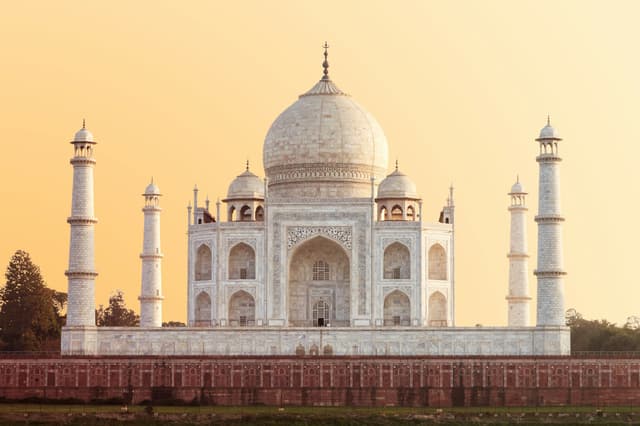
The official Taj Mahal website gives the key dimensions: the tomb stands on a platform 22 feet high and 313 feet square, the four corner minarets are 137 feet tall, and the outer dome rises to nearly 200 feet. The whole garden setting covers nearly 17 hectares, according to UNESCO. Those numbers explain why the building looks small from the main gate and then keeps growing as you walk towards it.
What is inside the Taj Mahal complex?
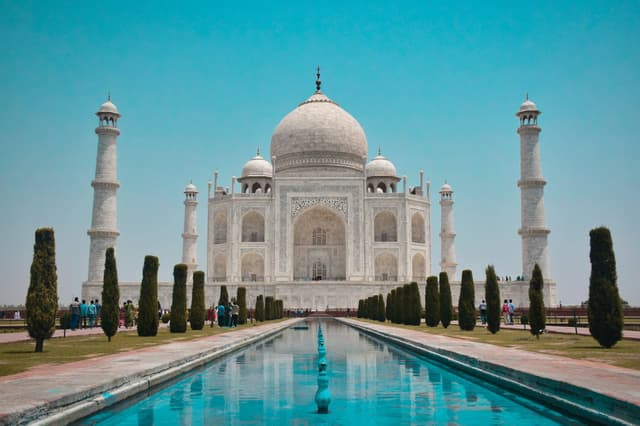
The Taj Mahal complex is far more than the white tomb: you pass through a red sandstone forecourt and the Great Gate, then cross a large Mughal garden to a marble platform with the mausoleum at its centre, flanked by a mosque on one side and a matching guest house on the other. Give yourself an unhurried morning rather than a quick stop, and note that the order below is roughly the order in which you see things.
| Part of the complex | What it is | What to look for |
|---|---|---|
| Great Gate (Darwaza-i-Rauza) | The red sandstone main gateway set in the centre of the garden's southern wall, facing the forecourt | Quranic calligraphy and inlaid flowers around the arch; your first framed view of the tomb |
| Garden (charbagh) | A four-part Mughal garden with water channels | The tomb sits at the far end, not the centre, which adds depth to the view |
| Mausoleum | White marble tomb on a raised platform, with four free-standing minarets | Inlaid semi-precious stones, calligraphy and the great dome |
| Mosque (west side) | Red sandstone mosque, still used for Friday prayers | The floor is laid out with outlines of 569 prayer rugs in black marble |
| Mihman Khana or Jawab (east side) | A near-identical twin of the mosque, built to balance the group | Working drawings of the dome scratched into the stone |
| Taj Museum | A small museum inside the complex | Open 10am to 5pm, according to the official site |
Checked: 28 Oct 2026, tajmahal.gov.in (Outlying Buildings, The Taj Interiors and Do's and Don'ts pages) and UNESCO World Heritage Centre, Taj Mahal.
Can you go inside the main mausoleum?
Yes, you can enter the main tomb chamber with the optional mausoleum add-on to your ticket. Inside is an octagonal hall with an intricately carved marble screen (jali) surrounding two cenotaphs. Mumtaz Mahal's cenotaph sits in the exact centre and Shah Jahan's larger one was added on its western side; the official site notes that, from a formal point of view, it appears as an afterthought in an otherwise symmetrical design.
The cenotaphs you see are not the actual graves. According to the official site, the real burials lie in a lower tomb chamber that is not open to visitors. The marble screen around the upper cenotaphs dates from 1643 and replaced an earlier gold one, and Mumtaz Mahal's cenotaph is inscribed with verses from the Quran. The official site also mentions that the hall has one of the longest echoes of any building in the world, which is one reason visitors are asked to keep their voices down. Photography is not allowed in this chamber.
What is the best route around the complex?
A simple loop works for most people:
- Enter through the Eastern or Western Gate into the forecourt, and stop under the Great Gate for the classic framed view.
- Walk down the central garden to the reflecting pool for photographs while the light is soft.
- Put on your shoe covers and climb to the platform; join the mausoleum queue early if you have the add-on.
- After the tomb, walk round the back of the platform for the view across the Yamuna towards Mehtab Bagh.
- Visit the mosque and the Jawab on either side, then the Taj Museum on your way out if it is open.
Is night viewing possible?
Yes, night viewing of the Taj Mahal is possible, but only on five nights a month: the full moon night and the two nights before and after it, and never on Fridays or during the month of Ramzan. It needs a separate ticket, numbers are capped, and visitors go in 30-minute batches.
| Night viewing detail | Official information |
|---|---|
| Which nights | Full moon night plus two nights before and two nights after |
| Not available | Fridays and the month of Ramzan |
| Viewing window | 8pm to 11:59pm (official Taj Mahal site) |
| Batches | 8 batches, up to 50 people each, 30 minutes per batch |
| Daily capacity | Up to 400 visitors |
| Check-in | Shilpgram, near the Eastern Gate, 30 minutes before your slot, for security |
| ID | Everyone must carry ID |
| Booking | Through the ASI online portal (asi.paygov.org.in); the official FAQ says online bookings open seven days before the viewing date. The same FAQ also lists the ASI office at 22 Mall Road, Agra, and says tickets there must be bought a day before the viewing date, so confirm the current process when you book |
| Phones | Mobile phones are banned for night viewing |
| Cameras | Still cameras allowed after the security check; video cameras and spare batteries are not |
Checked: 28 Oct 2026, Taj Mahal night viewing page (official site), plus the official FAQ and Do's and Don'ts pages.
Two honest caveats. First, the official sources do not agree on the exact window: the official Taj Mahal site and its FAQ give 8pm to 11:59pm, while the Agra district website gives 8:30pm to 12:30am, so go by the time printed on your ticket. Second, the official night viewing page shows a full moon date list as an image, and the dates move every month with the lunar calendar, so check the current list on tajmahal.gov.in or the ASI portal before you build a trip around it. Cloud can also hide the moon, which no ticket can fix.
Because phones are banned at night, leave yours at the hotel and agree a meeting point and transport back with your group before you go. If a full moon does not fit your dates, the sunset view from Mehtab Bagh, covered in the next section, is a good substitute.
How do you visit Agra Fort and Mehtab Bagh?
Agra Fort is 2.5 km from the Taj Mahal and open every day from sunrise to sunset, including Fridays, so it is the natural partner on the same day or the obvious plan for a Friday. Mehtab Bagh is a riverside garden directly opposite the Taj Mahal on the far bank of the Yamuna, open daily from sunrise to sunset, and it gives the best uncrowded view of the Taj Mahal at sunset.
| Agra Fort | Mehtab Bagh | |
|---|---|---|
| What it is | Mughal fortress and palace complex of red sandstone, with later white marble palaces | Mughal charbagh garden aligned with the Taj Mahal across the river |
| Hours | Sunrise to sunset, every day | Sunrise to sunset, every day |
| Open on Friday | Yes | Yes |
| Distance | 2.5 km from the Taj Mahal; about 3 km from Agra Cantt station | On the left bank of the Yamuna, opposite the Taj Mahal; about 8 km from Agra Fort by road |
| Entry point | Amar Singh Gate | Reached by road over the Ambedkar (Yamuna) Bridge |
| UNESCO | World Heritage Site since 1983 | Not one of Agra's three World Heritage Sites |
| Time needed | A longer visit: a walled complex with several palaces, halls and mosques | A short visit, best timed for the late afternoon and sunset |
| Best for | History, palaces and a distant river view of the Taj Mahal | Sunset photographs of the Taj Mahal without the crowds |
Checked: 28 Oct 2026, Agra Fort page, Agra district website, agra.nic.in Mehtab Bagh page, tajmahal.gov.in and Britannica.
What should you see inside Agra Fort?
According to the Agra district website, Emperor Akbar rebuilt Agra Fort in red sandstone from 1565, and Shah Jahan later added white marble palaces. Its walls run for about 2.5 km and enclose a whole royal city. The highlights most visitors look for are:
- Diwan-i-Am (Hall of Public Audience), where the emperor heard petitions; the official Taj Mahal website says it is believed to have been built by Shah Jahan in 1628.
- Diwan-i-Khas (Hall of Private Audience), where important guests were received.
- Jahangir Mahal, the largest residence inside the fort.
- Khas Mahal, the emperor's private palace in white marble.
- Sheesh Mahal, the palace of mirrors, with small mirrors set into walls and ceilings.
- Musamman Burj, the octagonal tower with a river view of the Taj Mahal.
The Musamman Burj carries the fort's most famous story. Britannica records that Shah Jahan was confined in Agra Fort by his son Aurangzeb from 1658 until his death in 1666, and the Agra district website says he spent his last years in the Musamman Burj, looking down the river to the tomb he built for Mumtaz Mahal. Standing there and seeing the Taj Mahal in the distance makes the history far more vivid than any guidebook.
How does Mehtab Bagh work as a sunset viewpoint?
Mehtab Bagh sits exactly opposite the Taj Mahal on the other side of the Yamuna. The Agra district website notes that Emperor Babur first laid out a garden here and Shah Jahan later aligned it with the Taj Mahal; the charbagh has since been restored. The district site calls it the finest vantage point for viewing and photographing the Taj Mahal, especially at sunset, and a quieter alternative to the crowds on the main bank.
Practical points from the same page: parking at the gate is limited and there are no food stalls inside, so carry water. Reach it by road over the Ambedkar (Yamuna) Bridge. Because it is open on Fridays, Mehtab Bagh also solves the Friday problem: you still see the Taj Mahal that day, just from across the river.
What else is worth seeing in Agra?
The official Taj Mahal FAQ lists Agra's three World Heritage Sites as the Taj Mahal, Agra Fort and Fatehpur Sikri, about 40 km away. Fatehpur Sikri was built by Emperor Akbar in the second half of the 16th century and served as the Mughal capital for about ten years. The FAQ also lists Itimad-ud-Daulah, often called the Baby Taj, along with Sikandra, Chini ka Rauza and the Taj Nature Walk. If you have a second day, Fatehpur Sikri is the strongest addition. For ideas beyond Agra, browse our list of things to do in India.
How should you order a day in Agra?
This is a sequence rather than a fixed schedule, and it assumes your Agra day is not a Friday:
- Taj Mahal at opening time, entering by the Eastern Gate.
- Breakfast and a rest at your hotel, since food is not allowed inside the complex.
- Agra Fort in the late morning or early afternoon.
- Itimad-ud-Daulah if you have time.
- Mehtab Bagh for sunset.
On a Friday, drop the Taj Mahal and use the day for Agra Fort, Fatehpur Sikri and Mehtab Bagh, then see the Taj Mahal at sunrise on Saturday.
How do you get to Agra from Delhi?
The fastest way to get from Delhi to Agra is by train, with semi-high-speed and express services reaching Agra Cantt in under two hours; by road it takes about 4 to 5 hours on the Yamuna Expressway and NH2, depending on traffic. Agra Cantt is the main station, a short taxi or auto-rickshaw ride from the Taj Mahal and Agra Fort, and Agra Fort station sits next to the fort.
| Option | Route | Approximate journey time | Notes |
|---|---|---|---|
| Gatimaan Express | Hazrat Nizamuddin to Agra Cantt | About 1 hour 40 minutes | Listed on the official Taj Mahal website among the main Delhi trains; not every train runs every day, so check running days for your date |
| Shatabdi Express | New Delhi to Agra Cantt | About 2 hours | Also listed on the official Taj Mahal website; check running days for your date |
| Other trains (Rajdhani, Taj Express and more) | Delhi stations to Agra Cantt | Varies by train | Journey times vary by train; check NTES or IRCTC |
| Car or taxi | Delhi to Agra via the Yamuna Expressway and NH2 (about 204 km) | About 4 to 5 hours | Agra district website estimate; depends on traffic and time of day |
| Bus | Delhi to Agra (Idgah and ISBT bus stands) | Varies | Regular buses; Idgah is about 8 km from the Taj Mahal |
| Flight | Agra (Kheria) airport, about 13 km from the city | Check current schedules | The district website describes Kheria as a seasonal commercial airport; check whether any Delhi flights are running for your dates before relying on this option |
Checked: 28 Oct 2026. Road, bus and air details: Agra district website, How to Reach and tajmahal.gov.in (Getting Around). Train journey times are approximate, taken from published Indian Railways timetables; departure times and running days change, so confirm on the Indian Railways NTES service or IRCTC before you book.
What is the Yamuna Expressway?
The Yamuna Expressway is a six-lane expressway of about 165 km from Zero Point in Greater Noida to Agra, opened on 9 August 2012, according to the Yamuna Expressway Industrial Development Authority. For most drivers from Delhi it is the main road route to Agra. Remember that petrol and diesel cars cannot drive right up to the Taj Mahal; your driver will drop you at the Shilpgram or Amrood ka Teela parking areas, where battery buses and golf carts take over.
Is a day trip from Delhi enough?
A day trip from Delhi is enough to see the Taj Mahal and Agra Fort, but it is rushed, and an early train is the only realistic way to arrive near opening time. If you can, stay one night in Agra: you get a sunrise visit without a pre-dawn train, time for Agra Fort and Mehtab Bagh at sunset, and a calmer day overall. A night also gives you a buffer if trains run late. For more on trains, roads and domestic flights, see our guide to getting around India.
How does Agra fit with Jaipur and Kathmandu?
Agra is the middle stop of the Golden Triangle. According to the Agra district website, Jaipur is about 4 hours from Agra by road, so many travellers go Delhi, Agra, Jaipur and back to Delhi, or end in Jaipur and explore more of Rajasthan's forts and cities. Coming from Nepal, our guide to Kathmandu to Delhi flights covers the flight leg, and the train or road journey to Agra starts in Delhi.
How should you plan your Taj Mahal trip?
Plan your Taj Mahal trip around three fixed points: avoid Friday, aim for sunrise, and add at least one night in Agra if your schedule allows. Everything else, from which train to take to whether you chase a full moon, fits around those three choices.
| Planning step | What to decide | Why it matters |
|---|---|---|
| 1. Check the day of the week | Make sure your Taj Mahal visit is not on a Friday | General viewing is closed every Friday |
| 2. Check sunrise and sunset for your date | Set your arrival for 30 minutes before sunrise | Opening and closing times move with the sun |
| 3. Decide on the mausoleum add-on | Buy it with your ticket if you want to see the tomb chamber | It is optional and separate from the standard ticket |
| 4. Pack light | Phone, camera, water bottle, ID, small bag | Food, tripods, chargers and headphones are turned away at security |
| 5. Pick your gate | Eastern Gate for fewer crowds | Southern Gate is exit only |
| 6. Check the full moon list | Only if you want night viewing | Five nights a month, never Fridays or during Ramzan |
| 7. Book transport from Delhi | Train, car or bus | Train running days differ, and some trains skip particular weekdays |
| 8. Add Agra Fort and Mehtab Bagh | Same day, or use them on a Friday | Both are open every day |
For overall trip length, see our guide to how many days you need in India and our India itinerary ideas. If safety is on your mind, especially for families or solo travellers, read our guide on whether India is safe for travellers, and for meals around your sightseeing see what to eat in India.
Nepali citizens can check whether a passport is needed for India in our guide do Nepalis need a passport for India; travellers of other nationalities can start with our India visa page.
If you would rather have the trains, hotels and timings arranged around the Friday closure and a sunrise slot, browse our India tour packages.
Frequently asked questions
Is the Taj Mahal closed on Fridays?
Yes. The Taj Mahal is closed for general viewing every Friday, according to the official Taj Mahal website, and night viewing does not run on Fridays either. Agra Fort and Mehtab Bagh stay open on Fridays, so use that day for them. Checked: 28 Oct 2026, tajmahal.gov.in.
What time does the Taj Mahal open?
The Taj Mahal opens 30 minutes before sunrise and closes 30 minutes before sunset, so the exact time changes through the year. Ticket counters at the Western and Eastern Gates open one hour before sunrise and stop selling 45 minutes before sunset. Checked: 28 Oct 2026, tajmahal.gov.in.
Can you go inside the main mausoleum of the Taj Mahal?
Yes. Entry to the main mausoleum of the Taj Mahal is an optional add-on to the standard ticket. Inside you see the cenotaphs of Mumtaz Mahal and Shah Jahan behind a marble screen; the actual graves are in a lower chamber that is closed to visitors. Photography is not allowed inside.
Are phones allowed at the Taj Mahal?
Yes, phones are allowed at the Taj Mahal during the day but must be switched off or on silent mode, and mobile chargers and headphones are banned. For night viewing, mobile phones are not allowed at all. Photography is not permitted inside the main mausoleum. Checked: 28 Oct 2026, tajmahal.gov.in.
Who built the Taj Mahal?
The Taj Mahal was built by the Mughal emperor Shah Jahan in memory of his wife Mumtaz Mahal, who died in 1631. UNESCO names Ustad Ahmad Lahori as the main architect, while the official Taj Mahal website credits a team of architects and about twenty thousand workers from across northern India.
When was the Taj Mahal built?
The Taj Mahal was built between the early 1630s and 1653. Construction started in 1631 or 1632 (UNESCO and the official site use both years); the main mausoleum was completed in 1648, and the mosque, guest house, gate and gardens in 1653. It became a UNESCO World Heritage Site in 1983.
Is the Taj Mahal open at night?
Only on five nights a month: the full moon night and the two nights before and after it, except Fridays and the month of Ramzan. Night viewing of the Taj Mahal needs a separate ASI ticket, runs in 30-minute batches of up to 50 people, and starts with a security check at Shilpgram near the Eastern Gate.
Which gate usually has the shortest queue at the Taj Mahal?
The Eastern Gate is the one the official Taj Mahal website recommends to avoid crowds. The Western Gate is the main entrance from the city side and usually busier, and the Southern Gate is exit only at present. Arriving at opening time helps more than any choice of gate.
How far is Agra Fort from the Taj Mahal?
Agra Fort is about 2.5 km from the Taj Mahal, according to the Agra district website, a short taxi or auto-rickshaw ride. The fort is open daily from sunrise to sunset, including Fridays, and from its Musamman Burj you can see the Taj Mahal along the Yamuna River.
Is a day trip from Delhi to the Taj Mahal enough?
A day trip from Delhi is enough to see the Taj Mahal and Agra Fort if you take an early train, which reaches Agra Cantt in under two hours. It is a long, rushed day, though. One night in Agra gives you a relaxed sunrise visit and time for Mehtab Bagh at sunset.
Taj Mahal herna Nepali lai kati din chahinchha?
For most Nepali travellers, one full day in Agra covers the Taj Mahal, Agra Fort and Mehtab Bagh, and a second day adds Fatehpur Sikri. Agra ma ek din pugchha, tara ek raat basda sunrise ma Taj Mahal herna sajilo hunchha. Many travellers combine Agra with Delhi and Jaipur on the Golden Triangle.