

















































































Short answer: Tanah Lot is a Balinese Hindu sea temple on a rock just off the coast of Tabanan in southwest Bali, about 20 km northwest of Denpasar. Visitors cannot climb into the temple itself, which is kept for people coming to pray, but at low tide you can walk across to the base of the rock, receive holy water from the freshwater spring and see the temple close up. Come in the late afternoon, check the tide table before you leave your hotel, and stay for the sunset behind the rock, which in most months falls between about 18:05 and 18:50 local time.
That is the quick version. The rest of this guide to Tanah Lot Temple in Bali covers what the temple actually is, how it fits into a Hindu tradition that a visitor from Nepal will find both familiar and surprising, how to time the sunset and the tide on the same evening, the temple festival dates for the coming cycle, what to wear, the other temples along the same stretch of cliff, and realistic driving times from where most people stay. Volatile details such as tides, festival days and access rules were checked on 18 November 2026; sources are named in the text.
What is Tanah Lot Temple?
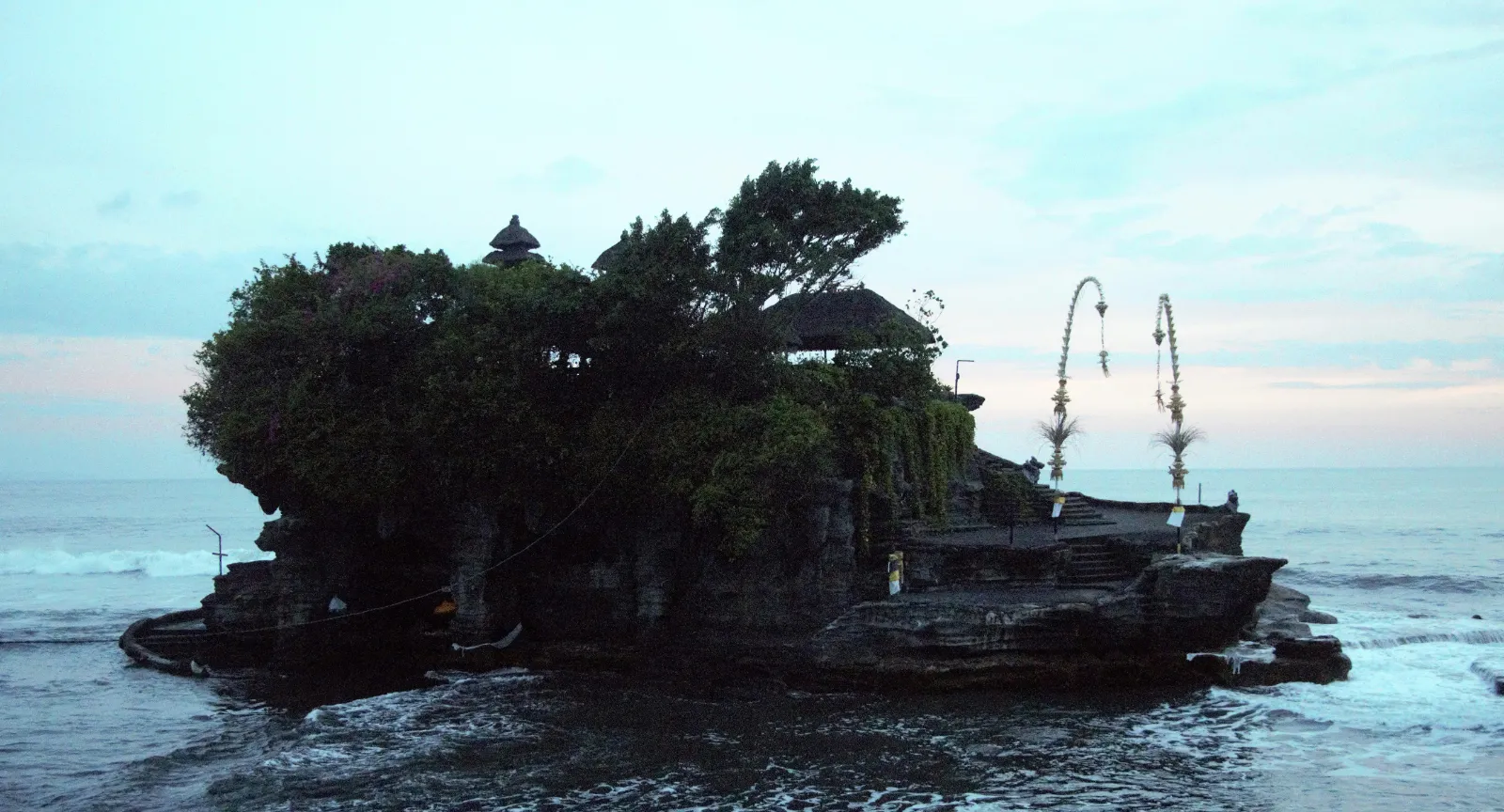
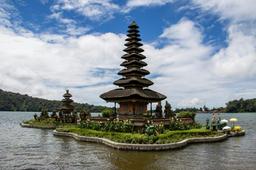
Tanah Lot, formally Pura Luhur Tanah Lot, is one of the main sea temples of Bali, dedicated to the power of the sea. The name means "land in the sea" in Balinese, which is exactly what you see: a dark rock islet topped with trees and tiered shrines, joined to the beach by sand and reef at low tide and cut off by the water at high tide.
According to Indonesia's official tourism site, the temple's history is believed to go back to the 16th century and is attributed to Dang Hyang Nirartha, a priest who travelled from Java and is remembered in Bali as one of the great religious teachers of the island. His wider legacy is visible across Bali: he is credited with spreading the padmasana, the tall stone lotus throne left empty for the supreme god, which you will find in almost every major temple. The main deity of Tanah Lot is described as Dewa Baruna or Bhatara Segara, the god of the sea. For a reader from Nepal, Baruna is simply the Balinese form of Varuna.
Tanah Lot is counted among the seven main Balinese sea temples along the southwestern coast, a group that also includes the clifftop sea temple at Uluwatu. The site sits in Beraban village, Kediri district, Tabanan regency.
Tanah Lot at a glance
The table below collects the core facts, with the source for each. Anything marked as reported was correct in the named report and may have changed since.
| Item | Detail | Source |
|---|---|---|
| Full name | Pura Luhur Tanah Lot | detikBali, 26 Jun 2026 |
| Location | Beraban village, Kediri, Tabanan regency, southwest Bali | Wikipedia; detikBali |
| Distance from Denpasar | About 20 km northwest | Wikipedia |
| Main deity | Dewa Baruna (Bhatara Segara), the sea god | Indonesia Travel; Wikipedia |
| Founder tradition | Dang Hyang Nirartha, 16th century | Indonesia Travel |
| Temple anniversary (pujawali) | Every 210 days, on Buda Wage Langkir in the pawukon calendar | Indonesia Travel (Indonesian page) |
| Visits in 2025 | More than 1.4 million, about 48 per cent foreign | detikBali, 30 Dec 2025 |
| Top foreign markets in 2025 | India, China and France | detikBali, 30 Dec 2025 |
| Opening hours | No official hours are published. Unofficial guides agree on a 19:00 close but give opening times from 06:00 to 07:00; the official tourism page says hours can change, so check with the site management | Indonesia Travel; unofficial guides (SB Excursion, tanahlot.org), checked 18 Nov 2026 |
| Who may enter the temple on the rock | People coming to pray, in Balinese temple dress | Antara Bali, 2022 and 2023; Governor's Circular No. 7 of 2025 |
Why does the rock look so solid if the sea is eroding it?
Because it has been reinforced. The rock face began to crumble in the 1980s, and conservation work since then has added a great deal of artificial support around the base and the shoreline. The World Monuments Fund placed Tanah Lot on its 2000 Watch list because of erosion and reports that about 100 concrete supports were installed along the shoreline in 1986. Wikipedia notes that more than a third of what you see as "rock" today is artificial, created during a Japanese-funded conservation programme.
A separate restoration of the shrines themselves is also in progress. NusaBali reported on 2 January 2025 that the first phase was complete and that new shrine structures were being made off site in a workshop, and The Bali Sun added on 5 January 2025 that the existing main shrine would stay in place until its replacement was ready. The work was targeted for completion in 2026, with the consecration ceremonies, Pamlaspas and Karya Memungkah, planned for 2027. We could not confirm the current stage of the work on 18 November 2026, so do not be surprised by new stonework or scaffolding.
What does Tanah Lot mean for a Hindu visitor from Nepal?
For a Hindu traveller from Nepal, Tanah Lot is a working Hindu temple, not a ruin or a museum, and much of what happens there will feel familiar: holy water, flowers, incense, rice grains on the forehead, and priests who chant mantras over the offerings. The differences are in how the temple is laid out, how the calendar works and who goes where inside. Our guide to how Balinese Hinduism differs from Hinduism in South Asia covers the religion in depth; this section is only what matters at Tanah Lot.
Balinese Hinduism, officially Agama Hindu Dharma, is sometimes called a religion of holy water, and Tanah Lot shows why. The freshwater spring at the foot of the rock is the reason most local worshippers come, and the short blessing ritual at the spring is the closest a non-worshipper gets to taking part.
Shared roots and real differences
This comparison is meant as a quick orientation for visitors who grew up with Hindu practice in Nepal. Practice varies between families and villages in both places.
| Element | Familiar from Nepal | How it works at Tanah Lot and in Bali |
|---|---|---|
| Holy water | Jal or tirtha from a river, a spring or a temple | Tirta from the spring at the base of the rock is sprinkled on the hands and head and sipped |
| Mark on the forehead | Tika and akshata (rice grains) | A few grains of wet rice, called bija, pressed to the forehead and sometimes the throat |
| Gods | Shiva, Vishnu, Brahma, Varuna and many others | The same names, understood as forms of one supreme god, Sang Hyang Widhi Wasa; the sea god here is Baruna |
| Temple building | A shrine with a murti (image) you approach for darshan | A walled compound of open courtyards with pavilions and empty thrones; deities are invited to descend during ceremonies |
| Tiered roofs | Pagoda temples such as those in Kathmandu Valley | Meru towers with odd numbers of thatched roofs, visible on top of the Tanah Lot rock |
| Festival calendar | Lunar dates in Bikram Sambat (Dashain, Tihar) | A 210-day pawukon cycle for Galungan, Kuningan and temple anniversaries, plus the Saka calendar for Nyepi |
| Big festival theme | Dashain celebrates the victory of good over evil | Galungan marks the victory of dharma over adharma and the return of ancestral spirits |
| Ritual purity | Menstruating women often stay away from puja | A similar rule is commonly posted at Balinese temple entrances and is written into Bali's 2025 visitor circular |
Two things often surprise Nepali visitors. First, there is no image to take darshan of: the shrines on the rock are seats for the divine, not houses for a murti. Second, being Hindu does not by itself open the temple steps. Access to the temple courtyards is for people who come to pray in proper Balinese dress, and in practice it is at the discretion of the temple's priests (pemangku). If you want to pray rather than look, ask the temple staff at the base, be prepared to wear full temple dress, and accept their answer gracefully. Antara reported in April 2023 that tourists were temporarily not allowed into the temple at all, with an exception only for people praying in full dress and accompanied by a pemangku. Nepali Hindus who want to see more of this family of traditions abroad may also like our round-up of Hindu temples outside South Asia.


Can you go inside Tanah Lot?
No, not if you are visiting as a tourist. You can walk around the clifftop gardens, cross to the base of the rock at low tide, receive holy water at the spring, and see the guardian snakes, but the stairway up into the temple on the rock is for worshippers. ANTARA's Bali bureau reported in June 2022 that only people who intend to pray may enter the temple area because it is sacred, and Bali's Governor's Circular No. 7 of 2025 bars foreign visitors from the inner and middle courtyards of any temple except to worship in traditional or prayer dress.
The picture on the ground has varied slightly over the years. A Liputan6 report from April 2023 described visitors who had received purification water being allowed up for photos as far as the penataran courtyard, while ANTARA's report the day before said tourists were temporarily barred from the temple. Because this changes, treat the temple on the rock as off limits unless staff at the base tell you otherwise on the day.
Who may go where at Tanah Lot
This table summarises access as reported by the official Indonesia Travel page, ANTARA Bali (2022, 2023, 2024) and the 2025 Governor's Circular. Staff can close the beach crossing at any time for safety or ceremonies.
| Area | Visitors | Worshippers | Notes |
|---|---|---|---|
| Entrance, market lane and parking | Yes | Yes | Busy souvenir lane between the car park and the coast |
| Clifftop gardens and viewpoints | Yes | Yes | Main sunset terraces and cliffside cafes |
| Beach and reef to the base of the rock | Yes, at low tide | Yes, at low tide | Closed in high tide or big swell |
| Holy spring and blessing at the base | Yes | Yes | Modest dress; a donation is customary |
| Holy snake cave | Yes | Yes | Guarded by a handler; the snakes are venomous |
| Steps and courtyards on the rock | No | Yes, in full temple dress | Not during menstruation; at the priests' discretion |
| Batu Bolong shrine on the arch | View only | Yes | Access was limited during crack repairs reported in October 2024 |
What happens at the holy spring?
At the base of the rock is a freshwater spring, which local belief holds to have healing power (ANTARA Bali, April 2024). When the tide is low, a temple attendant pours a little of this water into your cupped hands to sip and to wash your face and head, then presses a few grains of wet rice to your forehead. There is no fixed charge; a small donation is customary. ANTARA quoted the temple's water priest in April 2023 explaining that visitors may pray and make a wish "according to their own beliefs" before drinking or washing with it.
For a Hindu visitor this is the moment that feels most like home. For anyone else, treat it the way you would a blessing at any shrine: stand quietly in the queue, cover up, use your right hand, and do not turn it into a photo set-piece while others are waiting.
What is the holy snake at Tanah Lot?
The holy snakes are black-and-white banded sea snakes that live in the small caves in the rock face near the temple. Local tradition, recorded on the official Indonesia Travel page, holds that they live "around the rock cave as guardians of Pura Tanah Lot", and the legend says Nirartha turned his scarf into a snake to protect the temple. A cave marked as the holy snake cave, directly facing the temple, is kept by a handler, and visitors are encouraged to see it.
These are sea kraits, and they are venomous. Some handlers invite visitors to touch one; you do not have to, and with children it is wiser not to. Keep your hands where the handler tells you and do not try to touch snakes you see in the rocks on your own.
When is the best time to visit Tanah Lot for sunset?
The best time to visit Tanah Lot for sunset is to arrive about 90 minutes before sunset, which gives you time to walk to the base if the tide is low, receive the blessing, and then climb back to the clifftop for the light. In practice that means arriving between about 16:30 and 17:15 depending on the month. Sunset at Tanah Lot is earliest in late May and early June, at about 18:07, and latest in late January and early February, at around 18:45 to 18:47.
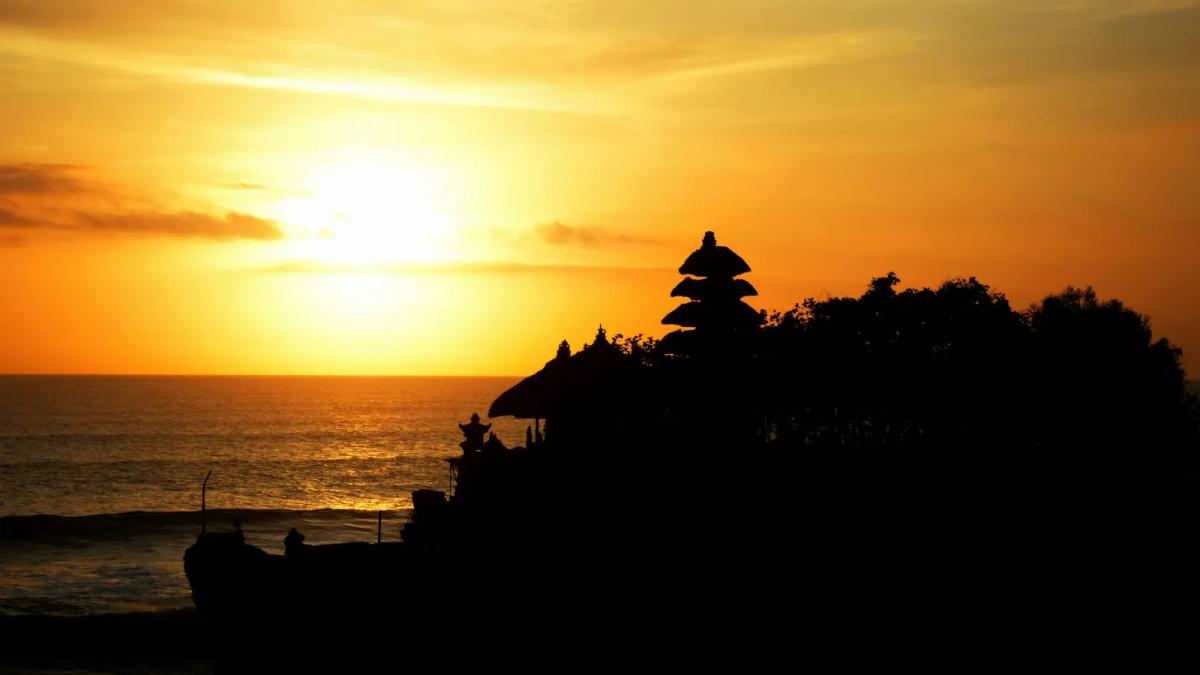
The Tanah Lot sunset is the reason most visitors come. The temple faces west across the Indian Ocean, so the sun drops behind or beside the rock depending on the season, and the rock turns into the classic silhouette. The best colour is often in the 15 to 25 minutes after the sun touches the horizon, so do not pack up the moment it disappears.
Sunset times at Tanah Lot by month
The times below are in local Bali time (WITA, UTC+8). They come from the US Naval Observatory's sun and moon data service for Tanah Lot's coordinates (checked 18 November 2026), and agree to within a minute or two with the published sunset table for nearby Tabanan on sunrisesunset.io. "Last light" is the end of civil twilight, when it becomes too dark to see the rock without lights. Weather, haze and cloud on the horizon can make the visible sunset a few minutes earlier.
| Month | Sunset on the 1st | Sunset on the 15th | Last light on the 15th | Suggested arrival |
|---|---|---|---|---|
| December 2026 | 18:26 | 18:33 | 18:56 | 17:00 |
| January 2027 | 18:42 | 18:46 | 19:09 | 17:15 |
| February 2027 | 18:47 | 18:45 | 19:07 | 17:15 |
| March 2027 | 18:40 | 18:33 | 18:54 | 17:00 |
| April 2027 | 18:24 | 18:17 | 18:38 | 16:45 |
| May 2027 | 18:11 | 18:08 | 18:30 | 16:30 |
| June 2027 | 18:07 | 18:09 | 18:32 | 16:30 |
| July 2027 | 18:12 | 18:16 | 18:38 | 16:40 |
| August 2027 | 18:18 | 18:19 | 18:41 | 16:45 |
| September 2027 | 18:18 | 18:16 | 18:37 | 16:45 |
| October 2027 | 18:15 | 18:14 | 18:35 | 16:40 |
| November 2027 | 18:16 | 18:19 | 18:41 | 16:45 |
Because the sun's timing barely shifts from year to year, these figures are a good guide for later years too, give or take a minute.
How to time it on the day
- Check the sunset time for your date in the table above or on a sunrise and sunset site for Tabanan.
- Check the tide. If low tide falls in the two to three hours before sunset, arrive early enough to cross to the base first. If the tide is high, you only need to be at the clifftop about 45 minutes before sunset.
- Work back from your hotel. Add the driving time from the getting-there table below, then add 30 minutes for late-afternoon traffic. From Ubud or Kuta that often means leaving around 15:00.
- Pick your spot. The main terraces facing the rock fill first. The Batu Bolong and Enjung Galuh area, a short walk along the cliff, gives another view over the Indian Ocean and a different angle on the coast.
- Plan the return. Everyone leaves at once after sunset, and the drive back to the south can take far longer than the drive out. Book a driver who waits for you rather than hoping to find a ride at dusk.
Is Tanah Lot crowded at sunset?
Yes, Tanah Lot is at its most crowded in the hour before sunset, especially on weekends, Indonesian public holidays and in the July and August peak. detikBali reported on 30 December 2025 that daily visits averaged 2,000 to 2,500 people outside holiday periods and rose to about 5,800 in a single day over the Christmas holiday and roughly 6,000 on 29 December 2025. ANTARA reported about 5,000 visitors a day after the 2024 Lebaran holiday. Most of these people arrive in the same window, between roughly 16:30 and sunset.
If you want the temple without the crowd, come early. The first two hours after opening are much quieter, the morning sun lights the face of the rock, and on days when low tide falls in the morning the spring is easier to reach.
Best time of day compared
| Time of day | Crowds | Light and photos | Good for |
|---|---|---|---|
| Early morning, first two hours | Low | Soft light on the face of the rock | Families, quiet prayer, photos without people |
| Late morning to mid afternoon | Moderate | Harsh overhead light, hot | Combining with Taman Ayun or the rice terraces inland |
| Late afternoon to sunset | Very high | Silhouette and colour | The classic sunset view, couples |
| After sunset, last light | Falling | Blue sky behind the dark rock | Photographers willing to leave in traffic |
Which season gives the best sunsets?
The dry season, roughly April to October, gives the most reliable clear sunsets and calmer seas, with July and August the busiest months. The wet season, roughly November to March, brings heavier cloud and bigger swell, so a clear sunset is less certain and the crossing to the rock is more often closed. Our guide to the best time to visit Bali month by month covers the weather in detail.
Many Nepali families travel during the Dashain and Tihar holidays, which usually fall between late September and November. That is the tail of the dry season and the start of the wet one: sunsets at Tanah Lot fall at about 18:14 to 18:27, and afternoon showers become more likely as November goes on, so keep a second evening free in case the first one is clouded out.
How do tides affect your visit?
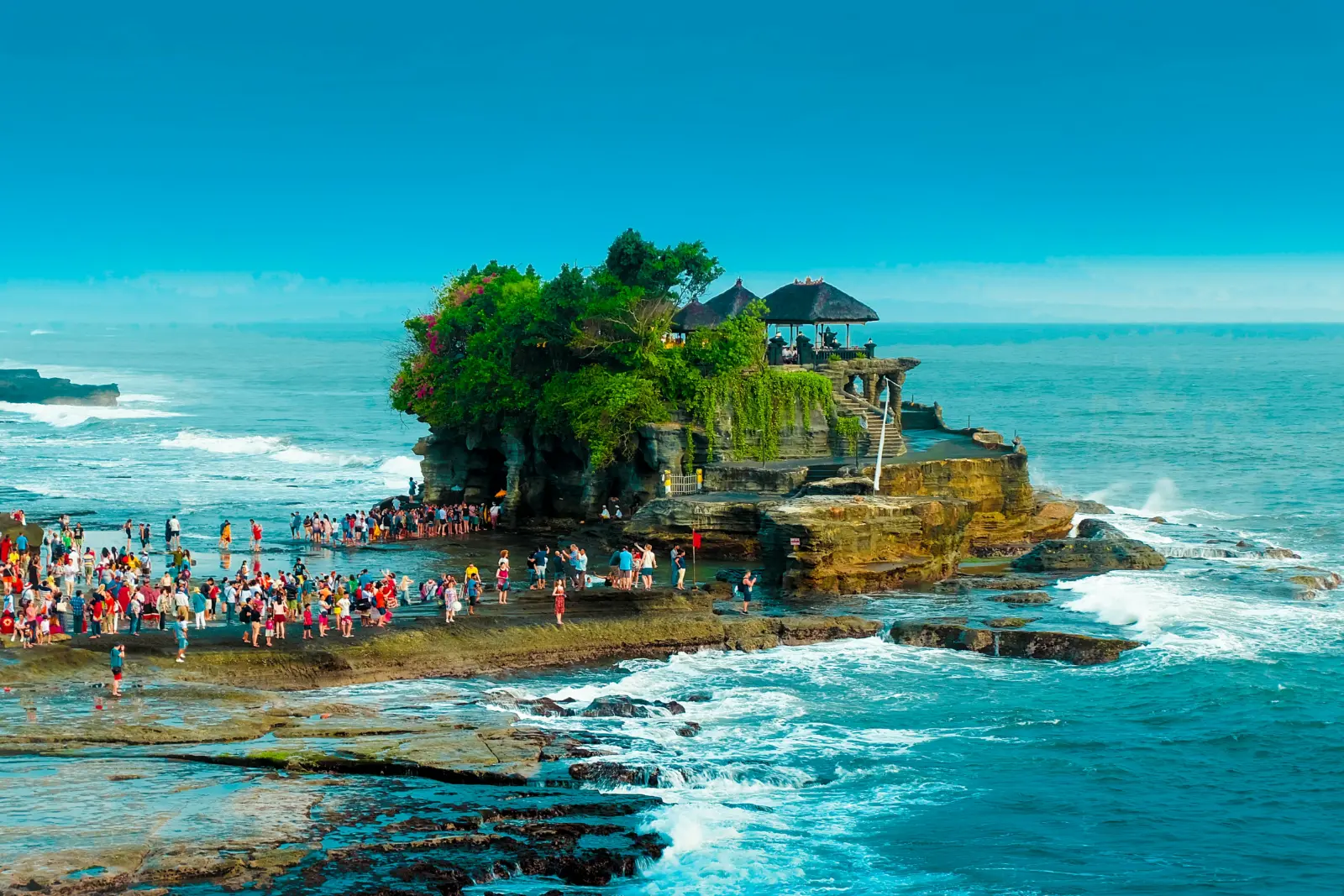
The tide decides whether you can reach the base of the rock. At low tide, sand and flat reef are exposed and you can walk across to the spring and the foot of the temple stairs. At high tide, the rock is surrounded by water and you view the temple from the clifftop only. The official Indonesia Travel page puts it simply: at low tide, part of the access from the land opens up, and at high tide the rock is surrounded by water.
The difference is large. Temple managers told ANTARA Bali in June 2022 that the water can rise above two metres at high tide, compared with about half a metre at low tide, and that warning signs go up when the tide is high. During the rainy season the Tabanan authorities also ask visitors to keep off the coastal area when waves exceed four metres (The Bali Sun, 5 January 2025).
Tide and access at a glance
Use this as a rule of thumb, not a guarantee; staff on the beach make the final call.
| Sea state | Can you cross to the base? | Holy spring and blessing | What to do instead |
|---|---|---|---|
| Low tide, calm sea | Yes, on foot across wet sand and reef | Usually available | Wear sandals with grip; expect wet feet |
| Rising or falling tide | Sometimes, if staff allow | Sometimes | Cross early and come back before the water rises |
| High tide | No | Not reachable | Watch from the clifftop; visit Batu Bolong and Enjung Galuh |
| Big swell, any tide | No, crossing closed | Not reachable | Stay well back from the edge on the cliff paths |
| Ceremony day | For worshippers first | Busy with worshippers | Give way to processions; watch from the side |
How to read the tide for Tanah Lot
Tides on this coast follow the moon. A lunar day is about 24 hours and 50 minutes long (NOAA), so low tide arrives roughly 50 minutes later each day. If low tide is at 15:00 today, it will be close to 16:40 two days later, and a late-afternoon low tide that lines up with sunset only happens on a few days in each two-week cycle. The lowest low tides come around the new and full moon.
- Look up a tide forecast for the Tabanan or Tanah Lot coast the day before, and again in the morning.
- Aim to be on the beach within about an hour either side of low tide.
- Ask at the information point on arrival. Before the July 2026 festival, the site's operations manager told detikBali that tide estimates are provisional because conditions can change at any time, and that all staff were on standby in the field.
- Never cross against staff instructions, and never stay on the rock as the water comes in. The reef is slippery and waves here can knock adults over.
When is the Tanah Lot odalan and other festival days?
The next Tanah Lot temple anniversary (odalan, also called pujawali or piodalan) is expected to begin on Wednesday 27 January 2027, followed by Wednesday 25 August 2027. The festival comes round every 210 days on Buda Wage Langkir in the Balinese pawukon calendar, four days after Kuningan, according to Indonesia's official tourism site and ANTARA Bali. The last one ran from 1 to 4 July 2026 (detikBali, 26 June 2026). We worked out the 2027 dates by counting the 210-day cycle forward from that confirmed date; check locally before you plan a trip around them.
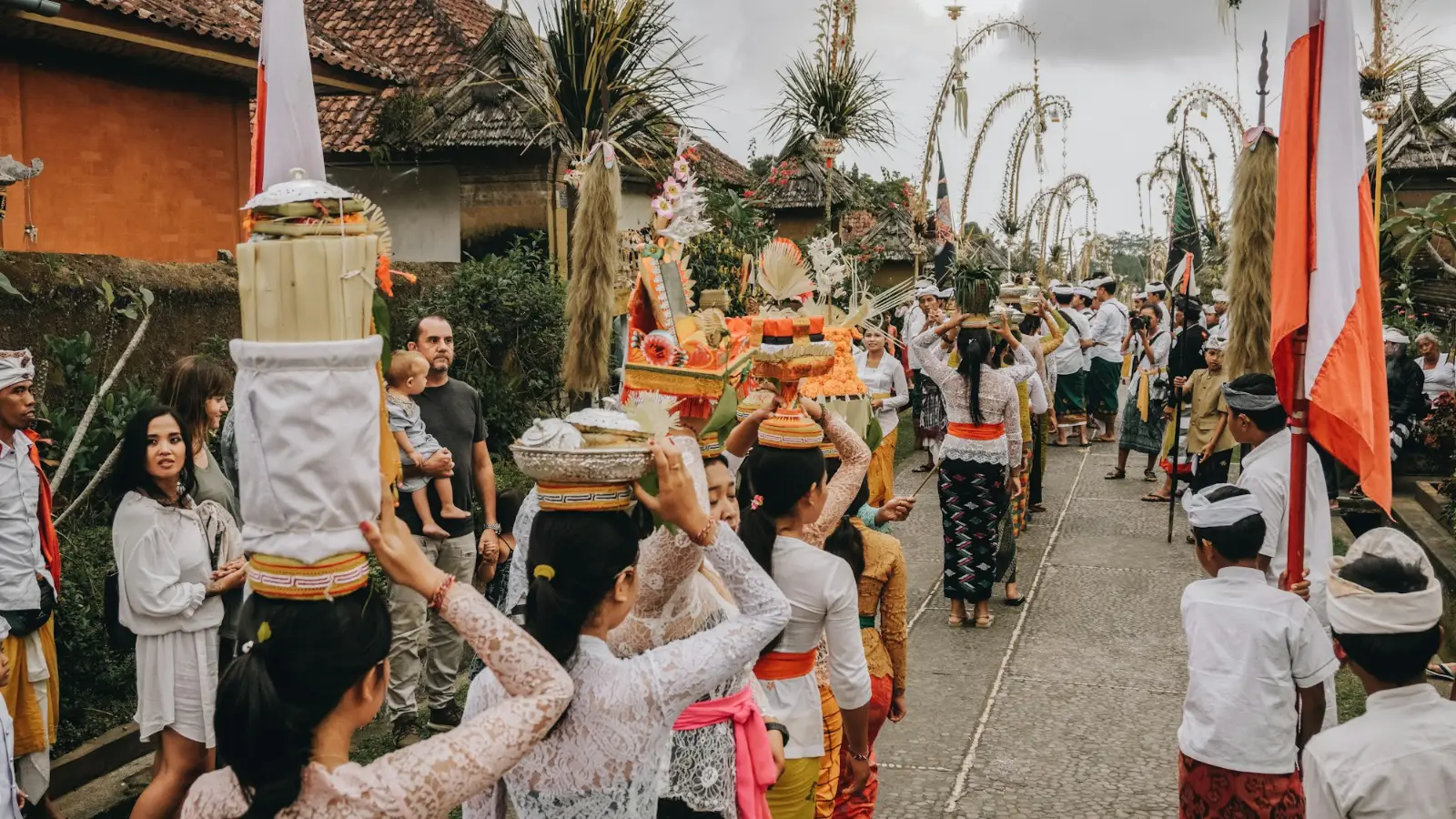
During odalan, large numbers of Balinese worshippers in white and gold temple dress cross to the rock with tall offerings balanced on their heads, gamelan music plays and the whole complex is decorated with penjor poles. It is the most beautiful time to see Tanah Lot and also the busiest. The site stayed open to tourists during the July 2026 ceremonies, with operations "running normally" according to the manager quoted by detikBali; expect worshippers to have priority at the base of the rock and the spring.
How does the pawukon calendar work?
The pawukon is a 210-day cycle made up of thirty seven-day weeks, each with its own name, running alongside several shorter cycles, including a five-day market week. A named day such as Buda Wage Langkir, meaning the Wednesday (Buda) that is also Wage in the five-day cycle, in the week called Langkir, comes round only once in every 210 days. That is why Balinese temple festivals do not fall on the same date each year, much as Dashain moves within the Gregorian calendar because it follows a lunar one.
Festival and closure dates to know
Dates below are for the coming year. Galungan and Kuningan dates follow the same 210-day count from the 2026 calendar published by detikBali; Nyepi 2027 is from the government's official holiday list published by the State Secretariat on 15 September 2026.
| Date | Observance | What it means at Tanah Lot |
|---|---|---|
| Wednesday 13 January 2027 | Galungan | Penjor poles across Bali; busier temples |
| Saturday 23 January 2027 | Kuningan | Many local worshippers; ceremonial dress everywhere |
| Wednesday 27 January 2027 (expected) | Tanah Lot pujawali begins | Large ceremonies over several days; worshippers have priority at the base |
| Monday 8 March 2027 | Nyepi, day of silence | All of Bali shuts for 24 hours, airport included; no visits possible |
| Wednesday 11 August 2027 | Galungan | As above |
| Saturday 21 August 2027 | Kuningan | As above |
| Wednesday 25 August 2027 (expected) | Tanah Lot pujawali begins | As above |
One more thing to watch: the Pamlaspas and Karya Memungkah consecration ceremonies for the restored shrines were planned for 2027 (NusaBali, 2 January 2025). Ceremonies on that scale can bring very large crowds and temporary restrictions. We could not find their dates on 18 November 2026; if you are visiting in 2027, ask your hotel or driver in the week before.
What should you wear and how should you behave?
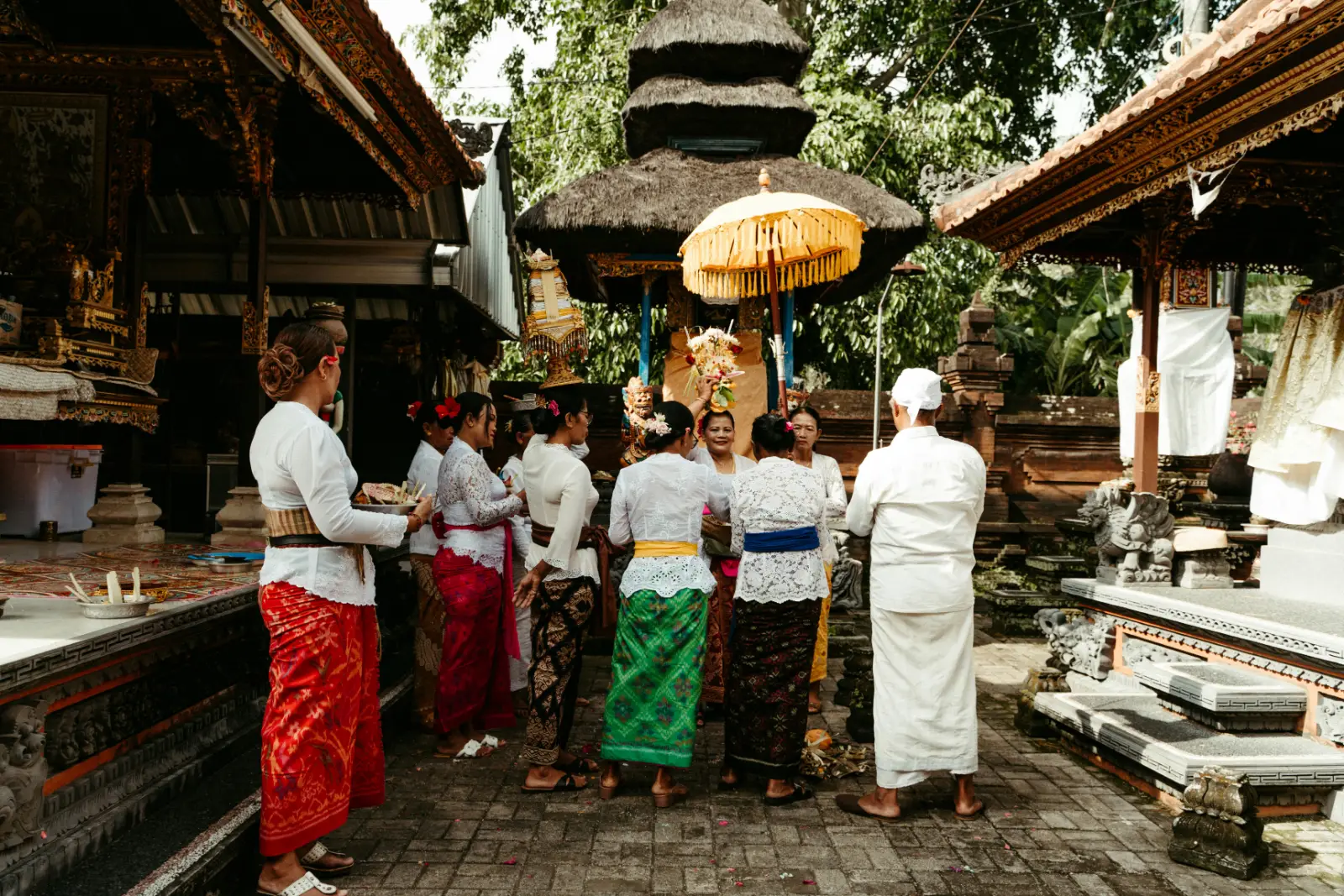
Wear light clothes that cover your shoulders and knees, and carry a sarong and sash for the holy spring and anywhere near the shrines. The clifftop gardens and market are a public tourist area where ordinary modest clothing is fine. ANTARA reported in 2023 that worshippers must wear full Balinese temple dress, while tourists may wear normal clothes in the open areas. Bali's Governor's Circular No. 7 of 2025 asks every foreign visitor to "dress modestly, appropriately, and respectfully when visiting sacred areas, tourist attractions, public places".
What to wear to Tanah Lot
| Item | For a visitor | For someone coming to pray |
|---|---|---|
| Top | T-shirt or blouse covering the shoulders | White or light temple shirt; kebaya for women |
| Lower half | Knee-length shorts or skirt, or trousers | Kamen (sarong) wrapped to the ankle |
| Sash | Carry one for the spring and blessing | Selendang or temple sash tied at the waist |
| Head | Hat for the sun is fine in open areas | Udeng headcloth for men |
| Feet | Sandals with grip for the wet reef | Sandals |
| Bag | Small, with a dry pouch for phone and cash | Offerings, if you have brought them |
Rules that apply at Tanah Lot
The first four rules below come from the Governor of Bali's Circular No. 7 of 2025 on the conduct of foreign tourists, dated 21 March 2025 and published by the provincial tourism office (full text, PDF); the rest are general Balinese temple etiquette. Breaking the circular's rules can lead to sanctions under Indonesian law.
- Do not enter the inner or middle courtyards of the temple unless you are there to pray in traditional or prayer dress.
- Women who are menstruating should not enter the inner and middle courtyards, even to pray; this is a ritual purity rule that applies to Balinese women too.
- Do not climb on shrines, sacred structures or sacred trees, including for photos.
- No indecent or inappropriate photos at sacred places, and no swimwear around the spring or the shrines.
- Do not walk in front of people praying or between them and the shrine they face.
- Do not step on offerings placed on the ground; walk around them.
- Keep drones away from worshippers and ceremonies, and follow any posted drone rules.
Most of this is common sense for anyone who has visited Pashupatinath or Muktinath. The full list of Bali etiquette, including how to behave on the street, in villages and at other temples, is in our Bali do's and don'ts guide.
Tips for families, couples and older travellers
- With children: hold hands on the reef, keep them well back from the cliff edge, and skip touching the snakes.
- With older parents: the reef at low tide is uneven and wet, so it is not for everyone. The clifftop gardens give a full view without crossing.
- Couples: the sunset is the reason most honeymooners come; a cliffside table at one of the cafes is calmer than the main terraces.
- Vegetarian travellers: at the cafes and warungs near the entrance, ask for dishes without meat, fish or shrimp paste (terasi).
What else is near Tanah Lot?
Tanah Lot is not a single temple but a complex of several temples spread along the cliffs, and two of Bali's best-known temples inland and to the south pair well with it. Indonesia's official tourism site lists Pura Batu Bolong, Pura Luhur Pakendungan, Pura Jro Kandang and Pura Batu Mejan (also called Pura Beji) among the temples of the Tanah Lot area, and names Enjung Galuh as a viewpoint over the Indian Ocean.
Batu Bolong, the temple on the arch
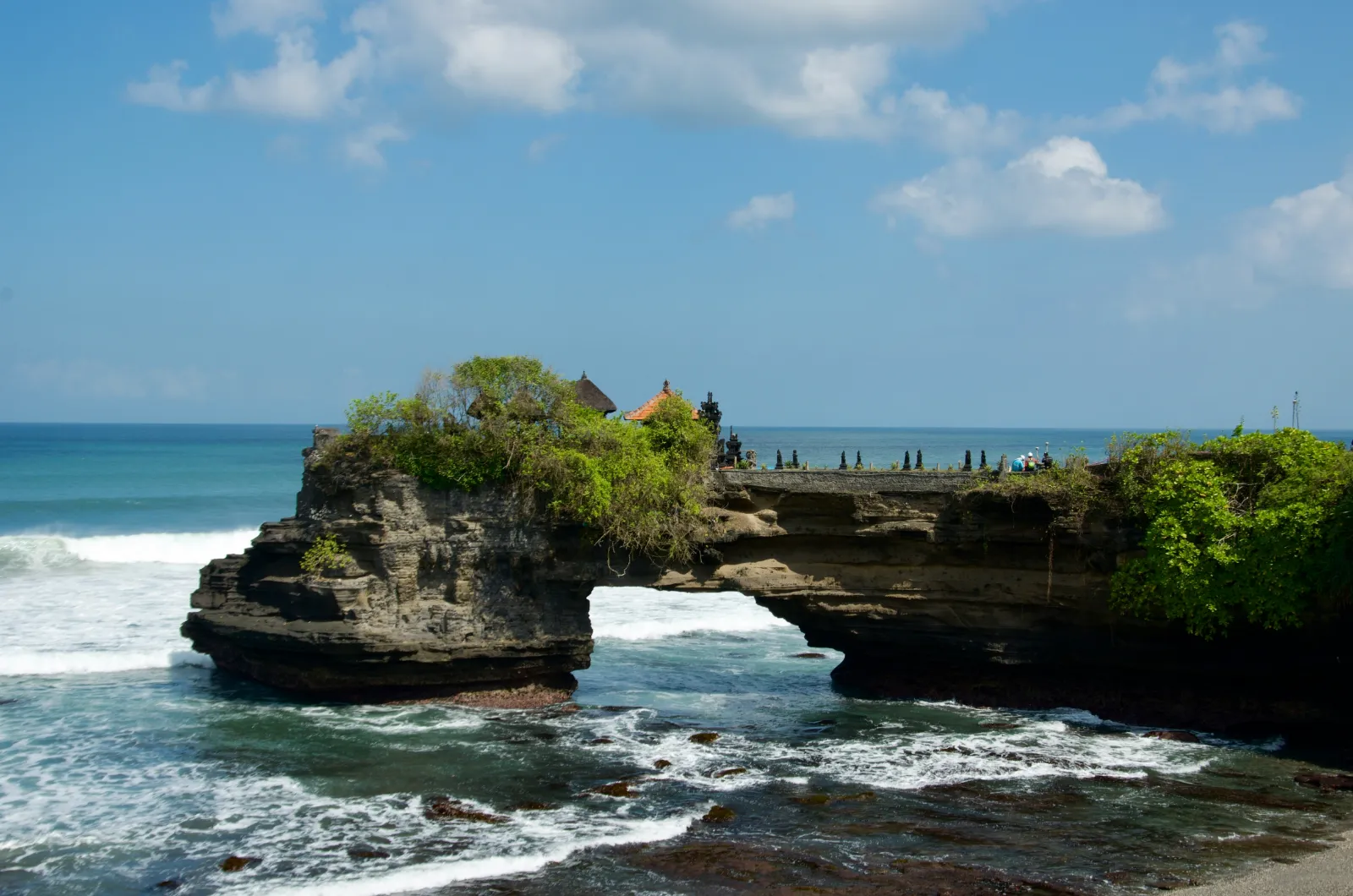
Pura Batu Bolong, "the hollow rock", is a small temple built on a headland that the sea has cut through into a natural arch, a few minutes' walk along the cliff from the main temple. Indonesia Travel describes it as the twin of Tanah Lot. At high tide the waves break straight through the arch below the shrine, which makes it one of the best photographs in the complex.
Bali Discovery reported on 6 October 2024 that inspectors had found ten cracks in the cliff, that the river basin authority was carrying out repairs, and that visitor access to the temple was limited while the work went on. We could not confirm on 18 November 2026 whether those limits have since been lifted, so treat the walkway on top of the arch as off limits unless it is clearly open, and view it from the cliff. Note that a map search for "Batu Bolong" can send you to the beach of the same name in Canggu, which is a different place.
The other temples in the complex
| Temple | Where | Why stop |
|---|---|---|
| Pura Luhur Tanah Lot | On the offshore rock | The main sea temple; view from the base at low tide |
| Pura Batu Bolong | On a rock arch west along the cliff | Waves through the arch; good sunset angle |
| Enjung Galuh | On the clifftop near Batu Bolong | Viewpoint over the Indian Ocean |
| Pura Batu Mejan (Pura Beji) | Near the coast in the complex | Spring regarded as purification water (tirta panglukatan) |
| Pura Luhur Pakendungan | Northwest of Tanah Lot | Part of the same temple group |
| Pura Jro Kandang | Within the Tanah Lot area | Part of the same temple group |
Paths within the complex change with repair works, so follow the signs from the main terraces.
Pura Taman Ayun, the royal water temple
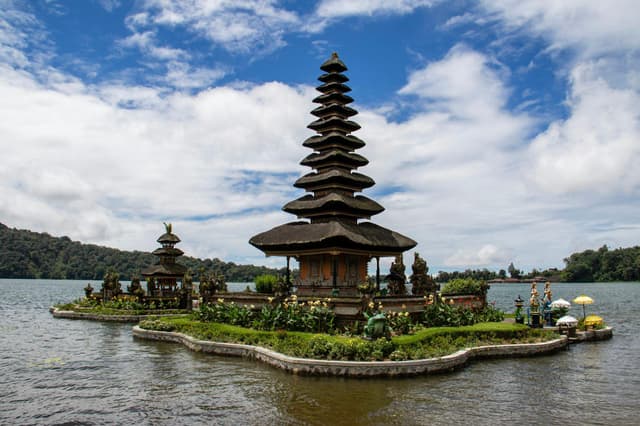
Pura Taman Ayun in Mengwi is the easiest add-on to a Tanah Lot afternoon, about 15 km away by road. It is the royal temple of the former kingdom of Mengwi (UNESCO calls it an 18th-century royal water temple, while other accounts date its founding to 1634), is surrounded by a wide moat and is known for its many-tiered meru towers. UNESCO inscribed it in 2012 as part of the Cultural Landscape of Bali Province: the Subak System as a Manifestation of the Tri Hita Karana Philosophy, describing it as the largest and most architecturally distinguished regional water temple on the island. Visit it in the early afternoon, then continue to Tanah Lot for the sunset.
Can you combine Tanah Lot with Uluwatu?
You can, but it is a long day, because the two sea temples sit at opposite ends of the southwest coast, around 43 km apart by road and typically 1.5 to 2 hours each way in traffic. Both are sunset temples, so you cannot do both at sunset on the same evening. Most visitors are happier giving each its own afternoon: Taman Ayun and Tanah Lot on one day, Uluwatu and its Kecak dance on another. Our overview of the best temples in Bali helps you choose which ones to fit in.
| Combination | Order | Works for |
|---|---|---|
| Taman Ayun and Tanah Lot | Taman Ayun early afternoon, Tanah Lot for sunset | First-time visitors, families, temple lovers |
| Tanah Lot morning and Canggu | Tanah Lot early, cafes and beach in Canggu afterwards | Couples avoiding crowds |
| Rice terraces inland and Tanah Lot | Jatiluwih or other Tabanan terraces in the morning, Tanah Lot late | Photographers, a full day with a driver |
| Tanah Lot and Uluwatu | Tanah Lot morning, Uluwatu sunset | Visitors with only one day for temples |
ANTARA Bali reported in April 2024 that a Kecak dance is staged at Tanah Lot in the late afternoon until sunset, so you can see Kecak here too if Uluwatu does not fit your plan. Check the schedule at the entrance on the day.
How do you get there from Ubud, Seminyak or Kuta?
Most visitors reach Tanah Lot by private car with a driver, taking 30 to 50 minutes from Canggu, about an hour or more from Seminyak, 1 to 1.5 hours from Kuta and the airport, and 1.5 to 2 hours from Ubud. There is no train, and public buses are not practical for a sunset visit. The road distances below are from Rome2rio and Daytrip route data; the typical times are from two Bali transport guides published in 2026 (Gede Bali Transport, 28 February 2026, and SB Excursion, updated 27 October 2026), which allow for normal traffic. Map apps often show the free-flow time, which is much shorter than what you will actually drive in the afternoon.
| From | Road distance (approx.) | Typical drive in daytime traffic | Return after sunset |
|---|---|---|---|
| Canggu | About 11 to 13 km | 30 to 50 minutes | Slower than the way out |
| Seminyak | About 18 km | 45 to 90 minutes | Often 1 to 2 hours |
| Kuta and Legian | About 22 km | 1 to 1.5 hours, sometimes more | Often 1 to 2 hours |
| Ngurah Rai airport | About 26 km | 1 to 1.5 hours | Allow at least 2 hours before a flight |
| Ubud | About 32 to 40 km | 1.5 to 2 hours | Similar or longer |
| Uluwatu and the Bukit | About 43 km | 1.5 to 2 hours | Similar or longer |
| Pura Taman Ayun, Mengwi | About 15 km | Allow 30 to 45 minutes | Not usually needed |
Practical tips for the drive
- Hire a driver who waits. Finding a ride from the car park at dusk, when thousands leave at once, can be slow and stressful.
- Leave earlier than you think. Traffic on the approach roads builds in the late afternoon, exactly when everyone heads for the sunset.
- Do not plan Tanah Lot on your arrival or departure day unless your flight is late at night and you have a big buffer.
- Carry cash in small notes for the blessing donation, parking and snacks.
- Check Nyepi. On 8 March 2027 the whole island, airport included, closes for 24 hours.
Coming from Nepal
There is no direct flight from Kathmandu to Bali, so Nepali travellers usually fly with one stop, most often through Kuala Lumpur, Bangkok or Singapore, into Ngurah Rai International Airport (DPS) near Kuta. Visa rules for Nepali passport holders change from time to time, so read our Indonesia visa page and check Indonesia's official e-Visa portal before booking. All international visitors to Bali must also pay the provincial tourist levy, which is paid online through the government's Love Bali portal before or during the stay. For visas, money and getting around the island, start with our Bali travel guide.
Is Tanah Lot worth visiting, and how long do you need?
Yes, Tanah Lot is worth visiting, as long as you go knowing what it is: a living temple that you watch and take a blessing at, not one you explore inside, and a sunset that you share with a crowd. Plan on 1.5 to 2 hours on site if you want to cross at low tide, visit the spring and see Batu Bolong before sunset, or about an hour if you only want the view. Add driving time on both sides and it becomes a half-day outing from most of the south.
It is especially worth it for Hindu visitors, who will recognise the holy water, the rice on the forehead and the gods behind the shrines; for couples who want the classic Bali sunset; and for families, because the clifftop gardens give a full view with little walking. It is less rewarding if you dislike crowds and can only come in the late afternoon of a holiday weekend; then the early morning is the better choice.
- Go early for calm and good light; go late for the sunset silhouette.
- Check the tide if you want to reach the spring.
- Check the festival calendar if you want, or want to avoid, the odalan crowds.
- Dress modestly and keep off the temple steps unless you are invited to pray.
If you would rather have the driver, hotels and day trips arranged around a sunset at Tanah Lot, you can see how a full trip fits together in our Bali tour packages.
Frequently asked questions
Can you go inside Tanah Lot Temple?
No, visitors cannot climb into the temple on the rock at Tanah Lot. The temple courtyards are kept for people coming to pray in Balinese temple dress, and Bali's 2025 Governor's Circular bars foreign visitors from inner temple courtyards except to worship. At low tide you can walk to the base, receive holy water at the spring and see the temple up close.
What is the best time to visit Tanah Lot?
The best time to visit Tanah Lot is either the first two hours after opening, for calm and soft light, or about 90 minutes before sunset, for the famous silhouette. Sunset falls between about 18:07 in early June and 18:47 in early February. Check the tide too, because the base of the rock is only reachable at low tide.
Is Tanah Lot worth visiting?
Yes, Tanah Lot is worth visiting for its setting, its sunset and the chance to receive a blessing at a working Hindu sea temple. It is crowded and commercial around the entrance, and you cannot enter the temple itself, so go with the right expectations. Early morning visits are much quieter than the sunset hour.
How long do you need at Tanah Lot?
Plan about 1.5 to 2 hours at Tanah Lot if you want to cross to the base at low tide, take the holy water blessing, see Batu Bolong and stay for sunset. An hour is enough just for the clifftop view. With driving from Seminyak, Kuta or Ubud, the visit usually takes half a day.
What should I wear to Tanah Lot?
Wear light clothes that cover your shoulders and knees, and bring a sarong and sash for the holy spring and the area near the shrines. Sandals with good grip help on the wet reef at low tide. People who come to pray wear full Balinese temple dress, which is required for entering the temple courtyards.
Is Tanah Lot crowded at sunset?
Yes, Tanah Lot is very crowded at sunset, especially on weekends, holidays and in July and August. detikBali reported daily visits of 2,000 to 2,500 in normal periods and around 6,000 on peak holiday days in December 2025, most arriving in the late afternoon. Arrive early for a good spot or visit in the morning instead.
How far is Tanah Lot from Seminyak?
Tanah Lot is about 18 km by road from Seminyak. In normal daytime traffic the drive usually takes 45 to 90 minutes, and the return after sunset can take one to two hours because everyone leaves at the same time. Hire a driver who waits rather than looking for a ride at dusk.
What is the holy snake at Tanah Lot?
The holy snakes at Tanah Lot are banded sea snakes living in small caves in the rocks near the temple, believed in local tradition to guard it. A cave marked as the holy snake cave is looked after by a handler. They are venomous sea kraits, so follow the handler's instructions and do not touch snakes on your own.
Can you visit Tanah Lot at high tide?
Yes, you can visit Tanah Lot at high tide, but you cannot cross to the rock, the spring or the blessing point. You watch the temple from the clifftop gardens instead, which is where most people stand for the sunset anyway. In big swell or bad weather, staff may also ask visitors to keep away from the shore.
When is the next Tanah Lot temple festival?
The next Tanah Lot odalan, or pujawali, is expected to begin on Wednesday 27 January 2027, four days after Kuningan, and then on 25 August 2027. It falls every 210 days on Buda Wage Langkir in the Balinese calendar. The last one ran from 1 to 4 July 2026. Confirm locally before planning around it.
Tanah Lot mandir ma ke cha, ra Nepali Hindu le puja garna milcha?
Tanah Lot is a Balinese Hindu sea temple to Baruna (Varuna), with a holy freshwater spring at its base where visitors receive tirta and rice on the forehead, much like jal and akshata at home. A Nepali Hindu who wants to pray inside must wear full Balinese temple dress and ask the temple priests, who decide on the day.