


























































+977-9709047652
Explore by Country
See all 22 Thailand packages
Most popular pick
See all 22 Thailand packages →
See all 11 Vietnam packages
Most popular pick
See all 11 Vietnam packages →
See all 10 Indonesia (Bali) packages
Most popular pick
See all 10 Indonesia (Bali) packages →
See all 7 Maldives packages
Most popular pick
See all 7 Maldives packages →
See all 10 China packages
Most popular pick
See all 10 China packages →
See all 13 Sri Lanka packages
Most popular pick
See all 13 Sri Lanka packages →
See all 9 Malaysia packages
Most popular pick
See all 9 Malaysia packages →
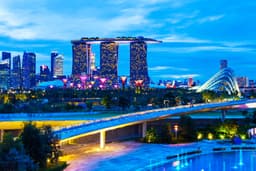
See all 8 Singapore packages
Most popular pick
See all 8 Singapore packages →
See all 2 Kenya packages
Most popular pick
See all 2 Kenya packages →
See all 16 India packages
Most popular pick
See all 16 India packages →
See all 3 Dubai packages
Most popular pick
See all 3 Dubai packages →
See all 7 Nepal packages
Most popular pick
See all 7 Nepal packages →
See all 6 Philippines packages
Most popular pick
See all 6 Philippines packages →
Search Tours or Places
Blog / Vietnam

Things to Do in Ho Chi Minh City: Markets, Museums and Food

27 min read 08 Oct 2026
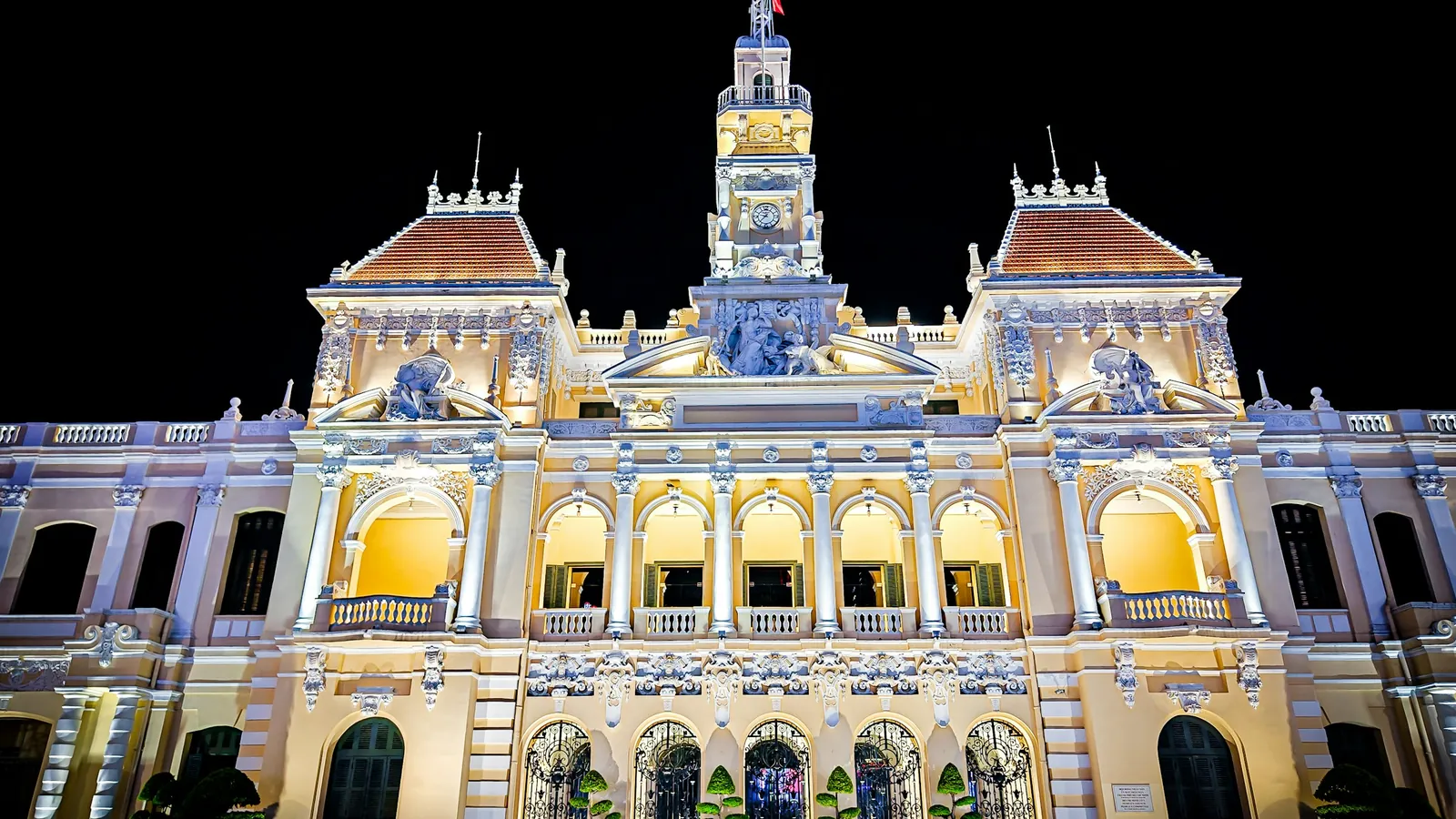
Ho Chi Minh City Hall lit up at night above Nguyen Hue Walking Street

Short answer: The best things to do in Ho Chi Minh City (Saigon) are browsing Ben Thanh Market, visiting the War Remnants Museum and Independence Palace, seeing the French colonial core around the Notre Dame Cathedral and Central Post Office, eating street food at night, and taking day trips to the Cu Chi Tunnels and the Mekong Delta. Plan three to four days, ideally in the dry season from December to April.

Ho Chi Minh City is Vietnam's largest city and its commercial engine: loud, fast, full of motorbikes and very easy to enjoy once you know where to point yourself. Most first-time visitors base themselves in the old centre that everyone still calls District 1, walk between the colonial landmarks, spend an afternoon on the city's difficult war history, and use the city as a launch pad for two classic day trips. This guide is written for international visitors, Nepali travellers flying in from Kathmandu and the Nepali diaspora meeting family in southern Vietnam. It is purely informational: no package prices and no day-by-day plans, just what each place is like, how long it takes and what to watch out for. For the bigger picture of the country, start with our complete Vietnam travel guide.

Checked: 8 Oct 2026. Opening hours below come from the official Independence Palace website and a February 2026 Saigon Giai Phong report on the War Remnants Museum, Metro Line 1 information from Ho Chi Minh City press reports, and restoration news from the Saigon cathedral parish and Vietnamese national media. Hours and access change, so confirm on the official source before you go.

What are the best things to do in Ho Chi Minh City?

The core list is short: one market, two war history sites, a cluster of French colonial buildings, a food night or two, Cholon (the old Chinese quarter), and day trips to the Cu Chi Tunnels and the Mekong Delta. Almost everything in the city centre is within a 20 to 30 minute walk of everything else, so a first visit is mostly about pacing yourself in the heat and saving the out-of-town trips for early starts.

Ho Chi Minh City and Saigon are the same place. The city was renamed in 1976, but "Saigon" is still used every day by locals, on shop signs and for the old centre. You will also see a new layer of names: on 1 July 2025 Vietnam abolished district-level government, Ho Chi Minh City absorbed the former provinces of Binh Duong and Ba Ria to Vung Tau, and the old districts were regrouped into wards. Old District 1, for example, is now mainly Saigon, Ben Thanh, Tan Dinh and Cau Ong Lanh wards. Taxi drivers, hotels and locals still use the old district numbers, so we give both below.

Attractions by area: old district and new ward

AttractionOld district (still widely used)Ward since July 2025Time to allowBest for
Ben Thanh MarketDistrict 1Ben Thanh1 to 2 hoursFood stalls, souvenirs, coffee
Notre Dame Cathedral and Central Post OfficeDistrict 1Saigon45 to 60 minutesArchitecture, photos
Saigon Opera House and Dong Khoi StreetDistrict 1Saigon30 minutes outside, longer for a showColonial streetscape, evening shows
Nguyen Hue Walking StreetDistrict 1Saigon1 hour in the eveningFamilies, night strolls
Bui Vien Walking StreetDistrict 1Ben Thanh1 to 2 hours after darkNightlife, backpackers
Independence PalaceDistrict 1 (on the District 3 border)Ben Thanh1.5 to 2 hoursModern history, 1960s design
War Remnants MuseumDistrict 3Xuan Hoa2 to 3 hoursWar history (adults and older teens)
Jade Emperor PagodaDistrict 1 (Da Kao area)Tan Dinh or Saigon (old Da Kao ward was split)30 to 45 minutesTaoist temple interior
Cholon: Binh Tay Market and Thien Hau TempleDistricts 5 and 6Cho Lon, Binh Tay and nearby wardsHalf a dayChinese heritage, wholesale markets
Cu Chi Tunnels (Ben Dinh, Ben Duoc)Cu Chi districtNhuan Duc and An Nhon Tay communesHalf day to a full dayHistory, outdoors
Mekong Delta day tripOutside the cityDong Thap and Vinh Long provincesFull dayRiver life, orchards, families

Ward names: Vietcetera post-merger guide and Vietnamese government notices on Resolution 1685/NQ-UBTVQH15. Checked: 8 Oct 2026.

Nguyen Hue Walking Street and Bui Vien

Nguyen Hue is the city's wide, car-free boulevard running from the riverside towards the colonial City Hall, and it is the easiest place to feel the city's evening energy with children or older parents. Families come out after sunset when the heat drops, there are fountains, street performers and a long line of cafes. Look for the old apartment block at 42 Nguyen Hue, whose floors are now packed with small cafes and boutiques; the balconies give a good view down the boulevard.

Bui Vien, a few blocks west in the old Pham Ngu Lao backpacker area, is a different experience: a narrow street that turns into a loud, neon-lit strip of bars and street food after dark. It is fun for an hour if you like nightlife. Couples with young children usually prefer Nguyen Hue. Keep phones and bags close on both streets, as they are the city's busiest pickpocket zones.

Cholon, Binh Tay Market and Thien Hau Temple

Cholon, the historic Chinese trading district in the west of the city, is the best half day for anyone who wants Saigon beyond the tourist core. Binh Tay Market is a working wholesale market, reopened in November 2018 after a restoration of nearly two years, where shopkeepers buy in bulk; you go for the atmosphere and the food stalls rather than souvenirs. Nearby, Thien Hau Temple, dedicated to the sea goddess honoured by Cantonese traders, is known for its hanging incense coils and carved roof figures.

Cholon is around 5 to 6 km from Ben Thanh, so take a Grab car or bike rather than walking. Visit in the morning, when the markets are busiest and the temple is calm.

Jade Emperor Pagoda

The Jade Emperor Pagoda (Chua Ngoc Hoang), built in the early twentieth century by the city's Cantonese community, is a small, dark, incense-filled Taoist temple with carved wooden figures and a pond of turtles in the courtyard. It is one of the most atmospheric religious buildings in the city and an easy stop between the centre and Tan Dinh's pink church. Dress modestly (shoulders and knees covered) and keep voices low, as it is an active place of worship.

Street food and coffee

Food is the main reason many visitors fall for Saigon. The south eats sweeter and more herb-heavy than Hanoi, and the street-food scene peaks in the evening. Dishes to look for:

  • Com tam (broken rice with grilled pork chop), the city's signature breakfast and lunch.
  • Banh mi, the baguette sandwich, best from busy street carts.
  • Hu tieu, a clear noodle soup with Chinese and Khmer roots, common in Cholon.
  • Banh xeo, a crisp turmeric pancake you wrap in lettuce and herbs.
  • Oc, the city's famous snail and shellfish restaurants, a night-time favourite.
  • Ca phe sua da, strong iced coffee with condensed milk, and the newer coconut coffee.

Vegetarian travellers, including many Nepali families who avoid beef or meat on certain days, should look for signs saying "com chay" (vegetarian rice). Buddhist vegetarian restaurants are common, especially near pagodas, and are busiest on the 1st and 15th days of the lunar month. For a dish-by-dish guide across the country, see what to eat in Vietnam.

What is Ben Thanh Market like?
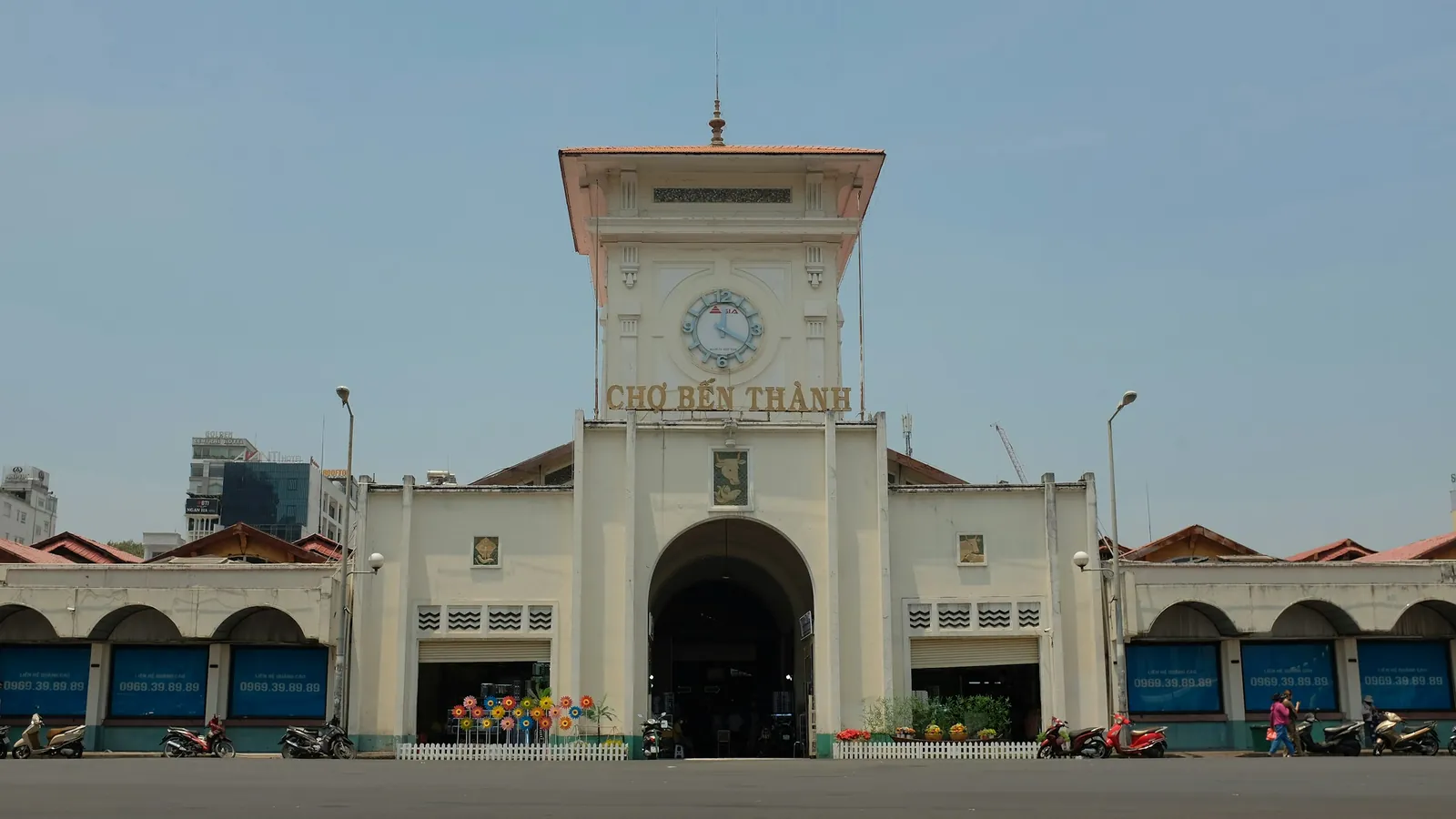
Main gate and clock tower of Ben Thanh Market in central Ho Chi Minh City

Ben Thanh Market is a large covered market in the centre of the old District 1, built by the French in the early twentieth century, with a famous clock tower over its south gate. Inside you find cooked food stalls, coffee and dried fruit, clothing, lacquerware and souvenirs, all under one roof. It is the most visited market in the city and it is aimed squarely at visitors, which means it is convenient but rarely the cheapest place to shop.

In January 2026 the city repainted the market, restored its red roof tiles and tidied the surrounding pavements ahead of Lunar New Year, so the building is looking its best for photos. Checked: 8 Oct 2026, Tuoi Tre News (23 Jan 2026).

Ben Thanh Market tips

TopicWhat to know
When to goMorning is calmer and cooler. The market is a daytime market; stalls begin closing in the early evening, after which the eating moves to the streets outside.
BargainingExpected for clothes, bags and souvenirs. Ask the price, offer clearly less, and settle somewhere between with a smile. Fixed prices are more common at food stalls.
What sells wellVietnamese coffee (robusta beans, phin filters), dried fruit, cashews, lacquer boxes, ao dai fabric and tailoring, conical hats.
Food courtStalls on the inside edges serve bun, banh xeo, com tam and fresh juices. Check the menu price before ordering.
PaymentCash in Vietnamese dong (VND) is still easiest at small stalls; QR payment is spreading. Count large notes carefully, as the zeros are easy to confuse.
SafetyCrowded aisles attract pickpockets. Use a zipped bag worn at the front.
MetroBen Thanh station, the city end of Metro Line 1, is beside the market roundabout.

If you want better prices or more local character, compare Ben Thanh with Binh Tay Market in Cholon, or with the clothing shops on the streets around Tan Dinh Market. Nepali shoppers buying gifts for relatives back home often find that coffee and cashews are the most practical: light, well packed and welcomed in Kathmandu. Remember that customs allowances apply when you return to Nepal.
Explore Vietnam tour packages
View all →

Is the War Remnants Museum worth visiting?

Yes, the War Remnants Museum is worth visiting for adults and older teenagers who want to understand what the war meant for Vietnamese civilians, but it is graphic and one-sided by design, so go in prepared. It is one of the most visited museums in Vietnam, with more than 1.4 million visits in 2025 according to Saigon Giai Phong (Checked: 8 Oct 2026). Allow two to three hours.

The museum opened on 4 September 1975, months after the war ended, and its exhibits reflect the Vietnamese state's view of what it calls the American War. The photographs of civilian casualties and the rooms on the long-term effects of Agent Orange are distressing. That honesty about suffering is exactly why many visitors say it is the most important stop in the city, and also why some parents choose to skip the indoor galleries with young children and show them the aircraft and tanks in the courtyard instead.

What you will see

  • Courtyard: captured military aircraft, a helicopter, tanks and artillery, plus a reconstruction of prison "tiger cages" from the Con Dao island prison.
  • Photography galleries: work by war photographers from many countries, including those killed while covering the conflict.
  • Agent Orange galleries: the most difficult rooms, covering the health effects of chemical defoliants across generations.
  • International response: anti-war movements around the world.

Museum and history site hours

SiteAddressOpening hoursSource
War Remnants Museum28 Vo Van Tan, Xuan Hoa ward (old District 3)7:30 to 17:30 daily; ticket counter closes at 17:00Saigon Giai Phong (10 Feb 2026)
Independence Palace135 Nam Ky Khoi Nghia, Ben Thanh ward (second gate at 106 Nguyen Du)7:00 to 18:00 daily, including holidays and Tet, except special cases announced separatelyOfficial Independence Palace website
Cu Chi Tunnels (Ben Dinh and Ben Duoc)Nhuan Duc and An Nhon Tay communes, former Cu Chi districtGenerally 7:00 to 17:00 dailyVietnamese travel press (MIA.vn, Sep 2026; VinWonders); confirm locally

Checked: 8 Oct 2026, dinhdoclap.gov.vn (Independence Palace) and Saigon Giai Phong (War Remnants Museum, which also sells tickets online). Ticket sales stop before closing time, so arrive at least 90 minutes before the end of the day, and check the official site before you go, as hours can change.

A good order for a history day: Independence Palace in the morning, lunch nearby, then the War Remnants Museum, which is about a 10 minute walk away. Pair this with the Cu Chi Tunnels on a separate day for the full picture.

What colonial landmarks can you see?

The best colonial landmarks sit within a few hundred metres of each other: the Notre Dame Cathedral Basilica, the Saigon Central Post Office, the Opera House, City Hall (viewed from outside) and the 1960s Independence Palace a short walk away. You can see the main exteriors in a single relaxed morning on foot.

LandmarkBuiltCan you go inside?Tip
Notre Dame Cathedral Basilica1877 to 1880Restoration ongoing since 2017; sightseeing access inside can be limited. Attending Mass is the surest way in.The new gold-plated crosses went up on the towers in March 2026
Saigon Central Post Office1886 to 1891Yes, it is still a working post officeSend a postcard home from the counters under the vaulted roof
Saigon Opera House (Municipal Theatre)1898 to 1900During performancesCheck the theatre's programme for evening shows
City Hall (People's Committee building)Early 1900sNo, government buildingBest seen lit up at night from Nguyen Hue
Independence Palace1962 to 1966Yes, open dailyAllow time for the basement command bunker

Notre Dame Cathedral Basilica

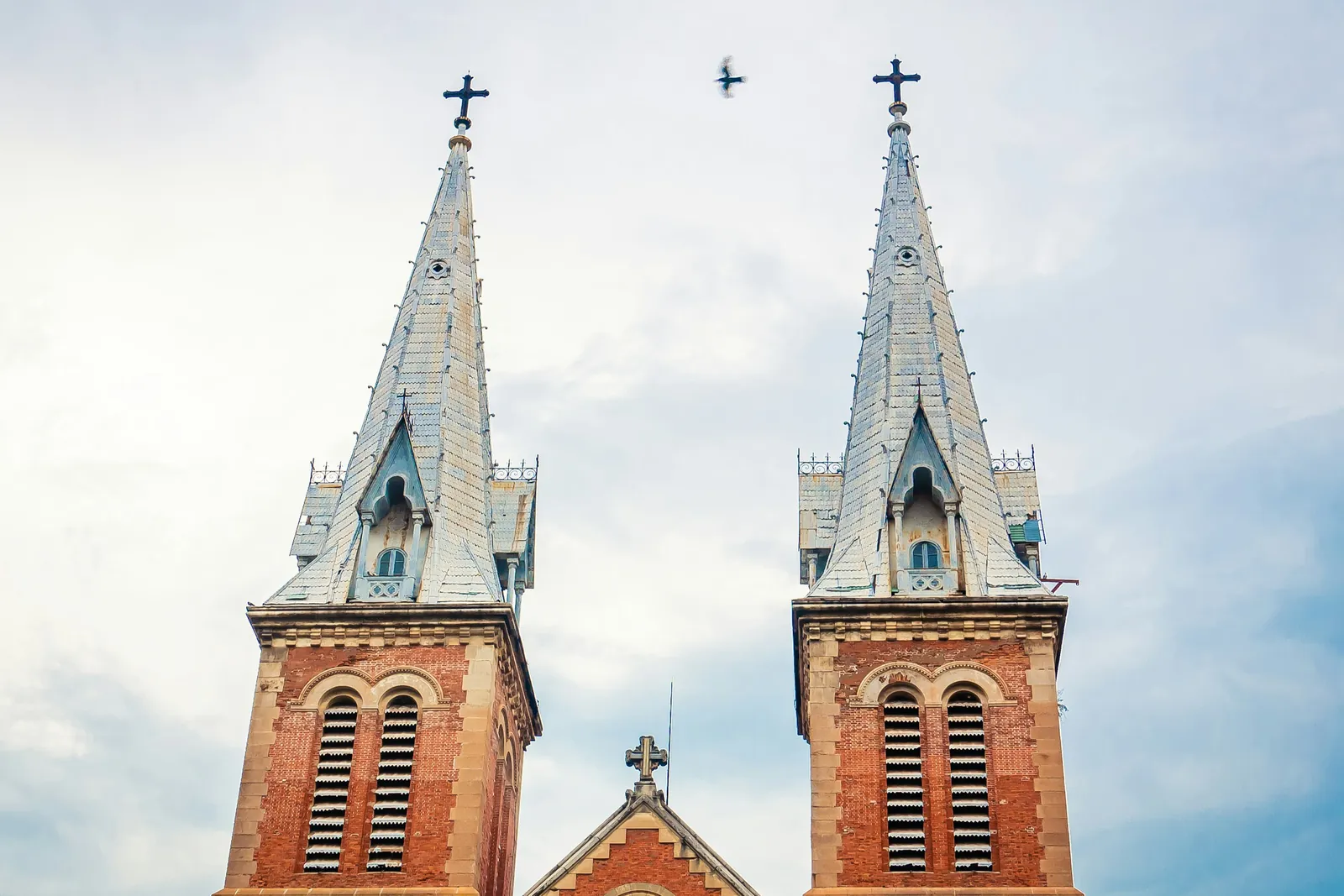
Twin red brick spires of Notre Dame Cathedral Basilica of Saigon against a blue sky

Saigon's Notre Dame Cathedral is still under restoration in 2026, but much of the exterior scaffolding has come down and the twin towers are visible again. The restoration, led by Belgian heritage specialists, began in July 2017. Two newly made gold-plated crosses, blessed in December 2025, were placed on top of the towers on 19 March 2026. The parish priest has said the full project will not finish by the end of 2027 as once planned, and that work inside (lighting, roof, gutters and interior painting) continues, so there is still no firm completion date.

What this means for visitors: the facade and towers make a fine photograph from the square in front, but do not count on walking around inside as a tourist. The cathedral continues to hold services; the parish website lists Masses daily early in the morning and late afternoon, plus several on Sunday including one in English. Attending a service respectfully is the most reliable way to see the interior.

Checked: 8 Oct 2026, Saigon Cathedral parish site (chinhtoasaigon.org), Dan Tri (21 Mar 2026), Thanh Nien (10 Dec 2025) and Viet Nam News (9 Dec 2025). Restoration status changes; check the parish site before planning around a visit inside.

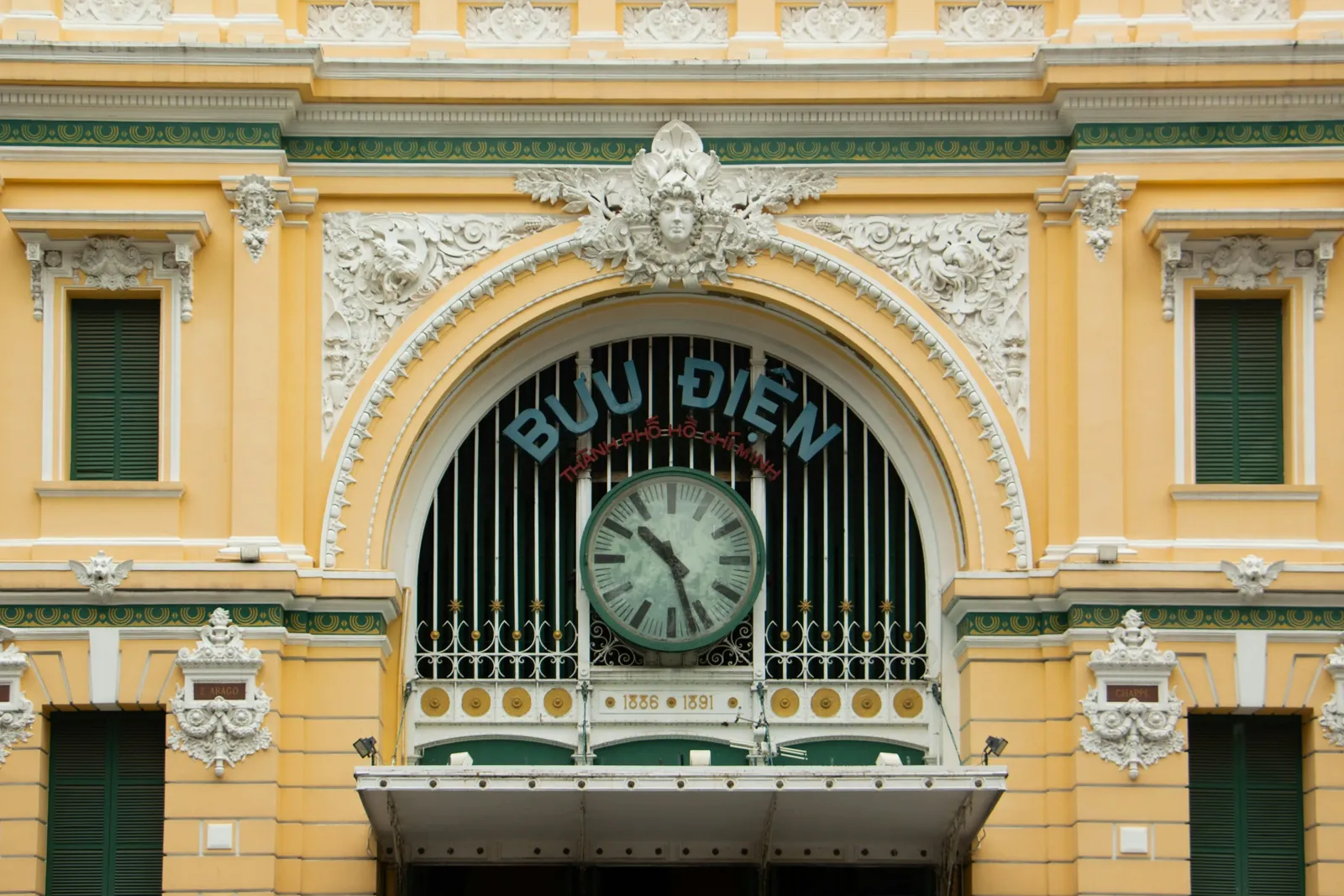
Saigon Central Post Office

Yellow colonial facade and clock of Saigon Central Post Office in Ho Chi Minh City

Directly across the square, the Saigon Central Post Office was built between 1886 and 1891 and is still a working post office. The interior is the draw: an arched, vaulted hall, old painted maps of the region on the walls, wooden phone booths and a large portrait of Ho Chi Minh at the far end. It is often credited to Gustave Eiffel, but heritage historians attribute the design to the French architect Alfred Foulhoux. Souvenir counters inside sell postcards and stamps; posting a card to family in Kathmandu is a simple, memorable souvenir.

Independence Palace

Independence Palace, also called Reunification Palace, is where the war ended: on 30 April 1975 a North Vietnamese tank broke through its main gate. The building you see was designed by Vietnamese architect Ngo Viet Thu, begun in 1962 and completed in 1966, and it is a rare, well-preserved example of 1960s modernist government architecture. Inside are reception halls, the president's offices and living quarters, a rooftop helipad with a helicopter, and the basement bunker with its original radio and map rooms. Replica tanks stand in the grounds.

The palace is open daily from 7:00 to 18:00 according to its official site (Checked: 8 Oct 2026). It works well for families because the rooms are spacious, the history is presented without graphic images, and children usually enjoy the bunker.

Can you visit the Cu Chi Tunnels?

Yes. The Cu Chi Tunnels are open to visitors at two sites, Ben Dinh and Ben Duoc, in the rural north-west of Ho Chi Minh City, about 70 km by road from the centre. Most people go on a half-day tour by road (around 1.5 to 2 hours each way, depending on traffic), and some travel by speedboat along the Saigon River. Sites generally open from 7:00 to 17:00.

The tunnel network, once more than 200 km long across several levels, was used as living quarters, supply routes and command bases during the war. The surviving sites have short sections that visitors can crawl through, some widened for tourists, along with reconstructed kitchens, meeting rooms and field hospitals, displays of booby traps, and documentary films. In July 2026 Vietnam added the Cu Chi Tunnels to its tentative list for UNESCO World Heritage status (Checked: 8 Oct 2026, UNESCO World Heritage Centre).

Ben Dinh or Ben Duoc?

FactorBen DinhBen Duoc
Location (since July 2025)Nhuan Duc communeAn Nhon Tay commune
Distance from the centreCloser of the twoFurther north, along the Saigon River
Wartime roleBase of the Cu Chi district party committeeBase of the Saigon to Cholon to Gia Dinh military region command
CrowdsBusier; most group tours go hereUsually quieter
ExtrasShooting range, a tank disabled by a mine in 1970, souvenir stallsLarge memorial temple complex overlooking the Saigon River
Best forFirst-timers on a short half-day tourTravellers who want more space and the memorial

Checked: 8 Oct 2026, Vietnamese travel press (MIA.vn, Sep 2026; VinWonders). Commune names follow the 2025 reorganisation (Resolution 1685/NQ-UBTVQH15).

Practical notes for Cu Chi

  • Fitness: the crawl sections are short but tight, hot and dark. Anyone with claustrophobia, knee problems or heart conditions can skip them and still see everything above ground.
  • Clothing: wear clothes you don't mind getting dusty, closed shoes and insect repellent.
  • Timing: leave early to beat both heat and tour buses. Combine with the War Remnants Museum on another day, not the same one; together they are a heavy dose of history.
  • Getting there: organised tours are simplest. Public buses run via Cu Chi bus station but involve changes and take much longer.
  • Shooting range: optional and noisy. Families with young children may want to stay away from that part of Ben Dinh.

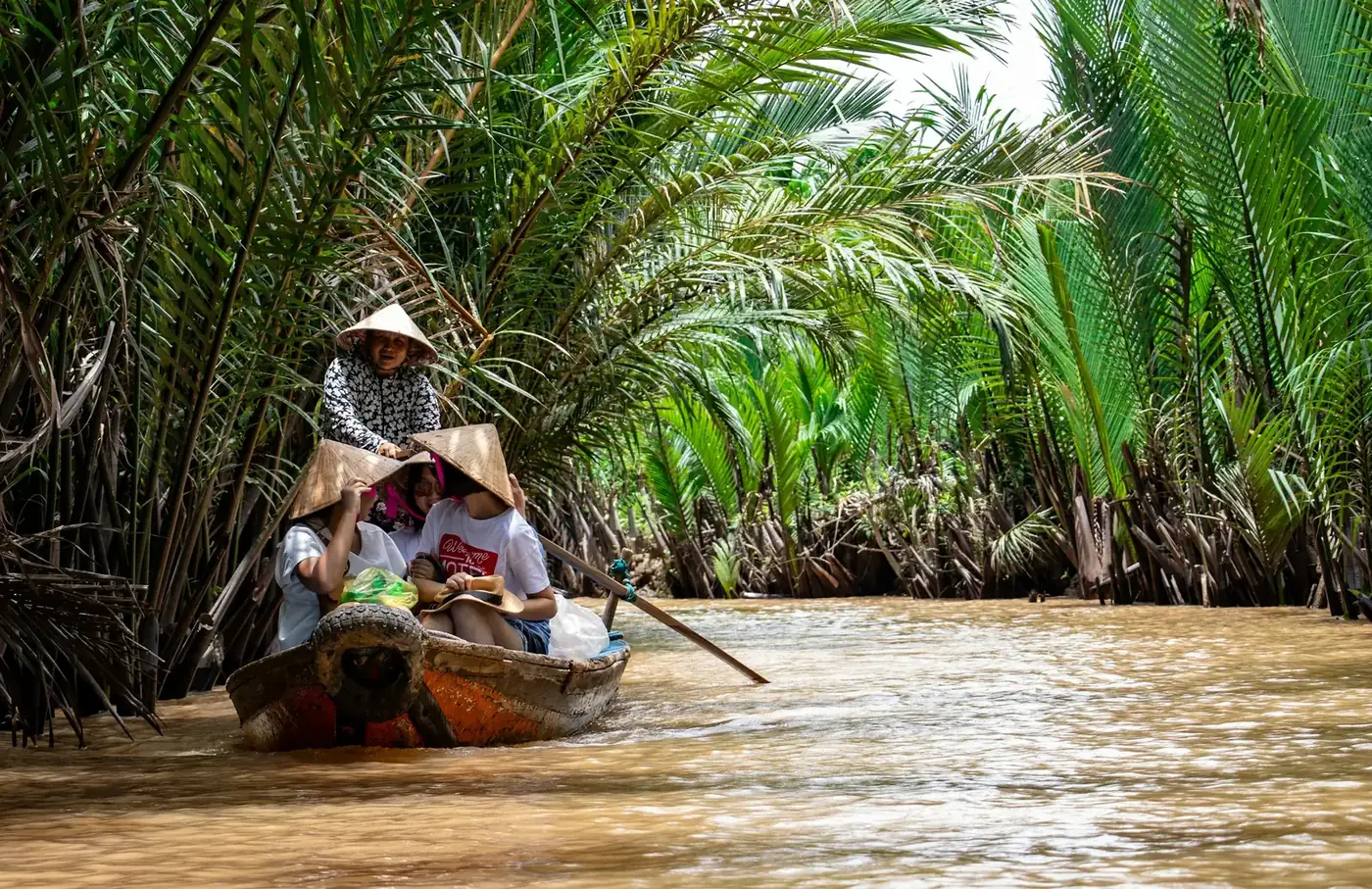
How do you take a Mekong Delta day trip?

Visitors in conical hats rowing along a palm lined canal in the Mekong Delta

The simplest Mekong Delta day trip from Ho Chi Minh City goes to My Tho and the Ben Tre side of the river, about 70 to 90 km south-west, roughly two hours each way by road. A typical day includes a motorboat across the Mekong to river islands, a ride in a small rowing boat through narrow coconut-palm canals, a visit to a fruit orchard and a coconut candy workshop, and lunch with river fish.

Note the new names: in July 2025 Vietnam merged its provinces, so Tien Giang (home of My Tho) is now part of Dong Thap province, Ben Tre is now part of Vinh Long province, and Soc Trang and Hau Giang were merged into Can Tho city. Tours still use the old town names, so look for My Tho, Ben Tre, Vinh Long and Can Tho on itineraries.

Mekong Delta options compared

OptionApproximate travel each wayWhat you seeDay trip or overnight?Best for
My Tho and Ben TreAbout 2 hoursRiver islands, coconut canals, orchards, workshopsEasy day tripFirst-timers, families, short stays
Vinh Long and Cai Be areaAbout 2.5 to 3 hoursQuieter villages, homestays, garden housesLong day, better overnightCouples, slow travellers
Can Tho and Cai Rang floating marketAbout 3.5 to 4 hoursThe delta's best-known floating market, open from about 4:00 to 9:00Overnight recommendedPhotographers, anyone with two days

Road times are approximate and depend heavily on traffic leaving the city. Cai Rang hours: Viet Nam News, 13 May 2026. Checked: 8 Oct 2026.

Can you see a floating market in a day?

Not comfortably. Cai Rang, about 6 km from central Can Tho and recognised as national intangible cultural heritage in 2016, trades mainly between about 4:00 and 9:00, so you need to sleep in Can Tho the night before. It is also smaller than it was: local reports in May 2026 counted about 100 to 200 boats, compared with up to 300 in the past, and the city is preparing a plan to preserve it. If you only have one day, choose My Tho and Ben Tre and enjoy the canals instead.

Choosing a good Mekong tour

  • Small groups spend less time in souvenir shops and more on the water.
  • Ask whether the rowing-boat section is included and whether life jackets are provided, especially with children.
  • In the wet season (roughly May to November) the river is high and fruit is plentiful; bring a light raincoat for afternoon showers.
  • Older parents usually manage the boats well, but the steps on and off at small jetties can be uneven, so a helping hand matters.

When is the best time to visit?

The best time to visit Ho Chi Minh City is the dry season from December to April, with the most comfortable weather from December to February. May to November is the wet season, with heavy but usually short afternoon storms, and September and October are the wettest months. The city is hot all year: average highs stay between about 31 and 35°C, so plan sightseeing for mornings and evenings whatever the month.

Southern Vietnam wet and dry seasons by month

MonthSeasonAverage high (°C)Average rainfall (mm)Rainy daysWhat to expect
JanuaryDry32.0122Sunny, lowest humidity; Tet may fall late Jan or Feb
FebruaryDry32.781Driest month; Tet 2027 is 6 February
MarchDry33.6181Hot and clear
AprilDry, getting hotter34.5574Hottest stretch begins; first showers
MayWet season starts34.920213Very hot, afternoon storms
JuneWet33.522416Short heavy showers, green delta
JulyWet33.023119Frequent showers; fewer crowds
AugustWet32.921917Similar to July
SeptemberWet, peak rain32.649018Wettest month; some street flooding
OctoberWet32.334016Rain easing late in the month
NovemberTransition32.41289Drier, pleasant by late month
DecemberDry31.6415Comfortable, festive, busy at Christmas

Climate averages for Tan Son Nhat Airport, as compiled on Wikipedia from the Vietnam Institute for Building Science and Technology (temperatures) and the World Meteorological Organization (rainfall). Checked: 8 Oct 2026. These are long-term averages, not forecasts; individual years vary a lot.

Dashain, Tihar and Tet timing for Nepali travellers

For travellers from Nepal, the Dashain and Tihar holidays in October and November fall at the tail end of Saigon's wet season. October can still bring heavy afternoon rain, while November is noticeably drier and a good compromise if your leave falls after Bhai Tika. Showers rarely last all day, so the city remains very visitable; just plan indoor stops like museums for the afternoons. Our guide to Dashain and Tihar holidays abroad matches leave days to destinations.

Be careful with Tet, the Vietnamese Lunar New Year. In 2027 it falls on 6 February. The days around Tet are joyful to watch (flower streets, decorations on Nguyen Hue), but many family-run restaurants and shops close for several days and transport out of the city is packed. For month-by-month advice for the whole country, including the very different north, see the best time to visit Vietnam.

How do you get around the city?

Walk within the old centre, use ride-hailing apps (Grab and local rivals) for longer hops, and try Metro Line 1, which runs from Ben Thanh east to Suoi Tien. Traffic is dense and motorbikes are everywhere, but the system works once you know a few rules.

Transport options compared

OptionGood forNotes
WalkingOld District 1: market, cathedral, post office, Opera House, Nguyen HuePavements are often blocked by parked motorbikes; walk early or late to avoid peak heat
Grab car or bikeCholon, Independence Palace, restaurants, the airportFixed fare shown in the app before you ride; cash or card
Metered taxiWhen apps are not workingUse well-known companies and make sure the meter is on
Metro Line 1Thao Dien (expat cafe area), Thu Duc, the university area14 stations over about 19.7 km; 3 underground in the centre
City busesBudget travel, Cu Chi by public transportCheap but slow; route apps help
Cyclo (pedal rickshaw)A short, slow sightseeing rideAgree the route and price in writing first

Metro Line 1 status

Ho Chi Minh City's first metro line opened on 22 December 2024. It runs 14 stations over about 19.7 km between Ben Thanh, next to the market, and Suoi Tien in Thu Duc, with three underground stations in the centre (Ben Thanh, Opera House and Ba Son) and the rest elevated. Trains have been running from about 5:00 to 22:00 Monday to Thursday and until 23:00 on Friday, weekends and public holidays. Gates accept contactless bank cards and QR tickets as well as cards from ticket machines. It is a useful way to reach Thao Dien and to see the riverside from the elevated track, but it does not yet serve the airport, Cholon or the Cu Chi area.

Checked: 8 Oct 2026, Nguoi Lao Dong and HCMC Party Committee news portal (timetable announcements, Jan 2026) and MIA.vn (Sep 2026). Timetables are set for set periods and can change; check the HCMC Metro app or station notices.

Crossing the street and staying safe

Ho Chi Minh City is generally safe for visitors, and violent crime against tourists is rare. The common problems are bag and phone snatching by passing motorbikes, pickpocketing in crowds and overcharging. Carry your phone on the side away from the road, keep bags zipped and in front, and use ride-hailing apps so the fare is fixed. To cross the street, walk at a slow, steady pace and do not stop suddenly or run; drivers judge your path and flow around you. For a fuller list of local etiquette, read our dos and don'ts in Vietnam.

Getting there from Kathmandu and how many days to plan

Ho Chi Minh City's airport is Tan Son Nhat (SGN), about 6 to 8 km north of the centre, usually 30 to 60 minutes by car depending on traffic. From Kathmandu we did not find a scheduled non-stop service as of 8 October 2026; travellers normally connect through Bangkok, Kuala Lumpur, Singapore or an Indian hub such as Delhi, with total journey times that depend heavily on the connection. Entry rules depend on the passport you hold, so check the visa rules for your passport with the official Vietnamese source before booking.

Time in the cityWhat fits
2 daysCentre on foot, Ben Thanh, the colonial landmarks, one museum, one food evening
3 daysAdd Independence Palace and the War Remnants Museum, plus a Cu Chi half day
4 daysAdd a Mekong Delta day trip and Cholon
5 days or moreOvernight in Can Tho for the floating market, or slow down in Thao Dien and the cafes

Saigon pairs naturally with central Vietnam: Da Nang and Hoi An are a short domestic flight away. Our guides to things to do in Da Nang and the best cities in Vietnam help you decide what to add, and our overview of things to do across Vietnam covers Ha Long Bay, the north and the islands. If you would rather have flights, hotels, transfers and tours arranged in one place, browse our Vietnam tour packages or message the Gomayu team on WhatsApp for a quote.

Frequently asked questions

What is Ho Chi Minh City famous for?

Ho Chi Minh City is famous for its street food, motorbike-filled streets, French colonial buildings such as the Notre Dame Cathedral and Central Post Office, its war history at the War Remnants Museum, Independence Palace and the nearby Cu Chi Tunnels, and as the gateway to the Mekong Delta. It is Vietnam's largest city and business hub.

Is Saigon the same as Ho Chi Minh City?

Yes. Saigon was officially renamed Ho Chi Minh City in 1976, but locals still use "Saigon" every day, especially for the old centre, and the airport code is SGN. Since July 2025 the city has also included the former Binh Duong and Ba Ria to Vung Tau provinces, and old districts were regrouped into wards.

Is Ben Thanh Market good for shopping?

Ben Thanh Market in Ho Chi Minh City is good for convenience and atmosphere: coffee, dried fruit, cashews, lacquerware, ao dai fabric and street food under one roof. Prices are aimed at visitors, so bargain politely for clothes and souvenirs. For more local prices and character, also try Binh Tay Market in Cholon.

How far are the Cu Chi Tunnels from Ho Chi Minh City?

The Cu Chi Tunnels are about 70 km north-west of central Ho Chi Minh City by road, about 1.5 to 2 hours each way by road depending on traffic. Ben Dinh is the closer and busier site; Ben Duoc, further north, is quieter and has a large memorial temple. Sites generally open from 7:00 to 17:00.

Can I do the Mekong Delta in a day from Saigon?

Yes. A Mekong Delta day trip from Saigon to My Tho and Ben Tre takes about two hours each way by road and includes boat rides, coconut canals and orchards. To see the Cai Rang floating market near Can Tho, which trades from about 4:00 to 9:00, you need to stay overnight.

What is the best time to visit Ho Chi Minh City?

The best time to visit Ho Chi Minh City is the dry season from December to April, with December to February the most comfortable. May to November is the wet season, with short heavy afternoon storms; September and October are the wettest. The city is hot all year, so sightsee in the mornings and evenings.

Is Ho Chi Minh City safe for tourists?

Ho Chi Minh City is generally safe, and violent crime against visitors is rare. The main risks are phone and bag snatching from passing motorbikes, pickpocketing in crowded areas such as Ben Thanh and Bui Vien, and overcharging. Use ride-hailing apps, keep bags in front and hold your phone away from the road.

How many days do you need in Saigon?

Three to four days is right for most first visits to Saigon: two days for the centre, markets, museums and food, and one or two days for the Cu Chi Tunnels and a Mekong Delta day trip. Add a night in Can Tho if you want to see the floating market at dawn.

What food should I try in Saigon?

In Saigon, try com tam (broken rice with grilled pork), banh mi, hu tieu noodle soup, banh xeo pancakes, the city's snail and shellfish restaurants, and iced coffee with condensed milk. Vegetarians should look for "com chay" signs; Buddhist vegetarian restaurants are common across Ho Chi Minh City, especially near pagodas.

Is the Notre Dame Cathedral in Saigon open?

The Notre Dame Cathedral in Saigon is still being restored in 2026. Much of the exterior scaffolding is gone and new crosses were placed on the towers in March 2026, but interior work continues with no firm finish date. Services continue, so attending Mass is the surest way to see inside. Check the parish website first.

Saigon ma k k herne?

Saigon (Ho Chi Minh City) ma herna laayak thau: Ben Thanh Market, War Remnants Museum, Independence Palace, Notre Dame Cathedral ra Central Post Office, Nguyen Hue Walking Street, ra Cholon. Day trip ma Cu Chi Tunnels ra Mekong Delta janus. Sukha mausam (December dekhi April) sabai bhanda ramro huncha.

Tags
Vietnam
Share
G
Gomayu Team
Writer at Gomayu
Keep reading
Blog / Vietnam
Things to Do in Ho Chi Minh City: Markets, Museums and Food
27 min read 08 Oct 2026
Ho Chi Minh City Hall lit up at night above Nguyen Hue Walking Street

Short answer: The best things to do in Ho Chi Minh City (Saigon) are browsing Ben Thanh Market, visiting the War Remnants Museum and Independence Palace, seeing the French colonial core around the Notre Dame Cathedral and Central Post Office, eating street food at night, and taking day trips to the Cu Chi Tunnels and the Mekong Delta. Plan three to four days, ideally in the dry season from December to April.

Ho Chi Minh City is Vietnam's largest city and its commercial engine: loud, fast, full of motorbikes and very easy to enjoy once you know where to point yourself. Most first-time visitors base themselves in the old centre that everyone still calls District 1, walk between the colonial landmarks, spend an afternoon on the city's difficult war history, and use the city as a launch pad for two classic day trips. This guide is written for international visitors, Nepali travellers flying in from Kathmandu and the Nepali diaspora meeting family in southern Vietnam. It is purely informational: no package prices and no day-by-day plans, just what each place is like, how long it takes and what to watch out for. For the bigger picture of the country, start with our complete Vietnam travel guide.

Checked: 8 Oct 2026. Opening hours below come from the official Independence Palace website and a February 2026 Saigon Giai Phong report on the War Remnants Museum, Metro Line 1 information from Ho Chi Minh City press reports, and restoration news from the Saigon cathedral parish and Vietnamese national media. Hours and access change, so confirm on the official source before you go.

What are the best things to do in Ho Chi Minh City?

The core list is short: one market, two war history sites, a cluster of French colonial buildings, a food night or two, Cholon (the old Chinese quarter), and day trips to the Cu Chi Tunnels and the Mekong Delta. Almost everything in the city centre is within a 20 to 30 minute walk of everything else, so a first visit is mostly about pacing yourself in the heat and saving the out-of-town trips for early starts.

Ho Chi Minh City and Saigon are the same place. The city was renamed in 1976, but "Saigon" is still used every day by locals, on shop signs and for the old centre. You will also see a new layer of names: on 1 July 2025 Vietnam abolished district-level government, Ho Chi Minh City absorbed the former provinces of Binh Duong and Ba Ria to Vung Tau, and the old districts were regrouped into wards. Old District 1, for example, is now mainly Saigon, Ben Thanh, Tan Dinh and Cau Ong Lanh wards. Taxi drivers, hotels and locals still use the old district numbers, so we give both below.

Attractions by area: old district and new ward

AttractionOld district (still widely used)Ward since July 2025Time to allowBest for
Ben Thanh MarketDistrict 1Ben Thanh1 to 2 hoursFood stalls, souvenirs, coffee
Notre Dame Cathedral and Central Post OfficeDistrict 1Saigon45 to 60 minutesArchitecture, photos
Saigon Opera House and Dong Khoi StreetDistrict 1Saigon30 minutes outside, longer for a showColonial streetscape, evening shows
Nguyen Hue Walking StreetDistrict 1Saigon1 hour in the eveningFamilies, night strolls
Bui Vien Walking StreetDistrict 1Ben Thanh1 to 2 hours after darkNightlife, backpackers
Independence PalaceDistrict 1 (on the District 3 border)Ben Thanh1.5 to 2 hoursModern history, 1960s design
War Remnants MuseumDistrict 3Xuan Hoa2 to 3 hoursWar history (adults and older teens)
Jade Emperor PagodaDistrict 1 (Da Kao area)Tan Dinh or Saigon (old Da Kao ward was split)30 to 45 minutesTaoist temple interior
Cholon: Binh Tay Market and Thien Hau TempleDistricts 5 and 6Cho Lon, Binh Tay and nearby wardsHalf a dayChinese heritage, wholesale markets
Cu Chi Tunnels (Ben Dinh, Ben Duoc)Cu Chi districtNhuan Duc and An Nhon Tay communesHalf day to a full dayHistory, outdoors
Mekong Delta day tripOutside the cityDong Thap and Vinh Long provincesFull dayRiver life, orchards, families

Ward names: Vietcetera post-merger guide and Vietnamese government notices on Resolution 1685/NQ-UBTVQH15. Checked: 8 Oct 2026.

Nguyen Hue Walking Street and Bui Vien

Nguyen Hue is the city's wide, car-free boulevard running from the riverside towards the colonial City Hall, and it is the easiest place to feel the city's evening energy with children or older parents. Families come out after sunset when the heat drops, there are fountains, street performers and a long line of cafes. Look for the old apartment block at 42 Nguyen Hue, whose floors are now packed with small cafes and boutiques; the balconies give a good view down the boulevard.

Bui Vien, a few blocks west in the old Pham Ngu Lao backpacker area, is a different experience: a narrow street that turns into a loud, neon-lit strip of bars and street food after dark. It is fun for an hour if you like nightlife. Couples with young children usually prefer Nguyen Hue. Keep phones and bags close on both streets, as they are the city's busiest pickpocket zones.

Cholon, Binh Tay Market and Thien Hau Temple

Cholon, the historic Chinese trading district in the west of the city, is the best half day for anyone who wants Saigon beyond the tourist core. Binh Tay Market is a working wholesale market, reopened in November 2018 after a restoration of nearly two years, where shopkeepers buy in bulk; you go for the atmosphere and the food stalls rather than souvenirs. Nearby, Thien Hau Temple, dedicated to the sea goddess honoured by Cantonese traders, is known for its hanging incense coils and carved roof figures.

Cholon is around 5 to 6 km from Ben Thanh, so take a Grab car or bike rather than walking. Visit in the morning, when the markets are busiest and the temple is calm.

Jade Emperor Pagoda

The Jade Emperor Pagoda (Chua Ngoc Hoang), built in the early twentieth century by the city's Cantonese community, is a small, dark, incense-filled Taoist temple with carved wooden figures and a pond of turtles in the courtyard. It is one of the most atmospheric religious buildings in the city and an easy stop between the centre and Tan Dinh's pink church. Dress modestly (shoulders and knees covered) and keep voices low, as it is an active place of worship.

Street food and coffee

Food is the main reason many visitors fall for Saigon. The south eats sweeter and more herb-heavy than Hanoi, and the street-food scene peaks in the evening. Dishes to look for:

  • Com tam (broken rice with grilled pork chop), the city's signature breakfast and lunch.
  • Banh mi, the baguette sandwich, best from busy street carts.
  • Hu tieu, a clear noodle soup with Chinese and Khmer roots, common in Cholon.
  • Banh xeo, a crisp turmeric pancake you wrap in lettuce and herbs.
  • Oc, the city's famous snail and shellfish restaurants, a night-time favourite.
  • Ca phe sua da, strong iced coffee with condensed milk, and the newer coconut coffee.

Vegetarian travellers, including many Nepali families who avoid beef or meat on certain days, should look for signs saying "com chay" (vegetarian rice). Buddhist vegetarian restaurants are common, especially near pagodas, and are busiest on the 1st and 15th days of the lunar month. For a dish-by-dish guide across the country, see what to eat in Vietnam.

What is Ben Thanh Market like?

Main gate and clock tower of Ben Thanh Market in central Ho Chi Minh City

Ben Thanh Market is a large covered market in the centre of the old District 1, built by the French in the early twentieth century, with a famous clock tower over its south gate. Inside you find cooked food stalls, coffee and dried fruit, clothing, lacquerware and souvenirs, all under one roof. It is the most visited market in the city and it is aimed squarely at visitors, which means it is convenient but rarely the cheapest place to shop.

In January 2026 the city repainted the market, restored its red roof tiles and tidied the surrounding pavements ahead of Lunar New Year, so the building is looking its best for photos. Checked: 8 Oct 2026, Tuoi Tre News (23 Jan 2026).

Ben Thanh Market tips

TopicWhat to know
When to goMorning is calmer and cooler. The market is a daytime market; stalls begin closing in the early evening, after which the eating moves to the streets outside.
BargainingExpected for clothes, bags and souvenirs. Ask the price, offer clearly less, and settle somewhere between with a smile. Fixed prices are more common at food stalls.
What sells wellVietnamese coffee (robusta beans, phin filters), dried fruit, cashews, lacquer boxes, ao dai fabric and tailoring, conical hats.
Food courtStalls on the inside edges serve bun, banh xeo, com tam and fresh juices. Check the menu price before ordering.
PaymentCash in Vietnamese dong (VND) is still easiest at small stalls; QR payment is spreading. Count large notes carefully, as the zeros are easy to confuse.
SafetyCrowded aisles attract pickpockets. Use a zipped bag worn at the front.
MetroBen Thanh station, the city end of Metro Line 1, is beside the market roundabout.

If you want better prices or more local character, compare Ben Thanh with Binh Tay Market in Cholon, or with the clothing shops on the streets around Tan Dinh Market. Nepali shoppers buying gifts for relatives back home often find that coffee and cashews are the most practical: light, well packed and welcomed in Kathmandu. Remember that customs allowances apply when you return to Nepal.
Explore Vietnam tour packages
View all →

Is the War Remnants Museum worth visiting?

Yes, the War Remnants Museum is worth visiting for adults and older teenagers who want to understand what the war meant for Vietnamese civilians, but it is graphic and one-sided by design, so go in prepared. It is one of the most visited museums in Vietnam, with more than 1.4 million visits in 2025 according to Saigon Giai Phong (Checked: 8 Oct 2026). Allow two to three hours.

The museum opened on 4 September 1975, months after the war ended, and its exhibits reflect the Vietnamese state's view of what it calls the American War. The photographs of civilian casualties and the rooms on the long-term effects of Agent Orange are distressing. That honesty about suffering is exactly why many visitors say it is the most important stop in the city, and also why some parents choose to skip the indoor galleries with young children and show them the aircraft and tanks in the courtyard instead.

What you will see

  • Courtyard: captured military aircraft, a helicopter, tanks and artillery, plus a reconstruction of prison "tiger cages" from the Con Dao island prison.
  • Photography galleries: work by war photographers from many countries, including those killed while covering the conflict.
  • Agent Orange galleries: the most difficult rooms, covering the health effects of chemical defoliants across generations.
  • International response: anti-war movements around the world.

Museum and history site hours

SiteAddressOpening hoursSource
War Remnants Museum28 Vo Van Tan, Xuan Hoa ward (old District 3)7:30 to 17:30 daily; ticket counter closes at 17:00Saigon Giai Phong (10 Feb 2026)
Independence Palace135 Nam Ky Khoi Nghia, Ben Thanh ward (second gate at 106 Nguyen Du)7:00 to 18:00 daily, including holidays and Tet, except special cases announced separatelyOfficial Independence Palace website
Cu Chi Tunnels (Ben Dinh and Ben Duoc)Nhuan Duc and An Nhon Tay communes, former Cu Chi districtGenerally 7:00 to 17:00 dailyVietnamese travel press (MIA.vn, Sep 2026; VinWonders); confirm locally

Checked: 8 Oct 2026, dinhdoclap.gov.vn (Independence Palace) and Saigon Giai Phong (War Remnants Museum, which also sells tickets online). Ticket sales stop before closing time, so arrive at least 90 minutes before the end of the day, and check the official site before you go, as hours can change.

A good order for a history day: Independence Palace in the morning, lunch nearby, then the War Remnants Museum, which is about a 10 minute walk away. Pair this with the Cu Chi Tunnels on a separate day for the full picture.

What colonial landmarks can you see?

The best colonial landmarks sit within a few hundred metres of each other: the Notre Dame Cathedral Basilica, the Saigon Central Post Office, the Opera House, City Hall (viewed from outside) and the 1960s Independence Palace a short walk away. You can see the main exteriors in a single relaxed morning on foot.

LandmarkBuiltCan you go inside?Tip
Notre Dame Cathedral Basilica1877 to 1880Restoration ongoing since 2017; sightseeing access inside can be limited. Attending Mass is the surest way in.The new gold-plated crosses went up on the towers in March 2026
Saigon Central Post Office1886 to 1891Yes, it is still a working post officeSend a postcard home from the counters under the vaulted roof
Saigon Opera House (Municipal Theatre)1898 to 1900During performancesCheck the theatre's programme for evening shows
City Hall (People's Committee building)Early 1900sNo, government buildingBest seen lit up at night from Nguyen Hue
Independence Palace1962 to 1966Yes, open dailyAllow time for the basement command bunker

Notre Dame Cathedral Basilica

Twin red brick spires of Notre Dame Cathedral Basilica of Saigon against a blue sky

Saigon's Notre Dame Cathedral is still under restoration in 2026, but much of the exterior scaffolding has come down and the twin towers are visible again. The restoration, led by Belgian heritage specialists, began in July 2017. Two newly made gold-plated crosses, blessed in December 2025, were placed on top of the towers on 19 March 2026. The parish priest has said the full project will not finish by the end of 2027 as once planned, and that work inside (lighting, roof, gutters and interior painting) continues, so there is still no firm completion date.

What this means for visitors: the facade and towers make a fine photograph from the square in front, but do not count on walking around inside as a tourist. The cathedral continues to hold services; the parish website lists Masses daily early in the morning and late afternoon, plus several on Sunday including one in English. Attending a service respectfully is the most reliable way to see the interior.

Checked: 8 Oct 2026, Saigon Cathedral parish site (chinhtoasaigon.org), Dan Tri (21 Mar 2026), Thanh Nien (10 Dec 2025) and Viet Nam News (9 Dec 2025). Restoration status changes; check the parish site before planning around a visit inside.

Saigon Central Post Office
Yellow colonial facade and clock of Saigon Central Post Office in Ho Chi Minh City

Directly across the square, the Saigon Central Post Office was built between 1886 and 1891 and is still a working post office. The interior is the draw: an arched, vaulted hall, old painted maps of the region on the walls, wooden phone booths and a large portrait of Ho Chi Minh at the far end. It is often credited to Gustave Eiffel, but heritage historians attribute the design to the French architect Alfred Foulhoux. Souvenir counters inside sell postcards and stamps; posting a card to family in Kathmandu is a simple, memorable souvenir.

Independence Palace

Independence Palace, also called Reunification Palace, is where the war ended: on 30 April 1975 a North Vietnamese tank broke through its main gate. The building you see was designed by Vietnamese architect Ngo Viet Thu, begun in 1962 and completed in 1966, and it is a rare, well-preserved example of 1960s modernist government architecture. Inside are reception halls, the president's offices and living quarters, a rooftop helipad with a helicopter, and the basement bunker with its original radio and map rooms. Replica tanks stand in the grounds.

The palace is open daily from 7:00 to 18:00 according to its official site (Checked: 8 Oct 2026). It works well for families because the rooms are spacious, the history is presented without graphic images, and children usually enjoy the bunker.

Can you visit the Cu Chi Tunnels?

Yes. The Cu Chi Tunnels are open to visitors at two sites, Ben Dinh and Ben Duoc, in the rural north-west of Ho Chi Minh City, about 70 km by road from the centre. Most people go on a half-day tour by road (around 1.5 to 2 hours each way, depending on traffic), and some travel by speedboat along the Saigon River. Sites generally open from 7:00 to 17:00.

The tunnel network, once more than 200 km long across several levels, was used as living quarters, supply routes and command bases during the war. The surviving sites have short sections that visitors can crawl through, some widened for tourists, along with reconstructed kitchens, meeting rooms and field hospitals, displays of booby traps, and documentary films. In July 2026 Vietnam added the Cu Chi Tunnels to its tentative list for UNESCO World Heritage status (Checked: 8 Oct 2026, UNESCO World Heritage Centre).

Ben Dinh or Ben Duoc?

FactorBen DinhBen Duoc
Location (since July 2025)Nhuan Duc communeAn Nhon Tay commune
Distance from the centreCloser of the twoFurther north, along the Saigon River
Wartime roleBase of the Cu Chi district party committeeBase of the Saigon to Cholon to Gia Dinh military region command
CrowdsBusier; most group tours go hereUsually quieter
ExtrasShooting range, a tank disabled by a mine in 1970, souvenir stallsLarge memorial temple complex overlooking the Saigon River
Best forFirst-timers on a short half-day tourTravellers who want more space and the memorial

Checked: 8 Oct 2026, Vietnamese travel press (MIA.vn, Sep 2026; VinWonders). Commune names follow the 2025 reorganisation (Resolution 1685/NQ-UBTVQH15).

Practical notes for Cu Chi

  • Fitness: the crawl sections are short but tight, hot and dark. Anyone with claustrophobia, knee problems or heart conditions can skip them and still see everything above ground.
  • Clothing: wear clothes you don't mind getting dusty, closed shoes and insect repellent.
  • Timing: leave early to beat both heat and tour buses. Combine with the War Remnants Museum on another day, not the same one; together they are a heavy dose of history.
  • Getting there: organised tours are simplest. Public buses run via Cu Chi bus station but involve changes and take much longer.
  • Shooting range: optional and noisy. Families with young children may want to stay away from that part of Ben Dinh.

How do you take a Mekong Delta day trip?
Visitors in conical hats rowing along a palm lined canal in the Mekong Delta

The simplest Mekong Delta day trip from Ho Chi Minh City goes to My Tho and the Ben Tre side of the river, about 70 to 90 km south-west, roughly two hours each way by road. A typical day includes a motorboat across the Mekong to river islands, a ride in a small rowing boat through narrow coconut-palm canals, a visit to a fruit orchard and a coconut candy workshop, and lunch with river fish.

Note the new names: in July 2025 Vietnam merged its provinces, so Tien Giang (home of My Tho) is now part of Dong Thap province, Ben Tre is now part of Vinh Long province, and Soc Trang and Hau Giang were merged into Can Tho city. Tours still use the old town names, so look for My Tho, Ben Tre, Vinh Long and Can Tho on itineraries.

Mekong Delta options compared

OptionApproximate travel each wayWhat you seeDay trip or overnight?Best for
My Tho and Ben TreAbout 2 hoursRiver islands, coconut canals, orchards, workshopsEasy day tripFirst-timers, families, short stays
Vinh Long and Cai Be areaAbout 2.5 to 3 hoursQuieter villages, homestays, garden housesLong day, better overnightCouples, slow travellers
Can Tho and Cai Rang floating marketAbout 3.5 to 4 hoursThe delta's best-known floating market, open from about 4:00 to 9:00Overnight recommendedPhotographers, anyone with two days

Road times are approximate and depend heavily on traffic leaving the city. Cai Rang hours: Viet Nam News, 13 May 2026. Checked: 8 Oct 2026.

Can you see a floating market in a day?

Not comfortably. Cai Rang, about 6 km from central Can Tho and recognised as national intangible cultural heritage in 2016, trades mainly between about 4:00 and 9:00, so you need to sleep in Can Tho the night before. It is also smaller than it was: local reports in May 2026 counted about 100 to 200 boats, compared with up to 300 in the past, and the city is preparing a plan to preserve it. If you only have one day, choose My Tho and Ben Tre and enjoy the canals instead.

Choosing a good Mekong tour

  • Small groups spend less time in souvenir shops and more on the water.
  • Ask whether the rowing-boat section is included and whether life jackets are provided, especially with children.
  • In the wet season (roughly May to November) the river is high and fruit is plentiful; bring a light raincoat for afternoon showers.
  • Older parents usually manage the boats well, but the steps on and off at small jetties can be uneven, so a helping hand matters.

When is the best time to visit?

The best time to visit Ho Chi Minh City is the dry season from December to April, with the most comfortable weather from December to February. May to November is the wet season, with heavy but usually short afternoon storms, and September and October are the wettest months. The city is hot all year: average highs stay between about 31 and 35°C, so plan sightseeing for mornings and evenings whatever the month.

Southern Vietnam wet and dry seasons by month

MonthSeasonAverage high (°C)Average rainfall (mm)Rainy daysWhat to expect
JanuaryDry32.0122Sunny, lowest humidity; Tet may fall late Jan or Feb
FebruaryDry32.781Driest month; Tet 2027 is 6 February
MarchDry33.6181Hot and clear
AprilDry, getting hotter34.5574Hottest stretch begins; first showers
MayWet season starts34.920213Very hot, afternoon storms
JuneWet33.522416Short heavy showers, green delta
JulyWet33.023119Frequent showers; fewer crowds
AugustWet32.921917Similar to July
SeptemberWet, peak rain32.649018Wettest month; some street flooding
OctoberWet32.334016Rain easing late in the month
NovemberTransition32.41289Drier, pleasant by late month
DecemberDry31.6415Comfortable, festive, busy at Christmas

Climate averages for Tan Son Nhat Airport, as compiled on Wikipedia from the Vietnam Institute for Building Science and Technology (temperatures) and the World Meteorological Organization (rainfall). Checked: 8 Oct 2026. These are long-term averages, not forecasts; individual years vary a lot.

Dashain, Tihar and Tet timing for Nepali travellers

For travellers from Nepal, the Dashain and Tihar holidays in October and November fall at the tail end of Saigon's wet season. October can still bring heavy afternoon rain, while November is noticeably drier and a good compromise if your leave falls after Bhai Tika. Showers rarely last all day, so the city remains very visitable; just plan indoor stops like museums for the afternoons. Our guide to Dashain and Tihar holidays abroad matches leave days to destinations.

Be careful with Tet, the Vietnamese Lunar New Year. In 2027 it falls on 6 February. The days around Tet are joyful to watch (flower streets, decorations on Nguyen Hue), but many family-run restaurants and shops close for several days and transport out of the city is packed. For month-by-month advice for the whole country, including the very different north, see the best time to visit Vietnam.

How do you get around the city?

Walk within the old centre, use ride-hailing apps (Grab and local rivals) for longer hops, and try Metro Line 1, which runs from Ben Thanh east to Suoi Tien. Traffic is dense and motorbikes are everywhere, but the system works once you know a few rules.

Transport options compared

OptionGood forNotes
WalkingOld District 1: market, cathedral, post office, Opera House, Nguyen HuePavements are often blocked by parked motorbikes; walk early or late to avoid peak heat
Grab car or bikeCholon, Independence Palace, restaurants, the airportFixed fare shown in the app before you ride; cash or card
Metered taxiWhen apps are not workingUse well-known companies and make sure the meter is on
Metro Line 1Thao Dien (expat cafe area), Thu Duc, the university area14 stations over about 19.7 km; 3 underground in the centre
City busesBudget travel, Cu Chi by public transportCheap but slow; route apps help
Cyclo (pedal rickshaw)A short, slow sightseeing rideAgree the route and price in writing first

Metro Line 1 status

Ho Chi Minh City's first metro line opened on 22 December 2024. It runs 14 stations over about 19.7 km between Ben Thanh, next to the market, and Suoi Tien in Thu Duc, with three underground stations in the centre (Ben Thanh, Opera House and Ba Son) and the rest elevated. Trains have been running from about 5:00 to 22:00 Monday to Thursday and until 23:00 on Friday, weekends and public holidays. Gates accept contactless bank cards and QR tickets as well as cards from ticket machines. It is a useful way to reach Thao Dien and to see the riverside from the elevated track, but it does not yet serve the airport, Cholon or the Cu Chi area.

Checked: 8 Oct 2026, Nguoi Lao Dong and HCMC Party Committee news portal (timetable announcements, Jan 2026) and MIA.vn (Sep 2026). Timetables are set for set periods and can change; check the HCMC Metro app or station notices.

Crossing the street and staying safe

Ho Chi Minh City is generally safe for visitors, and violent crime against tourists is rare. The common problems are bag and phone snatching by passing motorbikes, pickpocketing in crowds and overcharging. Carry your phone on the side away from the road, keep bags zipped and in front, and use ride-hailing apps so the fare is fixed. To cross the street, walk at a slow, steady pace and do not stop suddenly or run; drivers judge your path and flow around you. For a fuller list of local etiquette, read our dos and don'ts in Vietnam.

Getting there from Kathmandu and how many days to plan

Ho Chi Minh City's airport is Tan Son Nhat (SGN), about 6 to 8 km north of the centre, usually 30 to 60 minutes by car depending on traffic. From Kathmandu we did not find a scheduled non-stop service as of 8 October 2026; travellers normally connect through Bangkok, Kuala Lumpur, Singapore or an Indian hub such as Delhi, with total journey times that depend heavily on the connection. Entry rules depend on the passport you hold, so check the visa rules for your passport with the official Vietnamese source before booking.

Time in the cityWhat fits
2 daysCentre on foot, Ben Thanh, the colonial landmarks, one museum, one food evening
3 daysAdd Independence Palace and the War Remnants Museum, plus a Cu Chi half day
4 daysAdd a Mekong Delta day trip and Cholon
5 days or moreOvernight in Can Tho for the floating market, or slow down in Thao Dien and the cafes

Saigon pairs naturally with central Vietnam: Da Nang and Hoi An are a short domestic flight away. Our guides to things to do in Da Nang and the best cities in Vietnam help you decide what to add, and our overview of things to do across Vietnam covers Ha Long Bay, the north and the islands. If you would rather have flights, hotels, transfers and tours arranged in one place, browse our Vietnam tour packages or message the Gomayu team on WhatsApp for a quote.

Frequently asked questions

What is Ho Chi Minh City famous for?

Ho Chi Minh City is famous for its street food, motorbike-filled streets, French colonial buildings such as the Notre Dame Cathedral and Central Post Office, its war history at the War Remnants Museum, Independence Palace and the nearby Cu Chi Tunnels, and as the gateway to the Mekong Delta. It is Vietnam's largest city and business hub.

Is Saigon the same as Ho Chi Minh City?

Yes. Saigon was officially renamed Ho Chi Minh City in 1976, but locals still use "Saigon" every day, especially for the old centre, and the airport code is SGN. Since July 2025 the city has also included the former Binh Duong and Ba Ria to Vung Tau provinces, and old districts were regrouped into wards.

Is Ben Thanh Market good for shopping?

Ben Thanh Market in Ho Chi Minh City is good for convenience and atmosphere: coffee, dried fruit, cashews, lacquerware, ao dai fabric and street food under one roof. Prices are aimed at visitors, so bargain politely for clothes and souvenirs. For more local prices and character, also try Binh Tay Market in Cholon.

How far are the Cu Chi Tunnels from Ho Chi Minh City?

The Cu Chi Tunnels are about 70 km north-west of central Ho Chi Minh City by road, about 1.5 to 2 hours each way by road depending on traffic. Ben Dinh is the closer and busier site; Ben Duoc, further north, is quieter and has a large memorial temple. Sites generally open from 7:00 to 17:00.

Can I do the Mekong Delta in a day from Saigon?

Yes. A Mekong Delta day trip from Saigon to My Tho and Ben Tre takes about two hours each way by road and includes boat rides, coconut canals and orchards. To see the Cai Rang floating market near Can Tho, which trades from about 4:00 to 9:00, you need to stay overnight.

What is the best time to visit Ho Chi Minh City?

The best time to visit Ho Chi Minh City is the dry season from December to April, with December to February the most comfortable. May to November is the wet season, with short heavy afternoon storms; September and October are the wettest. The city is hot all year, so sightsee in the mornings and evenings.

Is Ho Chi Minh City safe for tourists?

Ho Chi Minh City is generally safe, and violent crime against visitors is rare. The main risks are phone and bag snatching from passing motorbikes, pickpocketing in crowded areas such as Ben Thanh and Bui Vien, and overcharging. Use ride-hailing apps, keep bags in front and hold your phone away from the road.

How many days do you need in Saigon?

Three to four days is right for most first visits to Saigon: two days for the centre, markets, museums and food, and one or two days for the Cu Chi Tunnels and a Mekong Delta day trip. Add a night in Can Tho if you want to see the floating market at dawn.

What food should I try in Saigon?

In Saigon, try com tam (broken rice with grilled pork), banh mi, hu tieu noodle soup, banh xeo pancakes, the city's snail and shellfish restaurants, and iced coffee with condensed milk. Vegetarians should look for "com chay" signs; Buddhist vegetarian restaurants are common across Ho Chi Minh City, especially near pagodas.

Is the Notre Dame Cathedral in Saigon open?

The Notre Dame Cathedral in Saigon is still being restored in 2026. Much of the exterior scaffolding is gone and new crosses were placed on the towers in March 2026, but interior work continues with no firm finish date. Services continue, so attending Mass is the surest way to see inside. Check the parish website first.

Saigon ma k k herne?

Saigon (Ho Chi Minh City) ma herna laayak thau: Ben Thanh Market, War Remnants Museum, Independence Palace, Notre Dame Cathedral ra Central Post Office, Nguyen Hue Walking Street, ra Cholon. Day trip ma Cu Chi Tunnels ra Mekong Delta janus. Sukha mausam (December dekhi April) sabai bhanda ramro huncha.
Tags
Vietnam
Share
G
Gomayu Team
Writer at Gomayu
Keep reading