



























































+977-9768558250
Search Tours or Places
Blog / Malaysia

Things to Do in Penang: George Town, Malaysia Street Art and Food

28 min read 12 Nov 2026 · Updated 16 Nov 2026
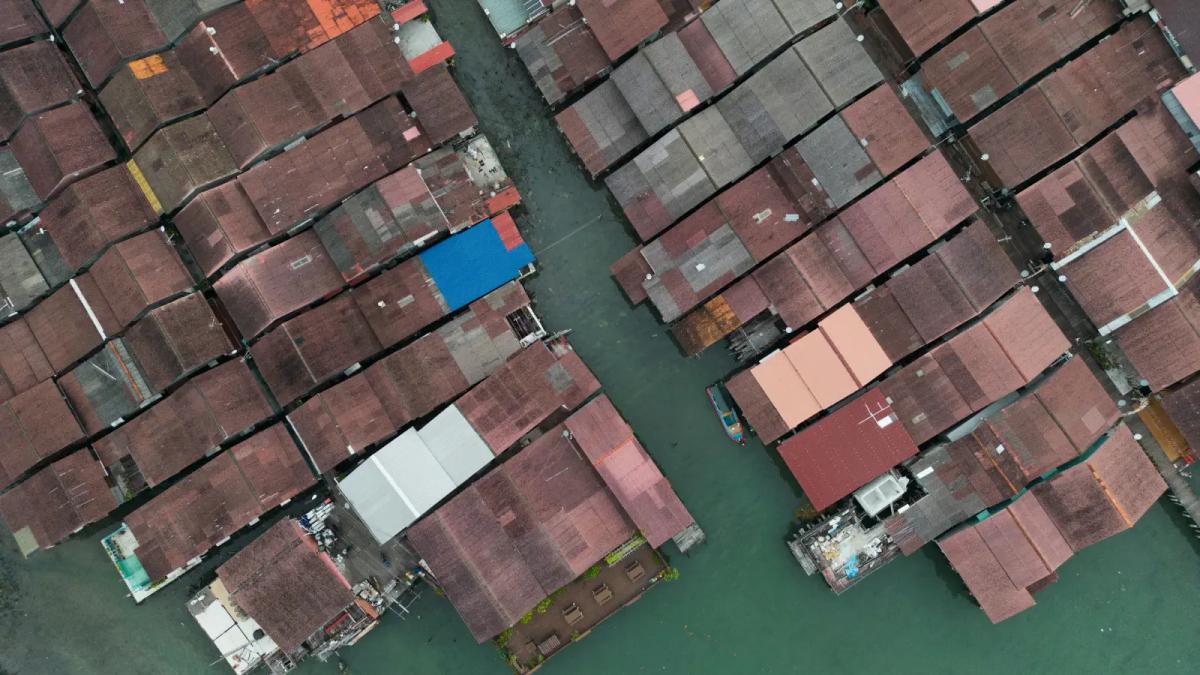
Aerial view of Clan Jetties stilt house rooftops over the sea in George Town

Short answer: Penang is one of Malaysia's strongest stops for food and heritage, and its capital, George Town, Malaysia's UNESCO-listed port city, is where most of the best things to do sit within walking distance of each other. Spend your time on the Armenian Street murals, the Clan Jetties, Cheong Fatt Tze Mansion, Little India and the hawker stalls, then add Penang Hill, The Habitat, Kek Lok Si and an evening at Batu Ferringhi. From Kuala Lumpur you can fly, take the ETS train to Butterworth and cross by ferry, or go by coach. Below is what each place is like, how to see it well, which hours we checked on 12 November 2026, and what to eat if you are vegetarian or avoid beef.

This guide is written for travellers adding Penang to a wider Malaysia trip: food lovers, couples, culture lovers, families and Nepali travellers who want to know where the vegetarian thalis and Hindu temples are. For the bigger picture of the country, start with our complete Malaysia travel guide.

Why visit Penang and George Town, Malaysia?
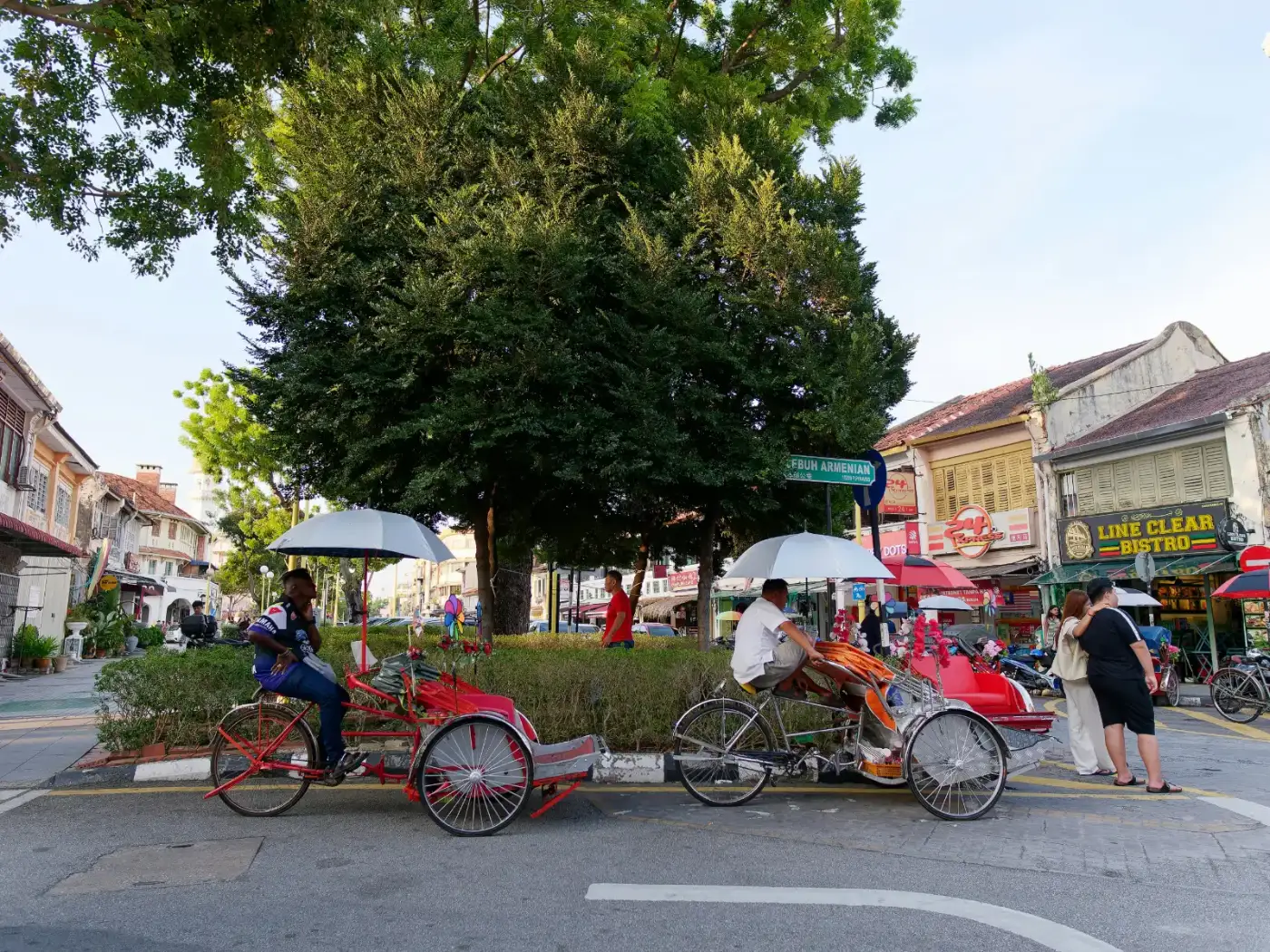
Two trishaws with white umbrellas parked by shophouses near the Lebuh Armenian sign, George Town

Visit Penang for three things: a living heritage town, some of the most varied street food in Asia, and an easy mix of city, hill and beach on one compact island. George Town is not a museum piece. People still live above the shophouses, run family trades on the ground floor and pray at temples, mosques and churches that stand a few streets apart.

George Town was inscribed by UNESCO on 7 July 2008, jointly with Melaka, as the World Heritage Site "Melaka and George Town, Historic Cities of the Straits of Malacca". The listing recognises the two towns as products of the Straits of Malacca trade route, where Malay, Chinese, Indian and European influences mixed in buildings, food and customs. According to George Town World Heritage Incorporated, the site's managing body, George Town's core zone covers 109.38 hectares, with a buffer zone of 150.04 hectares around it. That is small enough to cross on foot in an afternoon and dense enough to fill several days.

Penang works well as the second stop after Kuala Lumpur. KL gives you towers, malls and Batu Caves; Penang gives you slower streets, older buildings and better food at the stall level. If you are still deciding where Penang fits, our guide to the best places to visit in Malaysia compares it with Langkawi, Melaka, the Cameron Highlands and Borneo.

Penang at a glanceWhat to know
Where it isAn island state off the north-west coast of Peninsular Malaysia, with a mainland strip around Butterworth
Main townGeorge Town, on the north-east tip of Penang Island
UNESCO statusInscribed 7 July 2008, jointly with Melaka (Historic Cities of the Straits of Malacca)
Links to the mainlandTwo road bridges plus the Butterworth to George Town ferry for foot passengers, bicycles and motorcycles
Best known forHawker food, street art, clan houses, temples of many faiths, Penang Hill
CurrencyMalaysian ringgit (MYR); licensed money changers and ATMs are easy to find in George Town

What are the top things to do in George Town, Malaysia?

The top things to do in George Town are walking the heritage core, eating at hawker stalls, and seeing a handful of standout buildings: the Clan Jetties, Cheong Fatt Tze Mansion, Cheah Kongsi, the Sri Mahamariamman Temple and the Kapitan Keling Mosque. Beyond the town, Penang Hill, The Habitat, Kek Lok Si and Batu Ferringhi round out the island. Here is the full list, then the detail.

#Thing to doAreaBest forTime to allow
1Armenian Street and the muralsGeorge Town coreCouples, photographers, familiesHalf a morning
2Clan JettiesWeld Quay, George TownCulture, sunset light1 to 2 hours
3Cheong Fatt Tze Mansion (the Blue Mansion)Lebuh Leith, George TownArchitecture, history45 minute guided tour
4Little IndiaQueen Street area, George TownVegetarian food, Hindu travellersA meal plus a stroll
5Sri Mahamariamman TempleQueen Street, George TownHindu worship, heritage30 to 60 minutes
6Kapitan Keling Mosque and the multi-faith streetJalan Masjid Kapitan KelingCulture, architectureAn hour on foot
7Cheah Kongsi and the clan housesArmenian Street areaChinese heritage30 to 60 minutes
8Hawker foodAll over George TownEveryoneEvery evening
9Penang Hill by funicularAir ItamViews, cooler air, familiesHalf a day
10The HabitatTop of Penang HillNature, couples, kids2 to 3 hours
11Kek Lok Si TempleAir ItamBuddhist heritage, festival lights1 to 2 hours
12Batu FerringhiNorth coast of the islandBeach evenings, resortsAn evening or a resort stay

Times to allow are our planning guide, not official figures. Items 1 to 8 are in or next to George Town's heritage core and can be done on foot; items 9 to 12 need a car, bus or ride-hailing trip.

1. Walk Armenian Street and the heritage core

Armenian Street (Lebuh Armenian) is the easiest place to start because it packs shophouses, clan temples, cafés and the best-known murals into a few hundred metres. Come early, before the tour groups and the heat, and you will see the street as residents use it: shutters going up, coffee being poured, scooters weaving past. The street sits close to Cheah Kongsi, the Khoo Kongsi clan house and Lebuh Cannon, so you can loop through several sights without a plan.

A few things make the walk better. Wear shoes you can slip off, because many temples and some homes ask you to remove footwear. Carry water and a small umbrella, which works for both sun and the afternoon showers. Remember that many shophouses are private homes and family businesses, so ask before photographing people or stepping through an open door.

2. See the Clan Jetties at Weld Quay
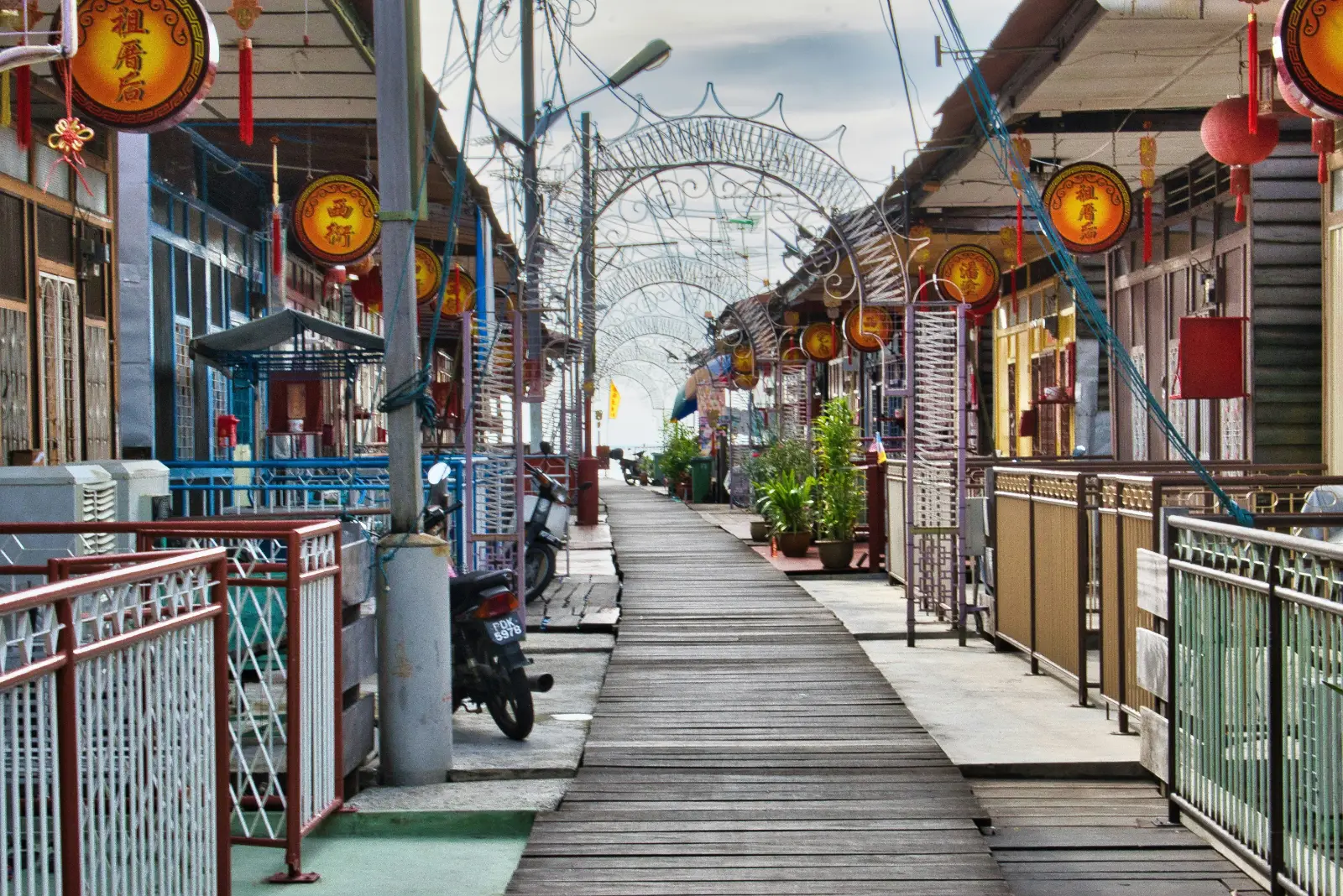
Wooden boardwalk lined with stilt houses and red lanterns at the Clan Jetties in George Town

The Clan Jetties are wooden villages on stilts over the water at Weld Quay, built and still lived in by Chinese clan communities. George Town World Heritage Incorporated notes that each jetty is named after the clan's surname. Chew Jetty is the best known and the busiest, with small shops and snack stalls along its boardwalk; the quieter jetties give a better sense of daily life.

Treat the jetties as a neighbourhood, not a theme park. Families live in these houses, so keep your voice down, do not walk into homes, and keep children close on the narrow boardwalks, where railings are not continuous everywhere. Late afternoon gives the softest light over the water. The jetties are an easy walk from the ferry terminal at Pangkalan Raja Tun Uda, so they fit well on the day you arrive from Butterworth.

3. Tour Cheong Fatt Tze Mansion, the Blue Mansion
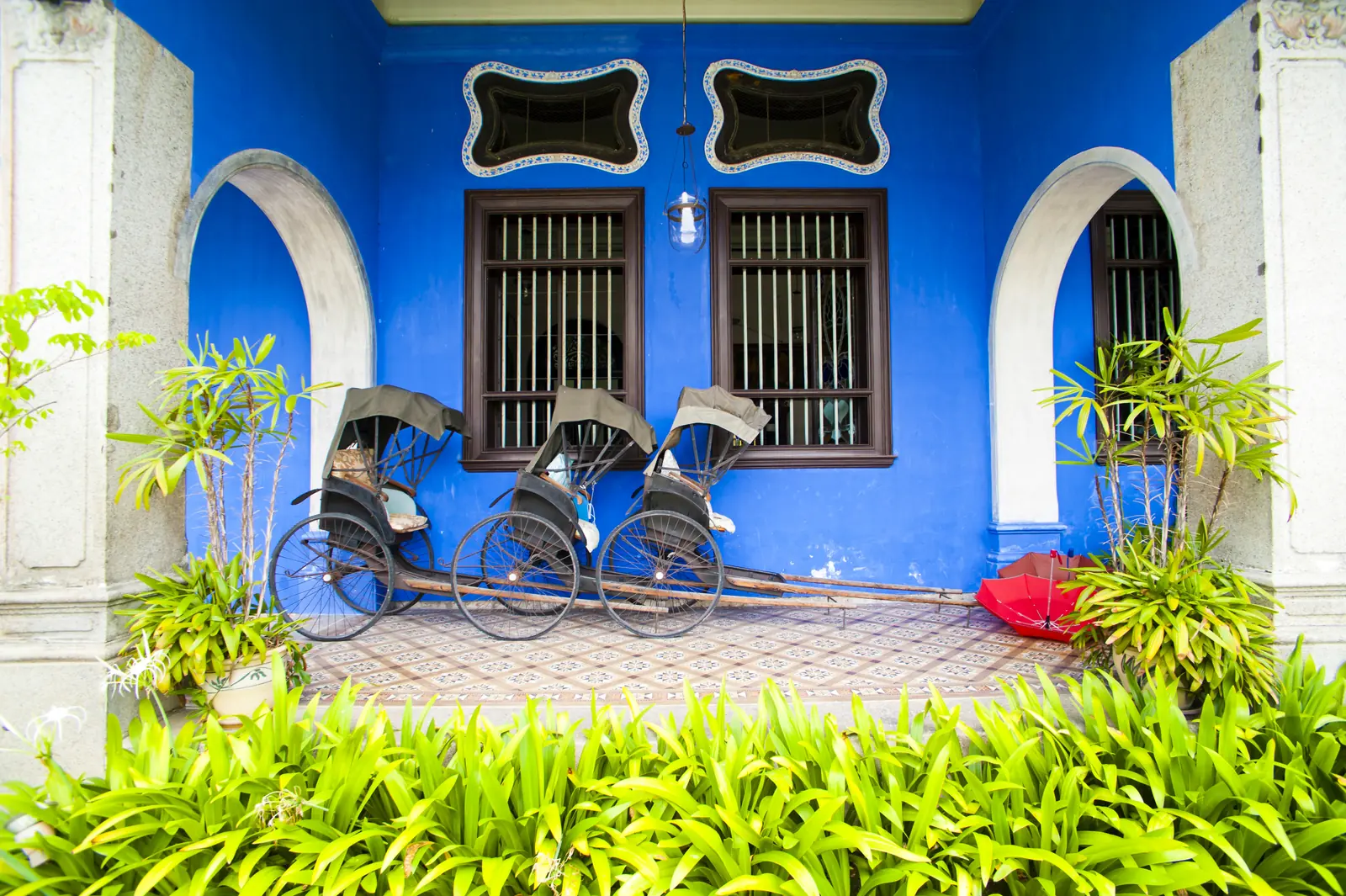
Old rickshaws parked against the indigo blue walls of Cheong Fatt Tze Mansion in George Town

Cheong Fatt Tze Mansion, known for its indigo walls as the Blue Mansion, is the grand courtyard house built for the Chinese merchant Cheong Fatt Tze, and you see the inside on a guided tour or a self-guided audio tour. The mansion's official daily tours page lists two guided tours a day, at 11am and 3.30pm, each about 45 minutes, with a maximum of 24 people per tour. It says tours are often sold out and recommends booking online in advance. The house is also a boutique hotel, so only some parts of the mansion are open during the tour, to protect the privacy of staying guests.

The guided tour covers the reception hall and the second-floor museum, and it is a good short introduction to feng shui design and the Straits Chinese world. Tour slots have changed over the years (an older page on the same site still lists a 2pm tour), so check the time when you book. Checked: 12 Nov 2026, cheongfatttzemansion.com.

4. Eat and shop in Little India

Little India, centred on Queen Street (Lebuh Queen) and the lanes around it, is where Nepali and Indian travellers usually feel most at home in George Town: Tamil music from shopfronts, flower garland sellers, sari and spice shops, and vegetarian restaurants serving rice meals on banana leaves. It is also one of the easiest places on the island to eat a full vegetarian meal without explaining yourself.

Little India is busiest in the evening and around Hindu festivals, when the streets fill with lights and stalls. If you are shopping, small grocery stores here stock the same lentils, spices and snacks you would find in Indian markets, which is handy for long-stay diaspora visitors.

5. Visit the Sri Mahamariamman Temple

The Queen Street Sri Maha Mariamman Temple is described by the Penang Hindu Endowments Board as the oldest Hindu temple in Penang. The shrine was enlarged into a temple in 1833, and some records say worship on the site began as early as 1801. The main deity is the goddess Mahamariamman, revered especially by Tamil Hindus as a protector.

The temple opens daily in a morning session and an evening session, with pujas at around 7.30am and 6.30pm. The Endowments Board page gives slightly different opening times in different places (roughly 6am or 6.30am to noon, and 4.30pm or 5pm to 9pm), so plan around the puja times and confirm on the day. Remove your shoes before entering the grounds and ask a priest's permission before going into the inner areas. Checked: 12 Nov 2026, hebpenang.gov.my.

6. Walk the multi-faith street past the Kapitan Keling Mosque
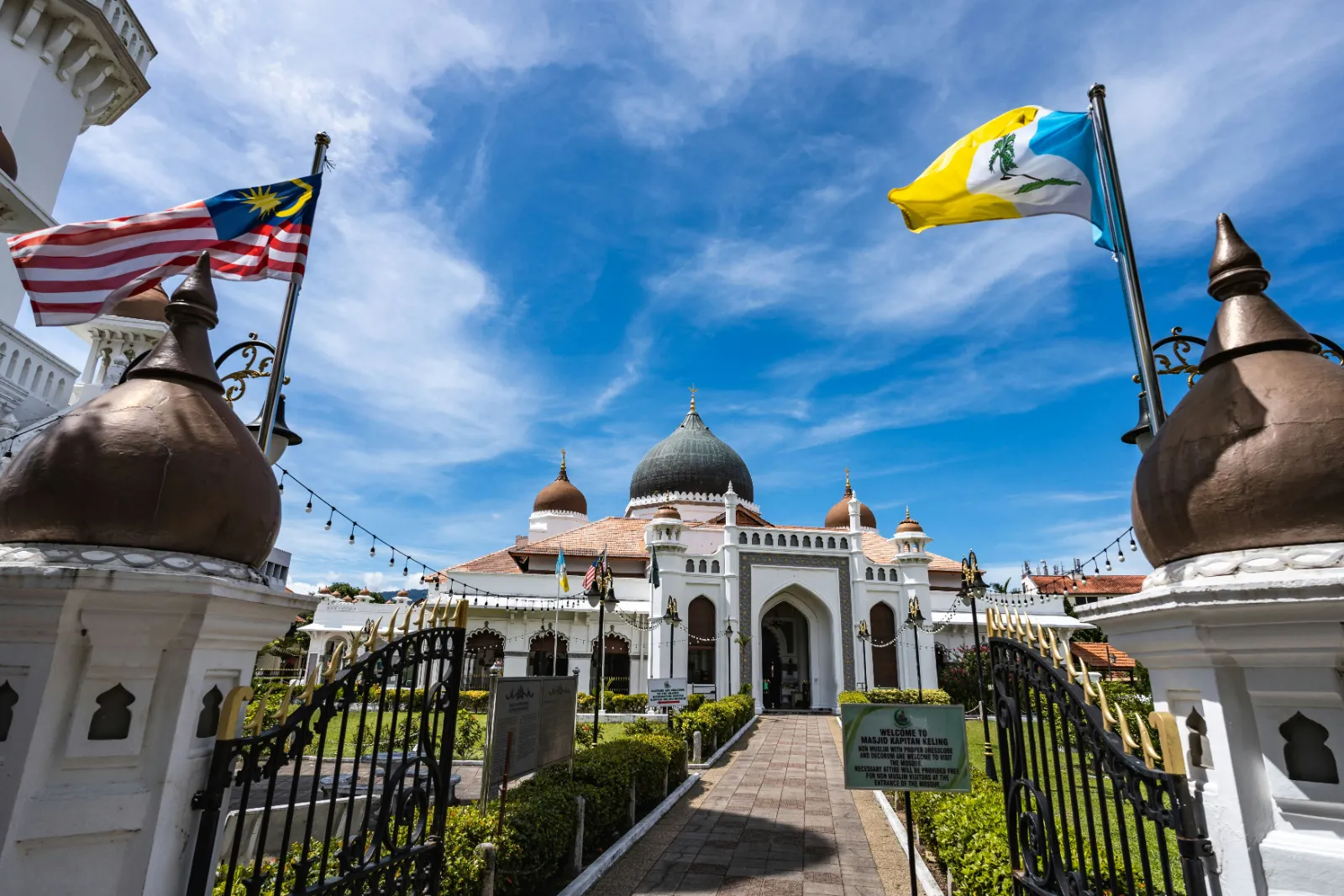
Kapitan Keling Mosque and its domes seen through the gates in George Town, Penang

Jalan Masjid Kapitan Keling (Pitt Street) is the street to walk if you want to understand George Town in one hour. George Town World Heritage Incorporated names it, along with Lebuh Cannon, as an area of harmonious co-existence of multicultural influences, where places of worship of different faiths stand close together. Guides and locals often call it the Street of Harmony.

Along or just off this street you will pass the Kapitan Keling Mosque, Chinese temples and an Anglican church, with the Sri Mahamariamman Temple a street away on Queen Street. At the mosque, dress modestly (shoulders and knees covered), remove your shoes and follow any visiting times posted at the entrance, and avoid visiting during prayer times. We could not find official visiting hours for the mosque online, so check at the gate.

7. Step into Cheah Kongsi and the clan houses
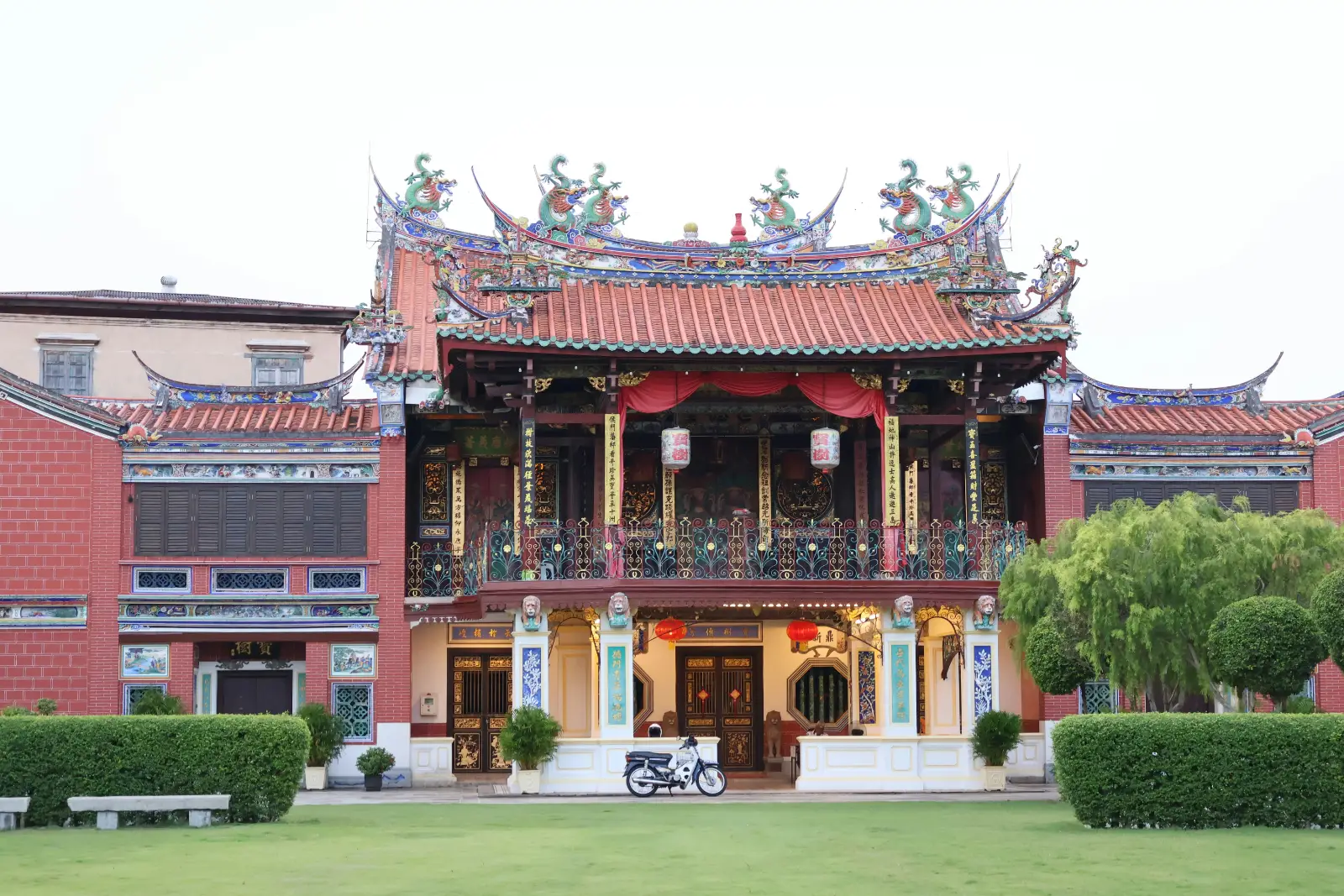
The ornate red and gold Cheah Kongsi clan temple on Armenian Street in George Town

Kongsi are Chinese clan associations, and their temples are some of the most ornate buildings in George Town. Cheah Kongsi, on Armenian Street, has a carved and painted temple front set behind a lawn, and it sits a few minutes' walk from Khoo Kongsi. Both show how the clans organised migration, welfare and worship for families arriving from southern China.

Clan houses are still active community buildings, so opening times vary and some areas close for clan events. Look for the entrance signs on the day, and keep voices low inside the prayer halls.

8. Eat your way through the hawker stalls
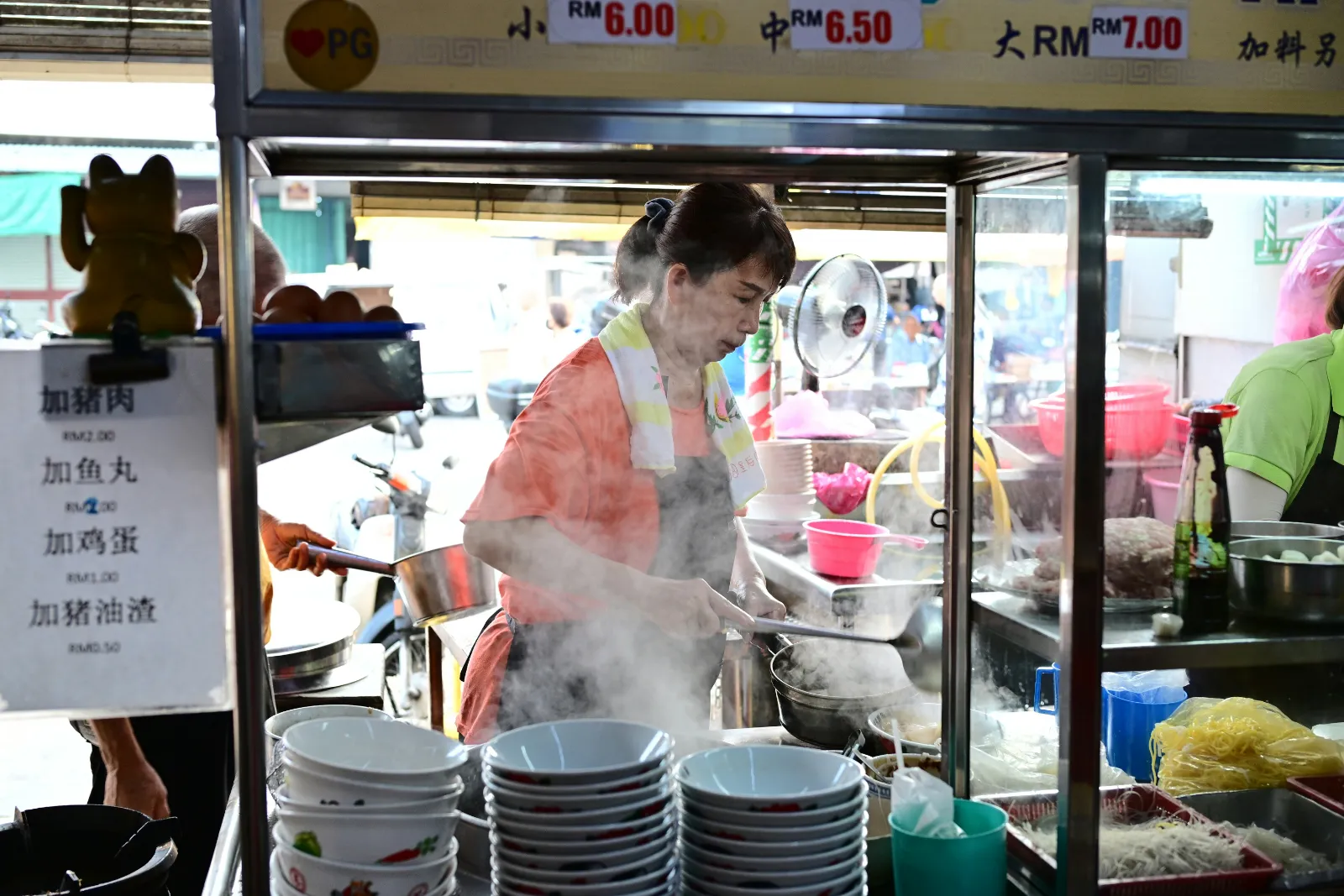
Hawker cooking noodles over steaming pots at a busy street food stall in Penang

Eating is the main event in George Town. Hawker centres, coffee shops and street carts serve Chinese, Malay, Indian Muslim, Peranakan and Thai-influenced dishes side by side, and many stalls cook only one or two dishes they have made for decades. We cover what to order, and what to skip if you are vegetarian or avoid beef, in the food section below.
Explore Malaysia tour packages
View all →

Where is Penang's street art and how do you see it?

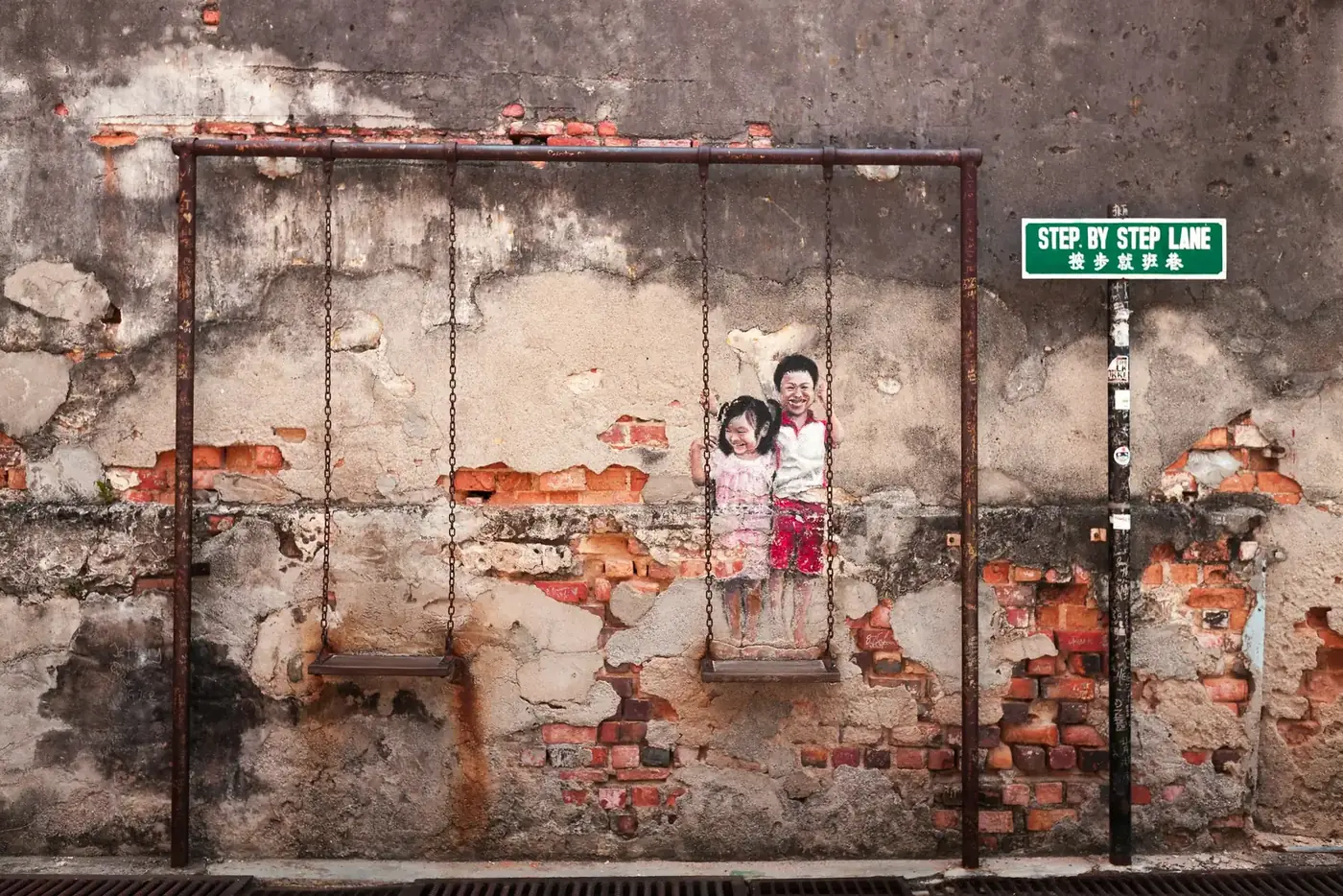
Mural of two children on a real metal swing on a weathered brick wall, George Town

Penang's best-known street art is in George Town's heritage core, mostly around Armenian Street and the lanes between Armenian Street, Lebuh Cannon, Lebuh Chulia and Lebuh Ah Quee, and the easiest way to see it is on foot early in the morning. Many of the famous pieces combine paint with real objects, such as a bicycle, a motorbike or a swing fixed to the wall, which is why people queue to pose with them.

The murals that made George Town's street art famous were painted by the Lithuanian-born artist Ernest Zacharevic. According to Malay Mail (January 2026), he painted his first mural on a shop wall on Armenian Street in 2011, followed by a series of everyday-life murals for the 2012 George Town Festival. The best known, "Children on a Bicycle" on Armenian Street, was first completed in 2012; the artist restored his murals in 2016 and again in 2019, after "Children on a Bicycle" was vandalised.

Street art fades, gets painted over and is sometimes restored, so no list stays accurate for long. We could not find an official, current register of which murals survive, so treat any online map as a guide rather than a promise.

Street art tipWhy it helps
Go before 9amShorter queues at the popular murals and cooler walking
Look for the welded iron caricaturesSmall steel-rod cartoons on building walls explain local street history in a sentence or two
Hire a trishaw for part of the loopUseful for older family members in the heat; agree the route before you set off
Respect residentsMany murals are on homes and working shops; do not block doorways or climb on fittings
Expect changesMurals fade or are replaced; if a piece is gone, there is usually new work nearby

Is Penang Hill worth visiting?

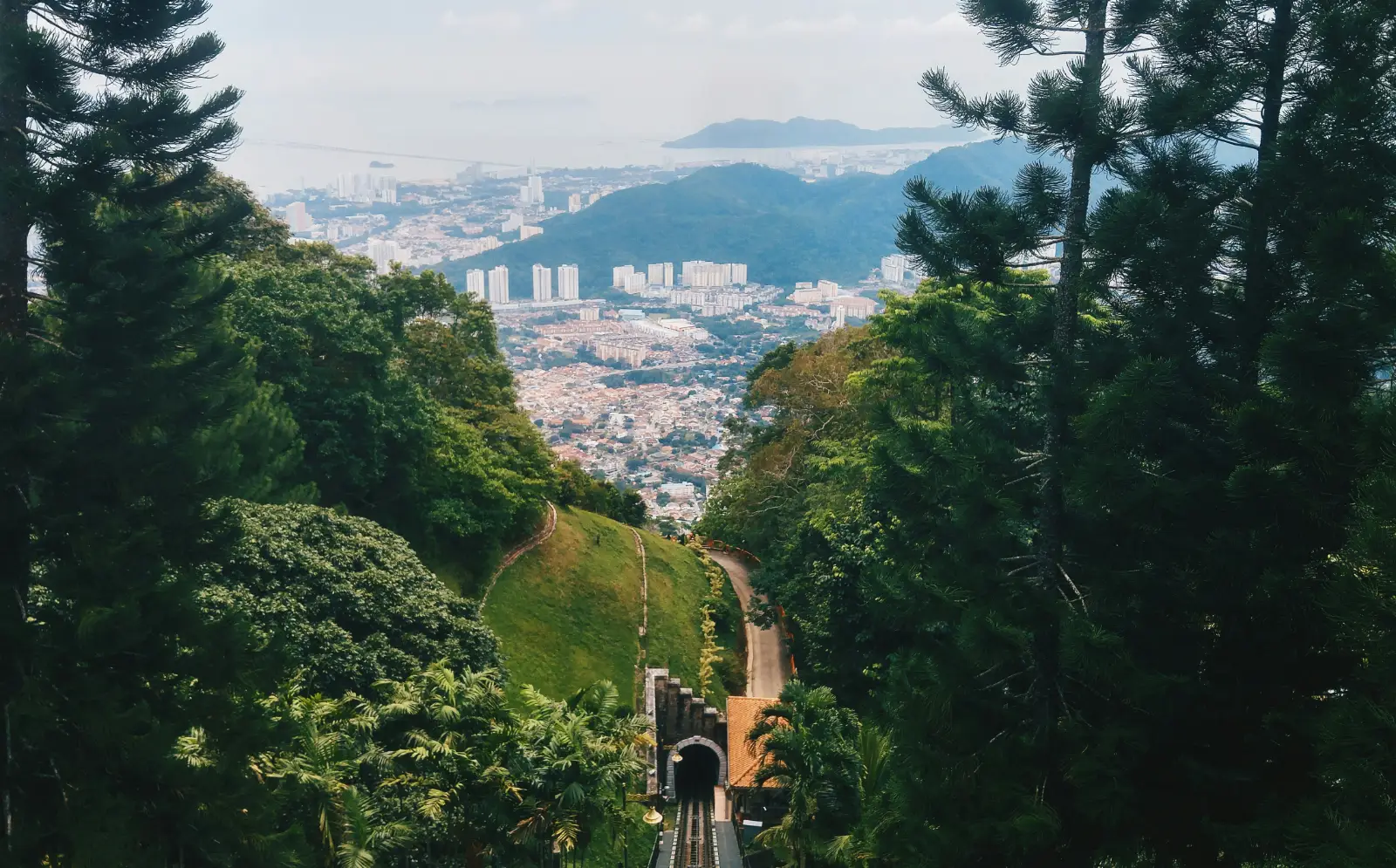
View from forested Penang Hill down the funicular track towards George Town and the sea

Yes, Penang Hill is worth visiting for the view over George Town and the strait, the cooler forest air and The Habitat nature park at the top, and the funicular makes it easy even for grandparents and small children. Penang Hill (Bukit Bendera) rises behind Air Itam, a short drive from the heritage core.

The Penang Hill Corporation's official FAQ says a one-way funicular trip takes about 4.5 minutes on a track about 2 km long, and each car can carry up to 100 passengers, although the corporation says it is running the cars at reduced capacity for now. The funicular starts at 6.30am. For the last train down, the corporation's Features and Services page and one FAQ answer give 11pm from the Upper Station, but another FAQ answer says the last trip down is 10pm, so plan to be on a train down by 10pm. Ticket counters open at 6.15am and close at 9.15pm or 9.45pm (the two official pages differ), and businesses at the Upper Station usually run from 9am to 7pm. Checked: 12 Nov 2026, penanghill.gov.my.

Plan around maintenance. The funicular closes twice a year for scheduled maintenance, and The Star and Malay Mail both reported on 17 August 2026 that the next closure runs from 4 to 10 January 2027, with service resuming on 11 January. During closures the alternatives are the privately run jeep service near the Penang Botanic Gardens and the hiking trails. Private cars are not allowed up unless you are a resident, business operator or contractor with a permit.

Way up Penang HillWhat it involvesGood for
Funicular from the Lower Station, Air ItamAbout 4.5 minutes each way; queues form at weekends and on public holidaysAlmost everyone, including families and older travellers
Jeep service from the Penang Botanic GardensPrivately managed jeeps on the hill roadFunicular closure days, small groups
Hiking trailsSteep forest trails; start early, carry water and tell someone your routeFit walkers in dry weather
Private carPermit holders only (residents, business operators, contractors)Not an option for visitors

For the best views, go up in the morning before cloud builds, or late afternoon to watch the lights come on over George Town. Weekday mornings are calmer than weekends. Carry a light layer: the top is cooler than town, and the air feels very different after a day on the coast.

The Habitat on Penang Hill

The Habitat is a rainforest nature park at the top of Penang Hill, with a 1.6 km trail, the Langur Way Canopy Walk and the Curtis Crest Tree Top Walk, which the park describes as the highest accessible viewing platform in Penang. Its official FAQ gives opening hours of 9am to 9pm daily, with last entry at 6.30pm and exit by 9pm. The park's café and retail close at 5pm, according to its operating hours notice. Checked: 12 Nov 2026, thehabitat.my.

The trail involves walking and climbing stairs, so it suits most families with children who can manage steps, but it is not a flat stroll. Bring insect repellent, wear grippy shoes and allow two to three hours if you want to read the signs and wait for wildlife. Couples often time a visit for the late afternoon and stay on the hill for the sunset view.

What should you eat in Penang?

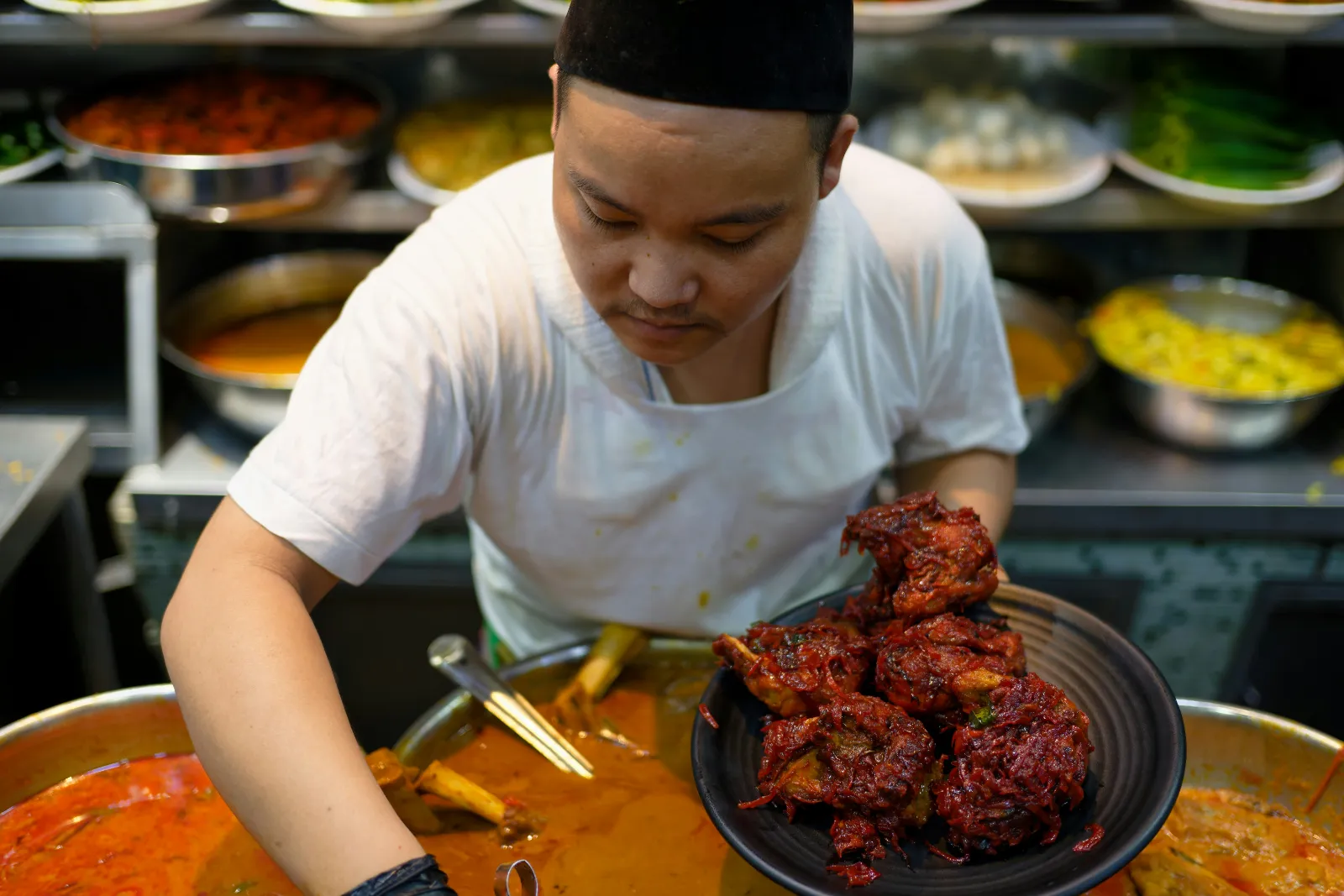
A cook serves fried chicken beside trays of curries at a George Town nasi kandar stall

In Penang, eat char kway teow, assam laksa, nasi kandar and cendol at least once, and if you are vegetarian, head to Little India's banana-leaf restaurants and the Chinese vegetarian stalls for meat-free versions of local dishes. Penang's food is a direct result of its trading history: Hokkien Chinese, Malay, Tamil Muslim, Peranakan and Thai cooking all left their mark. For a country-wide view of dishes, see our guide to what to eat in Malaysia.

DishWhat it isVegetarian or beef-free note
Char kway teowFlat rice noodles stir-fried over a very hot wok with soy, egg, bean sprouts and chives, usually with prawns and cocklesUsually not vegetarian; often cooked in lard. Ask for a vegetarian version at Chinese vegetarian stalls
Assam laksaThick rice noodles in a sour, tamarind-based fish broth with herbs and shrimp pasteContains fish; not vegetarian
Nasi kandarRice with your choice of curries, poured together over the plate, from a Tamil Muslim traditionHalal; vegetable curries and dhal are usually available. Ask which curries contain beef
CendolShaved ice with green rice-flour jelly, coconut milk and palm sugar syrupVegetarian; good after a hot walk
Roti canaiFlaky griddled flatbread with dhal or curryEasy vegetarian choice with dhal
Banana-leaf riceRice with vegetable dishes, pickles and papadum served on a banana leafFully vegetarian at vegetarian restaurants in Little India
PopiahFresh spring roll filled with stewed turnip, egg and saucesAsk; some stalls make it without meat or seafood
Chinese vegetarian riceRice with mock meat, tofu and vegetable dishes from Buddhist vegetarian stallsVegetarian; often without onion and garlic too

A few practical food notes for Nepali travellers:

  • Beef. Indian Muslim and Malay stalls serve halal food but may include beef. Hindu vegetarian restaurants and Chinese Buddhist vegetarian stalls are the safest choices if you avoid beef completely.
  • Pork. Many Chinese hawker dishes use pork or lard. If you need halal food, look for the halal certification sign at the stall or shop.
  • Spice. Penang curries are flavourful but not always very hot; sambal and chilli are often served on the side, so you control the heat.
  • Timing. Many hawkers open only for breakfast, lunch or dinner, and some close one day a week. If a stall is shut, the next one along is usually just as good.
  • Water. Drink bottled or filtered water and avoid ice from roadside carts if your stomach is sensitive.

Which temples and heritage sites should you see?

If you only have time for a few, see Kek Lok Si on the hillside at Air Itam, the Sri Mahamariamman Temple in Little India, the Kapitan Keling Mosque, and one clan house such as Cheah Kongsi or Khoo Kongsi. Together they show the Buddhist, Hindu, Muslim and Chinese clan traditions that make George Town distinctive.

Kek Lok Si Temple

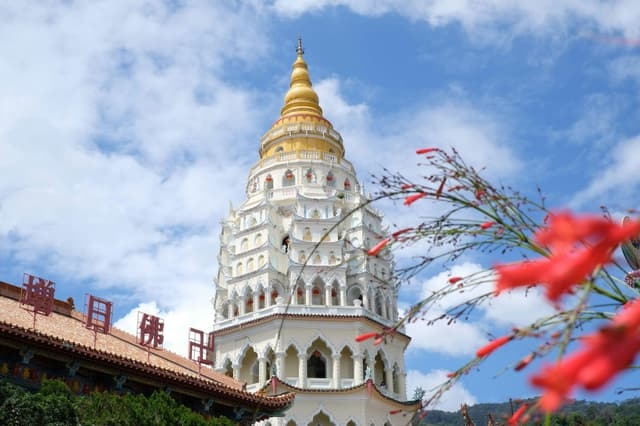
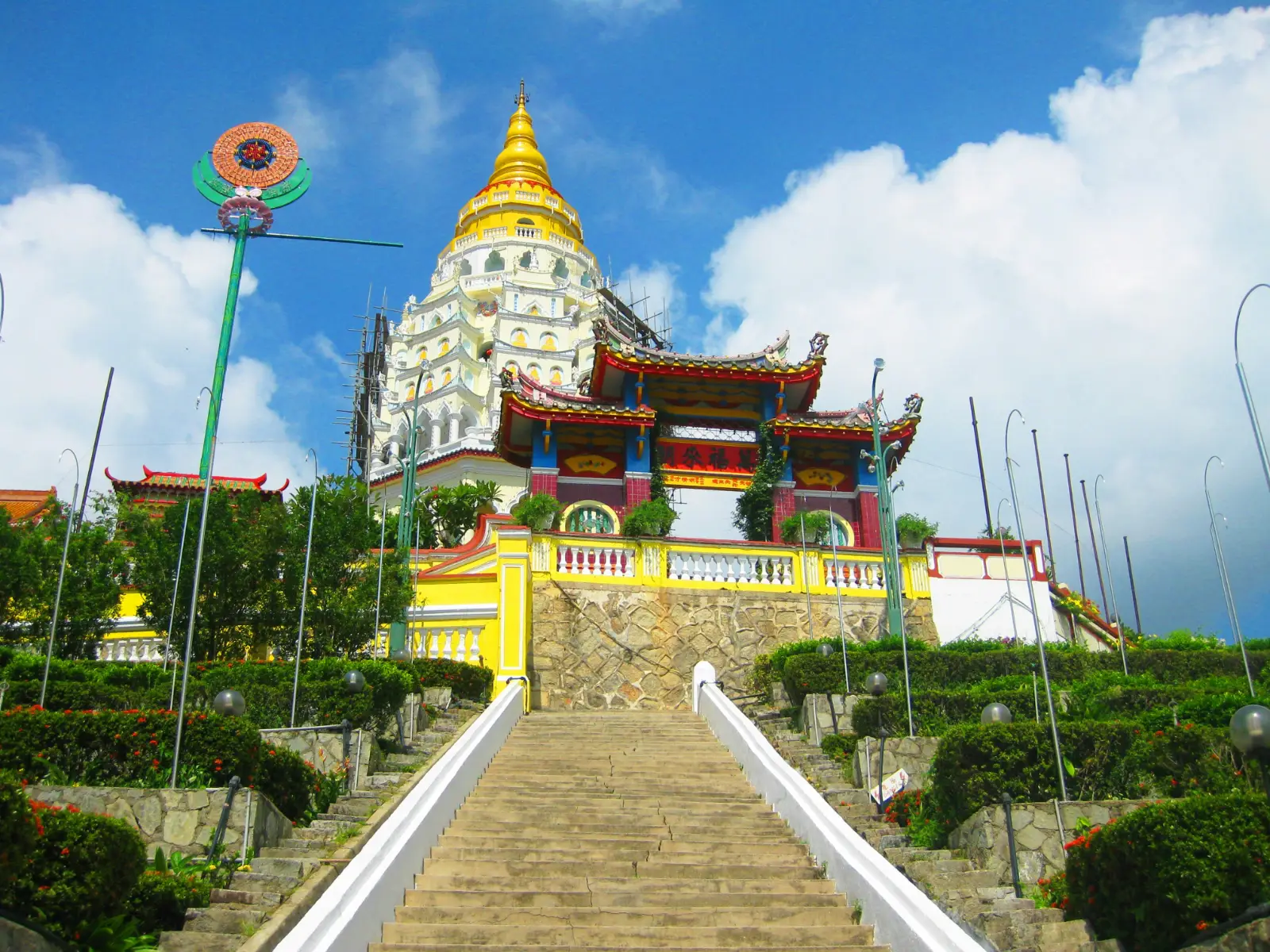
Stairway up to Kek Lok Si temple and its tall tiered pagoda, Air Itam, Penang

Kek Lok Si is a hillside Buddhist temple complex in Air Itam, often described as one of the largest Buddhist temples in the region, and it is the one sight outside George Town that most visitors should not skip. The temple was founded in the early 1890s by the monk Beow Lean (sources give 1890 or 1891 for the start of building) and grew in stages over several decades. Its seven-storey Pagoda of Ten Thousand Buddhas, fully completed in 1930, blends a Chinese octagonal base, Thai-style middle tiers and a Burmese-style crown; it is also called the Rama VI Pagoda because King Rama VI of Siam is said to have laid its foundation stone. Above it stands a tall bronze statue of Guanyin (Kuan Yin), the goddess of mercy, inaugurated in 2002.

The temple is spread over several levels joined by stairs, inclined lifts and paths, so it suits older travellers who would struggle with a full climb. Around Chinese New Year the complex is hung with red lanterns and lights, which is the most memorable time to go if your dates allow. Dress modestly, as at any place of worship. We could not confirm official opening hours from the temple itself, so check locally before you go. Kek Lok Si and the Penang Hill Lower Station are both in Air Itam, so they pair naturally on the same half day.

SiteFaith or traditionVisitor etiquette
Kek Lok SiMahayana BuddhistModest dress; quiet in prayer halls; follow signs on photography
Sri Mahamariamman TempleHindu (Tamil)Shoes off before the grounds; ask a priest before entering inner areas
Kapitan Keling MosqueMuslimShoulders and knees covered; shoes off; avoid prayer times
Cheah Kongsi, Khoo KongsiChinese clan templesRespect clan events; keep voices low
Cheong Fatt Tze MansionChinese merchant mansion, now a heritage hotelGuided or audio tour; some areas closed to protect hotel guests' privacy

A Hindu-friendly morning in George Town

For Hindu travellers from Nepal and the diaspora, a simple way to spend a morning is to attend the early puja at the Sri Mahamariamman Temple, take breakfast at a vegetarian restaurant on Queen Street, then walk along Jalan Masjid Kapitan Keling to see the mosque, Chinese temples and church that share the street. It is short, respectful and gives older family members a familiar anchor in an unfamiliar city. If temples abroad are part of why you travel, Batu Caves near Kuala Lumpur is the other major Hindu site in Malaysia.

Are there good beaches in Penang?

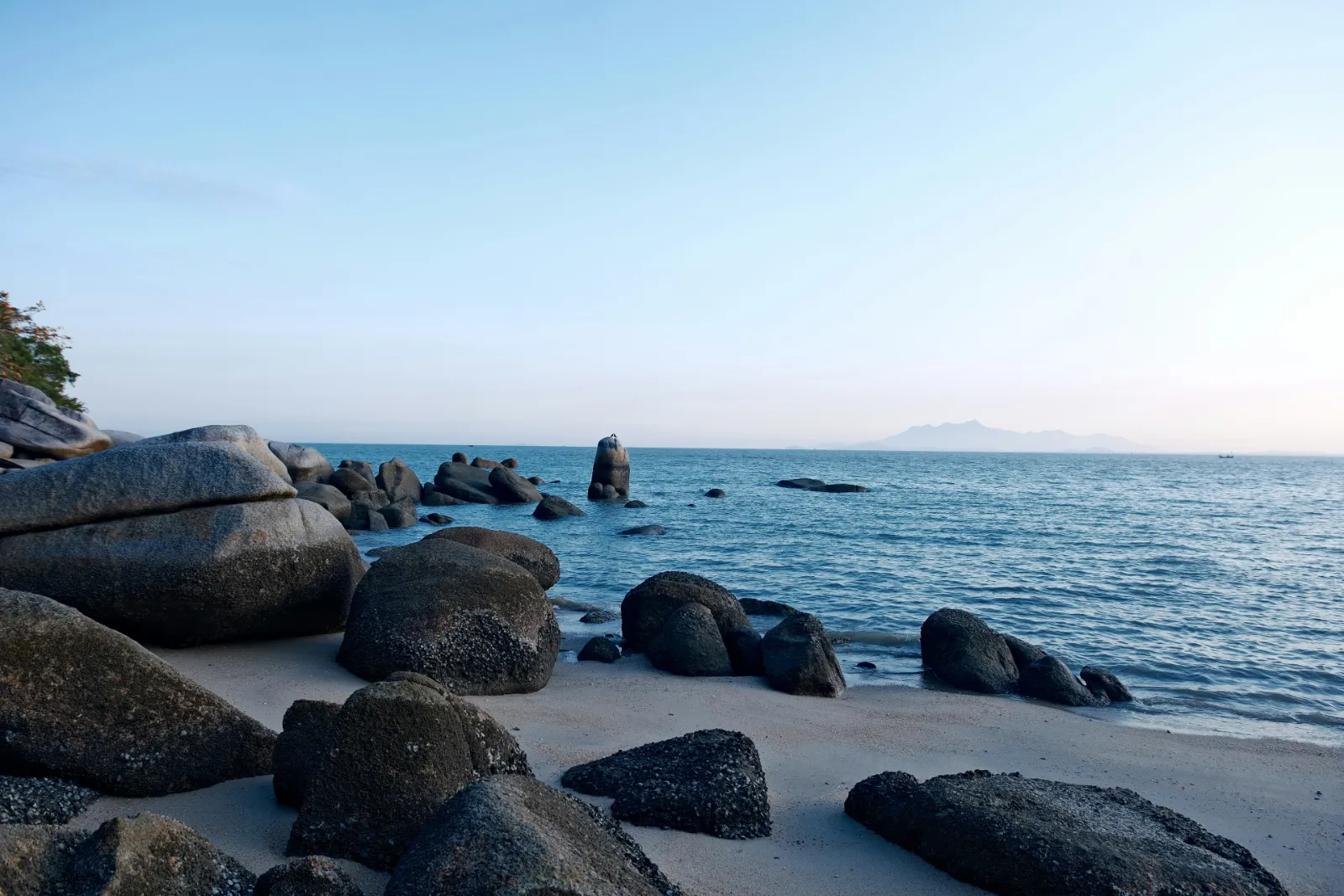
Granite boulders on the sandy shore at Batu Ferringhi beach on Penang's north coast

Penang has pleasant beaches, mainly at Batu Ferringhi on the north coast, but it is not a top swimming destination; come for resort pools, sunsets and the evening street stalls rather than clear water. Batu Ferringhi is a strip of beach hotels, cafés and night stalls west of George Town along the north coast road, and it makes a relaxed base for families who want a pool after mornings in town.

Sea conditions vary, so swim only where it looks safe and follow any posted warnings. If a beach holiday is the main goal of your trip, the islands of Langkawi or the east coast are usually a better fit; see our roundup of the best beaches in Malaysia to compare.

How do you get to Penang from Kuala Lumpur?

You can get from Kuala Lumpur to Penang by a short domestic flight to Penang International Airport, by KTMB's ETS electric train from KL Sentral to Butterworth followed by the ferry to George Town, or by express coach. The train is the most comfortable for most travellers; the flight is fastest if you are coming straight from KLIA after your international arrival.

From Nepal, most travellers reach Penang via Kuala Lumpur. Our guide to the Kathmandu to Kuala Lumpur flight explains the routing, and you can check entry rules for Nepali passport holders on our Malaysia visa page before you plan the Penang leg.

OptionRouteJourney timeGood for
FlightKuala Lumpur (KLIA) to Penang International Airport, then road to George TownA short domestic hop; allow extra time for airport transfers and check-inConnecting straight from an international arrival
ETS train plus ferryKL Sentral to Butterworth by ETS, walk to the ferry terminal, cross to Pangkalan Raja Tun Uda in George TownAbout 3 hours 35 minutes to 4 hours 20 minutes on the train (timetable below), plus the ferry crossingComfort, families, scenery, arriving into the heritage core
Express coachKuala Lumpur bus terminals to Butterworth or Penang Island via the North-South Expressway and the Penang bridgesVaries with traffic and stops; check with the operatorLate bookings, travellers on a tight budget
Car or private transferNorth-South Expressway, then either Penang bridgeVaries with trafficGroups, families with lots of luggage

ETS trains from KL Sentral to Butterworth

According to KTMB's official ETS timetable effective 1 June 2026 (document updated 3 April 2026), seven ETS trains a day run from KL Sentral to Butterworth. Several other northbound ETS trains continue to Padang Besar without calling at Butterworth, so check the destination before you buy.

TrainService typeDeparts KL SentralArrives Butterworth
EP9124ETS Platinum08:0512:10
EX9108ETS Express11:4015:15
EP9130ETS Platinum13:4017:45
EP9326ETS Platinum14:1018:15
EP9136ETS Platinum15:5520:00
EG9352ETS Gold18:2222:42
EP9138ETS Platinum20:1500:20 (next day)

Going back south, the same timetable lists Butterworth departures at 05:15, 06:30, 07:00, 07:50, 13:05, 16:05 and 18:45, arriving at KL Sentral between 09:20 and 22:50. Trains can sell out around public holidays and school breaks, so book early for those dates. Checked: 12 Nov 2026, KTMB ETS timetable (ktmb.com.my). Timetables change; recheck on the KTMB site before you travel.

The ferry from Butterworth to George Town

The Penang ferry is a short crossing from Pangkalan Sultan Abdul Halim in Butterworth to Pangkalan Raja Tun Uda in George Town, and it carries foot passengers, bicycles and motorcycles only, not cars. Penang Port's official ferry page states that the ferries carry passengers and two-wheelers across the 3.2 km Penang Strait, with services from 6.30am to 11.30pm. The current fleet of catamarans entered service in August 2023 and is not designed for cars, which have not been carried since 2021; drivers use the Penang Bridge or the Sultan Abdul Halim Muadzam Shah Bridge instead.

The Butterworth ferry terminal is beside Penang Sentral and the railway station, so the walk from the ETS platform is short. The George Town terminal is a short walk from the Clan Jetties and the heritage core. Note that the last ferry (11.30pm by Penang Port's listing) leaves before the latest ETS train arrives, so if you are on the 20:15 from KL Sentral, plan a road transfer across the bridge instead. Checked: 12 Nov 2026, penangport.gov.my.

When is the best time to visit Penang?

The best time to visit Penang is usually January and February, with a second, shorter drier window in June and July, because those are the driest periods for north-west Peninsular Malaysia; October and November are the wettest months. Penang is hot and humid all year, so the choice is really about rain, not temperature.

The Malaysian Meteorological Department (MetMalaysia) explains that Malaysia has four seasons: the north-east monsoon, the south-west monsoon and two shorter inter-monsoon periods. For most of the Peninsula outside the south-west coast, MetMalaysia says rainfall peaks in October to November, with a second peak in April to May. For the north-western region, which includes Penang, the driest periods are January to February and June to July. MetMalaysia also notes that the annual temperature variation is small, while the difference between day and night is larger.

MonthsRain in north-west Peninsular Malaysia (MetMalaysia pattern)What it means for a Penang trip
January to FebruaryPrimary rainfall minimumDriest stretch; Chinese New Year and Kek Lok Si lights often fall here, and crowds rise
MarchBetween dry and wet peaksGood walking weather on most days; very hot afternoons
April to MaySecondary rainfall maximumAfternoon thunderstorms are common; plan outdoor sights for mornings
June to JulySecondary rainfall minimumA useful drier window; matches summer school holidays for diaspora families
August to SeptemberRain building againMixed; showers more frequent
October to NovemberPrimary rainfall maximumWettest period; heavy downpours are common, so keep plans flexible
DecemberRain easingImproving weather, year-end holiday crowds

A note for travellers from Nepal: Dashain and Tihar usually fall between late September and November, which overlaps Penang's wettest stretch. That does not rule out a festival-holiday trip, because rain often comes as heavy afternoon bursts rather than all-day drizzle, but it does change how you plan. Do the murals, Clan Jetties and Penang Hill in the morning, keep museums, the Blue Mansion tour and long meals for the afternoon, and pack a compact umbrella and quick-dry shoes. Our month-by-month guide to the best time to visit Malaysia compares Penang with the east coast and Borneo, where the monsoon timing is different.

How should you plan your Penang trip?

Plan Penang as two parts: George Town on foot, and the rest of the island by car, bus or ride-hailing. Most travellers find two to three full days enough for the highlights in this guide, with a fourth day if you want a slow beach evening at Batu Ferringhi or a second visit to the hawker stalls.

  • Where to stay. Stay inside or next to George Town's heritage core if food and culture are your priority; restored shophouse hotels put the murals and hawkers at your door. Choose Batu Ferringhi if you want a resort pool and beach for children.
  • Getting around. Walk the core, use ride-hailing apps or buses for Penang Hill, Kek Lok Si and Batu Ferringhi, and save trishaws for short heritage loops.
  • Pairing with other places. Penang combines easily with Kuala Lumpur by train, and with Langkawi by a short flight. For a fuller look at the capital, see our list of things to do in Kuala Lumpur; for an island add-on, read the Langkawi travel guide.
  • Families. Penang Hill, The Habitat and the Clan Jetties suit children well. Build in pool time or air-conditioned breaks, and keep the heat in mind for grandparents.
  • Couples and honeymooners. Sunset on Penang Hill, a night in a heritage shophouse hotel and the Blue Mansion tour make a calm, romantic stop between busier cities.
  • Safety. George Town is generally comfortable to walk in the evening in busy areas. Use normal city care with bags and phones, especially around crowded food streets, and use ride-hailing apps late at night.
  • Money. Many hawkers prefer cash in Malaysian ringgit, while hotels, malls and larger restaurants take cards. Carry small notes for food stalls and trishaws.

If you would like a Penang stop built into a wider Malaysia trip, with hotels, transfers and the KL to Penang leg arranged, see the Malaysia tour packages.

Frequently asked questions

How many days are enough for Penang?

Two to three full days are enough for most first visits to Penang: one or two days on foot in George Town for the murals, Clan Jetties, temples and hawker food, and one day for Penang Hill, The Habitat and Kek Lok Si. Add a fourth day for Batu Ferringhi or simply more eating.

Is George Town walkable?

Yes, George Town's heritage core is very walkable. The UNESCO core zone covers about 109 hectares, so Armenian Street, the Clan Jetties, Little India and the Kapitan Keling Mosque are all within a short walk of each other. Walk in the morning or evening, because midday heat and humidity make long walks tiring.

Is Penang good for vegetarians?

Penang is one of the easier places in Malaysia for vegetarians. Little India in George Town has vegetarian banana-leaf restaurants, and Chinese Buddhist vegetarian stalls serve rice with tofu, mock meat and vegetables. Many popular hawker dishes, such as char kway teow and assam laksa, contain seafood or meat, so always ask.

How do you get up Penang Hill?

Most visitors go up Penang Hill by the funicular from the Lower Station in Air Itam, a trip of about 4.5 minutes, according to the Penang Hill Corporation. A private jeep service runs from the Penang Botanic Gardens, and fit walkers can hike. Visitors cannot drive private cars up the hill.

Is Penang better than Langkawi for a first trip?

Penang is better than Langkawi for a first trip if you care most about food, heritage and culture, because George Town gives you all three on foot. Langkawi is better if you want beaches, island scenery and a resort break. Many travellers do both, with a short domestic flight between them.

Can you take the train from KL to Penang?

Yes. KTMB's ETS trains run from KL Sentral to Butterworth on the mainland, and the timetable effective 1 June 2026 lists seven direct trains a day taking about 3.5 to 4.5 hours. From Butterworth station you walk to the ferry terminal and cross to George Town, or take a road transfer over the bridge.

Is Penang hot all year?

Yes, Penang is hot and humid all year, and MetMalaysia notes that temperatures change little from month to month. What changes is rain: in north-west Peninsular Malaysia, October and November are usually the wettest months and January to February the driest, so plan Penang around rain rather than heat.

Are there good beaches in Penang?

Penang's main beach area is Batu Ferringhi on the north coast, good for resort stays, sunsets and evening street stalls. The water is not as clear as on Malaysia's island destinations, and conditions vary, so follow posted warnings. For a swimming-focused beach holiday, Langkawi or the east coast islands are usually better.

Is George Town safe at night?

George Town is generally comfortable for evening walks in its busy streets, food areas and around Chulia Street and Little India. Use normal city care: keep bags zipped, watch your phone near crowded stalls, and use ride-hailing apps rather than walking through quiet, dark lanes late at night.

Is there Indian food in Penang?

Yes, Penang has plenty of Indian food. Little India around Queen Street in George Town has South Indian vegetarian restaurants serving banana-leaf meals, dosa and thali-style rice, and Penang's famous nasi kandar comes from a Tamil Muslim tradition. Nepali and Indian travellers usually find familiar flavours easily.

Can you see Penang Hill and Kek Lok Si on the same day?

Yes. Penang Hill's funicular Lower Station and Kek Lok Si Temple are both in Air Itam, a short drive from George Town, so they pair well on one half day. Visit Kek Lok Si first, then ride up Penang Hill for The Habitat and the late afternoon view over George Town.

Tags
Malaysia
Share
G
Gomayu Team
Writer at Gomayu
Keep reading
Blog / Malaysia
Things to Do in Penang: George Town, Malaysia Street Art and Food
28 min read 12 Nov 2026 · Updated 16 Nov 2026
Aerial view of Clan Jetties stilt house rooftops over the sea in George Town

Short answer: Penang is one of Malaysia's strongest stops for food and heritage, and its capital, George Town, Malaysia's UNESCO-listed port city, is where most of the best things to do sit within walking distance of each other. Spend your time on the Armenian Street murals, the Clan Jetties, Cheong Fatt Tze Mansion, Little India and the hawker stalls, then add Penang Hill, The Habitat, Kek Lok Si and an evening at Batu Ferringhi. From Kuala Lumpur you can fly, take the ETS train to Butterworth and cross by ferry, or go by coach. Below is what each place is like, how to see it well, which hours we checked on 12 November 2026, and what to eat if you are vegetarian or avoid beef.

This guide is written for travellers adding Penang to a wider Malaysia trip: food lovers, couples, culture lovers, families and Nepali travellers who want to know where the vegetarian thalis and Hindu temples are. For the bigger picture of the country, start with our complete Malaysia travel guide.

Why visit Penang and George Town, Malaysia?

Two trishaws with white umbrellas parked by shophouses near the Lebuh Armenian sign, George Town

Visit Penang for three things: a living heritage town, some of the most varied street food in Asia, and an easy mix of city, hill and beach on one compact island. George Town is not a museum piece. People still live above the shophouses, run family trades on the ground floor and pray at temples, mosques and churches that stand a few streets apart.

George Town was inscribed by UNESCO on 7 July 2008, jointly with Melaka, as the World Heritage Site "Melaka and George Town, Historic Cities of the Straits of Malacca". The listing recognises the two towns as products of the Straits of Malacca trade route, where Malay, Chinese, Indian and European influences mixed in buildings, food and customs. According to George Town World Heritage Incorporated, the site's managing body, George Town's core zone covers 109.38 hectares, with a buffer zone of 150.04 hectares around it. That is small enough to cross on foot in an afternoon and dense enough to fill several days.

Penang works well as the second stop after Kuala Lumpur. KL gives you towers, malls and Batu Caves; Penang gives you slower streets, older buildings and better food at the stall level. If you are still deciding where Penang fits, our guide to the best places to visit in Malaysia compares it with Langkawi, Melaka, the Cameron Highlands and Borneo.

Penang at a glanceWhat to know
Where it isAn island state off the north-west coast of Peninsular Malaysia, with a mainland strip around Butterworth
Main townGeorge Town, on the north-east tip of Penang Island
UNESCO statusInscribed 7 July 2008, jointly with Melaka (Historic Cities of the Straits of Malacca)
Links to the mainlandTwo road bridges plus the Butterworth to George Town ferry for foot passengers, bicycles and motorcycles
Best known forHawker food, street art, clan houses, temples of many faiths, Penang Hill
CurrencyMalaysian ringgit (MYR); licensed money changers and ATMs are easy to find in George Town

What are the top things to do in George Town, Malaysia?

The top things to do in George Town are walking the heritage core, eating at hawker stalls, and seeing a handful of standout buildings: the Clan Jetties, Cheong Fatt Tze Mansion, Cheah Kongsi, the Sri Mahamariamman Temple and the Kapitan Keling Mosque. Beyond the town, Penang Hill, The Habitat, Kek Lok Si and Batu Ferringhi round out the island. Here is the full list, then the detail.

#Thing to doAreaBest forTime to allow
1Armenian Street and the muralsGeorge Town coreCouples, photographers, familiesHalf a morning
2Clan JettiesWeld Quay, George TownCulture, sunset light1 to 2 hours
3Cheong Fatt Tze Mansion (the Blue Mansion)Lebuh Leith, George TownArchitecture, history45 minute guided tour
4Little IndiaQueen Street area, George TownVegetarian food, Hindu travellersA meal plus a stroll
5Sri Mahamariamman TempleQueen Street, George TownHindu worship, heritage30 to 60 minutes
6Kapitan Keling Mosque and the multi-faith streetJalan Masjid Kapitan KelingCulture, architectureAn hour on foot
7Cheah Kongsi and the clan housesArmenian Street areaChinese heritage30 to 60 minutes
8Hawker foodAll over George TownEveryoneEvery evening
9Penang Hill by funicularAir ItamViews, cooler air, familiesHalf a day
10The HabitatTop of Penang HillNature, couples, kids2 to 3 hours
11Kek Lok Si TempleAir ItamBuddhist heritage, festival lights1 to 2 hours
12Batu FerringhiNorth coast of the islandBeach evenings, resortsAn evening or a resort stay

Times to allow are our planning guide, not official figures. Items 1 to 8 are in or next to George Town's heritage core and can be done on foot; items 9 to 12 need a car, bus or ride-hailing trip.

1. Walk Armenian Street and the heritage core

Armenian Street (Lebuh Armenian) is the easiest place to start because it packs shophouses, clan temples, cafés and the best-known murals into a few hundred metres. Come early, before the tour groups and the heat, and you will see the street as residents use it: shutters going up, coffee being poured, scooters weaving past. The street sits close to Cheah Kongsi, the Khoo Kongsi clan house and Lebuh Cannon, so you can loop through several sights without a plan.

A few things make the walk better. Wear shoes you can slip off, because many temples and some homes ask you to remove footwear. Carry water and a small umbrella, which works for both sun and the afternoon showers. Remember that many shophouses are private homes and family businesses, so ask before photographing people or stepping through an open door.

2. See the Clan Jetties at Weld Quay

Wooden boardwalk lined with stilt houses and red lanterns at the Clan Jetties in George Town

The Clan Jetties are wooden villages on stilts over the water at Weld Quay, built and still lived in by Chinese clan communities. George Town World Heritage Incorporated notes that each jetty is named after the clan's surname. Chew Jetty is the best known and the busiest, with small shops and snack stalls along its boardwalk; the quieter jetties give a better sense of daily life.

Treat the jetties as a neighbourhood, not a theme park. Families live in these houses, so keep your voice down, do not walk into homes, and keep children close on the narrow boardwalks, where railings are not continuous everywhere. Late afternoon gives the softest light over the water. The jetties are an easy walk from the ferry terminal at Pangkalan Raja Tun Uda, so they fit well on the day you arrive from Butterworth.

3. Tour Cheong Fatt Tze Mansion, the Blue Mansion

Old rickshaws parked against the indigo blue walls of Cheong Fatt Tze Mansion in George Town

Cheong Fatt Tze Mansion, known for its indigo walls as the Blue Mansion, is the grand courtyard house built for the Chinese merchant Cheong Fatt Tze, and you see the inside on a guided tour or a self-guided audio tour. The mansion's official daily tours page lists two guided tours a day, at 11am and 3.30pm, each about 45 minutes, with a maximum of 24 people per tour. It says tours are often sold out and recommends booking online in advance. The house is also a boutique hotel, so only some parts of the mansion are open during the tour, to protect the privacy of staying guests.

The guided tour covers the reception hall and the second-floor museum, and it is a good short introduction to feng shui design and the Straits Chinese world. Tour slots have changed over the years (an older page on the same site still lists a 2pm tour), so check the time when you book. Checked: 12 Nov 2026, cheongfatttzemansion.com.

4. Eat and shop in Little India

Little India, centred on Queen Street (Lebuh Queen) and the lanes around it, is where Nepali and Indian travellers usually feel most at home in George Town: Tamil music from shopfronts, flower garland sellers, sari and spice shops, and vegetarian restaurants serving rice meals on banana leaves. It is also one of the easiest places on the island to eat a full vegetarian meal without explaining yourself.

Little India is busiest in the evening and around Hindu festivals, when the streets fill with lights and stalls. If you are shopping, small grocery stores here stock the same lentils, spices and snacks you would find in Indian markets, which is handy for long-stay diaspora visitors.

5. Visit the Sri Mahamariamman Temple

The Queen Street Sri Maha Mariamman Temple is described by the Penang Hindu Endowments Board as the oldest Hindu temple in Penang. The shrine was enlarged into a temple in 1833, and some records say worship on the site began as early as 1801. The main deity is the goddess Mahamariamman, revered especially by Tamil Hindus as a protector.

The temple opens daily in a morning session and an evening session, with pujas at around 7.30am and 6.30pm. The Endowments Board page gives slightly different opening times in different places (roughly 6am or 6.30am to noon, and 4.30pm or 5pm to 9pm), so plan around the puja times and confirm on the day. Remove your shoes before entering the grounds and ask a priest's permission before going into the inner areas. Checked: 12 Nov 2026, hebpenang.gov.my.

6. Walk the multi-faith street past the Kapitan Keling Mosque

Kapitan Keling Mosque and its domes seen through the gates in George Town, Penang

Jalan Masjid Kapitan Keling (Pitt Street) is the street to walk if you want to understand George Town in one hour. George Town World Heritage Incorporated names it, along with Lebuh Cannon, as an area of harmonious co-existence of multicultural influences, where places of worship of different faiths stand close together. Guides and locals often call it the Street of Harmony.

Along or just off this street you will pass the Kapitan Keling Mosque, Chinese temples and an Anglican church, with the Sri Mahamariamman Temple a street away on Queen Street. At the mosque, dress modestly (shoulders and knees covered), remove your shoes and follow any visiting times posted at the entrance, and avoid visiting during prayer times. We could not find official visiting hours for the mosque online, so check at the gate.

7. Step into Cheah Kongsi and the clan houses

The ornate red and gold Cheah Kongsi clan temple on Armenian Street in George Town

Kongsi are Chinese clan associations, and their temples are some of the most ornate buildings in George Town. Cheah Kongsi, on Armenian Street, has a carved and painted temple front set behind a lawn, and it sits a few minutes' walk from Khoo Kongsi. Both show how the clans organised migration, welfare and worship for families arriving from southern China.

Clan houses are still active community buildings, so opening times vary and some areas close for clan events. Look for the entrance signs on the day, and keep voices low inside the prayer halls.

8. Eat your way through the hawker stalls

Hawker cooking noodles over steaming pots at a busy street food stall in Penang

Eating is the main event in George Town. Hawker centres, coffee shops and street carts serve Chinese, Malay, Indian Muslim, Peranakan and Thai-influenced dishes side by side, and many stalls cook only one or two dishes they have made for decades. We cover what to order, and what to skip if you are vegetarian or avoid beef, in the food section below.
Explore Malaysia tour packages
View all →

Where is Penang's street art and how do you see it?
Mural of two children on a real metal swing on a weathered brick wall, George Town

Penang's best-known street art is in George Town's heritage core, mostly around Armenian Street and the lanes between Armenian Street, Lebuh Cannon, Lebuh Chulia and Lebuh Ah Quee, and the easiest way to see it is on foot early in the morning. Many of the famous pieces combine paint with real objects, such as a bicycle, a motorbike or a swing fixed to the wall, which is why people queue to pose with them.

The murals that made George Town's street art famous were painted by the Lithuanian-born artist Ernest Zacharevic. According to Malay Mail (January 2026), he painted his first mural on a shop wall on Armenian Street in 2011, followed by a series of everyday-life murals for the 2012 George Town Festival. The best known, "Children on a Bicycle" on Armenian Street, was first completed in 2012; the artist restored his murals in 2016 and again in 2019, after "Children on a Bicycle" was vandalised.

Street art fades, gets painted over and is sometimes restored, so no list stays accurate for long. We could not find an official, current register of which murals survive, so treat any online map as a guide rather than a promise.

Street art tipWhy it helps
Go before 9amShorter queues at the popular murals and cooler walking
Look for the welded iron caricaturesSmall steel-rod cartoons on building walls explain local street history in a sentence or two
Hire a trishaw for part of the loopUseful for older family members in the heat; agree the route before you set off
Respect residentsMany murals are on homes and working shops; do not block doorways or climb on fittings
Expect changesMurals fade or are replaced; if a piece is gone, there is usually new work nearby

Is Penang Hill worth visiting?

View from forested Penang Hill down the funicular track towards George Town and the sea

Yes, Penang Hill is worth visiting for the view over George Town and the strait, the cooler forest air and The Habitat nature park at the top, and the funicular makes it easy even for grandparents and small children. Penang Hill (Bukit Bendera) rises behind Air Itam, a short drive from the heritage core.

The Penang Hill Corporation's official FAQ says a one-way funicular trip takes about 4.5 minutes on a track about 2 km long, and each car can carry up to 100 passengers, although the corporation says it is running the cars at reduced capacity for now. The funicular starts at 6.30am. For the last train down, the corporation's Features and Services page and one FAQ answer give 11pm from the Upper Station, but another FAQ answer says the last trip down is 10pm, so plan to be on a train down by 10pm. Ticket counters open at 6.15am and close at 9.15pm or 9.45pm (the two official pages differ), and businesses at the Upper Station usually run from 9am to 7pm. Checked: 12 Nov 2026, penanghill.gov.my.

Plan around maintenance. The funicular closes twice a year for scheduled maintenance, and The Star and Malay Mail both reported on 17 August 2026 that the next closure runs from 4 to 10 January 2027, with service resuming on 11 January. During closures the alternatives are the privately run jeep service near the Penang Botanic Gardens and the hiking trails. Private cars are not allowed up unless you are a resident, business operator or contractor with a permit.

Way up Penang HillWhat it involvesGood for
Funicular from the Lower Station, Air ItamAbout 4.5 minutes each way; queues form at weekends and on public holidaysAlmost everyone, including families and older travellers
Jeep service from the Penang Botanic GardensPrivately managed jeeps on the hill roadFunicular closure days, small groups
Hiking trailsSteep forest trails; start early, carry water and tell someone your routeFit walkers in dry weather
Private carPermit holders only (residents, business operators, contractors)Not an option for visitors

For the best views, go up in the morning before cloud builds, or late afternoon to watch the lights come on over George Town. Weekday mornings are calmer than weekends. Carry a light layer: the top is cooler than town, and the air feels very different after a day on the coast.

The Habitat on Penang Hill

The Habitat is a rainforest nature park at the top of Penang Hill, with a 1.6 km trail, the Langur Way Canopy Walk and the Curtis Crest Tree Top Walk, which the park describes as the highest accessible viewing platform in Penang. Its official FAQ gives opening hours of 9am to 9pm daily, with last entry at 6.30pm and exit by 9pm. The park's café and retail close at 5pm, according to its operating hours notice. Checked: 12 Nov 2026, thehabitat.my.

The trail involves walking and climbing stairs, so it suits most families with children who can manage steps, but it is not a flat stroll. Bring insect repellent, wear grippy shoes and allow two to three hours if you want to read the signs and wait for wildlife. Couples often time a visit for the late afternoon and stay on the hill for the sunset view.

What should you eat in Penang?
A cook serves fried chicken beside trays of curries at a George Town nasi kandar stall

In Penang, eat char kway teow, assam laksa, nasi kandar and cendol at least once, and if you are vegetarian, head to Little India's banana-leaf restaurants and the Chinese vegetarian stalls for meat-free versions of local dishes. Penang's food is a direct result of its trading history: Hokkien Chinese, Malay, Tamil Muslim, Peranakan and Thai cooking all left their mark. For a country-wide view of dishes, see our guide to what to eat in Malaysia.

DishWhat it isVegetarian or beef-free note
Char kway teowFlat rice noodles stir-fried over a very hot wok with soy, egg, bean sprouts and chives, usually with prawns and cocklesUsually not vegetarian; often cooked in lard. Ask for a vegetarian version at Chinese vegetarian stalls
Assam laksaThick rice noodles in a sour, tamarind-based fish broth with herbs and shrimp pasteContains fish; not vegetarian
Nasi kandarRice with your choice of curries, poured together over the plate, from a Tamil Muslim traditionHalal; vegetable curries and dhal are usually available. Ask which curries contain beef
CendolShaved ice with green rice-flour jelly, coconut milk and palm sugar syrupVegetarian; good after a hot walk
Roti canaiFlaky griddled flatbread with dhal or curryEasy vegetarian choice with dhal
Banana-leaf riceRice with vegetable dishes, pickles and papadum served on a banana leafFully vegetarian at vegetarian restaurants in Little India
PopiahFresh spring roll filled with stewed turnip, egg and saucesAsk; some stalls make it without meat or seafood
Chinese vegetarian riceRice with mock meat, tofu and vegetable dishes from Buddhist vegetarian stallsVegetarian; often without onion and garlic too

A few practical food notes for Nepali travellers:

  • Beef. Indian Muslim and Malay stalls serve halal food but may include beef. Hindu vegetarian restaurants and Chinese Buddhist vegetarian stalls are the safest choices if you avoid beef completely.
  • Pork. Many Chinese hawker dishes use pork or lard. If you need halal food, look for the halal certification sign at the stall or shop.
  • Spice. Penang curries are flavourful but not always very hot; sambal and chilli are often served on the side, so you control the heat.
  • Timing. Many hawkers open only for breakfast, lunch or dinner, and some close one day a week. If a stall is shut, the next one along is usually just as good.
  • Water. Drink bottled or filtered water and avoid ice from roadside carts if your stomach is sensitive.

Which temples and heritage sites should you see?

If you only have time for a few, see Kek Lok Si on the hillside at Air Itam, the Sri Mahamariamman Temple in Little India, the Kapitan Keling Mosque, and one clan house such as Cheah Kongsi or Khoo Kongsi. Together they show the Buddhist, Hindu, Muslim and Chinese clan traditions that make George Town distinctive.

Kek Lok Si Temple
Stairway up to Kek Lok Si temple and its tall tiered pagoda, Air Itam, Penang

Kek Lok Si is a hillside Buddhist temple complex in Air Itam, often described as one of the largest Buddhist temples in the region, and it is the one sight outside George Town that most visitors should not skip. The temple was founded in the early 1890s by the monk Beow Lean (sources give 1890 or 1891 for the start of building) and grew in stages over several decades. Its seven-storey Pagoda of Ten Thousand Buddhas, fully completed in 1930, blends a Chinese octagonal base, Thai-style middle tiers and a Burmese-style crown; it is also called the Rama VI Pagoda because King Rama VI of Siam is said to have laid its foundation stone. Above it stands a tall bronze statue of Guanyin (Kuan Yin), the goddess of mercy, inaugurated in 2002.

The temple is spread over several levels joined by stairs, inclined lifts and paths, so it suits older travellers who would struggle with a full climb. Around Chinese New Year the complex is hung with red lanterns and lights, which is the most memorable time to go if your dates allow. Dress modestly, as at any place of worship. We could not confirm official opening hours from the temple itself, so check locally before you go. Kek Lok Si and the Penang Hill Lower Station are both in Air Itam, so they pair naturally on the same half day.

SiteFaith or traditionVisitor etiquette
Kek Lok SiMahayana BuddhistModest dress; quiet in prayer halls; follow signs on photography
Sri Mahamariamman TempleHindu (Tamil)Shoes off before the grounds; ask a priest before entering inner areas
Kapitan Keling MosqueMuslimShoulders and knees covered; shoes off; avoid prayer times
Cheah Kongsi, Khoo KongsiChinese clan templesRespect clan events; keep voices low
Cheong Fatt Tze MansionChinese merchant mansion, now a heritage hotelGuided or audio tour; some areas closed to protect hotel guests' privacy

A Hindu-friendly morning in George Town

For Hindu travellers from Nepal and the diaspora, a simple way to spend a morning is to attend the early puja at the Sri Mahamariamman Temple, take breakfast at a vegetarian restaurant on Queen Street, then walk along Jalan Masjid Kapitan Keling to see the mosque, Chinese temples and church that share the street. It is short, respectful and gives older family members a familiar anchor in an unfamiliar city. If temples abroad are part of why you travel, Batu Caves near Kuala Lumpur is the other major Hindu site in Malaysia.

Are there good beaches in Penang?
Granite boulders on the sandy shore at Batu Ferringhi beach on Penang's north coast

Penang has pleasant beaches, mainly at Batu Ferringhi on the north coast, but it is not a top swimming destination; come for resort pools, sunsets and the evening street stalls rather than clear water. Batu Ferringhi is a strip of beach hotels, cafés and night stalls west of George Town along the north coast road, and it makes a relaxed base for families who want a pool after mornings in town.

Sea conditions vary, so swim only where it looks safe and follow any posted warnings. If a beach holiday is the main goal of your trip, the islands of Langkawi or the east coast are usually a better fit; see our roundup of the best beaches in Malaysia to compare.

How do you get to Penang from Kuala Lumpur?

You can get from Kuala Lumpur to Penang by a short domestic flight to Penang International Airport, by KTMB's ETS electric train from KL Sentral to Butterworth followed by the ferry to George Town, or by express coach. The train is the most comfortable for most travellers; the flight is fastest if you are coming straight from KLIA after your international arrival.

From Nepal, most travellers reach Penang via Kuala Lumpur. Our guide to the Kathmandu to Kuala Lumpur flight explains the routing, and you can check entry rules for Nepali passport holders on our Malaysia visa page before you plan the Penang leg.

OptionRouteJourney timeGood for
FlightKuala Lumpur (KLIA) to Penang International Airport, then road to George TownA short domestic hop; allow extra time for airport transfers and check-inConnecting straight from an international arrival
ETS train plus ferryKL Sentral to Butterworth by ETS, walk to the ferry terminal, cross to Pangkalan Raja Tun Uda in George TownAbout 3 hours 35 minutes to 4 hours 20 minutes on the train (timetable below), plus the ferry crossingComfort, families, scenery, arriving into the heritage core
Express coachKuala Lumpur bus terminals to Butterworth or Penang Island via the North-South Expressway and the Penang bridgesVaries with traffic and stops; check with the operatorLate bookings, travellers on a tight budget
Car or private transferNorth-South Expressway, then either Penang bridgeVaries with trafficGroups, families with lots of luggage

ETS trains from KL Sentral to Butterworth

According to KTMB's official ETS timetable effective 1 June 2026 (document updated 3 April 2026), seven ETS trains a day run from KL Sentral to Butterworth. Several other northbound ETS trains continue to Padang Besar without calling at Butterworth, so check the destination before you buy.

TrainService typeDeparts KL SentralArrives Butterworth
EP9124ETS Platinum08:0512:10
EX9108ETS Express11:4015:15
EP9130ETS Platinum13:4017:45
EP9326ETS Platinum14:1018:15
EP9136ETS Platinum15:5520:00
EG9352ETS Gold18:2222:42
EP9138ETS Platinum20:1500:20 (next day)

Going back south, the same timetable lists Butterworth departures at 05:15, 06:30, 07:00, 07:50, 13:05, 16:05 and 18:45, arriving at KL Sentral between 09:20 and 22:50. Trains can sell out around public holidays and school breaks, so book early for those dates. Checked: 12 Nov 2026, KTMB ETS timetable (ktmb.com.my). Timetables change; recheck on the KTMB site before you travel.

The ferry from Butterworth to George Town

The Penang ferry is a short crossing from Pangkalan Sultan Abdul Halim in Butterworth to Pangkalan Raja Tun Uda in George Town, and it carries foot passengers, bicycles and motorcycles only, not cars. Penang Port's official ferry page states that the ferries carry passengers and two-wheelers across the 3.2 km Penang Strait, with services from 6.30am to 11.30pm. The current fleet of catamarans entered service in August 2023 and is not designed for cars, which have not been carried since 2021; drivers use the Penang Bridge or the Sultan Abdul Halim Muadzam Shah Bridge instead.

The Butterworth ferry terminal is beside Penang Sentral and the railway station, so the walk from the ETS platform is short. The George Town terminal is a short walk from the Clan Jetties and the heritage core. Note that the last ferry (11.30pm by Penang Port's listing) leaves before the latest ETS train arrives, so if you are on the 20:15 from KL Sentral, plan a road transfer across the bridge instead. Checked: 12 Nov 2026, penangport.gov.my.

When is the best time to visit Penang?

The best time to visit Penang is usually January and February, with a second, shorter drier window in June and July, because those are the driest periods for north-west Peninsular Malaysia; October and November are the wettest months. Penang is hot and humid all year, so the choice is really about rain, not temperature.

The Malaysian Meteorological Department (MetMalaysia) explains that Malaysia has four seasons: the north-east monsoon, the south-west monsoon and two shorter inter-monsoon periods. For most of the Peninsula outside the south-west coast, MetMalaysia says rainfall peaks in October to November, with a second peak in April to May. For the north-western region, which includes Penang, the driest periods are January to February and June to July. MetMalaysia also notes that the annual temperature variation is small, while the difference between day and night is larger.

MonthsRain in north-west Peninsular Malaysia (MetMalaysia pattern)What it means for a Penang trip
January to FebruaryPrimary rainfall minimumDriest stretch; Chinese New Year and Kek Lok Si lights often fall here, and crowds rise
MarchBetween dry and wet peaksGood walking weather on most days; very hot afternoons
April to MaySecondary rainfall maximumAfternoon thunderstorms are common; plan outdoor sights for mornings
June to JulySecondary rainfall minimumA useful drier window; matches summer school holidays for diaspora families
August to SeptemberRain building againMixed; showers more frequent
October to NovemberPrimary rainfall maximumWettest period; heavy downpours are common, so keep plans flexible
DecemberRain easingImproving weather, year-end holiday crowds

A note for travellers from Nepal: Dashain and Tihar usually fall between late September and November, which overlaps Penang's wettest stretch. That does not rule out a festival-holiday trip, because rain often comes as heavy afternoon bursts rather than all-day drizzle, but it does change how you plan. Do the murals, Clan Jetties and Penang Hill in the morning, keep museums, the Blue Mansion tour and long meals for the afternoon, and pack a compact umbrella and quick-dry shoes. Our month-by-month guide to the best time to visit Malaysia compares Penang with the east coast and Borneo, where the monsoon timing is different.

How should you plan your Penang trip?

Plan Penang as two parts: George Town on foot, and the rest of the island by car, bus or ride-hailing. Most travellers find two to three full days enough for the highlights in this guide, with a fourth day if you want a slow beach evening at Batu Ferringhi or a second visit to the hawker stalls.

  • Where to stay. Stay inside or next to George Town's heritage core if food and culture are your priority; restored shophouse hotels put the murals and hawkers at your door. Choose Batu Ferringhi if you want a resort pool and beach for children.
  • Getting around. Walk the core, use ride-hailing apps or buses for Penang Hill, Kek Lok Si and Batu Ferringhi, and save trishaws for short heritage loops.
  • Pairing with other places. Penang combines easily with Kuala Lumpur by train, and with Langkawi by a short flight. For a fuller look at the capital, see our list of things to do in Kuala Lumpur; for an island add-on, read the Langkawi travel guide.
  • Families. Penang Hill, The Habitat and the Clan Jetties suit children well. Build in pool time or air-conditioned breaks, and keep the heat in mind for grandparents.
  • Couples and honeymooners. Sunset on Penang Hill, a night in a heritage shophouse hotel and the Blue Mansion tour make a calm, romantic stop between busier cities.
  • Safety. George Town is generally comfortable to walk in the evening in busy areas. Use normal city care with bags and phones, especially around crowded food streets, and use ride-hailing apps late at night.
  • Money. Many hawkers prefer cash in Malaysian ringgit, while hotels, malls and larger restaurants take cards. Carry small notes for food stalls and trishaws.

If you would like a Penang stop built into a wider Malaysia trip, with hotels, transfers and the KL to Penang leg arranged, see the Malaysia tour packages.

Frequently asked questions

How many days are enough for Penang?

Two to three full days are enough for most first visits to Penang: one or two days on foot in George Town for the murals, Clan Jetties, temples and hawker food, and one day for Penang Hill, The Habitat and Kek Lok Si. Add a fourth day for Batu Ferringhi or simply more eating.

Is George Town walkable?

Yes, George Town's heritage core is very walkable. The UNESCO core zone covers about 109 hectares, so Armenian Street, the Clan Jetties, Little India and the Kapitan Keling Mosque are all within a short walk of each other. Walk in the morning or evening, because midday heat and humidity make long walks tiring.

Is Penang good for vegetarians?

Penang is one of the easier places in Malaysia for vegetarians. Little India in George Town has vegetarian banana-leaf restaurants, and Chinese Buddhist vegetarian stalls serve rice with tofu, mock meat and vegetables. Many popular hawker dishes, such as char kway teow and assam laksa, contain seafood or meat, so always ask.

How do you get up Penang Hill?

Most visitors go up Penang Hill by the funicular from the Lower Station in Air Itam, a trip of about 4.5 minutes, according to the Penang Hill Corporation. A private jeep service runs from the Penang Botanic Gardens, and fit walkers can hike. Visitors cannot drive private cars up the hill.

Is Penang better than Langkawi for a first trip?

Penang is better than Langkawi for a first trip if you care most about food, heritage and culture, because George Town gives you all three on foot. Langkawi is better if you want beaches, island scenery and a resort break. Many travellers do both, with a short domestic flight between them.

Can you take the train from KL to Penang?

Yes. KTMB's ETS trains run from KL Sentral to Butterworth on the mainland, and the timetable effective 1 June 2026 lists seven direct trains a day taking about 3.5 to 4.5 hours. From Butterworth station you walk to the ferry terminal and cross to George Town, or take a road transfer over the bridge.

Is Penang hot all year?

Yes, Penang is hot and humid all year, and MetMalaysia notes that temperatures change little from month to month. What changes is rain: in north-west Peninsular Malaysia, October and November are usually the wettest months and January to February the driest, so plan Penang around rain rather than heat.

Are there good beaches in Penang?

Penang's main beach area is Batu Ferringhi on the north coast, good for resort stays, sunsets and evening street stalls. The water is not as clear as on Malaysia's island destinations, and conditions vary, so follow posted warnings. For a swimming-focused beach holiday, Langkawi or the east coast islands are usually better.

Is George Town safe at night?

George Town is generally comfortable for evening walks in its busy streets, food areas and around Chulia Street and Little India. Use normal city care: keep bags zipped, watch your phone near crowded stalls, and use ride-hailing apps rather than walking through quiet, dark lanes late at night.

Is there Indian food in Penang?

Yes, Penang has plenty of Indian food. Little India around Queen Street in George Town has South Indian vegetarian restaurants serving banana-leaf meals, dosa and thali-style rice, and Penang's famous nasi kandar comes from a Tamil Muslim tradition. Nepali and Indian travellers usually find familiar flavours easily.

Can you see Penang Hill and Kek Lok Si on the same day?

Yes. Penang Hill's funicular Lower Station and Kek Lok Si Temple are both in Air Itam, a short drive from George Town, so they pair well on one half day. Visit Kek Lok Si first, then ride up Penang Hill for The Habitat and the late afternoon view over George Town.
Tags
Malaysia
Share
G
Gomayu Team
Writer at Gomayu
Keep reading