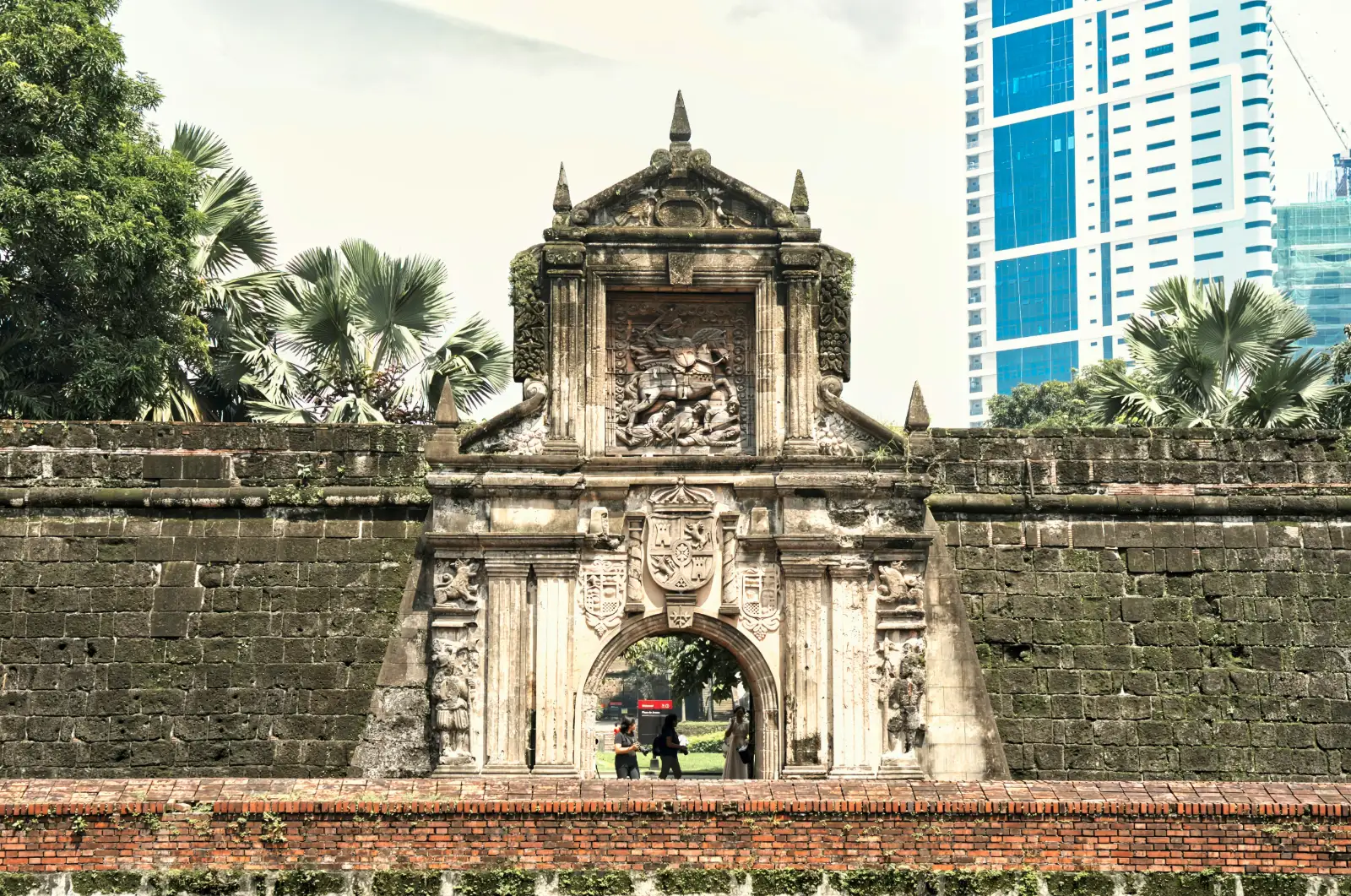




















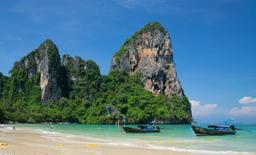




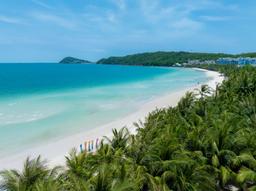






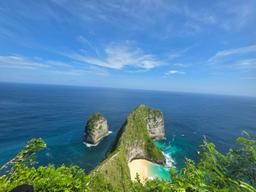




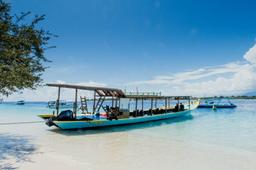




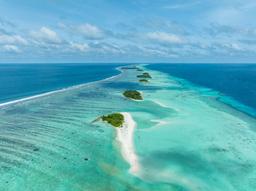

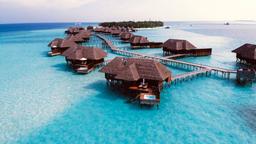





















































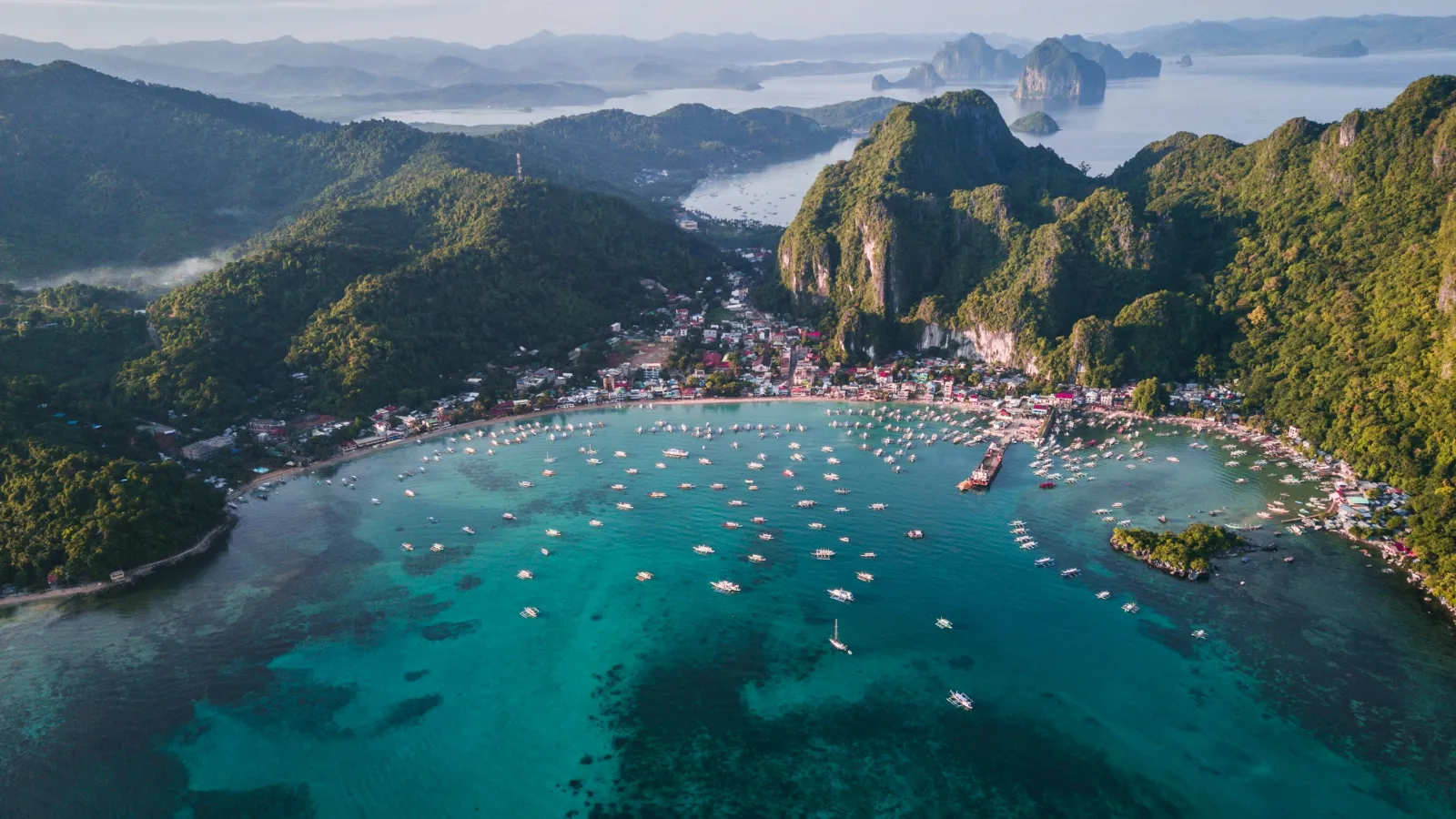
Short answer: El Nido, Palawan, is a small town at the northern tip of mainland Palawan in the Philippines, and its main attraction is island hopping in Bacuit Bay. Boats leave the town beach every morning on four set day routes called Tour A, B, C and D. Tour A covers the Big Lagoon and Secret Lagoon by kayak and swim, Tour B covers Snake Island sandbar and the caves, Tour C covers Hidden Beach, Secret Beach, Matinloc Shrine and Helicopter Island, and Tour D covers Cadlao Lagoon and the quieter beaches closest to town, often with the Small Lagoon. The best time to go is the dry season from about December to May, with the calmest water in March to May. Since late March 2026 there are no flights from Manila's main airport to El Nido: you either fly into El Nido's small Lio airport (mostly from Clark and Cebu) or fly to Puerto Princesa and ride a van for about 5 to 6 hours.
This guide is for couples, honeymooners, friends and families who want El Nido's lagoons and beaches without wasting a day on the wrong boat. It explains what each tour covers in 2026, which one to do first, how the sea changes through the year, how to get there (including from Kathmandu, which has no direct flight), the protected area rules, and how El Nido compares with Coron. It does not quote tour prices, which change by operator and season.
If you are still choosing where to go in the country, start with our Philippines travel guide for seasons, money and local customs, and see how El Nido fits into the wider province in our guide to things to do in Palawan.
| El Nido at a glance | Details |
|---|---|
| Where it is | Northernmost tip of mainland Palawan, facing Bacuit Bay, in the Mimaropa region of the Philippines |
| What it is known for | Limestone karst islands, lagoons, white sand beaches and day boat tours |
| Islands | About 45 islands and islets inside the municipality |
| Protected area | El Nido-Taytay Managed Resource Protected Area, declared in 1998, roughly 60% marine and 40% land |
| Island hopping | Four standard day tours (A, B, C, D), usually about 9 am to 4 or 5 pm |
| Best months | December to May for dry weather; March to May for the calmest seas |
| Rainy months | June to November nationally (PAGASA), with the southwest monsoon (habagat) bringing rougher seas |
| Nearest airport | El Nido (Lio) Airport, about 4 km from town, flights operated by Cebgo |
| By road | From Puerto Princesa, about 5 to 6 hours by van |
| From Kathmandu | No direct flight; connect to Manila via a hub such as Bangkok, Kuala Lumpur, Singapore or Hong Kong |
| Currency | Philippine peso (PHP); El Nido runs mostly on cash |
| Time difference | Philippines (UTC+8) is 2 hours 15 minutes ahead of Nepal |
Checked: 27 Oct 2026. Sources: PAGASA (Climate of the Philippines), Cebu Pacific Help Center (AirSWIFT transition to Cebgo), Philippine News Agency special report via PTV News (El Nido tour code, 3 Dec 2018), Wikipedia (El Nido, Palawan; El Nido Airport).
Why visit El Nido, Palawan?
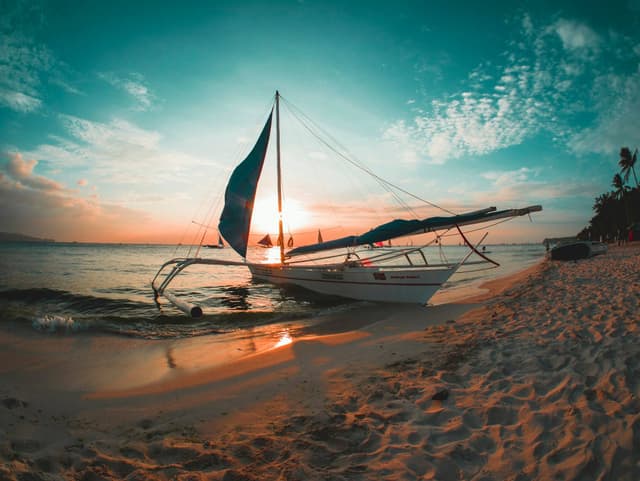
El Nido is worth visiting because it packs dozens of limestone islands, enclosed lagoons and small white beaches into one sheltered bay that you can explore on a day boat from the town beach. You do not need to be a diver or a strong swimmer: you walk to the pier after breakfast, move between lagoons and beaches by outrigger boat (bangka), and are back for sunset.
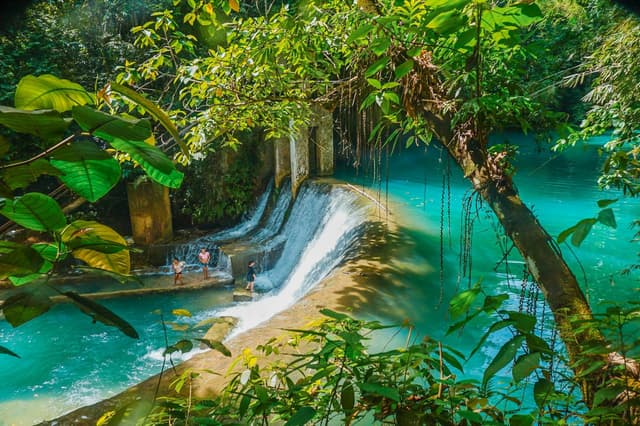
The scenery is the draw. Bacuit Bay is ringed by sheer grey karst cliffs that drop straight into green and turquoise water, and many of the lagoons can only be entered by kayak or by swimming through a gap in the rock. Our roundup of the best islands in the Philippines puts Palawan at the top for exactly this reason, and El Nido is where most first visitors to Palawan see it.
El Nido also works for very different kinds of trips:
- Honeymooners and couples come for sunset beaches, quiet resort stays in Corong Corong or on private islands in the bay, and private boat days.
- Groups of friends like the shared "joiner" boats, the busy town and the easy mix of island days and beach days.
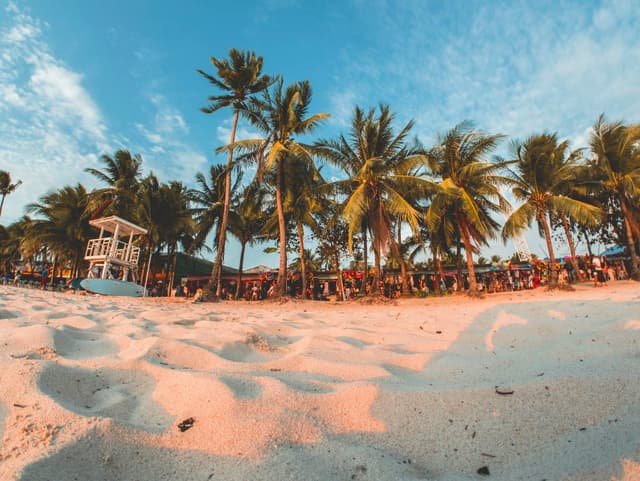
- Families can pick the calmer, shorter routes and spend spare days on long, open beaches such as Nacpan.
- Nepali travellers who have done Thailand or Bali often find El Nido a quieter, more nature-led alternative, with the same easy island rhythm but fewer big resorts and less nightlife.
Be realistic about what El Nido is not: there is no big resort strip or shopping mall, the town is small and busy around the pier, and cash matters more than cards. Most visitors forgive that the moment the boat rounds the first cliff.
What are El Nido Tours A, B, C and D?
El Nido Tours A, B, C and D are the four standard island hopping routes in Bacuit Bay, each visiting a different group of lagoons, beaches and snorkelling spots in one full day. The routes are set under the municipal tour code, and operators sell them either as shared "joiner" tours, where you share a boat with other travellers, or as private boat charters. Lunch is usually cooked on board or on a beach, and snorkel masks are normally provided.
One detail confuses many visitors. In late 2018 El Nido amended its tour code (Municipal Ordinance No. 101, Series of 2018, as reported by the Philippine News Agency) to split the two most crowded lagoons. Under that change Tour A keeps the Big Lagoon, while the Small Lagoon was moved to Tour D, so the two cannot be visited on the same day. In 2026 many operators still list the Small Lagoon on Tour D, but some booking pages still show it on Tour A. Treat the stop list as indicative and confirm with your operator the day before.
| Tour | Main stops (typical in 2026) | Highlights | Best for |
|---|---|---|---|
| Tour A | Big Lagoon, Secret Lagoon, Shimizu Island, Seven Commandos Beach, Payong-Payong Beach | Kayaking into the Big Lagoon between towering cliffs; squeezing through a small rock opening into the Secret Lagoon | First timers, couples, anyone who wants the classic El Nido photo |
| Tour B | Snake Island sandbar, Cudugnon Cave, Cathedral Cave (seen from the boat), Pinagbuyutan Island, Entalula Beach | A winding sandbar that appears at low tide, a cave you climb into, quieter beaches | Second tour, families, people who want fewer crowds |
| Tour C | Hidden Beach, Secret Beach, Matinloc Shrine, Helicopter Island, Star Beach | Beaches tucked behind rock walls, a clifftop shrine viewpoint, good snorkelling | Confident swimmers, snorkellers, photographers |
| Tour D | Cadlao Lagoon, Small Lagoon (on many operators' lists), Paradise Beach, Natnat Beach, Bucal Beach, Pasandigan Cove | Calm water close to town, a large lagoon you can swim or kayak in, shorter boat rides | Families with young children, rainy season days, a relaxed last day |
Checked: 27 Oct 2026. Sources: Philippine News Agency special report via PTV News, "Getting tourism management better in El Nido" (3 Dec 2018, Municipal Ordinance No. 101, Series of 2018); current stop lists compared across IslaVisit (checked 15 Sep 2026), El Nido Tours (updated 29 Jul 2026) and El Nido Insights (updated 24 Oct 2026). The municipal website (elnido.gov.ph) could not be reached on the day of writing, so the 2026 lists are from operators, not the municipality.
Tour A: the lagoons
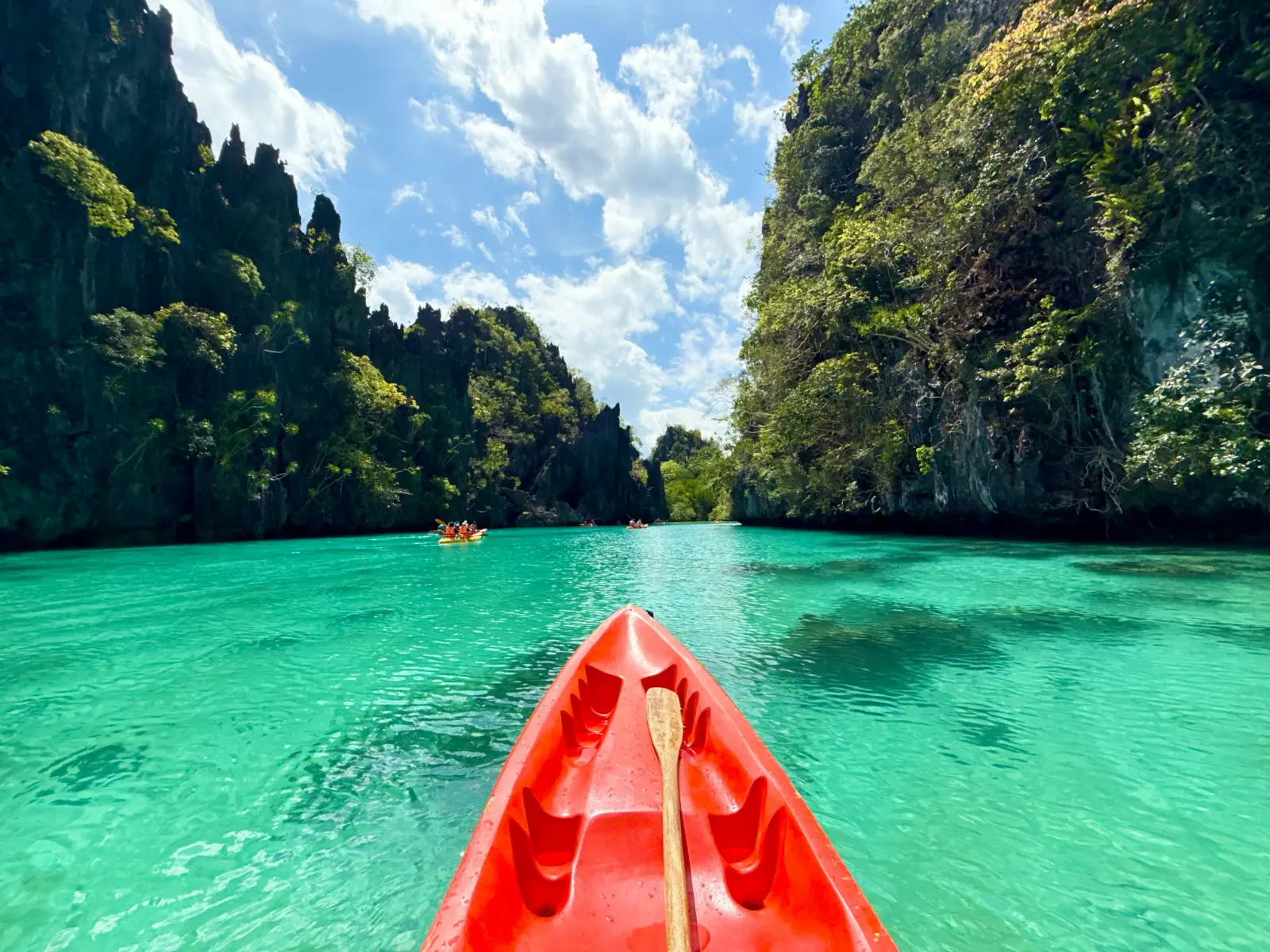
Tour A is the most famous El Nido island hopping tour because it includes the Big Lagoon on Miniloc Island. Tour boats are not allowed inside the Big Lagoon, so you transfer to a kayak at the entrance and paddle in between cliffs that rise straight out of the water. At low tide the entrance can be shallow enough that you walk or pull the kayak over the reef. The Secret Lagoon is a small pool behind a rock wall that you enter through a low opening, usually by wading or swimming. Shimizu Island and Seven Commandos Beach are the snorkelling and lunch stops. Tour A is the busiest route, so leave early.
Tour B: sandbar and caves
Tour B suits travellers who have already done the lagoons or want a calmer day. Snake Island takes its name from a long, curving sandbar that shows at lower tides; from the viewpoint on top it looks like a snake winding through the water. Cudugnon Cave is a small cave you crawl into through a narrow entrance, and Cathedral Cave is usually admired from the boat. Pinagbuyutan Island and Entalula Beach are quieter swim and lunch stops, and the order of stops follows the tide.
Tour C: hidden beaches and the shrine
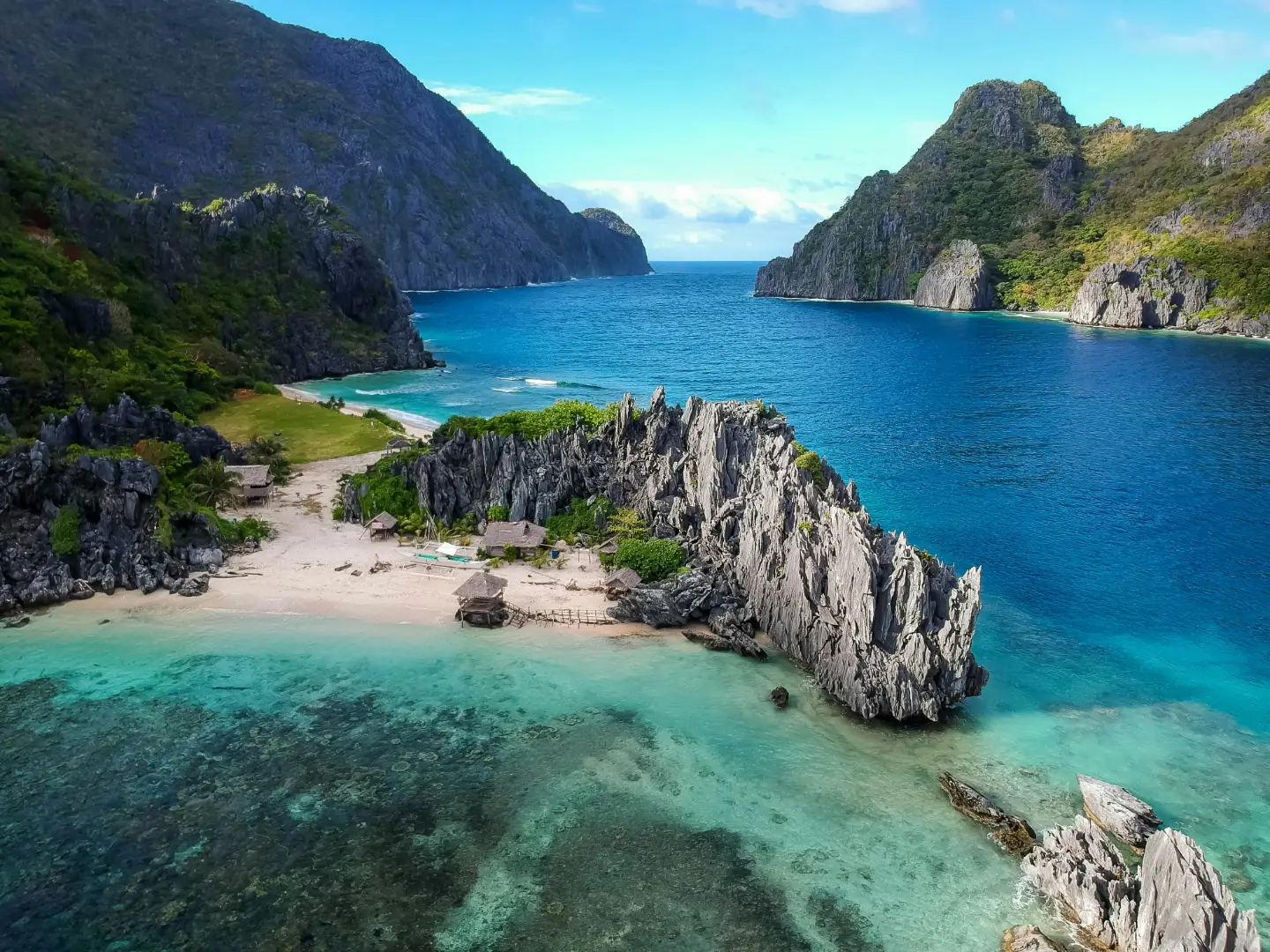
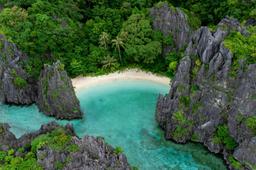
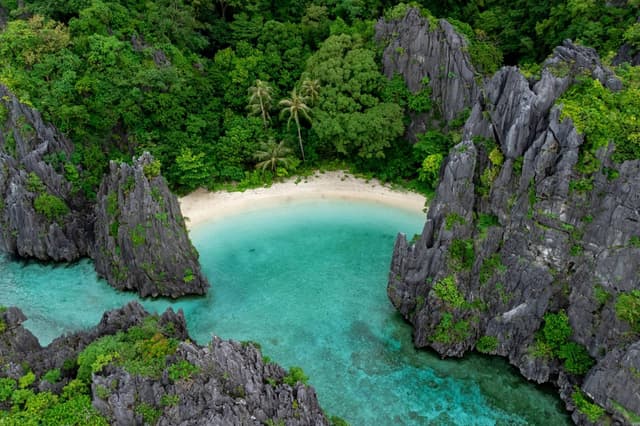
Tour C goes further out to Matinloc and Tapiutan islands, on the more open side of the bay. Hidden Beach and Secret Beach are enclosed by rock walls, and Secret Beach is entered by swimming through a gap in the rock, which can be tricky in swell. Matinloc Shrine is an abandoned shrine with a short climb to a viewpoint over the cliffs, and some operators mention a small separate entrance fee collected on the island. Helicopter Island (Dilumacad Island), named for its shape from a distance, has a long beach and good snorkelling nearby. Tour C is the route most likely to be cancelled or rerouted when the wind picks up.
Tour D: Cadlao Lagoon and the beaches near town
Tour D stays close to El Nido town, around Cadlao Island and the coves to the south. Cadlao Lagoon is large and open, good for swimming and kayaking, and the beaches on this route (Paradise, Natnat, Bucal, Pasandigan) are generally quieter than those on Tour A. On many operators' lists Tour D also includes the Small Lagoon, a narrow kayak-only lagoon whose inner channel can be passed only within a certain tide range. Short boat rides make Tour D good for children and lively sea days.

Which island hopping tour should you choose first?
For most first time visitors, Tour A is the one to do first, because the Big Lagoon is the defining El Nido experience and it is the route least likely to be cancelled. If you have two days, add Tour C in calm weather for snorkelling and hidden beaches, or Tour D if you want an easier, quieter day and the Small Lagoon. Tour B is the best third choice for families and anyone who prefers fewer boats.
The order also depends on the sea. Tour C crosses more open water, so do it on the first calm morning and keep Tour A for later; when the wind is up, Tours A and D usually still run in the sheltered bay.
| Your situation | Suggested order | Why |
|---|---|---|
| Only one island day | Tour A | The Big Lagoon is the signature sight, and Tour A is the most weather resistant route |
| Two island days, calm forecast | Tour C first, then Tour A | Use the calm day for the exposed route; Tour A can run in most conditions |
| Two island days, family with children | Tour A, then Tour D | Short boat rides and calm water on Tour D; Small Lagoon on many Tour D lists |
| Honeymoon or couple | Tour A on a private boat, then a beach day at Nacpan or Las Cabanas | A private boat lets you leave early and avoid the busiest hour at the lagoons |
| Strong swimmers and snorkellers | Tour C, then Tour A | Tour C has the best reef stops and the swim-in Secret Beach |
| Three or more island days | A, C, then B or D | Covers both lagoons and the best beaches without repeating stops |
| Rainy season visit | Tour A or D, keep C flexible | Sheltered routes are more likely to run during the southwest monsoon |
Checked: 27 Oct 2026. Based on the stop lists above and route weather notes reported by IslaVisit and El Nido Tours. Routes and stop orders are set on the day by the operator and the Coast Guard.
Can you combine two tours in one day?
Not on a normal shared boat: joiner boats run one route per day, and the 2018 tour code split the Big and Small Lagoons so they are not visited on the same day. Some private charters offer combinations within the lagoon rules, with less time at each stop.
Shared joiner boat or private boat?
A shared joiner boat is the simple option: a fixed route with other travellers. A private boat lets you choose the departure time, linger at stops and beat the mid-morning rush at the Big Lagoon, which honeymooners and families often value for at least one day. Either way, confirm in writing which fees (environmental fee, lagoon fees, kayak rental) and pickups are included.
Practical tips for tour day
- Leave early. The Big Lagoon is calmest and least crowded in the first part of the morning.
- Wear water shoes. Beach entries, the Secret Lagoon opening and some rocky landings are sharp underfoot.
- Carry a dry bag for your phone, passport copy and cash.
- Keep your environmental fee receipt with you. It is checked at the pier and at some stops.
- Expect the itinerary to change. Crews adjust the order around tides, crowds and wind.
- Tours are not suitable for wheelchair users or people with limited mobility, because of beach landings and kayak transfers.
What is the best time to visit El Nido?
The best time to visit El Nido is the dry season from about December to May, when skies are clearer and boat tours run most reliably; March to May brings the calmest, clearest water but also the most heat and the biggest crowds. PAGASA, the Philippine weather agency, divides the national year into a rainy season from June to November and a dry season from December to May, with the dry season split into a cool dry spell (December to February) and a hot dry spell (March to May).
El Nido sits on the west side of Palawan, so the southwest monsoon (habagat), which typically runs from around June to late September or early October (in 2026 PAGASA declared it over on 5 October), has the biggest effect. It brings heavier rain, stronger winds and choppier seas in Bacuit Bay, and the Coast Guard can stop boats from leaving when conditions are unsafe. The northeast monsoon (amihan), from roughly late October or November to around March, brings drier, cooler air; El Nido's western bays are generally more sheltered then, although some open-water crossings, including the ferry towards Coron, can be lively.
| Months | Season | Sea conditions | What to expect |
|---|---|---|---|
| December to February | Cool dry season, amihan | Mostly calm in Bacuit Bay; occasional windy days | Pleasant temperatures, busy around Christmas, New Year and Chinese New Year |
| March to May | Hot dry season | Calmest and clearest water of the year | Peak season, hot days, Holy Week is very busy with domestic travellers |
| June to September | Rainy season, habagat | Choppier, with a real chance of cancelled tour days | Fewer visitors, greener scenery, keep spare days in the plan |
| October to November | Transition | Improving through November but still unsettled | Shoulder season; storms are still possible, so check forecasts daily |
Checked: 27 Oct 2026. Sources: PAGASA, Climate of the Philippines (season definitions); habagat and amihan timing as reported from PAGASA declarations in Philippine media (GMA News, 5 Oct 2026: 2026 habagat ran from 30 May to 5 October). Monsoon start and end dates vary each year; PAGASA announces them.
Typhoons and storms
Palawan is further from the main typhoon tracks than eastern Luzon or the Visayas, but it is not immune. Typhoon Odette (international name Rai) made landfall in Palawan in December 2021, which shows that late-year storms can reach the province. Even a storm far away can strengthen the monsoon and keep boats in harbour. Before and during your trip, follow PAGASA's tropical cyclone bulletins and gale warnings, and expect the Philippine Coast Guard to suspend sea trips when warnings are in force.
Dashain, Tihar and Nepali holiday timing
For Nepali travellers, the long Dashain and Tihar break usually falls between late September and mid November, which overlaps the transition between the two monsoons in El Nido. Weather often improves through November, but it is still less predictable than December to May. If Dashain or Tihar is your only window, plan at least three nights so you have a spare day if one tour is cancelled, keep onward flights flexible, and choose Tour A or D for your first day. If you can wait, December to April gives far better odds of every route running. Our guide to the best time to visit the Philippines compares Palawan with regions that have a different rainy season.
How do you get to El Nido?
You get to El Nido either by flying into El Nido (Lio) Airport, about 4 km from town, or by flying to Puerto Princesa and travelling about 5 to 6 hours north by van or bus. A third option is the fast ferry from Coron, which takes roughly 3.5 to 4 hours when the sea allows. There is no flight from Manila's Ninoy Aquino International Airport (NAIA) to El Nido in 2026, because the small turboprop flights that serve Lio moved to Clark International Airport in March 2026.
| Route | How | Approximate time | Good to know |
|---|---|---|---|
| Clark to El Nido | Cebgo turboprop (formerly AirSWIFT) into Lio Airport | About 1.5 hours flying | Moved from Manila NAIA to Clark on 29 March 2026; Clark is about 2.5 to 3 hours by road from NAIA Terminal 3 |
| Cebu, Boracay (Caticlan), Bohol to El Nido | Cebgo turboprop into Lio Airport | Short turboprop hops; check the timetable | Frequencies vary by route and season; Bohol is not daily |
| Manila to Puerto Princesa, then road | Jet flight (Philippine Airlines or Cebu Pacific), then shared or private van | About 1.5 hours flying, plus about 5 to 6 hours by van | The most common budget route; vans leave from early morning to mid-afternoon |
| Puerto Princesa to El Nido by bus | Public bus | About 6 to 9 hours | Slower, with more stops, but runs through the day |
| Coron to El Nido | Fast ferry from Coron town | About 3.5 to 4 hours | Weather dependent; cancellations are common in the southwest monsoon |
| Coron (Busuanga) to El Nido | Cebgo flight | About 40 minutes | Useful when seas are rough or time is short |
Checked: 27 Oct 2026. Sources: Cebu Pacific Help Center (all AirSWIFT flights operated by Cebgo from 1 July 2026, code DG); The Philippine Star, 16 Jun 2026 (Clark to El Nido and El Nido to Boracay, Coron and Bohol services); PortCalls Asia (AirSWIFT El Nido flights moved from NAIA Terminal 2 to Clark, effective 29 Mar 2026); Top Gear Philippines, 16 Feb 2026 (NAIA to Clark P2P bus time); FlightConnections (Manila to Puerto Princesa); 12Go and El Nido Tours (van and bus times); Jonny Melon and Suroy (Coron ferry times). Schedules change; check the airline or ferry operator before booking.
Flying into Lio Airport
El Nido Airport, often called Lio Airport, is a small private airfield in Barangay Villa Libertad, north of town. It was long owned and run by AirSWIFT, which Cebu Pacific bought in October 2024. From 1 July 2026 all AirSWIFT flights are operated by Cebu Pacific's regional arm Cebgo under the DG flight code, and existing bookings were honoured. The aircraft are ATR turboprops, so checked and cabin baggage limits are tighter than on jet flights, and bags are weighed. Flying in saves most of a day compared with the road.
If you land at Manila NAIA from abroad, you now have to transfer to Clark for the El Nido flight; the P2P bus from NAIA Terminal 3 takes about 2.5 to 3 hours depending on traffic. Many travellers overnight near Clark or route through Puerto Princesa instead.
Puerto Princesa to El Nido by road
The road route is the classic way in. Puerto Princesa has frequent jet flights from Manila and is the gateway for the Underground River, so many visitors do a night there first. Shared vans to El Nido take about 5 to 6 hours with a meal stop and arrive at the El Nido transport terminal in Corong Corong, a short tricycle ride from the town beach. Private vans can collect you at the airport and drop you at your hotel.
Getting there from Kathmandu
There is no direct flight from Kathmandu to the Philippines, so Nepali travellers connect once on the way to Manila. The most common connecting hubs on this route are Bangkok, Kuala Lumpur, Singapore and Hong Kong, with Delhi also used. Our list of direct flights from Kathmandu shows which of those hubs you can reach nonstop from Tribhuvan International Airport. From Manila, choose between the jet flight to Puerto Princesa plus the van, or the road transfer to Clark and the short flight to Lio.
| Step | Typical options from Kathmandu | Planning note |
|---|---|---|
| 1. Kathmandu to a hub | Bangkok, Kuala Lumpur, Singapore, Hong Kong or Delhi | Pick a connection with enough time; a single ticket protects you if the first flight is late |
| 2. Hub to the Philippines | Usually Manila (NAIA); some hubs also have flights to Clark or Cebu | Landing at Clark or Cebu can make the El Nido flight easier |
| 3. Into El Nido | Fly to Lio from Clark or Cebu, or fly to Puerto Princesa and take a van | Allow a night in Manila, Clark or Puerto Princesa if your international flight lands late |
| Coming home | Reverse the route | Leave a buffer day between your last boat tour or ferry and your international flight |
Checked: 27 Oct 2026. Sources: KAYAK route data for Kathmandu to Manila (no nonstop service; Bangkok, Delhi, Singapore and Kuala Lumpur carry most one-stop trips), and the El Nido flight sources above.
Diaspora travellers based in Hong Kong, Korea, Japan, Malaysia or the Gulf often have more direct options into Manila, and sometimes Clark or Cebu, which can make El Nido a realistic long weekend. For the Philippines leg, Nepali passport holders should check the current entry rules and complete the eTravel registration before flying, both covered on our Philippines visa page. Once you are in the country, our guide on how to get around the Philippines explains domestic flights, ferries and ground transport in more detail.
What are the rules in El Nido's protected area?
El Nido's islands and reefs sit inside the El Nido-Taytay Managed Resource Protected Area, so every island hopping visitor pays an environmental fee and follows rules set by the Protected Area Management Board (PAMB) and the municipality. The main rules are simple: wear a life jacket on tours, do not touch or stand on coral, take all rubbish back with you, and do not bring single-use plastics.
The environmental fee, as a concept
El Nido charges every visitor joining an island hopping tour a municipal Eco-Tourism Development Fee (often shortened to ETDF or EDF). It is paid once, usually on your first tour day or at the tourism office, and the receipt then covers your tours for a set number of days (most 2026 guides say ten days, though at least one says five, so confirm when you pay). Keep the receipt or sticker with you, because it is checked at the pier. The Big Lagoon and Small Lagoon also carry separate environmental user fees, which a 2018 Philippine News Agency report said go into the protected area fund for conservation. Some operators also mention a small entrance fee at Matinloc Shrine. We do not quote amounts here: they are set by local ordinance and have changed in the past, and we could not confirm the current figures on the municipality's own website on the day of writing. Ask your operator which fees are included in your tour.
Lagoon limits and kayak rules
The Big and Small Lagoons have been managed for crowding since 2018. Tour boats are not allowed to enter the Big Lagoon, and boats may not anchor near the entrances of either lagoon, so visitors switch to kayaks or swim. During a crowd-control dry run in November 2018, the protected area office allowed about 60 visitors and 30 kayaks per hour into the Big Lagoon and about 30 visitors and 15 kayaks per hour into the Small Lagoon, between 7 am and 4 pm. Those were trial figures, not a confirmed current rule, but they explain why operators schedule lagoon entry for you. In peak season, book your tour at least a day ahead.
| Do | Do not |
|---|---|
| Wear a life jacket whenever the crew asks, including in kayaks | Stand on, touch or kick coral, or stir up the seabed |
| Use a reef-safe, mineral sunscreen and apply it well before swimming | Feed fish or throw food scraps into the water |
| Carry a refillable water bottle and reusable bags | Bring single-use plastic bottles, straws or bags on tours |
| Take every piece of rubbish back to town | Collect shells, sand, coral or starfish |
| Keep noise down in the lagoons | Cliff jump, smoke or drink alcohol in the lagoon areas |
| Keep your environmental fee receipt with you | Pressure the crew to go out when the Coast Guard has stopped trips |
Checked: 27 Oct 2026. Sources: Philippine News Agency special report via PTV News, 3 Dec 2018 (PAMB rules on life jackets, no loud sounds or cliff jumping in the lagoons, no grilling, no food scraps in the water, no stepping on corals, no smoking, alcohol or vendors near the lagoons; 2018 dry run limits; boat and anchoring rules); VICE, 24 Nov 2018 (El Nido single-use plastic restrictions). Rules can be updated by the municipality and PAMB; follow your crew's instructions on the day.
Reef-safe habits that actually help
Choose a mineral sunscreen (zinc oxide or titanium dioxide), apply it well before you swim, and wear a rash guard so you need less of it. Float on the surface with your fins away from the bottom; if you are not a confident snorkeller, keep the life jacket on and hold the boat line rather than standing on coral to rest.
Coron or El Nido: which suits you?
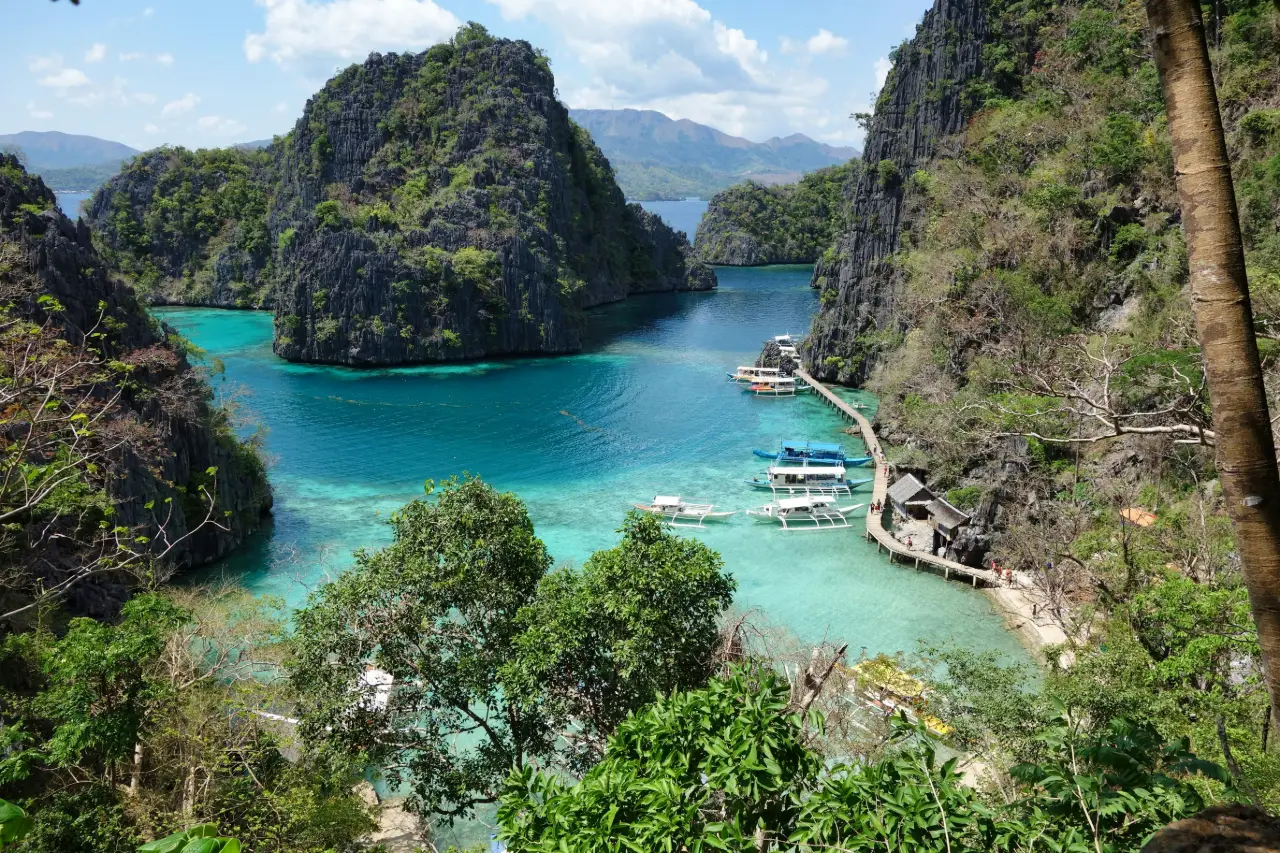
Choose El Nido if you want lagoons, beaches and easy island hopping from a lively small town; choose Coron if you want diving or snorkelling on Second World War shipwrecks and swimming in clear karst lakes. Both are in Palawan, both have dramatic limestone scenery, and they are linked by a fast ferry or a 40 minute flight, so many travellers with a week or more do both.
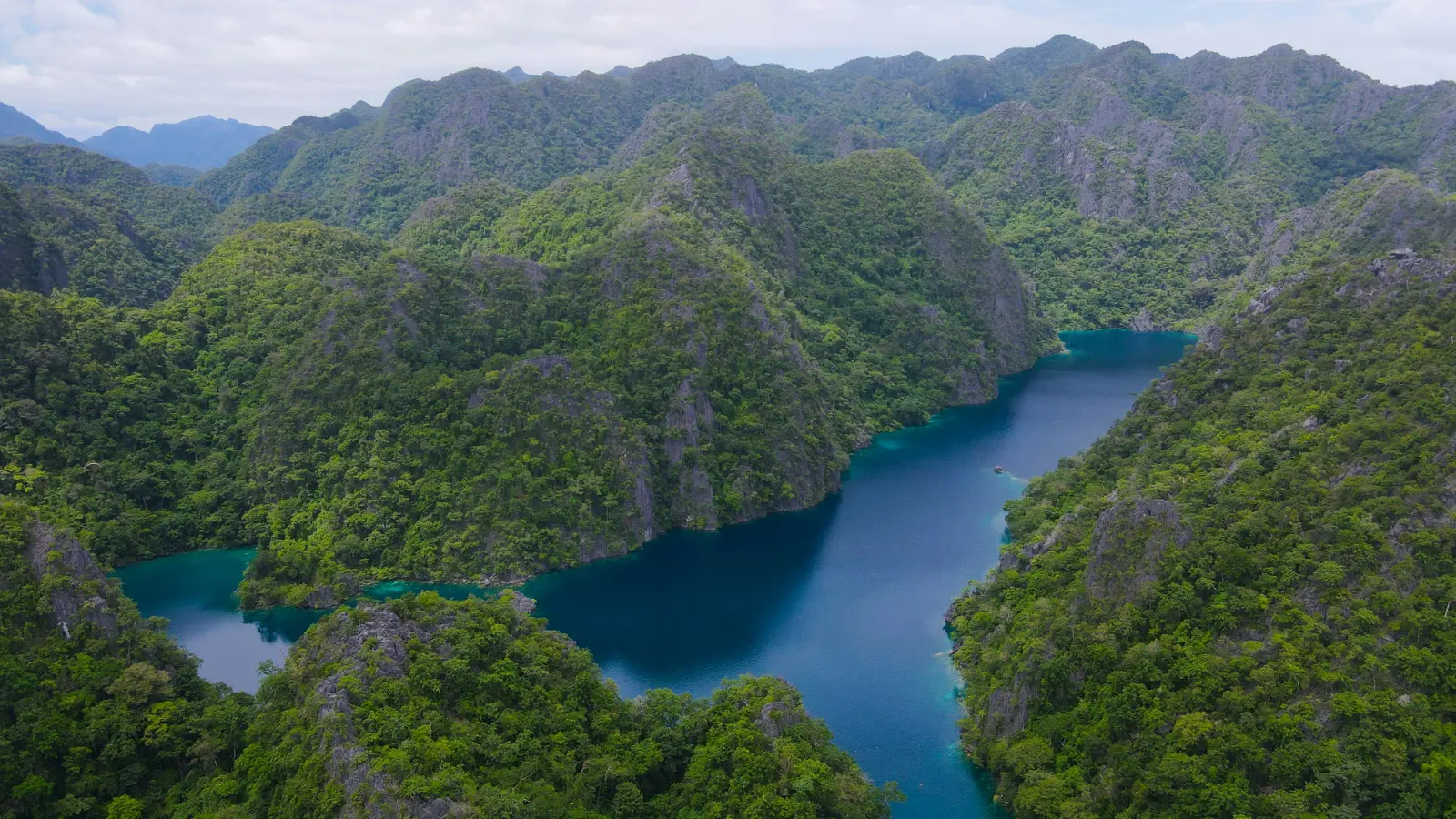
Coron town is on Busuanga Island, in the Calamian group north of mainland Palawan, and most of its famous sights are on Coron Island across the bay, which is recognised as the ancestral domain of the indigenous Tagbanua people. Its lakes and lagoons, such as Kayangan Lake, Barracuda Lake and the Twin Lagoon, are reached on day tours similar to El Nido's. Under the water, about a dozen Japanese ships sunk in a US air raid on 24 September 1944 lie at depths of roughly 10 to 40 metres, which makes Coron one of Asia's best known wreck diving areas.
| Question | El Nido | Coron |
|---|---|---|
| Signature sights | Big Lagoon, Secret Lagoon, hidden beaches, Bacuit Bay islands | Kayangan Lake, Barracuda Lake, Twin Lagoon, WWII shipwrecks |
| Best for | Beaches, lagoons by kayak, couples, first timers | Divers, wreck snorkellers, lake swimming, travellers who like a rougher edge |
| Snorkelling | Easy reef snorkelling straight off the boat, especially on Tour C | Reef and lake snorkelling plus a few shallow wrecks you can see from the surface |
| Diving | Reef diving in Bacuit Bay, good for beginners | Some of Asia's best known wreck diving, plus the unusual temperature layers of Barracuda Lake |
| Beaches | Many, from Nacpan's long sands to small coves on every tour | Fewer and smaller; the lakes and lagoons are the main event |
| Town feel | Busy beach town with restaurants and bars along the shore | Compact port town, more local, with dive shops and simple guesthouses |
| Getting there | Lio Airport from Clark and Cebu, or van from Puerto Princesa | Busuanga Airport, now served mainly from Clark and Cebu after the March 2026 turboprop move |
| Non-swimmers | Very manageable with a life jacket; Tours A and D suit best | Manageable with a life jacket; Kayangan Lake has a steep stair climb first |
| Time needed | 3 to 4 nights for two or three tours plus a beach day | 2 to 3 nights for the main tours, more for diving |
Checked: 27 Oct 2026. Sources: Wikipedia, Coron, Palawan (Tagbanua ancestral domain, 1998; wreck depths and 24 Sep 1944 air raid); Philstar Life (Philippine Airlines Manila to Busuanga moved to Clark, effective 29 Mar 2026); Wikipedia, Francisco B. Reyes Airport (current carriers from Clark and Cebu).
If you want to do both, the usual order is the one that matches your flights. Fly into Puerto Princesa or Lio, spend three or four nights in El Nido, take the fast ferry to Coron, then fly out of Busuanga, or reverse it. Leave a buffer night in case the ferry is cancelled. Our best beaches in the Philippines guide is useful if you are weighing Palawan against Boracay or the Visayas for the beach part of your trip.
How do you get from El Nido to Coron?
The fast ferry leaves from the terminal at the western end of the town beach and takes roughly 3.5 to 4 hours, with several operators offering morning or midday sailings that vary by day; a slower overnight cargo boat also runs. The Cebgo flight from Lio to Busuanga takes about 40 minutes. Check in at least an hour before sailing.
What else can you do in and around El Nido town?
Beyond the four boat tours, the best things to do in El Nido are beach days at Nacpan and Las Cabanas, the Taraw Cliff canopy walk above town, diving or a discover scuba session in Bacuit Bay, and sunset in Corong Corong. A good rule is to alternate: one boat day, then one land or beach day, so you are not on a boat in the sun every day.
| Beach | Where | What it is like | Good for |
|---|---|---|---|
| Nacpan Beach | About 17 km north of town, around 45 minutes by road | A long, golden beach, about 4 km together with neighbouring Calitang Beach (the "twin beaches") | Long walks, families, gentle surf, a full lazy day |
| Las Cabanas (Marimegmeg) Beach | About 6 km south of town past Corong Corong, a short tricycle ride | Sunset beach with bars and a zipline across to Depeldet Islet | Couples, sunset drinks, a half day |
| Duli Beach | Further north beyond Nacpan, on a rougher road | Wide, quiet beach with a more consistent swell | Surfers and people who want space |
| Corong Corong | Just south of town | Bay-front strip of resorts and restaurants facing the islands | Sunset, quieter evenings, kayaking from the shore |
| Lio Beach | North of town, next to the airport | Planned beachfront area with resorts, cafes and a long, tidy beach | Families, short stays, people flying in and out |
Checked: 27 Oct 2026. Sources: Mad Monkey Hostels Nacpan guide (length, distance and travel time; Duli Beach); Lonely Planet (Maremegmeg Beach, about 6 km from town); This Island Life (Las Cabanas zipline to Depeldet Island); Wikipedia, El Nido Airport (location in Villa Libertad, about 4 km from town).
Nacpan Beach and the twin beaches
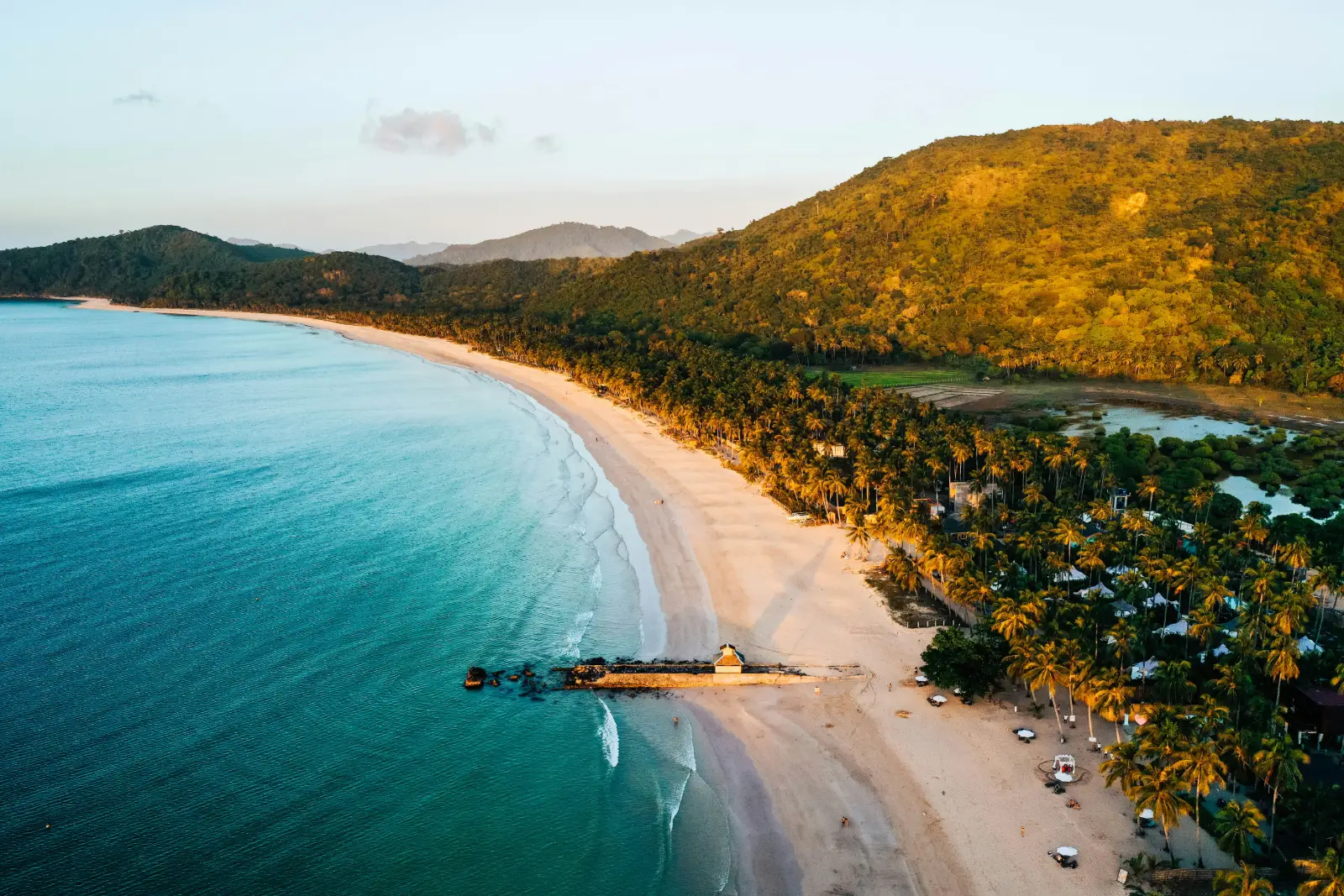
Nacpan is a long, curving strip of sand backed by coconut palms, with Calitang Beach and its fishing village over a low hill. It is about 45 minutes by tricycle, van or scooter, with simple restaurants but no resort strip. Go in the morning, and ask locally about currents before swimming far out.
Las Cabanas, Corong Corong and sunset
Las Cabanas, whose beach is often called Marimegmeg, is El Nido's sunset spot. It faces west across the bay, has relaxed beach bars, and a zipline runs about 750 metres over the water to Depeldet Islet; you can walk back along the sandbar when the tide allows. Corong Corong, between town and Las Cabanas, has the same sunset view and calmer evenings than the town centre. Both are an easy tricycle ride from town.
Taraw Cliff canopy walk
The El Nido Canopy Walk is a guided climb on the limestone of Taraw Cliff, right behind the town, using fixed steel rungs, cables and hanging bridges in a via ferrata style. The views over the town and Bacuit Bay are excellent, but the rock is sharp, so wear closed shoes and gloves are useful. It is best done on a non-boat day, early in the morning, and it is not suitable for anyone with a fear of heights or knee problems.
Food for Nepali travellers
El Nido's restaurants serve Filipino dishes, seafood and plenty of international food. Filipino cooking uses a lot of pork and seafood, so vegetarian and Hindu travellers who avoid beef or pork should say so clearly when ordering. Island hopping lunches are usually grilled fish, chicken or pork with rice, fruit and vegetables; tell your operator in advance about any diet. Our guide to what to eat in the Philippines lists dishes worth trying and those to ask about.
Where should you stay in El Nido, and what should you plan for?
Stay in El Nido town if you want to walk to the pier and restaurants, in Corong Corong for sunsets and quieter nights, in Lio if you fly in and want a calm family base, or near Nacpan if you want a beach and do not mind longer rides to the boats. Book your first nights ahead in the December to May peak, at Christmas and New Year, and in Holy Week.
| Area | Feel | Best for | Trade off |
|---|---|---|---|
| El Nido town (Buena Suerte, Masagana) | Busy, walkable, everything close | Groups of friends, short stays, early tour departures | Noisier, narrow lanes, rooms can be small |
| Corong Corong | Bay-front, relaxed, sunset views | Couples, honeymooners, longer stays | Short tricycle ride to the pier and centre |
| Las Cabanas area | Quiet, close to the sunset beach | Couples who want peace | Further from town and the pier |
| Lio | Planned beachfront area near the airport | Families, travellers flying in and out | Not in walking distance of town; tours may need a transfer |
| Nacpan | Remote beach, very relaxed | Beach days, people who have done the tours | Long ride to the pier for island hopping |
| Private island resorts in Bacuit Bay | Secluded, resort-run boat trips | Special occasion honeymoons | Reached only by boat; less freedom to explore town |
Checked: 27 Oct 2026. Area descriptions from our research and the Palawan and Philippines sources above; barangay names from Wikipedia, El Nido, Palawan. Room standards vary widely, so read recent reviews for power, water and noise.
Cash, ATMs and cards
El Nido runs mostly on cash. Only a few ATMs serve the town, and they can run out of money, especially on weekends and in peak season. Bring enough Philippine pesos from Manila, Clark, Cebu or Puerto Princesa to cover tours, fees, meals and transport, and keep some smaller notes for tricycles and tips. Larger hotels and some restaurants accept cards, but do not rely on them. Nepali travellers usually carry US dollars from Nepal and exchange them in the Philippines; check the exchange rate on the day rather than relying on old figures, and keep the bills clean and undamaged. For broader money and safety tips, see our Philippines travel guide and the advice in is the Philippines safe.
Packing list for island hopping
- Reef-safe mineral sunscreen, a hat and sunglasses
- Rash guard or long-sleeved swim top
- Water shoes for rocky entries and beach landings
- Dry bag and a waterproof phone pouch
- Refillable water bottle (single-use plastics are restricted)
- Your own snorkel mask if you have one, for a better fit
- Motion sickness tablets for boats, vans and ferries
- Cash in small notes, and a copy of your passport
- Light rain jacket from June to November
Couples, honeymooners and families
For a honeymoon, El Nido works best with a sunset-facing base in Corong Corong or Las Cabanas, one private boat day for Tour A, and a lazy day at Nacpan; our Philippines honeymoon guide shows how El Nido pairs with Coron, Boracay or Bohol. For families, choose Tours A and D, pack life jackets for small children if you have your own, keep boat days short, and stay in Lio or Corong Corong for calmer evenings. Groups of friends can enjoy the town's bars and shared boats, but should still respect the quiet rules inside the lagoons. When you are ready to compare complete trips that include El Nido, see our Philippines tour packages.
Frequently asked questions
Which El Nido island hopping tour is best?
For a first visit, El Nido Tour A is usually the best because it includes the Big Lagoon by kayak and the Secret Lagoon, and it runs in most weather. Tour C is best for snorkelling and hidden beaches when the sea is calm, Tour D is the easiest for families, and Tour B is quietest.
Do you need to book Big Lagoon kayaking ahead?
Your operator arranges Big Lagoon entry as part of El Nido Tour A, because boats cannot enter the lagoon and kayak numbers are managed. In peak season, book the tour at least a day ahead. Ask whether kayak rental and the lagoon fee are included, and keep your environmental fee receipt with you.
Can you do two El Nido tours in one day?
Not on shared joiner boats, which run one El Nido tour per day. Since 2018 the Big Lagoon and Small Lagoon have been on separate tours so they are not visited on the same day. Some operators offer combinations on private boats, but you get less time at each stop.
Is El Nido good in the rainy season?
El Nido can be good in the rainy season (June to November), with fewer crowds and greener scenery, but some tour days are cancelled when the southwest monsoon or a storm brings rough seas. Plan buffer days, start with Tour A or D, and follow PAGASA forecasts.
How far is El Nido from Puerto Princesa?
El Nido is roughly 230 km north of Puerto Princesa by road, which takes about 5 to 6 hours by shared or private van and 6 to 9 hours by public bus. Vans drop shared passengers at the El Nido terminal in Corong Corong, a short tricycle ride from town.
Is there an airport in El Nido?
Yes. El Nido (Lio) Airport is about 4 km from town. Since 1 July 2026 its flights are operated by Cebgo, mainly from Clark, Cebu, Caticlan for Boracay, Bohol and Busuanga for Coron. There are no flights from Manila NAIA since the March 2026 move to Clark.
Can non-swimmers do El Nido island hopping?
Yes. Life jackets are required on El Nido tours, and the Big Lagoon is explored by kayak. Non-swimmers find Tours A and D easiest. Secret Beach on Tour C and some lagoon entrances involve swimming or wading, so tell the crew and stay in your life jacket.
Is El Nido or Coron better for snorkelling?
El Nido is better for easy reef snorkelling straight off the boat, especially on Tour C. Coron is better if you want something unusual: clear lakes, the Twin Lagoon and a few shallow Second World War wrecks visible from the surface. Divers usually prefer Coron for its wrecks.
Is there an environmental fee in El Nido?
Yes. El Nido charges island hopping visitors a municipal Eco-Tourism Development Fee, paid once and valid for several days of tours, and the Big and Small Lagoons carry separate environmental user fees. Amounts are set locally and change, so ask your operator what is included and keep the receipt.
How do you get from El Nido to Coron?
Take the fast ferry from El Nido's terminal, about 3.5 to 4 hours depending on the sea, or the Cebgo flight from Lio to Busuanga, about 40 minutes. Ferries are often cancelled in rough weather, so leave a spare day before any international flight.
Is there a direct flight from Kathmandu to El Nido?
No. There is no direct flight from Kathmandu to the Philippines. Nepali travellers connect through a hub such as Bangkok, Kuala Lumpur, Singapore or Hong Kong to Manila, then fly to Puerto Princesa and take a van, or transfer to Clark and fly to El Nido.
Nepal bata El Nido jana kati din chahinchha?
El Nido ko lagi kamti ma 3 dekhi 4 raat rakhnu ramro hunchha: 2 din island hopping (Tour A ra C wa D), 1 din Nacpan wa Las Cabanas beach, ra mausam kharab bhaye ko lagi 1 din extra. Coron pani jodne bhaye 6 dekhi 7 raat chahinchha. (In English: plan 3 to 4 nights for El Nido, or 6 to 7 nights with Coron.)