












































































+977-9768558250
Search Tours or Places
Blog / India

Things to Do in Jaipur: Amber Fort, Hawa Mahal and Bazaars

30 min read 13 Nov 2026 · Updated 16 Nov 2026
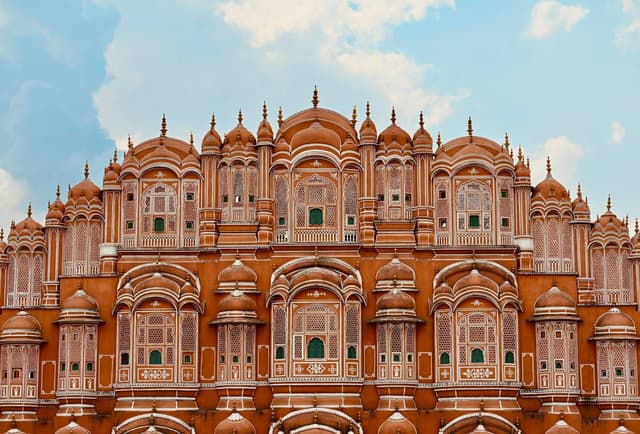
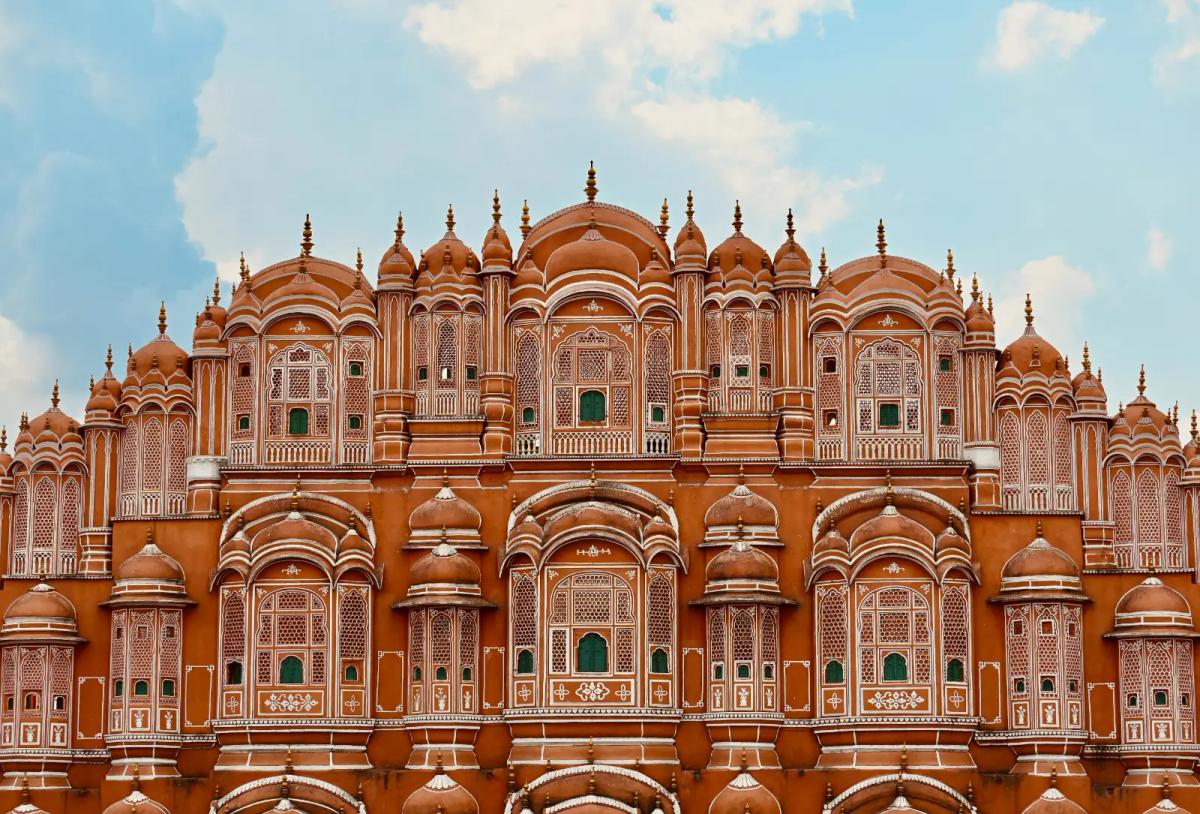
Pink sandstone domes and latticed jharokha windows across the upper facade of Hawa Mahal in Jaipur

Short answer: The best things to do in Jaipur are climbing Amber Fort above Maota Lake, seeing the 953 windows of Hawa Mahal, walking through the courtyards of City Palace, and testing the giant stone instruments of Jantar Mantar. Add sunset at Nahargarh Fort, the Jaivana cannon at Jaigarh, the Albert Hall Museum lit up at night, and an evening in the old city bazaars. Plan on two full days for the main sights, start at the hill forts early, and save the walled city and shopping for the afternoon and evening.

Jaipur is the capital of Rajasthan and the third corner of India's Golden Triangle with Delhi and Agra. Sawai Jai Singh II founded it in 1727 and laid it out on a grid, and UNESCO added the walled city to the World Heritage List in 2019, citing its planned streets, its chaupars (public squares) and its living bazaars. This guide lists 12 sights with the best time of day for each, explains how to visit Amber Fort without an elephant ride, shows which bazaar sells what, and gives dated, sourced timings, weather and transport facts. It is written for families, couples, first-time visitors to India and travellers coming from Nepal or the Nepali diaspora. For the wider state, see our Rajasthan tourism guide.

What are the top things to do in Jaipur?

The top things to do in Jaipur fall into three clusters: the hill forts north of the city (Amber, Jaigarh, Nahargarh), the monuments inside the pink walled city (Hawa Mahal, City Palace, Jantar Mantar), and the newer city to the south (Albert Hall, Birla Mandir, Patrika Gate). Grouping the sights by cluster saves hours in traffic. The table below is a quick planner; each sight then has its own short section.

Jaipur sights at a glance. Hours checked: 13 Nov 2026, Rajasthan Tourism and Incredible India (Ministry of Tourism) pages linked in each section
#SightAreaBest time of dayTime to allowWho runs the ticket
1Amber (Amer) FortAmer, about 11 km northOpening time, before tour buses2 to 3 hoursState Department of Archaeology and Museums
2Jaigarh FortRidge above AmerLate morning, after Amber1 to 2 hoursJaigarh Public Charitable Trust
3Nahargarh FortRidge above the old cityLate afternoon to sunset1.5 to 2 hoursState department
4Hawa MahalWalled cityEarly morning for the facade1 hourState department
5City PalaceWalled cityMorning, at opening2 to 3 hoursFormer royal family's museum trust
6Jantar MantarWalled city, next to City PalaceSunny midday, when the sundials work1 hour (more with a guide)State department
7Albert Hall MuseumRam Niwas GardenAfternoon inside, after dark outside1.5 hoursState department
8Patrika GateJawahar Circle, south JaipurEarly morning for empty photos30 to 45 minutesOpen public space
9Jal MahalMan Sagar Lake, Amer RoadSunrise or sunset20 to 30 minutesViewed from the shore only
10Galta JiAravalli hills, east edge of the cityLate afternoon1.5 hoursTemple, no monument ticket
11Birla MandirBelow Moti DoongriEvening, when it is lit30 to 45 minutesTemple, no monument ticket
12Jhalana leopard safariSoutheast edge of the cityEarly morning or late afternoon slotAbout 3 hoursRajasthan Forest Department

1. Amber Fort: the hill palace above Maota Lake
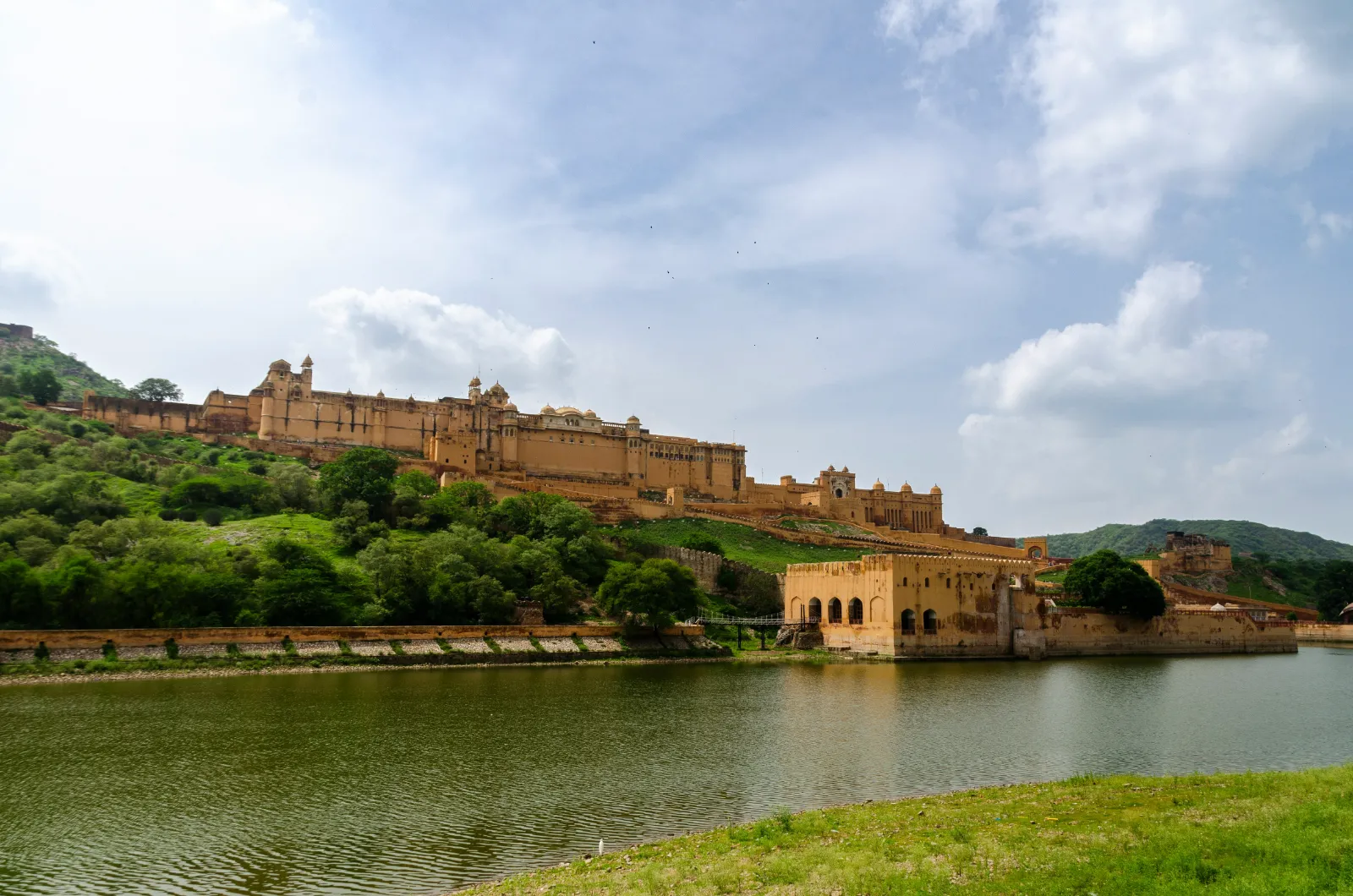
Amber Fort stretched along its green hillside above the still water of Maota Lake

Amber Fort (also spelt Amer) is the single most important sight in Jaipur and the one to see first. According to Rajasthan Tourism, construction began in 1592 under Raja Man Singh I, the palace sits about 11 km from the city, and it is built of red sandstone and white marble. In 2013 UNESCO inscribed it as one of the six Hill Forts of Rajasthan, alongside Chittorgarh, Kumbhalgarh, Ranthambore, Gagron and Jaisalmer.

Inside, you move through a sequence of courtyards: the Diwan-e-Aam (Hall of Public Audience), the painted Ganesh Pol gateway, the Sheesh Mahal with its walls and ceilings set with thousands of small mirrors, and the Sukh Niwas, where water channels once cooled the air. Go at opening time; by late morning the courtyards fill with groups. The full section on how to visit Amber Fort, further down this page, covers access routes, the elephant ride question and the evening show.

2. Jaigarh Fort: the Jaivana cannon and the long walls
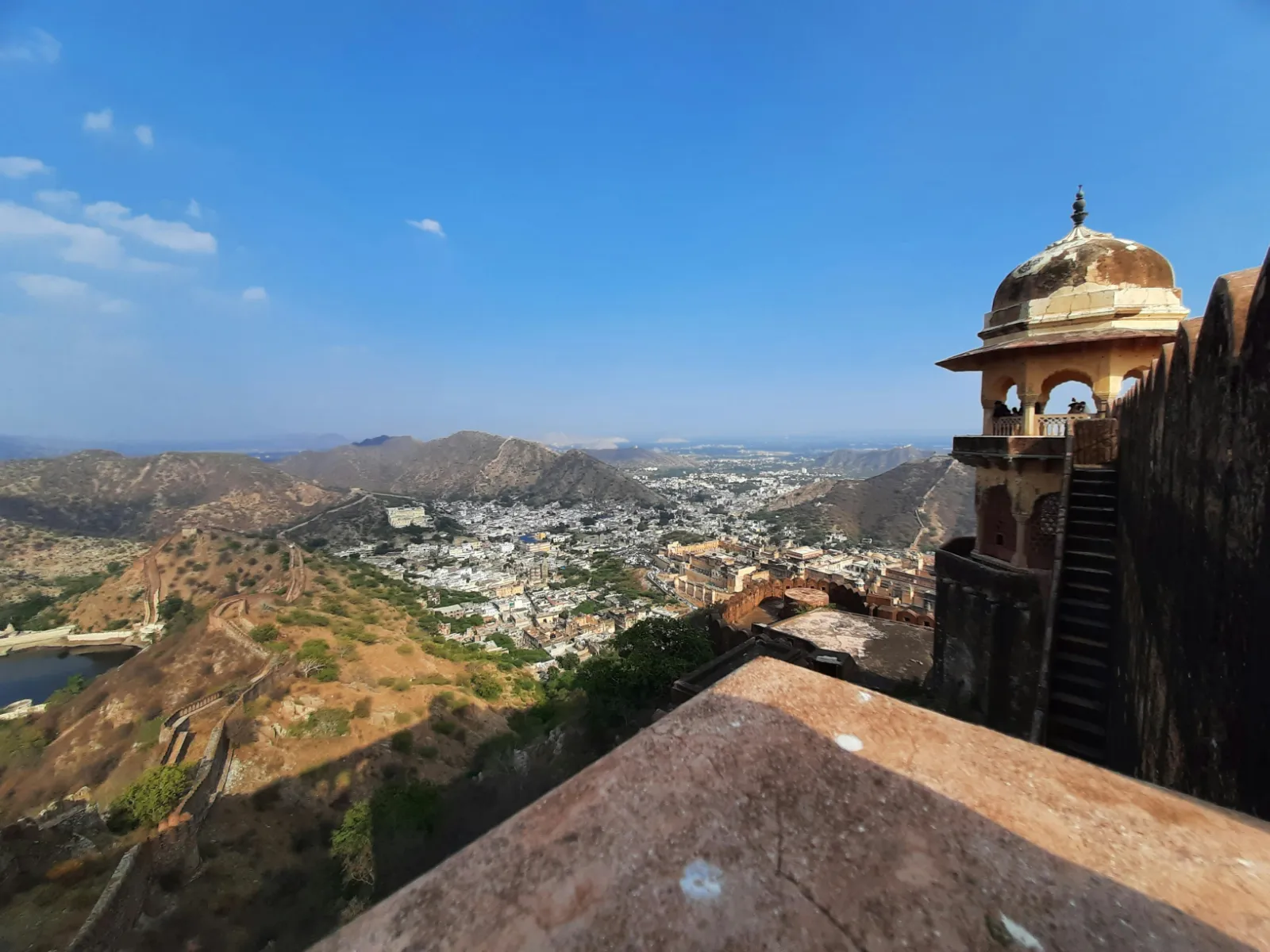
Domed watchtower on the Jaigarh Fort ramparts above Amer town, with old walls crossing the hills

Jaigarh Fort stands on the ridge directly above Amber and was built as its defensive bastion. Incredible India, the Ministry of Tourism site, says Jaigarh was commissioned by Jai Singh II on Cheelka Teela, the "Hill of Eagles", about 15 km from Jaipur. Its star exhibit is the Jaivana, described by the same source as the largest cannon on wheels; Wikipedia gives its barrel as roughly 6 m long and its weight as about 50 tonnes. Jaigarh and Amber are linked by underground passages, so many visitors treat them as one complex. Jaigarh is run by the Jaigarh Public Charitable Trust rather than the state department, so it has its own ticket. Listed hours are 9:30 am to 5:00 pm (Checked: 13 Nov 2026, Incredible India).

3. Nahargarh Fort: sunset over the Pink City
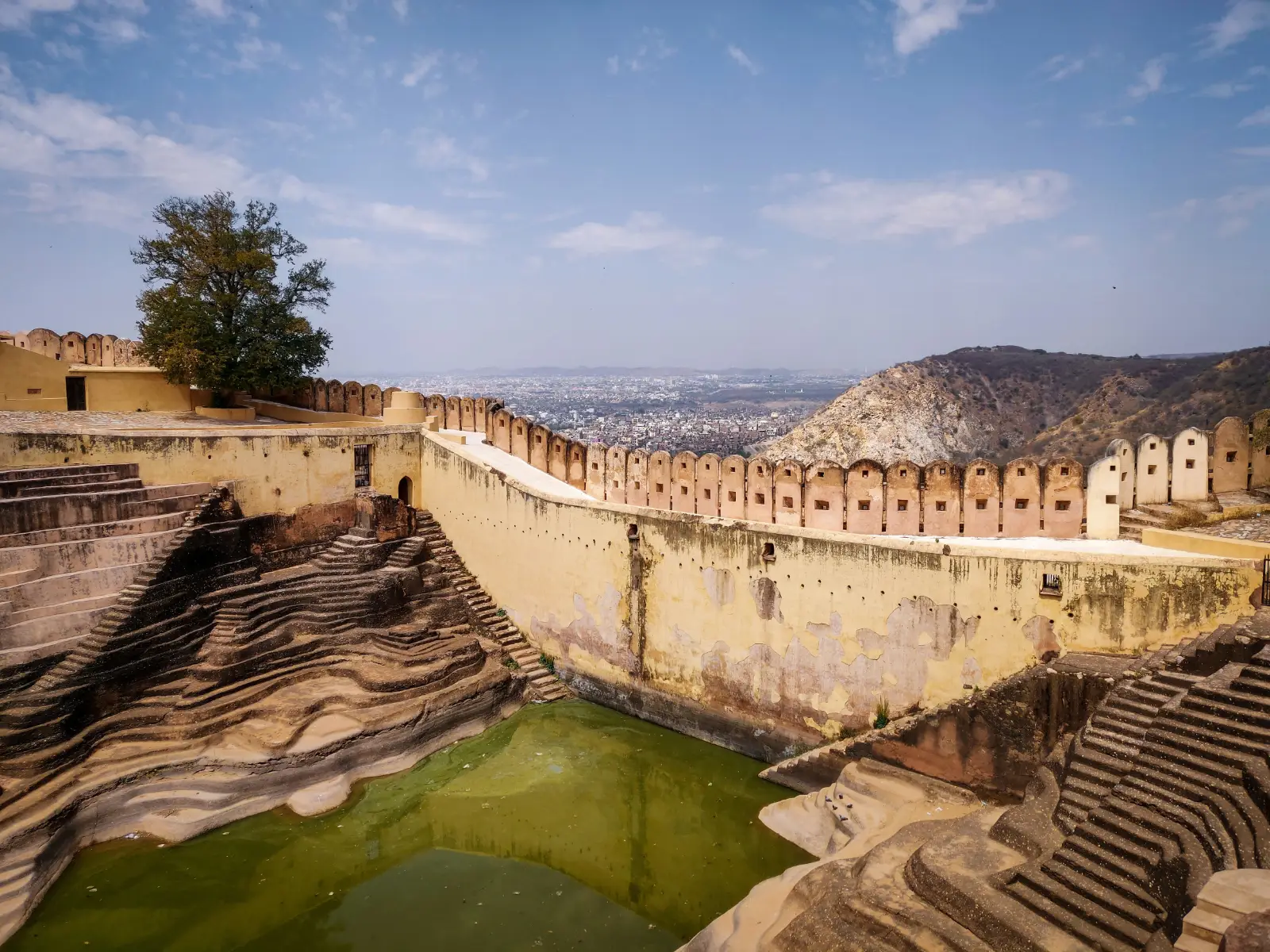
Stepped stone sides of the Nahargarh Fort stepwell with Jaipur city spread out below

Nahargarh is the fort for views. It sits on the ridge right above the old city, and from its walls you look straight down on Jaipur's grid. Incredible India says Sawai Jai Singh II completed it in 1734, originally naming it Sudarshangarh, as a retreat and a guard post alongside Amber and Jaigarh. Rajasthan Tourism notes it was expanded in 1868. Inside, the Madhavendra Bhawan is a palace of matching suites built for the king's queens, and the stepwell in the photo above is one of the most photographed corners. Listed hours are 10:00 am to 5:30 pm (Checked: 13 Nov 2026, Incredible India). Come in the late afternoon and stay for the light over the city.

4. Hawa Mahal: the Palace of Winds
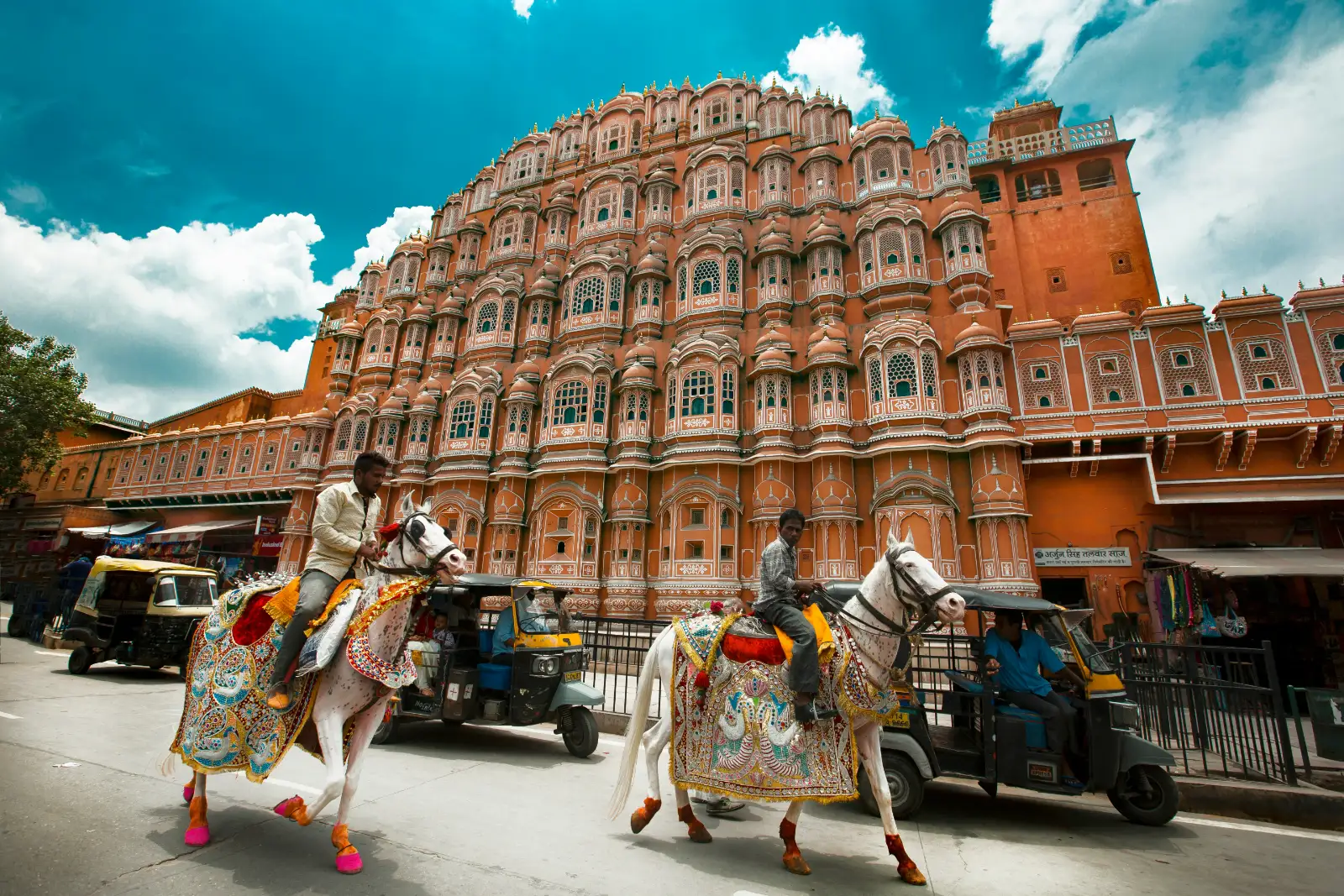
Riders on decorated white horses passing the pink facade of Hawa Mahal in Jaipur

Hawa Mahal is Jaipur's postcard image: a five-storey pink sandstone screen of 953 small windows (jharokhas). Built in 1799 by Maharaja Sawai Pratap Singh and designed by Lal Chand Ustad, it let the women of the royal household watch street life and processions without being seen, according to Incredible India's Hawa Mahal page. The famous street side is best photographed early in the morning, when the sun lights the facade and traffic is thin. Whether it is worth going inside is answered in its own section below.

5. City Palace: a royal home that is still lived in
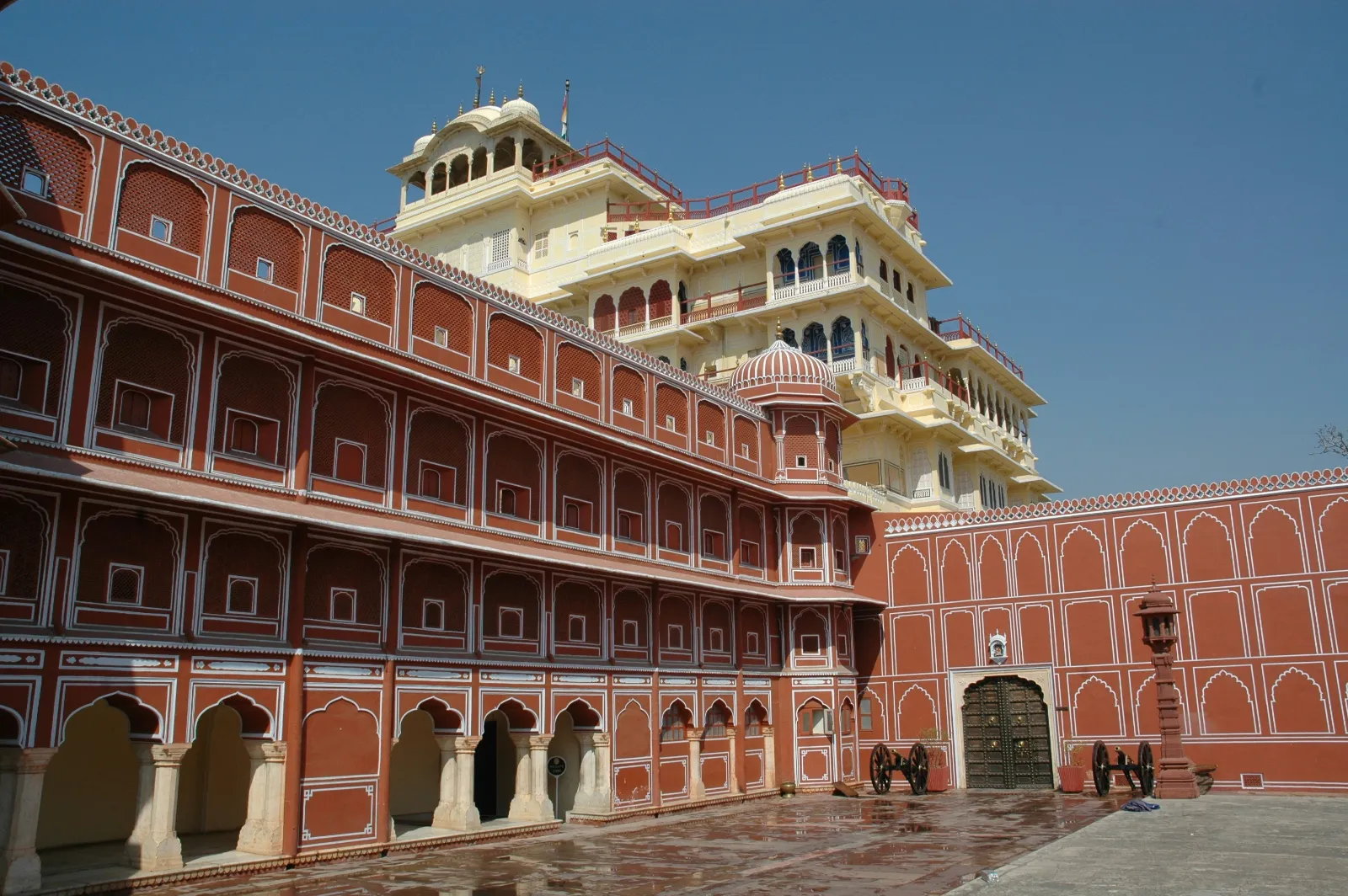
A terracotta red courtyard at City Palace, Jaipur, with the cream Chandra Mahal rising behind

City Palace is the working heart of the old city and still home to Jaipur's former royal family. Rajasthan Tourism says it was built mostly by Maharaja Sawai Jai Singh II. Visitors walk through the Mubarak Mahal, now part of the Maharaja Sawai Man Singh II Museum with its royal textiles and costumes, the Diwan-i-Khas with its two enormous silver vessels made to carry Ganges water, and the Pritam Niwas Chowk with its four painted gates. Because it is run by a royal family trust, City Palace is not on the state composite ticket. Details are in the City Palace and Jantar Mantar section below.

6. Jantar Mantar: an 18th century stone observatory
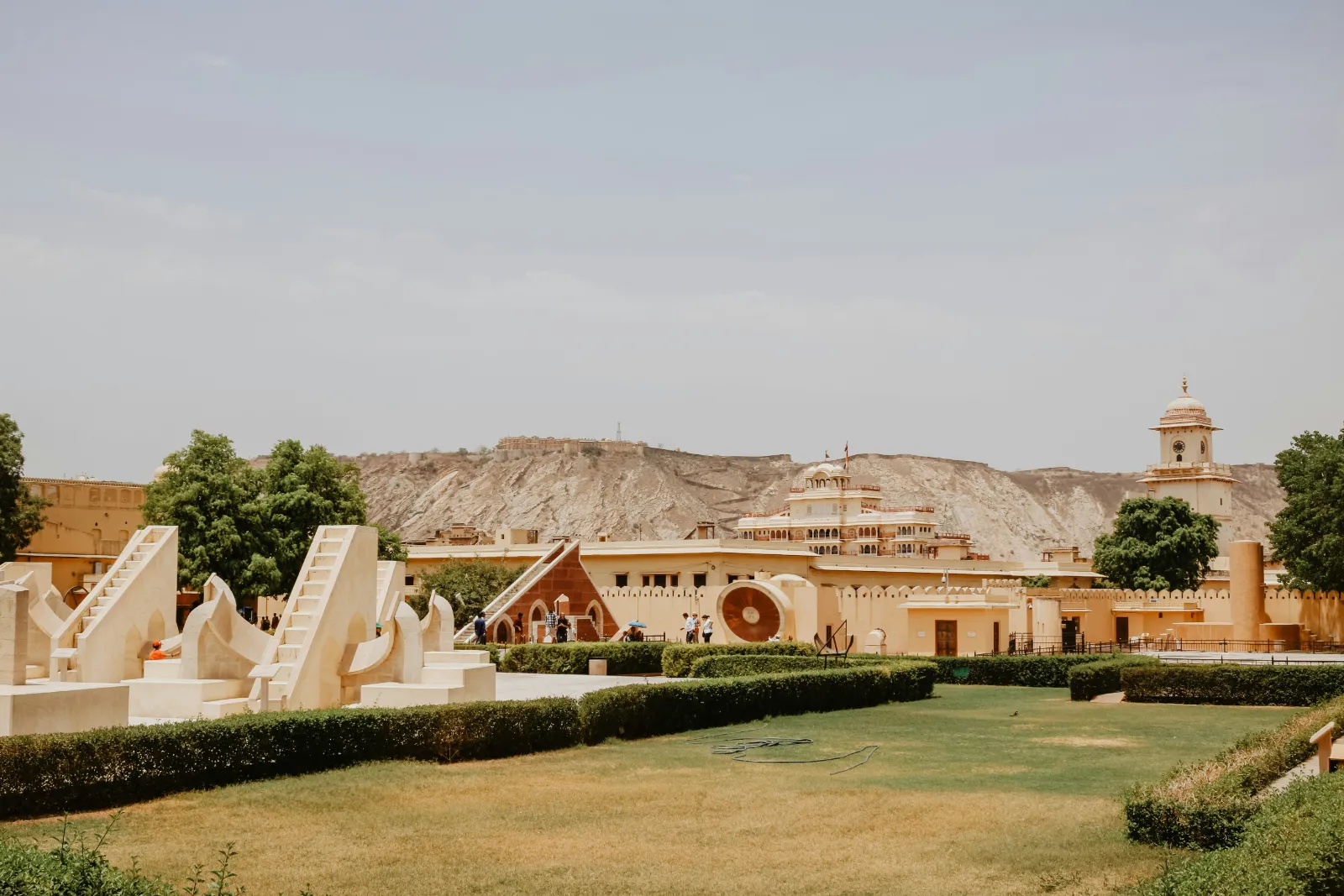
Giant stone astronomical instruments of Jantar Mantar with City Palace rising behind

Jantar Mantar is a UNESCO World Heritage Site and one of the most unusual things to see in India: a courtyard of giant masonry instruments that measure time and track the stars. Rajasthan Tourism describes it as a collection of nineteen instruments completed in 1734 by Sawai Jai Singh II. UNESCO inscribed it in 2010 (reference 1338). Go when the sun is out: the sundials only make sense with a sharp shadow. In the photo you can see the upper storeys of City Palace just behind the instruments, which shows how close the two sights are.

7. Albert Hall Museum: the city museum that glows at night
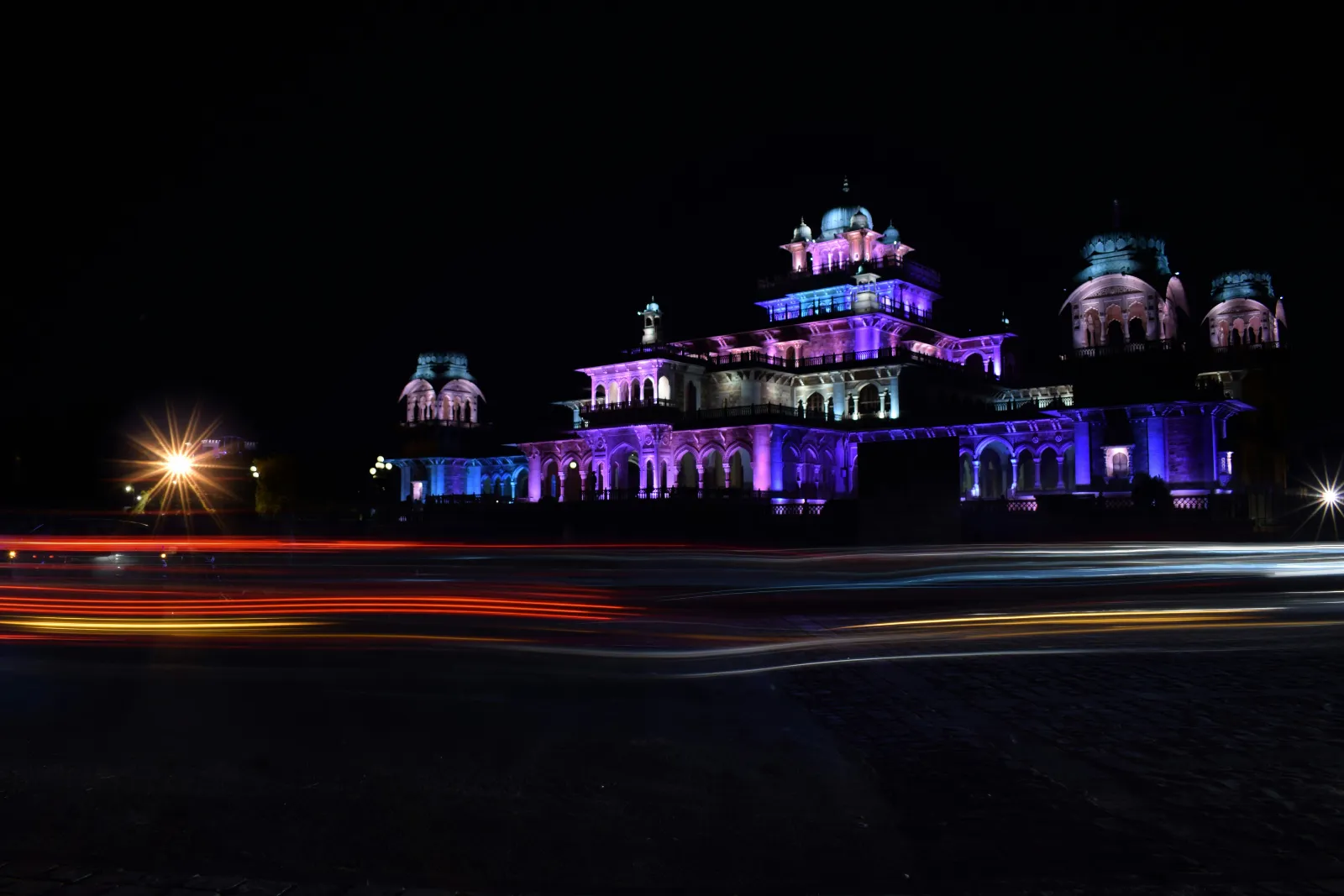
Albert Hall Museum in Jaipur lit in purple and blue at night, with traffic light trails

Albert Hall is Jaipur's grand state museum and a good place to escape the midday heat. Incredible India says Maharaja Sawai Ram Singh II commissioned it in 1868, the Prince of Wales laid the foundation stone in 1876, and it opened to the public in 1887. The building, designed by Samuel Swinton Jacob, holds about 20,000 objects in 16 galleries, including a Persian garden carpet, arms and armour, miniature paintings and an Egyptian mummy. Listed hours are 9:00 am to 5:00 pm and 7:00 pm to 9:30 pm, and the facade is lit in colour every night (Checked: 13 Nov 2026, Incredible India). Visit the galleries in the afternoon and come back after dark for photographs.

8. Patrika Gate: Jaipur's most colourful gateway
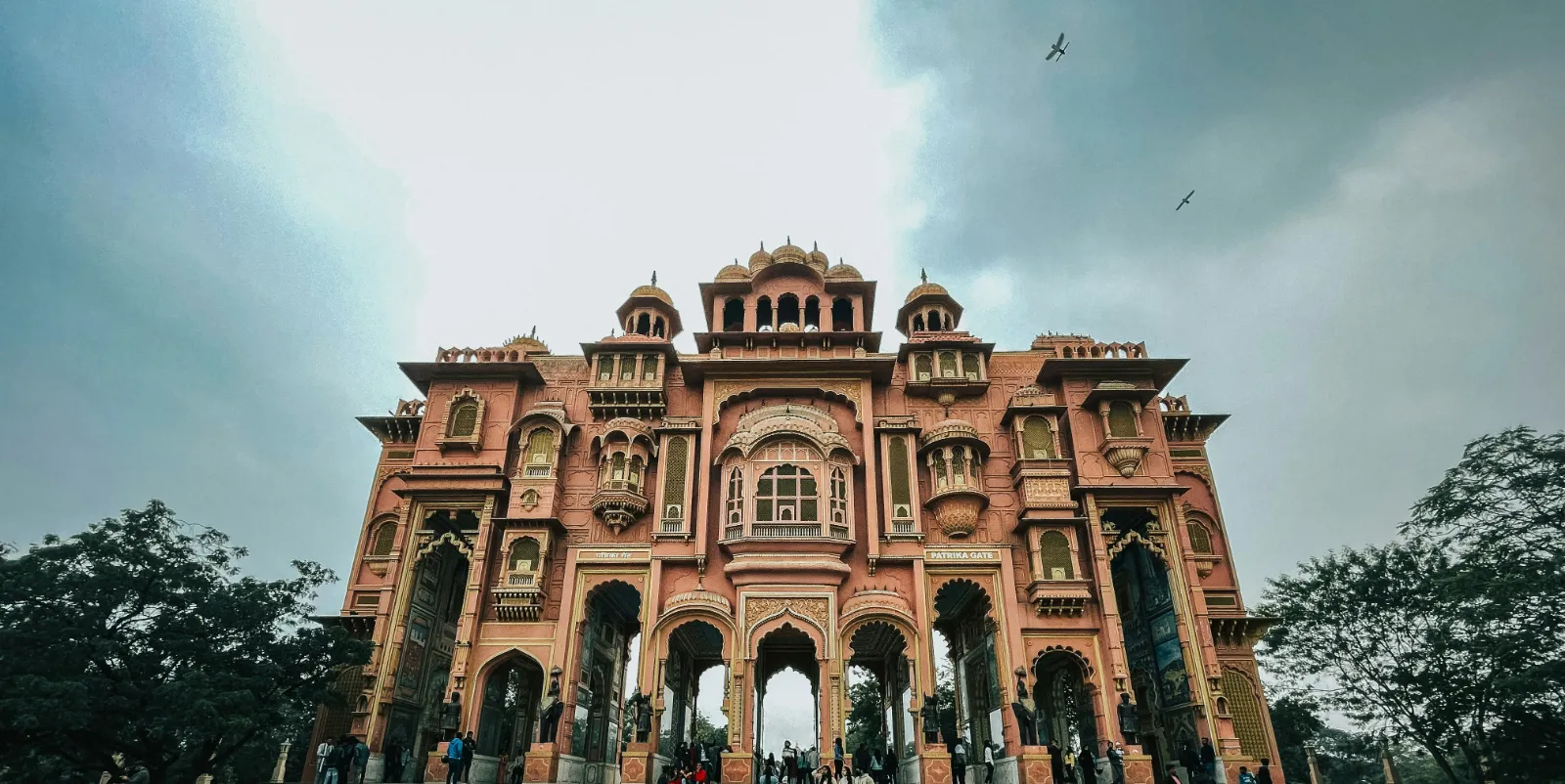
Painted arches and domed pavilions of Patrika Gate at Jawahar Circle in Jaipur

Patrika Gate is a new monument, not a historic one, but it has become one of Jaipur's favourite photo stops. It stands at the edge of Jawahar Circle, a large circular park in south Jaipur, and was built by the Rajasthan Patrika media group under the Jaipur Development Authority's Mission Anupam. India's Prime Minister inaugurated it by video conference in September 2020, as reported by Drishti IAS (9 Sep 2020). Its painted passages show scenes and motifs from across Rajasthan. Early morning is the only time you will get empty arches. Rajasthan Tourism lists a musical fountain show at Jawahar Circle that starts at 7:00 pm and lasts 30 minutes (Checked: 13 Nov 2026, Rajasthan Tourism).

9. Jal Mahal: the palace in Man Sagar Lake
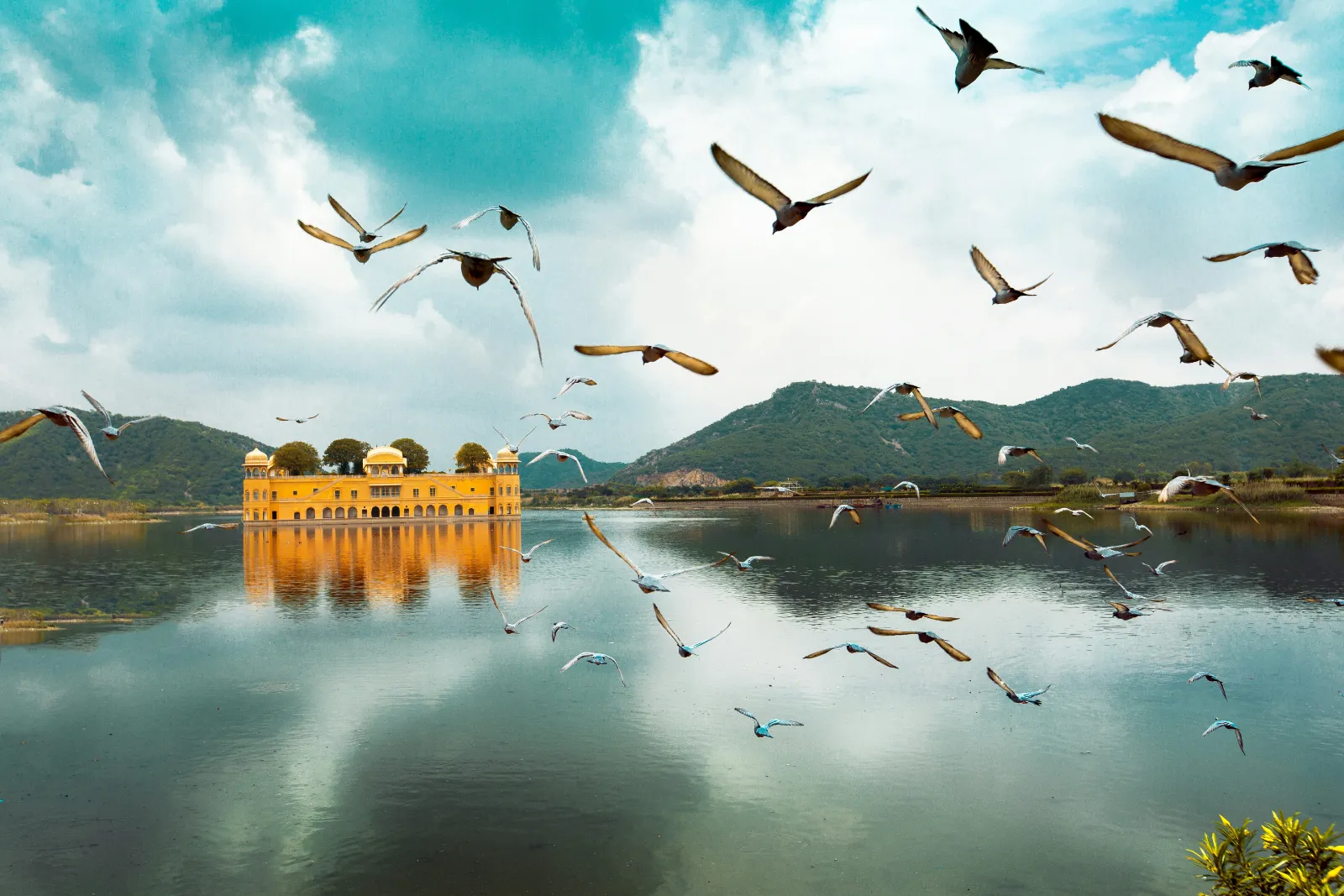
Jal Mahal palace reflected in Man Sagar Lake with birds flying over the water

Jal Mahal is a low sandstone palace that seems to float in Man Sagar Lake beside the road from Jaipur to Amer. According to Wikipedia, the five-storey building was renovated and enlarged in the mid 18th century under Maharaja Madho Singh I, and its lowest storey sits under water when the lake is full. The interior is not open to visitors, so this is a short stop on the lakeside promenade on your way to or from Amber. Sunrise and sunset give the best reflections.

10. Galta Ji: the temple in the gorge
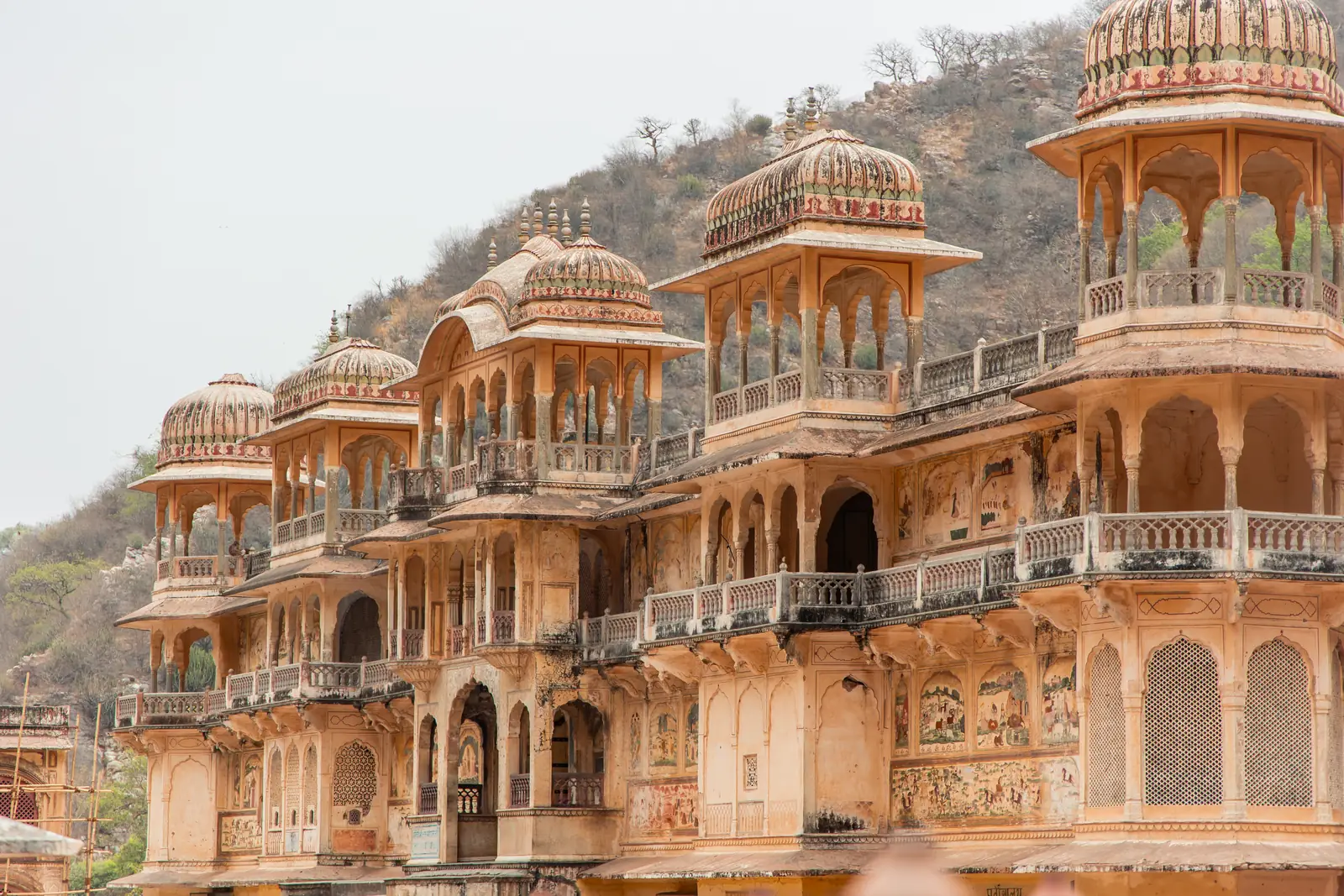
Domed pavilions and painted facades of the Galta Ji temple in the hills outside Jaipur

Galta Ji is a temple complex set in a rocky gorge in the Aravalli hills on Jaipur's eastern edge. Incredible India says it is believed to have been commissioned by Diwan Rao Kriparam, a courtier of Sawai Jai Singh II, in honour of the sage Galav. Seven holy water tanks (kunds) are fed by a spring that flows from a rock shaped like a cow's head, the Gaumukh. A large troop of monkeys lives here, which is why many visitors call it the Monkey Temple. Listed hours are 5:00 am to 9:00 pm (Checked: 13 Nov 2026, Incredible India). Keep food out of sight and do not feed the monkeys.

11. Birla Mandir: white marble at dusk
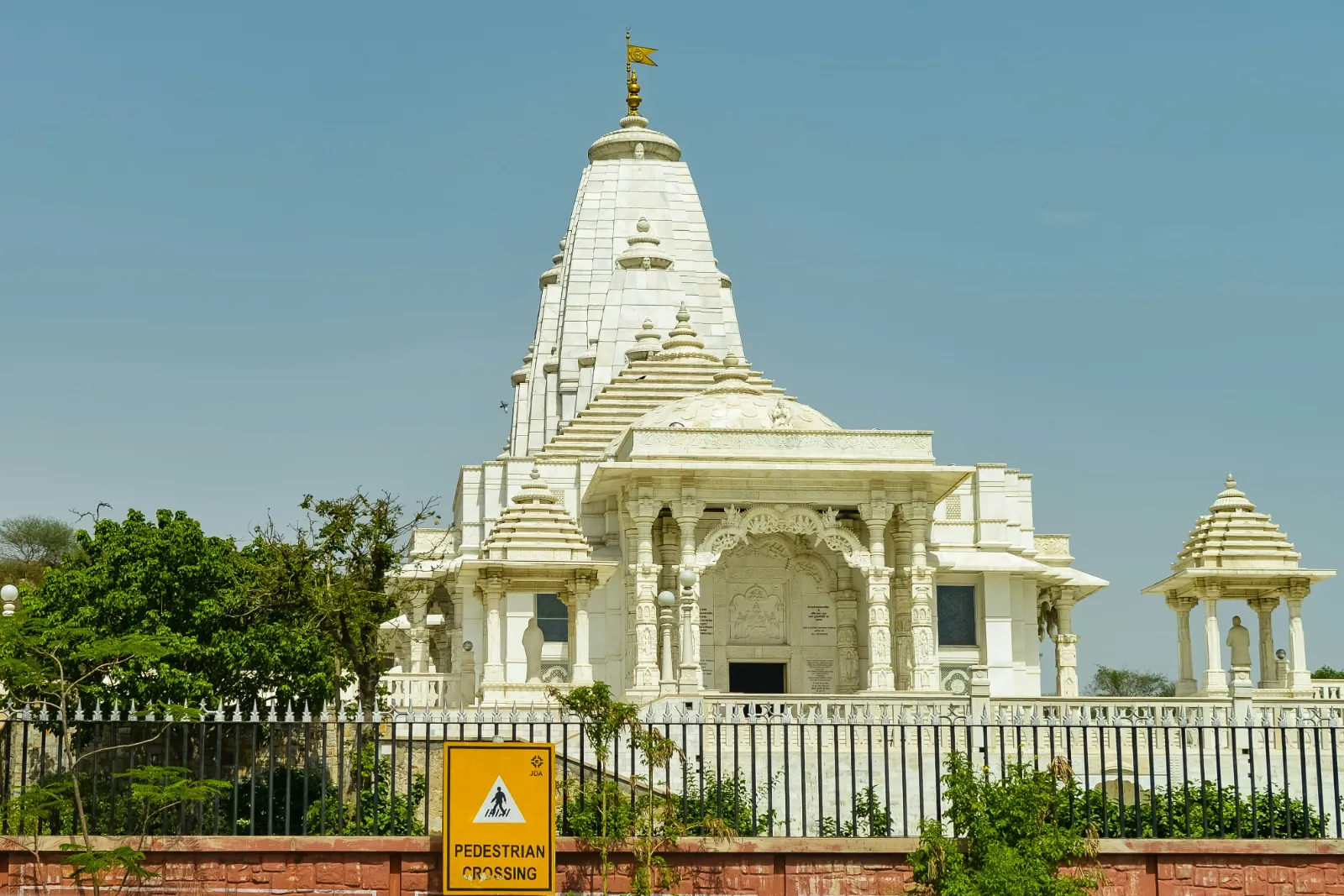
White marble shikhara of Birla Mandir, the Lakshmi Narayan temple in Jaipur, under a clear sky

Birla Mandir, also called the Lakshmi Narayan Temple, is a modern white marble temple dedicated to Vishnu and Lakshmi. Rajasthan Tourism says the Birla family built it in 1988. It sits below the hilltop Moti Doongri, where a popular Ganesh temple also draws worshippers. It is at its best in the evening when the marble is lit. Dress modestly, remove shoes at the entrance and follow the posted photography rules.

12. Jhalana: a leopard reserve inside the city limits

Jhalana is a rare thing: a dry forest reserve on the edge of a city of millions where leopards are regularly seen. Rajasthan Tourism describes Jhalana Safari Park as covering 1,978 hectares and known for leopard sightings (Checked: 13 Nov 2026, Rajasthan Tourism). Safaris run in fixed morning and afternoon slots with limited vehicles, so book ahead through the official forest department channel. Sightings are never guaranteed, but it makes a good contrast to a day of forts and palaces, especially for families.

How do you visit Amber Fort?

You visit Amber Fort by driving or taking a taxi about 11 km north from Jaipur to Amer town, then walking up the stone path from the lakeside or riding a jeep up to the main courtyard, Jaleb Chowk. Arrive at opening time, buy your ticket at the counter or on the official booking portal, and allow two to three hours. Wear shoes with grip: the ramps and stairs are steep and polished.

Amber Fort timings and shows. Checked: 13 Nov 2026, Rajasthan Tourism (Jaipur page) and Incredible India (Amber Fort page)
ItemWhat the official sources sayWhat it means for you
Day visiting hoursRajasthan Tourism: 8:00 am to 5:30 pm. Incredible India: 9:00 am to 6:00 pm.The two government sites disagree. Aim to be at the gate by 8:00 am and confirm on the day.
Light and sound showRajasthan Tourism: timings vary by season, for example the English show at 6:30 pm from October to February. Incredible India: English show 7:30 pm, Hindi show 8:00 pm.There are separate English and Hindi evening shows. Check the current slot when you buy your ticket.
Ticket typesThe state department sells separate tickets for Indian and foreign visitors, plus a composite ticket covering several monuments.Ask which category applies to your passport before you pay.

Getting up to the fort: walk, jeep or elephant

There are three ways up from the road to Jaleb Chowk, the main courtyard. Walking up the stone ramp and stairs from the lakeside is a steady climb with good views over Maota Lake; go early, before the heat builds. Jeeps run from Amer town for those who cannot manage the climb, including older parents and families with small children. The third option, an elephant ride, is still offered, and Rajasthan Tourism's Jaipur page lists it with visiting details. Before you choose it, read the welfare evidence below.

Should you ride an elephant at Amber Fort? An animal welfare note

We recommend walking or taking a jeep rather than riding an elephant, and the evidence is specific to Amber Fort, not general. A committee set up by the Project Elephant Division of India's environment ministry, following a Supreme Court order of 6 March 2020, inspected the captive elephants used at Amer. As reported in PETA India's release of 5 January 2021, it found that of 98 elephants inspected, 22 had irreversible eye problems and 42 had foot problems, and three tested positive for tuberculosis. The committee recommended phasing out rides by replacing them with electric or battery-operated vehicles, and not adding new elephants to ride work.

World Animal Protection (March 2023) describes ride elephants walking about 4 km each way on hot roads from their village to the fort and making repeated uphill trips under a heavy saddle. Separate incidents involving ride elephants, including people injured in October 2022, February 2024 and late 2025, are listed in a PETA India release of 16 Dec 2025. Demand is falling: fort administration data reported by PTI on ThePrint, 11 Aug 2026 show riders fell from 1,64,608 in 2018 to 2019 to 48,474 in 2025 to 2026. If you want to see elephants, look for a sanctuary that does not offer rides or bathing, and keep your distance.

Amber Fort elephant rides: what the records show. Checked: 13 Nov 2026, sources linked above
Source and dateFinding
Central government committee (reported 5 Jan 2021)98 elephants inspected: 22 with irreversible eye problems, 42 with foot problems, 3 TB positive. Recommended replacing rides with electric vehicles.
Animal Welfare Board of India inspection (reported in the same release)All elephants examined were carrying loads heavier than the 200 kg limit for hilly terrain.
World Animal Protection (Mar 2023)About 4 km walk each way on roads, repeated uphill trips under a saddle of about 50 kg.
Fort administration data via PTI (Aug 2026)Riders fell from 1,64,608 (2018 to 2019) to 48,474 (2025 to 2026), about 70 percent lower.

Inside Amber: what not to miss

  • Diwan-e-Aam: the raised hall of public audience with rows of columns, where the ruler heard petitions.
  • Ganesh Pol: the painted three-level gateway into the private palace.
  • Sheesh Mahal: the mirror hall in the Jai Mandir; a single light makes the ceiling sparkle.
  • Sukh Niwas: the hall cooled by water channels, an early form of air conditioning.
  • Kesar Kyari and Maota Lake views: the saffron garden in the lake below, best seen from the upper terraces.
Explore India tour packages
View all →

Is Hawa Mahal worth going inside?

Yes, Hawa Mahal is worth going inside if you have an hour, because the view out through the windows is better than the view of them. From the upper floors you look down on the busy street and across the old city rooftops, and you understand why the screens were built. If you are short of time, the facade from the street is the essential part and can be seen without a ticket.

A few things surprise first-time visitors. The famous street facade is actually the back of the building; the entrance is from the City Palace side, through a courtyard (Wikipedia). The structure is only about 15 m tall, so it feels more like a decorated screen than a palace. The top two floors are reached by ramps rather than stairs, and a small archaeological museum sits in the courtyard. Incredible India lists the floors as Sharad Mandir, Ratan Mandir, Vichitra Mandir, Prakash Mandir and Hawa Mandir.

Hawa Mahal quick facts. Checked: 13 Nov 2026, Incredible India Hawa Mahal page and Rajasthan Tourism
FactDetail
Built1799, by Maharaja Sawai Pratap Singh
ArchitectLal Chand Ustad
Windows953 jharokhas
StoreysFive
Listed hours9:00 am to 4:30 pm (Incredible India)
Best photo timeEarly morning from the street; upstairs cafes across the road give a level view
TicketState department ticket; included in the composite ticket

Practical tip: the pavement opposite Hawa Mahal is busy with traffic and vendors. Cross with care, keep bags in front of you, and if you are with children or elderly parents, view the facade from one of the upstairs cafes across the road instead of standing on the kerb.

What can you see at City Palace and Jantar Mantar?

At City Palace you see royal courtyards, textile and arms galleries, the Diwan-i-Khas with its giant silver vessels and the four painted gates of Pritam Niwas Chowk. At Jantar Mantar, next door, you see 19 stone instruments that tell local time, track the sun's position and map the stars. Together they fill a morning, and they sit within a short walk of Hawa Mahal.

City Palace highlights

  • Mubarak Mahal: a late 19th century reception hall, now galleries of royal robes, shawls and ceremonial dress.
  • Diwan-i-Khas: the marble hall of private audience, with two enormous silver vessels made to carry Ganges water, often described as among the largest silver objects in the world.
  • Pritam Niwas Chowk: an inner courtyard with four gates, each linked to a season: the Peacock Gate, Lotus Gate, Green Gate and Rose Gate.
  • Chandra Mahal: the residence of the former royal family. Most of it is private; access to some rooms is by a separately booked royal tour.

According to Lonely Planet's City Palace guide, the palace is open daily from 9:30 am to 5:30 pm, and a night ticket includes a sound and light show at 7:30 pm. City Palace is managed by the former royal family's museum trust, not the state department, so check the palace's own ticket counter for current hours.

Jantar Mantar highlights

The centrepiece is the Vrihat Samrat Yantra, a 27 m tall sundial that Rajasthan Tourism says calculates time to an accuracy of two seconds. Wikipedia notes that the blurred edge of the sun's shadow makes that precision more theoretical than practical, but standing beside it while the shadow visibly moves is memorable. Other instruments include the Jai Prakash Yantra, a pair of hollow hemispheres that map the sky, and a set of instruments aligned to each zodiac sign. Jai Singh II built five observatories in different cities, and UNESCO describes Jaipur's as the most significant and best preserved of India's historic observatories.

City Palace and Jantar Mantar compared. Checked: 13 Nov 2026, Rajasthan Tourism, Lonely Planet
City PalaceJantar Mantar
What it isRoyal palace and museum, still partly lived inOpen-air astronomical observatory
BuiltMostly under Sawai Jai Singh II, with later additionsCompleted 1734 by Sawai Jai Singh II
Listed hours9:30 am to 5:30 pm (Lonely Planet)9:00 am to 7:00 pm, last ticket 6:30 pm (Rajasthan Tourism)
UNESCO statusWithin the Jaipur City World Heritage Site (2019)Separate World Heritage Site (2010)
On the state composite ticket?NoYes
Best withAn audio guide or official guideA licensed guide; the instruments need explaining

Is the Jaipur composite ticket worth buying?

The composite ticket is worth buying if you plan to see three or more of the monuments run by the Rajasthan Department of Archaeology and Museums, which in Jaipur include Amber Fort, Hawa Mahal, Jantar Mantar, Albert Hall and Nahargarh Fort. It does not cover City Palace or Jaigarh Fort, which are run by their own trusts. Prices change and differ for Indian and foreign visitors, so we do not list them here; check the counter or the official booking portal.

The state revised monument ticket rates from 1 January 2026, its first major revision since 2015. A PinkCity Post report of 29 Dec 2025 describes the combined pass as covering department-controlled monuments, museums and galleries across Rajasthan, with separate passes for Indian and foreign tourists, and gives its validity as 10 days. Older guides describe a two-day Jaipur composite ticket, so read the validity printed on your ticket rather than relying on any blog, including this one.

Which Jaipur sights are on which ticket. Checked: 13 Nov 2026, PinkCity Post (29 Dec 2025), Wikipedia (Jaigarh Fort), Lonely Planet (City Palace)
SightManaged byOn the state composite ticket?
Amber FortState Department of Archaeology and MuseumsYes
Hawa MahalState departmentYes
Jantar MantarState departmentYes
Albert Hall MuseumState departmentYes
Nahargarh FortState departmentYes
City PalaceFormer royal family's museum trustNo, own ticket
Jaigarh FortJaigarh Public Charitable TrustNo, own ticket
Galta Ji, Birla MandirTemplesNot applicable

Which bazaars should you shop in?

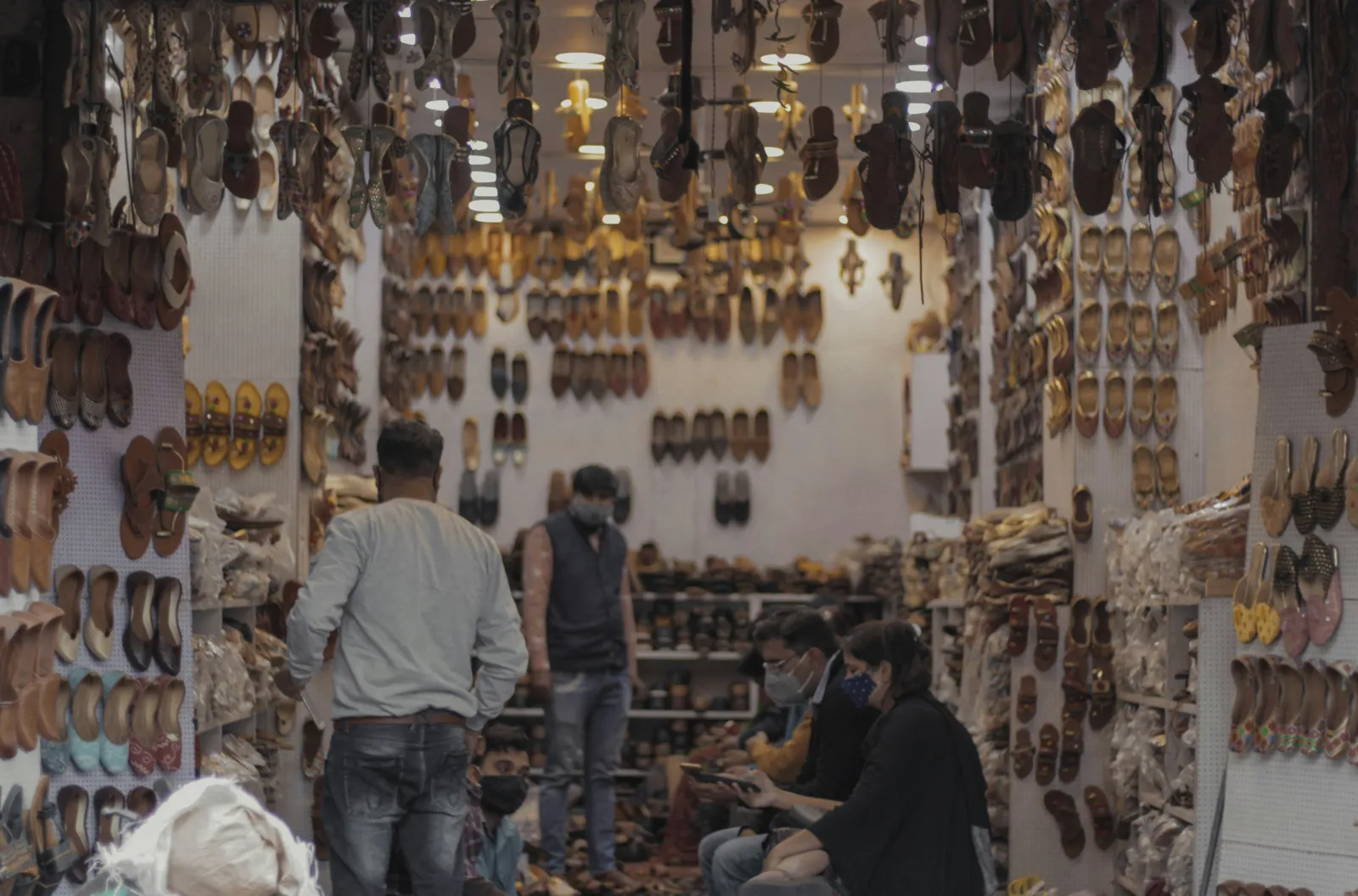
Rows of leather sandals and embroidered mojari shoes hanging inside a busy Jaipur bazaar shop

Shop in Johari Bazaar for jewellery and gemstones, Bapu Bazaar for mojari shoes, textiles and souvenirs, Tripolia Bazaar and the lane of Maniharon ka Rasta for lac bangles and brassware, and Chandpole and Kishanpole for marble carvings, turbans and tie-dye fabric. All of them lie inside or at the gates of the walled city, so you can walk from one to the next in the late afternoon when the heat drops. UNESCO's 2019 decision on Jaipur City notes that the main avenues were designed as markets and still work as bazaars today.

Jaipur bazaars by item. Sources: Frommer's Jaipur shopping guide, JaipurStuff market guide, Rajasthan Tourism. Checked: 13 Nov 2026
What you wantWhere to lookTip
Gold, silver, kundan and meenakari jewellery, loose gemstonesJohari BazaarBuy gems only with a certificate from a recognised lab, and never as an "investment" to resell abroad.
Mojari (jutti) shoes, camel leatherBapu Bazaar, Tripolia Bazaar, MI RoadTry both feet; handmade pairs vary in size.
Block-printed cotton, bandhej (tie-dye), quiltsBapu Bazaar, Johari Bazaar, Kishanpole BazaarSanganer and Bagru, near Jaipur, are the block-printing centres if you want to see it made.
Lac banglesManiharon ka Rasta, off Tripolia BazaarWatch the makers heat and shape them to fit your wrist.
Brass, copper and steel utensilsTripolia BazaarCheck weight and finish; plated pieces are lighter.
Marble and stone carving, turbans, spicesChandpole BazaarAsk for export packing for heavy carvings.
Blue potteryAmber Road outlets, Rajasthali showroom on MI RoadRajasthali is the state government showroom, useful for a fixed-price benchmark.

Two practical points. First, Sunday closures are common: Rajasthan Tourism says markets are generally closed on Sundays, while some bazaars open all week, so plan serious shopping for Monday to Saturday. Second, bargain politely in street stalls but expect fixed prices in government emporiums, and be wary of drivers or "guides" who steer you to particular shops, where they often earn commission. Our Golden Triangle route guide covers the common scams on the Delhi, Agra and Jaipur circuit.

What should you eat in Jaipur?

Three glasses of hot masala chai beside a samosa at a Jaipur tea stall

In Jaipur you should eat dal baati churma, pyaaz kachori, mawa kachori, ghewar and a tall glass of lassi, and finish with masala chai from a street stall. Jaipur is one of the easiest cities in India for vegetarians, which suits many Nepali, Indian and diaspora families, and a Rajasthani thali lets you try several dishes at once.

What to eat in Jaipur
DishWhat it isVegetarian?
Dal baati churmaBaked wheat balls (baati) with spiced lentils (dal) and a sweet crumbled wheat dessert (churma), served with gheeYes
Pyaaz kachoriFlaky fried pastry filled with spiced onion, a breakfast favouriteYes
Mawa kachoriFried pastry filled with sweetened milk solids and nuts, dipped in syrupYes
GhewarHoneycomb-textured sweet disc, traditionally eaten at the Teej festivalYes
Gatte ki sabziGram flour dumplings in a yoghurt curryYes
Ker sangriDesert beans and berries cooked with spicesYes
Laal maasFiery red mutton curry with chilliesNo
LassiThick sweet yoghurt drink, often served in clay cupsYes

For a one-stop taste, Rajasthan Tourism points to Masala Chowk, an open-air food court of 21 street-food stalls with an entry fee, best visited in the evening. Drink bottled or filtered water, choose busy stalls where food is cooked fresh in front of you, and go easy on chilli for the first day. Our guide to what to eat in India covers regional dishes beyond Rajasthan.

When is the best time to visit Jaipur?

The best time to visit Jaipur is October to March, when days are dry and warm and nights are cool. November to February is the most comfortable stretch for sightseeing on foot. April to June is very hot, with an average May high above 40 °C, and July and August bring most of the year's rain. These figures come from the India Meteorological Department's long-term normals for Jaipur.

Jaipur climate normals. Max and min temperature 1952 to 2009, rainfall 1969 to 2011. Source: India Meteorological Department, Meteorological Centre Jaipur; October and November mean temperature from WMO normals for Jaipur Sanganer via JMA Tokyo Climate Center. Checked: 13 Nov 2026
MonthAvg high (°C)Avg low (°C)Rainfall (mm)Sightseeing verdict
January22.57.85.5Excellent days, cold mornings and nights
February25.710.711.9Excellent
March31.516.24.2Good, warming up
April37.221.88.2Hot; sightsee early and late
May40.527.518.7Very hot; hardest month
June39.327.269Very hot, humid when the monsoon arrives
July34.225.7221Wettest month; green hills, fewer visitors
August32.324.5195Wet and humid
September33.723.071Rain easing, still warm
OctoberMean 27.0 (WMO)25.0Good; warm afternoons
NovemberMean 21.9 (WMO)3.9Excellent
December24.49.13.8Excellent days, cold nights

Source documents: IMD Jaipur climate summary and JMA Tokyo Climate Center, station 42348.

Tip for travellers from Nepal: Dashain and Tihar holidays usually fall between late September and November, which lines up well with the start of Jaipur's best weather. Tihar coincides with Diwali, when Jaipur's markets are decorated and lit, so the old city is especially lively, but hotels and trains also fill up. Book early if you plan to travel over the festival weeks or the December school holidays. For a month-by-month view of the whole country, see our guide to the best time to visit India.

Festivals worth timing a trip around, according to Rajasthan Tourism, include the kite festival around 14 January, Gangaur in March to April, and Teej in the monsoon, when a royal procession sets out from City Palace and ghewar is everywhere.

How do you get to Jaipur from Delhi or Agra?

From Delhi, the fastest way to Jaipur is a morning express train, which takes roughly 3.5 to 4.5 hours, or a drive on the Delhi Mumbai Expressway and its Jaipur link, which officials say takes about 3 to 3.5 hours. From Agra, express trains take roughly 4 hours, and a car lets you stop at Fatehpur Sikri and the Abhaneri stepwell on the way. Jaipur also has an international airport with domestic flights to major Indian cities.

Getting to Jaipur. Checked: 13 Nov 2026, RailYatri timetables, The Tribune (4 Jul 2025), FlightConnections, Rajasthan Tourism. Schedules change; confirm on the Indian Railways or airline site before booking
RouteModeDistanceTypical timeNotes
New Delhi to JaipurTrainAbout 293 km by rail3 h 37 min (fastest Vande Bharat) to 4 h 30 min (Ajmer Shatabdi); the AC Double Decker from Delhi Sarai Rohilla takes 4 h 35 min19 trains listed; book chair car early in peak season
Delhi to JaipurRoadVaries by route3 to 3.5 hours via the expressway link, about 4.5 hours by the older highwayThe Bandikui to Jaipur expressway link opened in July 2025
Agra to JaipurTrainAbout 240 kmAbout 3 h 50 min to 4 h 15 min on the fastest trainsNine daily trains listed from Agra Cantt
Agra to JaipurRoadRoughly 240 kmMost of a day with stopsFatehpur Sikri needs about 2 hours; Abhaneri is a short detour
Kathmandu to JaipurAirNot applicableNo direct flightConnect via Delhi, Kolkata or Mumbai; or fly to Delhi and continue by train
Gulf cities to JaipurAirNot applicableVariesRajasthan Tourism lists international flights to Dubai and Muscat, among others

Rail sources: New Delhi to Jaipur trains and Agra Cantt to Jaipur trains on RailYatri. Road: The Tribune, 4 Jul 2025. Air: FlightConnections states there are no direct flights between Jaipur and Kathmandu.

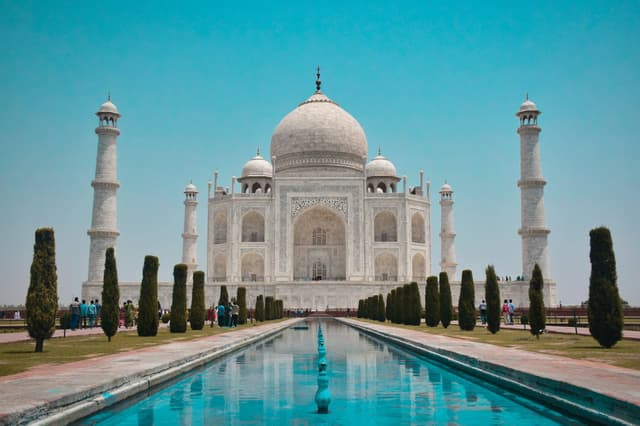
From Nepal, most travellers fly Kathmandu to Delhi, spend a night or two there, and then take a morning train to Jaipur; our guide to the Kathmandu to Delhi flight covers that first leg. Jaipur slots neatly into a Golden Triangle loop with Agra, where the Taj Mahal at sunrise is the reason to stay overnight. Within Jaipur, app cabs and auto rickshaws are the easiest way between clusters; agree the fare or use the meter before you set off.

Is Jaipur safe, and what should you know before you go?

Jaipur is generally safe for tourists who take ordinary city precautions. The main problems visitors report are touts, commission-driven shopping detours, gem "investment" scams and heavy traffic around Hawa Mahal and the bazaars, rather than violent crime. India's national emergency number is 112.

  • Touts and gem scams: ignore anyone who offers to help you profit by carrying gems abroad to resell; it is a well-known trick.
  • Heat: carry water, a hat and sunscreen even in winter; the forts have little shade.
  • Dress: cover shoulders and knees for temples; remove shoes where asked.
  • Monkeys: at Galta Ji and on the hill forts, keep food in your bag and do not feed them.
  • Money: India uses the Indian rupee (INR). Cards work in larger shops and hotels; carry small notes for autos, stalls and tips.
  • Elderly parents: use a jeep at Amber and Jaigarh, plan the walled city by car with short walks, and rest in the afternoon.

For a fuller picture, read our guide on whether India is safe for travellers.

How many days do you need in Jaipur?

Two full days is the right amount of time for most visitors to Jaipur: one for the hill forts north of the city and one for the walled city monuments and bazaars. A third day lets you add Galta Ji, a Jhalana safari, a block-printing visit to Sanganer, or simply slow down. One day is possible if you focus on Amber Fort, Hawa Mahal, City Palace and Jantar Mantar, but you will rush.

How to group Jaipur's sights by area
ClusterSightsBest time of day
Hill forts (north)Amber Fort, Jaigarh Fort, Jal Mahal on the way back, Nahargarh for sunsetStart at opening; end at Nahargarh in the late afternoon
Walled city (centre)City Palace, Jantar Mantar, Hawa Mahal, then the bazaarsMonuments in the morning, shopping from late afternoon
New city (south)Albert Hall Museum, Birla Mandir, Patrika Gate, Jawahar CircleAfternoon and evening, when the buildings are lit
EdgesGalta Ji (east), Jhalana safari (southeast)Early morning safari slot, late afternoon at Galta Ji

Entry documents: Nepali citizens do not need a visa for India; our guide on whether Nepalis need a passport for India explains which ID to carry. Travellers with other passports should read our India visa page and check the official site for their passport before booking.

Jaipur works well as part of a longer trip. Our complete India travel guide covers money, connectivity and planning across the country, and the Rajasthan guide linked at the top of this page shows how Jaipur connects to Udaipur, Jodhpur and Jaisalmer. If you would like to compare organised trips that include Jaipur, browse our India tour packages.

Frequently asked questions

Is one day enough for Jaipur?

One day in Jaipur is enough for the four headline sights, Amber Fort, Hawa Mahal, City Palace and Jantar Mantar, if you start at Amber at opening time. You will have little time for the bazaars, Nahargarh or the Albert Hall Museum, so two full days in Jaipur is far more comfortable.

Should you ride an elephant at Amber Fort?

We recommend walking or taking a jeep up to Amber Fort instead. A central government committee found eye and foot problems in many of the 98 ride elephants it inspected and recommended replacing rides with electric vehicles. The path from the lakeside is a steady climb that most fit visitors manage easily in the cool of the morning.

What time does Amber Fort open?

Rajasthan Tourism lists Amber Fort as open from 8:00 am to 5:30 pm, while Incredible India lists 9:00 am to 6:00 pm (checked 13 Nov 2026). Arrive at the Amber Fort gate by 8:00 am, confirm on the day, and check the evening light and sound show time separately.

Can you go inside Hawa Mahal?

Yes, you can go inside Hawa Mahal with a state department ticket, which is also included in the composite ticket. The entrance is on the City Palace side, not the famous street facade. Ramps lead to the upper floors, which give views over the old city of Jaipur.

What is Jaipur famous for shopping?

Jaipur is famous for gemstones and jewellery in Johari Bazaar, mojari shoes and block-printed textiles in Bapu Bazaar, lac bangles in Maniharon ka Rasta, blue pottery, and brassware in Tripolia Bazaar. Many Jaipur shops close on Sundays, so plan serious shopping for weekdays.

Is Jaipur safe for tourists?

Jaipur is generally safe for tourists who take normal city precautions. The common problems are touts, commission-driven shop visits, gem resale scams and heavy traffic around the old city. Use app cabs or agreed fares, keep valuables close, and call 112, India's emergency number, if needed.

Is Jaipur too hot in April?

Jaipur is hot in April, with an average high of about 37 °C according to India Meteorological Department normals, and May is hotter still at about 40.5 °C. You can still visit in April if you sightsee early and late, rest at midday and carry plenty of water.

Why is Jaipur called the Pink City?

Jaipur is called the Pink City because its old city buildings were painted pink in 1876 to welcome the Prince of Wales, and the terracotta pink colour has been kept ever since. The walled city, founded in 1727, became a UNESCO World Heritage Site in 2019.

What vegetarian food should you try in Jaipur?

In Jaipur, try dal baati churma, pyaaz kachori, mawa kachori, gatte ki sabzi, ker sangri, ghewar and a thick lassi. Jaipur is one of the easiest cities in India for vegetarians, and a Rajasthani thali lets you sample several dishes in one meal.

How far is Jaipur from Delhi?

Jaipur is about 293 km from New Delhi by rail. The fastest trains take about 3 hours 37 minutes to 4 hours 35 minutes, and the drive via the Delhi Mumbai Expressway and its Jaipur link takes about 3 to 3.5 hours, according to timetables and reports checked on 13 Nov 2026.

Is there a direct flight from Kathmandu to Jaipur?

No, there is no direct flight from Kathmandu to Jaipur as of 13 Nov 2026, according to FlightConnections. Travellers from Nepal usually connect through Delhi, or fly to Delhi and take an express train to Jaipur, which takes around four hours.

Tags
India
Share
G
Gomayu Team
Writer at Gomayu
Keep reading
Blog / India
Things to Do in Jaipur: Amber Fort, Hawa Mahal and Bazaars
30 min read 13 Nov 2026 · Updated 16 Nov 2026
Pink sandstone domes and latticed jharokha windows across the upper facade of Hawa Mahal in Jaipur

Short answer: The best things to do in Jaipur are climbing Amber Fort above Maota Lake, seeing the 953 windows of Hawa Mahal, walking through the courtyards of City Palace, and testing the giant stone instruments of Jantar Mantar. Add sunset at Nahargarh Fort, the Jaivana cannon at Jaigarh, the Albert Hall Museum lit up at night, and an evening in the old city bazaars. Plan on two full days for the main sights, start at the hill forts early, and save the walled city and shopping for the afternoon and evening.

Jaipur is the capital of Rajasthan and the third corner of India's Golden Triangle with Delhi and Agra. Sawai Jai Singh II founded it in 1727 and laid it out on a grid, and UNESCO added the walled city to the World Heritage List in 2019, citing its planned streets, its chaupars (public squares) and its living bazaars. This guide lists 12 sights with the best time of day for each, explains how to visit Amber Fort without an elephant ride, shows which bazaar sells what, and gives dated, sourced timings, weather and transport facts. It is written for families, couples, first-time visitors to India and travellers coming from Nepal or the Nepali diaspora. For the wider state, see our Rajasthan tourism guide.

What are the top things to do in Jaipur?

The top things to do in Jaipur fall into three clusters: the hill forts north of the city (Amber, Jaigarh, Nahargarh), the monuments inside the pink walled city (Hawa Mahal, City Palace, Jantar Mantar), and the newer city to the south (Albert Hall, Birla Mandir, Patrika Gate). Grouping the sights by cluster saves hours in traffic. The table below is a quick planner; each sight then has its own short section.

Jaipur sights at a glance. Hours checked: 13 Nov 2026, Rajasthan Tourism and Incredible India (Ministry of Tourism) pages linked in each section
#SightAreaBest time of dayTime to allowWho runs the ticket
1Amber (Amer) FortAmer, about 11 km northOpening time, before tour buses2 to 3 hoursState Department of Archaeology and Museums
2Jaigarh FortRidge above AmerLate morning, after Amber1 to 2 hoursJaigarh Public Charitable Trust
3Nahargarh FortRidge above the old cityLate afternoon to sunset1.5 to 2 hoursState department
4Hawa MahalWalled cityEarly morning for the facade1 hourState department
5City PalaceWalled cityMorning, at opening2 to 3 hoursFormer royal family's museum trust
6Jantar MantarWalled city, next to City PalaceSunny midday, when the sundials work1 hour (more with a guide)State department
7Albert Hall MuseumRam Niwas GardenAfternoon inside, after dark outside1.5 hoursState department
8Patrika GateJawahar Circle, south JaipurEarly morning for empty photos30 to 45 minutesOpen public space
9Jal MahalMan Sagar Lake, Amer RoadSunrise or sunset20 to 30 minutesViewed from the shore only
10Galta JiAravalli hills, east edge of the cityLate afternoon1.5 hoursTemple, no monument ticket
11Birla MandirBelow Moti DoongriEvening, when it is lit30 to 45 minutesTemple, no monument ticket
12Jhalana leopard safariSoutheast edge of the cityEarly morning or late afternoon slotAbout 3 hoursRajasthan Forest Department

1. Amber Fort: the hill palace above Maota Lake

Amber Fort stretched along its green hillside above the still water of Maota Lake

Amber Fort (also spelt Amer) is the single most important sight in Jaipur and the one to see first. According to Rajasthan Tourism, construction began in 1592 under Raja Man Singh I, the palace sits about 11 km from the city, and it is built of red sandstone and white marble. In 2013 UNESCO inscribed it as one of the six Hill Forts of Rajasthan, alongside Chittorgarh, Kumbhalgarh, Ranthambore, Gagron and Jaisalmer.

Inside, you move through a sequence of courtyards: the Diwan-e-Aam (Hall of Public Audience), the painted Ganesh Pol gateway, the Sheesh Mahal with its walls and ceilings set with thousands of small mirrors, and the Sukh Niwas, where water channels once cooled the air. Go at opening time; by late morning the courtyards fill with groups. The full section on how to visit Amber Fort, further down this page, covers access routes, the elephant ride question and the evening show.

2. Jaigarh Fort: the Jaivana cannon and the long walls

Domed watchtower on the Jaigarh Fort ramparts above Amer town, with old walls crossing the hills

Jaigarh Fort stands on the ridge directly above Amber and was built as its defensive bastion. Incredible India, the Ministry of Tourism site, says Jaigarh was commissioned by Jai Singh II on Cheelka Teela, the "Hill of Eagles", about 15 km from Jaipur. Its star exhibit is the Jaivana, described by the same source as the largest cannon on wheels; Wikipedia gives its barrel as roughly 6 m long and its weight as about 50 tonnes. Jaigarh and Amber are linked by underground passages, so many visitors treat them as one complex. Jaigarh is run by the Jaigarh Public Charitable Trust rather than the state department, so it has its own ticket. Listed hours are 9:30 am to 5:00 pm (Checked: 13 Nov 2026, Incredible India).

3. Nahargarh Fort: sunset over the Pink City

Stepped stone sides of the Nahargarh Fort stepwell with Jaipur city spread out below

Nahargarh is the fort for views. It sits on the ridge right above the old city, and from its walls you look straight down on Jaipur's grid. Incredible India says Sawai Jai Singh II completed it in 1734, originally naming it Sudarshangarh, as a retreat and a guard post alongside Amber and Jaigarh. Rajasthan Tourism notes it was expanded in 1868. Inside, the Madhavendra Bhawan is a palace of matching suites built for the king's queens, and the stepwell in the photo above is one of the most photographed corners. Listed hours are 10:00 am to 5:30 pm (Checked: 13 Nov 2026, Incredible India). Come in the late afternoon and stay for the light over the city.

4. Hawa Mahal: the Palace of Winds

Riders on decorated white horses passing the pink facade of Hawa Mahal in Jaipur

Hawa Mahal is Jaipur's postcard image: a five-storey pink sandstone screen of 953 small windows (jharokhas). Built in 1799 by Maharaja Sawai Pratap Singh and designed by Lal Chand Ustad, it let the women of the royal household watch street life and processions without being seen, according to Incredible India's Hawa Mahal page. The famous street side is best photographed early in the morning, when the sun lights the facade and traffic is thin. Whether it is worth going inside is answered in its own section below.

5. City Palace: a royal home that is still lived in

A terracotta red courtyard at City Palace, Jaipur, with the cream Chandra Mahal rising behind

City Palace is the working heart of the old city and still home to Jaipur's former royal family. Rajasthan Tourism says it was built mostly by Maharaja Sawai Jai Singh II. Visitors walk through the Mubarak Mahal, now part of the Maharaja Sawai Man Singh II Museum with its royal textiles and costumes, the Diwan-i-Khas with its two enormous silver vessels made to carry Ganges water, and the Pritam Niwas Chowk with its four painted gates. Because it is run by a royal family trust, City Palace is not on the state composite ticket. Details are in the City Palace and Jantar Mantar section below.

6. Jantar Mantar: an 18th century stone observatory

Giant stone astronomical instruments of Jantar Mantar with City Palace rising behind

Jantar Mantar is a UNESCO World Heritage Site and one of the most unusual things to see in India: a courtyard of giant masonry instruments that measure time and track the stars. Rajasthan Tourism describes it as a collection of nineteen instruments completed in 1734 by Sawai Jai Singh II. UNESCO inscribed it in 2010 (reference 1338). Go when the sun is out: the sundials only make sense with a sharp shadow. In the photo you can see the upper storeys of City Palace just behind the instruments, which shows how close the two sights are.

7. Albert Hall Museum: the city museum that glows at night

Albert Hall Museum in Jaipur lit in purple and blue at night, with traffic light trails

Albert Hall is Jaipur's grand state museum and a good place to escape the midday heat. Incredible India says Maharaja Sawai Ram Singh II commissioned it in 1868, the Prince of Wales laid the foundation stone in 1876, and it opened to the public in 1887. The building, designed by Samuel Swinton Jacob, holds about 20,000 objects in 16 galleries, including a Persian garden carpet, arms and armour, miniature paintings and an Egyptian mummy. Listed hours are 9:00 am to 5:00 pm and 7:00 pm to 9:30 pm, and the facade is lit in colour every night (Checked: 13 Nov 2026, Incredible India). Visit the galleries in the afternoon and come back after dark for photographs.

8. Patrika Gate: Jaipur's most colourful gateway

Painted arches and domed pavilions of Patrika Gate at Jawahar Circle in Jaipur

Patrika Gate is a new monument, not a historic one, but it has become one of Jaipur's favourite photo stops. It stands at the edge of Jawahar Circle, a large circular park in south Jaipur, and was built by the Rajasthan Patrika media group under the Jaipur Development Authority's Mission Anupam. India's Prime Minister inaugurated it by video conference in September 2020, as reported by Drishti IAS (9 Sep 2020). Its painted passages show scenes and motifs from across Rajasthan. Early morning is the only time you will get empty arches. Rajasthan Tourism lists a musical fountain show at Jawahar Circle that starts at 7:00 pm and lasts 30 minutes (Checked: 13 Nov 2026, Rajasthan Tourism).

9. Jal Mahal: the palace in Man Sagar Lake

Jal Mahal palace reflected in Man Sagar Lake with birds flying over the water

Jal Mahal is a low sandstone palace that seems to float in Man Sagar Lake beside the road from Jaipur to Amer. According to Wikipedia, the five-storey building was renovated and enlarged in the mid 18th century under Maharaja Madho Singh I, and its lowest storey sits under water when the lake is full. The interior is not open to visitors, so this is a short stop on the lakeside promenade on your way to or from Amber. Sunrise and sunset give the best reflections.

10. Galta Ji: the temple in the gorge

Domed pavilions and painted facades of the Galta Ji temple in the hills outside Jaipur

Galta Ji is a temple complex set in a rocky gorge in the Aravalli hills on Jaipur's eastern edge. Incredible India says it is believed to have been commissioned by Diwan Rao Kriparam, a courtier of Sawai Jai Singh II, in honour of the sage Galav. Seven holy water tanks (kunds) are fed by a spring that flows from a rock shaped like a cow's head, the Gaumukh. A large troop of monkeys lives here, which is why many visitors call it the Monkey Temple. Listed hours are 5:00 am to 9:00 pm (Checked: 13 Nov 2026, Incredible India). Keep food out of sight and do not feed the monkeys.

11. Birla Mandir: white marble at dusk

White marble shikhara of Birla Mandir, the Lakshmi Narayan temple in Jaipur, under a clear sky

Birla Mandir, also called the Lakshmi Narayan Temple, is a modern white marble temple dedicated to Vishnu and Lakshmi. Rajasthan Tourism says the Birla family built it in 1988. It sits below the hilltop Moti Doongri, where a popular Ganesh temple also draws worshippers. It is at its best in the evening when the marble is lit. Dress modestly, remove shoes at the entrance and follow the posted photography rules.

12. Jhalana: a leopard reserve inside the city limits

Jhalana is a rare thing: a dry forest reserve on the edge of a city of millions where leopards are regularly seen. Rajasthan Tourism describes Jhalana Safari Park as covering 1,978 hectares and known for leopard sightings (Checked: 13 Nov 2026, Rajasthan Tourism). Safaris run in fixed morning and afternoon slots with limited vehicles, so book ahead through the official forest department channel. Sightings are never guaranteed, but it makes a good contrast to a day of forts and palaces, especially for families.

How do you visit Amber Fort?

You visit Amber Fort by driving or taking a taxi about 11 km north from Jaipur to Amer town, then walking up the stone path from the lakeside or riding a jeep up to the main courtyard, Jaleb Chowk. Arrive at opening time, buy your ticket at the counter or on the official booking portal, and allow two to three hours. Wear shoes with grip: the ramps and stairs are steep and polished.

Amber Fort timings and shows. Checked: 13 Nov 2026, Rajasthan Tourism (Jaipur page) and Incredible India (Amber Fort page)
ItemWhat the official sources sayWhat it means for you
Day visiting hoursRajasthan Tourism: 8:00 am to 5:30 pm. Incredible India: 9:00 am to 6:00 pm.The two government sites disagree. Aim to be at the gate by 8:00 am and confirm on the day.
Light and sound showRajasthan Tourism: timings vary by season, for example the English show at 6:30 pm from October to February. Incredible India: English show 7:30 pm, Hindi show 8:00 pm.There are separate English and Hindi evening shows. Check the current slot when you buy your ticket.
Ticket typesThe state department sells separate tickets for Indian and foreign visitors, plus a composite ticket covering several monuments.Ask which category applies to your passport before you pay.

Getting up to the fort: walk, jeep or elephant

There are three ways up from the road to Jaleb Chowk, the main courtyard. Walking up the stone ramp and stairs from the lakeside is a steady climb with good views over Maota Lake; go early, before the heat builds. Jeeps run from Amer town for those who cannot manage the climb, including older parents and families with small children. The third option, an elephant ride, is still offered, and Rajasthan Tourism's Jaipur page lists it with visiting details. Before you choose it, read the welfare evidence below.

Should you ride an elephant at Amber Fort? An animal welfare note

We recommend walking or taking a jeep rather than riding an elephant, and the evidence is specific to Amber Fort, not general. A committee set up by the Project Elephant Division of India's environment ministry, following a Supreme Court order of 6 March 2020, inspected the captive elephants used at Amer. As reported in PETA India's release of 5 January 2021, it found that of 98 elephants inspected, 22 had irreversible eye problems and 42 had foot problems, and three tested positive for tuberculosis. The committee recommended phasing out rides by replacing them with electric or battery-operated vehicles, and not adding new elephants to ride work.

World Animal Protection (March 2023) describes ride elephants walking about 4 km each way on hot roads from their village to the fort and making repeated uphill trips under a heavy saddle. Separate incidents involving ride elephants, including people injured in October 2022, February 2024 and late 2025, are listed in a PETA India release of 16 Dec 2025. Demand is falling: fort administration data reported by PTI on ThePrint, 11 Aug 2026 show riders fell from 1,64,608 in 2018 to 2019 to 48,474 in 2025 to 2026. If you want to see elephants, look for a sanctuary that does not offer rides or bathing, and keep your distance.

Amber Fort elephant rides: what the records show. Checked: 13 Nov 2026, sources linked above
Source and dateFinding
Central government committee (reported 5 Jan 2021)98 elephants inspected: 22 with irreversible eye problems, 42 with foot problems, 3 TB positive. Recommended replacing rides with electric vehicles.
Animal Welfare Board of India inspection (reported in the same release)All elephants examined were carrying loads heavier than the 200 kg limit for hilly terrain.
World Animal Protection (Mar 2023)About 4 km walk each way on roads, repeated uphill trips under a saddle of about 50 kg.
Fort administration data via PTI (Aug 2026)Riders fell from 1,64,608 (2018 to 2019) to 48,474 (2025 to 2026), about 70 percent lower.

Inside Amber: what not to miss

  • Diwan-e-Aam: the raised hall of public audience with rows of columns, where the ruler heard petitions.
  • Ganesh Pol: the painted three-level gateway into the private palace.
  • Sheesh Mahal: the mirror hall in the Jai Mandir; a single light makes the ceiling sparkle.
  • Sukh Niwas: the hall cooled by water channels, an early form of air conditioning.
  • Kesar Kyari and Maota Lake views: the saffron garden in the lake below, best seen from the upper terraces.
Explore India tour packages
View all →

Is Hawa Mahal worth going inside?

Yes, Hawa Mahal is worth going inside if you have an hour, because the view out through the windows is better than the view of them. From the upper floors you look down on the busy street and across the old city rooftops, and you understand why the screens were built. If you are short of time, the facade from the street is the essential part and can be seen without a ticket.

A few things surprise first-time visitors. The famous street facade is actually the back of the building; the entrance is from the City Palace side, through a courtyard (Wikipedia). The structure is only about 15 m tall, so it feels more like a decorated screen than a palace. The top two floors are reached by ramps rather than stairs, and a small archaeological museum sits in the courtyard. Incredible India lists the floors as Sharad Mandir, Ratan Mandir, Vichitra Mandir, Prakash Mandir and Hawa Mandir.

Hawa Mahal quick facts. Checked: 13 Nov 2026, Incredible India Hawa Mahal page and Rajasthan Tourism
FactDetail
Built1799, by Maharaja Sawai Pratap Singh
ArchitectLal Chand Ustad
Windows953 jharokhas
StoreysFive
Listed hours9:00 am to 4:30 pm (Incredible India)
Best photo timeEarly morning from the street; upstairs cafes across the road give a level view
TicketState department ticket; included in the composite ticket

Practical tip: the pavement opposite Hawa Mahal is busy with traffic and vendors. Cross with care, keep bags in front of you, and if you are with children or elderly parents, view the facade from one of the upstairs cafes across the road instead of standing on the kerb.

What can you see at City Palace and Jantar Mantar?

At City Palace you see royal courtyards, textile and arms galleries, the Diwan-i-Khas with its giant silver vessels and the four painted gates of Pritam Niwas Chowk. At Jantar Mantar, next door, you see 19 stone instruments that tell local time, track the sun's position and map the stars. Together they fill a morning, and they sit within a short walk of Hawa Mahal.

City Palace highlights

  • Mubarak Mahal: a late 19th century reception hall, now galleries of royal robes, shawls and ceremonial dress.
  • Diwan-i-Khas: the marble hall of private audience, with two enormous silver vessels made to carry Ganges water, often described as among the largest silver objects in the world.
  • Pritam Niwas Chowk: an inner courtyard with four gates, each linked to a season: the Peacock Gate, Lotus Gate, Green Gate and Rose Gate.
  • Chandra Mahal: the residence of the former royal family. Most of it is private; access to some rooms is by a separately booked royal tour.

According to Lonely Planet's City Palace guide, the palace is open daily from 9:30 am to 5:30 pm, and a night ticket includes a sound and light show at 7:30 pm. City Palace is managed by the former royal family's museum trust, not the state department, so check the palace's own ticket counter for current hours.

Jantar Mantar highlights

The centrepiece is the Vrihat Samrat Yantra, a 27 m tall sundial that Rajasthan Tourism says calculates time to an accuracy of two seconds. Wikipedia notes that the blurred edge of the sun's shadow makes that precision more theoretical than practical, but standing beside it while the shadow visibly moves is memorable. Other instruments include the Jai Prakash Yantra, a pair of hollow hemispheres that map the sky, and a set of instruments aligned to each zodiac sign. Jai Singh II built five observatories in different cities, and UNESCO describes Jaipur's as the most significant and best preserved of India's historic observatories.

City Palace and Jantar Mantar compared. Checked: 13 Nov 2026, Rajasthan Tourism, Lonely Planet
City PalaceJantar Mantar
What it isRoyal palace and museum, still partly lived inOpen-air astronomical observatory
BuiltMostly under Sawai Jai Singh II, with later additionsCompleted 1734 by Sawai Jai Singh II
Listed hours9:30 am to 5:30 pm (Lonely Planet)9:00 am to 7:00 pm, last ticket 6:30 pm (Rajasthan Tourism)
UNESCO statusWithin the Jaipur City World Heritage Site (2019)Separate World Heritage Site (2010)
On the state composite ticket?NoYes
Best withAn audio guide or official guideA licensed guide; the instruments need explaining

Is the Jaipur composite ticket worth buying?

The composite ticket is worth buying if you plan to see three or more of the monuments run by the Rajasthan Department of Archaeology and Museums, which in Jaipur include Amber Fort, Hawa Mahal, Jantar Mantar, Albert Hall and Nahargarh Fort. It does not cover City Palace or Jaigarh Fort, which are run by their own trusts. Prices change and differ for Indian and foreign visitors, so we do not list them here; check the counter or the official booking portal.

The state revised monument ticket rates from 1 January 2026, its first major revision since 2015. A PinkCity Post report of 29 Dec 2025 describes the combined pass as covering department-controlled monuments, museums and galleries across Rajasthan, with separate passes for Indian and foreign tourists, and gives its validity as 10 days. Older guides describe a two-day Jaipur composite ticket, so read the validity printed on your ticket rather than relying on any blog, including this one.

Which Jaipur sights are on which ticket. Checked: 13 Nov 2026, PinkCity Post (29 Dec 2025), Wikipedia (Jaigarh Fort), Lonely Planet (City Palace)
SightManaged byOn the state composite ticket?
Amber FortState Department of Archaeology and MuseumsYes
Hawa MahalState departmentYes
Jantar MantarState departmentYes
Albert Hall MuseumState departmentYes
Nahargarh FortState departmentYes
City PalaceFormer royal family's museum trustNo, own ticket
Jaigarh FortJaigarh Public Charitable TrustNo, own ticket
Galta Ji, Birla MandirTemplesNot applicable

Which bazaars should you shop in?

Rows of leather sandals and embroidered mojari shoes hanging inside a busy Jaipur bazaar shop

Shop in Johari Bazaar for jewellery and gemstones, Bapu Bazaar for mojari shoes, textiles and souvenirs, Tripolia Bazaar and the lane of Maniharon ka Rasta for lac bangles and brassware, and Chandpole and Kishanpole for marble carvings, turbans and tie-dye fabric. All of them lie inside or at the gates of the walled city, so you can walk from one to the next in the late afternoon when the heat drops. UNESCO's 2019 decision on Jaipur City notes that the main avenues were designed as markets and still work as bazaars today.

Jaipur bazaars by item. Sources: Frommer's Jaipur shopping guide, JaipurStuff market guide, Rajasthan Tourism. Checked: 13 Nov 2026
What you wantWhere to lookTip
Gold, silver, kundan and meenakari jewellery, loose gemstonesJohari BazaarBuy gems only with a certificate from a recognised lab, and never as an "investment" to resell abroad.
Mojari (jutti) shoes, camel leatherBapu Bazaar, Tripolia Bazaar, MI RoadTry both feet; handmade pairs vary in size.
Block-printed cotton, bandhej (tie-dye), quiltsBapu Bazaar, Johari Bazaar, Kishanpole BazaarSanganer and Bagru, near Jaipur, are the block-printing centres if you want to see it made.
Lac banglesManiharon ka Rasta, off Tripolia BazaarWatch the makers heat and shape them to fit your wrist.
Brass, copper and steel utensilsTripolia BazaarCheck weight and finish; plated pieces are lighter.
Marble and stone carving, turbans, spicesChandpole BazaarAsk for export packing for heavy carvings.
Blue potteryAmber Road outlets, Rajasthali showroom on MI RoadRajasthali is the state government showroom, useful for a fixed-price benchmark.

Two practical points. First, Sunday closures are common: Rajasthan Tourism says markets are generally closed on Sundays, while some bazaars open all week, so plan serious shopping for Monday to Saturday. Second, bargain politely in street stalls but expect fixed prices in government emporiums, and be wary of drivers or "guides" who steer you to particular shops, where they often earn commission. Our Golden Triangle route guide covers the common scams on the Delhi, Agra and Jaipur circuit.

What should you eat in Jaipur?
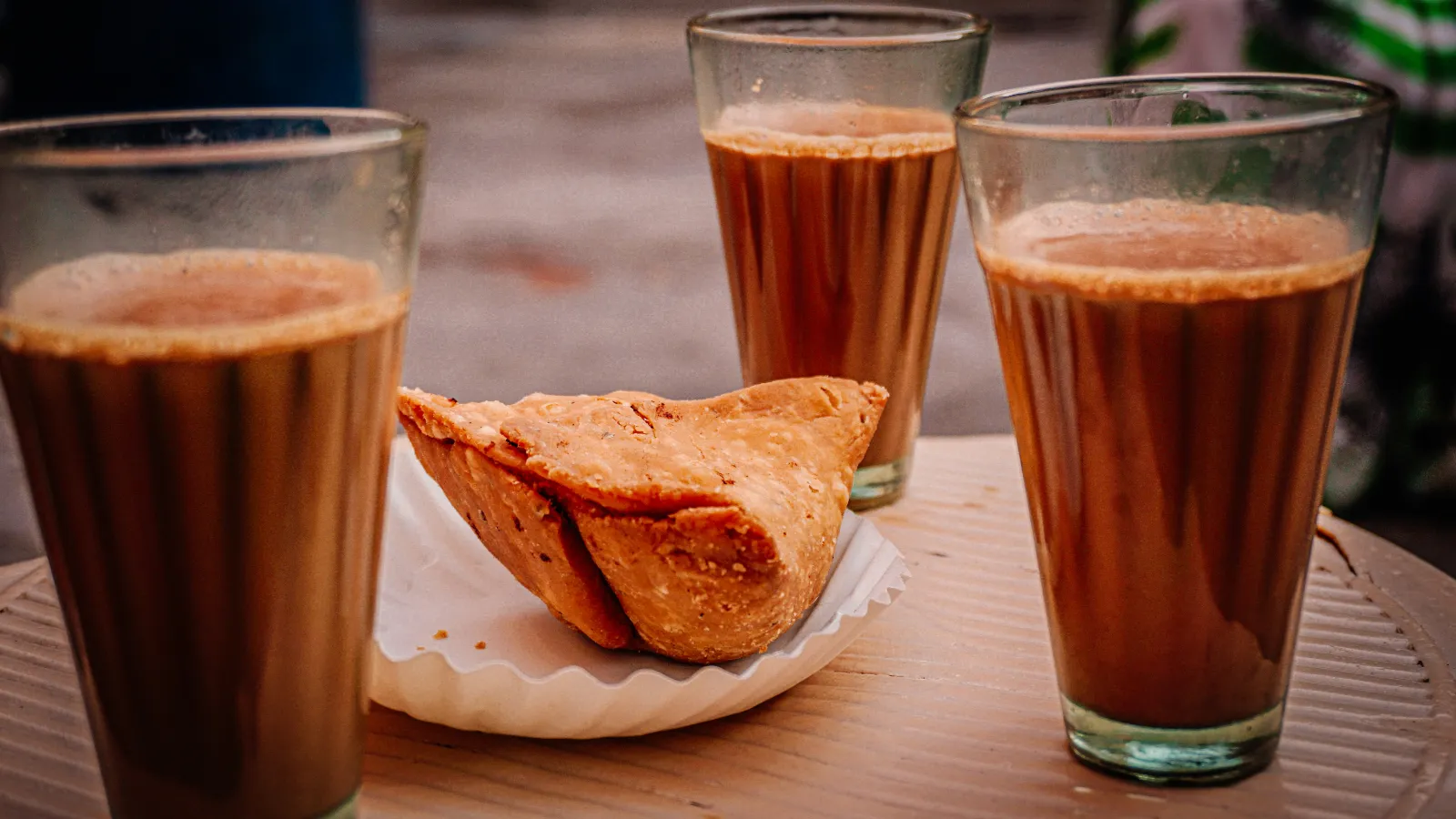
Three glasses of hot masala chai beside a samosa at a Jaipur tea stall

In Jaipur you should eat dal baati churma, pyaaz kachori, mawa kachori, ghewar and a tall glass of lassi, and finish with masala chai from a street stall. Jaipur is one of the easiest cities in India for vegetarians, which suits many Nepali, Indian and diaspora families, and a Rajasthani thali lets you try several dishes at once.

What to eat in Jaipur
DishWhat it isVegetarian?
Dal baati churmaBaked wheat balls (baati) with spiced lentils (dal) and a sweet crumbled wheat dessert (churma), served with gheeYes
Pyaaz kachoriFlaky fried pastry filled with spiced onion, a breakfast favouriteYes
Mawa kachoriFried pastry filled with sweetened milk solids and nuts, dipped in syrupYes
GhewarHoneycomb-textured sweet disc, traditionally eaten at the Teej festivalYes
Gatte ki sabziGram flour dumplings in a yoghurt curryYes
Ker sangriDesert beans and berries cooked with spicesYes
Laal maasFiery red mutton curry with chilliesNo
LassiThick sweet yoghurt drink, often served in clay cupsYes

For a one-stop taste, Rajasthan Tourism points to Masala Chowk, an open-air food court of 21 street-food stalls with an entry fee, best visited in the evening. Drink bottled or filtered water, choose busy stalls where food is cooked fresh in front of you, and go easy on chilli for the first day. Our guide to what to eat in India covers regional dishes beyond Rajasthan.

When is the best time to visit Jaipur?

The best time to visit Jaipur is October to March, when days are dry and warm and nights are cool. November to February is the most comfortable stretch for sightseeing on foot. April to June is very hot, with an average May high above 40 °C, and July and August bring most of the year's rain. These figures come from the India Meteorological Department's long-term normals for Jaipur.

Jaipur climate normals. Max and min temperature 1952 to 2009, rainfall 1969 to 2011. Source: India Meteorological Department, Meteorological Centre Jaipur; October and November mean temperature from WMO normals for Jaipur Sanganer via JMA Tokyo Climate Center. Checked: 13 Nov 2026
MonthAvg high (°C)Avg low (°C)Rainfall (mm)Sightseeing verdict
January22.57.85.5Excellent days, cold mornings and nights
February25.710.711.9Excellent
March31.516.24.2Good, warming up
April37.221.88.2Hot; sightsee early and late
May40.527.518.7Very hot; hardest month
June39.327.269Very hot, humid when the monsoon arrives
July34.225.7221Wettest month; green hills, fewer visitors
August32.324.5195Wet and humid
September33.723.071Rain easing, still warm
OctoberMean 27.0 (WMO)25.0Good; warm afternoons
NovemberMean 21.9 (WMO)3.9Excellent
December24.49.13.8Excellent days, cold nights

Source documents: IMD Jaipur climate summary and JMA Tokyo Climate Center, station 42348.

Tip for travellers from Nepal: Dashain and Tihar holidays usually fall between late September and November, which lines up well with the start of Jaipur's best weather. Tihar coincides with Diwali, when Jaipur's markets are decorated and lit, so the old city is especially lively, but hotels and trains also fill up. Book early if you plan to travel over the festival weeks or the December school holidays. For a month-by-month view of the whole country, see our guide to the best time to visit India.

Festivals worth timing a trip around, according to Rajasthan Tourism, include the kite festival around 14 January, Gangaur in March to April, and Teej in the monsoon, when a royal procession sets out from City Palace and ghewar is everywhere.

How do you get to Jaipur from Delhi or Agra?

From Delhi, the fastest way to Jaipur is a morning express train, which takes roughly 3.5 to 4.5 hours, or a drive on the Delhi Mumbai Expressway and its Jaipur link, which officials say takes about 3 to 3.5 hours. From Agra, express trains take roughly 4 hours, and a car lets you stop at Fatehpur Sikri and the Abhaneri stepwell on the way. Jaipur also has an international airport with domestic flights to major Indian cities.

Getting to Jaipur. Checked: 13 Nov 2026, RailYatri timetables, The Tribune (4 Jul 2025), FlightConnections, Rajasthan Tourism. Schedules change; confirm on the Indian Railways or airline site before booking
RouteModeDistanceTypical timeNotes
New Delhi to JaipurTrainAbout 293 km by rail3 h 37 min (fastest Vande Bharat) to 4 h 30 min (Ajmer Shatabdi); the AC Double Decker from Delhi Sarai Rohilla takes 4 h 35 min19 trains listed; book chair car early in peak season
Delhi to JaipurRoadVaries by route3 to 3.5 hours via the expressway link, about 4.5 hours by the older highwayThe Bandikui to Jaipur expressway link opened in July 2025
Agra to JaipurTrainAbout 240 kmAbout 3 h 50 min to 4 h 15 min on the fastest trainsNine daily trains listed from Agra Cantt
Agra to JaipurRoadRoughly 240 kmMost of a day with stopsFatehpur Sikri needs about 2 hours; Abhaneri is a short detour
Kathmandu to JaipurAirNot applicableNo direct flightConnect via Delhi, Kolkata or Mumbai; or fly to Delhi and continue by train
Gulf cities to JaipurAirNot applicableVariesRajasthan Tourism lists international flights to Dubai and Muscat, among others

Rail sources: New Delhi to Jaipur trains and Agra Cantt to Jaipur trains on RailYatri. Road: The Tribune, 4 Jul 2025. Air: FlightConnections states there are no direct flights between Jaipur and Kathmandu.

From Nepal, most travellers fly Kathmandu to Delhi, spend a night or two there, and then take a morning train to Jaipur; our guide to the Kathmandu to Delhi flight covers that first leg. Jaipur slots neatly into a Golden Triangle loop with Agra, where the Taj Mahal at sunrise is the reason to stay overnight. Within Jaipur, app cabs and auto rickshaws are the easiest way between clusters; agree the fare or use the meter before you set off.

Is Jaipur safe, and what should you know before you go?

Jaipur is generally safe for tourists who take ordinary city precautions. The main problems visitors report are touts, commission-driven shopping detours, gem "investment" scams and heavy traffic around Hawa Mahal and the bazaars, rather than violent crime. India's national emergency number is 112.

  • Touts and gem scams: ignore anyone who offers to help you profit by carrying gems abroad to resell; it is a well-known trick.
  • Heat: carry water, a hat and sunscreen even in winter; the forts have little shade.
  • Dress: cover shoulders and knees for temples; remove shoes where asked.
  • Monkeys: at Galta Ji and on the hill forts, keep food in your bag and do not feed them.
  • Money: India uses the Indian rupee (INR). Cards work in larger shops and hotels; carry small notes for autos, stalls and tips.
  • Elderly parents: use a jeep at Amber and Jaigarh, plan the walled city by car with short walks, and rest in the afternoon.

For a fuller picture, read our guide on whether India is safe for travellers.

How many days do you need in Jaipur?

Two full days is the right amount of time for most visitors to Jaipur: one for the hill forts north of the city and one for the walled city monuments and bazaars. A third day lets you add Galta Ji, a Jhalana safari, a block-printing visit to Sanganer, or simply slow down. One day is possible if you focus on Amber Fort, Hawa Mahal, City Palace and Jantar Mantar, but you will rush.

How to group Jaipur's sights by area
ClusterSightsBest time of day
Hill forts (north)Amber Fort, Jaigarh Fort, Jal Mahal on the way back, Nahargarh for sunsetStart at opening; end at Nahargarh in the late afternoon
Walled city (centre)City Palace, Jantar Mantar, Hawa Mahal, then the bazaarsMonuments in the morning, shopping from late afternoon
New city (south)Albert Hall Museum, Birla Mandir, Patrika Gate, Jawahar CircleAfternoon and evening, when the buildings are lit
EdgesGalta Ji (east), Jhalana safari (southeast)Early morning safari slot, late afternoon at Galta Ji

Entry documents: Nepali citizens do not need a visa for India; our guide on whether Nepalis need a passport for India explains which ID to carry. Travellers with other passports should read our India visa page and check the official site for their passport before booking.

Jaipur works well as part of a longer trip. Our complete India travel guide covers money, connectivity and planning across the country, and the Rajasthan guide linked at the top of this page shows how Jaipur connects to Udaipur, Jodhpur and Jaisalmer. If you would like to compare organised trips that include Jaipur, browse our India tour packages.

Frequently asked questions

Is one day enough for Jaipur?

One day in Jaipur is enough for the four headline sights, Amber Fort, Hawa Mahal, City Palace and Jantar Mantar, if you start at Amber at opening time. You will have little time for the bazaars, Nahargarh or the Albert Hall Museum, so two full days in Jaipur is far more comfortable.

Should you ride an elephant at Amber Fort?

We recommend walking or taking a jeep up to Amber Fort instead. A central government committee found eye and foot problems in many of the 98 ride elephants it inspected and recommended replacing rides with electric vehicles. The path from the lakeside is a steady climb that most fit visitors manage easily in the cool of the morning.

What time does Amber Fort open?

Rajasthan Tourism lists Amber Fort as open from 8:00 am to 5:30 pm, while Incredible India lists 9:00 am to 6:00 pm (checked 13 Nov 2026). Arrive at the Amber Fort gate by 8:00 am, confirm on the day, and check the evening light and sound show time separately.

Can you go inside Hawa Mahal?

Yes, you can go inside Hawa Mahal with a state department ticket, which is also included in the composite ticket. The entrance is on the City Palace side, not the famous street facade. Ramps lead to the upper floors, which give views over the old city of Jaipur.

What is Jaipur famous for shopping?

Jaipur is famous for gemstones and jewellery in Johari Bazaar, mojari shoes and block-printed textiles in Bapu Bazaar, lac bangles in Maniharon ka Rasta, blue pottery, and brassware in Tripolia Bazaar. Many Jaipur shops close on Sundays, so plan serious shopping for weekdays.

Is Jaipur safe for tourists?

Jaipur is generally safe for tourists who take normal city precautions. The common problems are touts, commission-driven shop visits, gem resale scams and heavy traffic around the old city. Use app cabs or agreed fares, keep valuables close, and call 112, India's emergency number, if needed.

Is Jaipur too hot in April?

Jaipur is hot in April, with an average high of about 37 °C according to India Meteorological Department normals, and May is hotter still at about 40.5 °C. You can still visit in April if you sightsee early and late, rest at midday and carry plenty of water.

Why is Jaipur called the Pink City?

Jaipur is called the Pink City because its old city buildings were painted pink in 1876 to welcome the Prince of Wales, and the terracotta pink colour has been kept ever since. The walled city, founded in 1727, became a UNESCO World Heritage Site in 2019.

What vegetarian food should you try in Jaipur?

In Jaipur, try dal baati churma, pyaaz kachori, mawa kachori, gatte ki sabzi, ker sangri, ghewar and a thick lassi. Jaipur is one of the easiest cities in India for vegetarians, and a Rajasthani thali lets you sample several dishes in one meal.

How far is Jaipur from Delhi?

Jaipur is about 293 km from New Delhi by rail. The fastest trains take about 3 hours 37 minutes to 4 hours 35 minutes, and the drive via the Delhi Mumbai Expressway and its Jaipur link takes about 3 to 3.5 hours, according to timetables and reports checked on 13 Nov 2026.

Is there a direct flight from Kathmandu to Jaipur?

No, there is no direct flight from Kathmandu to Jaipur as of 13 Nov 2026, according to FlightConnections. Travellers from Nepal usually connect through Delhi, or fly to Delhi and take an express train to Jaipur, which takes around four hours.
Tags
India
Share
G
Gomayu Team
Writer at Gomayu
Keep reading