













































































Short answer: From Nepal, most pilgrims reach Ayodhya by road through the Sonauli (Belahiya) or Rupaidiha (Nepalgunj) border, each roughly 175 to 190 km from the city, or by flying from Kathmandu to Delhi and on to Ayodhya's Maharishi Valmiki International Airport. The Ram Janmabhoomi Mandir is the reason most people go, and the other tourist places in Ayodhya, such as Hanuman Garhi, Kanak Bhawan, Ram ki Paidi and Guptar Ghat, are a short ride or walk from it. Darshan is free and runs in slots from 7:00 am to 8:30 pm according to the temple trust (checked 16 Nov 2026), and Indian Railways has approved a weekly Janakpur to Ayodhya train whose start date was not officially confirmed when we checked on 16 Nov 2026.
This guide is written in Kathmandu for Nepali pilgrims, especially families from Janakpur and the Tarai, for the Nepali diaspora visiting on a foreign passport, and for devotees from anywhere who want the Nepal side of the Ramayana story. It covers the routes from Nepal, how a Ram Mandir visit works on the ground, the places worth your time beyond the main temple, the Sita and Ram link between Janakpur and Ayodhya, and the festival dates that shape crowds. Temple rules, timetables and festival arrangements change often, so every volatile fact below carries the date we checked it and the source we used.
One small detail Nepali travellers often miss: India Standard Time is 15 minutes behind Nepal time. If your phone stays on Nepal time after you cross the border, you will arrive 15 minutes early for an aarti, which is better than arriving 15 minutes late, but it is worth switching.
Why is Ayodhya important for Nepali pilgrims?
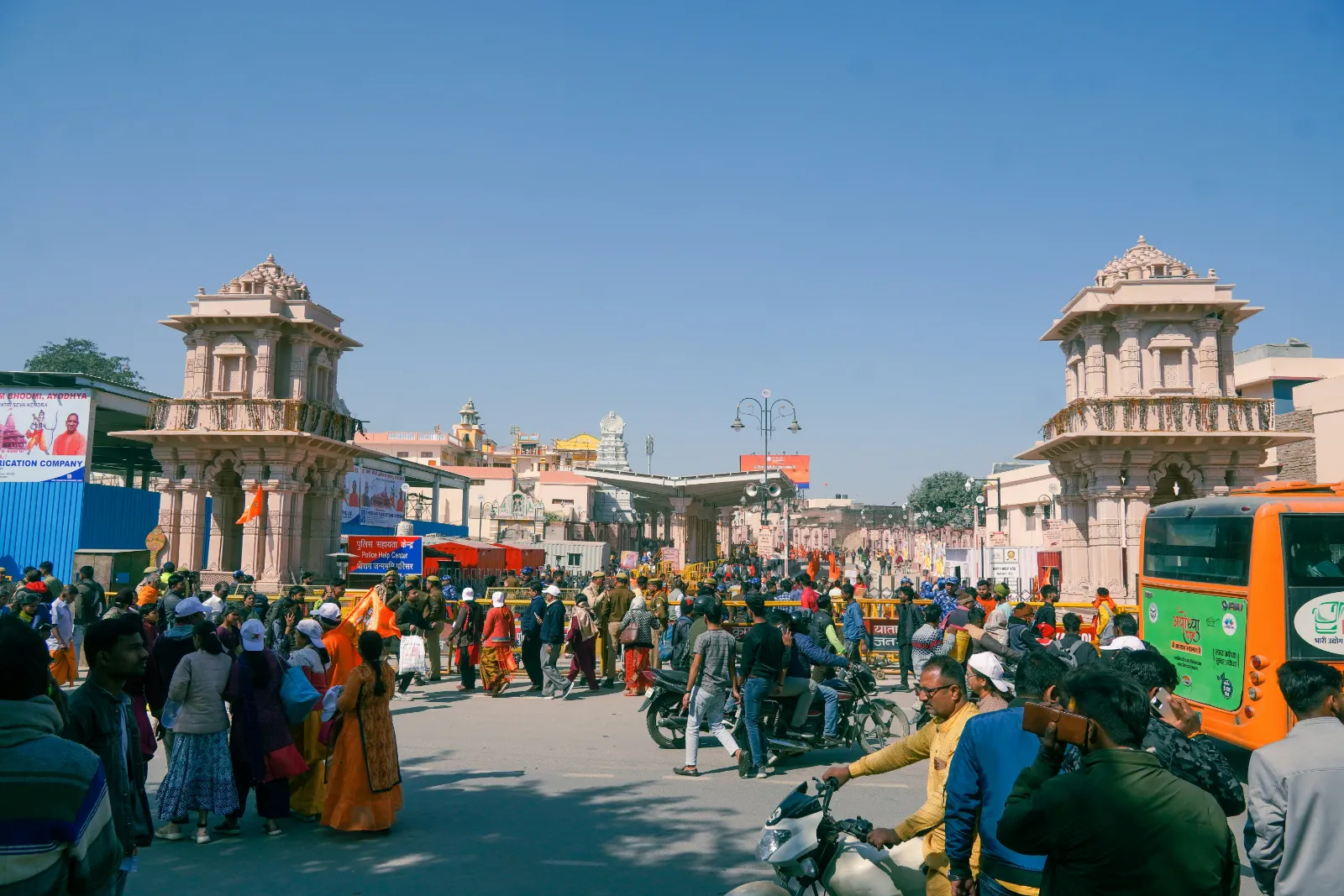
Ayodhya matters to Nepali Hindus because it is honoured as the birthplace of Lord Ram, and Nepal's Janakpur is honoured as the home of Sita, so for many families in Nepal Ayodhya is not a foreign shrine but Sita's marital home. That shared story makes an Ayodhya trip feel like the second half of a pilgrimage that begins at the Janaki Mandir.
The city sits on the south bank of the Saryu River in Uttar Pradesh, India. In the Ramayana it is the capital of the Kosala kingdom of King Dasharatha, the place Ram leaves for his exile and the place he returns to as king. For devotees in Mithila, on both sides of the border, Ram is often spoken of as the son-in-law of Janakpur, and the wedding of Ram and Sita is still re-enacted every year at Vivah Panchami.
Two recent events changed how many people visit. The consecration (Pran Pratishtha) of the new Ram Lalla idol took place on 22 January 2024, and the temple opened to the general public the next day, as Lokmat Times later recorded, and the flag-hoisting ceremony that marked the completion of the temple's construction took place on 25 November 2025, which was Vivah Panchami that year, according to All India Radio News. Nepali Times reported in February 2024 that the consecration was celebrated in Janakpur as well, which tells you how closely the two cities are tied in the minds of pilgrims.
This guide is planned around three kinds of traveller from Nepal: Tarai families taking elderly parents for darshan, often by road; Kathmandu and hill families who combine Ayodhya with Varanasi or Prayagraj; and diaspora Nepalis in the Gulf, Malaysia, the UK, the US and Australia who plan a pilgrimage during a home visit around Dashain and Tihar. If you are still deciding where to go abroad, our round-up of the most popular destinations for Nepalese travellers puts India in context with the other short-haul options.
Table note: key facts about Ayodhya for planning from Nepal. Sources: Shri Ram Janmabhoomi Teerth Kshetra Trust, Wikipedia station and airport pages, Kathmandu Post (15 Nov 2026). Checked: 16 Nov 2026.
| Item | What to know |
|---|---|
| Location | Ayodhya district, Uttar Pradesh, India, on the Saryu River |
| Main temple | Shri Ram Janmabhoomi Mandir, managed by the Shri Ram Janmabhoomi Teerth Kshetra Trust |
| Nearest Nepal border crossings | Sonauli (opposite Belahiya, Bhairahawa) and Rupaidiha (opposite Jamunaha, Nepalgunj) |
| Airport | Maharishi Valmiki International Airport, Ayodhya Dham (code AYJ), domestic flights only |
| Main railway stations | Ayodhya Dham Junction (AY), about 1.2 km from the temple, and Ayodhya Cantt (AYC), the former Faizabad Junction |
| Darshan cost | Free; the trust says it charges no fee for darshan and aarti passes |
| Currency | Indian rupee (INR); Nepal Rastra Bank keeps a fixed peg of NPR 1.60 to INR 1 |
| Time zone | India Standard Time, 15 minutes behind Nepal time |
How do you get from Nepal to Ayodhya?
There is no direct flight from Kathmandu to Ayodhya, so you either go overland through a border crossing in western or central Nepal, or fly to an Indian hub and connect. For most Nepali pilgrims the road through Sonauli or Rupaidiha is the simplest; for diaspora visitors short on time, flying via Delhi is usually easier.
Here is how the main options compare. Road distances below are approximate, taken from OpenStreetMap routing (OSRM) between the border town and central Ayodhya, and from the trust's own "How to reach" page for Indian cities. Driving times are not listed for most routes because border formalities, traffic and road works vary too much to give an honest single figure.
Table note: routes from Nepal to Ayodhya, no fares. Distances are approximate. Checked: 16 Nov 2026 (OSRM routing, srjbtkshetra.org, Kathmandu Post, Buddha Air, flightconnections.com).
| Route | Crossing or hub | Approx. distance to Ayodhya | What operates (as of check date) | Best for |
|---|---|---|---|---|
| Bhairahawa to Ayodhya by road | Belahiya and Sonauli border | About 185 km by road via Basti; about 230 km if you go through Gorakhpur city | Taxis and private cars; buses usually involve a change at Gorakhpur | Kathmandu, Pokhara, Butwal and Lumbini side travellers |
| Nepalgunj to Ayodhya by road | Jamunaha and Rupaidiha border | About 175 km by road, via Bahraich and Gonda | Taxis and private cars | Banke, Bardiya and far west families |
| Birgunj to Ayodhya by road | Birgunj and Raxaul border | About 335 km by road | Long road journey; rail from Raxaul is an option | Central Tarai and Kathmandu travellers who prefer Birgunj |
| Janakpur to Ayodhya by rail | Janakpur Dham to Ayodhya Cantt via Jaynagar | About 604 km by rail (Kathmandu Post) | Weekly train approved by Indian Railways; start date and timings not confirmed | Janakpur and Madhesh pilgrims |
| Janakpur to Ayodhya by road | Jaleshwar, Bhitthamore or other Bihar crossings | About 445 km by road | No confirmed direct bus service | Groups with a hired vehicle |
| Kathmandu to Delhi to Ayodhya by air | Delhi airport | Not applicable | Air India, IndiGo and Nepal Airlines fly Kathmandu to Delhi; IndiGo and Akasa Air fly Delhi to Ayodhya | Diaspora visitors, elderly travellers who cannot do long road days |
| Kathmandu to Varanasi by air, then road or rail | Varanasi airport | About 200 km from Varanasi by road (trust figure) | Buddha Air lists 3 Kathmandu to Varanasi flights a week | Pilgrims combining Kashi and Ayodhya |
By road through Sonauli or Rupaidiha
The Sonauli route is the classic one. From Kathmandu or Pokhara you reach Bhairahawa by road or by a domestic flight, cross at Belahiya into Sonauli, and continue to Ayodhya either via Basti, the shorter road, or through Gorakhpur, the usual bus route. Rome2rio lists the drive from Sunauli to Ayodhya at about 176 km and just under three hours, and the bus option as two buses with a change at Gorakhpur, taking about seven and a half hours in total. Treat both as rough guides: border queues, festival traffic and fog on winter mornings can add hours.
The Rupaidiha route suits families from the mid and far west. From Nepalgunj you cross at Jamunaha into Rupaidiha and drive through Bahraich and Gonda towards Ayodhya. OpenStreetMap routing puts the distance at about 175 km, slightly shorter than the Sonauli route.
If you are bringing a Nepali-registered vehicle across, the border paperwork for the vehicle is a separate process handled at customs, so ask at the border office before you set off. For the wider picture on trains, buses and taxis once you are inside India, our guide on getting around India by train, bus and car covers bookings and etiquette.
By rail via Gorakhpur or Lucknow
Ayodhya sits on the Lucknow to Ayodhya to Varanasi rail line, and some trains between Lucknow and Gorakhpur, including a Vande Bharat service, run via Ayodhya Dham Junction. That makes Gorakhpur, about 140 km from Ayodhya by road according to the trust, the natural rail gateway from the Sonauli side, and Lucknow, about 130 km away, the gateway from the west. Vande Bharat trains connecting Ayodhya Dham with Gorakhpur, Lucknow and Delhi are listed on the station's Wikipedia page; check the current timetable on Indian Railways' NTES or IRCTC before you plan around a specific train.
Ayodhya airport: Maharishi Valmiki International Airport
Ayodhya's airport is Maharishi Valmiki International Airport, Ayodhya Dham (code AYJ). It was inaugurated on 30 December 2023 and commercial flights began on 10 January 2024. Despite the word "international" in its name, it handles domestic flights only. As of November 2026, flightconnections.com lists direct flights to New Delhi, Bengaluru, Navi Mumbai, Hyderabad and Ahmedabad, with IndiGo on all five routes and Akasa Air on the Delhi route. For a traveller from Nepal this means one connection, usually in Delhi.
Railway stations: Ayodhya Dham Junction and Ayodhya Cantt
The city has two main stations. Ayodhya Dham Junction (code AY) was renamed from Ayodhya Junction in December 2023, and its redeveloped first phase was opened on 30 December 2023; it is about 1.2 km from the Ram Mandir. Ayodhya Cantt (code AYC) is the former Faizabad Junction, renamed in November 2021. The new Janakpur train is reported to run between Janakpur Dham and Ayodhya Cantt with a stop at Ayodhya Dham, so know which station your ticket names.
ID and entry rules
Nepali citizens do not need a visa for India; our guide on whether Nepalis need a passport for India explains which ID works by road and by air. Diaspora Nepalis on a foreign passport, and every other nationality, should check the Indian visa rules for your passport well before travel.
How do you visit the Ram Mandir?
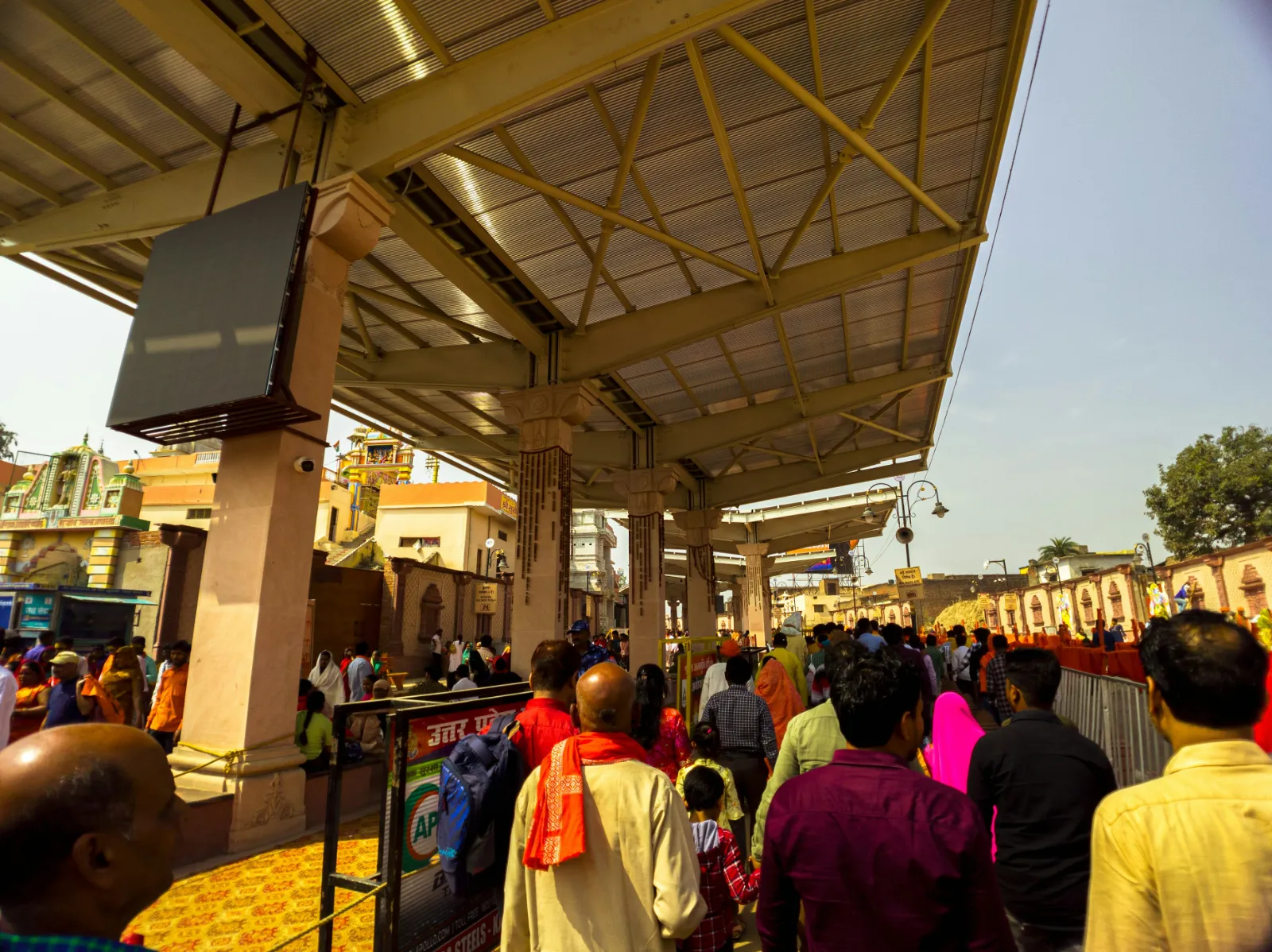
You visit the Ram Mandir by joining the free general darshan queue during the trust's darshan hours, after leaving your phone, footwear and bags outside the temple premises. Free passes for darshan and aarti can be reserved on the trust's official booking site, but no paid or VIP darshan exists, and the trust has warned that anyone selling one may be running a scam.
Dated rule box. Checked: 16 Nov 2026, Shri Ram Janmabhoomi Teerth Kshetra Trust (srjbtkshetra.org) and the dated news reports named in the table. The trust's homepage says its listed timings "will be reflected from 1 November, 2026 in the Booking receipt", and that the "Trust does not charge any fee for aarti & darshan passes." Rules on phones, bags and wheelchairs are not published on the trust website, so the second table below relies on the trust's own public guidance as reported by the press, with dates. Always confirm with the trust's devotee helpdesk before you travel.
Table note: Ram Mandir darshan slots and aarti times as listed by the trust. Checked: 16 Nov 2026, srjbtkshetra.org homepage.
| Type | Time (India Standard Time) | Pass |
|---|---|---|
| Darshan slot 1 | 7:00 am to 9:00 am | Free |
| Darshan slot 2 | 9:00 am to 11:00 am | Free |
| Darshan slot 3 | 11:00 am to 12:00 pm | Free |
| Midday | No slot listed between 12:00 pm and 1:30 pm | Not applicable |
| Darshan slot 4 | 1:30 pm to 3:00 pm | Free |
| Darshan slot 5 | 3:00 pm to 5:00 pm | Free |
| Darshan slot 6 | 5:00 pm to 7:00 pm | Free |
| Darshan slot 7 | 7:00 pm to 8:30 pm | Free |
| Mangal Aarti | 4:30 am | Free pass |
| Shringar Aarti | 6:30 am | Free pass |
| Shayan Aarti | 9:30 pm | Free pass |
Table note: visitor rules and facilities, with source and date. Rules can change during festivals. Checked: 16 Nov 2026.
| Topic | What the source says | Source and date |
|---|---|---|
| Phones, footwear, bags | Devotees are asked to leave mobile phones, footwear, purses and other belongings outside the temple premises | Trust guidance on its X account, reported by Lokmat Times, 13 Mar 2024 |
| Electronic devices | Phones and electronic keys are banned on the premises; locker and cloakroom facilities are available | Trust member Anil Mishra, quoted by Outlook Traveller, 28 May 2024 |
| Time for darshan | "Typically, devotees can have a smooth Darshan of Prabhu Shri Ram Lalla Sarkar within 60 to 75 minutes." | Trust guidance, reported by Lokmat Times, 13 Mar 2024 |
| Wheelchairs | Wheelchairs are available in the Mandir for the elderly and differently abled, for use inside the premises | Trust guidance, reported by Lokmat Times, 13 Mar 2024 |
| Devotees aged 70 and over | No prior approval needed for a Sugam Darshan pass; the report says it is issued on showing an Aadhaar card | Amar Ujala, 6 Aug 2026 |
| Ram Darbar | The separate Ram Darbar pass has ended; devotees reach the first-floor Ram Darbar after the general Ram Lalla darshan | Amar Ujala, 6 Aug 2026 |
| VIP or paid darshan | No paid or special-pass darshan; offers of one may be a scam | Trust guidance, reported by Lokmat Times, 13 Mar 2024 |
| Passes | Free passes are reserved online through the trust's booking site | srjbtkshetra.org, checked 16 Nov 2026 |
| Helpdesk | 05278-292000 and +91-80095-22111, devotee helpdesk 10 am to 9 pm; toll free 1860-180-1992 | srjbtkshetra.org, checked 16 Nov 2026 |
A note for Nepali and foreign pilgrims on the 70-plus rule: Aadhaar is an Indian resident ID that most Nepali citizens and foreign visitors do not hold. The report does not say what older visitors without Aadhaar should show, so call the helpdesk before you travel and ask what document they accept for a senior pilgrim from Nepal. Carry the same ID you used to enter India.
How a visit usually flows
Most visits follow the same pattern. Plan your day around it and you will spend less time standing in the sun.
- Reserve if you can. Free darshan and aarti passes are reserved on the trust's official booking site, online.srjbtkshetra.org. Follow the instructions printed on the pass; the trust says this avoids problems at entry.
- Leave things behind. Ideally keep phones, bags and leather items at your hotel. If you cannot, use the lockers and cloakroom near the entry, and keep your locker token safe.
- Walk the approach. Most devotees approach along Janmabhoomi Path, where long covered walkways shade the queue, then pass a security check.
- Darshan of Ram Lalla. The general queue leads to the sanctum on the ground floor. Expect a brief moment in front of the idol rather than a long stop, especially on busy days.
- Ram Darbar. According to the August 2026 report, the first-floor Ram Darbar now follows directly after the general queue, without a separate pass.
- Prasad and exit. Collect prasad where it is offered, then exit and pick up your belongings.
Weekends, Indian public holidays and festival days bring the heaviest crowds. On those days, the earliest slots and the late evening slots tend to be the calmest, though nothing is guaranteed. If you are travelling with a parent who struggles to stand for long, ask the helpdesk about wheelchair access before you join the queue rather than after.
Which other tourist places in Ayodhya should you see?
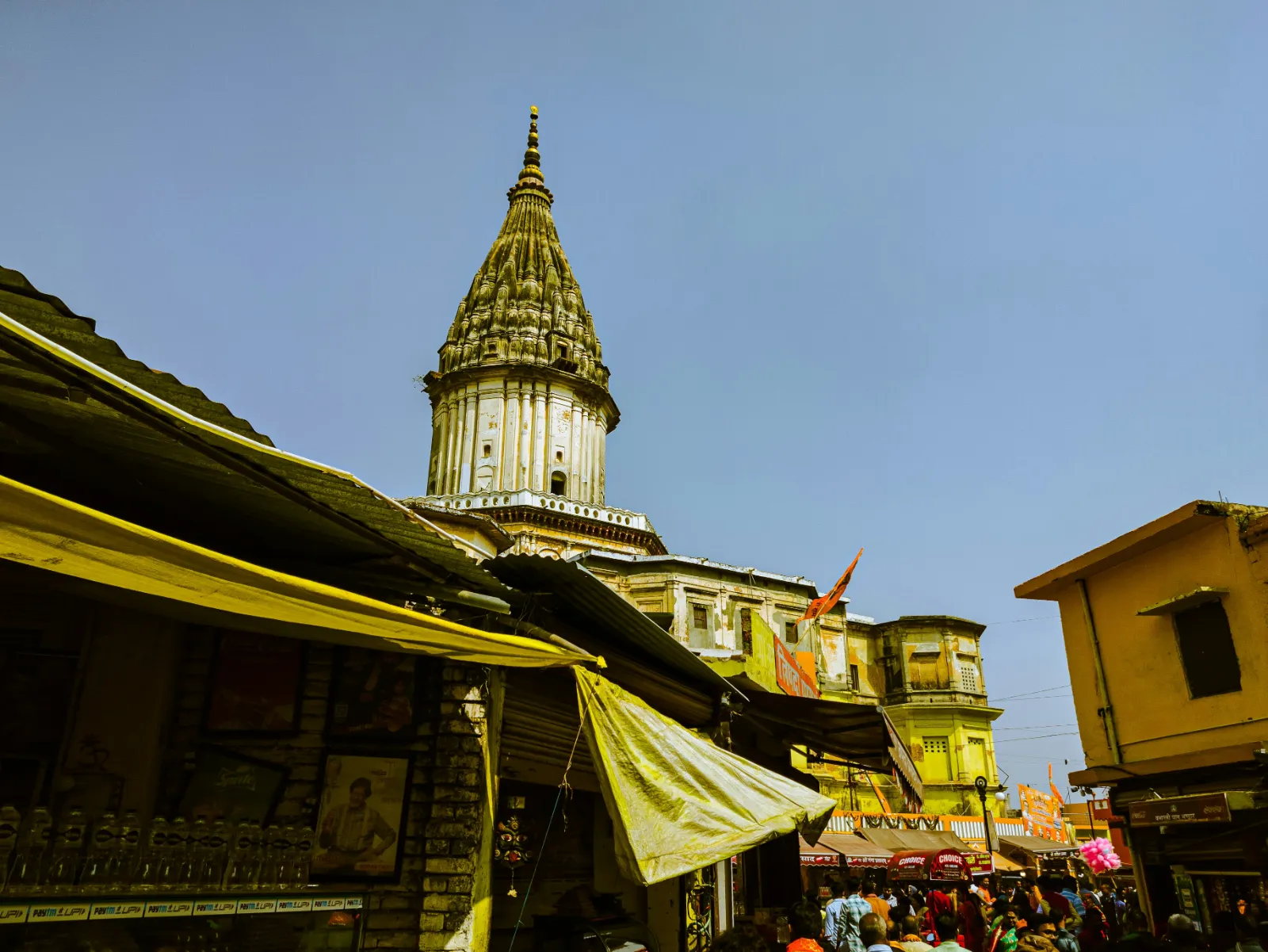
Beyond the Ram Mandir, the tourist places in Ayodhya most pilgrims visit are Hanuman Garhi, Kanak Bhawan, Nageshwarnath Temple, the Saryu ghats at Ram ki Paidi and Naya Ghat, and Guptar Ghat; Bharat Kund at Nandigram is a short drive south. Most of the city sites are within a few kilometres of each other, so they fit easily around a darshan slot.
Many families follow a long-held custom of visiting Hanuman Garhi before the Ram Mandir, since Hanuman is regarded as the guardian of Ayodhya. The trust's own "Places to see" page tells the story that Ram asked Hanuman to remain in Ayodhya to protect its devotees, and that he has been seated there ever since.
Table note: key places to see in Ayodhya, with descriptions drawn from the trust's "Places to see" page and India's official tourism site, Incredible India. Checked: 16 Nov 2026.
| Place | What it is | Why pilgrims go |
|---|---|---|
| Hanuman Garhi | Hilltop Hanuman temple reached by steps from a busy bazaar lane | Traditionally visited before Ram Lalla; Incredible India notes a statue of the young Hanuman in his mother's embrace |
| Kanak Bhawan | Temple of Sita and Ram close to the Janmabhoomi area | Believed to be Sita's palace; the trust says it was King Janak's wedding gift, Incredible India says it was a gift from Queen Kaikeyi |
| Nageshwarnath Temple | Shiva temple at Ram ki Paidi | Believed to have been founded by Kush, Ram's son; the current structure dates to 1750 according to Incredible India; busy at Mahashivaratri |
| Ram ki Paidi | Series of ghats on the Saryu | Bathing in the Saryu and evening views when the ghats are lit; the main stage for Deepotsav |
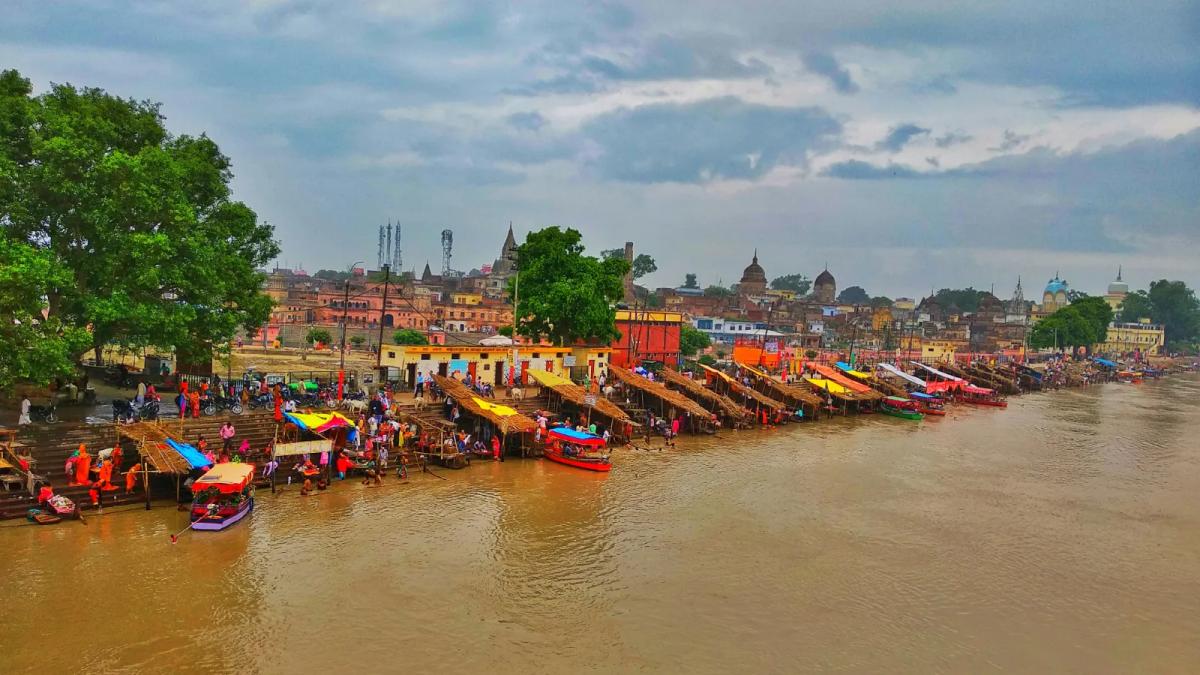
| Naya Ghat and the Saryu riverfront | Riverside steps lined with boats and small shrines | Holy dip, boat rides and evening prayers by the river |
| Guptar Ghat (Guptahari) | Ghat on the Saryu to the west of the city | The trust records the tradition that Ayodhya's people entered the Saryu here at Ram's command |
| Sita Kup | Sacred well to the southeast of the Janmasthan, according to the trust | Listed by the trust as a tirth linked to Sita |
| Bharat Kund, Nandigram | Tank and temples about 18 km south of Ayodhya (trust figure) | Where Bharat is said to have kept Ram's sandals and waited 14 years for his return |
| Mani Parvat and Vashishtha Kund | A mound and a sacred tank in the old city | Linked by the trust to Sita (Mani Parvat) and to the sage Vashishtha, Ram's teacher |
| Gulab Bari | Garden tomb of Nawab Shuja-ud-Daula | A garden tomb from the Nawabs of Awadh, a reminder of the area's wider history |
Hanuman Garhi and Kanak Bhawan
These two sit close to each other and close to the main temple, so most people see them on the same walk. Hanuman Garhi is reached by steps from a busy lane of prasad and flower shops, so elderly visitors should take it slowly. Kanak Bhawan, a short walk away, is dedicated to Sita and Ram together. Sources disagree on who gave the palace to Sita, King Janak or Queen Kaikeyi, which is a nice detail for Janakpur visitors, since the trust's version makes Kanak Bhawan a gift from Sita's own family in Mithila.
Ram ki Paidi and the Saryu ghats
Ram ki Paidi is a series of ghats beside the Saryu and the stage for Ayodhya's biggest riverside events, including Deepotsav. Pilgrims bathe here, and in the evening the ghats are lit. Nageshwarnath Temple stands at the same spot. A little further along, Naya Ghat is where you find the boats and the riverfront shrines. If you are travelling in winter, the river can be cold in the early morning, so older pilgrims may prefer a symbolic sprinkling of water to a full dip.
Guptar Ghat and Bharat Kund
Guptar Ghat lies to the west of the old city, away from the main temple cluster, so it needs a short ride and is usually visited separately. Bharat Kund at Nandigram, about 18 km south of Ayodhya according to the trust, is where tradition places Bharat's long wait for Ram's return. It needs a vehicle, so plan it as a separate short trip rather than on foot.
If Ayodhya is your first India trip and you want to see where it sits among the country's other holy cities and classic sights, our guide to the best places to visit in India covers the spiritual heartland alongside the Golden Triangle, Rajasthan and Kerala.
What is the Janakpur-Ayodhya connection?
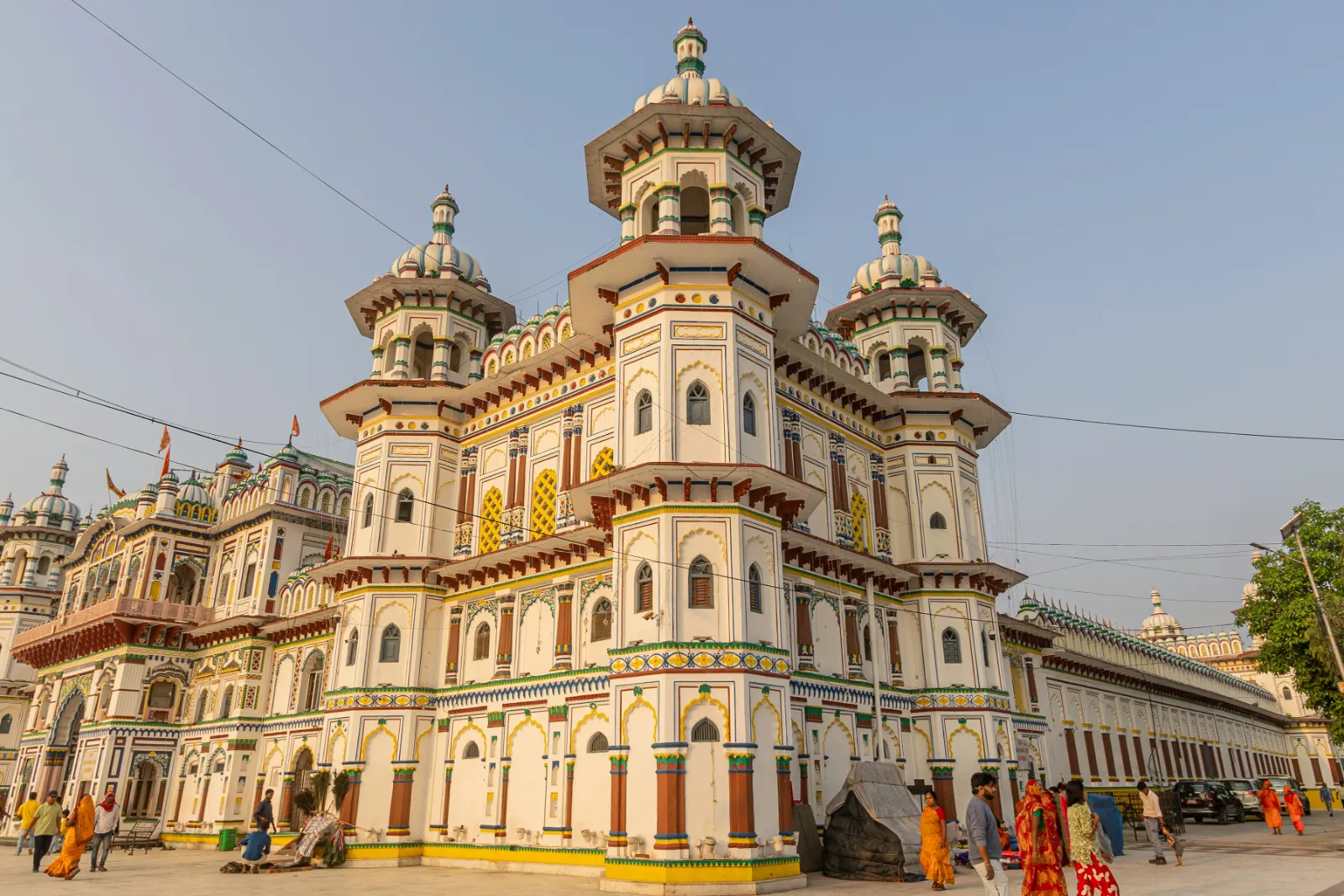
The Janakpur-Ayodhya connection is the marriage of Sita and Ram: Janakpur, in Nepal's Madhesh Province, is honoured as the city of King Janak and the birthplace of Sita, and Ayodhya as Ram's birthplace, so the two cities are linked as the bride's home and the groom's home. The link is kept alive every year when a symbolic wedding party travels from Ayodhya to Janakpur for Vivah Panchami.
Janakpur was the capital of the Mithila kingdom in the Ramayana. Its Janaki Mandir, the white, many-domed temple dedicated to Sita, was built in 1910 by Queen Vrishabhanu of Orchha (Tikamgarh) in central India, according to Wikipedia and Nepali Times. It was placed on UNESCO's tentative World Heritage list in 2008. The Vivah Mandap in the temple complex marks the place traditionally linked to the wedding. So the Janaki Mandir, a Nepali landmark, was itself built by an Indian queen, which is a neat symbol of how much the two sides of the border share.
Every year at Vivah Panchami, a Ram Barat (wedding procession) travels from Ayodhya to Janakpur. The Federal noted in December 2025 that, in Valmiki's account, the original wedding party took four days to travel from Ayodhya to Janakpur, halting three nights on the way, and returned in another four days; that old route, the Ram Janaki Path of nearly 500 km, is now being revived as a pilgrimage trail. In Janakpur, the Tribune's report on Vivah Panchami 2025 described two palanquin processions carrying idols of Ram and Sita from the Ram Temple and the Janaki Temple, meeting at the Barha Bigha ground for the swayambar ritual, before wedding rituals continued through the night at the Janaki Temple.
Table note: Janakpur and Ayodhya side by side. Sources: Wikipedia (Janaki Mandir), Nepali Times (3 Feb 2024), srjbtkshetra.org. Checked: 16 Nov 2026.
| Point | Janakpur (Nepal) | Ayodhya (India) |
|---|---|---|
| Role in the Ramayana | City of King Janak, home of Sita | City of King Dasharatha, birthplace of Ram |
| Main temple | Janaki Mandir (built 1910) | Shri Ram Janmabhoomi Mandir (consecrated 22 Jan 2024) |
| Wedding link | Vivah Mandap; Vivah Panchami celebrations | Starting point of the Ram Barat; Kanak Bhawan as Sita's palace |
| River | Ponds (sagar) such as Dhanush Sagar and Ganga Sagar in the city | Saryu River |
| Rail | Janakpur Dham station on the Jaynagar to Bijalpura line, which runs regular passenger trains into Bihar | Ayodhya Dham Junction and Ayodhya Cantt |
| Air | Domestic flights to Kathmandu | Domestic flights to Indian cities |
Is there a direct Janakpur to Ayodhya bus or train?
As of 16 November 2026 there is no confirmed regular direct bus between Janakpur and Ayodhya, and a direct weekly train has been approved but its start date and timings are not yet confirmed. A Janakpur to Ayodhya bus was flagged off by the two countries' prime ministers in May 2018 under the Ramayana Circuit, and ETV Bharat reported on 14 November 2026 that an earlier bus service between the two cities "could not succeed due to unavoidable reasons."
On rail, the Kathmandu Post reported on 15 November 2026, citing India's Press Information Bureau, that Indian Railways has approved a weekly service between Janakpur Dham and Ayodhya Cantt, about 604 km, leaving Janakpur Dham on Saturdays and Ayodhya Cantt on Mondays, with stops at Jaynagar, Madhubani, Shisho, Sitamarhi, Raxaul, Narkatiaganj, Gorakhpur, Basti, Mankapur and Ayodhya Dham. The same report says the start date, timings and fares have not been announced. ETV Bharat, a day earlier, reported a first run from 23 November with a virtual flag-off by the two prime ministers and gave the route as 464 km, so the reports do not yet agree on the start date or the distance. Treat 23 November as reported, not confirmed, until Indian Railways publishes a timetable. Earlier, on 30 October 2026, Nepal Railway Company's managing director Paribesh Parajuli told Peoples' Review: "We are preparing to inaugurate the special train service during Prime Minister Shah's visit to India."
Until a timetable is published, the practical route from Janakpur is still by road, or by the Jaynagar train into Bihar and onward Indian trains. Read the Kathmandu Post report and check IRCTC for the train once bookings open.
When is the best time to visit, including Vivah Panchami and Ram Navami?
The most comfortable time to visit Ayodhya is from October to March, when days are mild, though December and January mornings can be cold and foggy in the Gangetic plain. The biggest crowds come at Ram Navami (spring), Deepotsav (around Diwali) and Vivah Panchami (late November or December), so go then for the atmosphere, or avoid those dates for an easier darshan.
Table note: main festivals for Ayodhya and Janakpur pilgrims. Dates from Drik Panchang (New Delhi), Vedic Marga for the Bikram Sambat date, and ANI. Festival dates in Nepal can differ by a day from Indian panchang dates. Checked: 16 Nov 2026.
| Festival | What it marks | Next date | What to expect |
|---|---|---|---|
| Vivah Panchami | Wedding of Ram and Sita, Margashirsha Shukla Panchami | Monday 14 December 2026 (Mangsir 28, 2083 BS); Panchami tithi from 4:47 pm on 13 Dec to 7:15 pm on 14 Dec, New Delhi time | Biggest day in Janakpur; Ram Barat travels from Ayodhya; also observed in Ayodhya |
| Ram Navami | Birth of Ram, Chaitra Shukla Navami | Thursday 15 April 2027 (India) | Very heavy crowds at the Ram Mandir; special arrangements announced close to the date |
| Deepotsav | Lighting of lamps on the Saryu ghats on Diwali eve | The 10th edition was held on 7 November 2026; the 2027 date is not yet announced | Lakhs of diyas on the ghats, a light and sound show, very heavy crowds and traffic controls |
| Dashain and Tihar holidays | Nepal's main holiday window | Autumn each year | Popular with Nepali families and diaspora; book transport early |
Vivah Panchami 2026
Vivah Panchami 2026 falls on Monday 14 December 2026 according to Drik Panchang, which gives the Panchami tithi from 4:47 pm on 13 December to 7:15 pm on 14 December (New Delhi time). In the Nepali calendar this is Mangsir 28, 2083 BS. Janakpur's celebrations run for about a week around the main day, so if you want to combine Janakpur and Ayodhya around the festival, start planning early, since both cities draw large festival crowds and road diversions are common. Vivah Panchami is not on Nepal's national public holiday list published by the Ministry of Home Affairs for 2083 BS, so check local notices if you need a day off in Madhesh.
Ram Navami and Deepotsav
Ram Navami 2027 falls on Thursday 15 April 2027 in India. It is one of the busiest days at the Ram Mandir, and special darshan arrangements are usually announced close to the date, so check the trust's website in the week before you travel. Expect hot weather by mid-April.
Deepotsav is Ayodhya's lamp festival on the eve of Diwali. ANI reported that the 10th edition on 7 November 2026 set out to light more than 30 lakh diyas across 56 ghats on the Saryu. If you want to see it, plan to arrive a day or two early and expect road closures in the old city. The next edition will fall around Diwali 2027; the date has not been announced.
Month by month
Table note: general conditions by season in Ayodhya. These are broad patterns for the north Indian plains, not forecasts. Check a weather forecast a week before you travel.
| Season | Months | Conditions | Pilgrim notes |
|---|---|---|---|
| Post-monsoon and autumn | October to November | Warm days, cooler evenings | Overlaps Dashain, Tihar and Deepotsav; busy |
| Winter | December to February | Cold mornings and nights, frequent fog | Vivah Panchami; fog can delay trains and flights |
| Spring | March to April | Warming quickly | Ram Navami crowds |
| Summer | May to June | Very hot | Visit early morning or late evening slots |
| Monsoon | July to September | Humid with heavy rain at times | Fewer crowds; the Saryu runs high |
Can you combine Ayodhya with Varanasi?
Yes. Varanasi and Ayodhya are about 200 km apart by road according to the temple trust, and the two cities are joined by the Lucknow to Ayodhya to Varanasi rail line, so many pilgrims from Nepal visit both on one trip. Buddha Air's flights from Kathmandu to Varanasi make it possible to fly into Kashi and return to Nepal overland through Gorakhpur and Sonauli, or the other way round.
Varanasi is the natural partner for Ayodhya: one city is the seat of Shiva as Kashi Vishwanath, the other the seat of Ram. Our guide to things to do in Varanasi covers the ghats, the evening Ganga Aarti and Sarnath, and the separate guide to Kashi Vishwanath Temple darshan explains the queue, lockers and aarti tickets there. Prayagraj, about 160 km from Ayodhya according to the trust, is a third option for pilgrims who want the Sangam as well.
Table note: ways to combine Ayodhya with Varanasi from Nepal. No fares. Distances from srjbtkshetra.org and OSRM routing. Checked: 16 Nov 2026.
| Direction | Enter India | Link between the cities | Return to Nepal | Suits |
|---|---|---|---|---|
| Kashi first | Fly Kathmandu to Varanasi (Buddha Air, 3 flights a week) | Road or rail, about 200 km | Ayodhya to Gorakhpur to Sonauli by road | Kathmandu families who want one flight and one road leg |
| Ayodhya first | Sonauli or Rupaidiha by road | Road or rail, about 200 km | Fly Varanasi to Kathmandu | Tarai families and anyone who wants to finish at Kashi |
| Both by road | Sonauli | Road or rail | Sonauli or Raxaul | Groups with a hired vehicle |
| Diaspora via Delhi | Fly to Delhi | Fly Delhi to Ayodhya, then rail or road to Varanasi | Fly Varanasi to Kathmandu | Overseas visitors who start in Delhi |
A combined Varanasi and Ayodhya trip is a plains pilgrimage that works in most months, while the Himalayan Char Dham Yatra in Uttarakhand runs only from late April or May to around Diwali and involves high-altitude travel. Some Nepali families do Ayodhya and Varanasi in winter and save Char Dham for the following summer.
What should pilgrims carry and wear?
Carry valid ID, Indian rupees in cash plus a working payment app or card, and as little else as possible, because phones and bags cannot go into the Ram Mandir. Wear modest, comfortable clothes and footwear you can slip off easily, and add a warm shawl for winter mornings.
Table note: packing list for an Ayodhya pilgrimage from Nepal. Based on the trust's guidance on belongings; adapt it to your own needs.
| Item | Why |
|---|---|
| Valid ID (and a photocopy) | Needed for hotels, trains, flights and possibly the temple pass; keep the original safe |
| Indian rupees in small notes | For rickshaws, prasad, flowers, lockers and food stalls |
| Payment app or card that works in India | Many shops display QR payment codes; check before you go whether your Nepali card or wallet works in India |
| Small cloth bag | Easier to store in a locker than a backpack |
| Slip-on footwear and socks | Shoes come off before the temple; stone floors are cold in winter and hot in summer |
| Shawl or light jacket | For early aarti and December to February mornings |
| Water bottle, cap, sunscreen | Queues can be long and partly in the sun |
| Personal medicines and prescriptions | Especially for elderly pilgrims with blood pressure or diabetes |
| Printed or saved temple pass | If you reserved a free pass, the trust asks you to follow the instructions on it |
What to wear
There is no published dress code on the trust's website, but modest, traditional or simple clothes are the norm at the Ram Mandir and the other temples: shoulders and knees covered, nothing with offensive slogans. Many Nepali women travel in a sari or kurta, and many men in kurta or simple shirts and trousers. Leather belts and wallets are best left at the hotel, since you will be leaving belongings outside anyway.
Money, food and staying well
India uses the Indian rupee. The Nepali rupee is pegged at NPR 1.60 to INR 1, a peg Nepal Rastra Bank kept in its July 2026 monetary policy, but there are rules on how much Indian currency you can carry from Nepal and in which notes, so read our guide to the foreign currency limit from Nepal before you exchange. Food around the temples is overwhelmingly vegetarian, and many pilgrims eat sattvik meals while in the city; simple north Indian vegetarian thalis are easy to find near the temples. For the long road days, carry snacks, take breaks, and keep elderly travellers well hydrated, particularly from April onwards. If you are taking parents, read our guide to travel insurance from Nepal before you go, since medical help in a crowded festival city is easier to arrange when you are covered.
Planning the trip as a whole
The simplest plans are often the best: a road crossing at Sonauli or Rupaidiha, a night or two in Ayodhya so you are not rushing darshan, and Varanasi or Janakpur added if you have time. Elderly parents do better with a private vehicle and a hotel close to the temple, and diaspora visitors with fixed leave do better flying via Delhi. For the full country picture, from documents and money to regions and transport, start with our India travel guide for first-time and repeat visitors. When you are ready to compare organised options, you can browse our India tour packages.
Sources checked on 16 Nov 2026 for this guide: Shri Ram Janmabhoomi Teerth Kshetra Trust website (homepage, How to reach, Places to see), Kathmandu Post (15 Nov 2026), Radio Nepal (15 Nov 2026), ETV Bharat (14 Nov 2026), Peoples' Review (30 Oct 2026), Amar Ujala (6 Aug 2026), ANI (7 Nov 2026), Drik Panchang, Incredible India, Buddha Air, flightconnections.com, OpenStreetMap routing (OSRM), The Federal (21 Dec 2025), The Tribune (25 Nov 2025), Nepali Times (3 Feb 2024), Lokmat Times (13 Mar 2024) and Outlook Traveller (28 May 2024).
Frequently asked questions
How far is Ayodhya from the Nepal border?
Ayodhya is roughly 175 to 190 km by road from the two nearest Nepal border crossings: about 185 km from Sonauli (opposite Belahiya, Bhairahawa) via Basti and about 175 km from Rupaidiha (opposite Jamunaha, Nepalgunj), based on OpenStreetMap routing. Rome2rio lists the Sunauli drive at just under three hours, but border queues and traffic often add time.
Is there a bus from Janakpur to Ayodhya?
As of 16 Nov 2026 there is no confirmed regular direct bus. A Janakpur to Ayodhya bus launched in May 2018 under the Ramayana Circuit, and ETV Bharat reported on 14 Nov 2026 that an earlier bus service between the two cities did not succeed. Most Janakpur pilgrims go by hired vehicle or by rail via Bihar.
Is there a train from Janakpur to Ayodhya?
Indian Railways has approved a weekly Janakpur Dham to Ayodhya Cantt train, about 604 km, leaving Janakpur on Saturdays and Ayodhya on Mondays, according to the Kathmandu Post (15 Nov 2026). Start date, timings and fares were not officially confirmed at the time of checking; ETV Bharat reported a first run on 23 November 2026, so check IRCTC before you plan around it.
What are the Ram Mandir darshan timings?
The Ram Mandir trust lists free darshan slots from 7:00 am to 8:30 pm, with no slot between 12:00 pm and 1:30 pm. Aarti times are 4:30 am (Mangal), 6:30 am (Shringar) and 9:30 pm (Shayan). Checked: 16 Nov 2026, srjbtkshetra.org. Times are India Standard Time, 15 minutes behind Nepal.
Are phones allowed inside the Ram Mandir?
No. The trust has asked devotees to leave mobile phones, footwear, purses and other belongings outside the temple premises, and a trust member told Outlook Traveller in 2024 that phones and electronic keys are banned, with lockers and cloakrooms available. Leaving your phone at the hotel is the simplest option.
When is Vivah Panchami 2026?
Vivah Panchami 2026 is on Monday 14 December 2026, which is Mangsir 28, 2083 BS. Drik Panchang gives the Panchami tithi from 4:47 pm on 13 December to 7:15 pm on 14 December (New Delhi time). Janakpur's celebrations run for about a week around this date.
How far is Ayodhya from Varanasi?
Ayodhya is about 200 km from Varanasi by road according to the Shri Ram Janmabhoomi Teerth Kshetra Trust, and the two cities are linked by the Lucknow to Ayodhya to Varanasi rail line. Many Nepali pilgrims fly Kathmandu to Varanasi with Buddha Air and travel on to Ayodhya by road or rail.
Is there an airport in Ayodhya?
Yes. Maharishi Valmiki International Airport, Ayodhya Dham (AYJ) opened for flights in January 2024. It handles domestic flights only, with direct services listed in November 2026 to Delhi, Bengaluru, Navi Mumbai, Hyderabad and Ahmedabad. From Nepal, the usual connection is via Delhi.
Can elderly pilgrims get wheelchair help at the Ram Mandir?
Yes. The trust has said wheelchairs are available in the Mandir for elderly and differently abled devotees, for use inside the premises. Amar Ujala reported in August 2026 that devotees aged 70 and over can get a Sugam Darshan pass without prior approval on showing Aadhaar; Nepali pilgrims should ask the helpdesk what ID they accept.
What is Deepotsav in Ayodhya?
Deepotsav is Ayodhya's lamp festival on the eve of Diwali, when lakhs of earthen diyas are lit along the Saryu ghats, including Ram ki Paidi. ANI reported that the 10th Deepotsav on 7 November 2026 planned more than 30 lakh diyas across 56 ghats. Expect very heavy crowds and road closures.
What are the main tourist places in Ayodhya?
The main tourist places in Ayodhya are the Shri Ram Janmabhoomi Mandir, Hanuman Garhi, Kanak Bhawan, Nageshwarnath Temple, Ram ki Paidi, Naya Ghat and Guptar Ghat, with Bharat Kund at Nandigram about 18 km south. Most city sites are close together, so they fit around a darshan slot.
Ayodhya jana passport chahinchha?
Nepali citizens do not need a visa for Ayodhya or anywhere in India, but they should carry valid ID; the ID that works depends on whether you travel by road or by air, as explained in our Nepali passport for India guide. Diaspora Nepalis on a foreign passport need to check the Indian visa rules for that passport.