

































































Short answer: The Kerala backwaters are a network of more than 900 kilometres of lakes, rivers, lagoons and canals running parallel to India's southwest coast, and the easiest way into them is through Alleppey (officially Alappuzha) or Kumarakom on the shores of Vembanad Lake. Choose an overnight houseboat for privacy and a slow evening on the water, a shikara canoe for the narrow village canals, or the government ferry for a local's view. October to February is the most comfortable season, the monsoon from June to September is green and quiet, and houseboats stop moving at night and moor until morning.
This guide is written for couples, honeymooners, families, Nepali travellers and the Nepali diaspora who want to choose between Alleppey and Kumarakom, pick the right kind of boat, check a houseboat properly before booking and time the trip around the weather and the Nehru Trophy Boat Race. It contains no prices: houseboat rates change by season, size and category, so the focus here is on what you should know and verify. Every rule, date and weather figure below carries the source and the day we checked it.
Checked: 13 Nov 2026, Kerala Tourism, India Meteorological Department (IMD), Nehru Trophy Boat Race Society, Alappuzha district administration, All India Radio News and Kerala news reports linked in each section.
| Question | Quick answer |
|---|---|
| Main bases | Alleppey (Alappuzha) and Kumarakom, both on or near Vembanad Lake |
| Signature experience | An overnight stay on a kettuvallam houseboat |
| Lighter options | A day cruise, a shikara canoe ride or a State Water Transport ferry |
| Most comfortable months | October to February (expect some showers in October and November) |
| Monsoon | June to September; IMD declared the 2026 onset over Kerala on 4 June |
| Night rule | Houseboats in Alappuzha and Kottayam districts are not permitted to move at night (Onmanorama, December 2025) |
| Nehru Trophy Boat Race 2026 | Held on 22 August 2026 on Punnamada Lake; the 2027 date had not been announced on 13 Nov 2026 |
| Nearest airport | Cochin International Airport, about 85 to 90 km from Alappuzha |
| Direct flight from Kathmandu? | No; connect through an Indian hub such as Bengaluru, Mumbai or Delhi |
What are the Kerala backwaters?
The Kerala backwaters are a chain of brackish lagoons, freshwater lakes, rivers and canals that sit just inland from the Arabian Sea coast of Kerala, separated from the sea by narrow strips of land. According to the Kerala backwaters entry on Wikipedia, the waterways form a network of more than 900 kilometres, with five large lakes linked by natural and man made canals. People live along the banks, farm rice in fields reclaimed from the water and still use boats to reach school, work and the market.
For a traveller, the backwaters are not one sight but a way of moving through a landscape. You drift past coconut palms, paddy fields that sit lower than the water beside them, small churches and temples, toddy shops, fishing nets and village homes with their own little jetties. The pace is slow on purpose. That is the whole point, and it is why the backwaters sit at the centre of most first trips to the state; our wider Kerala tourism guide shows how they fit with the tea hills, Kochi and the beaches.
Alleppey and Alappuzha: the same place
Alleppey is the older English name of Alappuzha, the town and district that serves as the main gateway to the backwaters. Official bodies now use Alappuzha, while many travellers, train boards and booking sites still say Alleppey. The Kerala Tourism page on Alappuzha district describes it as the "Venice of the East", with a network of canals, rivers and lakes crossing the district, and it lists Kuttanad, Alappuzha Beach, Champakulam and the Nehru Trophy race among its highlights. When you search for an Alleppey houseboat or an Alappuzha houseboat, you are looking at the same waters.
Vembanad Lake and Kuttanad
Vembanad Lake is the heart of the system. It is about 96.5 kilometres long, which makes it the longest lake in India, and it borders the districts of Alappuzha, Kottayam and Ernakulam (Vembanad, Wikipedia). The wider Vembanad Kol wetland was listed as a Ramsar site of international importance in 2002. At Thanneermukkom a long barrage and bund holds back tidal salt water so that the low fields of Kuttanad can be farmed.
Kuttanad is the reason the landscape looks the way it does. Farmers here grow rice below sea level, behind earth embankments, and the system has been recognised by the Food and Agriculture Organization as a Globally Important Agricultural Heritage System, which the FAO describes as the only system in India that practises rice cultivation below sea level. From the deck of a boat you can often look down onto a paddy field on one side and across open water on the other.
What is a kettuvallam?
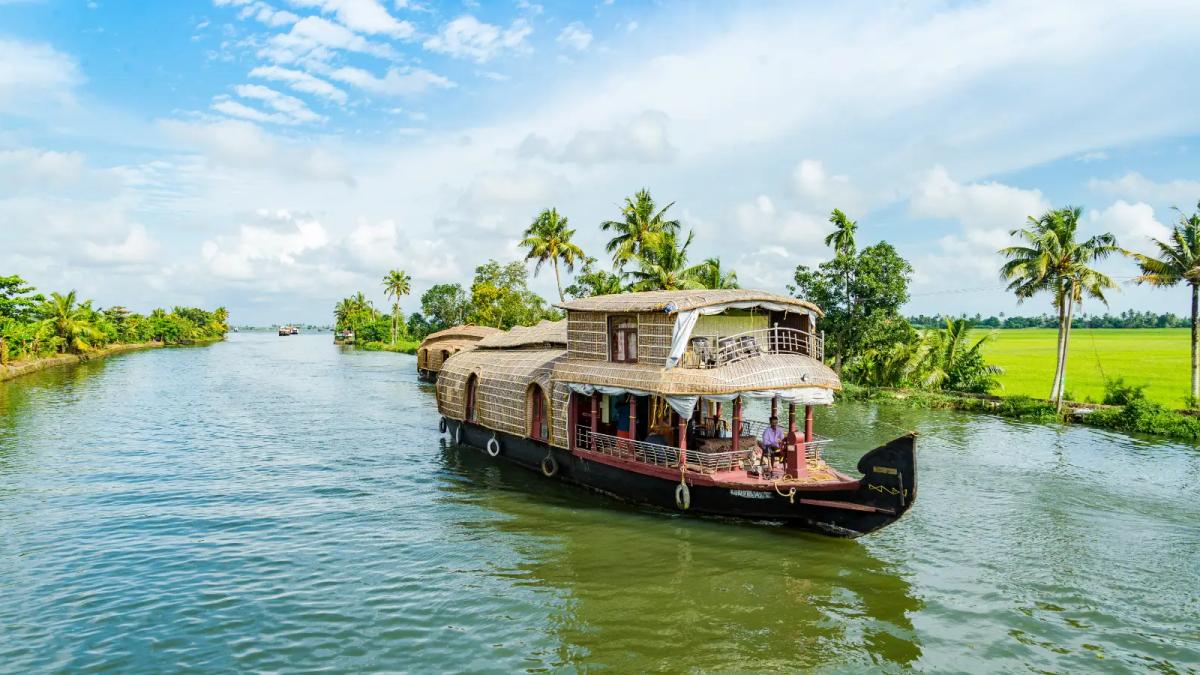
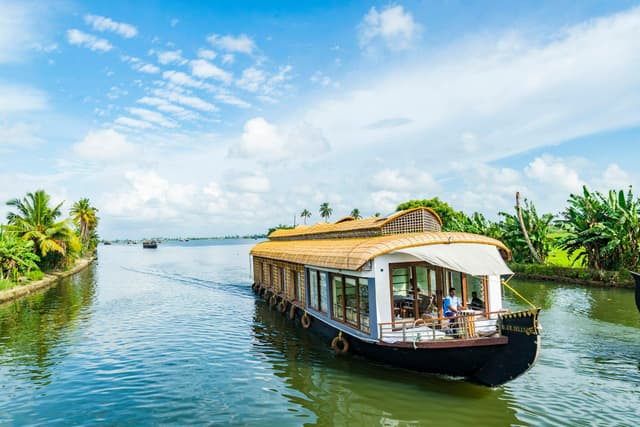
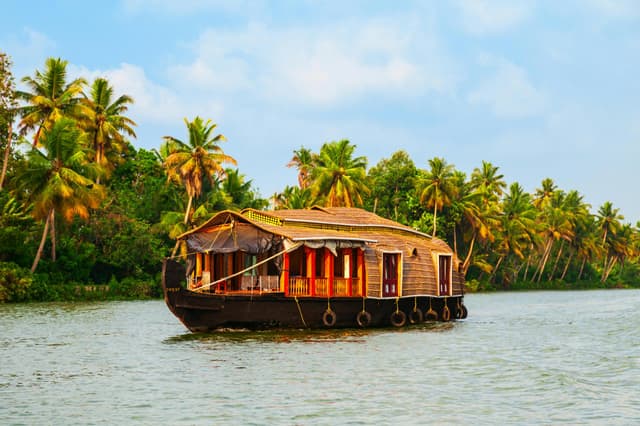
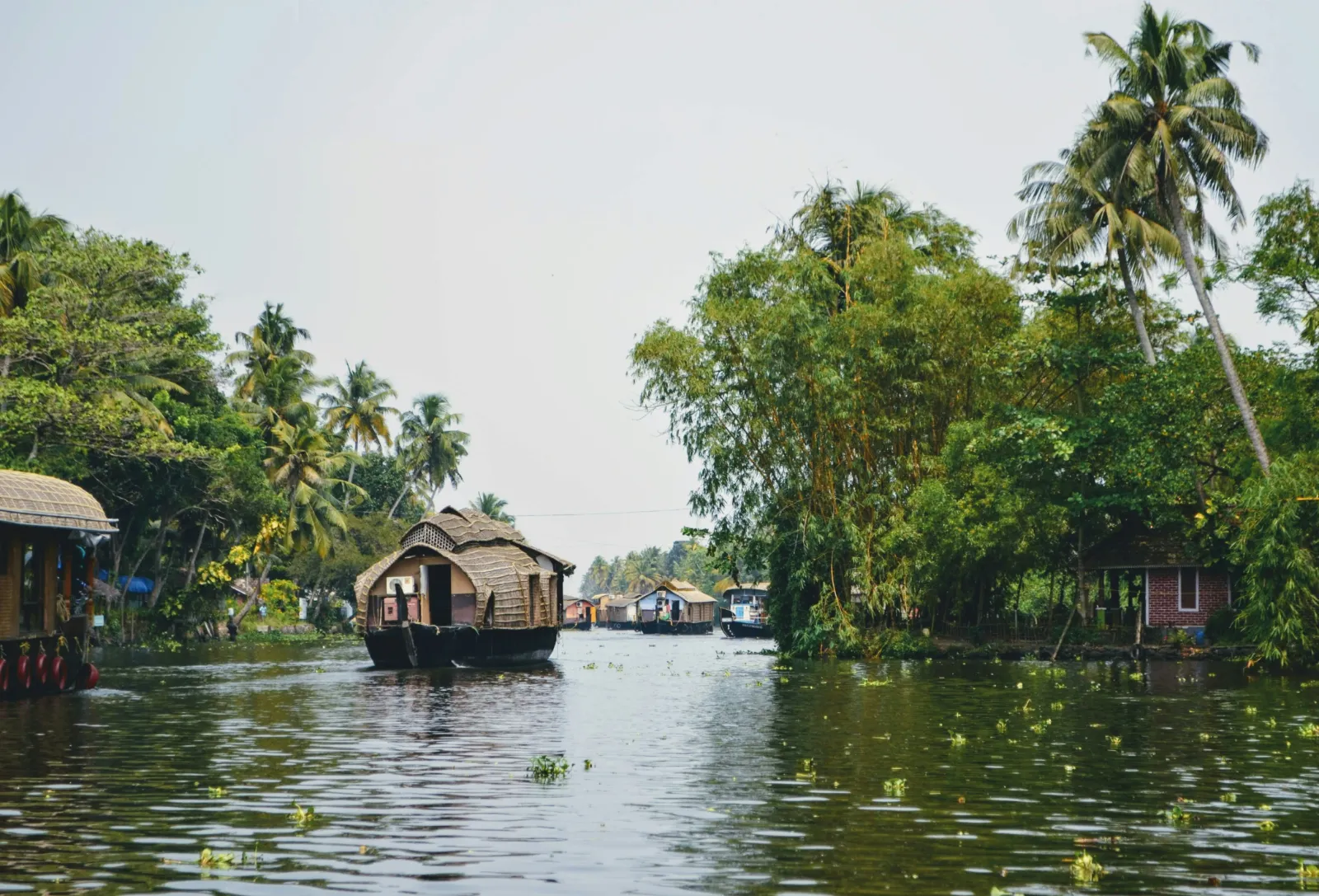
A kettuvallam is a traditional Kerala boat built from wooden planks tied together with coir rope. Kerala Tourism notes that these boats, made of jackwood planks lashed with coir, once carried rice and spices along the waterways and have since been converted into floating accommodation. A modern houseboat keeps the curved hull and the thatched or woven roof but adds bedrooms, bathrooms, a kitchen, a dining area and a sundeck. Some are small one bedroom boats; others are two deck vessels for larger groups.
| Fact | Detail | Source |
|---|---|---|
| Length of waterways | More than 900 km of connected lakes, rivers and canals | Wikipedia, Kerala backwaters |
| National Waterway 3 | 205 km from Kollam to Kottappuram, almost parallel to the coast | Wikipedia, Kerala backwaters |
| Vembanad Lake | About 96.5 km long, the longest lake in India | Wikipedia, Vembanad |
| Ramsar listing | Vembanad Kol wetland, designated 2002 | Wikipedia, Vembanad |
| Kuttanad | Rice grown below sea level; FAO heritage farming system | FAO GIAHS |
| Houseboat origin | Kettuvallam rice and spice barges of jackwood and coir | Kerala Tourism |
Alleppey or Kumarakom: which is better?
Alleppey is better if you want choice, easy rail access and the classic canal scenery of Kuttanad; Kumarakom is better if you want a calmer lakeside base, resort style stays and birdwatching. Both sit on Vembanad Lake and both start houseboat cruises, so the right answer depends on your travel style rather than on which one is more beautiful.
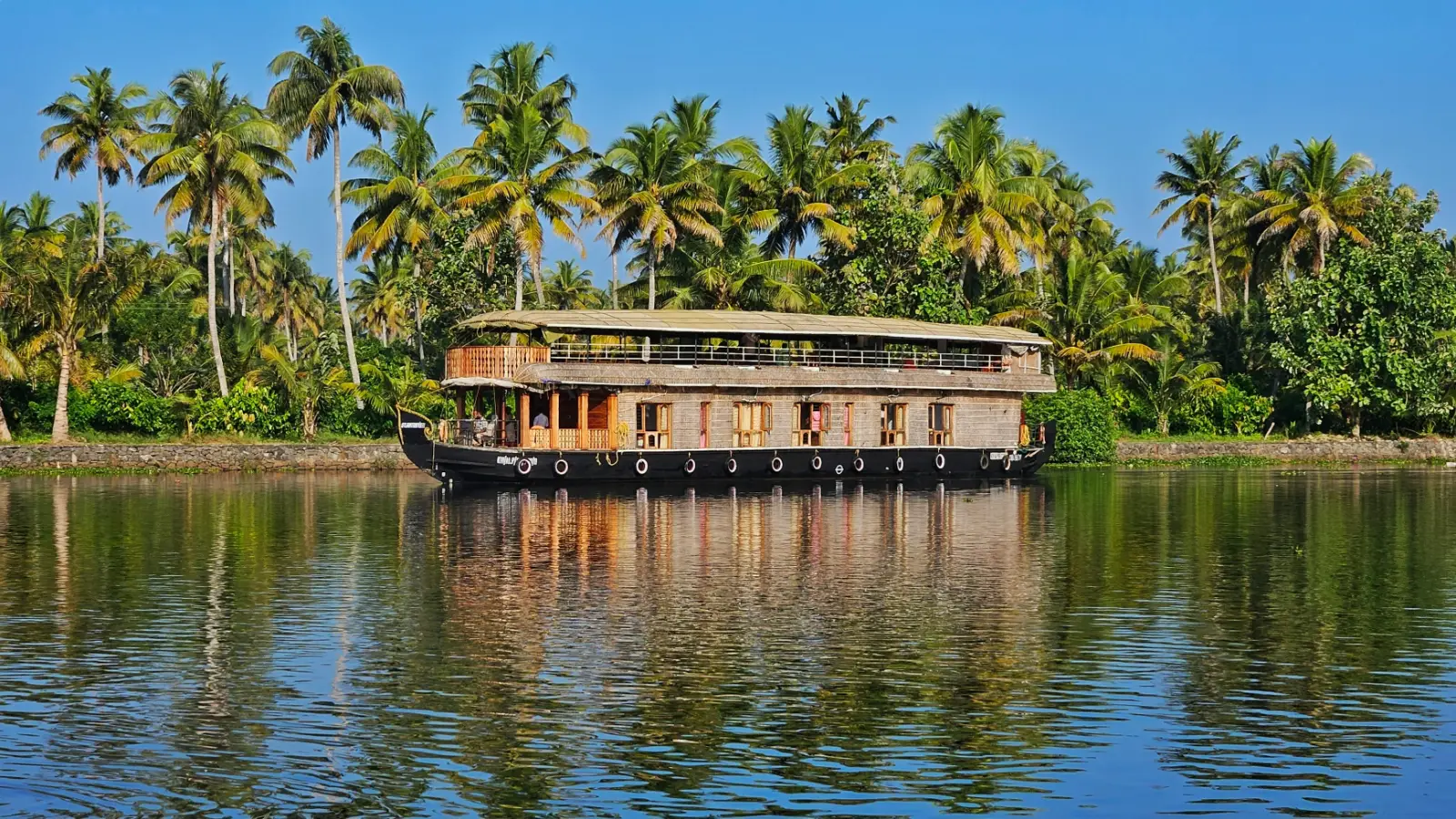
Alleppey is a working town with a railway station, a busy boat jetty, a beach and hundreds of registered houseboats (827 in Alappuzha, according to a July 2025 report cited below). Its strength is the maze of canals heading south and east into Kuttanad, where the boats pass close to villages and paddy fields. The trade off is traffic: on busy days in peak season you will share the main channels with many other boats.
Kumarakom is a village rather than a town. The Kerala Tourism page on Kumarakom describes it as a cluster of little islands on Vembanad Lake, part of the Kuttanad region and about 14 km from Kottayam. Many of its hotels sit right on the water, so it suits travellers who want a lakeside room plus a shorter boat outing rather than a full night on a houseboat.
| Factor | Alleppey (Alappuzha) | Kumarakom |
|---|---|---|
| Character | Busy town and boat hub | Quiet lakeside village of small islands |
| Scenery | Narrow canals, Kuttanad paddy fields, village life | Open views across Vembanad Lake, mangroves and birdlife |
| Houseboat choice | Very wide, from small one bedroom boats to large vessels | Good, with fewer boats overall |
| Places to stay on land | Homestays, town hotels, beach stays at Marari nearby | Lakeside resorts and homestays |
| Nearest railway station | Alappuzha | Kottayam (about 14 km from Kumarakom) |
| Nearest airport | Cochin International Airport, about 85 to 90 km | Cochin International Airport |
| Crowds in peak season | Higher on the main channels | Lower |
| Best for | First timers, budget to premium travellers, rail travellers | Honeymooners, slow travellers, birdwatchers |
Kumarakom Bird Sanctuary
The Kumarakom Bird Sanctuary is a small protected patch of woodland and waterline on the shore of Vembanad Lake, and it is the main reason birdwatchers choose Kumarakom. The Kerala Tourism page on the sanctuary says it was established by the Kerala Tourism Development Corporation, that resident species include egrets, herons, kingfishers, darters and cormorants, and that November to February is the best time to see migratory birds such as teals and pintails. Kerala Tourism's Kumarakom page adds that more than 180 bird species have been identified there.
Go early in the morning, when birds are most active and the air is cool, and take binoculars. Opening hours and entry fees change, and Kerala Tourism itself advises checking the latest timings before visiting, so confirm locally on the day. A morning walk here pairs well with an afternoon shikara ride or a lakeside lunch.
Other backwater bases worth knowing
Alleppey and Kumarakom are not the only gateways. Kollam, to the south, sits on Ashtamudi Lake, another of the system's large lakes, and is the start of the long Kollam to Alappuzha waterway. Marari, a beach village north of Alleppey, lets you combine a houseboat night with quiet sea days. Kochi has its own harbour and backwater edges, which suit travellers with very little time. For most first visits, though, Alleppey or Kumarakom gives the classic experience with the least transfer time.
Houseboat, shikara or ferry: how should you see the backwaters?
An overnight houseboat gives the most privacy and the full experience of an evening and a sunrise on the water, a shikara gets you into narrow canals the big boats cannot reach, and the public ferry is the most local and least packaged way to cross the backwaters. Many travellers combine two: for example a short shikara ride plus a houseboat night, or a ferry crossing plus a lakeside hotel.
| Option | Typical duration | Privacy | Overnight option | Reaches narrow canals? | Best for |
|---|---|---|---|---|---|
| Overnight houseboat | From around midday to the next morning | High; your own boat and crew (shared boats exist) | Yes, moored for the night | Mostly wider channels and the lake | Couples, honeymooners, families, groups |
| Day cruise houseboat | A few hours in daylight | High if private | No | Mostly wider channels | Short trips, travellers who prefer a hotel bed |
| Shikara (small covered canoe boat) | One to a few hours | Medium to high | No | Yes | Village life, photography, tight schedules |
| Country canoe or kayak | One to a few hours | High | No | Yes, the narrowest | Active travellers, birdwatching |
| State Water Transport ferry | From under an hour to a few hours by route | Low; public boat | No | Main public routes | Budget travellers, solo travellers, curious locals' view |
Overnight houseboat
An overnight houseboat is the signature way to experience the Kerala backwaters because you get both the daylight cruise and the quiet evening. A typical stay begins around midday with check in and lunch on board, continues with an afternoon cruise across the lake and through the channels, and ends with the boat mooring for the evening. Dinner is cooked on board, and you wake to birds and village sounds before breakfast and check out the next morning. Exact boarding and check out times vary by operator, so ask for them in writing.
Houseboats range from one bedroom boats for couples to large multi bedroom boats for families and groups. Most have a cook, a driver and a helper. Ask whether your boat is private or shared, how many bedrooms it has, whether the bedrooms are air conditioned and when the air conditioning runs, and whether the top deck is open to guests.
Do houseboats cruise at night?
No. Houseboats operating in Alappuzha and Kottayam districts are not permitted to move at night, so they stay moored overnight with guests on board, as reported by Onmanorama on 5 December 2025. In practice this means your cruising happens between check in and the evening mooring, and again for a short stretch after breakfast. If someone offers a night cruise, treat it as a warning sign rather than a bonus.
Checked: 13 Nov 2026, Onmanorama report citing the rule for Alappuzha and Kottayam districts. We could not find the original government order online; confirm the current rule with your operator.
Shikara and canoe rides
A shikara is a small covered motor boat or canoe that carries a few passengers and can slip into canals far too narrow for a houseboat. This is often where the backwaters feel most intimate: washing steps, children walking to school along the bunds, ducks herded across the water, and coir and fishing work by the bank. A one to three hour shikara ride is a good choice if you only have a day, or as a complement to a houseboat night. Paddled country canoes and kayaks are even quieter and are popular with birdwatchers early in the morning.
The public ferry: State Water Transport Department
The Kerala State Water Transport Department (SWTD), founded in 1968 and headquartered in Alappuzha, runs public passenger boats across the backwaters. For a traveller these ferries are the most local way to see the water, and they carry office workers, students and villagers rather than tourists. A December 2025 Onmanorama piece on exploring Kumarakom by public boat lists the Kottayam to Alappuzha route, the Kumarakom to Muhamma crossing (about 45 minutes), and services from Muhamma to Pathiramanal island.
The Alappuzha to Kottayam boat is the best known route for visitors because it runs through the northern Kuttanad villages and paddy fields. An Onmanorama report from June 2024 called the morning Kottayam to Alappuzha service a lifeline for office goers and students of northern Kuttanad, and noted that SWTD boats are the only regular operators on the route. The Wikivoyage guide to Alappuzha (a community travel guide, so treat it as approximate) describes the Alappuzha boats leaving from the jetty opposite the KSRTC bus stand, with the Kottayam crossing taking around two hours. The SWTD website did not load for us on 13 Nov 2026, so we could not confirm the current timetable at the official source: check departure times at the jetty the day before.
| Route | What you see | Notes |
|---|---|---|
| Alappuzha to Kottayam | Northern Kuttanad canals, paddy fields, village jetties | Commuter service; around two hours; confirm times at the jetty |
| Kumarakom to Muhamma | Open crossing of Vembanad Lake | About 45 minutes; links the Kottayam and Alappuzha sides of the lake |
| Muhamma to Pathiramanal | Small island surrounded by Vembanad Lake | Good for birdwatching; check return boat times |
| Kollam to Alappuzha | The long coastal waterway and Ashtamudi Lake | SWTD's popular cruise was stalled by silt in March 2024; check whether it is running |
Kerala Tourism describes Pathiramanal island as a small island surrounded by Vembanad Lake, home to many seasonal migratory birds and reached by boat, including from Kumarakom. On the Kollam route, Onmanorama reported in March 2024 that silt deposits had stalled SWTD's Alappuzha to Kollam cruise. We found no official confirmation of its status in November 2026, so treat it as uncertain until you confirm locally.
What should you check before booking a houseboat?
Before booking a houseboat, check that it is registered and licensed, that it carries a life jacket for every person on board including children, that it has working fire and first aid equipment, and that it handles toilet waste through a proper septic or bio toilet system. Ask for the boat's registration number and photos of that exact boat, not a brochure image, and check the Kerala Tourism classification if the operator claims one.
This matters because the backwaters are crowded and enforcement is uneven. A July 2025 Onmanorama report on a crackdown ordered on illegal houseboats in Vembanad said 827 houseboats were registered in Alappuzha while a satellite survey counted 928 boats operating, excluding those anchored along the banks, and that a 2013 study had set Vembanad's carrying capacity at 350 houseboats. In January 2026 the same publication reported guest complaints about unclean boats, untrained staff, water drawn straight from the lake and guests being given a different, more basic boat than the one shown online.
Kerala Tourism houseboat classification
Kerala Tourism runs a voluntary houseboat classification scheme. Under the revised scheme the categories are Silver Vessel, Gold Vessel and Diamond Vessel, which replaced the older Silver Star, Gold Star and Green Palm labels; Silver has the minimum facilities and Diamond the highest. An inspection committee chaired by the Director of Tourism, with members including the Port Department, recommends the category, the Director of Tourism issues the certificate, and the classification is valid for two years. Classified houseboats must permanently display their KIV (Kerala Inland Vessel) number, name and classification certificate, and operators must produce a valid Port Department licence to the Tourism Department every year.
Kerala Tourism also publishes a list of houseboats under its Where to Stay section with a download of approved houseboats. Listing details are supplied by the owners, so use it as a starting point and still check the boat in person or by video call. A classification is a useful signal but not a guarantee: ask to see the certificate on board and check that the name and number match.
Safety rules you can check yourself
Kerala's Inland Vessels Rules, 2010 require a life jacket for each person on board every boat, houseboats included, and children's life jackets numbering 10 percent of the boat's capacity, according to an Onmanorama explainer published after the 2023 Tanur boat tragedy in Malappuram, in which a tourist boat overturned and 22 people died. The same explainer says houseboats need at least four lifebuoys. The Kerala Tourism classification checklist adds fire buckets, at least two fire extinguishers in the kitchen, a first aid kit, a GPS system, handrails, a smoke alarm in the engine room, life jacket demonstration posters and staff trained in first aid and fire safety.
Incidents still happen. In the early hours of 5 December 2025 a moored houseboat sank at Cheepunkal near Kumarakom after crew noticed water entering the hull; two tourist couples were evacuated unhurt and police opened an inquiry into whether the boat had been operated despite technical problems (Onmanorama, 5 Dec 2025, linked above). The lesson is simple: ask about the boat's survey and maintenance, and notice whether the crew knows where the safety gear is.
Waste and the Vembanad compliance deadline
Houseboat sewage and plastic are among the biggest pressures on Vembanad. Under pollution control norms reported by Onmanorama in July 2025, toilet waste should be offloaded regularly at authorised treatment facilities, with receipts kept as proof. Following a Kerala High Court interim order of 20 January 2026, which gave operators three months to comply, the Port Officer and Registering Authority announced in April 2026 that only houseboats equipped with pollution control systems and valid certification would be allowed to operate on Vembanad Lake after 19 April 2026 (Devdiscourse report of 17 April 2026). Ask your operator how the boat handles toilet waste and whether it holds that certification.
| Check | What to ask or look for | Why it matters |
|---|---|---|
| Registration and licence | KIV registration number displayed on board; current Port Department or Maritime Board licence | Unregistered boats operate outside safety inspection |
| Classification | Silver, Gold or Diamond Vessel certificate on display, if claimed, and within its two year validity | Confirms an inspection of facilities by Kerala Tourism |
| Exact boat | Photos or a video call of the actual boat; its name and number in your confirmation | Guests have reported being switched to a more basic boat |
| Life jackets | One per person on board, plus children's sizes; ask where they are stored | Required by the Inland Vessels Rules |
| Lifebuoys and fire gear | Lifebuoys on deck; fire extinguishers in the kitchen; first aid kit | Kitchens on board use gas and open flame |
| Railings and deck | Handrails at the front and back; secure upper deck railings | Important for children and older parents |
| Crew | Licensed driver; crew trained in first aid and fire safety | The crew is your safety team in an emergency |
| Toilet waste | Septic tank or bio toilet; waste offloaded at authorised facilities | Untreated sewage pollutes the lake villagers depend on |
| Pollution certification | Pollution control system and valid certification for Vembanad | Required to operate on Vembanad after 19 April 2026 |
| Drinking water | Sealed or properly filtered drinking water; ask about the water used for cooking | Some boats have been reported using lake water |
| Night rule | Confirm the boat moors for the night | Moving at night is not permitted in Alappuzha and Kottayam districts |
A few habits make you a better guest on the water: refuse single use plastic, keep music low because sound carries across the lake, do not throw anything overboard, ask before photographing people at their homes, and tip the crew directly if you were happy with the service.
When is the best time to visit the Kerala backwaters?
The best time to visit the Kerala backwaters for most travellers is October to February, when temperatures are comfortable, the lake is calm and migratory birds arrive at Kumarakom; the monsoon from June to September brings heavy rain but also lush green scenery and fewer visitors. March to May is hot and humid but still workable if you spend the middle of the day in the shade. Our month by month guide to the best time to visit India shows how Kerala fits with the rest of the country.
| Season | Months | What to expect on the water | Good for |
|---|---|---|---|
| Post monsoon (northeast monsoon) | October to November | Green landscape, afternoon and evening showers possible | Dashain and Tihar holidays, photographers, fewer crowds than December |
| Cool dry season | December to February | Most comfortable weather, calm lake, busiest period | Honeymooners, families on winter school holidays, birdwatchers |
| Pre monsoon heat | March to May | Hot and humid, occasional thunderstorms | Travellers who want quieter waters and do not mind heat |
| Southwest monsoon | June to September | Heavy rain, high water, intensely green; some days washed out | Ayurveda trips, monsoon lovers, the Nehru Trophy race season |
What the 2026 rainfall data shows
Monsoon dates and totals shift from year to year, so it helps to look at real figures rather than general claims. The IMD declared that the southwest monsoon set in over Kerala on 4 June 2026, three days after the normal onset date of 1 June (IMD onset release). The 2026 southwest monsoon then turned out drier than normal across the backwater districts, according to the IMD Thiruvananthapuram southwest monsoon report.
| District | Actual (mm) | Normal (mm) | Departure from normal |
|---|---|---|---|
| Alappuzha | 1111.4 | 1643.0 | 32 percent below |
| Kottayam (Kumarakom) | 1588.3 | 1905.3 | 17 percent below |
| Ernakulam (Kochi) | 1522.5 | 2116.9 | 28 percent below |
| Kerala state | 1446.6 | 2018.6 | 28 percent below |
The northeast monsoon matters for anyone travelling at Dashain and Tihar time. Between 1 October and 12 November 2026, Alappuzha had already received 415.1 mm of rain against a normal of 428.1 mm for the period, according to the IMD northeast monsoon report. In other words, October and early November are not dry in the backwaters: expect some wet afternoons, pack a light rain layer and keep your boat day flexible if you can.
| District | Actual (mm) | Normal (mm) | Departure from normal |
|---|---|---|---|
| Alappuzha | 415.1 | 428.1 | 3 percent below |
| Kottayam (Kumarakom) | 362.9 | 443.8 | 18 percent below |
| Ernakulam (Kochi) | 350.7 | 455.6 | 23 percent below |
Is Alleppey good in the monsoon?
Yes, if you like rain and want quieter waters, but plan for it. The monsoon turns Kuttanad and the canal banks a deep green, the light is soft and there are far fewer boats. On the other hand, heavy spells can confine you to the covered deck, water levels rise, and trips may be cut short or rescheduled in bad weather. Check IMD district warnings in the days before you travel, keep a flexible plan and choose an operator who will reschedule if the weather turns. Monsoon also brings the snake boat race season in August and September.
Timing tips for Nepali travellers and the diaspora
For travellers from Nepal, the Dashain and Tihar holidays usually fall in October and November, right as the backwaters come out of the southwest monsoon. That timing is good for green scenery and fewer crowds than late December, but as the 2026 data shows, rain is still part of the picture. Families tied to school holidays often find the December and January winter break the most comfortable window, while members of the Nepali diaspora in the Gulf, Malaysia or further away may find June to September the easiest time to take leave, which is when the backwaters are greenest and quietest.
When is the Nehru Trophy Boat Race?
The Nehru Trophy Boat Race is held on Punnamada Lake in Alappuzha, usually in August, but the exact date is fixed each year by the Nehru Trophy Boat Race Society and has moved in recent years. The 72nd edition was held on Saturday 22 August 2026. As of 13 Nov 2026 no date for 2027 had been announced on the official sources we checked.
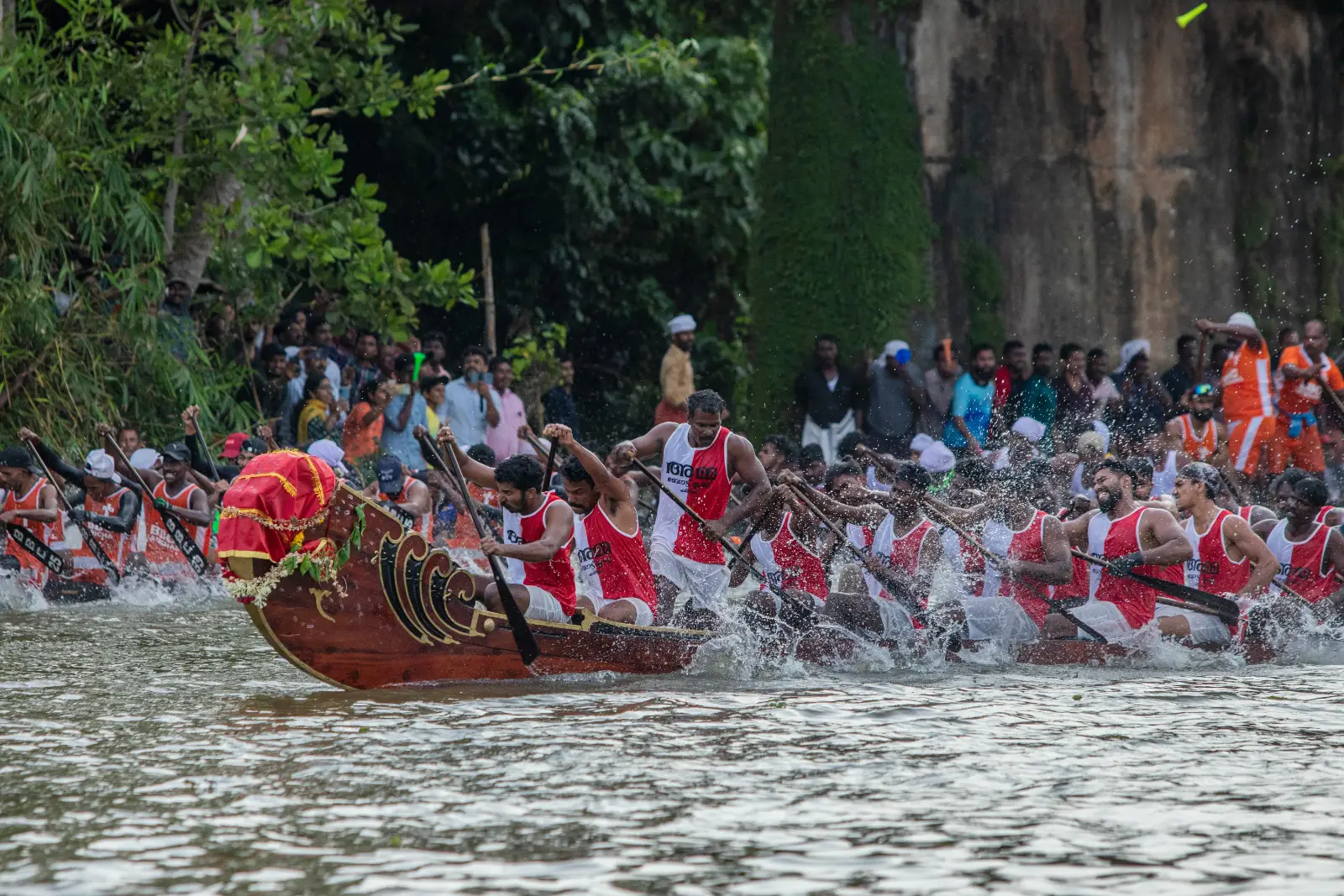
The race is the best known vallam kali (boat race) in Kerala. Long chundan vallams, or snake boats, crewed by large teams of rowers race in heats to the rhythm of boat songs while crowds line the banks. The official Nehru Trophy website still describes the race as being held on the second Saturday of August every year, but recent editions show that the date is often set later. The Alappuzha district administration confirmed that the 72nd Nehru Trophy Boat Race in 2026 was scheduled for 22 August 2026, and ThePrint reported in March 2026 that the society chose the date so the race would fall in the Onam season for spectators and tourists. All India Radio News reported that the 2026 race featured 71 boats, including 22 traditional snake boats.
| Year | Edition | Date held | Note |
|---|---|---|---|
| 2023 | 69th | 12 August 2023 | Second Saturday of August |
| 2024 | 70th | 28 September 2024 | Moved from 10 August after the July 2024 Wayanad landslides |
| 2025 | 71st | 30 August 2025 | Set later than the usual second Saturday |
| 2026 | 72nd | 22 August 2026 | Chosen to fall in the Onam season; 71 boats including 22 snake boats |
| 2027 | Next edition | Not announced as of 13 Nov 2026 | Watch nehrutrophy.nic.in and Alappuzha district notices |
Sources for the earlier years: Onmanorama on the 2023 date, Metro Vaartha on the 69th edition in 2023, Onmanorama on the 2024 postponement and Onmanorama on the 2025 date, confirmed as held on 30 August 2025 by a PTI report in The Week.
Planning around the race
If you want to see the race, do not book flights until the society announces the date, and expect Alleppey to be at its busiest around race day, with houseboats and hotels near Punnamada Lake filling early. For tickets, viewing areas and access arrangements, follow the official Nehru Trophy website and Alappuzha district notices rather than third party listings. If you would rather avoid the crowds, the same reasoning works in reverse: check the date and plan your houseboat night for a different weekend.
How do you get to Alleppey?
Most travellers reach Alleppey by flying into Cochin International Airport in Kochi and driving about 85 to 90 km south, or by taking the train to Alappuzha railway station on the coastal line. Kumarakom is reached via Kottayam, about 14 km away, which has its own railway station. There is no direct flight from Kathmandu to Kochi, so travellers from Nepal connect through an Indian hub or another regional airport.
Kerala Tourism gives Cochin International Airport as the nearest airport, about 85 km from Alappuzha on its Kuttanad travel page and about 90 km on its Alappuzha Beach page, with Alappuzha railway station about 5 km from the beach. Road time depends heavily on traffic through Kochi, so leave a generous buffer before a houseboat check in. For trains, buses and domestic flights across the country, see our guide on how to get around India.
| From | Route | Notes |
|---|---|---|
| Cochin International Airport (COK) | Road to Alappuzha, about 85 to 90 km | Main gateway for both Alleppey and Kumarakom |
| Kochi city | Train or road south to Alappuzha | Alappuzha station is on the coastal railway line |
| Kottayam | Road to Kumarakom, about 14 km | Kottayam railway station is the nearest for Kumarakom |
| Kollam | Road, rail or the waterway north to Alappuzha | Check whether the Kollam to Alappuzha boat is running |
| Kathmandu (KTM) | One stop flights to Kochi via Bengaluru, Mumbai, Colombo or Delhi | No direct flight; FlightConnections lists flying time of about 4 h 45 min via Bengaluru, Mumbai or Colombo, about 5 h 10 min via Delhi, excluding layovers |
Flying from Kathmandu to Kochi
FlightConnections confirms that there are no direct flights from Kathmandu to Kochi. It lists one stop connections via Bengaluru, Mumbai and Colombo (about 4 hours 45 minutes of flying time, excluding the layover) and via Delhi (about 5 hours 10 minutes), with longer options through Bangkok, Kuala Lumpur and Gulf hubs. Schedules change by season, so check the airline before you plan around a connection. If you are also visiting Delhi, north India or Goa, you can fold the backwaters into the same trip and fly onward to Kochi from there.
Entry rules in one line
Nepali citizens do not need a visa for India; see our guide on whether Nepalis need a passport for India for the ID rules. Other passport holders need an Indian visa: see our India visa page and check the official site for your passport.
Are the backwaters good for honeymooners and families?
Yes. The Kerala backwaters suit honeymooners because a private houseboat gives you space, privacy and an unhurried evening on the water, and they suit families because the pace is gentle and there is no long walking; families with young children simply need to choose a boat with good railings and child life jackets. Older parents enjoy the backwaters too, as long as the boarding point and the boat's steps are manageable.
For honeymooners and couples
Couples usually choose a private one bedroom houseboat, a lakeside room in Kumarakom or a mix of both. Ask for a boat with a good upper deck for sunset, check that the bedroom faces away from the kitchen, and consider pairing the backwaters with the Munnar tea hills or a quiet beach at Marari. The backwaters are one of the most popular romantic escapes in India, and they appear in our list of honeymoon destinations from Nepal.
For families with children
Children love the boats, the ducks and the village life, but water safety comes first. Check that the boat carries children's life jackets in the right sizes (the Inland Vessels Rules require children's jackets equal to 10 percent of capacity), that deck railings are high and secure, and that the upper deck stairs are not too steep. Keep young children in life jackets whenever they are on an open deck, agree a no running rule, and ask the crew to keep the kitchen area off limits. A two bedroom boat often works better for families than two separate boats.
For older parents and multi generation groups
Boarding usually means stepping from a jetty or a bank onto a moving deck, so ask the operator how the boat is boarded and whether the crew will help. Bedrooms on the lower deck avoid stairs. If a parent has mobility limits, a lakeside hotel plus a short day cruise may be easier than a full night on board. Our guide to travelling abroad with elderly parents has more practical tips.
Food on board, including vegetarian meals
Houseboat meals are cooked on board by the crew and usually follow Kerala home cooking: rice, sambar, thoran (stir fried vegetables with coconut), avial, fish curry and karimeen (pearl spot fish) fry. Vegetarian meals are widely available on request, which matters for many Nepali families, and the crew can usually adjust spice levels. Tell the operator your preferences when you book, including any no onion, no garlic, egg free or Jain requirements, so the cook can shop beforehand.
| Traveller | Best fit | Ask before booking |
|---|---|---|
| Honeymooners | Private one bedroom houseboat or a Kumarakom lakeside stay | Upper deck access, bedroom position, privacy at the mooring point |
| Families with young children | Private two bedroom houseboat with high railings | Children's life jackets, railing height, stairs, kitchen access |
| Older parents | Lakeside hotel plus a day cruise, or a lower deck bedroom | Boarding method, steps, toilet access, air conditioning hours |
| Solo and budget travellers | Public ferry plus a shikara or canoe ride | Departure times at the jetty; return boat times |
| Birdwatchers | Kumarakom with an early canoe ride | Sanctuary opening times; canoe start time |
How should you plan a Kerala backwaters trip?
Plan the backwaters as one or two calm days within a wider Kerala or south India trip: choose your base first (Alleppey for choice, Kumarakom for calm), then the type of boat, then check the season, the Nehru Trophy date and the houseboat's safety and waste credentials before you pay. One night on a houseboat is enough for most people; a second day on land gives time for a shikara ride or the bird sanctuary.
| Step | Decision | Tip |
|---|---|---|
| 1 | Base: Alleppey or Kumarakom | Alleppey for rail access and choice; Kumarakom for calm and birds |
| 2 | Experience: houseboat, shikara, ferry or a mix | A shikara ride shows narrow canals a houseboat cannot enter |
| 3 | Season | October to February for comfort; expect showers in October and November |
| 4 | Event timing | Check the Nehru Trophy date before fixing August or September travel |
| 5 | Houseboat checks | Registration, classification, life jackets, waste handling, the exact boat |
| 6 | Getting there | Fly to Kochi; leave a time buffer for the drive before check in |
| 7 | Documents and insurance | Carry valid ID; consider travel insurance that covers water activities |
If you are combining Kerala with other regions, the complete India travel guide covers the bigger picture of routes, food and money. If you prefer to have the houseboat, transfers and hotels arranged together, you can compare options among our India tour packages.
Frequently asked questions
Is an overnight houseboat worth it?
For most couples and families, yes. An overnight houseboat on the Kerala backwaters adds a quiet evening, dinner on board and a misty sunrise that a day cruise cannot give. Because houseboats do not move at night, the cruising time is limited to the afternoon and the next morning, so if you only want to see the canals, a day cruise or shikara ride may be enough.
Do houseboats cruise at night?
No. Houseboats in Alappuzha and Kottayam districts are not permitted to move at night, as reported by Onmanorama in December 2025, so they moor in the evening and stay put with guests on board until morning. Cruising happens between check in and the evening mooring and for a short stretch after breakfast. Treat any offer of a night cruise as a warning sign.
Is Alleppey good in the monsoon?
Alleppey is good in the monsoon if you enjoy rain and quiet waters. From June to September the Kerala backwaters are intensely green and far less crowded, but heavy spells can keep you under the covered deck and trips may be cut short in bad weather. Check IMD district warnings before travelling and book with an operator who will reschedule if needed.
Are Alleppey and Alappuzha the same place?
Yes. Alleppey is the older English name and Alappuzha is the official name of the same town and district in Kerala. Kerala Tourism and government bodies use Alappuzha, while many travellers and booking sites still say Alleppey. An Alleppey houseboat and an Alappuzha houseboat both cruise the same Vembanad Lake and Kuttanad canals.
How far is Alleppey from Kochi?
Alleppey (Alappuzha) is about 85 to 90 km by road from Cochin International Airport, according to Kerala Tourism. Travel time depends heavily on traffic through Kochi, so leave a generous buffer before a houseboat check in. Alappuzha is also on the coastal railway line, and the railway station is about 5 km from Alappuzha Beach.
Is vegetarian food available on houseboats?
Yes. Kerala backwater houseboats cook meals on board, and vegetarian food is widely available on request, including rice, sambar, thoran and avial. Tell the operator your needs when you book, such as no onion and garlic, egg free or Jain meals, so the cook can shop beforehand, and mention your preferred spice level.
Are houseboats safe for kids?
Houseboats in the Kerala backwaters can be safe for children if you choose carefully. Kerala's Inland Vessels Rules require a life jacket for every person on board and children's life jackets for 10 percent of capacity. Check sizes, railing height and stairs before booking, keep young children in life jackets on open decks and keep them away from the kitchen.
When is the Nehru Trophy Boat Race?
The Nehru Trophy Boat Race is held on Punnamada Lake in Alappuzha, usually in August. The 72nd edition took place on 22 August 2026. Recent dates have moved (28 September in 2024 and 30 August in 2025), and the 2027 date had not been announced on 13 Nov 2026, so check nehrutrophy.nic.in before booking.
Can I see the backwaters by public ferry?
Yes. The Kerala State Water Transport Department runs public boats on routes such as Alappuzha to Kottayam through northern Kuttanad and Kumarakom to Muhamma across Vembanad Lake. These ferries are the most local way to see the Kerala backwaters. Timetables change, and we could not verify them on the official site, so confirm departure times at the jetty.
Is Kumarakom quieter than Alleppey?
Yes, generally. Kumarakom is a lakeside village of small islands on Vembanad Lake, about 14 km from Kottayam, with fewer houseboats and many hotels right on the water. Alleppey is a busier town and the main houseboat hub. Choose Kumarakom for calm and birdwatching, and Alleppey for choice, rail access and the narrow Kuttanad canals.
Do Nepali citizens need a visa to visit the Kerala backwaters?
No. Nepali citizens do not need a visa to travel to India, including Kerala, but they do need valid identity documents; our guide on whether Nepalis need a passport for India explains the ID rules. Travellers with other passports need an Indian visa and should check the official site for their passport.