








































































































Short answer: Yes, you can fly from Kathmandu with a power bank, but only in your cabin bag, never in a checked suitcase. Under the ICAO rule in force since 27 March 2026, each passenger may carry no more than two power banks, each must be 100 Wh or less on most airlines, and you must not recharge a power bank on board. Several carriers that serve Kathmandu, including Emirates and flydubai, go further and allow only one power bank and ban using it during the flight. For the plug question, a single universal travel adapter covers all 12 destinations in this guide: every one of them runs on 220 to 240 volts like Nepal, so Nepali phone and laptop chargers need an adapter only for the socket shape, not a voltage converter.
This guide is for anyone flying out of Tribhuvan International Airport with a phone, a power bank, a laptop or a camera: first-time flyers, families on a Dashain or Tihar holiday, students, and Nepali diaspora visiting home on a foreign passport. It covers the battery rules in the order you meet them (packing, security, the cabin), then the plug and voltage at each destination. It sits under our full Kathmandu packing and baggage allowance guide, which explains weight limits and liquids. Battery rules changed several times in 2025 and 2026, so every rule below carries the date we checked it and the source.
| Question | Quick answer | Where the rule comes from |
|---|---|---|
| Power bank in cabin bag? | Yes, with terminals protected | ICAO Technical Instructions, IATA |
| Power bank in checked bag? | No, never | ICAO, IATA, every airline we checked |
| How many? | Two at most; one on Emirates and flydubai | ICAO addendum of 27 March 2026; airline pages |
| Biggest size? | 100 Wh (roughly 27,000 mAh at 3.7 V) | IATA guidance, airline pages |
| Recharge the power bank on board? | No | ICAO addendum, all airlines checked |
| Charge your phone from it on board? | Not recommended by ICAO; banned by many airlines | ICAO addendum, airline pages |
| Plug adapter needed? | Not in India; yes for most other destinations | National plug standards |
| Voltage converter needed? | No for Nepali devices; maybe for 120 V devices from the US, Canada or Japan | Mains voltage tables |
Can you carry a power bank on a flight from Kathmandu?
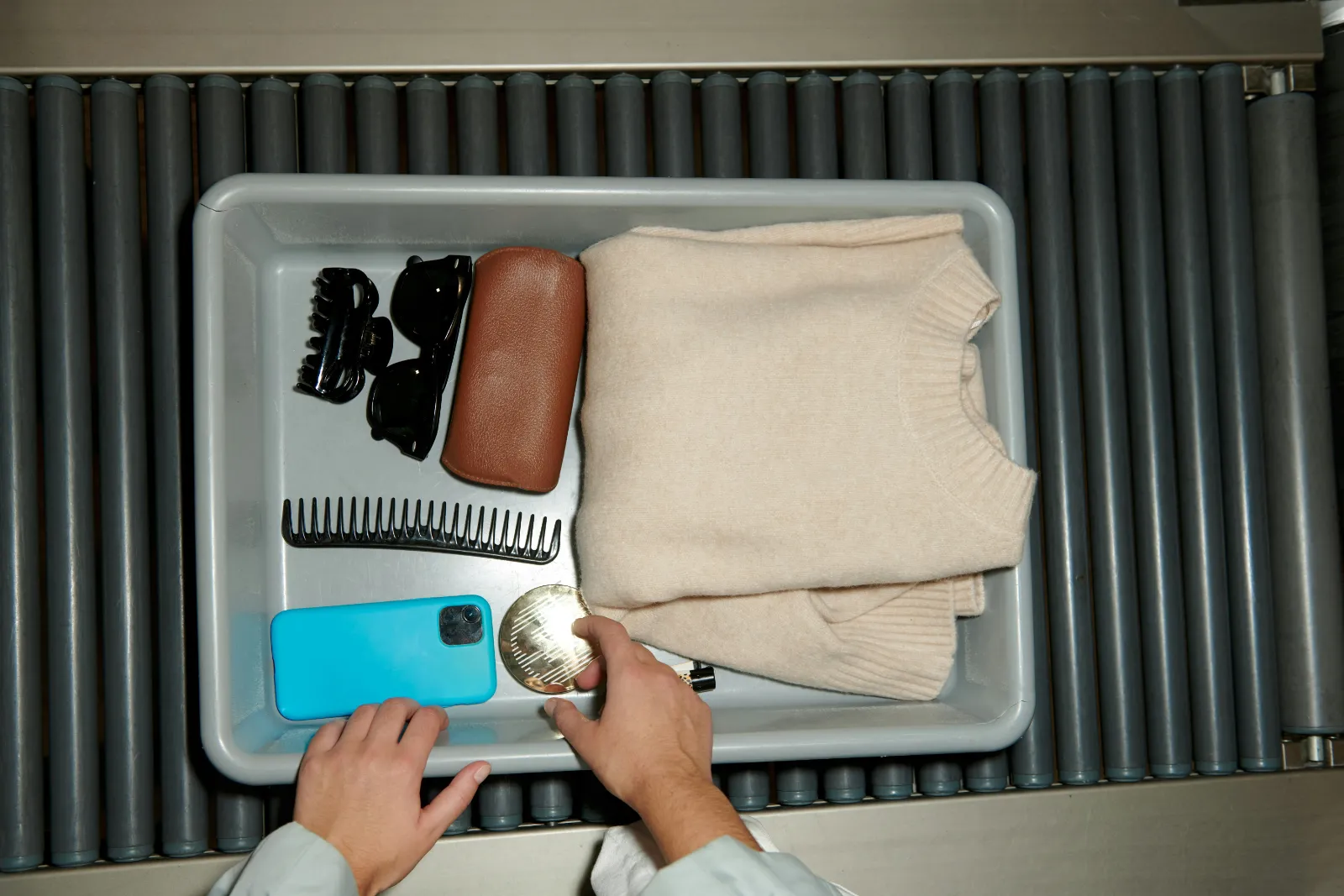
Yes. A power bank is allowed on international flights from Kathmandu as long as it travels in your hand luggage, is 100 Wh or less, and you carry no more than two (or one, on airlines with a stricter rule). Security at Tribhuvan International Airport screens hand baggage before the gates, and airline staff can refuse a power bank whose capacity they cannot read.
The baseline rule is international. On 27 March 2026 the International Civil Aviation Organization (ICAO) announced an addendum to its Technical Instructions for the Safe Transport of Dangerous Goods by Air (Doc 9284), applicable the same day. In its news release, ICAO said the change caps each passenger at two power banks and stops passengers recharging them in flight. The text of the addendum, reproduced in the IATA guidance document for operators (dated 31 March 2026), says power banks:
- must be carried as carry-on baggage;
- must not be recharged while on board the aircraft;
- should not be used to recharge a portable electronic device while on board;
- are limited to two per person;
- must be individually protected against short circuits when not in use, for example in the original retail packaging, with tape over exposed terminals, or each in its own plastic bag or pouch.
Nepal applies the same international framework. A Nepal News report of 8 June 2026, drawing on Civil Aviation Authority of Nepal (CAAN) information officer Gyanendra Bhul, says power banks and spare batteries are placed under strict scrutiny for safety and security reasons. Bhul told the paper: "Passengers are only allowed to carry items that strictly comply with the regulations. The criteria can vary significantly depending on the country and the specific airline." We did not find a separate CAAN passenger circular on power banks, so at Kathmandu the ICAO rule and your airline's rule are the ones that apply. Our Kathmandu airport international departure guide walks through check-in, immigration and the final security screening where hand baggage, including power banks, is checked.
In practice the rule that decides your trip is your airline's, because airlines may be stricter than ICAO and many are. IATA's passenger guidance says plainly that "airlines may impose more stringent conditions on the carriage and use of power banks by passengers." If your ticket has two airlines (for example Kathmandu to Doha on one carrier and onward on another), follow the stricter of the two for the whole journey.
What changed in 2025 and 2026?
Power bank rules tightened in steps, first airline by airline after several cabin fires, then through regulators. The table lists the changes that matter most for flights out of Kathmandu.
Checked: 20 Nov 2026. Sources: airline and regulator pages linked in the next table, ICAO, IATA, Business Standard (14 Oct 2026), Kantipur (13 Oct 2026), Thansettakij (6 Jun 2026). The Singapore Airlines 1 April 2025 date is from The Star (12 Mar 2025) and the flydubai 1 October 2025 date is from Gulf News (3 Oct 2025); neither airline's current page states that start date.
| Date | Who | What changed |
|---|---|---|
| 15 March 2025 | Thai Airways | Use of power banks on board prohibited |
| 1 April 2025 | Singapore Airlines, Malaysia Airlines | No charging power banks from seat power and no using them to charge devices on board |
| 28 June 2025 | China (CAAC) | Power banks without a 3C mark, or from recalled batches, barred on domestic flights in China |
| 1 October 2025 | Emirates, flydubai | One power bank per passenger, no use on board, not in the overhead bin |
| 11 November 2025 | India (DGCA) | Advisory Circular 01/2025: no using or charging power banks in flight, not in overhead bins |
| 27 March 2026 | ICAO | Two power banks per person worldwide, no recharging on board |
| 28 March 2026 | Hong Kong (CAD) | Two power banks, carry-on only, for all flights leaving Hong Kong |
| 15 April 2026 | Singapore (CAAS), Singapore Airlines | Maximum two power banks per person on flights departing Singapore |
| 30 April 2026 | Malaysia (CAAM) | Safety Directive 01/2026: all Malaysian operators apply the ICAO two-bank limit and recharging ban |
| Reported 6 June 2026 | Thailand (CAAT) | Notification No. 122: two power banks, Wh label required, no use or charging in flight |
| 13 to 14 October 2026 | Nepal Airlines, India (DGCA) | One model (MOBIKINS MK-PB-04) banned on flights to, from and within India, in cabin, checked bags and cargo |
| 1 January 2027 | IATA | 68th edition of the Dangerous Goods Regulations lists power banks above 100 Wh as forbidden for passengers |
Which airline rules apply to your flight from Kathmandu?
The airlines below fly from Kathmandu or carry many Nepali travellers on connections. Read across your airline's row, and treat the strictest airline on your ticket as the rule for the whole trip.
Checked: 20 Nov 2026, from each airline's own page (linked in the first column), the Dubai Media Office release for Emirates, or the regulator named. Rows without a link had no airline page we could verify, so they show the regulator's rule instead. Airline pages often carry no update date, so check again in the week you fly.
| Airline | How many | Size limit | Use or charging on board | Where to keep it |
|---|---|---|---|---|
| Emirates | One | Under 100 Wh, rating must be readable | Not used at all in the cabin; no charging it from aircraft power | Seat pocket or bag under the seat, not the overhead bin |
| flydubai | One | Up to 100 Wh, rating printed on it | Use on board strictly prohibited | Under the seat in front or seat pocket, not the overhead bin |
| Air Arabia | Not stated on the page | Up to 100 Wh | Must stay switched off; cannot charge devices; no charging from onboard power | Seat pocket or bag under the seat, not overhead lockers |
| Qatar Airways | Two | 100 Wh; above 100 Wh no longer allowed | Charging the power bank banned in all phases; may charge your own device in non-critical phases if kept under your direct supervision | Not in a bag or the overhead bin while charging |
| Singapore Airlines | Two | Up to 100 Wh free; 100 to 160 Wh with prior approval; above 160 Wh not allowed | No charging from seat power or USB; not used to charge devices | Seat pocket or under the seat, not overhead |
| Thai Airways | Two (Thailand CAAT rule) | CAAT rule: up to 100 Wh; 100 to 160 Wh needs airline permission | Use on board prohibited since 15 March 2025 | On you, seat pocket or under the seat |
| Malaysia Airlines | Two (CAAM directive) | ICAO limits | Charging or using strictly prohibited for the whole flight | Kept with you; not overhead; magnetic wireless banks in a separate pouch |
| AirAsia (Malaysia): no AirAsia page verified, rule from the CAAM directive | Two (CAAM directive for all Malaysian operators) | ICAO limits | No recharging; not used to charge devices | On you or within reach, not overhead |
| Cathay Pacific | Two | Not stated on the update page | Not used at any time in flight; no recharging | Carry-on only; extra units confiscated at Hong Kong screening |
| IndiGo, Air India: no airline page verified, rule from the DGCA circular | ICAO limit | ICAO limits | DGCA: using or charging power banks not allowed in flight | Hand baggage only, not overhead bins |
| Nepal Airlines: no airline power bank page found | ICAO limit | ICAO limits | No published power bank page found; follow ICAO and crew instructions | Hand baggage; MOBIKINS MK-PB-04 banned on India flights |
For the Malaysian rows, the source is the Civil Aviation Authority of Malaysia's Safety Directive 01/2026, issued 14 April 2026 and effective 30 April 2026, which tells all airline operators to apply the two-bank limit and the recharging ban, and to advise passengers to keep power banks out of overhead compartments. For Thai Airways, the two-bank and permission rules come from Civil Aviation Authority of Thailand Notification No. 122, as reported by Thansettakij on 6 June 2026. For India, the Directorate General of Civil Aviation issued Dangerous Goods Advisory Circular No. 01/2025 on 11 November 2025, and in October 2026 it banned the MOBIKINS MK-PB-04 model on flights to, from and within India after a fire on an IndiGo Delhi to Chennai flight, Business Standard reported. Nepal Airlines issued a matching notice for its India flights, Kantipur reported on 13 October 2026.
Two more notes for connections. Flights leaving Hong Kong follow the Civil Aviation Department's Dangerous Goods Advisory Circular 2/2026 (28 March 2026): two power banks, carry-on only, no recharging. And if you connect onto a domestic flight inside China, for example after flying Kathmandu to Chengdu, power banks without a 3C certification mark or from recalled batches have been barred on China's domestic flights since 28 June 2025, according to the Beijing municipal government. A power bank bought in Kathmandu may not carry a 3C mark, so check the label before a China trip.
What do the watt-hour limits mean?
The watt-hour (Wh) rating is the energy stored in a lithium-ion battery, and it is the number airlines use to decide what you may carry. For power banks the line is 100 Wh: at or under 100 Wh is allowed in the cabin, above 100 Wh is forbidden under IATA guidance, and above 160 Wh is never allowed for passengers.
The three bands are the same for every lithium-ion item, but what is allowed in each band depends on whether the battery is a power bank, a spare battery (such as a camera or drone battery) or a battery inside a device. In 2026 the rules for power banks split away from those for spare batteries, which is why the table has separate columns.
Checked: 20 Nov 2026, IATA Passengers Travelling with Lithium Batteries guidance (revised 31 March 2026) and the IATA Dangerous Goods Regulations 68th edition tables 2.3.B and 2.3.C (effective 1 January 2027).
| Wh band | Power bank | Spare battery (camera, drone) | Battery inside a phone, laptop or camera |
|---|---|---|---|
| 100 Wh or less | Cabin only, maximum two, no approval needed | Cabin only, terminals protected, no approval (IATA lists up to 20 per person in 2026 and 18 from 1 January 2027) | Cabin recommended; checked bag allowed if completely switched off (maximum 15 devices per person) |
| Over 100 Wh, up to 160 Wh | Forbidden in IATA's 2026 guidance and in DGR 68 from 1 January 2027; ICAO, Singapore (CAAS), Singapore Airlines and Thailand (CAAT) still allow it with airline approval | Cabin only, maximum two, airline approval needed | Allowed with airline approval |
| Over 160 Wh | Forbidden for passengers | Forbidden for passengers (cargo only) | Forbidden for passengers (cargo only) |
The 100 to 160 Wh power bank band is the one place where official sources disagree, so it deserves a careful word. Checked on 20 Nov 2026, the sources say:
- ICAO addendum (27 March 2026): a power bank of 100 to 160 Wh is allowed with the airline's approval.
- IATA guidance to operators (31 March 2026): that approval provision "will not be carried into the 68th edition" of the Dangerous Goods Regulations, and IATA's 2026 passenger guidance already marks power banks of 100 to 160 Wh as forbidden.
- IATA DGR 68th edition (in force from 1 January 2027): lists "power banks exceeding 100 Wh" as forbidden for passengers.
- Still allowed with airline approval: Singapore's Civil Aviation Authority (CAAS) passenger FAQ for its 15 April 2026 rule, the Singapore Airlines advisory effective 15 April 2026, and Thailand's CAAT Notification No. 122 as reported on 6 June 2026.
- Only 100 Wh or less: Emirates, flydubai, Air Arabia and Qatar Airways, on their current pages.
The national rules may change once DGR 68 takes effect, and most airlines follow the IATA regulations. The safe choice on any route from Kathmandu is a power bank of 100 Wh or less.
How do you work out Wh from mAh and volts?
Multiply the capacity in ampere-hours by the battery's nominal voltage. Because most power banks print capacity in milliampere-hours (mAh), the working formula is: Wh = mAh multiplied by volts, divided by 1,000. IATA's guidance gives the same rule as Wh = Ah x V.
Use the battery or cell voltage printed on the label (usually 3.6 V or 3.7 V for lithium-ion power banks), not the 5 V USB output. Using 5 V makes the battery look bigger than it is. Worked example: a 20,000 mAh power bank at 3.7 V is 20,000 x 3.7 / 1,000 = 74 Wh, comfortably under 100 Wh.
Calculated with the formula above. Always trust a Wh figure printed on the label over your own calculation.
| Capacity on the label | Wh at 3.6 V | Wh at 3.7 V | Typical result |
|---|---|---|---|
| 5,000 mAh | 18 Wh | 18.5 Wh | Allowed (cabin) |
| 10,000 mAh | 36 Wh | 37 Wh | Allowed (cabin) |
| 20,000 mAh | 72 Wh | 74 Wh | Allowed (cabin) |
| 25,000 mAh | 90 Wh | 92.5 Wh | Allowed (cabin) |
| 26,800 mAh | 96.5 Wh | 99.2 Wh | Just under the limit; label must show it |
| 30,000 mAh | 108 Wh | 111 Wh | Over 100 Wh: forbidden on most airlines |
| 40,000 mAh | 144 Wh | 148 Wh | Over 100 Wh: forbidden on most airlines |
| 50,000 mAh | 180 Wh | 185 Wh | Over 160 Wh: never allowed |
So the rough rule is that any power bank marked up to about 26,000 mAh is under 100 Wh, and 30,000 mAh and above is not. Singapore's CAAS uses the same approximation in its passenger FAQ, describing 100 Wh as about 27,000 mAh.
What if the label is missing or worn off?
Leave that power bank at home. IATA's passenger guidance says all lithium-ion batteries must have the Wh rating marked on the case, and that if staff cannot verify the rating from the battery or its documents, the airline may refuse to carry it. flydubai requires the rating to be printed, labelled or embossed on the device, and Thailand's CAAT notification bars power banks whose rating is missing or cannot be verified. A sticker that peels off can leave you with no readable rating, so buy a power bank with the capacity moulded or printed into the case.




















Can power banks go in checked luggage?
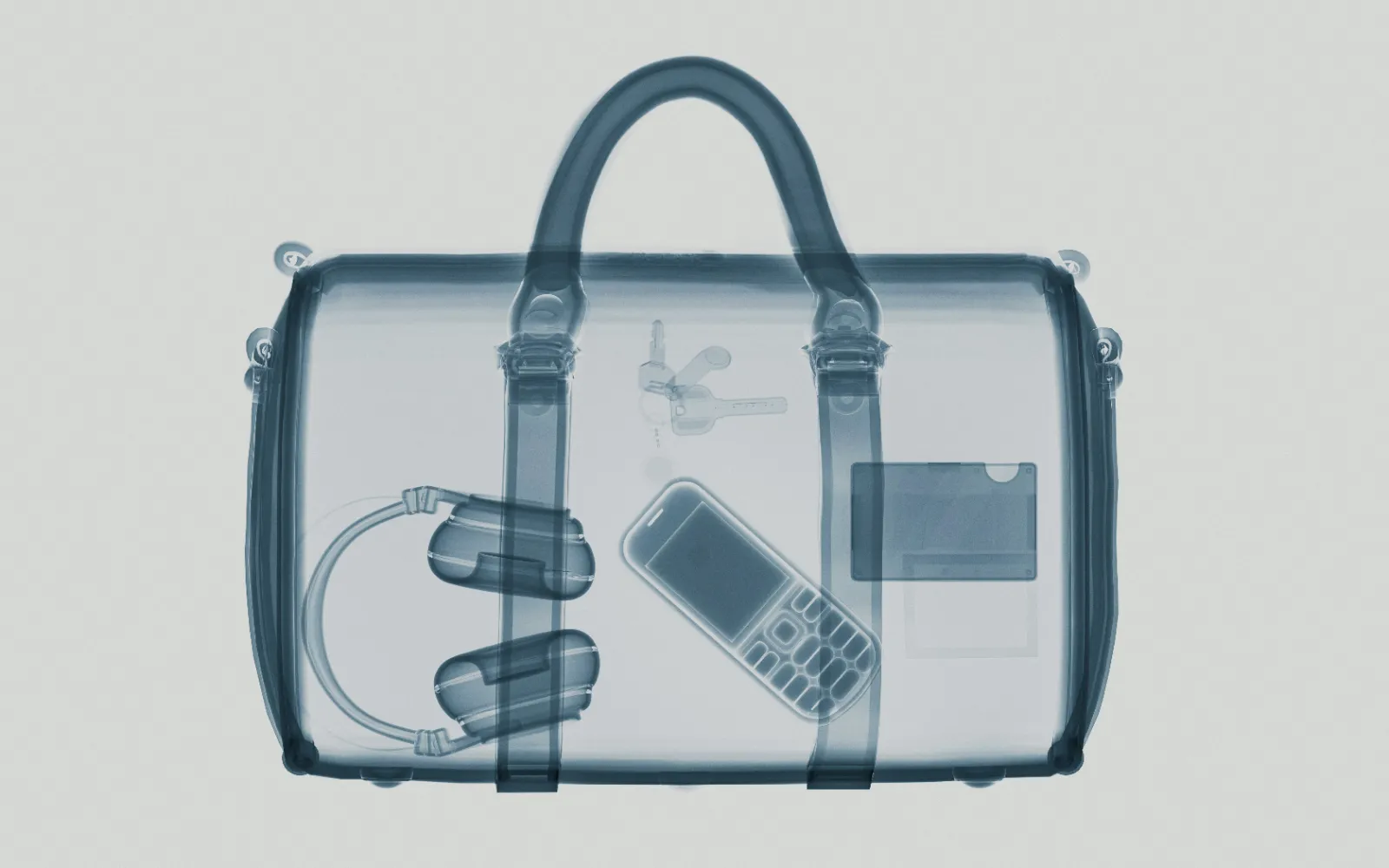
No. Power banks are not allowed in checked baggage on any airline, at any size. This is the oldest and firmest part of the rule: ICAO, IATA and every airline we checked say power banks and spare lithium batteries go in the cabin only, where crew can reach a battery that overheats.
The reason is simple. A lithium battery fire in the cabin can be seen, smelled and put out by trained crew. In the hold it may not be noticed until it has spread. If your suitcase is X-rayed at check-in at Kathmandu or at a transit airport and a power bank shows up, expect the bag to be pulled and opened, which can make you late for boarding.
The same applies to a cabin bag taken from you at the gate. IATA's passenger guidance is direct: if your hand baggage is taken at the gate to go in the hold, remove all lithium batteries and devices first. Gate checking can happen on any full flight, so keep power banks in a small pouch you can pull out in seconds.
Checked: 20 Nov 2026, IATA passenger guidance (31 March 2026), IATA DGR 68th edition Table 2.3.B, airline pages linked above.
| Item | Cabin bag | Checked bag | Notes |
|---|---|---|---|
| Power bank, 100 Wh or less | Yes, maximum two (one on Emirates, flydubai) | No | Terminals protected; not in overhead bin on most airlines |
| Spare camera or drone battery, 100 Wh or less | Yes | No | Original packaging, taped terminals or a separate pouch each |
| Spare battery 100 to 160 Wh | Yes, maximum two, airline approval | No | Ask the airline well before the flight |
| Phone, tablet, laptop, camera | Yes (recommended) | Allowed if completely switched off and protected | Not sleep or hibernation mode |
| E-cigarette or vape | Yes, protected from switching on | No | No recharging on board; banned in some destinations |
| Smart luggage, non-removable battery over 2.7 Wh | No | No | Forbidden |
| Smart luggage, removable battery | Yes | Only with the battery removed and carried in the cabin | Take the battery out before check-in |
| Bag tag or GPS tracker | Yes | Yes | Not restricted under IATA guidance |
| Wired charger, cable, plug adapter | Yes | Yes | No battery inside, so no battery rule |
Can a laptop go in checked luggage?
Yes, a laptop may go in checked luggage under the international rules, but only if it is completely switched off (not asleep or hibernating) and protected from damage and accidental switching on. IATA's guidance says devices "should" travel in the cabin, and the flydubai and Qatar Airways pages both allow switched-off laptops in checked bags. Each device battery must be 100 Wh or less, or approved by the airline if it is 100 to 160 Wh.
Allowed does not mean wise. A laptop in a suitcase can be crushed, stolen or delayed with a lost bag, and in the cabin you can watch it. Keep it in your cabin bag unless your cabin allowance makes that impossible.
What about e-cigarettes and vapes?
On the plane, e-cigarettes and vapes may travel only in your cabin bag or on your person, protected against switching on, and you must not recharge them on board (IATA guidance and DGR 68th edition). The bigger risk is at your destination. The UK government's travel advice, checked on 20 Nov 2026, says it is illegal to possess or use any vape, e-cigarette, pod, e-liquid or heat-not-burn device in Thailand; that vapes and e-cigarettes are banned in Singapore and illegal to bring in; and that you cannot buy vapes in India or bring them into the country. If you vape, check the destination's law before you pack, not just the airline's rule.
Camera batteries, drones and smart luggage
Spare camera and drone batteries count as spare batteries, not power banks, so the two-power-bank cap does not apply to them, but they still travel in the cabin only with each one protected. Large drone batteries are often above 100 Wh: check the Wh figure on each one, and ask your airline for approval in advance if any are between 100 and 160 Wh. IATA also notes that airlines may ask for multiple spare batteries to be carried at a low state of charge (under 25 percent) as a condition of approval. For smart suitcases with a built-in battery, the battery must be removable if the case is checked in, and the removed battery then rides in the cabin.
Can you use or charge a power bank on board?
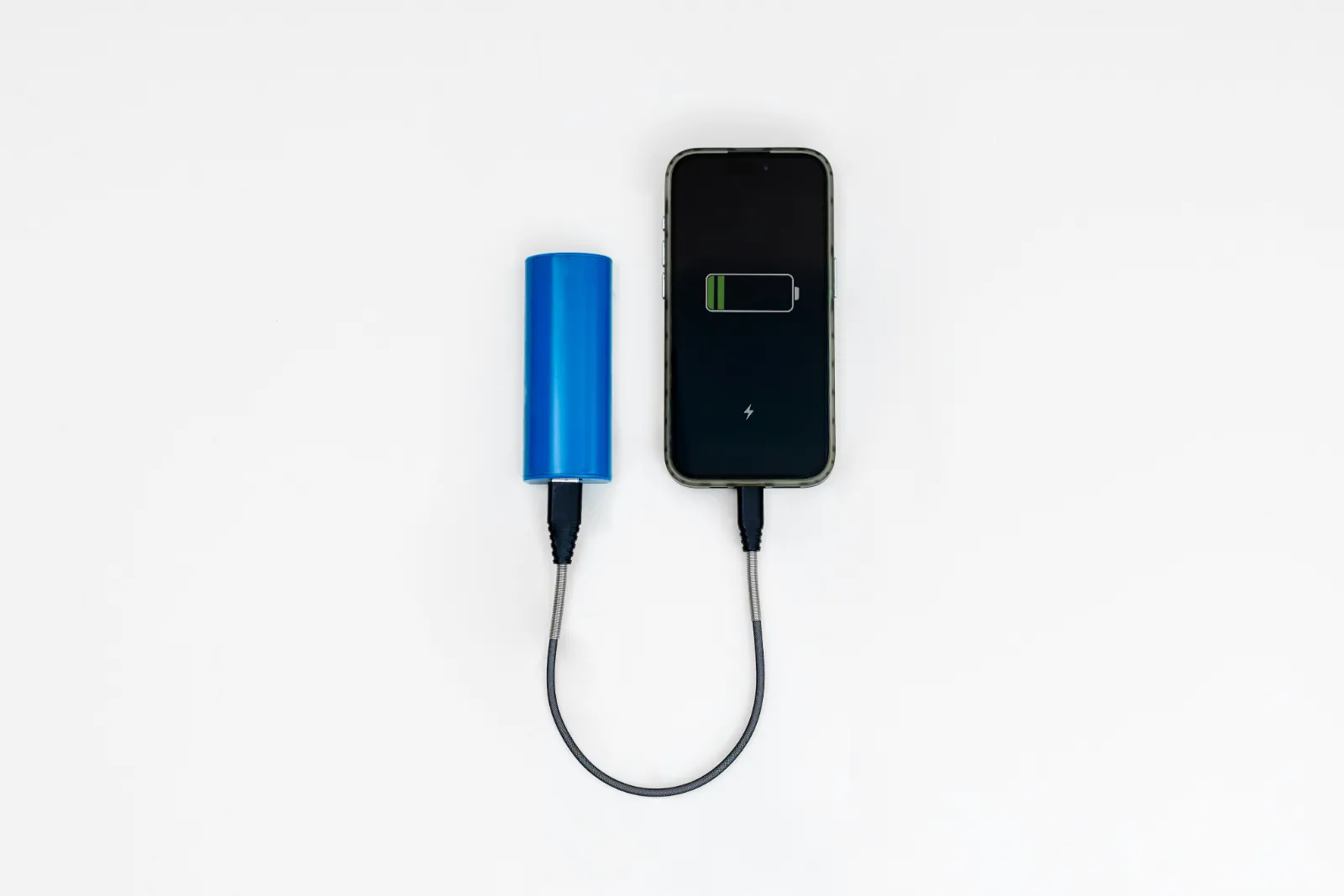
You may not recharge a power bank on board any flight under the ICAO rule, and on most airlines that serve Kathmandu you may not use one to charge your phone either. ICAO says power banks "should not" be used to recharge devices on board, and Emirates, flydubai, Air Arabia, Singapore Airlines, Thai Airways, Malaysia Airlines, Cathay Pacific and Indian airlines turn that into a ban.
Qatar Airways is the main exception among the carriers we checked. Its restricted items page says charging the power bank itself is prohibited in all phases of flight, but in non-critical phases you may use a power bank to recharge your own device if it stays under your direct supervision and is not stowed in a bag or the overhead bin while charging. Even there, the power bank must not be plugged into seat power.
Where should the power bank sit during the flight? Not in the overhead locker. IATA's passenger guidance says power banks should not be stored there, Emirates, flydubai, Air Arabia, Singapore Airlines and Malaysia Airlines all keep them out of the overhead bin, and most of them ask for the seat pocket or a bag under the seat in front. The point is that you, or crew, can see and reach it quickly if it heats up.
How do you keep your phone charged on a long journey?
The rules we checked target power banks, not phones. None of them stops you charging a phone or laptop directly from a seat power socket or USB port where the aircraft has one, unless crew say otherwise. A few habits make the ban painless:
- Charge your phone fully at home before you leave. IATA notes that airlines prefer power banks and spare batteries at under 25 percent charge, and advises against recharging a power bank just before boarding; if you do charge one, let it cool before you pack it.
- Download boarding passes, hotel vouchers and maps before you leave, so a low battery is not a problem on arrival. Our list of the best travel apps for international trips flags which ones work offline.
- Use the transit airport. On a connection in Dubai or Kuala Lumpur you are on the ground long enough to top up your power bank at an airport socket. Our Dubai airport guide and Kuala Lumpur airport guide explain the transfer areas.
- Switch the phone to airplane mode and low power mode for the flight.
What should you do if a device gets hot or smokes?
Tell the cabin crew immediately and do not try to handle it yourself. IATA's passenger guidance asks passengers to report any device that is hot, smoking or damaged, and India's DGCA circular tells airlines to announce the same: inform crew straight away if a device emits heat, smoke or an unusual smell. Do not put a hot device in a bag or the seat pocket where it cannot be seen. If a phone slips into a reclining seat mechanism, call crew rather than moving the seat: India's DGCA circular lists crushing among the ways a lithium battery fire can start.
Which plug type does each destination use, and which travel adapter fits?
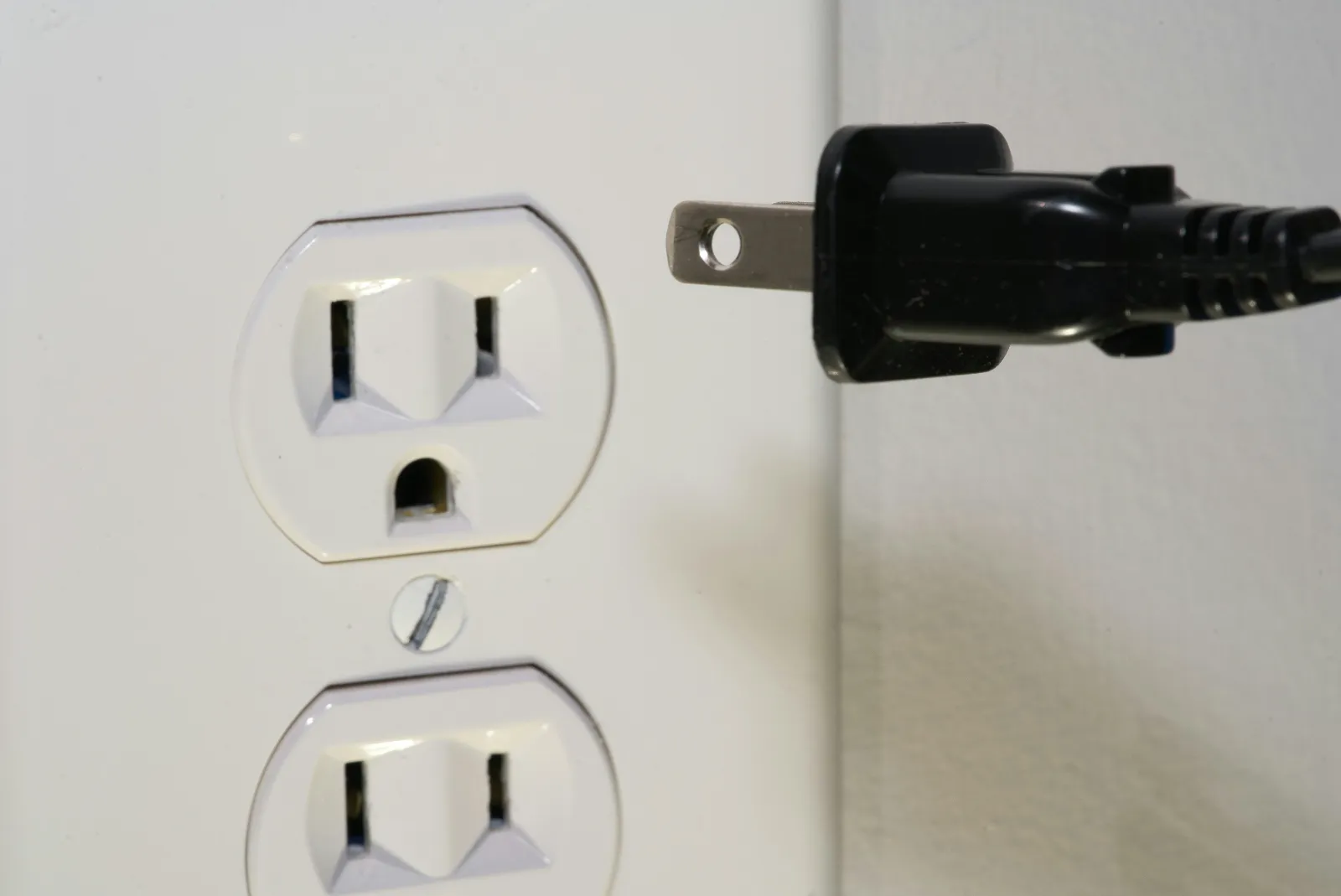
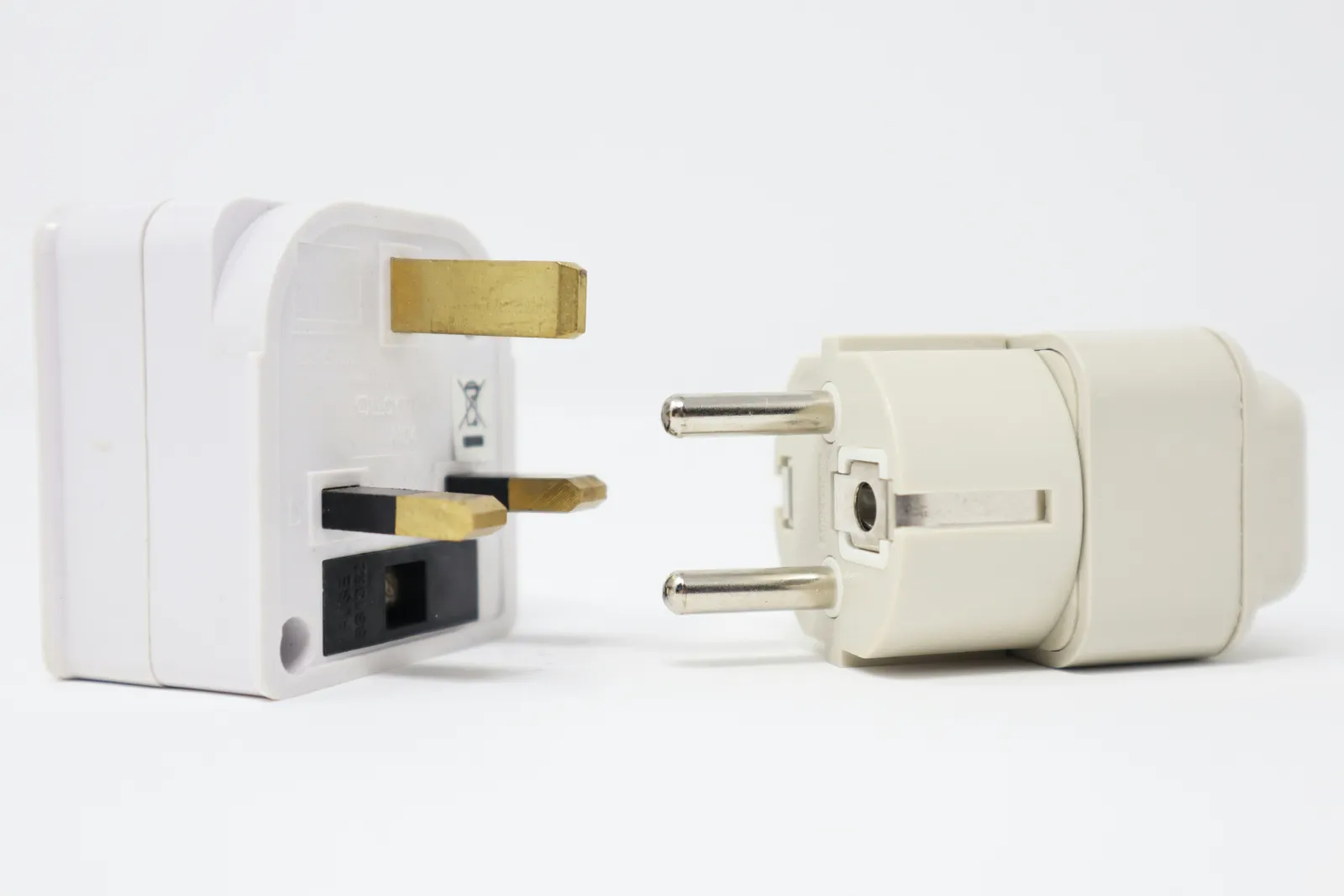
Nepal uses Types C, D and M at 230 V, and of the 12 Gomayu destinations only India uses exactly the same set. Kenya, Dubai, Singapore, Malaysia and newer Sri Lankan buildings use the British Type G; Thailand, Vietnam, Bali and the Philippines mostly accept two-pin plugs; China uses Types A and I; and the Maldives has a mix. One universal travel adapter that converts to Types A, C, G and I covers nearly every socket you will meet.
The table lists the plug types and household voltage for Nepal and each destination, plus a plain note on whether a Nepali plug fits. "Two round pins" means a Type C plug; "three round pins" means Nepal's Type D or M.
Checked: 20 Nov 2026. Source: Wikipedia, Mains electricity by country (which cites IEC World Plugs and national standards, including Singapore's Consumer Product Safety Office and Sri Lanka's Public Utilities Commission), cross-checked against the WorldStandards plug and voltage list. The IEC World Plugs site itself would not load for this check. The two lists agree on the adapter you need in every destination; they differ only in small details (for example 220 V or 230 V for China and Vietnam, and whether India and Sri Lanka also list extra socket types). Hotels sometimes fit universal sockets, so treat the adapter column as the safe minimum.
| Country | Plug types | Voltage | Frequency | Does a Nepali plug fit? | Pack |
|---|---|---|---|---|---|
| Nepal | C, D, M | 230 V | 50 Hz | Home standard | Nothing extra |
| India | C, D, M | 230 V | 50 Hz | Yes, same types as Nepal | No adapter needed |
| Thailand | A, B, C, O | 230 V | 50 Hz | Two round pins usually fit the common hybrid sockets; three round pins do not | Universal adapter if any plug has three pins |
| Vietnam | A, B, C, F | 220 V | 50 Hz | Two round pins fit most sockets; three round pins do not | Universal adapter for three-pin plugs |
| Indonesia (Bali) | C, F | 230 V | 50 Hz | Two round pins fit; three round pins do not | Adapter only for three-pin plugs |
| Malaysia | G (most common), C, M | 230 V | 50 Hz | No; two-pin plugs need an adapter | Type G adapter |
| Singapore | G (most common), C, M | 230 V | 50 Hz | No; two-pin plugs need a suitable adapter | Type G adapter |
| Sri Lanka | D, G, M | 230 V | 50 Hz | Older Type D sockets may take three round pins; newer sockets are Type G | Type G adapter |
| Maldives | D, G, J, K, L | 230 V | 50 Hz | Varies by resort or guesthouse | Universal adapter |
| China | A, I | 220 V | 50 Hz | No; Type C sockets no longer meet the national standard | Universal adapter (Type A or I) |
| Kenya | G | 240 V | 50 Hz | No | Type G adapter |
| UAE (Dubai) | G | 230 V | 50 Hz | No | Type G adapter |
| Philippines | A, B, C | 230 V | 60 Hz | Two round pins fit many dual sockets; three round pins do not | Universal adapter; check the charger says 50/60 Hz |
A few country notes from the same sources. In Singapore, Type G (three rectangular pins) is the most common socket, Type M is used mainly for air conditioners and other heavy appliances, and two-pin Type C appliances need an adaptor. In Sri Lanka, only Type G has been permitted for manufacture or import since August 2017, so newer hotels have Type G sockets. In China, Type C sockets no longer meet the national standard since GB/T 1002-2021 came into effect, so a plain two-round-pin plug may not fit in a new building. In Thailand, the common hybrid socket accepts Types A, B, C and the Thai Type O. If you are going on safari, our Kenya safari packing list covers the rest of the gear for camps and game drives.
What do the plug letters mean?
The letters are the standard labels used by the International Electrotechnical Commission (IEC) and by adapter makers. These are the ones you will meet on trips from Nepal.
| Type | What it looks like | Where you meet it on Gomayu routes |
|---|---|---|
| A | Two flat parallel pins | Thailand, Vietnam, Philippines, China |
| B | Two flat pins plus a round earth pin | Thailand, Vietnam, Philippines |
| C | Two round pins (Europlug) | Nepal, India, Thailand, Vietnam, Bali, Philippines |
| D | Three large round pins in a triangle | Nepal, India, Sri Lanka, Maldives |
| F | Two round pins with earth clips on the sides | Vietnam, Bali |
| G | Three rectangular pins, usually fused | Dubai, Singapore, Malaysia, Sri Lanka, Kenya, Maldives |
| I | Two angled flat pins, often with an earth pin | China |
| M | Three very large round pins, for heavy appliances | Nepal, India, Sri Lanka, Singapore, Malaysia |
| O | Three round pins, the Thai national plug | Thailand |
Will a Nepali plug work in India?
Yes. India uses Types C, D and M at 230 V and 50 Hz, the same combination as Nepal, so Nepali phone chargers, laptop chargers and most small appliances plug straight in. You do not need an adapter or a converter for an India trip. India's plug standard is IS 1293 from the Bureau of Indian Standards, and its socket types are the same family Nepal uses.
Transit airports and diaspora home countries
Many journeys from Kathmandu change planes in Doha, Hong Kong, Dubai, Singapore or Kuala Lumpur, and diaspora travellers often arrive from countries with different sockets. Same source and check date as the destination table.
| Place | Plug types | Voltage | Frequency | Note |
|---|---|---|---|---|
| Qatar (Doha transit) | D, F, G, L | 240 V | 50 Hz | Universal adapter if you want to charge in transit |
| Hong Kong | G (most common), D, M | 220 V | 50 Hz | Type G adapter |
| United Kingdom | G | 230 V | 50 Hz | Same plug as Dubai, Singapore, Kenya |
| Australia | I | 230 V | 50 Hz | Type I, also used in China |
| United States, Canada | A, B | 120 V | 60 Hz | Check every device's voltage label |
| Japan | A, B | 100 V | 50 or 60 Hz by region | Check every device's voltage label |
| South Korea | C, F | 220 V | 60 Hz | Nepali two-pin plugs fit |
Do you need a voltage converter?
No, not for devices bought in Nepal. Nepal runs at 230 V and every Gomayu destination runs at 220 to 240 V, so a Nepali charger only needs the right socket shape. A voltage converter matters mainly for diaspora travellers bringing 120 V or 100 V appliances from the United States, Canada or Japan.
The difference between the two products is the key point. A travel adapter changes only the shape of the plug; the electricity coming out is still the local voltage. A voltage converter (or transformer) changes the voltage itself. Plugging a 120 V-only hair dryer into a 230 V socket through an adapter alone can damage it quickly.
The quickest check is the small print on the charger or appliance, next to the word INPUT:
- INPUT 100 to 240V, 50/60Hz (often printed as 100-240V~): works on every network in this guide with only a plug adapter. Many phone, tablet, laptop and camera chargers are made this way; check yours.
- A single range such as 220 to 240V: works in Nepal and all 12 destinations, but not in the US, Canada or Japan without a step-up converter.
- 110 to 120V only: needs a step-down converter in Nepal and in every destination here, or leave it at home and buy locally.
| Device | Usual label to look for | From Nepal to the 12 destinations | From the US, Canada or Japan to Asia |
|---|---|---|---|
| Phone or tablet charger | Check INPUT line | Adapter only | Adapter only if it says 100 to 240 V |
| Laptop charger | Check INPUT line on the brick | Adapter only | Adapter only if it says 100 to 240 V |
| Camera battery charger | Check INPUT line | Adapter only | Adapter only if it says 100 to 240 V |
| Hair dryer, straightener | Often a single voltage, or a dual-voltage switch | Adapter only (230 V device) | Dual-voltage model or converter |
| Electric shaver, toothbrush | Varies; check the base or charger | Usually adapter only | Check the label first |
| Kettle, rice cooker, iron | High wattage, single voltage | Adapter only, but heavy for travel | Needs a heavy-duty converter; buying locally is simpler |
The Philippines and South Korea use 60 Hz instead of 50 Hz. Chargers labelled 50/60Hz do not care, but some clocks and motor-driven appliances designed for 50 Hz can run slightly differently. Check the label if you are taking anything with a motor.
What should you pack in your charging kit?
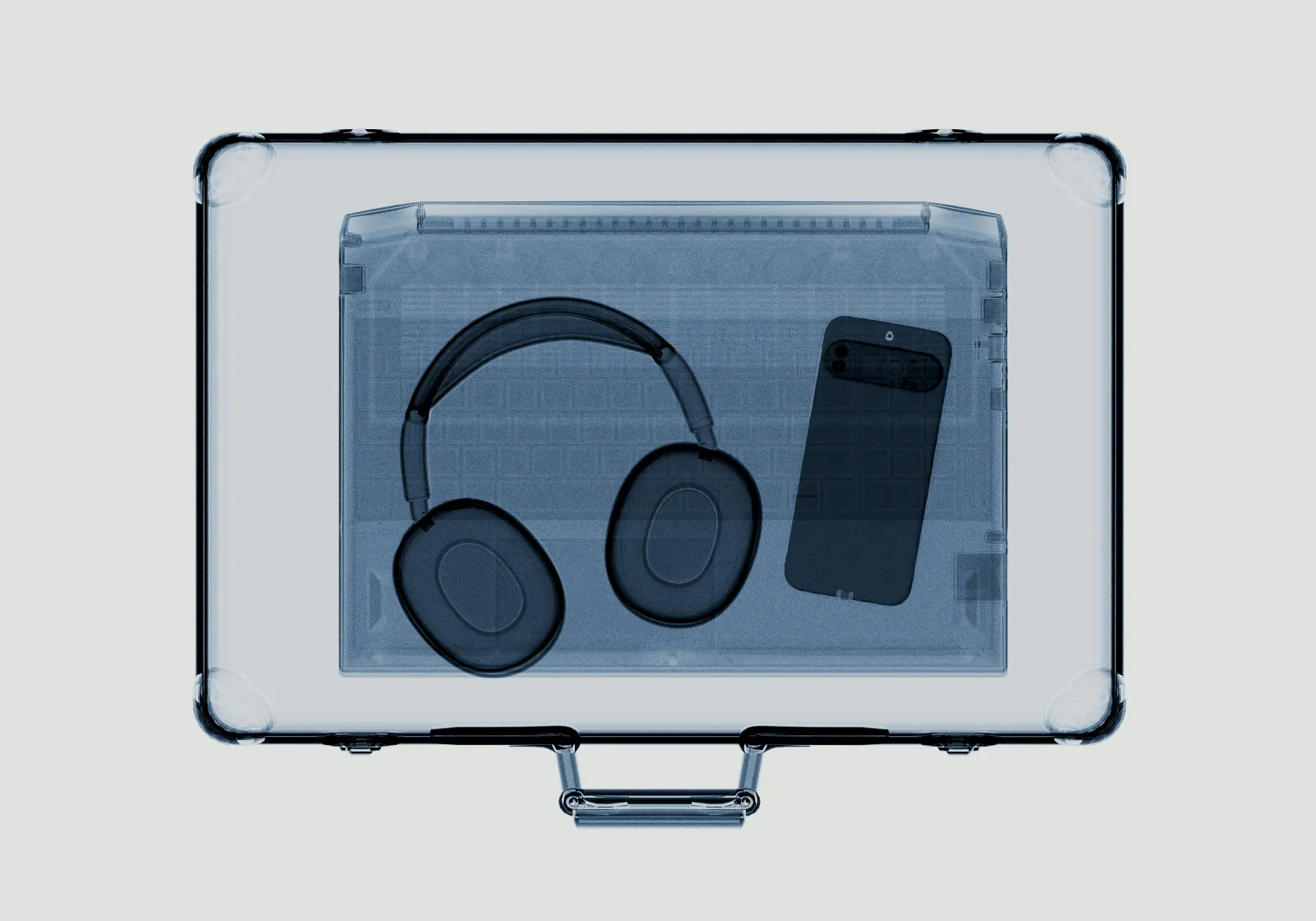
Pack one universal travel adapter, one or two power banks of 100 Wh or less with a readable Wh label, a multi-port charger, short cables, and a small pouch to keep all batteries together in your cabin bag. That kit covers every Gomayu destination and every airline rule in this guide.
Charging kit checklist
- One universal travel adapter that converts to Types A, C, G and I, ideally with built-in USB-C and USB-A ports so one socket charges several devices.
- One power bank of 10,000 to 20,000 mAh (about 37 to 74 Wh) with the Wh rating printed on the case. Take a second only if your airline allows two; on Emirates and flydubai, one.
- A multi-port USB charger marked INPUT 100 to 240V, so a family can share one adapter in a hotel room.
- Short cables for each device (USB-C, Lightning or micro-USB) and one spare.
- A small zip pouch for power banks and spare batteries, so you can show them at security and lift them out if your cabin bag is gate-checked.
- Tape or caps for spare battery terminals, or keep spares in their original packaging.
- Printed copies of your boarding pass and hotel booking, in case the phone dies. Our pre-trip checklist for international travel lists what to print and when.
What should a good travel adapter have?
The best travel adapter for trips from Nepal is the one that covers the socket types on your route safely, not the one with the most plug shapes. A few features are worth checking in the shop:
- The right outputs. For the 12 destinations here you need Type A, C, G and I outputs (Type I covers China). An India-only trip needs nothing.
- A fuse and a clear rating. Look for the maximum current or wattage printed on the body, and a fuse, especially if you plan to use it in Type G countries where plugs are normally fused.
- Safety shutters and a firm fit. Loose adapters that wobble in the socket heat up. Avoid ones that bend when you pull a charger out.
- USB-C power delivery if you carry a laptop that charges over USB-C, so the adapter can replace a separate laptop brick.
- No built-in battery. Some adapters include a power bank; that makes them subject to power bank rules at the airport. A plain adapter has no battery limit.
An adapter does not convert voltage, even if the packaging says "universal". For Nepali devices that does not matter, but check the INPUT label on anything from abroad.
Tips for families and first-time flyers
A family can easily travel with several phones, tablets and power banks. The two-per-person limit applies to each passenger, so spread power banks across family members' cabin bags rather than putting six in one parent's backpack, and keep each passenger's power banks with that passenger. If this is your first time flying abroad, our first-time flight tips walk through check-in, security and the flight itself, and our guide to popular destinations for Nepalese travellers helps you pick where to go first. Diaspora travellers visiting family in Nepal on a foreign passport face the same battery rules on the way in and out of Kathmandu. Nepal uses Type C sockets alongside Types D and M, so two-round-pin chargers from Europe or South Korea often fit directly; from the US, Canada, the UK or Australia, bring an adapter and check each device's INPUT label.
Frequently asked questions
Can I take a power bank on a plane from Nepal?
Yes. You can take a power bank on a plane from Nepal in your cabin bag only, with its terminals protected. Under the ICAO rule in force since 27 March 2026, the limit is two power banks per person, each normally 100 Wh or less. Emirates and flydubai allow only one, so check your airline before you fly from Kathmandu.
How many mAh power bank is allowed on flights?
Airlines limit power banks by watt-hours, not mAh. The usual cabin limit is 100 Wh, which is about 27,000 mAh for a 3.7 V lithium-ion power bank. A 20,000 mAh power bank (about 74 Wh) is allowed; a 30,000 mAh one (about 111 Wh) is over the limit on most airlines. Use the formula mAh x V / 1,000 to check.
Can I put a power bank in checked baggage?
No. A power bank is never allowed in checked baggage on any airline flying from Kathmandu or anywhere else, whatever its size. ICAO and IATA rules require power banks and spare lithium batteries to travel in the cabin. If your cabin bag is taken at the gate to go in the hold, remove the power bank first.
Can I use a power bank during the flight?
Usually not. ICAO bans recharging a power bank on board and says power banks should not be used to charge devices in flight. Emirates, flydubai, Air Arabia, Singapore Airlines, Thai Airways, Malaysia Airlines, Cathay Pacific and Indian airlines ban using them. Qatar Airways allows charging your own device in non-critical phases under direct supervision.
What plug is used in Thailand?
Thailand uses plug Types A, B, C and O at 230 V and 50 Hz. The common hybrid socket in Thailand accepts two flat pins (Type A), two round pins (Type C) and the Thai Type O, so a Nepali two-round-pin charger usually fits. A Nepali three-round-pin plug does not, so pack a universal travel adapter for those.
Do I need an adapter in Dubai?
Yes. Dubai and the rest of the UAE use the British Type G socket with three rectangular pins, at 230 V and 50 Hz. Nepali Type C, D and M plugs do not fit, so you need a Type G adapter or a universal travel adapter. You do not need a voltage converter for Nepali devices in Dubai.
Does Nepal's plug work in India?
Yes. India uses the same plug Types C, D and M as Nepal, at the same 230 V and 50 Hz, so Nepali chargers and appliances plug straight into Indian sockets. You need neither an adapter nor a voltage converter for an India trip from Nepal.
Are e-cigarettes allowed on flights?
E-cigarettes and vapes are allowed on flights only in your cabin bag or on your person, protected against switching on, and never in checked baggage. You must not recharge them on board. Some destinations ban them outright: UK travel advice says vapes are illegal to possess or use in Thailand and banned in Singapore and India, so check the law before packing one.
Can I carry a laptop in checked luggage?
Yes, a laptop is allowed in checked luggage if it is completely switched off (not asleep or hibernating) and protected from damage, and its battery is 100 Wh or less. IATA still recommends keeping laptops in the cabin, which also protects them from theft and loss. Spare laptop batteries and power banks must stay in the cabin.
Can I carry a 30,000 mAh power bank on a flight?
On most airlines, no. A 30,000 mAh power bank at 3.7 V is about 111 Wh, above the 100 Wh limit. Emirates, flydubai, Air Arabia and Qatar Airways do not allow power banks over 100 Wh, and IATA's regulations list them as forbidden from 1 January 2027. Singapore Airlines still accepts 100 to 160 Wh with prior approval.
Which travel adapter do I need for trips from Nepal?
For trips from Nepal to Thailand, Vietnam, Bali, Malaysia, Singapore, Sri Lanka, the Maldives, China, Dubai, Kenya and the Philippines, one universal travel adapter with Type A, C, G and I outputs covers nearly every socket. India needs no adapter. Choose one with USB-C ports and a clear current rating, and remember it does not change voltage.
Power bank flight ma lana milcha?
Milcha, tara cabin bag ma matra, checked luggage ma kahile pani hoina. ICAO niyam anusar 27 March 2026 dekhi ek jana yatri le dui wota samma power bank lana paucha, harek 100 Wh bhanda kam hunu parcha, ra plane bhitra power bank charge garna paidaina. Emirates ra flydubai ma ek wota matra, tyesaile flight aghi aafno airline ko niyam hernus.